THE FALSE RIGHT WING ARGUMENT HAS ALWAYS BEEN 'WHY SHOULD WE REDUCE OUR ENERGY CONSUMPTION, WHEN CHINA ISN'T?'
THAT'S JUST ANOTHER RIGHT WING LIE!
CHINA IS LEADING AS THE US FALLS BEHIND!
TRUMP WRONGLY BELIEVES THE SOLUTION IS 'DRILL BABY DRILL!' WHICH WILL
PUT THE US FURTHER BEHIND!
THIS IS A MUST READ FROM POLITICO!
ELECTRIC FEEL — In the middle of a sleepy suburb of Shanghai, surrounded by farmland, a canal and small buildings, sits a giant, hulking structure. In operation since 2010, the Xiangjiaba-Shanghai transmission link is meant to send high voltage energy around the country. And with China producing more green energy than any other country, they’re now betting big onFelectrical grid. The concept is a “bullet train for power” that can remake the grid. Xiaoying You reports on how this big bet is going, issues R
 Getty Images
China produces more clean energy than any other country. Now it's rolling out an ultra-high-voltage grid to match – will its strategy of going big pay off?
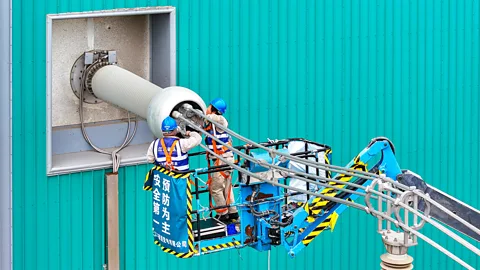
In a sleepy village on the fringes of Shanghai, China's megacity of 25 million people, a hulking green building surrounded by a labyrinth of electric wires and poles stands in contrast with the landscape around it. Surrounding this beast, not far from the coastline of Hangzhou Bay, the vast funnel-shaped inlet of the East China Sea, are an array of vegetable plots, winding country paths and a tranquil canal.
This oddly out-of-place building is the Fengxian Converter Station, a hub for receiving electricity that has travelled some 1,900km (1,200 miles) before it is routed to power Shanghai's homes, offices and factories. At the other end of the transmission line lies the Xiangjiaba Hydropower Station in south-west China, which harnesses the energy of the mighty Jinsha River, the upper stretches of the Yangtze River.
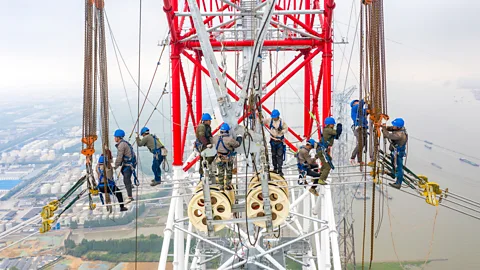
The Xiangjiaba-Shanghai transmission link, which went into service in 2010, is one of China's first ultra-high-voltage (UHV) projects – a technology designed to deliver electricity over long distances. It spearheaded an era that would see the country build a vast network of UHV infrastructure, dubbed the "bullet trains for power", to send electricity generated from hydro and coal in remote regions to populous cities.
China now considers these huge power cables key to its rapid buildout of wind and solar power bases, which are concentrated in several far-flung regions. Countries such as the UK, India and Brazil have adopted similar strategies.
Although using UHV isn't the only way to transmit renewable energy, its application in China – home to the world's largest national power system – can provide valuable lessons in a global quest for solutions to fast-track the energy transition.
The 'bullet train for power'
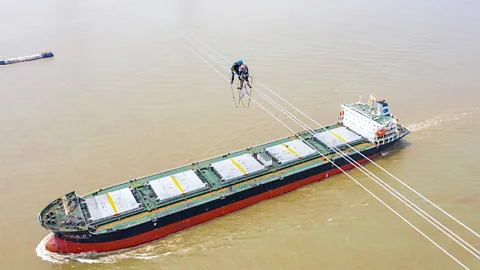
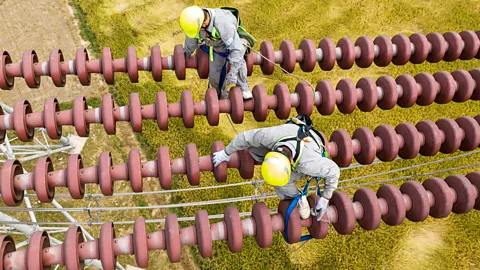
In a nutshell, UHV transmission lines work to the principle that the higher the voltage is, the lower the electric currents are for the same amount of power transmitted. Lower currents lead to less heat lost as power moves through cables, enabling it to travel long distance with greater efficiency.
 Getty Images
The Chinese call them the "Shinkansen for power", using the Japanese name for bullet trains, a symbol of speed and efficiency.
For Guo Liang, an engineer at the Chinese Academy of Sciences, the fastest way to supply electricity is to wire it to its users rather than transporting raw materials to power plants that are closer to them.
Electricity travels nearly as fast as light and is expensive to store. "As soon as it is generated, it needs to be sent out. That's why we need such a network, the Shinkansen for power, to ensure its transmission" to those who use it, Guo said during a talk show on China Central Television.
Different countries have different thresholds for what is considered a UHV line. China defines those sending direct currents (DC) at voltage levels of 800 kilovolts (kV) or above and alternating currents (AC) at 1,000 kV or above as UHV links. DC systems can carry more power with less loss than AC, and are used to cover greater distances, but they are more expensive to build. In comparison, AC lines can be connected to the local grids enroute, so they are more flexible. But their lengths typically do not exceed 1,500km (930 miles), so as to be cost-effective. China has a mix of them.
Although China now regards the technology as a key part of its wind and solar plan, it didn't set out to build them for renewables. China's State Grid, one of the country's two grid operators, proposed the technology to the government in 2004 to connect the country's hydro and coal power stations with the economic hubs that gobbled electricity hundreds of miles away.
"Most of China's natural resources are situated in the north, north-west and south-west, while the highest electricity demand and population are concentrated on the southern and eastern coast," says Deng Simeng, a Shanghai-based renewables analyst at Norwegian consultancy Rystad Energy.
In the early 2000s, China was experiencing regular power shortages. Even though three-quarters of the country's freight traffic was devoted to transporting raw materials, especially coal, resources weren't arriving fast enough. At that point, the central government was also seeking ways to develop its vast western regions by tapping into its resources.
 Getty Images
Liu Zhenya, the then head of China's State Grid and dubbed by the Chinese media as the "father of UHV power lines", envisioned a future where a mega grid would end the country's blackouts – by transmitting electricity nationwide – and make China a global leader in transmission technologies. But his idea was met with staunch opposition. In the years to come, his opponents, which included officials and prominent scholars, repeatedly highlighted to the government their concerns, such as the reliability of the technology and its impacts on the environment.
"[Liu's] proposal was really bold and a novel concept at the time, and gained traction amongst Chinese policy makers," says Fiona Quimbre, a Cambridge-based analyst focusing on China at RAND, a global research organisation. The State Grid, a major state-owned company, managed to align itself "really well with other government priorities", including a plan to foster domestic supply chains, she says.
In 2006, developing UHV made into Beijing's five-year plan, a sign that it had become a national strategy. China began constructing its first project in the same year, a 640km (400-mile) AC link connecting its coal heartland of Shanxi in the north to the central province of Hubei, via a stop in the middle. It went into operation in early 2009.
More ambitious projects quickly followed. The Xiangjiaba-Shanghai line, completed in 2010, was the longest and most powerful transmission system worldwide at the time. With 3,939 pylons carrying cables over gorges, rivers and rolling fields across eight provincial-level regions, the DC link sends Jinsha River's hydropower directly to Shanghai at a maximum capacity of 6.4 gigawatts, meeting up to 40% of the city's power demand.
As of April 2024, China had put into operation 38 UHV lines, which deliver not only hydro and coal power, but also wind and solar power, according to China Power Equipment Management Net, an industry website. Among them, 18 were AC lines and the rest DC lines.
Delivering renewables
UHV technology was not invented by China, but Beijing has made these projects "business as usual", says Ismael Arciniegas Rueda, a Washington DC-based economist at RAND who specialises in energy and transmission infrastructure.
"China has taken [UHV] to the next level and pushed the envelope" in a way it has with many technologies associated with energy transition, Arciniegas says.
He describes China as "the only game in town" when it comes to the number of miles built of this technology. Other countries, such as India and Brazil, also have some of the longest UHV lines in the world, but they do not use them at quite the same scale or operate at the same level of voltages.
 Getty Images
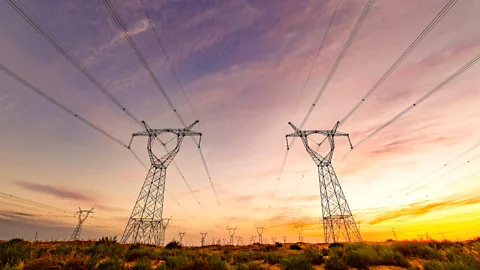
According to China Energy News, the combined length of the UHV transmission lines operating in China had reached 48,000km (30,000 miles) by the end of 2020, more than enough to wrap around the Earth by the equator.
As China has accelerated its renewable energy deployment, the mission for UHV lines has changed. In 2022, the country's National Energy Administration said desert-based wind and solar bases should plan transmission lines to bring out their electricity to towns and cities on the other side of the country. In 2023, construction started on the first such dedicated line, linking the Ningxia Hui Autonomous Region in the north-west with the southern province of Hunan.
The technology acts as a key component in China's proposal to build a global power grid, known as the Global Energy Interconnection. The idea – announced by China's president Xi Jinping at a United Nations summit in 2015 – is to link up national grids over the next three decades. The aim is to enable "large-scale development, transmission and utilisation of clean energy around the globe", according to Liu Zhenya, who now chairs the Global Energy Interconnection Development and Cooperation Organization, a non-governmental organisation set up to promote the concept.
To some researchers, UHV brings obvious benefits. "Of all existing technologies, UHV is the only one that can send wind and solar power from far-flung areas to load centres (places with high electricity consumption)," says Fang Lurui, an assistant professor of power-system planning at Xi'an Jiaotong-Liverpool University in Suzhou, China.
Lauri Myllyvirta, co-founder of Finland-based Centre for Research on Energy and Clean Air (CREA), agrees that the distances between energy production sites and cities is a challenge in such a large country. But the technology comes with energy benefits, too.
"China is so large – when the Sun has set in eastern China, it is still shining in western China," says Myllyvirta. "And when a low-pressure zone is generating high winds in one part of China, another part of China will be part of a completely different weather system at the same time."
Therefore, UHV transmission lines can even out the variations in solar and wind generation by zipping electricity from a place that has favourable weather conditions to another that doesn't, he says.
Challenges for UHV
However, the share of wind and solar power carried by China's UHV lines is still low.
One of the reasons is related to their high cost. In China, the investments for UHV lines come from two grid operators, and the financial undertaking has been enormous. No official figure of a total investment has been released. But Huaxia Energy, a Chinese industry website, reported in August 2023 that the country had spent 1.6 trillion yuan (£173bn/$222bn) on UHV lines, which included 33 already in operation and 38 more under construction. The Xiangjiaba-Shanghai line, for example, cost 23 billion yuan (£2.5bn/$3.2bn), according to official figures.
Such vast inputs mean the grids must ensure those lines' annual operating hours in order to recover their investments. "Therefore, if there isn't enough wind and solar power when a line is expected to operate, it will send coal power instead," says Shen Xinyi, a researcher at CREA.
Because wind and solar power is intermittent, UHV lines still rely heavily on coal or gas-fired power to ensure that their transmission is stable, Shen notes.
In 2022, 56.2% of the electricity transmitted by UHV lines in China came from renewable sources, beating the government's target of "no less than 50%". But most of this was hydropower – which China classes as renewable and clean – a government report showed. While hydropower does not rely on fossil fuels, it has other environmental drawbacks, such as harming river health and releasing methane. The portion for wind and solar carried on the UHV lines is much lower, averaging 27.25%, according to an analysis of the report by Chinese thinktank Lingdian Energy.
 Getty Images
The power shortages that struck China's Sichuan two years ago and this summer have exposed another weakness: the "rigid" management of UHV lines in China, according to Shen.
Even though Sichuan is the country's hydro hub, most of its newly built hydropower stations, such as the world's second largest hydropower plant, Baihetan, were designed to have their electricity exported to eastern and central regions via UHV lines. Even when there was not enough electricity to go around locally, Sichuan – home to several emerging manufacturing industries, such as lithium batteries – could not use its own hydropower because the UHV lines were not connected to the local grid, Shen explains.
Yu Aiqun, a research analyst with Global Energy Monitor, a US-based NGO points out that it may be more cost-effective for cities and towns to generate power locally than to import them long distance because of how expensive it is to build a UHV line.
Moreover, Chinese coastal provinces are planning to build nuclear and offshore wind power plants on a large scale, which means they may not need to import electricity in the future, Yu adds. Researchers at the Lawrence Berkeley National Laboratory in the US have projected that the deployment of offshore wind power would reduce Chinese coastal regions' reliance on imported electricity and shift the country's transmission networks.
The global picture
China isn't the only country that has resorted to the UHV technology. Brazil, the largest country in South America, has two 800kV DC lines in operation, both built by China's State Grid. They send hydropower from the Amazon Basin in the north to populous south-eastern regions including Sao Paulo and Rio de Janeiro. The State Grid is building another UHV line in Brazil.
In India, the government has initiated the Green Energy Corridor scheme since 2015, which includes dedicated transmission lines for renewable energy in states rich in those resources, such as Andhra Pradesh in the south and Gujarat in the west, according to Uttamarani Pati, a Bangalore-based renewables analyst at Rystad Energy. UHV lines operate at a voltage level of 765kV in India.
Cross-continental high-voltage projects – which run at voltage levels lower than those of UHV – are also on the drawing board in various parts of the world. In Europe, several undersea cables are being developed to bring solar and wind power from North Africa. They include Xlinks, a 4,000km (2,500-mile) link to hook Morrocco to the UK, and the project "GREGY" that connects Egypt to Greece, covering roughly 950km (600 miles). In the Asia Pacific region, a mega project called the Sun Cable has been proposed to export solar power from northern Australia to Singapore, which is 4,300km (2,700 miles) away, via Indonesia.
Moving electricity across borders – or across states in the US – faces other challenges in spite of the evolving technology, warns Arciniegas of RAND. The biggest hurdles are regulatory issues, he says. "You'll need a lot of paperwork, permits, etc, to make [this] happen and not everyone wants to have a transmission line next to their house."
Cost is another roadblock, especially in the US. Not only all stakeholders involved in a long-distance transmission line must greenlight the project, relevant regional transmission organisations also will have to agree to share the cost, according to Wang Xuan, an advisor on clean energy strategies at Regulatory Assistance Project, a global non-governmental organisation. "That is why UHV hasn't taken off in the US," she says.
Mega grids also mean higher risks of mass blackouts if one part of it fails, like the widespread power outage that struck parts of Canada and the US in 2003, which was largely caused by a failure in the alarm system at an Ohio-based electric utility that affected the whole network. "The bigger they get, the more safeguards you will need to prevent something like that happening," Arciniegas says.
Ultimately, the solution to a renewable future won't rely on one transmission technology, but a mix of solutions, as many researchers believe. One alternative at the other end of the spectrum are microgrids, which see localised energy generation, storage and usage. They are gaining popularity in some developing countries because they are nimble and cost-effective.
"I do think that the distributed-level developments and individuals putting in place solar panels and community-owned wind, etc, are part of the solution," says Antony Froggatt, a London-based consultant on climate change and energy. "Because it's not just about local generation for security supply, it's also about education," he says. "Having these high-voltage lines from a different part of the world misses that opportunity about engaging people."
For Arciniegas, however, UHV transmission can be part of a portfolio of options countries need to consider, but it is a key one.
"What the grid provides is like a backbone, so you need to be connected to the grid somehow. But if the grid fails, then it would be nice to have an alternative," he says.
--
For essential climate news and hopeful developments to your inbox, sign up to the Future Earth newsletter, while The Essential List delivers a handpicked selection of features and insights twice a week.
For more science, technology, environment and health stories from the BBC, follow us on Facebook, X and Instagram.


