


Sunday, November 19, 2023

POLITICO Massachusetts Playbook: Transportation temperature check vvv


Massachusetts Playbook logo

BY KELLY GARRITY AND LISA KASHINSKY

Presented by

Conservation Law Foundation

TRANSIT VIBE CHECK — Few Bay Staters feel “very safe” driving on highways or taking any form of the MBTA. They think Gov. Maura Healey and the Legislature's handling of transportation in the state has been middling. And they’re concerned that traffic is not only back from its pandemic decline, but worse than ever, a new MassINC Polling Group survey shows.

And that lack of full confidence in the safety of the state’s biggest public transit system came before MBTA leaders said yesterday that they need an eye-popping $24.5 billion — yes, billion — to fix the T’s broken tracks, falling ceiling tiles and crumbling train platforms.

Just 12 percent of the 1,390 residents MassINC surveyed felt very safe riding the MBTA’s subway trains or buses, while just 17 percent felt very safe riding the Commuter Rail. A little under a third of respondents felt “somewhat safe” riding all three. The survey, conducted by phone from Oct. 23 through Nov. 6 and sponsored by The Barr Foundation, has a margin of error of plus or minus 3 percentage points.

Crime is the overwhelming concern for people who feel at least somewhat unsafe taking the T, followed by overcrowding. But 43 percent of respondents attributed their fears to those old, broken transit vehicles and stations in apparently pricey need of repair.

Meanwhile, more than half of those surveyed think traffic where they live is worse now than before the pandemic began in March 2020, compared to 37 percent who think it’s about the same and 7 percent who think it’s better.

And they’re not giving the governor high marks for her handling of the state’s myriad transportation issues: Just 7 percent gave Healey an A, while 23 percent gave her a B and 32 percent gave her a C. The numbers were similar when asked specifically about her handling of the T.

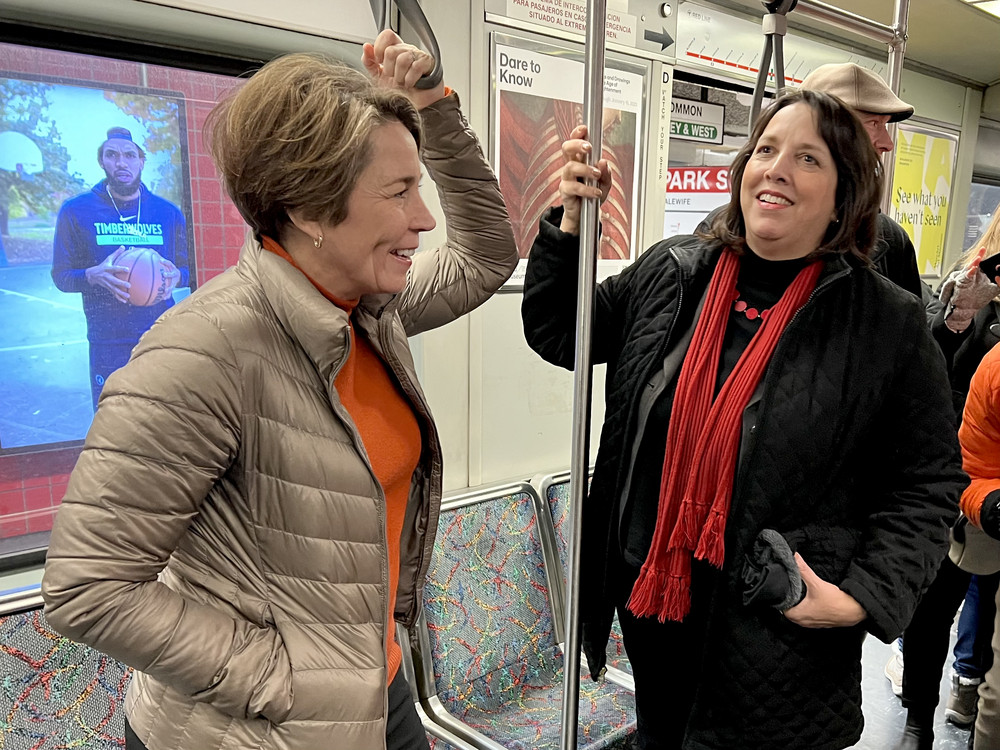
Maura Healey and Kim Driscoll on the MBTA

Gov. Maura Healey (left) and Lt. Gov. Kim Driscoll ride the Red Line. | Lisa Kashinsky/POLITICO

Massachusetts’ transportation troubles didn’t start under Healey — they’re the product of years of underinvestment and mismanagement. But this poll shows residents are still holding the new governor responsible for the state of their commutes.

“For a governor who hasn't been in office for a year, there's a limit to what she can do to correct years and decades of underinvestment in the T. And there's very little she can do directly to redirect traffic congestion,” former state transportation secretary Jim Aloisi told Playbook.

But Healey’s administration has made progress. Phil Eng, the transit agency’s general manager, told the board of directors Thursday that the T has hired about 1,200 people — though that’s only good for a net gain of 599 workers because of other people leaving. And he laid out the work that will begin later this month to fix the Green Line Extension that opened with tracks that were too close together — a problem some at the MBTA knew about as early as April 2021 .

“Improvements at the T are going to be incremental,” Aloisi said. “It's not like turning on and off a light switch.”

GOOD FRIDAY MORNING, MASSACHUSETTS. Healey did fare better than the Legislature in the MassINC poll — only a quarter of respondents said lawmakers deserved an A or a B for their role in funding roads and rails across the state.

TODAY — Healey speaks at an Adoption Day celebration at 9:30 a.m. at Boston Juvenile Court. Lt. Gov. Kim Driscoll speaks at MAHP’s annual conference at 8 a.m., a South Shore Chamber of Commerce housing forum at 2:30 p.m. and the grand opening of La Colaborativa’s Chelsea Survival Center at 7 p.m. Auditor Diana DiZoglio joins a Diwali celebration at 3 p.m. at the State House.

THIS WEEKEND — Northeastern University professor Dan Kennedy is on WBZ’s “Keller @ Large” at 8:30 a.m. Sunday. MBTA GM Phil Eng is on WCVB’s “On the Record” at 11 a.m. Sunday. Healey is on NBC10’s “At Issue” at 11:30 a.m. Sunday.

Tips? Scoops? Email us: kgarrity@politico.com and lkashinsky@politico.com

A message from Conservation Law Foundation:

Conservation Law Foundation is separating fact from fiction when it comes to the role of bioenergy in cutting climate-damaging pollution and transforming our economy to one built on clean energy. The economic, environmental, and public health of our communities and businesses demand that we invest in energy efficiency and clean energy sources – while moving with caution and care on bioenergy resources. Get the full story.

 
DATELINE BEACON HILL

SHELTER MONEY FALLOUT — As Democratic legislative leaders butted heads Wednesday over whether the Healey administration should have to open an overflow site for families being waitlisted for the state’s emergency shelter program, more than two dozen migrants were at Logan Airport trying to find a place to sleep for the night.

It’s the exact scenario lawmakers said they were trying to avoid. “We want to prevent people from sleeping in airports or sleeping in our streets,” House Ways and Means Chair Aaron Michlewitz told reporters after reaching a negotiating impasse with his Senate counterpart. He was likely unaware of the situation at Logan, where WBUR’s Gabrielle Emanuel reports 31 people, including 17 children, were told they couldn’t stay the night.

Democratic legislative leaders tried to downplay the consequences of not passing the $2.8 billion supplemental budget, which included $250 million for the emergency shelter system before formal sessions ended for the year. Senate President Karen Spilka told reporters “it’s not that unusual” for pricey spending plans to get done in informal sessions .

But what’s normally a routine spending bill to close out the last fiscal year isn’t coming under normal circumstances this time. The state’s overburdened, maxed-out emergency shelter system is projected to exhaust its budget in January. Dozens of families seeking emergency housing are being told this “right-to-shelter” state has nowhere to put them because they arrived a few days too late. While more than 70 families have exited the shelter system since Nov. 1, there were still 63 families on the waitlist as of Wednesday afternoon, according to the most recent data available from the state.

On top of that, Democrats are giving Republicans unusual leverage by resorting to informal sessions where one lawmaker’s objection can derail a bill. And Republicans in both chambers — who are already on record opposing the larger spending bill over its emergency shelter component — are telling the Boston Herald they’re willing to use it.

The blowback on the Legislature for breaking without a deal was swift. A spokesperson for Gov. Maura Healey , who requested the $250 million in September, said the administration “believes it’s critical to pass the supplemental budget as soon as possible.”

The Massachusetts Teachers Association was less restrained, saying its members are “shocked and, frankly, disgusted that state legislators, mired in their personal and petty disputes, failed to pass” the supplemental budget that included both the migrant money and collective bargaining agreements with raises for thousands of state workers.

OPEN LETTER — State Sen. Becca Rausch led an open letter to President Joe Biden , Vice President Kamala Harris and congressional leaders denouncing “antisemitism, Islamophobia, and all forms of hatred and bigotry, which have increased amid the bloodshed of war commenced by Hamas” and pledging to keep up educational efforts to “expose and reduce anti-Jewish prejudice.” The letter was signed by a bipartisan group of 288 lawmakers across 26 states, including 55 of Rausch’s Massachusetts peers.


GO INSIDE THE CAPITOL DOME: From the outset, POLITICO has been your eyes and ears on Capitol Hill, providing the most thorough Congress coverage — from political characters and emerging leaders to leadership squabbles and policy nuggets during committee markups and hearings. We're stepping up our game to ensure you’re fully informed on every key detail inside the Capitol Dome, all day, every day. Start your day with Playbook AM, refuel at midday with our Playbook PM halftime report and enrich your evening discussions with Huddle. Plus, stay updated with real-time buzz all day through our brand new Inside Congress Live feature. Learn more and subscribe here.


FROM THE HUB

— “The plan for a New England Revolution stadium in Everett has hit a speed bump — including concerns from Mayor Wu,” by Jon Chesto, Boston Globe: “Legislation that would have paved the way for a New England Revolution stadium to go up along the Mystic River in Everett was sidelined when state House and Senate negotiators failed to reach an agreement on migrant aid in a broader budget bill. … And later in the day came a new complication, when Boston Mayor Michelle Wu’s administration expressed surprise and disappointment about being left out of negotiations between the Kraft Group and the city of Everett over a stadium that would sit on Boston’s doorstep.”

— “Incoming Boston city councilor broke law, pays $5,400 penalty after promoting fund-raiser while still a city employee,” by Matt Stout, Boston Globe: “Enrique PepĂ©n, a former City Hall official who won a hotly contested Boston City Council seat this month, broke state campaign finance laws when he promoted his campaign kickoff in a half-dozen social media posts while still working as a city employee, state regulators ruled."

— “Growing local calls for ‘cease-fire’ in Gaza echo through protesters blocking BU Bridge, Black pastors speaking out,” by Grace Zokovitch, Boston Herald.

— “Boston pays $2.6M to Black police officers who alleged racial bias in hair tests for drug use,” by the Associated Press.


A message from Conservation Law Foundation:

Advertisement Image 

 
BALLOT BATTLES

— “Effort to get legal psychedelics on Mass. ballot hits signature snag,” by Walter Wuthmann, WBUR: “The campaign to legalize the use of plant-based psychedelic substances in Massachusetts is at risk of missing the 2024 ballot, after state officials found several 'disqualifying marks' on their ballot papers. A group of activists said the campaign printed a labor union logo on their ballot sheets, violating signature-gathering regulations and potentially invalidating thousands of signatures.”

— “Proposed ballot question to end MCAS graduation requirement gains momentum,” by James Vaznis, Boston Globe: “The Massachusetts Teachers Association has collected more than 130,000 signatures — far more than legally required — in its quest to get a question on next year’s election ballot that would no longer make high school diplomas contingent on students passing MCAS exams, union officials announced Thursday.”

MARIJUANA IN MASSACHUSETTS

— “Collins stepping down as cannabis commission executive director,” by Bhaamati Borkhetaria and Gintautas Dumcius, CommonWealth Beacon: “Two months after pushing back on a claim he would be leaving by the end of the year, Shawn Collins is resigning as executive director of the Cannabis Control Commission, the latest move to rock the troubled state agency whose chair was suspended in September. … The news comes as a lawmaker who has been critical of the agency is due to speak with Auditor Diana DiZoglio about his request for an audit of the cannabis commission.”

— “Cannabis worker’s death prompts call for steps to prevent work-related asthma,” by Felice J. Freyer, Boston Globe: “The state Department of Public Health on Thursday called on the cannabis industry to take steps to prevent work-related asthma, in the wake of the 2022 death of a 27-year-old worker from an asthma attack triggered by cannabis dust.”


GET A BACKSTAGE PASS TO COP28 WITH GLOBAL PLAYBOOK : Get insider access to the conference that sets the tone of the global climate agenda with POLITICO's Global Playbook newsletter. Authored by Suzanne Lynch, Global Playbook delivers exclusive, daily insights and comprehensive coverage that will keep you informed about the most crucial climate summit of the year. Dive deep into the critical discussions and developments at COP28 from Nov. 30 to Dec. 12.. SUBSCRIBE NOW .


FROM THE 413

— “Young. Communist. Gun-owner. Multimillionaire. Pro-Palestine. Pro-Hamas. Berkshire landowner. Meet James 'Fergie' Chambers,” by Heather Bellow, Berkshire Eagle: “[Chambers] is a founder of Berkshire Communists, a group he headquartered off East Road in Alford (population, 486), one of the county’s sleepiest — and wealthiest — towns with no local police department of its own.”

— “‘The threat is real’: Easthampton council takes stand against antisemitism with wide-ranging resolution,” by Maddie Fabian, Daily Hampshire Gazette.

— “Fenton says he has the votes to return as Springfield City Council president,” by Ian Pickus, WAMC.

MEANWHILE IN NEW HAMPSHIRE

POLL POSITION — Nikki Haley keeps rising in New Hampshire, where Chris Christie is also on the upswing but Donald Trump remains the far and away frontrunner in the GOP presidential field, a new poll shows.

Trump leads the UNH/CNN poll of likely New Hampshire Republican primary voters with 42 percent support, followed by Haley at 20 percent and Christie at 14 percent. Florida Gov. Ron DeSantis , once Trump’s main competition in New Hampshire and nationally, follows at 9 percent and Vivek Ramaswamy is at 8 percent. The online survey of 994 likely GOP primary voters was conducted Nov. 10-14 and has a margin of error of plus or minus 3.1 percent.

Christie said the poll matches what he’s seeing on the ground in the Granite State. Unlike 2016, “when people come to our events now, they’re sold. They’re not shopping,” Christie told reporters after campaigning in Portsmouth yesterday. He declared New Hampshire a “three-person race” between himself, Haley and Trump. Yet 47 percent of respondents still said they wouldn’t vote for Christie under any circumstances — the highest percentage for any candidate.

A message from Conservation Law Foundation:

Conservation Law Foundation is working to fight climate change and secure a livable and healthy future for all New Englanders. We know New England needs to end its reliance on fossil fuels, and that presents a pressing question: What role will bioenergy play in the region’s energy system as we move toward 2050? The fossil fuel industry is leaning hard on selling biofuels such as renewable natural gas as viable options to meet state mandates for cutting climate-damaging emissions. But what’s beneath the surface is more of the same climate-damaging fuels. We don’t have time or resources to waste on costly and ineffective solutions. Conservation Law Foundation is sorting fact from fiction. Bioenergy’s role in New England’s clean energy future is a limited and targeted one. Get the full story.

 
HEARD ‘ROUND THE BUBBLAH

TRANSITIONS — Dylan Sodaro is now chief of staff for Rep. Gabe Amo (D-R.I.). Kate Michaud is district director.

— Justin Trudell will become president and CEO of Firstlight Power on Dec. 1.

HAPPY BIRTHDAY — to Ann Murphy , partner at Seven Letter; Aidan Golub, Alexandra Goodwin, Sophia Wang , policy director for Boston City Council President Ed Flynn; and Laurie Norton Moffatt .

HAPPY BIRTHWEEKEND — to Rory Clark, POLITICO’s Hailey Fuchs, Eric D. Roiter and Monica Rosales , who celebrate Saturday; and to Sunday birthday-ers WaPo’s Matt Viser, Sean Rourke, Evan Falchuk and Matt Barron .

NEW HORSE RACE ALERT: (THE PARENTS THINK) THE KIDS ARE ALL RIGHT — Hosts Jennifer Smith and Steve Koczela talk through new MassINC education polling. The Boston Globe’s Catherine Carlock breaks down the latest on rent control. Subscribe and listen on iTunes and SoundCloud .

Want to make an impact? POLITICO Massachusetts has a variety of solutions available for partners looking to reach and activate the most influential people in the Bay State. Have a petition you want signed? A cause you’re promoting? Seeking to increase brand awareness among this key audience? Share your message with our influential readers to foster engagement and drive action. Contact Jesse Shapiro to find out how: jshapiro@politico.com .


Follow us on Twitter

Lisa Kashinsky @lisakashinsky

Kelly Garrity @KellyGarrity3


Subscribe to the POLITICO Playbook family

Playbook  |  Playbook PM  |  California Playbook  |  Florida Playbook  |  Illinois Playbook  |  Massachusetts Playbook  |  New Jersey Playbook  |  New York Playbook  |  Ottawa Playbook  |  Brussels Playbook  |  London Playbook

View all our politics and policy newsletters

FOLLOW US

Follow us on FacebookFollow us on TwitterFollow us on InstagramListen on Apple Podcast
 

 POLITICO, LLC 1000 Wilson Blvd. Arlington, VA, 22209, USA


Altemeyer on Trump’s Supporters


Altemeyer on Trump’s Supporters


When writing my book Conservatives Without Conscience (Penguin, 2007) about the authoritarianism that was gaining influence in the Republican Party in the early 2000s, I read most everything that social scientists had to say about folks with such dispositions. Particularly helpful was psychology professor Bob Altemeyer’s book for Harvard University Press, The Authoritarian Specter (1996). No one has done more ground-breaking work in testing the nature of these people than this professor, who was then at the University of Manitoba in Canada. A native of St. Louis who had done his graduate work at Carnegie Mellon University in Pittsburgh, Bob is also a keen student of American politics. Indeed, his son is in the business in Canada, and a member of the Manitoba Legislature.

I thought it would be helpful to many Americans to be exposed to Bob’s scholarly studies, and convinced him to write them up in a book for the general reader. He did, and placed it online for anyone to read for free. See The Authoritarians. (Last time I checked, over 670,000 people had visited the book, and hopefully read it!)

Bob Altemeyer saw Donald Trump coming. More accurately, he saw the kinds of men and women who would vote for a Donald Trump-type candidate for high office. These are people he described in earlier works as Right Wing Authoritarians, and Enemies of Freedom. Without going too deep into the weeds, let me note a few of these people score high on testing that shows they not only can be devoted followers of authoritarian leaders, the so-called social dominators like Trump who want to be in charge, but they also test high as social dominators themselves. These seemingly incongruous testing results—testing high as both followers and leaders—have been explained as the social dominators envisioning the type of follower they want as leaders, or their willingness to be good followers until they get their chance to become leaders. I labeled these “double high” people as conservatives without conscience, because it is a perfect description of those who top both scales in this testing.

When I started writing about these authoritarian personalities in 2005, I was looking for an explanation of the people who had taken charge of the Republican Party. That’s when I found Altemeyer’s work, which was (and still is) widely accepted. In fact, he was awarded the prestigious prize for behavioral science research in 1986, when the American Association for the Advancement of Science recognized his work. Working in 2005, I asked him what percentage of the American population might he estimate (or intelligently guess) were authoritarian followers, and he thought maybe 30 percent. Working on my book it seemed inconceivable that so few could ever elect a president. When Trump emerged in 2015 as a GOP contender, while I thought he could win the nomination, I was certain that was the end of the road: “Of only one thing am I absolutely certain: Donald Trump will never be President of the United States, so rest easy. Authoritarians remain a minority in America, thankfully,” I declared on July 24, 2015.

Authoritarians do remain a minority, but with non-voters and anti-Hillary Clinton voters, Trump pulled off a historic upset. It appears his core supporters remain faithful—regardless of what he does or doesn’t do. So, I asked Bob Altemeyer, what if anything would get through to the Trump supporters, given the fact Trump has shown himself, so far, totally incompetent as President of the United States. Set forth below in italics is material from Bob, who is now enjoying his retirement.

It took many months for Americans to stop supporting President Nixon during Watergate, and even at the end he could count on a hard knot of supporters who would believe him, as he said to [his chief of staff] H. R. Haldeman, because they wanted to. (NYT, 11/22/1974, p. 20). A few days before he resigned, 24% of a Gallup sample approved of the way Nixon was doing his job, including 38% of the Republicans polled.

Most of Donald Trump’s supporters are probably people whom social psychologists call authoritarian followers, because they are so supportive of the authorities they consider legitimate. These are the people Trump was talking about when he famously bragged that he could shoot somebody in broad daylight on Fifth Avenue and it would make no difference to his backers. They are the people who so willingly took the “loyalty pledge” at Trump rallies in the early primaries—even calling on Trump to “do the swearing” when he had skipped it.

We know enough about authoritarian supporters from research, and history, to know it will be very hard to change their minds about the leader they adore.

  • They are extremely ethnocentric, dividing the world sharply into people in their in-group, and automatically disliking all others. They feel politicians who promote minority rights and immigration discriminate against them. Donald Trump tells them they are right. He is their champion.
  • They are highly dogmatic. They get their ideas from others in the in-group, especially from their leader, not from evidence and logic. They say there is no evidence that will make them change their minds. They’re quite comfortable believing “alternate facts.”
  • They get great satisfaction from being part of a large movement. Being in a cohesive crowd at rallies thrills them because they silently tell one another, just by being there, that they are powerful and right. They create an echo chamber that reinforces the belief that all the good people think like they do.
  • They severely limit their sources of information. They get the news that they want to get. This also produces an echo chamber when the news sources they trust are copying each other and relaying Trump’s message.
  • They have highly compartmentalized minds. When an unpleasant truth forces its way into their awareness, they do not try to integrate the other things they believe with it. Instead they put it in a box and isolate it from the rest of their thinking, which proceeds as if the truth never existed.

Put all this together and you get an idea how hard it will be to change their minds about Donald Trump.

One can expect some of Trump’s followers to waver if the months ahead are thick with damaging revelations like those that brought down the Nixon White House. But a repeat of “Watergate-type scandals” may not damage Trump as much as they did Nixon.

Nixon had little means of communicating directly with his supporters. Trump’s followers eagerly await his tweets to tell them the truth they will believe and repeat to one another. And so far, they have apparently believed everything he’s said.

Second, the major news outlets in the 1970s were the three TV networks. There was no Fox News. And while there were some newspaper columnists and radio personalities who supported Nixon, today there are dozens of Trump-endorsing blogs that are on tens of millions of “Favorites” lists in American homes.

Third, Trump’s party controls all three branches of the federal government.

Given this gloomy assessment of how likely Trump’s support is going to weaken, it seems clear that the more effective strategy now is to activate the Americans who oppose him, who happily amount to a solid majority of the public.

Questions [people ask):

How do people get this way? Answer: There is evidence that authoritarian followers are more afraid than most people. And also, that they were trained in self-righteousness, and ethnocentric thinking in early age.

Will Trump supporters never change? Answer: Some will, if their personal experience shows them Trump has misled them or caused them grief, such as a loss of medical coverage. And if you anticipate a close election in 2020, these people are worth pursuing. But Trump will blame others, and his supporters will give him the benefit of the doubt more than most people will.

Isn’t all this true of Obama/Clinton supporters too? Answer: Yes, to a certain extent, but the studies show it’s much more prevalent “on the right.” If you want a generalization about generalizations, these things are about 2-3x as true among right-wingers as among left-wingers. Research has shown that “progressives” are much less ethnocentric, much less prejudiced, much more likely to be guided by logic and evidence, much more likely to have consistent ideas, much less likely to conform, much less likely to trust someone just because he says he agrees with them, have much more self-insight, and so on.

With that information in mind, from someone who may understand Trump supporters better than Trump does, it is clear that to prevail in 2018 and 2020, Democrats must focus on getting sympathetic non-voters to the polls, and bring back into the fold the anti-Hillary folks, who suffered from Clinton exhaustion—voters who are clearly not right-wing authoritarians.
A REMINDER: The cult of ignorance in the United States: Anti-intellectualism and the "dumbing down" of America


The cult of ignorance in the United States: Anti-intellectualism and the "dumbing down" of America


dumb down
© reddit.com
There is a growing and disturbing trend of anti-intellectual elitism in American culture. It's the dismissal of science, the arts, and humanities and their replacement by entertainment, self-righteousness, ignorance, and deliberate gullibility.

Susan Jacoby, author of The Age of American Unreason, says in an article in the Washington Post, "Dumbness, to paraphrase the late senator Daniel Patrick Moynihan, has been steadily defined downward for several decades, by a combination of heretofore irresistible forces. These include the triumph of video culture over print culture; a disjunction between Americans' rising level of formal education and their shaky grasp of basic geography, science and history; and the fusion of anti-rationalism with anti-intellectualism."

There has been a long tradition of anti-intellectualism in America, unlike most other Western countries. Richard Hofstadter, who won a Pulitzer Prize in 1964 for his book, Anti-Intellectualism In American Life, describes how the vast underlying foundations of anti-elite, anti-reason and anti-science have been infused into America's political and social fabric. Famous science fiction writer Isaac Asimov once said:
"There is a cult of ignorance in the United States, and there has always been. The strain of anti-intellectualism has been a constant thread winding its way through our political and cultural life, nurtured by the false notion that democracy means that my ignorance is just as good as your knowledge."
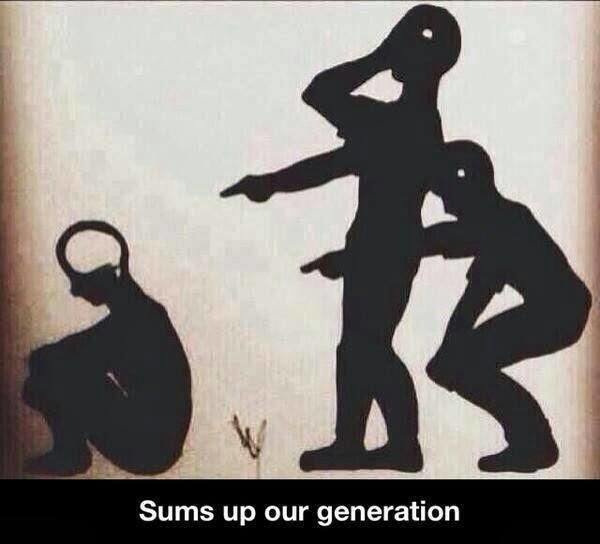
Mark Bauerlein, in his book, The Dumbest Generation, reveals how a whole generation of youth is being dumbed down by their aversion to reading anything of substance and their addiction to digital "crap" via social media.

Journalist Charles Pierce, author of Idiot America, adds another perspective:
"The rise of idiot America today represents - for profit mainly, but also and more cynically, for political advantage in the pursuit of power - the breakdown of a consensus that the pursuit of knowledge is a good. It also represents the ascendancy of the notion that the people whom we should trust the least are the people who best know what they are talking about. In the new media age, everybody is an expert."
"There's a pervasive suspicion of rights, privileges, knowledge and specialization," says Catherine Liu, the author of American Idyll: Academic Antielitism as Cultural Critique and a film and media studies professor at University of California. The very mission of universities has changed, argues Liu. "We don't educate people anymore. We train them to get jobs."

Part of the reason for the rising anti-intellectualism can be found in the declining state of education in the U.S. compared to other advanced countries:
  • After leading the world for decades in 25-34 year olds with university degrees, the U.S. is now in 12th place. The World Economic Forum ranked the U.S. at 52nd among 139 nations in the quality of its university math and science instruction in 2010. Nearly 50% of all graduate students in the sciences in the U.S. are foreigners, most of whom are returning to their home countries;
  • The Oklahoma Council of Public Affairs commissioned a civic education poll among public school students. A surprising 77% didn't know that George Washington was the first President; couldn't name Thomas Jefferson as the author of the Declaration of Independence; and only 2.8% of the students actually passed the citizenship test. Along similar lines, the Goldwater Institute of Phoenix did the same survey and only 3.5% of students passed the civics test;
  • According to the National Research Council report, only 28% of high school science teachers consistently follow the National Research Council guidelines on teaching evolution, and 13% of those teachers explicitly advocate creationism or "intelligent design;"
  • 18% of Americans still believe that the sun revolves around the earth, according to a Gallup poll;
  • The American Association of State Colleges and Universities report on education shows that the U.S. ranks second among all nations in the proportion of the population aged 35-64 with a college degree, but 19th in the percentage of those aged 25-34 with an associate or high school diploma, which means that for the first time, the educational attainment of young people will be lower than their parents;
  • 74% of Republicans in the U.S. Senate and 53% in the House of Representatives deny the validity of climate change despite the findings of the U.S. National Academy of Sciences and every other significant scientific organization in the world;
  • According to the 2009 National Assessment of Educational Progress, 68% of public school children in the U.S. do not read proficiently by the time they finish third grade. And the U.S. News & World reported that barely 50% of students are ready for college level reading when they graduate;
  • According to a 2006 survey by National Geographic-Roper, nearly half of Americans between ages 18 and 24 do not think it necessary to know the location of other countries in which important news is being made. More than a third consider it "not at all important" to know a foreign language, and only 14 percent consider it "very important;"
  • According to the National Endowment for the Arts report in 1982, 82% of college graduates read novels or poems for pleasure; two decades later only 67% did. And more than 40% of Americans under 44 did not read a single book--fiction or nonfiction--over the course of a year. The proportion of 17 year olds who read nothing (unless required by school ) has doubled between 1984-2004;
  • Gallup released a poll indicating 42 percent of Americans still believe God created human beings in their present form less than 10,000 years ago;
  • A 2008 University of Texas study found that 25 percent of public school biology teachers believe that humans and dinosaurs inhabited the earth simultaneously.
In American schools, the culture exalts the athlete and good-looking cheerleader. Well-educated and intellectual students are commonly referred to in public schools and the media as "nerds," "dweebs," "dorks," and "geeks," and are relentlessly harassed and even assaulted by the more popular "jocks" for openly displaying any intellect. These anti-intellectual attitudes are not reflected in students in most European or Asian countries, whose educational levels have now equaled and and will surpass that of the U.S. And most TV shows or movies such as The Big Bang Theory depict intellectuals as being geeks if not effeminate.
John W. Traphagan, Professor of Religious Studies at the University of Texas, argues the problem is that Asian countries have core cultural values that are more akin to a cult of intelligence and education than a cult of ignorance and anti-intellectualism. In Japan, for example, teachers are held in high esteem and normally viewed as among the most important members of a community. There is suspicion and even disdain for the work of teachers that occurs in the U.S. Teachers in Japan typically are paid significantly more than their peers in the U.S. The profession of teaching is one that is seen as being of central value in Japanese society and those who choose that profession are well compensated in terms of salary, pension, and respect for their knowledge and their efforts on behalf of children.

In addition, we do not see in Japan significant numbers of the types of religious schools that are designed to shield children from knowledge about basic tenets of science and accepted understandings of history - such as evolutionary theory or the religious views of the Founding Fathers, who were largely deists - which are essential to having a fundamental understanding of the world, Traphagan contends. The reason for this is because in general Japanese value education, value the work of intellectuals, and see a well-educated public with a basic common knowledge in areas of scientific fact, math, history, literature, etc. as being an essential foundation to a successful democracy.

We're creating a world of dummies. Angry dummies who feel they have the right, the authority and the need not only to comment on everything, but to make sure their voice is heard above the rest, and to drag down any opposing views through personal attacks, loud repetition and confrontation.

Bill Keller, writing in the New York Times argues that the anti-intellectual elitism is not an elitism of wisdom, education, experience or knowledge. The new elite are the angry social media posters, those who can shout loudest and more often, a clique of bullies and malcontents baying together like dogs cornering a fox. Too often it's a combined elite of the anti-intellectuals and the conspiracy followers - not those who can voice the most cogent, most coherent response. Together they foment a rabid culture of anti-rationalism where every fact is suspect; every shadow holds a secret conspiracy. Rational thought is the enemy. Critical thinking is the devil's tool.

Keller also notes that the herd mentality takes over online; the anti-intellectuals become the metaphorical equivalent of an angry lynch mob when anyone either challenges one of the mob beliefs or posts anything outside the mob's self-limiting set of values.

Keller blames this in part to the online universe that "skews young, educated and attentive to fashions." Fashion, entertainment, spectacle, voyeurism - we're directed towards trivia, towards the inconsequential, towards unquestioning and blatant consumerism. This results in intellectual complacency. People accept without questioning, believe without weighing the choices, join the pack because in a culture where convenience rules, real individualism is too hard work. Thinking takes too much time: it gets in the way of the immediacy of the online experience.

Reality TV and pop culture presented in magazines and online sites claim to provide useful information about the importance of The Housewives of [you name the city] that can somehow enrich our lives. After all, how else can one explain the insipid and pointless stories that tout divorces, cheating and weight gain? How else can we explain how the Kardashians, or Paris Hilton are known for being famous without actually contributing anything worth discussion? The artificial events of their lives become the mainstay of populist media to distract people from the real issues and concerns facing us.

The current trend of increasing anti-intellectualism now establishing itself in politics and business leadership, and supported by a declining education system should be a cause for concern for leaders and the general population, one that needs to be addressed now.

Comment: Professor Patrick Deneen explains how kids have become a generation of know-nothings
We have fallen into the bad and unquestioned habit of thinking that our educational system is broken, but it is working on all cylinders. What our educational system aims to produce is cultural amnesia, a wholesale lack of curiosity, history-less free agents, and educational goals composed of content-free processes and unexamined buzz-words like "critical thinking," "diversity," "ways of knowing," "social justice," and "cultural competence."

Our education system produces solipsistic, self-contained selves whose only public commitment is an absence of commitment to a public, a common culture, a shared history. They are perfectly hollowed vessels, receptive and obedient, without any real obligations or devotions.

https://www.sott.net/article/313177-The-cult-of-ignorance-in-the-United-States-Anti-intellectualism-and-the-dumbing-down-of-America


Middleborough Historical Museum


In case you didn’t notice, we here in Middleborough have a beautiful town hall, and this year marks its 150th anniversary! Here is a brief history of our great historic landmark.
For a while after the town was resettled following King Philip's War, town meetings were held either in private homes or local meeting houses--such as that of Isaac Howland--or at the First Church (of the Green). A building said to be 36x30 was erected near the Church at the Green about 1700. Another similar building was built about 1745, and was known as the Easterly Precinct Meeting House. Beginning in the years after the end of the American Revolution, a number of votes were put forward as to whether or not the town should raise money for the construction of a purpose-built, dedicated structure for the use of the town’s business.
As the center of town moved away from the Green and closer to what was once known as Mortontown, there was a desire to see the town’s offices relocated there as well. Consequently, a simple wooden building was built there in the final decade of the 18th century, unassuming and very plain in nature. Clad in shingles, at least in later years, it had two large wooden doors on the front side, facing (South) Main Street, and six tall windows. Either end was adorned with three windows of the same dimensions. It seems that the interior of the building may have been one large, open hall, perhaps with a small subdivision of space within for different functions. The building was erected over 1797, and was accepted by the town on January 2, 1798.
The building must have presided over many important meetings and town functions over the next seventy-five years. Such illustrious Middleboro personalities as Levi Peirce, J.W.P. Jenks, Cephas Thompson, Charles “Tom Thumb” Stratton and Peter H. Peirce all surely would have been very familiar with the building.
The town voted to replace the old, simple structure with the current building, which was completed in 1873. Some of the timber from the old building, which was disassembled, was salvaged and used in the building of another domicile in town.
The building was designed by Solomon K. Eaton, who was also overseeing its elaborate construction. Work began in the summer of 1872. However, Eaton suddenly died that October, at the age of 55, leaving the project unexpectedly in the hands of the town committee, especially chairman Horatio Barrows. They hurriedly pushed to have the boarding completed, lest the cold snows of winter should get inside and ruin the frame and structure. The framing incorporated $4,700 of lumber provided by A.T Stearns and Son, as well as Pratt and Company The roof was built by Middleborough carpenter James Sparrow, who also built four of our local schools--those at Thomastown, the Green, Fall Brook and Waterville. A night watchman stood guard over the construction site in November, to keep the rogues away. It was estimated that he probably saved some lumber from being stolen.
The work continued all throughout 1873, and was completed that December. There was rightfully a lot of buzz concerning the new town house as the exciting day drew near. Two brass bands were commissioned to celebrate the event, and a procession marched through town, proclaiming with great fanfare that this town hall had been completed. The procession included several bands, plus a number of chaplains, the building committee, selectmen and town officers, police and firefighters, and other honored guests. The keys to the building were handed over by the chairman, Horatio Barrows, to the town selectmen, after which time the public was allowed to tour the building. There was quite a reception held in the upstairs hall, where the American Brass Band of Providence, Rhode Island, entertained the gathered parties with a selection of music by Strauss, Wagner and others. Afterwards, the local post of the GAR provided refreshments for the public in the basement, and dinner in the high school room. Clam chowder, meats, vegetables, hot tea and coffee made up the bill of fare. At ten o’clock, a dance was held---the first of many, enduring until 2:00am the next morning.
The grand ballroom today features hardwood floors, a Steinway grand piano, and a stage for performances. In a Gazette article from 1999, it was said that during construction in 1873, “plastermen working in the second floor auditorium were hampered by little girls who play hide and seek in the attic, and whose feet occasionally pierced the ceiling plaster, all of which was described as, quote, “naughty.” As the author noted, it was also quite dangerous, as the drop to the floor below was something like 30 feet.
The total cost is recorded as $48,984.36 in 1873 dollars, which translates to $1,256,000 in 2023. In 1896, the Soldiers’ and Sailors’ monument was added to the front lawn, facing South Main Street, and after World War I, an honor roll was dedicated inside the first floor vestibule area facing onto Union Street.
Since 1873, the upstairs ballroom/auditorium has served in many capacities. It has been used as a concert hall, gymnasium, movie theater, roller skating rink, dance hall, political forum, town meeting space, health clinic, as well as the location of dozens of graduations from Middleborough High School. As for the basement, it still holds three brick jail cells, which were used by the town's police force into the early part of the 20th century. Interestingly, at one time, this space was also used as a shooting range!
From the beginning, the town hall served a variety of functions for the bustling, growing town. Besides furnishing space for town offices and meetings, the building was also the home of Middleborough’s first semi-modern high school, between 1873 and 1886, when that role was filled by the Bates School (1886-1954). Furthermore, the town’s first library was housed here, prior to the building of our beautiful library building in 1904. Finally, some of the building’s abundant square footage also housed a succession of local banks, as well as the Fourth District Court, until 1914. It has survived a number of fires, including notable ones in 1917 and 1944, and even vandals: in 1964, the town’s safe was raided by criminals who made off with money and assets, and then in 1971, the town’s Christmas manger scene was also vandalized.
During the 20th century, the town hall’s exterior was replaced with white vinyl siding, which many of us may yet well recall. Shortly after the turn of the century, however, this was stripped off, and the exterior was painted in two-tone shades of brown. Presumably, this new color scheme more closely matches the original paint of the building when it was first built.
The building’s distinctive eight-sided tower housed a bell from 1893 to 1917 when it was replaced by an air whistle used to sound school cancellations and other signals. Many years later, the 13 foot upper cupola was seen to be noticeably tilting in 2011. It was determined to be unstable and a threat to public safety, and was removed and restored off site. Over the course of the following year, a new system of reinforcement was engineered, shoring up the structure. It involved stiffening portions of the supporting attic framing supporting the cupola, replacing rot damaged framing, and adding tension rod bracing and a compression ring in a pattern that provided torsional restraint. Computer modeling guided the construction crew in executing the repairs and the cupola was returned to its rightful place in 2012 with a new connection to the main structure and a reinforced load path down to the attic level of the building. Today, the main level of the tower is rented out to a major telecommunications company, whose equipment takes up much of the space there.
The town hall that we all know today sits on 2.55 acres of town-owned land at 10 Nickerson Avenue. According to the town assessor’s office, the building and land together are evaluated as being worth $3.3 million dollars as of 2023. Its ‘living area’ is just under 20,000 square feet---pinned at 19,973 to be exact. The cupola is capped with a flagpole, whose top reaches up about 120 feet--though nobody could provide me with a precise measurement.
Today, we commemorate the 150th anniversary of our beautiful town hall building. Its role has changed a lot over the years--notably in that many municipal office functions are currently housed in the Bank Building at Four Corners--but it still serves aptly as the center of the town’s governance, and as an enduring symbol of our community.
B.C.


Top News | 'He’s Not Going to Run Unopposed': Sanders Rejects Schumer for Majority Leader

                                                               LOTS OF POSTS IGNORED BY BLOGGER..... OR REMOVED ON THEIR WHIM! ALL POSTS ARE...