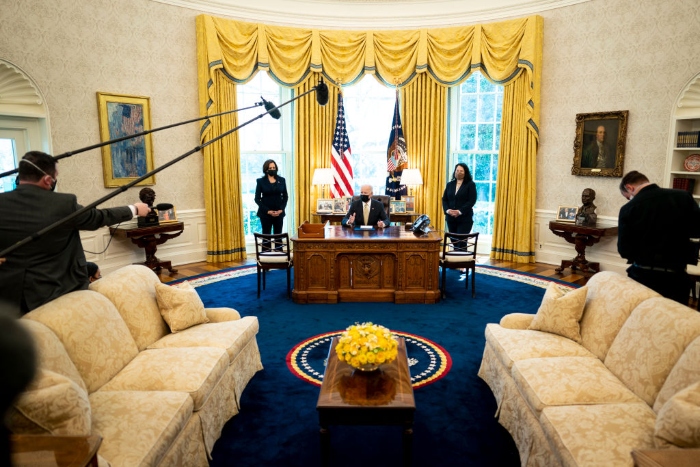
It's Live on the HomePage Now: RSN: William Boardman | Peace With Iran Is Tricky. Is Biden Making It Impossible?
OK, it’s true that stupid, self-defeating policy toward Iran is an American tradition of more than 70 years standing. And yes, it has had some short-term benefits, enriching the Shah’s thugocracy and its American supporters like the Rockefellers and other oil interests. That’s a plus in some books, just not in Iranian books. There it looks more like colonial exploitation laced with crimes against humanity. Wait a minute: didn’t they take our diplomats hostage in 1979? As well they might. Get over it. Some of you should be particularly grateful for that hostage-taking, since Iran did the US the great “favor” of holding the hostages till their captivity helped elect Ronald Reagan. Ever since then, most Americans have been the hostages of the American right. Once in power, Reagan showed US gratitude by supporting Saddam Hussein’s war on Iran. Iraq had invaded Iran in September 1980 and the Reagan administration backed Iraq’s eight-year war against Iran. Iraq sometimes used chemical weapons, with US blessing. Over the last thirty years, US policy has largely consisted of a cold war typified by demonization of anything Iranian and by repeated sky-is-falling cries of Iran getting nuclear weapons as soon as next month. That it never happened has done nothing to quell the cries of wolf. From time to time the US and Israelis assassinate Iranian officials and nuclear scientists, but we don’t call that terrorism. What we call terrorism is any Iranian support for its allies in the region. The US broke diplomatic relations with Iran in 1979 and has not attempted to restore normal diplomatic dialogue since then. No wonder, then, that American policy toward Iran has long since lost touch with anything resembling intellectual integrity, never mind moral authority. American policy toward Iran is little more than chauvinistic resentment supported by tenacious bigotry against non-white Shia Muslims with a civilization millennia older than ours. The present moment, the early Biden administration, presents the US with a rare opportunity to re-think our Iran policy and at least attempt to create a relationship with Iran based on mutual respect, honesty, and a recognition of our own historical culpability. This is an opportunity that is not likely to last for long. And it will likely lead nowhere unless the US takes the initiative. So far, that appears unlikely. At the core of the present moment is the Iran nuclear deal, formally known as the Joint Comprehensive Plan of Action (JCPOA) signed on July 14, 2015, by the US, China, France, Germany, Russia, UK, the European Union, and Iran, after almost two years of negotiation. The joint treaty established limits on Iranian nuclear development, enforced by inspections by the International Atomic Energy Agency (IAEA). In exchange for signing the agreement, Iran was to be relieved of various sanctions imposed by the other parties. (Only three countries in the world opposed the JCPOA at the time – Saudi Arabia, United Arab Republic, and Israel.) In October 2017, the Trump administration unilaterally violated the agreement by refusing to lift agreed-upon sanctions. In May 2018, the Trump administration violated the agreement again, by unilaterally withdrawing from it despite opposition from all the other signatories. No other signatory has withdrawn from the JCPOA. The US has acted in bad faith toward Iran at least since 2017, and that bad faith continues under the Biden administration. According to the IAEA, Iran remained in compliance with the agreement through May 2019. Two months later, Iran announced that it had breached its limit on low-level enriched Uranium, which the IAEA confirmed: Iran had 205 kg of enriched Uranium, 2.2 kg above the agreement’s level of 202.8 kg. This is not a significant difference, it was self-reported, and it is meaningless in relation to nuclear weapons. In January 2020, the Trump administration assassinated an Iranian general at the Baghdad airport in Iraq, deemed a violation of international law by the UN. In response, Iran said it would not continue to comply with the agreement without US assurance that it would rejoin the agreement and lift the sanctions it had previously agreed to lift. The Trump administration maintained its hard line. The IAEA has maintained a partial verification with Iran through March 2021. The Biden administration has maintained the Trump administration’s hard line. Despite President Biden’s expressed intention to rejoin the JCPOA, he has taken unilateral inaction to maintain President Trump’s unilateral action to disrupt the agreement. In addition, in late February, Biden used disputed assertions of “Iranian influence” to launch a dubiously-legal attack on a base in Syria said to be the source of attacks in Iraq on US mercenaries there. The US attack came in the midst of intensified Israeli bombing of “Iran-backed” forces in Syria, along with Israel’s announced contingency plans for bombing nuclear facilities in Iran. For more than two years, Israel has carried on an undeclared war on Iranian shipping (according to Haaretz and the Wall Street Journal): “several dozen attacks were carried out, which caused the Iranians cumulative damage of billions of dollars, amid a high rate of success in disrupting its shipping.” Haaretz has also reported two unconfirmed “Iranian missile” attacks on Israeli ships in the Arabian Sea and the Gulf of Oman. US intelligence on Iran has been politicized and unreliable for decades. Iran is a country of fifty million people on the other side of the world, ringed by US military bases and the US Navy. Iran is under the threat of nuclear attack from US forces every minute of every day. Iran is struggling under crippling economic sanctions imposed and enforced by the US. Despite this longstanding reality, US senators Bob Menendez (D-NJ) and Lindsey Graham (R-SC) recently wrote to President Biden affirming the deep-seated lie that “Iran continues to pose a threat to US and international security.” Whatever sliver of truth may lurk in that assertion, it’s minuscule compared to the threat the US continues to pose to the rest of the world. Official American paranoia about Iran became hilarious on March 21, as dutifully and uncritically reported by the Associated Press (AP) under the headline: The breathless lead gave no clue that the “threats” were already two months old, as well as virtually impossible to carry out: Iran has made threats against Fort McNair, an Army post in the U.S. capital, and against the Army’s vice chief of staff, two senior U.S. intelligence officials said. The most serious question raised here is why the AP, much less anyone else, should take seriously a story leaked by anonymous sources offering no evidence of any credible military threat by a country thousands of miles away from a US fort on an inland waterway in Washington, DC. How scared are we supposed to be? Intelligence agencies refused to respond to press queries. The local military commander, Gen. Omar Jones, had already managed to reduce the threat to absurdity: “The only specific security threat he offered was about a swimmer who ended up on the installation and was arrested.” In a rational world, a story like this would go unpublished. Or it would be written in its real context: a local zoning dispute between the city and the Pentagon. The same day that the AP was indulging in Iranophobia, Iran was reiterating its position with regard to US sanctions and entering new negotiations. As reported by Al Jazeera, Iran said that, first, the US should restore the JCPOA to its pre-Trump status and lift all Trump-imposed sanctions, then Iran would return to full compliance. In an hour-long address marking the Persian new year that coincides with the spring equinox, Supreme Leader Ayatollah Ali Khamenei said in part: … that previous fool [Trump] … went away in that infamous way, bringing disgrace to his country…. [The US] must know ‘maximum pressure’ has failed so far, and if the current US administration wants to continue, it will also fail. This was not widely reported in US media. Reuters omitted mention of Iran’s stated position on the JCPOA, but mentioned Biden’s empty gesture of sending the Iranians greetings and hope for the new year. Loss of trust in the US is the crux of the Trump legacy. The US has demonstrated that it cannot be trusted to abide by international agreements. The US has demonstrated that it cannot be trusted to protect its own citizens from a pandemic. Biden cannot evade this multifaceted reality by pretending it doesn’t exist. Restoring trust is not likely to be quick or easy, but it won’t be possible without determined effort. The Biden administration has made some progress on the pandemic front. So far, some of the Biden administration’s cold war mentality hardliners seem to have stymied progress on Iran. There can be no break with the past as long as the US continues Trump’s policies, which are themselves breaks with the past. Biden’s special envoy to Iran provides reason for hope. Robert Malley is generally respected for his nuanced understanding of Middle East politics. He is a veteran diplomat and mediator who served in both the Clinton and Obama administrations. His appointment sparked right-wing accusations that he has too much sympathy for Iran and an “animus towards Israel,” even though he is of Egyptian Jewish descent. Malley has a record of challenging Washington orthodoxy. In a lecture in 2008, Malley acknowledged that US actions abroad have often been “destructive,” and that the US: … anoints preselected leaders, misreads local dynamics, misinterprets local balances of power, misuses its might, misjudges the toxicity of its embrace, encourages confrontation, exports political models and plays with the sectarian genie. Although that analysis has been true since long before 2008, it still raises hackles in that part of US leadership still guided more by ideological fantasy than complex reality. That reality added a new complexity March 27, when China and Iran announced a new economic agreement for the next quarter-century. Five years in negotiation, the pact provides $400 billion in Chinese investments in Iran in exchange for a steady supply of Iranian oil at a discounted price. At a minimum, this agreement seems to offer Iran some breathing room and stability as well as real relief from economic sanctions. The Biden administration continues to take positions designed to assure failure to resolve the issue. Maybe that’s the Biden goal, in which case all the posturing is time-wasting theatre. When the US Secretary of State is publicly saying, “The ball is really in their court,” he sounds like he’s mired in mindless denial, not making any gesture to restore broken trust. But if Biden actually wants rapprochement of some balanced nature, he has to decide just how long it’s in US interests to continue to accept the damage of prolonging Trump policies. How is that such a hard choice? William M. Boardman has over 40 years experience in theatre, radio, TV, print journalism, and non-fiction, including 20 years in the Vermont judiciary. He has received honors from Writers Guild of America, Corporation for Public Broadcasting, Vermont Life magazine, and an Emmy Award nomination from the Academy of Television Arts and Sciences. Reader Supported News is the Publication of Origin for this work. Permission to republish is freely granted with credit and a link back to Reader Supported News.
'Best and Brightest': Biden Announces 'Trailblazing' Slate of Judicial Nominees Ketanji Brown Jackson nominated to replace Merrick Garland on US appeals court, as part of president’s 11 diverse selections
Ketanji Brown Jackson, a US district judge, was nominated on Tuesday to replace attorney general Merrick Garland on the influential US appeals court for the District of Columbia circuit. In 2016, Garland was nominated for the supreme court by Barack Obama but blocked from even receiving a hearing by Republicans determined to fill the vacancy themselves. It was a hugely dramatic gambit by then Senate majority leader Mitch McConnell, as he set out to transform the federal judiciary. With McConnell’s help, Donald Trump was able to do so. On the campaign trail last year, Biden pledged to name the first Black woman to the supreme court. Jackson, who regularly clashed with the Trump administration, now moves into that spotlight. Many liberals are eyeing retirement for Stephen Breyer, at 82 the oldest member of the court, for whom Jackson once clerked. When she was sworn in as a district judge, in May 2013, Breyer delivered the oath. “She sees things from different points of view,” he said, “and she sees somebody else’s point of view and understands it.” In December, Biden asked senators for a diverse slate of possible judicial picks. “We are particularly focused on nominating individuals whose legal experiences have been historically underrepresented on the federal bench,” he said, “including those who are public defenders, civil rights and legal aid attorneys and those who represent Americans in every walk of life.” His first picks, which the Washington Post called “the largest and earliest batch … by a new administration in decades”, also include the first Muslim named to a district court, Zahid Quraishi, a New Jersey judge. Biden also named Candace Jackson-Akiwumi for the Chicago-based seventh circuit and Tiffany Cunningham for the federal circuit in Washington. Among other appointments, Florence Pan will if confirmed be the first Asian American woman on the DC district court, while Lydia Griggsby will be the first black woman on the Maryland district court. Judge Rupa Ranga Puttagunta, a Washington DC local judge of Indian ancestry, is nominated for DC superior court. Carl Tobias, Williams chair in Law at Richmond University, said the president had delivered on his promise and chosen “an incredible group of people”. “There is diversity along a number of lines, ethnicity, gender, I assume sexual orientation and experiential diversity in terms of former federal public defenders or criminal defense lawyers as opposed to big, firm, lawyers and federal prosecutors,” he said. “Biden made promises both on the campaign trail and since being elected that he wants to rebalance the bench, which was unbalanced in terms of ideology with the appellate appointments that Trump made. “The question is how quickly they can be confirmed and how many more similar nominees he will bring forward. There are seven vacancies now on the appeals courts, 61 on the district court, and I think he’s committed to bringing forward many more very similar nominees.” In a statement to the Post, Biden said: “This trailblazing slate of nominees draws from the very best and brightest minds of the American legal profession. “Each is deeply qualified and prepared to deliver justice faithfully under our constitution and impartially to the American people – and together they represent the broad diversity of background, experience and perspective that makes our nation strong.” Alliance for Justice, a liberal advocacy group, praised Biden’s choices. “Today’s nominees embody the demographic and professional diversity and forward-thinking that will ensure justice is served to the American people when they enter a courtroom,” the group’s president, Nan Aron, said in a statement. Referring to recent battles over picks for cabinet posts and other administration positions, she added: “We have already seen Senate Republicans’ willingness to maliciously smear Biden’s nominees, particularly targeting those who are not white men. We will not abide their callous attacks. Today’s nominees, and the many more outstanding jurists to come, will be confirmed.” Nomination hearings could begin in April. Biden and the Democratic Senate majority leader, Chuck Schumer, have work to do. McConnell and Trump placed three justices on the supreme court, giving it a 6-3 conservative majority. But the extensive reshaping of the judiciary below the highest court could be their most lasting legacy. Observers have noted, for example, that though punitive voting rights restrictions being passed in Republican-led states are being challenged in court, the judiciary that will hear such cases is heavily staffed with conservatives. McConnell was proud of his ruthlessness, telling Fox News there was one reason so many vacancies were left for Trump to fill. “I’ll tell you why,” he said, in December 2019. “I was in charge of what we did the last two years of the Obama administration.” Last April, he told an interviewer his “motto for the year is leave no vacancy behind”. Biden, Tobias said, will have paid attention. “I think Obama had one person on 17 March, but then it was very slow the first year, and Biden was vice-president. He and his people have learned from that, that you have to move very expeditiously,” he said. “I expect to see other similar packages sooner rather than later and [Biden is] watching the 2022 election because [Democrats] can lose the Senate.” Trump’s success contributed to his strength at the polls. In 2019, Josh Blackman, a professor at the South Texas College of Law, told the Guardian: “Not all conservatives are happy with a lot of things Trump has done, but on judges he’s killing it. It’s an across-the-board success that we’ve seen in this area.” Tobias, and others, saw Biden’s picks on Tuesday as the first steps in redressing the balance.
Andrew Bacevich | America's Longest War Winds Down: No Bang, No Whimper, No Victory
America’s Longest War Winds Down “Ours is the cause of freedom.
In the immediate wake of 9/11, it fell to President George W. Bush to explain to his fellow citizens what had occurred and frame the nation’s response to that singular catastrophe. Bush fulfilled that duty by inaugurating the Global War on Terror, or GWOT. Both in terms of what was at stake and what the United States intended to do, the president explicitly compared that new conflict to the defining struggles of the twentieth century. However great the sacrifices and exertions that awaited, one thing was certain: the GWOT would ensure the triumph of freedom, as had World War II and the Cold War. It would also affirm American global primacy and the superiority of the American way of life. The twentieth anniversary of the terrorist attack on the World Trade Center and the Pentagon now approaches. On September 11, 2021, Americans will mark the occasion with solemn remembrances, perhaps even setting aside, at least momentarily, the various trials that, in recent years, have beset the nation. Twenty years to the minute after the first hijacked airliner slammed into the North Tower of the World Trade Center, bells will toll. In the ensuing hours, officials will lay wreathes and make predictable speeches. Priests, rabbis, and imams will recite prayers. Columnists and TV commentators will pontificate. If only for a moment, the nation will come together. It’s less likely that the occasion will prompt Americans to reflect on the sequence of military campaigns over the two decades that followed 9/11. This is unfortunate. Although barely noticed, those campaigns — the term GWOT long ago fell out of favor — give every sign of finally winding down, ending not with a promised victory but with something more like a shrug. On that score, the Afghanistan War serves as Exhibit A. President Bush’s assurances of ultimate triumph now seem almost quaint — the equivalent of pretending that the American Century remains alive and well by waving a foam finger and chanting “We’re number one!” In Washington, the sleeping dog of military failure snoozes undisturbed. Senior field commanders long ago gave up on expectations of vanquishing the enemy. While politicians ceaselessly proclaim their admiration for “the troops,” in a rare show of bipartisanship they steer clear of actually inquiring about what U.S. forces have achieved and at what cost. As for distracted and beleaguered ordinary Americans, they have more pressing things to worry about than distant wars that never panned out as promised. Into the Graveyard of Empires In his January 2001 farewell address, welcoming the dawn of the Third Millennium, President Bill Clinton asserted with sublime assurance that, during his eight years in office, the United States had completed its “passage into the global information age, an era of great American renewal.” In fact, that new century would bring not renewal but a cascade of crises that have left the average citizen reeling. First came 9/11 itself, demolishing assurances that history had rendered a decisive verdict in America’s favor. The several wars that followed were alike in this sense: once begun, they dragged on and on. More or less contemporaneously, the “rise” of China seemingly signaled that a centuries-old era of Western global dominion was ending. After all, while the United States was expending vast sums on futile military endeavors, the People’s Republic was accumulating global market share at a striking rate. Meanwhile, on the domestic front, a populist backlash against neoliberal and postmodern nostrums vaulted an incompetent demagogue into the White House. As the worst pandemic in a century then swept across the planet, killing more Americans than died fighting World War II, the nation’s chosen leader dithered and dissembled, depicting himself as the real victim of the crisis. Astonishingly, that bogus claim found favor with tens of millions of voters. In a desperate attempt to keep their hero in office for another four (or more) years, the president’s most avid supporters mounted a violent effort to overturn the constitutional order. Add to the mix recurring economic cataclysms and worries about the implications of climate change and Americans have good reason to feel punch drunk. It’s hardly surprising that they have little bandwidth left for reflecting on the war in Afghanistan as it enters what may be its final phase. After all, overlapping with the more violent and costly occupation of Iraq, the conflict in Afghanistan never possessed a clear narrative arc. Lacking dramatic duels or decisive battles, it was the military equivalent of white noise, droning in the background all but unnoticed. Sheer endlessness emerged as its defining characteristic. The second President Bush launched the Afghan War less than a month after 9/11. Despite what seemed like a promising start, he all but abandoned that effort in his haste to pursue bigger prey, namely Saddam Hussein. In 2009, Barack Obama inherited that by-now-stalemated Afghan conflict and vowed to win and get out. He would do neither. Succeeding Obama in 2017, Donald Trump doubled down on the promise to end the war completely, only to come up short himself. Now, taking up where Trump left off, Joe Biden has signaled his desire to ring down the curtain on America’s longest-ever armed conflict and so succeed where his three immediate predecessors failed. Doing so won’t be easy. As the war dragged on, it accumulated complications, both within Afghanistan and regionally. The situation remains fraught with potential snags. While in office, Trump committed to a complete withdrawal of U.S. troops from Afghanistan by May 1st of this year. Although Biden recently acknowledged that meeting such a deadline would be “tough,” he also promised that any further delay will extend no more than a few months. So it appears increasingly likely that a conclusion of some sort may finally be in the offing. Prospects for a happy ending, however, range between slim and nonexistent. One thing seems clear: whether Washington’s ongoing efforts to broker a peace deal between the Taliban and the Afghan government succeed, or whether the warring parties opt to continue fighting, time is running out on the U.S. military mission there. In Washington, the will to win is long gone, while patience with the side we profess to support wastes away and determination to achieve the minimalist goal of avoiding outright defeat is fading fast. Accustomed to seeing itself as history’s author, the United States finds itself in the position of a supplicant, hoping to salvage some tiny sliver of grace. What then does this longest war in our history signify? Even if the issue isn’t one that Americans now view as particularly urgent, at least a preliminary answer seems in order, if only because the U.S. troops who served there — more than three-quarters of a million in all — deserve one. And there’s also this: A war that drags on inconclusively for 20 years is not like a ballgame that goes into extra innings. It’s a failure of the first order that those who govern and those who are governed should face squarely. To simply walk away, as Americans may be tempted to do, would be worse than irresponsible. It would be obscene. A Fresh Bite of a Poisonous Imperial Apple Assessing the significance of Afghanistan requires placing it in a larger context. As the first war of the post-9/11 era, it represents a particularly instructive example of imperialism packaged as uplift. The European powers of the nineteenth and early twentieth centuries pioneered a line of self-regarding propaganda that imparted a moral gloss to their colonial exploitation throughout much of Asia and Africa. When the United States invaded and occupied Cuba in 1898 and soon after annexed the entire Philippine archipelago, its leaders devised similar justifications for their self-aggrandizing actions. The aim of the American project in the Philippines, for example, was “benevolent assimilation,” with Filipino submission promising eventual redemption. The proconsuls and colonial administrators Washington dispatched to implement that project may even have believed those premises. The recipients of such benefactions, however, tended to be unpersuaded. As Filipino leader Manuel Quezon famously put it, “Better a government run like hell by the Filipinos than one run like heaven by the Americans.” A patriotic nationalist, Quezon preferred to take his chances with self-determination, as did many other Filipinos unimpressed with American professions of benign intentions. This gets to the core of the problem, which remains relevant to the U.S. occupation of Afghanistan in the present century. In 2001, American invaders arrived in that country bearing a gift labeled “Enduring Freedom” — an updated version of benign assimilation — only to find that substantial numbers of Afghans had their own ideas about the nature of freedom or refused to countenance infidels telling them how to run their affairs. Certainly, efforts to disguise Washington’s imperial purposes by installing Hamid Karzai, a photogenic, English-speaking Afghan, as the nominal head of a nominally sovereign government in Kabul fooled almost no one. And once Karzai, the West’s chosen agent, himself turned against the entire project, the jig should have been up. The U.S. war in Afghanistan has to date claimed the lives of more than 2,300 U.S. troops, while wounding another 20,000. Staggeringly larger numbers of Afghans have been killed, injured, or displaced. The total cost of that American war long ago exceeded $2 trillion. Yet, as documented by the “Afghanistan Papers” published last year by the Washington Post, the United States and its allies haven’t defeated the Taliban, created competent Afghan security forces, or put in place a state apparatus with the capacity to govern effectively. Despite almost 20 years of effort, they haven’t come close. Neither have the U.S. and its NATO coalition partners persuaded the majority of Afghans to embrace the West’s vision of a suitable political order. When it comes to the minimum preconditions for mission accomplishment, in other words, the United States and its allies are batting 0 for 4. Intensive and highly publicized American attempts to curb Afghan corruption have failed abysmally. So, too, have well-funded efforts to reduce opium production. With the former a precondition for effective governance and the latter essential to achieving some semblance of aboveboard economic viability, make that 0 for 6, even as the momentum of events at this moment distinctly favors the Taliban. With 75% of government revenues coming from foreign donors, the Islamic Republic of Afghanistan is effectively on the international dole and has no prospect of becoming self-sufficient anytime soon. Whether the U.S.-led effort to align Afghanistan with Western values was doomed from the start is impossible to say. At the very least, however, that effort was informed by remarkable naïveté. Assessing the war a decade ago — 10 years after it began — General Stanley McChrystal, former commander of all coalition forces there, lamented that “we didn’t know enough and we still don’t know enough” about Afghanistan and its people. “Most of us — me included — had a very superficial understanding of the situation and history, and we had a frighteningly simplistic view of recent history, the last 50 years.” Implicit in that seemingly candid admission is the suggestion that knowing more would have yielded a better outcome, that Afghanistan should have been “winnable.” For the thwarted but unreconstructed imperialist, consider this the last line of retreat: success could have been ours if only decision makers had done things differently. Anyone familiar with the should-have-beens trotted out following the Vietnam War in the previous century — the U.S. should have bombed more (or less), invaded the North, done more to win hearts-and-minds, etc. — will recognize those claims for what they are: dodges. As with Vietnam, to apply this if-only line of reasoning to Afghanistan is to miss that war’s actual significance. Minor War, Major Implications As American wars go, Afghanistan ranks as a minor one. Yet this relatively small but very long conflict stands at the center of a distinctive and deeply problematic era in American history that dates from the end of the Cold War some 40 years ago. Two convictions defined that era. According to the first, by 1991 the United States had achieved something akin to unquestioned global military supremacy. Once the Soviets left the playing field, no opponent worthy of the name remained. That appeared self-evident. According to the second conviction, circumstances now allowed — even cried out for — putting the U.S. military to work. Reticence, whether defined as deterrence, defense, or containment, was for wusses. In Washington, the temptation to employ armed force to overthrow “evil” became irresistible. Not so incidentally, periodic demonstrations of U.S. military might would also warn potential competitors against even contemplating a challenge to American global primacy. Lurking in the background was this seldom acknowledged conviction: in a world chockablock full of impoverished, ineptly led nations, most inhabited by people implicitly classified as backward, someone needed to take charge, enforce discipline, and provide at least a modicum of decency. That the United States alone possessed the power and magnanimity to play such a role was taken for granted. After all, who was left to say nay? So, with the passing of the Cold War, a new chapter in the history of American imperialism commenced, even if in policy circles that I-word was strictly verboten. Among the preferred euphemisms, humanitarian intervention, sometimes justified by a recently discovered “responsibility to protect,” found particular favor. But this was mostly theater, an updating of Philippine-style benevolent assimilation designed to mollify twenty-first-century sensibilities. In actual practice, it fell to the president of the United States, commonly and without irony referred to as “the most powerful man in the world,” to decide where U.S. bombs were to fall and U.S. troops arrive. When American forces flexed their muscles in faraway places, ranging from Panama, Iraq, Somalia, Haiti, Bosnia, Kosovo, Serbia, Afghanistan, Sudan, and the Philippines to Afghanistan (again), Iraq (again), Libya, various West African countries, Somalia (again), Iraq (for a third time), or Syria, authorization by the United Nations Security Council or Congress ranked as somewhere between incidental and unnecessary. For military actions that ranged from full-scale invasions to assassinations to a mere show of force, whatever justification the “leader of the Free World” chose to offer was deemed sufficient. Military action undertaken at the behest of the commander-in-chief became the unspoken but definitive expression of American global leadership. That Bush the father, Clinton, Bush the son, Obama, and Trump would all wield extra-constitutional authority to — so the justification went — advance the cause of peace and freedom worldwide only testified to the singularity of the United States. In this way, an imperial presidency went hand-in-hand with imperial responsibilities and prerogatives. At first imperceptibly, but more overtly with the passage of time, military adventurism undertaken by imperial presidents fostered a pattern of hypocrisy, dishonesty, cynicism, waste, brutality, and malaise that have today become pervasive. In certain quarters, the tendency persists to blame former President Trump for just about everything that ails this nation, including racism, sexism, inequality, public-health crises, and the coarsening of public discourse, not to speak of inattention to environmental degradation and our crumbling infrastructure. Without letting him off the hook, let me suggest that Washington’s post-Cold War imperial turn contributed more to our present discontent and disarray than anything Trump did in his four years in the White House. On that score, the Afghan War made a pivotal and particularly mournful contribution, definitively exposing as delusionary claims of U.S. military supremacy. Even in late 2001, only weeks after President George W. Bush had promised “ultimate victory,” the war there had already gone off script. From early on, in other words, there was unmistakable evidence that military activism pursuant to neo-imperial ambitions entailed considerable risk, while exacting costs far outweighing any plausible benefits. The longest war in U.S. history should by now have led Americans to reflect on the consequences that stem from succumbing to imperial temptations in a world where empire has long since become obsolete. Some might insist that present-day Americans have imbibed that lesson. In Washington, hawks appear chastened, with few calling for President Biden to dispatch U.S. troops to Yemen or Myanmar or even Venezuela, our oil-rich “neighbor,” to put things right. For now, the nation’s appetite for military intervention abroad appears to be sated. But mark me down as skeptical. Only when Americans openly acknowledge their imperial transgressions will genuine repentance become possible. And only with repentance will avoiding further occasions to sin become a habit. In other words, only when Americans call imperialism by its name will vows of “never again” deserve to be taken seriously. In the meantime, our collective obligation is to remember. The siege of ancient Troy, which lasted a decade, inspired Homer to write the Iliad. Although the American war in Afghanistan has now gone on almost twice as long, don’t expect it to be memorialized in an epic poem. Yet with such poetry out of fashion, perhaps a musical composition of some sort might act as a substitute. Call it — just to suggest a title — “Requiem for the American Century.” For one thing should be clear by now: over the course of the nation’s longest war, the American Century breathed its last. Follow TomDispatch on Twitter and join us on Facebook. Check out the newest Dispatch Books, John Feffer’s new dystopian novel Frostlands (the second in the Splinterlands series), Beverly Gologorsky’s novel Every Body Has a Story, and Tom Engelhardt’s A Nation Unmade by War, as well as Alfred McCoy’s In the Shadows of the American Century: The Rise and Decline of U.S. Global Power and John Dower’s The Violent American Century: War and Terror Since World War II.
No Convictions for St. Louis Officers Who Beat Black Undercover Colleague at Protest Officer Luther Hall, who was recording criminal activity during protests, required multiple surgeries after the attack
A jury on Monday acquitted officer Steven Korte of charges of deprivation of rights under color of law and of lying to the FBI in connection to the attack on officer Luther Hall. It happened when Hall was mistaken for a protester during demonstrations that erupted after former police officer Jason Stockley, who is white, was found not guilty in the 2011 death of Anthony Lamar Smith, who was Black. Hall described the 2017 attack to jurors as a “free-for-all”. The former officer Christopher Myers also was acquitted of a deprivation of rights count but the jury could not reach a verdict on a charge of destruction of evidence against Myers for allegedly smashing Hall’s cellphone. The jury also deadlocked on the deprivation of rights charge against the former officer Dustin Boone, leading the judge to declare a mistrial on counts where the jury could not agree. Defense lawyers said police department dysfunction meant officers and supervisors on the street didn’t know undercover officers were working that night. Defense lawyers also challenged Hall’s ability to identify his attackers. The verdicts reignited criticisms that an all-white jury was picked to decide the case. “If an undercover cop can’t get justice, how will the rest of us who have been maced, shot, beaten, and brutalized ever get justice?” Tweeted Cori Bush, a Black congresswoman who represents the Missouri district that includes St Louis. Two other officers, Randy Hays and Bailey Colletta, both of whom are white, entered pleas in the case. Hays pleaded guilty in 2018 to one felony count of deprivation of rights under color of law and admitted hitting Hall with a baton and shoving him to the ground. Colletta pleaded guilty to making false statements to the grand jury about the assault. The St Louis region was still recovering from unrest that followed the fatal 2014 police shooting of Michael Brown in nearby Ferguson. Two nights after Stockley’s acquittal, demonstrators broke windows downtown. Police made 123 arrests but protesters and civil rights leaders said many of those arrested were peaceful demonstrators, journalists and onlookers who were brutalized and taunted. Hall, who had been recording criminal activity during the protests, became separated from his partner while fleeing officers who were firing pepper-spray pellets and bean bag rounds into the crowd. The assistant US attorney Carrie Costantin told the jurors that as Hall was complying with orders to get on the ground, he was knocked down, hit, picked up and knocked down again before being attacked with fists, feet and a baton. Hall said he did not push, fight or pull away from the officers. He said he was stunned. “I couldn’t believe it was happening,” he told the jury. Prosecutors have said two of the officers, Myers and Boone, were motivated by an eagerness to harm protesters, the St Louis Post-Dispatch reported. Hall didn’t tell officers he was undercover because he did not want to ruin his chances of working undercover at future protests. A sergeant later recognized Hall and had him pulled aside. Hall suffered a hole in his lip that had to be stitched closed, injuries to his jaw and injuries to his neck that would later require spinal fusion. He also was unable to eat solid food for weeks, causing him to lose 20lbs. Hall sued the department and officers, including Myers and Boone, but recently settled the case against the department for $5m. He remains with the department. Korte also is still with the department, but the others have all left.
After Half Century in Prison, Elderly Black Panther Should Not Be Left to Die The case of 84-year-old Sundiata Acoli, who is low risk of re-offending, shows the limits of pandemic relief for incarcerated people.
The idea that this elderly Black community leader could be a risk to society outside the prison walls is laughable. Yet Acoli’s release does not appear to be on the horizon. He has been consistently denied parole since the early 1990s. His last bid, in February, was again denied. The parole board determined that he should be considered ineligible for another hearing for an extended but unspecified period of time. Acoli will likely not live long enough to appear before the board again. He is in poor health, as you might expect at his age, after enduring 48 years of prison’s effects on the body. His conditions include advancing dementia, cardiovascular disease, hypertension, emphysema, and glaucoma. Acoli survived a serious Covid-19 infection last year, which left him 30 pounds lighter and more infirm. Even for those who believe in the possibility of justice through carceral punishment — and I do not — Acoli’s ongoing imprisonment should be deemed unacceptable. It has long been the case, however, that the criminal legal system denies individuals in Acoli’s position even the dregs of earnest due process afforded incarcerated people. He is a former Black Panther, convicted for the killing of a New Jersey state trooper in the same incident that saw the revolutionary Assata Shakur wounded and captured. The reason he has not been released, according to his longtime friend and supporter the Rev. Lukata Mjumbe, “has been politics.” Nearly 50 religious leaders from across New Jersey urged Gov. Phil Murphy to immediately release Acoli last year, when the incarcerated elder was rushed to hospital with Covid-19 complications. In a recent interview with former political prisoner and Black Panther Marshall “Eddie” Conway, Mjumbe said, “Moving forward, we’re not dealing with a focus and a fixation on politics, we’re calling for the compassionate release of an 84-year-old man who has been in prison for almost 48 years, who was born in 1937, incarcerated in 1973, who is a grandfather, who is a father, who is sick and who needs to come home.” New Jersey introduced one of the first bills in the country last year to reduce prison sentences during the pandemic. Around 2,600 incarcerated individuals in the state, who were nearing the end of their prison terms, have been released; those convicted of murder were unsurprisingly considered ineligible. Coronavirus-related releases around the country have consistently upheld blunt legal-criminal taxonomies in determining who should go free, but they fail to account for a number of vulnerable individuals at extremely low risk of re-offending, like Acoli, who nonetheless have been deemed “violent” in perpetuity. Even without the context of a pandemic, the grounds for freeing the 84-year-old are abundant. It is, however, cases like Acoli’s — and other long-incarcerated Black liberation leaders — that reveal the true nature of a system, in which so-called blue lives matter and Black lives do not. Calls for Acoli’s release do not focus on the extreme persecution faced by Black liberation fighters at the time of the former Panther’s arrest; they don’t need to. By any measure, he has more than served his time. In 2014, a New Jersey appeals court challenged Acoli’s previous parole denial and ordered his release. The judges wrote, “Acoli has paid the penalty under the laws of this state for his crimes.” A higher court later reversed the ruling. Powerful police unions fight with near-religious zeal to ensure that “cop killers” never see a day of freedom. Since 2000, eight former Black Panther Party members have died while incarcerated, all at least 10 years younger than Acoli. Following changes to New York parole guidelines and parole board makeup, however, two former Panthers have been granted parole in recent years, both having served over 40 years in prison. Like Acoli, Herman Bell and Jalil Muntaqim posed no risk to society and were regarded as mentors by numerous younger people with whom they had served time. They were also the targets of tireless racist and reactionary police union campaigns. Acoli’s fate is determined by a different state’s powers, but the grounds for his long overdue freedom are no less strong. The same is true of Mumia Abu-Jamal, 66; Russell Maroon Shoatz, 77; and Mutulu Shakur, 70 — all Black elders whose ongoing imprisonments constitute an excess of carceral cruelty. Each of the men has at some point in the last year contracted Covid-19. Shoatz has stage four colon cancer and was reportedly held for 10 days in a gymnasium with 30 other coronavirus-positive detainees who all shared one toilet. Abu-Jamal tested positive for the virus earlier this month; he, too, lost 30 pounds, has congestive heart failure, and a skin condition that has flared up, leaving exposed bloody wounds all over his body. Laura Whitehorn, co-founder of the Release Aging People in Prison campaign, and herself a former political prisoner, tweeted that Acoli, Abu-Jamal, Shoatz, and Shakur, among others, remain behind bars “while ‘Judas & the Black Messiah wins film awards” — referring to the recent Hollywood depiction of the betrayal and government execution of Black Panther Party Illinois chapter chair, Fred Hampton. Anyone rightfully horrified on learning of the persecution Hampton faced must reckon with the fact that a number of his contemporaries remain in cages, where, without intervention, they will die. As Whitehorn wrote, “All elders, all ill, should have been released years ago.”
Yemeni-Americans Launch Hunger Strike in Washington, DC In February, UN agencies denounced that 2.3 million children under the age of five in Yemen are projected to suffer from acute malnutrition.
The Yemeni-Americans demand an end to any support for the blockade and call for President Joe Biden to use "all diplomatic tools to pressure Saudi Arabian dictator Mohammed bin Salman to end it,” the YLM stated. “With the lives of hundreds of thousands of Yemeni children hanging in the balance, we have to do whatever it takes to finally bring this cruel blockade to an end,” the YLM Coordinator Iman Saleh said. Calls for an immediate end to the blockade have become widespread after media published reports showing that the U.S. supports Saudi actions that are leading to deadly fuel and food shortages in Yemen, a country where hospitals are full of starving children. The World Food Programme (WFP) Director David Beasley described Yemen as “hell on earth in many places” and pleaded with Saudi Arabia that the “blockade must be lifted... Otherwise, millions more will spiral into crisis.” In February, four United Nations agencies denounced that 2.3 million children under the age of five in Yemen are projected to suffer from acute malnutrition, with 400,000 expected to suffer from severe acute malnutrition that will lead to death. A nearly 25 percent increase since the escalation of the conflict in 2015. “Calls by humanitarian organizations for an end to the blockade were ignored by the Trump Administration but we are hopeful that President Biden will listen,” the Yemen Relief and Reconstruction Foundation President Aisha Jumaan said. “We cannot wait for a political agreement that may take months or years to allow basic necessities to reach millions of innocent Yemeni families. I am so grateful that these activists are making this sacrifice to draw attention to this unfathomable and avoidable tragedy,” he added.
Report: Indonesian Forestry Company Cleared Endangered Orangutan Habitat
Nusantara Fiber controls 242,000 hectares (598,000 acres) of industrial tree plantations via six subsidiary companies in the Bornean provinces of West, Central and East Kalimantan. Industrial trees include acacia and eucalyptus, which are used in the production of paper and textile fibers; timber trees; and trees grown for biomass energy generation. The Nusantara Fiber group obtained most of its permits from 2009-2011 and started clearing forest areas to develop its plantations in 2016, according to a spatial analysis by the research consultancy Aidenvironment. The analysis used satellite imagery, forest cover maps from Indonesia's Ministry of Environment and Forestry, and Global Forest Watch maps of tree cover loss. The analysis shows that from 2016 to 2020, the group cleared 26,000 hectares (64,200 acres) of forests, making it the top deforester among all company groups with industrial tree concessions in Indonesia during this period. Most recently, the group cleared 6,500 hectares (16,000 acres) of forests in 2020. It contends these areas were designated as degraded land, and that its clearing activity was approved by the Ministry of Environment and Forestry, which Aidenvironment acknowledged in its report. "Indeed, the Indonesian government has not banned all forest-clearing," it said. But the forests that were lost were still valuable, according to the NGO. It cited a concession managed by PT Industrial Forest Plantation (IFP), one of Nusantara Fiber's six subsidiaries, in Kapuas district, Central Kalimantan province. Based on a 2016 assessment of orangutan habitat in Indonesia, the forests inside IFP's concession overlapped almost fully with a known habitat of the southwestern subspecies of the Bornean orangutan, Pongo pygmaeus wurmbii, a critically endangered animal. A 2014 assessment commissioned by IFP had also identified the presence of orangutans inside the concession boundaries, as well as other protected fauna and flora, including 29 bird species, 22 mammal species, six types of reptiles, and 15 tree and plant species. Despite these assessments, IFP went on to deforest 10,700 hectares (26,400 acres) between 2016 and the end of October 2020. Most of the deforestation took place in 2019 and 2020, with 3,200 hectares (7,900 acres) and 5,800 hectares (14,300 acres) of forests cleared respectively. "Bornean orangutans are Critically Endangered, so any disturbance of their habitat is massively concerning," Aidenvironment Asia program director Chris Wiggs told Mongabay. Aidenvironment said IFP's case shows how the cleared areas were still valuable, even though they might have been classified as secondary or degraded forests. As of now, there are approximately 50,000 hectares (124,000 acres) of forests remaining in Nusantara Fiber's concessions. They are at risk of disappearing too, as the concession holders are licensed to clear them. "If it's cleared it could have a devastating impact on orangutans and wider biodiversity in this area." Wiggs said. "Nusantara Fiber must urgently halt forest clearance on its concessions." Aidenvironment also called on Nusantara Fiber to publish assessments of high conservation value (HCV) and high carbon stock (HCS) areas inside the concessions. Audits of some of Nusantara Fiber's subsidiaries make references to HCV assessments that appear to have been conducted, yet none of these assessments are publicly available. There's also no information on any HCS assessments that may have been carried out. Who's Behind Nusantara Fiber? Despite being the top industrial tree plantation deforester, the Nusantara Fiber group is shrouded in secrecy, with its owners' identities concealed thanks to the offshore secrecy jurisdiction of Samoa. That's where Nusantara Fiber's parent company, Green Meadows Holdings Limited, is registered. While registering in an offshore jurisdiction is not in itself illegal, it's often done to shield the beneficial owners of a company from liabilities, obligations and accountability in the territory where it operates. "Establishing connections between companies is always difficult, and it's made harder when companies use secrecy jurisdictions like the British Virgin Islands," Wiggs said. In the case of Nusantara Fiber, Aidenvironment has unearthed historical records and incorporation documents that potentially link the group to palm oil and pulp and paper conglomerate Royal Golden Eagle (RGE). A subsidiary of Green Meadows Holdings Limited is Hong Kong-based Green Meadows Fiber Products Limited. This company is also the majority owner of Nusantara Fiber's plantation subsidiaries. Two of the three first directors of Green Meadows Fiber Products Limited previously worked at RGE, Aidenvironment found. "Another couple of the first directors are or were involved in various palm oil businesses totalling 27 palm oil mills and/or kernel crushers, and RGE is a customer of all 27 companies," the report says. "Historical ownership records of Nusantara Fiber group's companies reveal past control by entities that are part of or connected to RGE, before the companies were moved to secrecy jurisdictions." These records, Wiggs said, "clearly connect the group to Royal Golden Eagle," and should be reason enough for RGE to step up and put an end to the deforestation conducted by Nusantara Fiber's industrial tree plantations. "The RGE group of companies should engage with the Nusantara Fiber group, and use its leverage to immediately stop the present and any future deforestation," Aidenvironment said. "The leverage should decisively include the palm oil businesses RGE undertakes with past or present directors of the Nusantara Fiber group." A chart of Royal Golden Eagle trade volume and deforestation within Central Kalimantan, Indonesia. RGE is the fourth-biggest palm oil refiner in Indonesia, which in turn is the world's top producer of palm oil. Like its major competitors, RGE has a policy of no deforestation, no developing on peatland, and no exploiting workers and local communities, known as an NDPE policy. It covers commitments to preserve HCV and HCS areas as well as peatlands, but is restricted only to its palm oil business. For its pulp and paper business, which is supplied by industrial tree plantations, RGE has adopted what it calls a Forestry, Fibre, Pulp & Paper Sustainability Framework across the group. While it's similar to the NDPE policy in use across its palm oil business, this sustainability framework still allows development of peatland as long as it's not forested, Aidenvironment said. It called on RGE to apply its NDPE policy to all its businesses, not only palm oil. "Whenever the palm oil refiners adopted a cross-commodity NDPE policy, they could stop more deforestation," Aidenvironment said. Even then, the policy would only apply to companies and their suppliers that RGE acknowledges as being part of the RGE group of companies. In the case of Nusantara Fiber and its subsidiaries, RGE has denied any connection. "We can confirm that neither RGE nor [pulp and paper unit] APRIL Group's supply chain have any connection to the six Nusantara Fiber Group companies mentioned in Aidenvironment's February 2021 report," RGE spokesman Ignatius Ari Djoko Purnomo told Mongabay. He added the fact that two of the Nusantara Fiber group's directors were past RGE employees didn't constitute any kind of link. "We operate in a free and open employment market in which employees can choose to join or leave employers as they wish," Ignatius said. In response to the ownership of the 27 Nusantara Fiber-linked palm oil mills that RGE sources from, Ignatius said the group had no knowledge of the alleged ownership links listed in the report. "There was no alleged violation against palm oil industry standards or Apical's sustainability policy by these suppliers noted in the report," he said, referring to RGE's palm oil arm, Apical. "Apical is not the sole buyer of palm oil from these suppliers." Wiggs said RGE should have provided its own data to back up its denials and be fully transparent. "We welcome any willingness by Nusantara Fiber and Royal Golden Eagle to clarify any incorrect data in our report," he said. "Agricultural sectors must be fully transparent about their ownership structures, corporate links and operations." Instead, he said, RGE is able to deny any connection to Nusantara Fiber because both entities use opaque and complex company structures. "Industrial tree and palm oil businesses should refrain from using opaque company structures," Aidenvironment said, "because this hinders their accountability for unsustainable practices." This article was originally published on Mongabay. |



 oe Biden has announced a “trailblazing” set of federal judicial nominees, 11 picks including three Black women.

 eorge W. Bush,

 o convictions were returned for three white St Louis police officers accused of beating a Black undercover colleague so severely during a protest over another officer’s acquittal that he had to undergo multiple surgeries.

 undiata Acoli is 84 years old and has been in prison for nearly half a century. When the state of New Jersey locked him up in 1974, Acoli was not sentenced to die behind bars; he has been eligible for parole for almost three decades. The much-loved father and grandfather has an exemplary disciplinary record and a stellar history of work and academic achievement while incarcerated.

 he grassroots group Yemeni Liberation Movement (YLM) on Monday launched a hunger strike in Washington D.C. to protest U.S. support for the Saudi-led blockade on Yemen.