
22 October 22
Live on the homepage now!
Reader Supported News
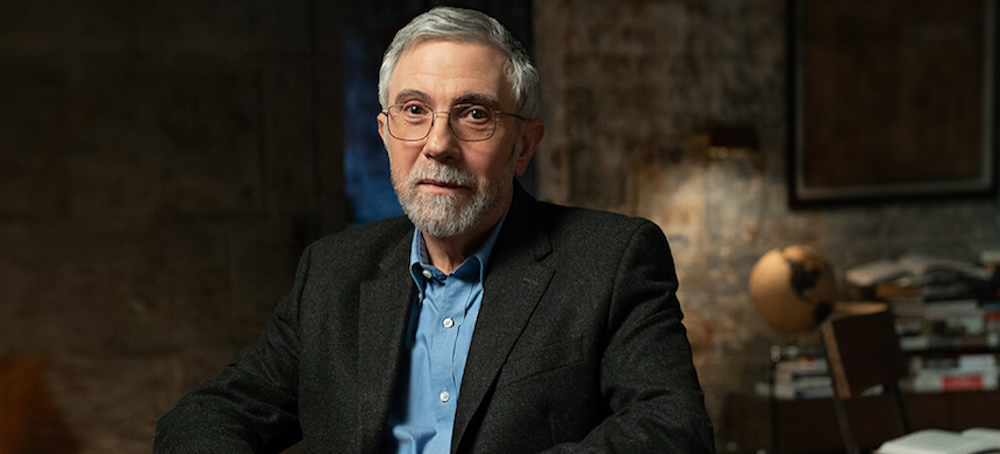
Will the price of gasoline — a price that has very little to do with which party controls the government — nonetheless determine the outcome of the midterm elections, and quite possibly the fate of American democracy?
I wish that were a silly question, but it isn’t. This year there has been a strong correlation between the price of gasoline and political polls.
Earlier this year, when gas reached an average of $5 a gallon, everything seemed to point to a Republican blowout. By mid-September, with gas prices down almost $1.50, the election looked much more competitive. And some apparent recent deterioration in Democrats’ prospects coincided with an upward tick in prices in late September and early October. (Prices are now falling again.)
Now, this correlation might be spurious. Other things have been going on, notably a partisan Supreme Court’s overthrow of Roe v. Wade. And political scientists who have studied the issue find that normally the effect of gas prices on political outcomes is fairly weak.
But we are arguably in a special situation right now. Americans have been shocked by a sudden surge in inflation, which had been quiescent for decades, and the price of gasoline — displayed on huge signs every few blocks — is a potent reminder of our economic difficulties.
What we know for sure is that politicians are harping on gas prices. Republicans don’t talk about the core personal consumption expenditure deflator, they declare that “gas was only $2 a gallon when Trump was in office!” The Biden administration talked a lot about the long slide in prices and is trying to get out the word that this slide has resumed.
So this seems like a good time to make three important points about gasoline prices.
First, the most important determinant of prices at the pump is the world price of crude oil, over which the United States has little influence. And I do mean “world price”: Prices in Europe and the United States normally move almost perfectly in tandem.
Crude prices and hence gas prices were unusually low during Donald Trump’s last year in office, not because of anything he did, but because Covid had the world economy flat on its back, greatly reducing oil demand. Crude temporarily shot up after Russia invaded Ukraine, out of fears that Russian oil exports would be greatly reduced; it fell again as it became clear that a lot of Russian oil would continue to find its way to world markets.
Second, smaller fluctuations are usually driven by technical issues at the refineries that turn crude oil into gasoline and other products. The mini-surge in gas prices that began in September (and now seems to be over) was caused by shutdowns of several refineries for maintenance and a fire at one refinery in Ohio. Again, this has nothing to do with policy.
What about accusations that energy companies are deliberately holding production back to raise prices and profits?
We shouldn’t dismiss this possibility out of hand. Some readers may recall the California electricity crisis of 2000 and 2001. When some analysts, myself included, argued that the facts suggested that market manipulation was playing a large role, we faced considerable ridicule. But it turned out that markets were, in fact, being manipulated; we have the receipts.
As far as I can tell, however, the refining issues that led to recent price increases were genuine. I don’t think it’s wrong to stay suspicious, and keep energy companies on notice against pulling an Enron. But it’s probably not a current problem.
Finally, gas isn’t expensive compared with the fairly recent past.
One way I like to look at this is to look at the ratio of the price of gasoline to the average worker’s hourly earnings. Right now this ratio is considerably lower than it was in the early 2010s. Gasoline prices did plunge in 2014 — yes, under Barack Obama, not Trump. But this reflected a surge in fracking, which actually did increase U.S. oil production enough to have a significant effect on world markets. Unfortunately the fracking boom turned out to be a bubble that eventually burned up more than $300 billion in investors’ money.
So gas prices probably won’t go back to the levels of the late 2010s, not because the Biden administration is hostile to oil production, but because those low prices depended on investors’ delusions about fracking’s profitability. Taking a longer view, as I said, gas isn’t actually expensive at this point.
Furthermore, experts believe that with some troubled refineries coming back online, gas prices will fall substantially over the next few weeks.
So what does this tell us about the success or failure of Biden administration policy? Very little. Biden’s jawboning of refiners over their margins might be having some effect; so might his release of extra oil from the Strategic Petroleum Reserve. Overall, however, it’s hard to think of a worse metric for judging a president and his party than a price determined mainly by events abroad and technical production issues here at home, a price that isn’t even high compared with, say, a decade ago.
Yet gas prices may sway a crucial election, a fact that is both ludicrous and terrifying.
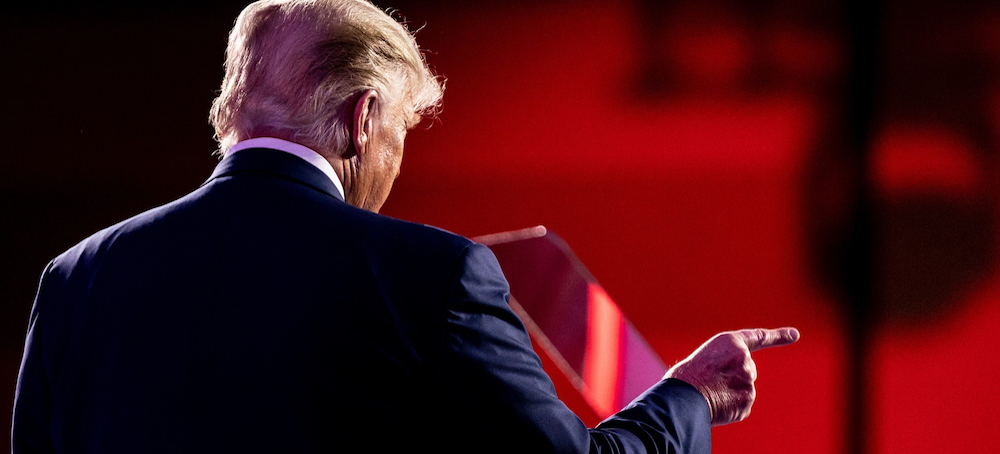 Donald Trump. (photo: Erin Schaff/NYT/Redux)
The committee issued the subpoena to try to compel Trump to sit for a deposition under oath and to provide documents. The panel is ordering Trump turn over documents by November 4 and either appear in person or virtually for “one or more days of deposition testimony beginning on or about November 14.”
Trump’s attorneys said Friday afternoon that they will review the subpoena “and respond as appropriate to this unprecedented action.”
While it is not clear if Trump will comply with the subpoena, the action serves as a way for the committee to set down a marker and make clear they want information directly from Trump as the panel investigates the attack. Trump could also fight the subpoena in court, possibly setting up a hugely significant battle that could go to the highest level of the nation’s Judicial Branch, but it’s also possible such a legal challenge would outlast the committee’s mandate.
Ahead of the subpoena’s release, the committee’s vice chairwoman, Republican Rep. Liz Cheney of Wyoming said at a Harvard event earlier this week she assumes Trump will fulfill his legal obligation and honor the committee’s subpoena, “but if that doesn’t happen, then we’ll take the steps we need to take after that, but I don’t want to go too far down that path at this point.”
Unlike with previous subpoena announcements, the committee released on Friday the entire subpoena it sent to Trump along with the documents it is requesting.
“As demonstrated in our hearings, we have assembled overwhelming evidence, including from dozens of your former appointees and staff, that you personally orchestrated and oversaw a multi-part effort to overturn the 2020 presidential election and to obstruct the peaceful transition of power,” Cheney and Democratic Rep. Bennie Thompson of Mississippi, the committee’s chairman, write in the subpoena letter.
The panel summarizes what it presented in its hearings to demonstrate why it believes Trump “personally orchestrated and oversaw” the efforts to overturn the election.
It says Trump “purposely and maliciously” disseminated false claims that the 2020 election was stolen in order to help his plan to overturn the election and to solicit contributions. The committee paints Trump as “orchestrating and overseeing” the effort to obtain false state electors. On pressure campaigns Trump enacted, the panel highlight says Trump attempted to “corrupt the Department of Justice,” by getting officials to make “false statements,” illegally pressured state officials to change election results, pressured former Vice President Mike Pence to refuse to count electoral votes on January 6 “despite knowing specifically that it was illegal,” and pressured members of Congress to object to valid electors.
Trump’s attorney David Warrington released a statement Friday afternoon, saying, “We are going to be handling this matter as counsel for President Donald J. Trump. We understand that, once again, flouting norms and appropriate and customary process, the Committee has publicly released a copy of its subpoena. As with any similar matter, we will review and analyze it, and will respond as appropriate to this unprecedented action.”
The former president posted a lengthy response criticizing the committee on Truth Social after members voted unanimously to subpoena him but did not say whether he would comply. Trump also recently shared a Fox story on Truth Social that claimed he “loves the idea of testifying.” But Trump could also fight the subpoena in court, and such a legal challenge would likely outlast the committee’s mandate.
In its subpoena, the committee specifically demands Trump turn over any communications, sent or received during the period of November 3, 2020, to January 20, 2021, with more than a dozen of his close allies who have emerged as key players in the broader plan to overturn the 2020 election:
- Michael Flynn, Trump’s former national security adviser
- Roger Stone, a long-time Republican operative, pardoned by Trump
- Stephen Bannon, former Trump adviser, convicted of contempt of Congress
- Rudy Giuliani, Trump’s former attorney
- Jeffrey Clark, a former Justice Department official
- John Eastman, a conservative attorney who worked with Trump to overturn 2020 election
- Christina Bobb, a former One America News Network host and current Trump lawyer
- Jenna Ellis, a former member of Trump’s legal team
- Sidney Powell, a former member of Trump’s legal team
- Kenneth Chesebro, an attorney behind legal theories for overturning 2020 election
- Boris Epshteyn, a Trump adviser
- Cleta Mitchell, an attorney who worked with Trump campaign after 2020 election
- Patrick Byrne, a former Overstock CEO and election denier
The panel’s request for communications includes Trump’s Signal communications. The committee also notes that it wants Trump to testify about his interactions with several individuals, including people on the same list, who invoked their Fifth Amendment rights when questioned by the committee about their dealings with the former President.
“This subpoena calls for testimony regarding your dealings with multiple individuals who have now themselves invoked their Fifth Amendment privilege against self-incrimination regarding their communications with you, including Roger Stone, Lt. Gen. Michael Flynn, U.S. Army (Retired), John Eastman, Jeffrey Clark and Kelli Ward,” the committee wrote in a letter to Trump.
Rep. Zoe Lofgren, a California Democrat who serves on the committee, was asked Friday if she and her colleagues are open to the former President testifying before the panel. She told CNN’s Wolf Blitzer on “The Situation Room” that it’s “subject to negotiation,” but reiterated that Trump must respond to the subpoena first.
“We asked for the documents first, so that we can consider what additional questions we may wish to pose to him,” Lofgren added.
The House committee latest public hearing, where members voted to subpoena him, served as a closing argument to the American public ahead of the midterm election that Trump is at the center of the multifaceted plot to overturn the 2020 presidential election.
“It is our obligation to seek Donald Trump’s testimony,” Thompson said ahead of the subpoena vote during the hearing.
Cheney said during the hearing that seeking Trump’s testimony under oath remains “a key task” because several witnesses closest to the former President invoked their Fifth Amendment right against self-incrimination in response to their interactions with Trump.
“We are obligated to seek answers directly from the man who set this all in motion,” Cheney said, referring to Trump.
READ MORE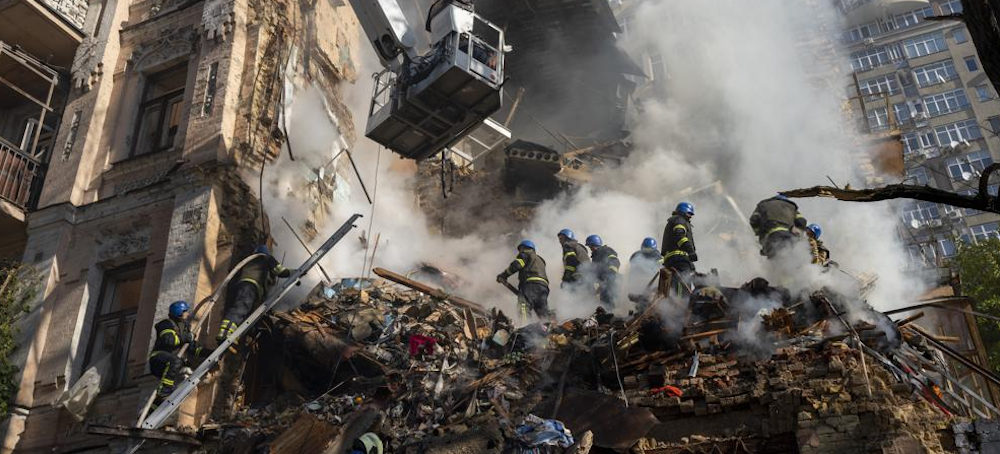 Firefighters work after a drone attack on buildings in Kyiv, Ukraine. (photo: Roman Hrytsyna/AP)
ALSO SEE: Major Power Outages in Central and
Western Ukraine After Russian Shelling
Air strikes have hit critical infrastructure in central and western Ukraine, as Russia continues to target the country's energy grid.
Ukrainian officials say many Russian cruise missiles have been intercepted by air defence systems.
Almost a third of the country's power stations have been destroyed in a wave of air strikes since Monday last week.
On Saturday Ukrainian officials said "critical infrastructure" had been hit in the Cherkasy region, south-east of the capital Kyiv. A huge fire has been reported near the town of Smila.
There have been blackouts in Khmelnytskyi, further west. Air strikes and power disruptions are also being reported from Odesa in the south to Rivne and Lutsk in the north-west.
The national electricity operator, Ukrenergo, said it would limit supply in several regions, including Kyiv. Saturday's strikes may have caused more damage than intense bombardment earlier this month, it added.
The government introduced restrictions on the use of power for the first time on Thursday.
Ukraine's air force command said its defence systems had destroyed 18 Russian cruise missiles launched on Saturday morning.
The deputy mayor of the western city of Lviv, Serhiy Kiral, told the BBC on Saturday that Russia's strategy was to damage critical infrastructure before the winter, and bring the war to areas beyond the front line.
"The more successes the Ukrainian armed forces are having at the front the worse it's going to be for people on the home front because Russia is going to do all it can to target civilians and to target critical infrastructure," he said in an interview with the Newshour radio programme.
On Friday Ukrainian President Volodymyr Zelensky accused Russia of planting mines at a hydroelectric dam in the Kherson region of southern Ukraine, which is under the control of Moscow's forces.
He said that if the Kakhovka hydropower plant was destroyed, hundreds of thousands of people would be in danger of flooding. Russia has denied planning to blow up the dam and said Ukraine was firing missiles at it.
Neither side produced evidence to support their claims.
The dam may provide Russia with one of the few remaining routes across the River Dnieper (called Dnipro by Ukrainians) in the partially occupied Kherson region.
Russia is moving civilians from the areas under its control, in expectation of a Ukrainian offensive to take the city.
READ MORE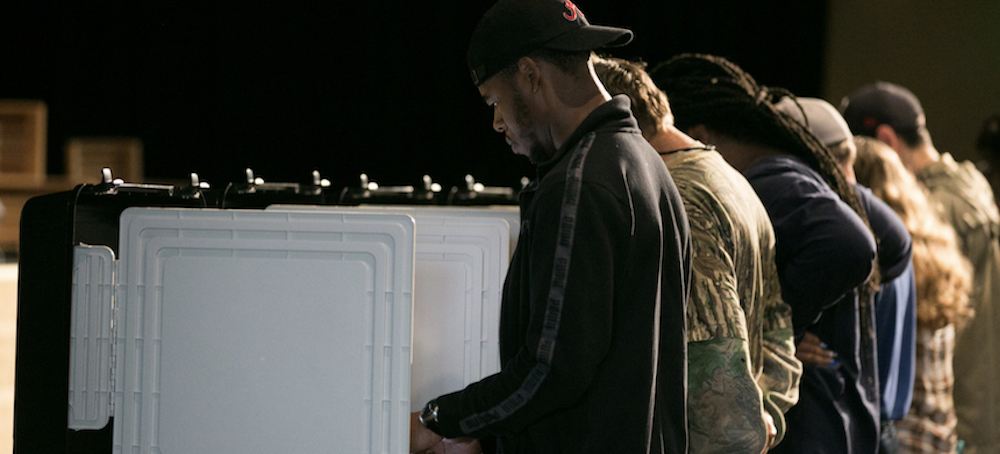 Voters at a polling precinct. (photo: Jessica McGowan/Getty Images)
Unlimited challenges to eligibility and poorly trained poll workers cause frustration in key gubernatorial and US Senate contests
“When I handed in my ID, the poll worker said I was being challenged,” said Jones. “They said I had to complete a provisional ballot, but I wasn’t really comfortable doing that, so I didn’t get to cast my ballot that day.”
Under the state’s new Election Integrity Act, Georgia citizens can challenge a voter’s eligibility on the state’s voting rolls an unlimited number of times. Right-wing groups, spurred by baseless claims that the 2020 election was rife with voter fraud, have mounted thousands of organized challenges across the state, putting even more pressure on the election process for voters, poll workers and election officials. While most have been dismissed already, more challenges cropped up ahead of early voting.
In most cases, voters like Jones don’t know why their status is being challenged in the first place, causing even more confusion.
“The poll worker didn’t tell me why I was being challenged, even after calling someone else for assistance,” said Jones. “They just kept telling me I would have to vote with a provisional ballot.”
Georgia voters turned out in record numbers for the first week of early voting, casting their ballots in the two critical elections, the gubernatorial and Senate races. However, as the election progresses, the impact of Georgia’s new voting laws continues to unfold. Election and voter protection organizations across Georgia have been preparing for moments like this, working to educate voters on what to do if they experience issues when voting.
“I felt discouraged, but I knew I needed to reach out to someone for help and knew I could call Fair Fight and get help,” said Jones.
Fair Fight, a national voting rights organization based in Georgia, has used grassroots campaigning since its founding to educate voters on the resources at their disposal each election season. When Jones called Fair Fight, the organization connected her with Helen Butler and the Election Protection Project.
“I informed [Helen Butler] what happened and told her that I had my ID and precinct card and everything,” said Jones. “She seemed surprised that they wouldn’t let me cast a regular ballot.”
Butler, the executive director of the Georgia Coalition for the People’s Agenda, believes Jones’s ordeal points to a more significant issue this election season.
“This whole thing, and the new law, is alienating more people about the election process,” says Butler. “Especially people like Ms Jones, who was targeted and shouldn’t have been, just because the poll worker wasn’t aware of the additional instructions from the secretary of state’s office.”
These additional instructions from the secretary of state explain that counties should work in favor of the challenged voter, granting poll workers the ability to verify a voter’s residence at the precinct when provided with documentation of the voter’s address or by having the voter sign a residency affirmation form. Once a voter completes these steps, which can be done on the spot, the voter should then be given access to a regular ballot.
However, Butler asserts that this process was not initially made clear. “The first notice they sent out was not very clear, but the second notice gave clearer guidance,” she said. “Somewhere along the line, maybe by the county not updating the poll workers, there is miscommunication.”
To Butler and other voting rights organizers, these instances of miscommunication at the polls stem from the state’s new voting law.
“SB202, this Election Integrity [Act], has highlighted that folks can now do unlimited challenges,” said Butler. “And though people have always been able to challenge the voting rolls, this again creates a problem and creates distrust and is ultimately trying to limit who has access to the ballot.”
Jones is just one of the voters whose distrust of Georgia’s electoral process has grown this election season. “I do feel disenfranchised, especially as a Black voter, and because of the way I vote,” she said. “I know they offered a provisional ballot, but I just didn’t know if it would be counted properly.”
Another aspect of the new voting law includes new rules surrounding provisional ballots. While Jones’s case would not necessarily fall under this aspect of the law, which states that provisional ballots submitted outside of a voter’s precinct will not be counted, she says her broader distrust of the electoral process deterred her from voting with a provisional ballot that day. Still, Jones knows the importance of seeing this process through and clearing the challenge against her voting eligibility. She still plans to vote this election.
“My grandmother marched with Dr Martin Luther King; my family fought for this,” said Jones. “I am the next generation that she was fighting for, and I am not about to let up. I will not risk getting to cast my vote. I will not stop fighting, and I will not be complacent in the difficulty of this process.”
READ MORE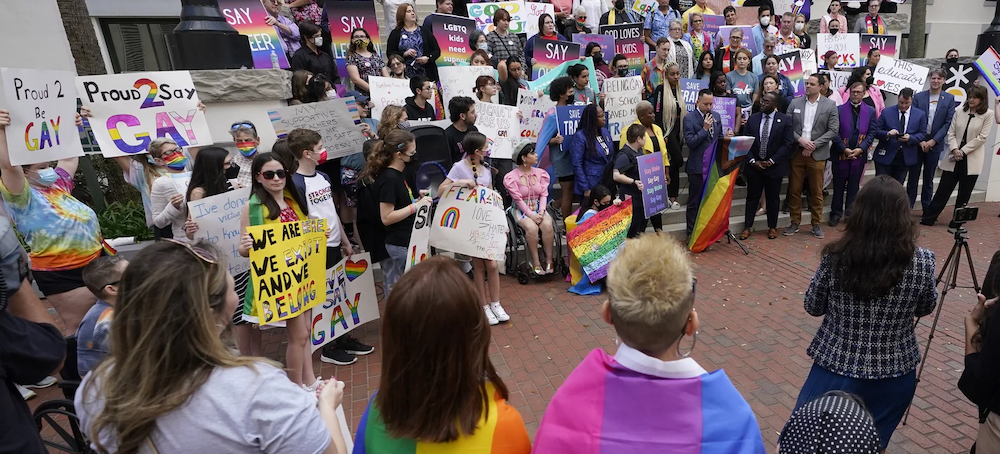 Demonstrators gather on the steps of the Florida Historic Capitol Museum in front of the Florida State Capitol in March in Tallahassee, Florida, protesting what opponents call the "Don't Say Gay" bill. (photo: Wilfredo Lee/AP)
If the federal bill were to become law, which is unlikely in the current Congress, its effects could be far more sweeping, affecting not just instruction in schools, but also events and literature at any federally-funded institution.
Here's what's in the bill – and what people are saying about it.
The bill's language is broad and consequential
The measure was introduced on Tuesday by Rep. Mike Johnson, R-La., and co-sponsored by 32 other Republicans.
"The Democrat Party and their cultural allies are on a misguided crusade to immerse young children in sexual imagery and radical gender ideology," Johnson said in a statement, calling the bill "commonsense."
The bill, called the "Stop the Sexualization of Children Act," aims "To prohibit the use of Federal funds to develop, implement, facilitate, or fund any sexually-oriented program, event, or literature for children under the age of 10, and for other purposes."
The language in the proposed legislation lumps together topics of sexual orientation and gender identity, with sexual content such as pornography and stripping.
It would prohibit federal funds from being used to support any "sexually-oriented" programs, events, and literature for children under 10; ban federal facilities from hosting or promoting such events or literature; and allow parents and guardians to sue government officials, agencies and private entities if a child under 10 is "exposed" to such materials.
The bill complains that some school districts have implemented sex ed programming for kids under 10, and that "[m]any newly implemented sexual education curriculums encourage discussion of sexuality, sexual orientation, transgenderism, and gender ideology as early as kindergarten." It also calls out events such as drag queen story hours in libraries, which it describes as "sexually-oriented."
The bill follows GOP-driven "parental rights" measures in Florida and elsewhere
The proposed federal measure is framed in terms of parents' rights, a rallying cry on the right that in the last couple years has included battles against schools' COVID-19 vaccine requirements and fervent activism against critical race theory in classrooms.
In March, Florida Gov. Ron DeSantis signed into law the "Parental Rights in Education" bill, which bans public school personnel from conducting classroom instruction on sexual orientation or gender identity in "kindergarten through grade 3 or in a manner that is not age-appropriate or developmentally appropriate for students in accordance with state standards."
Critics of the measure dubbed the Florida law "Don't Say Gay" and argue that its intent is to marginalize LGBTQ people and their families. A cascade of other states quickly introduced similar legislation, and Alabama passed its own version of the bill into law.
Among the proposed legislation's definition of the "sexually-oriented material" that it would limit, it includes description and depiction of sexual acts and "lewd or lascivious depiction or description" of human genitals.
But it also prohibits a full range of topics related to the LGBTQ community – "gender identity, gender dysphoria, transgenderism, sexual orientation" — that are largely about identity.
The bill's prospects are nil while Democrats control the White House and Senate
The bill would not pass in the current Congress, given that such legislation is solely a Republican effort and Democrats have a functional majority in each chamber.
Depending on the November election results, the makeup of the House and Senate could shift. Still, it's not clear how many Republicans would support the bill, even if it is popular among a certain strain of the party.
Even if the proposed legislation were to pass in a Republican-controlled House and Senate, it would be vetoed by President Biden. So don't expect this bill to go anywhere, for at least a while.
LGBTQ groups condemn the bill and warn against its potential effects
The Human Rights Campaign, which advocates for the rights of LGBTQ people, decried the proposed legislation.
"Extremist House Republicans like Mike Johnson are continuing their assault on LGBTQ+ Americans' ability to live their lives openly and honestly. A federal 'Don't Say Gay or Trans' bill ... is their latest cruel attempt to stigmatize and marginalize the community, not in an attempt to solve actual problems but only to rile up their extremist base," Human Rights Campaign Government Affairs Director David Stacy said in a statement.
Activist Erin Reed, who tracks anti-transgender legislation, argues that the comparison to a "Don't Say Gay" bill minimizes the potential effects of this proposed legislation.
"Don't Say Gay/Trans was focused on 'classroom instruction' which was bad enough," she wrote on Twitter. "This goes WAY beyond the classroom, and WAY beyond 'instruction.' "
READ MORE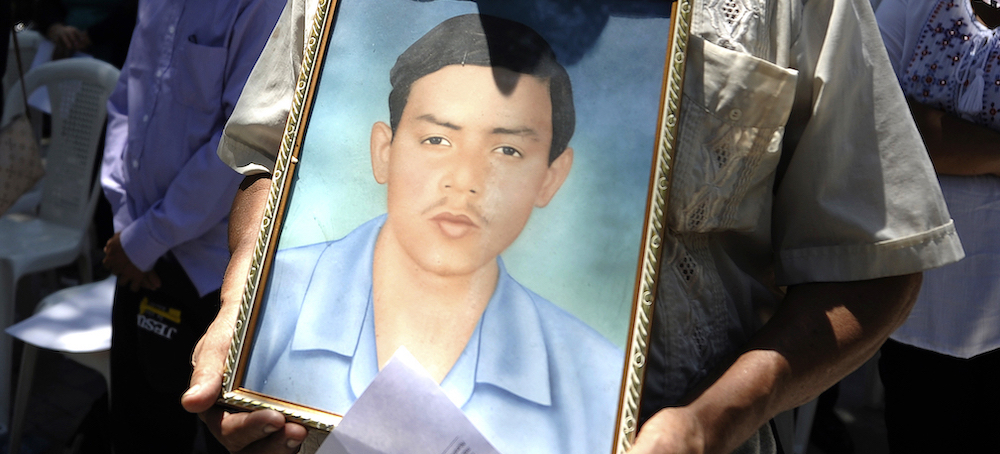 A man holds a picture of his son as part of the commemoration of the International Day of the Disappeared on August 30, 2019, in San Salvador, El Salvador. (photo: Camilo Freedman/APHOTOGRAFIA/Getty Images)
The Salvadoran civil war didn’t just see US-trained-and-financed far-right forces commit endless war crimes — it also ripped children from families, an unknown number of whom never found their way back to their parents.
In the foreword to a forthcoming book by Elizabeth Barnert, anthropologist Philippe Bourgois refers to these abductions as “the demographic crime against humanity of a ‘disappeared’ generation of poor rural children” in El Salvador. These children were often delivered to the Red Cross and placed in orphanages or put up for international adoption. Many were raised by loving foreign families who believed they had rescued victims of the violence. Others bounced between abusive homes and institutions. Most never knew their true names or birthdays and believed that their biological families were lost.
Decades later, one group is tirelessly working to reunite these missing children with their biological relatives. Pro-Búsqueda, the subject of Barnert’s Reunion: Finding the Disappeared Children of El Salvador, was founded in the years following the Peace Accords that brought a negotiated end to the twelve-year civil war. By 2020, Pro-Búsqueda had resolved 443 of 994 cases registered with the organization, while demanding reparations from the perpetrators of these crimes.
Searching for Truth
Pro-Búsqueda, which translates to “pro-search,” was founded in 1994 by Father Jon Cortina and dozens of relatives of disappeared children from El Salvador’s so-called repopulated communities. These highly organized villages were founded by families displaced into Honduran refugee camps during the war, who reentered the country to establish settlements in territory controlled by the Farabundo Martí National Liberation Front (FMLN), the organization of Salvadoran leftist guerrillas. Many of these families were survivors of guindas, the sometimes weeks-long escapes through the mountains from scorched-earth military invasions and massacres. Many, even most of such families, were missing children.
Cortina, a Basque-born Jesuit priest of the liberation theology tradition, survived the 1989 massacre of his colleagues at the Central American University after military checkpoints prevented his return to campus that night from Guarjila, the repopulated community where he ministered to parishioners on weekends. He founded Pro-Búsqueda after helping several families locate children who had been lost in the notorious 1982 Guinda de Mayo, when a deadly counterinsurgency operation drove hundreds of rural families into flight through the northern mountains.
Barnert reproduces the testimony of Francisca Romero, one of the first mothers reunited with her missing child, who watched helplessly with her two young children as her daughter, Elsy, was captured by soldiers and taken away in a helicopter. Romero spent the first two years of peacetime searching for her daughter. In 1994, Elsy and two other children lost in the guinda were identified, having spent the remainder of the conflict in a San Salvador orphanage. Elsy describes how she witnessed soldiers murder and mutilate her father before they kidnapped her, together with over fifty other children.
“I was never told that my family might still be alive,” she remembers.
Barnert began her collaboration with Pro-Búsqueda as a graduate student, volunteering to collect DNA samples from searching families and inquiring adoptees in 2005. By then, the group had located 281 missing children and facilitated 162 reunions. Most were identified living in El Salvador, but dozens more had been adopted in the United States and Europe, and a handful elsewhere in Central America.
“Father Jon suspects that the military and the Salvadoran Red Cross trafficked kidnapped children as international adoptees,” for up to $20,000 per child, writes Barnert. Some thirty thousand Salvadoran children were adopted during the war. The United States alone issued twenty-three hundred adoption visas to citizens for Salvadoran children in that period.
Unbeknownst to the adoptive families, many of these processes were fraudulent or coerced. Barnert shares the story of María Inés, a Pro-Búsqueda employee, who was told by a lawyer that her children would be returned to her in six months. The boys were eventually located in Italy as young men, adopted by separate families.
Pro-Búsqueda was inspired by the work of Argentina’s Madres de Plaza de Mayo, who fought for truth and justice for their disappeared children under the military dictatorship. But rather than force found children back into their biological families as the Madres did — potentially causing further trauma — Pro-Búsqueda leaves the decision of what kind of relationship they want with their relatives to the jovenes encontrados (found young people).
These decisions are not easy, and the reunions that Barnert helps facilitate are often fraught and contradictory. One former FMLN combatant who was ordered to leave her daughter with others by her superiors was pained that she continued to live with her adoptive parents after their reunion. Often, searching families remain wracked with guilt and shame, or fractured by recriminations. Most are burdened by tremendous trauma from the war.
These conflicts can be even more acute in the case of international adoptions, which generate sharp class and cultural divides. In the final section of the book, Barnert relays the story of Angela, a US adoptee raised by a loving family in Berkeley. She accompanies Angela through a process of “ambiguous reunification,” in which Angela navigates feelings of discomfort and anger after her impoverished biological mother makes repeated appeals for money.
Still, Pro-Búsqueda’s work is constantly rewarded by beautiful moments. Barnert translates for a tearful reunion with a fourteen-year-old US adoptee who arrives with her adoptive parents to meet her biological mother for the first time. She witnesses a mother speaking by telephone to her biological son in Italy for the first time; he tells her he’s learning Spanish, she tells him his real birthday.
US Legacies
Barnert is no radical. She has little difficulty assimilating the religious fundamentalism she encounters in postwar El Salvador but struggles with the revolutionary politics of many of her Pro-Búsqueda colleagues. Unsurprisingly, the concept of “imperialism” is absent from her account. Its fingerprints, however, are everywhere throughout.
One of the book’s most penetrating insights comes as the author relays the story of a young man who migrated to the United States from the repopulated community where he lived after being reunited with his biological mother. His tale of scattered corpses and lost children in the desert is strikingly similar to the horrors recounted of the guindas. In these recurring cycles of family separation and state violence, US intervention looms large.
Barnert makes these connections explicit, using her expertise in DNA matching to help reunify migrant families separated by the Trump administration’s zero-tolerance regime at the US southern border. She notes that “thousands of new family separations occur each day in the United States due to mass incarceration,” as well as foster care interventions.
Barnert’s book is moving, her dedication and connection to the work of Pro-Búsqueda palpable. But perhaps its most extraordinary contribution comes via Bourgois, who pens the publication’s foreword and supplies two appendixes. In his introductory remarks, Bourgois reflects poignantly on the question of trauma and survivor’s guilt, having barely escaped alive from a military operation in El Salvador’s northern Cabañas province as a twenty-four-year-old graduate student in 1981. The first appendix contains his field notes and photographs from that harrowing eleven-day guinda.
“Shit it’s midday now and I’m stretched out scared in the cave again, ‘cause the mortars are falling close now,” his notes begin on November 10, 1981. “How the hell are we gonna get out of here and what is going to happen to us all?” Bourgois describes writing goodbye letters to his loved ones, making provisions for his notebooks and camera to be sent to his mother in the event of his death, and staggering through gunfire and explosions past the wounded and the dead as FMLN guerrillas fought to guide the some fourteen hundred civilians he was trapped with past the military cordon to safety.
His photographs include a US-made, US-provided Huey UH-1H helicopter passing overhead on day five: “Outrageously, the US State Department claimed in 1981 that these Huey helicopters were ‘non-military, human rights assistance,’” he writes. “The only difference between ‘nonlethal’ helicopters and military-grade ones was the removal of the external machine-gun parapet with its 360 degree pivot. Instead, the gunners had to open their side door when strafing civilians from their human rights helicopters during this Cabañas invasion.”
Bourgois now understands that he had the “bad luck at being in a transition moment in US-Salvadoran military tactics.” Participating in the invasion was the first batch of Salvadoran officers from the infamous Atlácatl battalion, fresh from training at the School of the Americas at Fort Benning, Georgia.
“FMLN commanders did not yet know how to keep a step ahead of these new rapid flexible Atlácatl patrols and their onsite US Green Beret Special Forces advisers.” Incredibly, Bourgois and his fellow survivors were spared when a Today Show news crew accompanying Bianca Jagger on a visit to a Honduran refugee camp heard the bombardments from across the river, their approach causing the military to retreat in fear of international scandal.
The final appendix includes drawings collected from children in refugee camps by Bourgois in subsequent visits. With the uncanny innocence of a child’s hand, they depict unspeakable atrocities. These devastating testimonies illustrate the conditions under which hundreds of the children Pro-Búsqueda has located were separated from their families, at the hands of US-backed security forces.
No Closure
Jon Cortina, who passed away in 2006, made repeated and unanswered calls for the Salvadoran military and Red Cross to open their archives to aid investigations for missing children. Pro-Búsqueda continues to pressure the Salvadoran state to collaborate with the search and provide restitution through claims in the Inter-American Court of Human Rights.
In 2005, Barnert translated a letter written by Cortina to the US Congress, requesting monetary reparations to fund the search. “Father Jon feels that, since the United States financed the war that tore families apart, it has a moral obligation to assist El Salvador’s disappeared children.” Instead, the United States has continued to fuel the separation of Salvadoran families, most recently through its merciless pursuit of mass detention, deportation, and exclusion of asylum seekers.
Barnert’s narrative falters somewhat toward the end; the author seems unsure how to bring the book to a close. Like the family reunifications she helps facilitate, these stories resist closure. Pro-Búsqueda’s work continues apace, despite harassment from military and other reactionary elements intent on sabotaging their investigations. Working-class Salvadorans remain beset by the twin US progenies of gang violence and mass incarceration, and US capital persistently resorts to force to subordinate Salvadoran labor to its demands on both sides of the border.
“Tell people what happened here,” Francisca Romero told the author. “Let them know the reality of El Salvador — how the war was and how the children were lost, so that young people in other countries can be in solidarity with us.” Barnert found a way to mobilize her solidarity through her technical expertise. She now honors the struggle of people like Romero with her book, which reveals how the violence of empire is reproduced at scales at once geopolitical and profoundly intimate.
READ MORE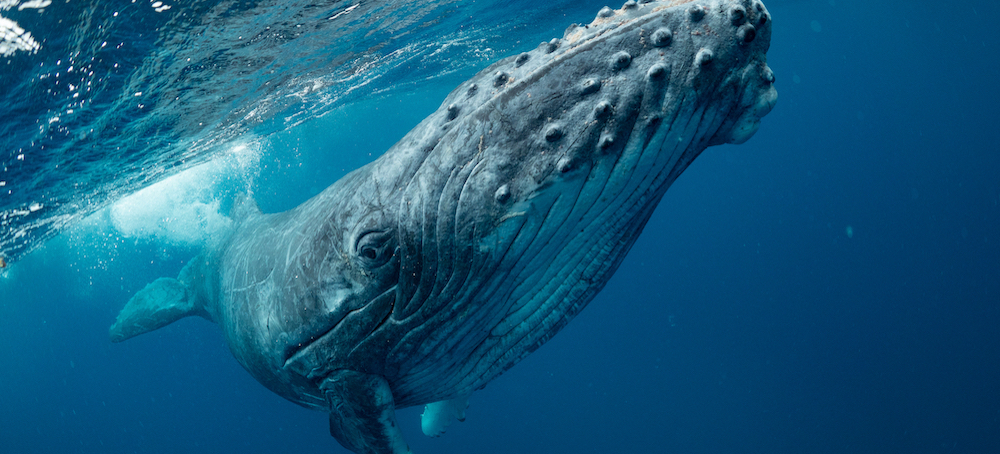 A humpback whale. (photo: Live Science)
You don’t need to be a scientist to understand the urgent nature of the challenges facing the ocean, our most precious natural resource that provides more than 50% of our oxygen and supports up to 80% of life on the planet. These impacts aren’t nuanced trends on a chart, they are widely visible. If you view footage from Jacques Cousteau’s original film The Silent World, you will see the waters off the coast of France teeming with sea life, from giant groupers to stunning corals. Today, those waters bear little resemblance to that vibrant world of a few decades ago. Startling ecosystem declines are evident from the Great Barrier Reef to the Florida Keys to the coral ridges off the coasts of Hawai’i.
Fifty years ago, the United States ushered in a new era of ocean conservation with the National Marine Sanctuaries Act. Jacques Cousteau himself was an early supporter of the movement to preserve key ocean habitats and helped introduce a new mindset regarding ocean conservation. Since then, the initiative has grown into a nationwide network of 15 national marine sanctuaries and two marine national monuments that, combined, conserve more than 620,000 square miles of spectacular ocean and Great Lakes waters, an area nearly the size of Alaska. We have discovered that when ocean ecosystems are given time and space to recover from detrimental human activities, they can rebound at an astonishing rate.
In the United States, the National Marine Sanctuary System supports coastal communities and drives local economies by providing jobs and opportunities for people to discover, recreate, and form life-long connections with these spectacular places. Perhaps most importantly, these sanctuaries connect people to the ocean through science education and stewardship. We rely on these networks to inspire community-based solutions that help us understand and protect our nation’s most spectacular underwater habitats, archaeological wonders, and cultural seascapes. Marine protected areas also play a key role in promoting climate resilience by offering protection for “blue carbon” habitats—coastal ecosystems including salt marshes, seagrasses, and mangroves that provide long term storage for massive amounts of atmospheric carbon.
Other benefits may not be as obvious. The National Marine Sanctuary System also provides a rich resource for research that can directly impact human health and wellness, such as a recent study of the medicinal potential of marine sponges and corals that yield novel compounds effective in combating prostate and ovarian cancer cell lines.
Linking this research to some of the largest marine protected areas, including Papahānaumokuākea Marine National Monument, allows us to pinpoint opportunities that combine exciting medical breakthroughs with marine conservation.
The state of the ocean, at its core, is a people problem and thus people are the key to solving it. Youth in particular are a growing voice in the push for action. At EarthEcho International, tens of thousands of young people each year are given the knowledge and tools to understand how their communities are impacted by the ocean and what they can do about it. From coastal cleanups and restoration projects to education campaigns and engaging policymakers, EarthEcho youth are changing the world. National marine sanctuaries and marine protected areas provide a foundation for this growing youth movement to take action in communities around the globe.
Ultimately, each one of us is connected to the ocean regardless of age, geographic location, race, or economic status. We all have a role to play in ensuring our ocean planet is a thriving, healthy home for all people. As we look toward the future, national marine sanctuaries can help us make that connection to the ocean and be a source of pride, enjoyment, and hope for all. They should be cherished and celebrated on their 50th anniversary and every day.
Follow us on facebook and twitter!
PO Box 2043 / Citrus Heights, CA 95611


 fter weeks of speculation about the potential for

 resident Trump raged on Wednesday that he wants "all voting to stop." But emails obtained by


 he Commission for the Conservation of Antarctic Marine Living Resources (CCAMLR), a governing body of 25 member states and the European Union, missed an opportunity to establish a network of three


