|


|
|
|

11 July 22
Live on the homepage now!
Reader Supported News
In trying to defend Biden’s response to the overturning of Roe, the White House appears to have shown more frustration with pro-choice activists than with Republicans.
The apparent jab was made in a statement to The Washington Post responding to criticism of what many Democrats see as a response that has been too little, too late. White House communications director Kate Bedingfield said: “The president has been showing his deep outrage as an American and executing his bold plan—which is the product of months of hard work—ever since this decision was handed down.”
She went on to say that “Joe Biden’s goal in responding to Dobbs is not to satisfy some activists who have been consistently out of step with the mainstream of the Democratic Party” but “to deliver help to women who are in danger and assemble a broad-based coalition to defend a woman’s right to choose now, just as he assembled such a coalition to win during the 2020 campaign.”
Women’s March Director Rachel O’Leary Carmona told activists she hoped to “push [Biden’s] authority to the limit” regarding abortion rights. By Sunday morning, Carmona had changed her Twitter name to “Out of Touch Activist.”
The statement, which many noted had taken aim at those fighting to uphold abortion rights rather than those who actively put women “in danger” by stripping them of the right to bodily autonomy, came as more than 1,000 demonstrators with the Woman's March's “Summer of Rage” rally surrounded the White House to urge Biden to declare a state of emergency to protect abortion access.
Upon getting to the tall north gates outside the White House on Saturday afternoon, some abortion-rights activists danced while others expressed frustration at the Biden administration.
“Whose house?” organizers yelled at one point, while activists responded: “Our house.”
Abortion rights activists further tied green bandanas to the gates of the White House as part of their demonstration.
Despite the group predicting arrests of its activists over blocking the sidewalk near the White House, neither D.C. Metropolitan police nor U.S. Park Police took any activist into custody.
Since the Supreme Court decided on June 24 to effectively overturn Roe v Wade, activists and abortion rights advocates have questioned why the White House apparently did not have a contingency plan for such a landmark decision, given that a draft opinion leaked nearly two months beforehand had given fair warning the ruling was on the horizon.
More frustration followed over what many saw as a lethargic response.
It took the Biden administration six days after the Supreme Court decision to announce its support for an exception to the filibuster to codify it into law. Its executive order to protect access to abortions took a week longer.
The White House’s apparent dismissal of some activists as “out of step” on Saturday seemed to be just the latest move to leave activists feeling jilted.
“All this White House has for people who need abortions is empty promises and disrespect,” tweeted activist Renee Bracey Sherman, the founder of We Testify, an organization that aims to spread awareness about abortions.
Hayley McMahon, an abortion researcher and PhD student at Emory University, tweeted, “Biden and the Democrats have done absolutely fuck all to ‘deliver help to women who are in danger,’ whatever that ultra-vague bullshit means.”
“I cannot emphasize enough how badly telling pro-choice people to go fuck themselves right after Roe was overturned is going to go,” she wrote.
“It is remarkably concerning that there are members of the Biden Administration who seem more frustrated at pro choice activists than at Republicans who systematically dismantled abortion rights,” tweeted Matt McDermott, a Democratic pollster and strategist.
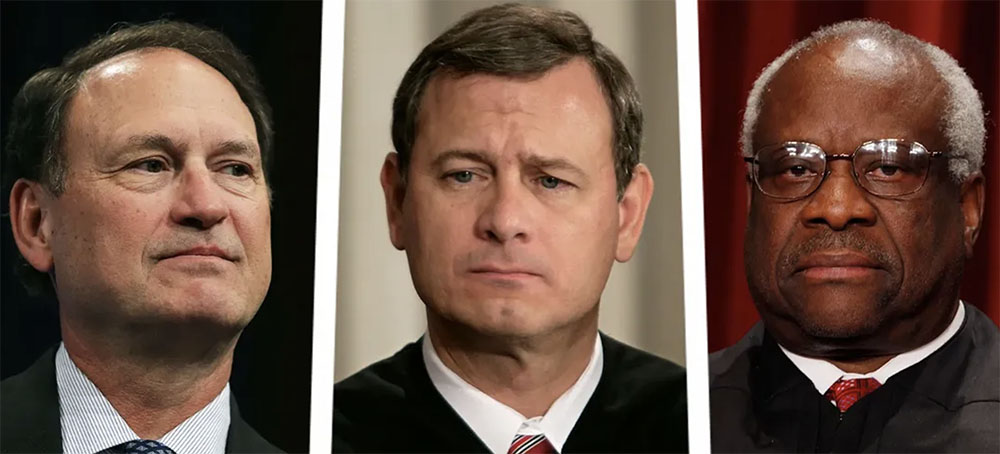 049476-scotus-071122.jpg Img Cap/Cred_// Justices Samuel Alito, John Roberts and Clarence Thomas. (image: Salon/Getty Images)
How far are we? Who really knows? Let’s just say that we’re somewhere significantly down the road to extremity, all-American style. With a hung (and wrung-out) Congress and a lame (and aged) president, our tripartite government is looking ever less “tri” and ever more “part.” And it increasingly seems that the part being emphasized is a Supreme Court that should perhaps be renamed the Extreme Court. Only recently, it issued a series of Trumpist rulings that, from green-lighting the carrying of concealed weaponry to suppressing abortion to keeping climate change on track, rivaled in their extremity the 1857 Dred Scott ruling’s endorsement of slavery that helped launch the Civil War.
And that may just be the beginning. In their next term, for instance, the six justices of the Extreme Court could turn directly to that “tri” and try to whittle it down further. In particular, they may endorse what’s called the independent state legislature doctrine, an extremist theory that, according to the New York Times, “would give state legislatures independent power, not subject to review by state courts, to set election rules at odds with state constitutions, and to draw congressional maps warped by partisan gerrymandering.” And since, at this point, a significant majority of state legislatures are controlled by Republicans the possibility of gerrymandering the political map into a forever-winning extremist government seems all too imaginable.
So hold onto your hats (and guns) folks — we’ve already passed through the diciest post-election season in memory. (Sedition, you bet!) And we could be heading toward an all-American, all-Trumpist Extreme Court and Republican Party version of something akin to fascism.
With that in mind, could there be anything more important than getting out the vote in elections of 2022 and 2024? I doubt it. So, thank you TomDispatch regular Rebecca Gordon for heading back to Nevada to lend a hand. We should all, whatever our doubts, take her as an example of what has to be done to prevent the Extremes from taking this land from so many of the rest of us. Tom
-Tom Engelhardt, TomDispatch
Returning to Reno
In the Shadow of Roe's Undoing
She just laughed.
“What’s so funny?” I asked.
“You’ve been saying that as long as I’ve known you,” she replied with a grin.
How right she was. And “as long as I’ve known you” has been a pretty long time. We met more than a quarter of a century ago when my partner and I hired her as the first organizer in a field campaign to defeat Proposition 209. That ballot initiative was one of a series pandering to the racial anxieties of white Californians that swept through the state in the 1990s. The first of them was Prop 187, outlawing the provision of government services, including health care and education, to undocumented immigrants. In 1994, Californians approved that initiative by a 59% to 41% vote. A federal court, however, found most of its provisions unconstitutional and it never went into effect.
We weren’t so lucky with Proposition 209, which, in 1996, outlawed affirmative-action programs statewide at any level of government or public service. Its effects reverberate to this day, not least at the prestigious University of California’s many campuses.
A study commissioned 25 years later by its Office of the President revealed that “Prop 209 caused a decline in systemwide URG enrollment by at least twelve percent.” URGs are the report’s shorthand for “underrepresented groups” — in other words, Latinos, Blacks, and Native Americans. Unfortunately, Proposition 209’s impact on the racial makeup of the university system’s students has persisted for decades and, as that report observed, “led URG applicants to cascade out of UC into measurably less-advantageous universities.” Because of UC’s importance in California’s labor market, “this caused a decline in the total number of high-earning ($100,000) early-30s African American and Hispanic/Latinx Californians by at least three percent.”
Yes, we lost the Prop 209 election, but the organization we helped start back in 1995, Californians for Justice, still flourishes. Led by people of color, it’s become a powerful statewide advocate for racial justice in public education with a number of electoral and legislative victories to its name.
Shortcomings and the Short Run
How do I hate thee, electoral organizing? Let me count the ways. First, such work requires that political activists like me go wide, but almost never deep. It forces us to treat voters like so many items to be checked off a list, not as political actors in their own right. Under intense time pressure, your job is to try to reach as many people as possible, immediately discarding those who clearly aren’t on your side and, in some cases, even actively discouraging them from voting. In the long run, treating elections this way can weaken the connection between citizens and their government by reducing all the forms of democratic participation to a single action, a vote. Such political work rarely builds organized power that lasts beyond Election Day.
In addition, electoral campaigns sometimes involve lying not just to voters, but even to your own canvassers (not to speak of yourself) about whether you can win or not. In bad campaigns — and I’ve seen a couple of them — everyone lies about the numbers: canvassers about how many doors they’ve knocked on; local field directors about what their canvassers have actually done; and so on up the chain of command to the campaign director. In good campaigns, this doesn’t happen, but those may not, I suspect, be in the majority. And lying, of course, can become a terrible habit for anyone hoping to construct a strong organization, not to mention a better world.
Lying, as the philosopher Immanuel Kant argued, is a way of treating people as if they were merely things to be used. Electoral campaigns can often tempt organizers to take just such an instrumental approach to others, assuming voters and campaign workers have value only to the extent that they can help you win. Such an approach, however efficient in the short run, doesn’t build solidarity or democratic power for the long haul. Sometimes, of course, the threat is so great — as was true when it came to the possible reelection of Donald Trump in 2020 — that the short run simply matters more.
Another problem with elections? Campaigns so often involve convincing people to do something they’ve come to think of as a waste of time, namely, going to the polls. A 2018 senatorial race I worked on, for example, focused on our candidate’s belief in the importance of raising the minimum wage. And yes, we won that election, but four years later, the federal minimum wage is still stubbornly stuck at $7.25 an hour, though not, of course, through any fault of our candidate. Still, the voters who didn’t think electing Nevada Senator Jacky Rosen would improve their pay weren’t wrong.
On the other hand, the governor we helped elect that same year (and for whose reelection I’ll be working again soon) did come through for working Nevadans by, for example, signing legislation that guarantees a worker’s right to be recalled before anyone new is hired when a workplace reopens after a Covid shutdown.
You’ll hear some left-wing intellectuals and many working people who are, in the words of the old saying, “too broke to pay attention,” claim that elections don’t change anything. But such a view grows ever harder to countenance in a world where a Supreme Court disastrously reshaped by Donald Trump and Mitch McConnell is hell-bent on reshaping nearly the last century of American political life. It’s true that overturning Roe v. Wade doesn’t affect my body directly. I’m too old to need another abortion. Still, I’m just as angry as I was in 2016 at people who couldn’t bring themselves to vote for Hillary Clinton because she wasn’t Bernie Sanders. As I told such acquaintances at the time, “Yes, we’ll hate her and we’ll have to spend the next four years fighting her, but on the other hand, SUPREME COURT, SUPREME COURT, SUPREME COURT!”
Okay, maybe that wasn’t exactly the most elegant of arguments, but it was accurate, as anyone will tell you who’d like to avoid getting shot by a random heat-packing pedestrian, buried under the collapsing wall between church and state, or burned out in yet another climate-change-induced conflagration.
If Voting Changed Anything…
Back in 1996, as Election Day approached, Californians for Justice had expanded from two offices — in Oakland and Long Beach — to 11 around the state. We were paying a staff of 45 and expanding (while my partner and I lay awake many nights wondering how we’d make payroll at the end of the week). We were ready for our get-out-the-vote push.
Just before the election, one of the three organizations that had given us seed money published its monthly newsletter. The cover featured a photo of a brick wall spray-painted with the slogan: “If voting changed anything, they’d make it illegal.” Great, just what we needed!
It’s not as if I didn’t agree, at least in part, with the sentiment. Certainly, when it comes to foreign policy and the projection of military force globally, there has been little difference between the two mainstream political parties. Since the end of World War II, Democrats and Republicans have cooperated in a remarkably congenial way when it comes to this country’s disastrous empire-building project, while financially rewarding the military-industrial complex, year after year, in a grandiose fashion.
Even in the Proposition 209 campaign, my interest lay more in building long-term political power for California communities of color than in a vote I already knew we would lose. Still, I felt then and feel today that there’s something deeply wrong with the flippant response of some progressives that elections aren’t worth bothering about. I’d grown up in a time when, in the Jim Crow South, voting was still largely illegal for Blacks and people had actually died fighting for their right to vote. Decades earlier, some of my feminist forebears had been tortured while campaigning for votes for women.
Making Voting Illegal Again
In 1965, President Lyndon Johnson signed the Voting Rights Act, explicitly outlawing any law or regulation that “results in the denial or abridgement of the right of any citizen to vote on account of race or color.” Its specific provisions required states or counties with a history of voter suppression to receive “pre-clearance” from the attorney general or the District Court for the District of Columbia for any further changes in election laws or practices. Many experts considered this provision the heart of that Act.
Then, in 2013, in Shelby County v. Holder, a Supreme Court largely shaped by Republican presidents tore that heart right out. Essentially, the court ruled that, because those once excluded from voting could now do so, such jurisdictions no longer needed preclearance to change their voting laws and regulations. In other words, because it was working, it should be set aside.
Not surprisingly, some states moved immediately to restrict access to voting rights. According to the Brennan Center for Justice, “within 24 hours of the ruling, Texas announced that it would implement a strict photo ID law. Two other states, Mississippi and Alabama, also began to enforce photo ID laws that had previously been barred because of federal preclearance.” Within two months, North Carolina passed what that center called “a far-reaching and pernicious voting bill” which:
“instituted a strict photo ID requirement; curtailed early voting; eliminated same day registration; restricted preregistration; ended annual voter registration drives; and eliminated the authority of county boards of elections to keep polls open for an additional hour.”
Fortunately, the Fourth Circuit Court of Appeals struck down the North Carolina law in 2016, and surprisingly the Supreme Court let that ruling stand.
But as it turned out, the Supremes weren’t done with the Voting Rights Act. In 2021, the present Trumpian version of the court issued a ruling in Brnovich v. Democratic National Committee upholding Arizona’s right to pass laws requiring people to vote only in precincts where they live, while prohibiting anyone who wasn’t a relative of the voter from hand-delivering mail-in ballots to the polls. The court held that, even though in practice such measures would have a disproportionate effect on non-white voters, as long as a law was technically the same for all voters, it didn’t matter that, in practice, it would become harder for some groups to vote.
Writing for the majority, Justice Samuel Alito declared that states have a different and more important interest in such voting restrictions: preventing voter fraud. In other words — at least in the minds of two-thirds of the present Supreme Court — some version of Donald Trump’s big lie about rigged elections and voter fraud has successfully replaced racist voter suppression as the primary future danger to free and fair elections.
Maybe elections do change something. Otherwise, why, in the wake of the 2020 elections, would “they” (including Republican-controlled state legislatures across significant parts of the country) be so intent on making it ever harder for certain people to vote? And if you think that’s bad, wait until the Supremes rule next year on the fringe legal theory of an “independent state legislature.” We may well see the court decide that a state’s legislature can legally overrule the popular vote in a federal election — just in time for the 2024 presidential race.
The Future Awaits Us
A couple of times a week I talk by phone with another friend. We began doing this at the height of George W. Bush’s and Dick Cheney’s vicious “war on terror.” We’d console each other when it came to the horrors of that conflict, including the illegal invasion of Iraq, the deaths and torture of Iraqi and Afghan civilians, and the seemingly endless expansion of American imperial meddling. We’re still doing it. Somehow, every time we talk, it seems as if the world has travelled one more mile on its way to hell in a handbasket.
Both of us have spent our lives trying, in our own modest fashion, to gum up the works of capitalism, militarism, and authoritarian government. To say that we’ve been less than successful would certainly be understating things. Still, we do keep at it, while discussing what in the world we can still do.
At this point in my life and my country’s slide into authoritarian misery, I often find it hard even to imagine what would be useful. Faced with such political disorientation, I fall back on a core conviction that, when the way forward is unclear, the best thing we can do is give people the experience of achieving in concert what they could never achieve by themselves. Sometimes, the product of an organizing drive is indeed victory. Even when it isn’t though, helping create a group capable of reading a political situation and getting things done, while having one another’s backs, is also a kind of victory.
That’s why, this election season, my partner and I are returning to Reno to join hotel housekeepers, cooks, and casino workers trying to ensure the reelection of two Democrats, Senator Catherine Cortez Masto and Governor Steve Sisolak, in a state where the margin of Democratic Party victories hasn’t grown since 2012.
From our previous experience, we know one thing: we’ll be working in a well-run campaign that won’t waste anyone’s time and has its eye on the future. As I wrote about the union’s 2020 presidential campaign for Joe Biden, more than winning a difficult election is at stake. What’s also important is building organized power for working people. In other words, providing the kind of training and leadership development that will send “back to every hotel, restaurant, casino, and airport catering service leaders who can continue to organize and advocate for their working-class sisters and brothers.”
I still hate electoral politics, but you don’t always get to choose the terrain you’re fighting on. Through its machinations at the federal, state, and county level, the Republican Party has been all but screaming its plans to steal the next presidential election. It’s no exaggeration to say that preserving some form of democratic government two years from now depends in part on keeping Republicans from taking over Congress, especially the Senate, this year.
So, it’s back to Reno, where the future awaits us. Let’s hope it’s one we can live with.
Follow TomDispatch on Twitter and join us on Facebook. Check out the newest Dispatch Books, John Feffer’s new dystopian novel, Songlands (the final one in his Splinterlands series), Beverly Gologorsky’s novel Every Body Has a Story, and Tom Engelhardt’s A Nation Unmade by War, as well as Alfred McCoy’s In the Shadows of the American Century: The Rise and Decline of U.S. Global Power and John Dower’s The Violent American Century: War and Terror Since World War II.
Follow us on facebook and twitter!
PO Box 2043 / Citrus Heights, CA 95611


