'This Is Illegal': US Lawmakers Slam Strikes on Yemen
|
|
|
|
|
|
In Blow to Democracy, British Parliament Votes to Outlaw University and Council Boycotts of Israel amid Gaza Genocide Belfast (Special to Informed Comment; Feature) – On January 10, the UK parliament passed the third and final reading of the anti-boycott bill proposed by pro-Israel Conservative hawk Michael Gove, who serves as Secretary of State for Leveling Up, Housing and Communities and Minister for Governmental Relations. The House of Lords still needs to approve […] |
Global warming on course for Destabilizing 5.2° F. (2.9° C) Rise, UN report warns Catherine Early ( China Dialogue ) – Countries must make far greater efforts to implement their climate strategies this decade to stand a chance of keeping global temperature rise within 1.5C (2.7F) of the pre-industrial average. Continued delays will only increase the world’s reliance on uncertain carbon dioxide removal technologies (CDR), according to the UN […] |
The Int’l Court of Justice Case is a Chance to hold Israel and the US to Account for Genocide ( Code Pink) – On January 11th, the International Court of Justice (ICJ) in The Hague is holding its first hearing in South Africa’s case against Israel under the Genocide Convention. The first provisional measure South Africa has asked of the court is to order an immediate end to this carnage, which has already killed […] |
RON DESANTIS SERVED IN GUANTANAMO & IGNORED THE TORTURE
During his captivity, my client Sharqawi Al Hajj has lost both parents and gone through his 30s and most of his 40s. He wonders what future he has left
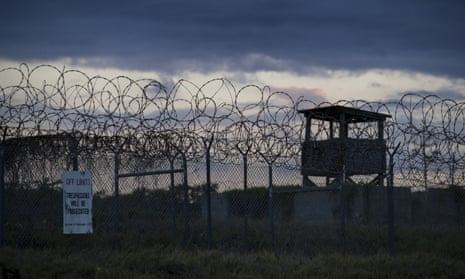
Sharqawi Al Hajj is a man detained at the US military prison in Guantánamo Bay, Cuba. I have been his lawyer for many years. This week marks 22 years since the prison was opened, and Sharqawi’s 20th year inside. He is one of 30 men still detained there, down from nearly 800 ever held. This trajectory is because Guantánamo, though not singular among prisons in its harsh treatment and arbitrary detention, was at least for a time very overt in its extremeness, and what could be seen more plainly than usual caused a reaction.
There are public records and images of an earlier period that people who are old enough remember. A news article from 2002, reporting on the first planeload of detainees arriving, sticks with me. Men chained to their seats for 8,000 miles were led off the plane because they wore goggles covered with black tape; some fell to the ground. A government report from 2008 described interrogations during those years, things like a man being found immobile on the floor of an interview room next to a pile of his own hair.
These accounts and many that followed led to a movement over the years. By the time of Barack Obama’s presidency, seven years after Guantánamo opened and 15 years ago looking back, the United States’ position was that the prison should be closed – within one year. The commander who set up the prison wrote an op-ed saying it should never have been opened. There was an international outcry, with the UN and the European parliament and countries around the world issuing condemnations.
So there are reasons for the emptying of this prison from hundreds to a few remaining, and for the long-standing position of the United States and the international community that it should be closed for good. The 30 men left are in a degraded, vacant complex. Guantánamo is a horrible relic of the past, with the 30 inside still bearing its legacy.
The steps needed for true closure are obvious, yet stuck. Like the majority of those still there, Sharqawi is cleared for release from Guantanamo. In 2021 a government board took the recommendations of prison authorities with other intelligence and determined that his continuing detention was no longer necessary for national security. His imprisonment drags on for other reasons, political and otherwise, all of which are beside the only point: that his detention today is unjustified, and this after two decades at Guantanamo.
In the time that Sharqawi has been held, his father passed, then his mother. He has gone through his 30s and most of his 40s. He was brutally treated before, which is lodged in him. That brutality, along with the deprivations that go with years of imprisonment, have been toxins for his body. He wonders what kind of future he has even if he is released.
I do not know what to tell him on this point, nor how to elevate his suffering to make it seen, in this time of many other extremes.
What seems most gratuitous here is that those closest to Guantánamo agree that it was a profound mistake, that most of those ever detained never should have been held at all, and that the majority of those still imprisoned after 22 years do not belong there now. In a sea of deep suffering, this is a place where there should be release.
Pardiss Kebriaei is Mr Sharqawi Al Hajj’s lawyer and has represented men at Guantánamo since 2007. She is a senior attorney at the Center for Constitutional Rights in New York
I hope you appreciated this article. Before you move on, I wanted to ask if you would consider supporting the Guardian’s journalism as we enter one of the most consequential news cycles of our lifetimes in 2024.
From Elon Musk to the Murdochs, a small number of billionaire owners have a powerful hold on so much of the information that reaches the public about what’s happening in the world. The Guardian is different. We have no billionaire owner or shareholders to consider. Our journalism is produced to serve the public interest – not profit motives.
And we avoid the trap that befalls much US media: the tendency, born of a desire to please all sides, to engage in false equivalence in the name of neutrality. We always strive to be fair. But sometimes that means calling out the lies of powerful people and institutions – and making clear how misinformation and demagoguery can damage democracy.
From threats to election integrity, to the spiralling climate crisis, to complex foreign conflicts, our journalists contextualise, investigate and illuminate the critical stories of our time. As a global news organisation with a robust US reporting staff, we’re able to provide a fresh, outsider perspective – one so often missing in the American media bubble.
Around the world, readers can access the Guardian’s paywall-free journalism because of our unique reader-supported model. That’s because of people like you. Our readers keep us independent, beholden to no outside influence and accessible to everyone – whether they can afford to pay for news, or not. If you can, please consider supporting us just once from $1, or better yet, support us every month with a little more. Thank you.
Betsy Reed
Editor, Guardian US
https://www.theguardian.com/commentisfree/2024/jan/11/guantanamo-bay-men-prison
California’s Great Battery Revolution Allows Closure of Peaker Gas Plants and move to 100% Wind, Solar, Water Ann Arbor (Informed Comment) – The renewables revolution around the world has depended primarily on wind, hydro, and solar. A fourth factor is now swiftly emerging as essential, that is, mega-battery storage. Batteries store energy when the wind is blowing or the sun is shining, to release it when those sources decline. California has so […] |
In Earth’s Hottest Year on Record, an Unprecedented 28 Billion-dollar Disasters struck US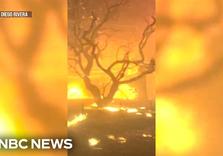 By Shuang-Ye Wu, University of Dayton | – National weather analysts released their 2023 billion-dollar disasters list on Jan. 9, just as 2024 was getting off to a ferocious start. A blizzard was sweeping across across the Plains and Midwest, and the South and East faced flood risks from extreme downpours. The U.S. set an […] |
Sunsetting the War on Terror — Or Not: The Stubborn Legacy of America’s Response to 9/11 ( Tomdispatch.com ) – This week marks the 22nd anniversary of the opening of the Guantánamo Bay detention facility, the infamous prison on the island of Cuba designed to hold detainees from this country’s Global War on Terror. It’s an anniversary that’s likely to go unnoticed, since these days you rarely hear about the war […] |
|
|