Showing posts with label RUSSIAN ASSASSINATIONS. Show all posts

Tuesday, April 12, 2022

RSN: Sergei Lavrov Says Russia's War With Ukraine Is 'Meant to Put an End' to US World Domination, NATO Expansion


Reader Supported News
12 April 22

Live on the homepage now!
Reader Supported News

WE HAVE TO — REALLY — FIGHT TO MAKE OUR BUDGET — It is very hard right now. In truth far harder then it should be. If even 10% of our readers were responding and helping fundraising would be totally painless. For real. Please be a bit more responsive. In peace and solidarity.
Marc Ash • Founder, Reader Supported News

Sure, I'll make a donation!


Russian foreign minister Sergey Lavrov. (photo: Russian Foreign Affairs Ministry/Anadolu Agency/Getty Images)
Sergei Lavrov Says Russia's War With Ukraine Is 'Meant to Put an End' to US World Domination, NATO Expansion
Natalie Musumeci, Business Insider
Musumeci writes: "Russian Foreign Minister Sergey Lavrov said Monday that Russia's unprovoked war with Ukraine was 'meant to put an end' to US-led global domination and the expansion of NATO, a report said."

Russian Foreign Minister Sergey Lavrov said Monday that Russia's unprovoked war with Ukraine was "meant to put an end" to US-led global domination and the expansion of NATO, a report said.

"Our special military operation is meant to put an end to the unabashed expansion [of NATO] and the unabashed drive towards full domination by the US and its Western subjects on the world stage," Lavrov told the state-owned television news channel Rossiya 24, according to a translation from the Russian state-run media outlet RT.

Additionally, Lavrov accused the US of international-law violations over what he said were America's attempts to impose its own "rules-based international order," according to the report.

"This domination is built on gross violations of international law and under some rules, which they are now hyping so much and which they make up on a case-by-case basis," Lavrov said during the interview, RT reported.

Russian President Vladimir Putin launched his country's invasion of Ukraine on February 24, with Russian troops surrounding and shelling towns and cities across the country.

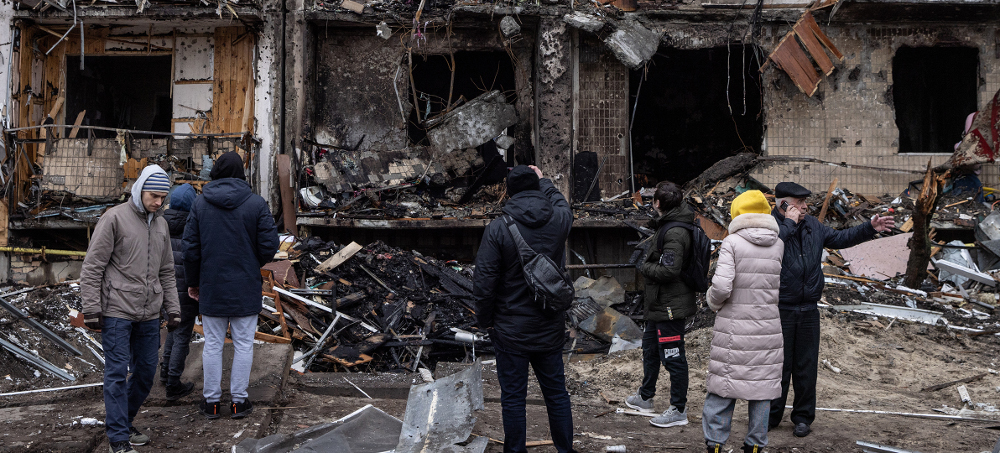
The United Nations' Office of the High Commissioner for Human Rights said Monday that at least 1,842 civilians had been killed in attacks across Ukraine, though it said "the actual figures are considerably higher." More than 4.5 million Ukrainians have fled the country during Russia's invasion, the UN said.

When Putin announced his invasion of Ukraine, he said he was seeking the "denazification" of Ukraine, a country whose democratically elected leader, President Volodymyr Zelenskyy, is Jewish.

Putin has also attempted to defend the war with baseless allegations of genocide against ethnic Russians in eastern Ukraine.

Ukraine's pursuit of NATO membership has also been cited by Putin as a justification for his decision to invade Ukraine.

Zelenskyy said last month he had "cooled down" on Ukraine's bid to join NATO.

Earlier in March, Lavrov offered another reason for Russia invading Ukraine, saying the Kremlin was trying to prevent a separate war in Ukraine.

"The goal of Russia's special military operation is to stop any war that could take place on Ukrainian territory or that could start from there," Lavrov said, according to a tweet posted by the Russian Embassy in London.

Since Russia invaded, Ukrainian forces have put up fierce resistance, which has resulted in heavy losses for Russian troops despite Ukrainian troops being largely outnumbered and outgunned by the Russians.

READ MORE


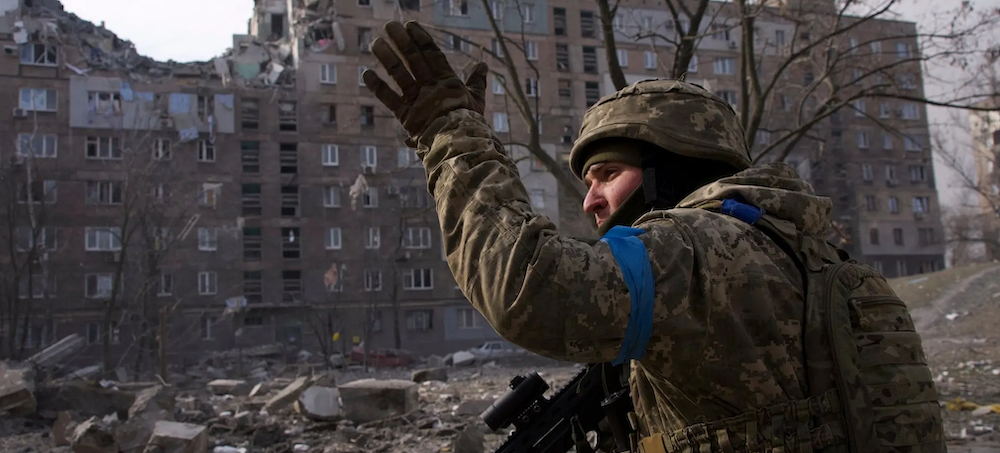
Last Marines Defending Mariupol 'Running Out of Ammunition'A Ukrainian soldier guards his position in Mariupol, Ukraine. (photo: Mstyslav Chernov/AP)

Last Marines Defending Mariupol 'Running Out of Ammunition'
Luke Harding, Isobel Koshiw and Bethan McKernan, Guardian UK
Excerpt: "The last Ukrainian soldiers defending Mariupol said they were 'running out of ammunition' on Monday and expected to be killed or taken prisoner very soon by Russian forces surrounding the city."

The 36th brigade say they face ‘death for some of us, and captivity for the rest’ as Russian offensive continues

The last Ukrainian soldiers defending Mariupol said they were “running out of ammunition” on Monday and expected to be killed or taken prisoner very soon by Russian forces surrounding the city.

Writing on Facebook, the 36th brigade said its 47-day defence of Mariupol was coming to a tragic conclusion.

“We were bombed from airplanes and shot at by artillery and tanks. We have been doing everything possible and impossible. But any resource has the potential to run out,” it said.

Russian troops have been besieging the city on the Sea of Azov since the beginning of March. The territory controlled by Ukrainian forces has gradually shrunk to a few central areas. The surviving marines are now holed up in the Azovstal iron and steelworks next to the port.

“The enemy gradually pushed us back. They surrounded us with fire, and are now trying to destroy us,” the marines posted. The “mountain of wounded” amounted to nearly half of the brigade, they added, with those “whose limbs are not torn off” continuing to fight.

Their infantry soldiers had all been killed. The “shootings battles” against the Russians were now being conducted by artillerymen and anti-aircraft gunners, as well as radio operators, drivers and cooks. Even musicians from the orchestra were fighting, they said.

The desperate last bulletin came as Ukraine’s president Volodymyr Zelenskiy said Russia had “destroyed” Mariupol. “There are tens of thousands of dead. Even despite this the Russians are not stopping their offensive,” he told South Korea’s parliament.

Zelenskiy said it was too soon for Ukraine to declare it had won the battle for Kyiv, given the scale of the suffering of civilians living in Russian-occupied areas in the capital’s garden suburbs.

“Bucha, Irpin, Hostomel – if the people of those [towns] were wiped out, then did we win this battle? I’m not sure. We’ve withstood, and we did not give up what is ours. But whether we won, I can’t say,” he told CBS News.

The exact number of residents killed in Mariupol is unlikely to be known. Its Ukrainian-controlled council said the Russians had been collecting bodies – many of them lying in shattered streets – and incinerating them in a mobile crematorium.

After failing to seize Kyiv, Russia has refocused its military efforts on the eastern Donbas region. When Mariupol falls, Russian tactical battalions are expected to advance north and to try to link up with other military columns moving south from the city of Iyzum and the Kharkiv region.

Western officials said they expected Russia to try to “double or perhaps even treble” its forces in Donbas as it shifts forces from Kyiv and elsewhere in the coming weeks.

The first of those forces had begun to redeploy via Belarus, but the whole exercise would take “some considerable time” and it was unclear how many units could be effectively brought back into battle.

Ukraine’s defence ministry said a full-scale Kremlin attack is likely. “They have almost finished their preparations. We expect an offensive in the near future,” spokesman Oleksandr Motuzyanyk told the Guardian. Asked if the Russians could encircle Ukraine’s defending eastern army, he replied: “We are not going to let this happen.”

Ukraine’s high command faces an urgent tactical dilemma. Several Russian battalions retreated late last month from the Kyiv region to Belarus. Some are now making the long journey via Belgorod on the Russian side of the border, to redeploy into the south-east of Ukraine.

Other units have stayed put. If Kyiv moves the bulk of its forces to the Donetsk and Luhansk territories, this would leave the capital exposed to a second surprise Russian attack from Belarus.

In their message, the marines in Mariupol also say they feel “written off” by their commander in chief. They say repeated promises to relieve the crushing Russian blockade of the city, or to evacuate some of their wounded by helicopter, came to nothing. “There were chances. Due to silliness they were not implemented,” the brigade wrote.

Like Mariupol’s trapped civilian population, the soldiers have been living in hellish conditions. “For more than a month, we fought without resupplying our ammunition, without food, without water,” the marines posted, adding that they were forced to drink water from puddles.

The message ends: “It’s death for some of us, and captivity for the rest. Do not talk badly about the Marines. For we are FAITHFUL FOREVER!”

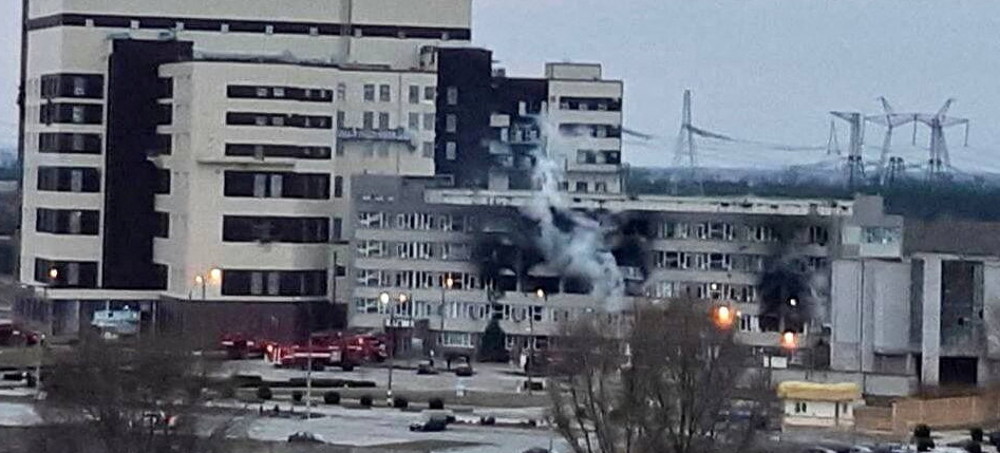
Russia has claimed it targeted Ukrainian air defence systems in airstrikes overnight on Sunday which completely destroyed the airport in the eastern city of Dnipro. Another attack wounded five people in the town of Zvonetsky, according to Ukrainian officials.

Emergency workers were also combing through an infrastructure facility in Zvonetsky that was attacked on Monday. Valentyn Reznichenko, governor of the Dnipropetrovsk region, said casualty figures would be given at a later point.

Reznichenko earlier said that the Dnipro attack had wounded one person, while rockets had sparked a fire that was eventually put out. A missile had also hit a building in the Pavlohrad district, he added.

Separately, the head of the Dnipro region council, Mykola Lukashuk, said five staff members of the state emergency service had been wounded by the strike on the airport.

Russia said that it had targeted an S-300 air defence missile system transported to Ukraine by Slovakia last week, a claim denied by Slovakia. Kyiv has repeatedly begged its western allies for long-range air defence systems to help it against the Russian invasion.

Dnipro, an industrial city home to 1 million people, has become a vital reception point for Ukrainians from farther east who have been told to evacuate in the face of both Russian advances on the ground and intensifying airstrikes and artillery attacks.

There seems little prospect Moscow will stop its Ukraine invasion anytime soon. Russia’s foreign minister, Sergei Lavrov, said negotiation talks with Ukraine would continue, but stressed in an interview with Itar-Tass there will be no pause in hostilities until a final agreement is reached and signed.


READ MORE


Gee, Wonder Why Mohammed Bin Salman Personally Intervened to Give Jared Kushner $2 BillionJared Kushner. (photo: Win McNamee/Getty Images)

Gee, Wonder Why Mohammed Bin Salman Personally Intervened to Give Jared Kushner $2 Billion
Ryan Bort, Rolling Stone
Excerpt: "Advisers for the Saudi Arabian foreign wealth fund didn't want to infuse Kushner's private equity firm with cash. Crown Prince Mohammed bin Salman did it anyway."

Advisers for the Saudi Arabian foreign wealth fund didn’t want to infuse Kushner’s private equity firm with cash. Crown Prince Mohammed bin Salman did it anyway

Jared Kushner landed $2 billion from Saudi Arabia six months after his father-in-law, Donald Trump, left the White House. The sum was sent to Kushner’s private equity firm after Saudi Crown Prince Mohammed bin Salman overruled advisers for his nation’s sovereign wealth fund, who thought Kushner and his firm were too sketchy to warrant such a large investment, The New York Times reported on Sunday.

The $620 billion fund’s advisory panel was reportedly concerned that Kushner’s newly created firm, Affinity Partners, didn’t have much experience; that the firms operations were “unsatisfactory in all aspects”; and that Kushner posed a “public relations risk” because of his work in the Trump administration. The fund’s advisers discussed these issues during a meeting last June 30, days after which bin Salman overruled them and green-lit the payment.

The panel may have thought Kushner’s association with Trump was cause for concern, but bin Salman clearly sees it as an advantage — especially considering Kushner could be back in the White House if Trump runs and wins in 2024. The two political scions have become friendly, with bin Salman undeterred by the Trump family’s financial volatility — and potential criminality — and Kushner undeterred by the Saudi government’s gruesome murder of Washington Post columnist Jamal Khashoggi in 2018. The two chatted regularly before and after the murder, the Times reported in 2018, calling each other “Jared” and “Mohammed” in text messages.

“Affinity, like many other top investment firms, is proud to have PIF and other leading organizations that have careful screening criteria, as investors,” a spokesperson for Kushner’s firm told the Times of its relationship with the Saudi sovereign wealth fund.

The news of bin Salman overruling objections of the Saudi sovereign wealth fund’s advisers to send $2 billion to Kushner’s firm comes as Trump and other right-wing shit-stirrers have decided to once again the kick the tires on the idea that Hunter Biden received $3.5 million from the widow of the former mayor of Moscow. Trump tried to press Biden on the payment in the debates ahead of the 2020 election, and brought it up again last month when he asked Vladimir Putin to provide information on the transaction — despite the fact that Putin is murdering civilians by the thousand as he directs Russia’s invasion of Ukraine, a U.S. ally.

The only problem is that there’s no evidence this actually happened. Senate Republicans released a report before the 2020 election that alleged Yelena Baturina sent the sum to a Biden-connected firm called Rosemont Seneca Thornton in 2014. Trump tried to make hay out of the report’s findings, but The Washington Post recently dug into what the report said beyond its headline-worthy summary, and found that it does not actually claim that Biden received the money. The Post found no evidence Biden had anything to do with the transaction.

READ MORE


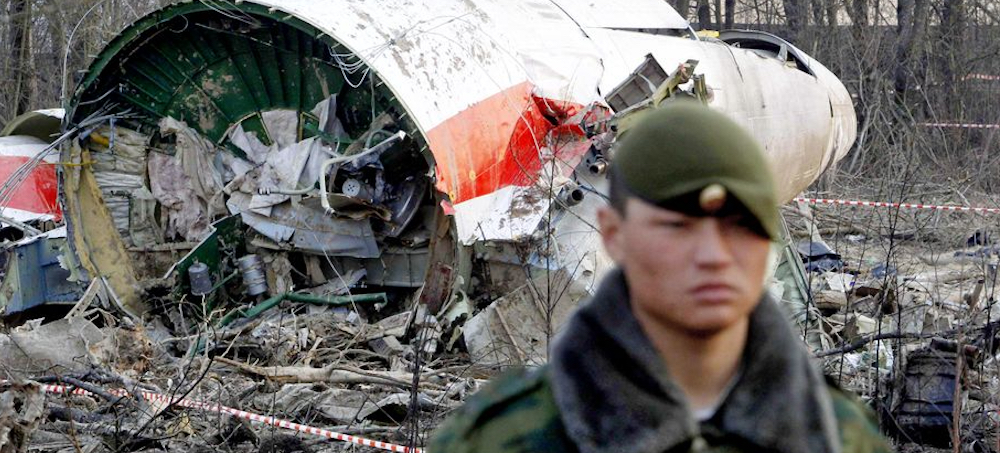
Polish Panel: Russia Behind Polish Leader's Plane CrashOn April 10, 2010, the Tupolev Tu-154 aircraft carrying Polish president Lech Kaczynski and 95 others crashed in Smolensk, Russia. (photo: Sergei Karpukhin/Reuters)

Polish Panel: Russia Behind Polish Leader's Plane Crash
Associated Press
Excerpt: "A Polish government special commission has reinforced its earlier allegations that the 2010 plane crash that killed President Lech Kaczynski and 95 others in Russia was the result of Moscow's assassination plan."

A Polish government special commission has reinforced its earlier allegations that the 2010 plane crash that killed President Lech Kaczynski and 95 others in Russia was the result of Moscow's assassination plan.

The latest of the commission’s reports, released Monday, alleges that an intentional detonation of planted explosives caused the April 10, 2010 crash of Soviet-made Tu-154M plane that killed Kaczynski, the first lady and 94 other government and armed forces figures as well as many prominent Poles.

Their deaths were the result of an “act of unlawful interference by the Russian side,” the commission's head Antoni Macierewicz told a news conference.

"The main and indisputable proof of the interference was an explosion in the left wing ... followed by an explosion in the plane's center," said Macierewicz, who in 2015-2018 served as defense minister in Poland's right-wing government.

He denied that any mistakes were made by the Polish pilots or crew members, despite bad weather at the time of the crash.

The report repeats many previous allegations made by the commission, appointed by the government whose key figure is the main ruling Law and Justice party leader, Jaroslaw Kaczynski, the twin of the late president.

It comes at a time when Russia has unleashed a war on Poland’s neighbor Ukraine, and among the current tense relations between Warsaw and Moscow. Poland supports Ukraine in its struggle against Russia and is calling for very tough sanctions on Moscow for its Feb. 24 invasion of Ukraine.

The latest report once again drums up hostility toward Russia among some Poles, chiefly supporters of the nationalist government, it what seems to be an effort to consolidate the voter base of the Law and Justice party, which was founded by the Kaczynski twins in 2001.

Suspicions are additionally fuelled by Russia's refusal to return the wreckage, which has complicated Poland's investigation.

Earlier, two separate reports by Polish and Russian experts on aviation incidents said the crash on approach in dense fog to the Smolensk airport, which did not have sophisticated aviation equipment, was the result of human errors made in adverse weather conditions.

They found no proof of foul play.
READ MORE


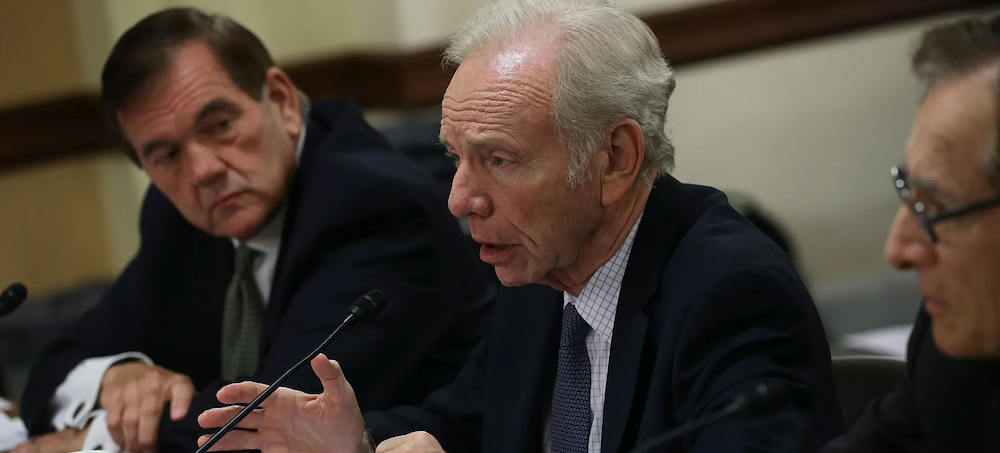
They Warned About Pandemics Before COVID-19. Now They Have a $100 Billion Plan to Stop the Next One.Bipartisan Commission on Biodefense co-chairs Tom Ridge and Joe Lieberman. (photo: Alex Wong/Getty Images)

They Warned About Pandemics Before COVID-19. Now They Have a $100 Billion Plan to Stop the Next One.
Dylan Matthews, Vox
Matthews writes: "A bipartisan group of retired public officials is begging Congress to finally get serious on preventing pandemics."

2003’s most famous politicians are begging the US to stop ignoring biosecurity.


A bipartisan group of retired public officials is begging Congress to finally get serious on preventing pandemics.

The Bipartisan Commission on Biodefense released a new report this morning urging policymakers to fund, and the executive branch to implement, what it calls the Apollo Program for Biodefense, a $100 billion, 10-year effort that would prepare the nation to meet any future viral threat head-on. The new report, called The Athena Agenda (they like Greek gods), takes the framework the Apollo report outlined and provides more detail on how to fund and achieve it. Commission deputy director Ambika Bumb, a medical scientist who served in the Biden White House and Trump State Department, told me that the new report aims to put the recommendations in terms that “Congress can directly take and put in legislation.”

Among other priorities, the plan includes funding for: creating vaccine candidates for each of the 26 families of viruses known to infect humans; developing antiviral medications that can work against a broad spectrum of viruses; building out manufacturing capacity for vaccines, antivirals, tests, and other countermeasures; deploying genomic sequencing as a way to track outbreaks; developing broadly useful diagnostic technologies and better regulatory processes for approving and disseminating plentiful rapid tests; and improving security in laboratories dealing with dangerous viruses.

The White House, to its credit, has already proposed funding around this level. Most recently, in its 2023 budget proposal, the Biden administration asked for $88.2 billion in funding over five years on pandemic preparedness. That includes $40 billion for the Office of the Assistant Secretary for Preparedness and Response (ASPR) at the Department of Health and Human Services to “invest in advanced development and manufacturing of countermeasures for high priority threats and viral families, including vaccines, therapeutics, diagnostics, and personal protective equipment (PPE),” as well as $12.1 billion in research funding for the National Institutes of Health for vaccine, therapeutics, and diagnostics development.

Bumb notes that the Biden proposal actually drew on the original Apollo plan put out by the bipartisan commission. That’s part of why the new commission report is so notable: This is a group that’s capable of driving policymaking at high levels.

That said, Congress has yet to appropriate money at the commission’s desired level to prevent the next pandemic. It’s barely interested in further funding response to the current, ongoing pandemic, which is still killing hundreds of Americans a day. A group of senators recently cut a deal for $10 billion to fund Covid-19 response, after slashing funding the White House wanted to help fight the pandemic abroad — only to have Republicans block the deal on the Senate floor over separate immigration concerns. Even if the funding eventually passes, it’ll have to wait until after the Easter recess ends on April 22.

The commission members are desperate for Congress to act

The biodefense commission is a bipartisan group that has existed since 2014 and aims to “provide for a comprehensive assessment of the state of US biodefense efforts, and to issue recommendations that will foster change.” Its initial report in 2015 called for heavy investment to “prevent, deter, prepare for, detect, respond to, attribute, recover from, and mitigate biological incidents.” That call was obviously not heeded in time for the Covid-19 pandemic.

The group is chaired by former Sen. Joe Lieberman and former Pennsylvania governor and Secretary of Homeland Security Tom Ridge. The other members include former Congress member and Secretary of Health and Human Services Donna Shalala; former Senate Majority Leader Tom Daschle; former Reps. Susan Brooks and James Greenwood; former FDA commissioner Peggy Hamburg; and former Justice Department official Kenneth Wainstein.

This is not some group of big-spending left-wing ideologues. It’s a collection of old-fashioned moderates, one of whom (Lieberman) is perhaps most famous for frustrating Democratic spending ambitions on health care. Theirs is a dying breed given the extent of partisan polarization in 2022.

We at Vox argued for a number of these measures in our recent series, Pandemic-Proof. And the commission notes that had the plan been in place before Covid-19 (for instance, after the commission’s initial 2015 report), the US response to the pandemic would’ve been vastly improved. “Had we created a vaccine for SARS-CoV-1,” the virus that caused the 2003 SARS outbreak, “we could have produced a vaccine for SARS-CoV-2,” which causes Covid-19, “even faster,” they write.

“This is not about some theoretical future threat only,” Bumb told me. It might have been theoretical when the commission first issued its 2015 report, but after Covid-19, the consequences of inaction should be incredibly vivid.

This Apollo program pales next to the budget of the original Apollo project aimed at putting a man on the Moon. That effort, the commission estimates, cost roughly $280 billion in today’s dollars; the International Space Station cost about $255 billion.

The federal government can make major investments like this when it wants to. The question when it comes to pandemic prevention is, does it want to?

READ MORE


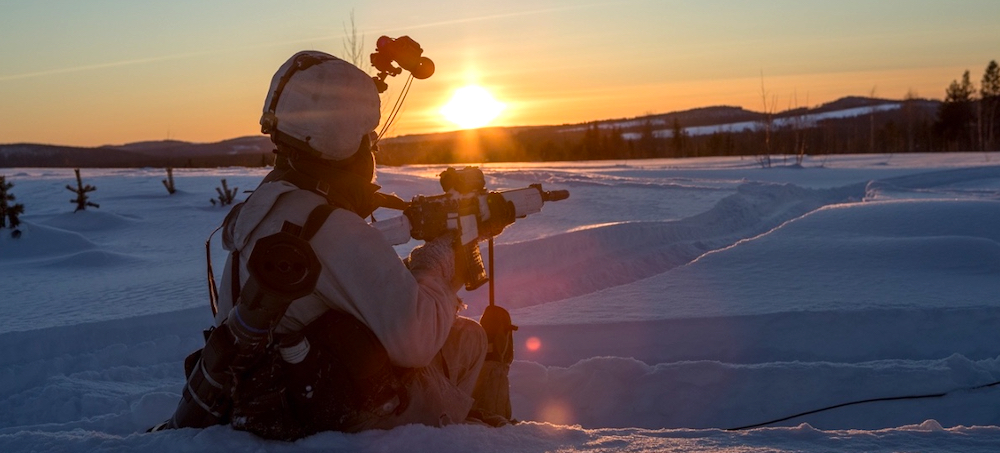
Putin's War Moves Finland and Sweden Closer to Joining NATONATO Allies and partners participating in the Swedish exercise NORTHERN WIND 19 in northeastern Sweden. (photo: Swedish Armed Forces)

Putin's War Moves Finland and Sweden Closer to Joining NATO
Ishaan Tharoor, The Washington Post
Tharoor writes: "The Russian assault on Ukraine has led to an almost unprecedented moment of solidarity in Europe."

ALSO SEE: Sweden and Finland Make Moves to Join NATO

If one accepts the rationale that Russia invaded Ukraine to thwart Kyiv’s entry into NATO and check the Western military alliance’s eastward march — and there are plenty of reasons, of course, not to accept that rationale — then on those grounds alone, President Vladimir Putin’s gambit has been a disaster. The Russian assault on Ukraine has led to an almost unprecedented moment of solidarity in Europe, waves of Western military equipment pouring into Ukraine and the mass expulsion of suspected Russian spies in European capitals. Ukraine might not be in the queue to join NATO right now, but its dogged resistance has accelerated its prospect of joining the European Union and further unmooring itself from the Russian orbit.

On Sunday, NATO Secretary General Jens Stoltenberg said that the alliance was now planning a much larger, permanent military presence on its borders with Russia. “Regardless of when, how, the war in Ukraine ends, the war has already had long-term consequences for our security,” he told Britain’s Daily Telegraph newspaper. “NATO needs to adapt to that new reality. And that’s exactly what we are doing.”

Indeed, one of the lasting legacies of the Russian invasion may be how the war spurred NATO’s strengthening and expansion. Finland and Sweden, two Nordic countries with deep histories of nonalignment, now appear on the precipice of joining the bloc. A report Monday in the Times of London suggested that both nations could clinch NATO membership in a matter of months.

“I think we will end the discussion before midsummer,” Finnish Prime Minister Sanna Marin told reporters on Friday, referring to imminent deliberations on NATO membership that would conclude by the June 25 holiday. “We will have very careful discussions, but we will also not take any more time than we have to in this process, because the situation is of course very severe.”

A statement Monday from Sweden’s Social Democrats, who lead a minority government in Stockholm, made clear that the center-left party was reevaluating its traditional opposition to NATO membership. “When Russia invaded Ukraine, Sweden’s security position changed fundamentally,” the party said.

Public opinion in both countries lurched dramatically in favor of joining NATO after the invasion began. For the first time, a majority of Swedes support entry to the bloc, while a poll this weekend found that 68 percent of Finns would back gaining membership and that an even greater number would support the endeavor if it had the public endorsement of the country’s President Sauli Niinisto and Marin’s government. (Consider that, just in 2019, more than half of Finns were opposed to joining NATO.)

The swing in sentiment has prompted parties in and out of power in both countries to announce ongoing reassessments of their policy positions on NATO. Parliamentary processes will play out over the coming months but the conclusion seems clear: No NATO member state — not even Putin-friendly Hungary — is expected to veto the Finnish and Swedish membership bids, whenever they formally materialize.

On Monday, Kremlin spokesman Dmitry Peskov warned the two Nordic countries against joining NATO, an alliance which he said “remains a tool geared towards confrontation.” Given the ongoing Russian campaign in Ukraine, Peskov’s admonishment — as well as a Russian foreign ministry threat in February of “serious military and political consequences” for Finland and Sweden — probably only strengthens the case to enter the alliance.

In one stroke, Finland joining NATO would more than double Russia’s existing land border with the member states of the Western military alliance, fencing in the Kremlin further. “How can this be anything but a massive strategic blunder for Putin?” a senior U.S. official scoffed to the Times.

Entry into NATO would be a historic move for both countries. Since the early 19th century, for reasons initially tied up in the geopolitics of the Napoleonic wars, Swedish governments maintained a studied neutrality that lasted through the end of the Cold War. After heroically resisting a Soviet invasion more than eight decades ago, tiny Finland settled for an uneasy status quo next to the Soviet juggernaut: It adopted a careful neutrality, accepted a degree of Soviet influence in its affairs, but avoided the same fate of Soviet domination experienced by countries in Eastern and Central Europe.

This arrangement became known as “Finlandization” — a nation converted into a process of geopolitical submission — and has been repeatedly mooted as a path through which Moscow and Kyiv can find some form of peaceful understanding. More than six weeks into the war, though, it’s hard to imagine Ukrainians accepting any kind of tacit subordination to Russia. Finlandization, meanwhile, has long been viewed as a pejorative term in Finland itself.

In practice, both Finland and Sweden already have close military ties with NATO partners and E.U. neighbors. According to the Economist, some experts even suggest that Finland’s military capabilities are “more ‘NATO interoperable’ — capable of conducting joint operations alongside other allies — than some actual members.”

The political journey toward NATO has taken longer. “It was only when Russia under Putin started to demonstrate that its threshold for using military force was lower than many had hoped — first with the war with Georgia in 2008 and then the invasions of Ukraine beginning in 2014 — that a debate on possible NATO membership started,” wrote former Swedish prime minister Carl Bildt in a Washington Post op-ed last month.

After Putin’s war on Ukraine, Bildt added, “there is no way back to a past of illusionary neutrality.”


READ MORE


Methane Emissions Soar to Highest Level Ever RecordedOil pumps. (photo: History)

Methane Emissions Soar to Highest Level Ever Recorded
Kate Yoder, Grist
Yoder writes: "Methane emissions rose by a record amount last year, making the biggest jump since the National Oceanic and Atmospheric Administration began monitoring them 40 years ago."

Uncontrolled gas leaks and flaring are pushing the planet toward catastrophe.

Methane emissions rose by a record amount last year, making the biggest jump since the National Oceanic and Atmospheric Administration began monitoring them 40 years ago. Carbon dioxide emissions also climbed at a historically high rate for the 10th straight year.

The new numbers come on the heels of the latest report from the Intergovernmental Panel on Climate Change, in which scientists warned that the world is on track for catastrophic warming, with fossil fuel emissions driving an “almost inevitable” breakdown of some of Earth’s life-supporting systems.

“Our data show that global emissions continue to move in the wrong direction at a rapid pace,” Rick Spinrad, NOAA’s administrator, said in a statement. “The evidence is consistent, alarming, and undeniable.”

Methane, a potent greenhouse gas, leaks out of oil wells and gas pipes, vents from rotting food in landfills, and escapes from cows in their burps and manure. It’s one of the main drivers of climate change, responsible for 30 percent of the warming since preindustrial times, second only to carbon dioxide. While methane doesn’t linger in the atmosphere as long as CO2, it’s much more powerful at heating the planet in the short term.

That makes cutting methane emissions a high priority. But as the new data from NOAA show, the world is heading in the wrong direction. Atmospheric levels of methane jumped 17 parts per billion in 2021, beating the previous record set in 2020.

This surge is happening just as methane is getting more recognition as a problem that requires urgent action. Last fall, the United States and European Union initiated an effort to cut methane emissions 30 percent by the end of the decade. Roughly 100 countries have joined the Global Methane Pledge since then, minus a few of the top emitters, like China and Russia. A new initiative called the Global Methane Hub launched this week to support these efforts, putting $340 million toward helping countries track and reduce emissions.

Measuring methane accurately has proven to be a challenge of its own. A report from the International Energy Agency in February found that governments were undercounting methane emissions from oil, gas, and coal, which satellite data showed were about 70 percent higher than previously estimated.

But on the bright side, the IEA said, many of these emissions could be trimmed relatively easily by installing leak-proof equipment and putting a stop to the common practice of burning surplus natural gas, known as flaring. Rapid cuts to global methane emissions, according to one study, could stave off half a degree Celsius (nearly 1 degree Fahrenheit) of warming by the end of the century. These reductions could have quick effects, as methane disappears from the atmosphere after about nine years.

Carbon dioxide, on the other hand, can continue to warm the atmosphere for thousands of years. 2021 marked the 10th year in a row that CO2 emissions had risen by more than 2 parts per million, “the fastest sustained rate of increase in the 63 years since monitoring began,” according to NOAA.

Today’s atmospheric concentration of carbon dioxide is as high as it was 4.3 million years ago — when the sea level was roughly 75 feet higher, the Arctic was covered in forests, and global temperatures were 7 degrees F hotter than right before the Industrial Revolution.


READ MORE

Special Coverage: Ukraine, A Historic Resistance
READ MORE


Contribute to RSN

Follow us on facebook and twitter!

Update My Monthly Donation

PO Box 2043 / Citrus Heights, CA 95611


Sunday, March 6, 2022

RSN: Could Putin Go Nuclear?


Reader Supported News
05 March 22

Live on the homepage now!
Reader Supported News

ONE GOOD DONATION CAN BE A GOOD START — One larger donation alone can amount to a good start to a fundraising drive. We don’t always get that but when we do it really helps. One.
Marc Ash • Founder, Reader Supported News

Sure, I'll make a donation!


People look at the exterior of a damaged residential block hit by an early morning missile strike on February 25, 2022, in Kyiv, Ukraine. (photo: Chris McGrath/Getty)
Could Putin Go Nuclear?
Jeff Wise, New York Magazine
Wise writes: "Alex McKeever, a part-time furniture mover in Ridgewood, Queens, woke up Wednesday and started scrolling on his phone."

Alex McKeever, a part-time furniture mover in Ridgewood, Queens, woke up Wednesday and started scrolling on his phone. Like many of us, he’s been obsessed with the invasion of Ukraine and has been spending ten hours a day trying to piece together what was happening from news coverage and social media. That morning, McKeever, who is 30, saw that someone had tweeted a video of destroyed vehicles in a suburb of Kharkiv called Bucha. It appeared to be the aftermath of a significant battle. The blackened wreckage of numerous Russian military vehicles lay scattered and smoldering along the road. Where exactly, McKeever wondered, had it taken place?

He wasn’t idly musing. For the last six years, McKeever has been active in open-source intelligence, or OSINT, which involves gathering and analyzing online information in much the same way that government intelligence professionals analyze classified data: identifying when and where events took place, who was involved, what kinds of weapons were used, and so on.

The movement began in 2011, when internet hobbyists began studying social-media posts to identify war crimes and human-rights violations in Syria. It grew steadily in the years that followed, then accelerated when Russian forces started massing near Ukraine late last year. OSINT findings proved vital in validating the Biden administration’s claims throughout February that an attack was imminent, and they informed subsequent coverage by traditional print and broadcast outlets. That exposure, in turn, drew a wave of new volunteers, many of them eager to help the Ukrainian cause. “I’ve had 50, 60 people a day getting in touch, offering their skill sets,” says Ross Burley, executive director of the Centre for Information Resilience, a U.K. nonprofit focused on countering misinformation. “We’ve had teachers, engineers, doctors. It’s staggering how everyone is coming together for this.”

McKeever, who works part-time as an OSINT researcher for a Syrian human-rights group, took a closer look at the Bucha video. Finding no distinctive landmarks that would help him pinpoint the location, he searched for “Bucha” on Twitter and found an image that showed the same scene from a different angle. Two buildings with distinctive roofs stood side by side behind a fence.

Poking around the area on Google Maps, he found only one road wide enough to match the image: a major artery that ran from the suburb into Kharkiv. Using Google’s Street View mode, he explored along the road until he found a pair of buildings under construction that might fit the bill. The image was from 2019. He switched to Google Earth and found an image of the completed buildings from 2020 that looked “pretty compelling” but whose resolution was too low to provide definitive proof. Returning to Street View, McKeever compared the details of the fence and the trees across the street. They matched. He took a screenshot and tweeted it alongside the original image with the exact coordinates: 50.543838 degrees north, 30.226820 degrees east. “The whole process took 20 or 30 minutes,” McKeever says.

Geolocation is just one of the methods that OSINT researchers are using to clarify what is happening in Ukraine. Others include identifying Russian projectiles from the fragments they leave behind, locating military convoys in satellite imagery, and tallying equipment losses. And clever researchers are forever adding to the tool kit. One enterprising college student uses automated air-traffic data to keep tabs on Russian oligarchs’ jets.

On its own, a single tweet like McKeever’s doesn’t mean much for the outcome of a war. But taken together, OSINT contributions can provide a panoramic perspective. The sheer volume of thousands of eyes poring over a vast stream of information allows the community to digest information on a scale that not even a superpower spy agency can manage. Marco Rubio, the ranking member of the Senate Intelligence Committee, underlined the value of OSINT in a recent tweet: “Much respect to the international online #OSINT community, many of whom may not realize how much of their geolocation & vetting of videos & satellite imagery is integrated into the broader work of the intelligence community.”

Lukas Andriukaitis, who used to serve in the Lithuanian special forces and is now the associate director of the Atlantic Council’s Digital Forensic Research Lab, says that information produced by OSINT often makes its way to NATO intelligence officials. “Open source is a huge part of the work they’re doing,” he says. “There’s no need to rely on a huge network of spies because guess what? It’s out there for free.”

With the war in Ukraine, OSINT researchers have been helped by the huge amount of data generated every day by the local population. “This is the first war which is almost live-broadcast,” says Andriukaitis. “We’re getting so much information from social media.” Then there’s all the data being shared by Russians inadvertently. Invading troops made little effort to conceal their encampments from satellites, leaving trunks and tanks lined up in plain sight. Short on military radios, they have reportedly had to communicate via unencrypted transmissions, some of which have been intercepted and recorded by ham-radio hobbyists and then published on Twitter.

With no real rules governing the movement, some of the activity approaches or crosses ethical lines. Pro-Ukraine hackers managed to steal a database with the names of 120,000 Russian soldiers and publish it on the web. And after the 2014 Russian shootdown of Malaysia Airlines Flight 17 over Ukraine, the Dutch journalism collective Bellingcat used stolen data to track down the culprits.

Still, the work being done by OSINT practitioners is growing in scope and influence, and not just in the realm of war. Traditional news organizations are building out their own open-source departments — the New York Times calls its division “Visual Investigations,” while the Washington Post prefers “Visual Forensics” — and using them to examine topics from police shootings to the January 6 riot at the Capitol. “Originally, open-source was quite a sort of geeky thing to do,” says Ben Strick, director of investigations at the Centre for Information Resilience. “Now, we’re almost like the people’s army.”

interested in getting involved, McKeever says, should start by learning the basics. Of the many guides available online, he recommends Strick’s YouTube channel. From there, it’s a matter of jumping in and taking a whack at an image or video. If you’re able to reach an interesting conclusion, you can post it to an online discussion or as a reply to a Twitter thread. “A lot of the people in this community are open to people who reply to them with work that’s accurate and clear,” McKeever says.

For advice and guidance on projects to work on, there are OSINT-focused discussion groups both on Reddit and at the Project Owl server on Discord. Volunteers can also pitch in at nonprofit organizations like the Digital Forensic Research Lab, Bellingcat, and the Centre for Information Resilience. The latter has set up a centralized resource called the Russia-Ukraine Monitor Map that collates hundreds of OSINT reports about military movements, bombings, civilian casualties, and destroyed equipment.

“People want to contribute towards a bigger picture and do good,” says Strick, “and there are people doing good already that have never done this before.” He cites the case of a new volunteer who so expertly analyzed photos of shrapnel that Strick assumed he had a background in the field. “I said, ‘You must be some sort of explosives expert.’ And he said, ‘No, I’ve got Google Images. I can just cross-reference the pictures.’”


READ MORE


Volodymyr Zelenskyy Has Reportedly Survived 3 Assassination Attempts in the Last WeekUkrainian president Volodymyr Zelenskyy. (photo: Getty)

Volodymyr Zelenskyy Has Reportedly Survived 3 Assassination Attempts in the Last Week
Ryan Grenoble, Huffington Post
Grenoble writes: "Since Russia's unprovoked war on its western neighbor began last week, Zelenskyy has been conducting business from a handful of bunkers throughout the nation's capital, having declined an offer from the U.S. to evacuate him."

The Kremlin has dispatched two separate groups of mercenaries to Kyiv in an attempt to kill the Ukrainian President.

Ukrainian President Volodymyr Zelenskyy has survived at least three targeted assassination attempts in the last week, according to The Times of London.

Since Russia’s unprovoked war on its western neighbor began last week, Zelenskyy has been conducting business from a handful of bunkers throughout the nation’s capital, having declined an offer from the U.S. to evacuate him.

That’s left him vulnerable to attempts on his life by teams of Kremlin-backed assassins.

Ukrainian National Security and Defense Council Secretary Oleksiy Danilov told a Ukrainian television network that anti-war elements in Russia’s Federal Security Service (FSB) have been essential in helping foil some of the plots.

In a defiant speech last week, Zelenskyy acknowledged that he is “target No. 1” in an effort to “damage Ukraine politically by destroying the head of state.”

“But we are not afraid, we are not afraid of anything,” he said. “We are not afraid to defend our country. We are not afraid of Russia.”

U.S. officials warned last month that Russian forces have compiled a hit list of Ukrainian citizens to be killed or sent to detention camps.

The Kremlin has reportedly dispatched two separate groups of mercenaries to Kyiv in an attempt to fulfill that directive. One is being orchestrated by the Wagner Group, a private military contractor run by Vladimir Putin ally Yevgeny Prigozhin, aka “Putin’s Chef.” The other is a group of elite Chechen fighters controlled by Chechen Republic leader Ramzan Akhmadovich Kadyrov.

Danilov said on Tuesday that an assassination attempt by the Chechens over the weekend failed, and the group responsible for the attempt had been “destroyed.”

Among those killed by Ukrainian forces was Chechen-Russian Gen. Magomed Tushayev, who has been accused of torturing and killing LGBTQ+ people in Chechnya.

“As we’ve seen in the past, we expect Russia will try to force cooperation through intimidation and repression,” a U.S. official speaking on condition of anonymity told Foreign Policy.

“These acts, which in past Russian operations have included targeted killings, kidnappings/forced disappearances, detentions, and the use of torture, would likely target those who oppose Russian actions, including Russian and Belarusian dissidents in exile in Ukraine, journalists and anti-corruption activists, and vulnerable populations such as religious and ethnic minorities and LGBTQI+ persons.”


READ MORE


The Devastating Effects of Losing the Child Tax Credit"I think policymakers right now know that they have a lever at their hands that, if pulled, would move millions of children out of poverty," Sophie Collyer says. (photo: Alamy)

Isaac Chotiner | The Devastating Effects of Losing the Child Tax Credit
Isaac Chotiner, The New Yorker
Chotiner writes: "In February, the Center on Poverty and Social Policy, at Columbia University, released a staggering new report on child poverty in the United States. The study found that the child-poverty rate had increased dramatically in the space of just a month, with seventeen per cent of children living in poverty in January, 2022."

The research director of Columbia University’s Center on Poverty and Social Policy discusses a staggering new report on child poverty in the United States.

In February, the Center on Poverty and Social Policy, at Columbia University, released a staggering new report on child poverty in the United States. The study found that the child-poverty rate had increased dramatically in the space of just a month, with seventeen per cent of children living in poverty in January, 2022, compared with around twelve per cent at the end of 2021. The reason for the sharp rise was the expiration of the expanded child tax credit, which President Biden signed into law last spring, and which Congress has not agreed to renew. In the absence of the monthly cash payments guaranteed by the expanded credit, about 3.7 million more American children are living in poverty.

The child tax credit has existed in several different forms since it first became law, in 1997, and Biden’s expansion of it was the biggest in its history: the payments became bigger, and were distributed through monthly checks instead of a single annual lump sum. Perhaps most crucially, Biden made the benefit available to families with little to no income, who were previously ineligible for the credit. I discussed the Columbia report with one of its three authors, Sophie Collyer, the research director at the center. During our conversation, which has been edited for length and clarity, we discussed what made the child tax credit so effective, the impact of its disappearance on Black and Latino children, and what the pandemic has taught us about how to improve the social safety net.

What did your study find at the most basic level?

We found that 3.7 million more children are in poverty as a result of rolling back the child tax credit between December and January. We’ve been measuring poverty over all and among children since the beginning of the pandemic, but using a monthly framework. Traditionally, poverty’s measured in an annual framework, where you take people’s incomes across the year and evaluate it against a poverty threshold that’s calculated for that year. What we’ve seen though, with the pandemic, is much volatility in terms of income that families are receiving from month to month, because different government policies have been in effect for part of the year and not in effect for other parts of the year. Some examples would be things like stimulus checks and unemployment benefits.

So it’s been a really useful tool for evaluating the impact of the expanded child tax credit in real time. Over the summer, with the initial payments, we saw an immediate reduction in the rate of child poverty, particularly because it was being paid out monthly for the first time and reaching about one in three children who were previously ineligible for the credit. So over the summer you’re seeing both the initial payments being paid monthly for the first time but also a much greater share of the child population being eligible for the credit. But it was only in effect in terms of monthly payments through the end of 2021. And the expansion of the child tax credit was only in effect for the calendar year 2021. With the change in the year from December to January, January was the first month where families would not receive these monthly payments of either three hundred dollars or two hundred and fifty dollars per child, depending on age. So the exact reverse of what we saw over the summer happened, and we saw a spike in child poverty as a direct result.

Intuitively, it seems very likely that the end of the credit is responsible for the spike we saw from December to January. But are there ways to control for the increase so that we know it was due to the child-tax-credit expiration?

That’s a great question. Within December, for example, you could see the number of children moved out of poverty by the credit in that month. In December, we saw about 3.7 million children being moved out of poverty as a direct result of the credit. Then when we move to January, we’re seeing 3.7 million more children in poverty. I think the difference between those two months lends more evidence to the fact that this is a direct result of the absence of the credit.

When you’re studying this, obviously you’re not talking to 3.7 million people, but you’re studying individuals. Are you having people tell you directly that the credit is why they have less money, or something else?

This framework is developed using data from something called the Current Population Survey, which is run by the Census Bureau. The Census Bureau every year releases an annual poverty rate based on data collected in the March version of this C.P.S. survey. But there’s actually a survey done every month. And there’s a methodology that allows us to use the most recent data from the C.P.S. to estimate or project what the monthly poverty rate is within a month, and also account for these variations in income from different policies.

What did you find about poverty rates for Black and Latino children specifically in this December-to-January change?

A big piece of the expanded child tax credit last year was that the earnings requirement associated with the credit was removed for 2021, and it was made fully refundable. The amount that you received was independent of your earnings. This was the first time this has ever happened. Before the expansion, many Black and Latino children were left behind when it came to receiving the full benefits of this credit—one out of two Black children and one out of two Latino children were ineligible for the full credit because of family income levels.

Then, with the expansion, you saw that gap being filled in. Now, with the absence of the credit, we saw a 5.5-percentage-point increase in the poverty rate of Black children and 7.1 percentage points for Latino children, translating to about nearly seven hundred thousand Black children falling into poverty and 1.3 million Latino children falling into poverty as a direct result of the credit being removed. It gets tricky when you are talking between these relative increases and percentage-point increases, but over all Black and Latino children saw the largest percentage-point increase in their poverty rates.

You said that you’ve been studying child poverty since the beginning of the pandemic. I just wanted to take a step back. What did child poverty look like for the first year-plus of the pandemic, before this expanded child tax credit went into effect?

Child poverty in 2020 was actually lower than you might have expected. And that actually had to do with the stimulus payments and the unemployment-insurance benefits that many families received. Counter to what many people probably think, 2020 actually had one of the lowest poverty rates on record as a direct result of the policies in place in that year. That said, child poverty has been higher in the United States than nearly any other wealthy nation for decades, or at least for the past decade. We had a child-poverty rate of about thirteen per cent before the pandemic, which again was extremely high, and it was much higher in various areas, and by ethnicity there were also dramatic variations. Before the pandemic, people were pushing for this expansion to the child tax credit, knowing that it would address the problem that we had, and had for a long time, which is strikingly high rates of child poverty.

So it was introduced and included as part of the American Rescue Plan, in part because of the knowledge that it would help address child poverty at the same time as levelling income in response to the pandemic. But it wasn’t necessarily thought of as a specifically pandemic-related policy. In 2019, the National Academy of Sciences released a report on policy packages that would reduce rates of child poverty, and the expansion of the child tax credit was found to have the greatest potential impact on the child-poverty rate.

So it seems like what you’re saying is that before the pandemic, we had these terrible child-poverty rates compared with other rich countries, and then things actually got better than people expected during the pandemic. But it appears, from the latest report, that child poverty has now risen above what it was prior to the pandemic. Is that accurate?

Before the pandemic, it was about fourteen per cent. Now it’s higher than it was before the pandemic. All of the government support, in terms of what families were receiving to stabilize their incomes, is basically gone at this point, with maybe the exception of some continued expansions to food stamps. That’s the only piece of pandemic-related income support that is still being made. But also the seventeen per cent is based on a monthly framework, and it’s not necessarily apples to apples because it jumps around from month to month, and you tend to see dips around March and April.

Why is it that the child tax credit is so effective, do you think?

Well, it’s giving families money directly. When you’re thinking about poverty, you’re evaluating a family’s income relative to a line, and this is a direct way of increasing family income. That’s why it’s so effective. It’s also been extremely effective because it fills in so many of those gaps that existed beforehand. Children in poverty and low-income children benefitted disproportionately from this expansion because they were ineligible for the full value of the credit beforehand, so they were seeing greater gains than middle-income families as a direct result of the expansion. But basically all children were receiving this credit. More than ninety per cent of children in the country were eligible for either the full thirty-six-hundred-dollar credit or the three-thousand-dollar credit in 2021.

Does the incredibly steep rise from December to January change any of your prior assumptions about the social safety net?

I think it wasn’t that surprising, and that’s an unfortunate thing. We knew that providing this money to families had a direct impact, and so the inverse of that is the same, where it has a direct impact below the poverty line or further below the poverty line. I wouldn’t say it was something unexpected, but what I think about is the volatility that families are facing. We’re both seeing an increase in the poverty rate, and that it’s connected to families having had a stable flow of income for six months in 2021, and then that just disappearing. We’re seeing the impact of it in terms of the poverty rate, but it’s also creating more instability for families and children across the country.

There has been a lot of well-done qualitative work on what families have been using the money for. What is a theme across all data sets and many different sources of information is that many families have been using this to purchase food. Just as we’re seeing this increase in poverty, one might expect—we don’t know yet—an increase in the rate of food insufficiency and hunger among households with kids and among children, which is deeply troubling.

But another very interesting aspect of the program is that it’s cash-based. So many social policies and social programs in the United States consist of in-kind transfers—housing subsidies, food stamps—and they’re infrequently cash. But with this you saw families receiving a cash payment, and cash is fungible. In one month, you might need it to fill in a food budget, but for the next month, it might be used to fix a car. Another month, it might help with child care. That flexibility is also something that comes out of the data, with families using it to meet needs that vary from month to month. I think that’s a really important takeaway in terms of the importance of cash in families’ lives and the importance of the monthly aspect of this. As I said, it used to be this tax refund that would come at tax time in a lump-sum payment for those who were eligible for the full credit. Bills often come once a month. They don’t just pile up and come at tax time, when you might be able to use a refund to pay them back. The monthly aspect of this also contributes to that stabilizing effect.

I don’t want to put a rosy spin on any of this, but it seems like, from what you’re saying, the one positive that might come out of this, even if it is not renewed, is that there are some new ideas about smart ways to do social policy.

Yeah. I think policymakers right now know that they have a lever at their hands that, if pulled, would move millions of children out of poverty. I think that’s just an important thing for everyone to know: that there’s a choice at hand that people can make, and it will have dramatic impacts on the poverty rate. I think that the pandemic also over all has revealed how effective policy can be at stabilizing family income. We did not see a sharp rise in the poverty rate in 2020, and I don’t think anybody in March of 2020 thought that would be the case. Every family experienced a lot of financial strain, but it also revealed that policies can be effective at least at keeping people out of poverty.


READ MORE


Trump's Border Wall Breached by Smugglers Over 3,000 Times, Records RevealA Border Patrol agent walks by the border wall near Sunland Park, N.M. (photo: Salwan Georges/The Washington Post)


Trump's Border Wall Breached by Smugglers Over 3,000 Times, Records Reveal
Jessica Glenza, Guardian UK
Glenza writes: "Smugglers have breached the Trump administration's border wall along the US-Mexico frontier more than 3,000 times, government maintenance records obtained by the Washington Post reveal."

The barrier Trump touted as ‘impenetrable’ can be breached with common power tools, the Washington Post reports

Smugglers have breached the Trump administration’s border wall along the US-Mexico frontier more than 3,000 times, government maintenance records obtained by the Washington Post reveal.

Nearly 500 miles of barrier was constructed by the Trump administration beginning in 2019, mostly in rural New Mexico and Arizona. Former president Trump touted the “big, beautiful wall” as the “Rolls-Royce” of barriers, but smugglers have breached the wall at least 3,272 times, mostly with common power tools found at hardware stores.

“No structure is impenetrable, so we will continue to work to focus resources on modern, effective border management measures to improve safety and security,” Luis Miranda, a spokesperson for Customs and Border Protection (CBP) told the Post.

He added that border security “requires a variety of resources and efforts, infrastructure, technology, and personnel”, much of which was not funded when Trump’s wall was constructed.

Before its construction, former president Donald Trump promised Mexico would pay for construction of the border wall and that it would be “virtually impenetrable”.

Ultimately, 458 miles of new border fencing was paid for by taxpayers at a cost of $11bn and there was evidence as early as 2019 that smugglers were sawing through the boundary with $100 power tools.

Part of the border wall is constructed using posts cemented in concrete at the base which support a long lintel at the top. Smugglers are easily able to saw through the posts and swing them open, then continue using the same breach until the damage is detected by the border patrol. Other sections have been damaged by monsoons.

Smuggling organizations have sawn large enough holes to pass an SUV through. In one instance, an SUV loaded with 23 migrants passed through a section of border wall near San Diego and soon after collided with a semi-truck, killing 13 people.

By 2021, the government had spent another $2.6m in taxpayer funds to repair the “wall”, and cited the lack of infrastructure infrastructure and personnel as an impediment to keeping it intact.


READ MORE


Despite Amazon's Propaganda, Local Alabamans Overwhelmingly Support the Bessemer Union DriveLocals pose for a photo at a rally in support of a union for Amazon workers in Bessemer, Alabama, February 26. (photo: Elijah Nouvelage/Getty)

Despite Amazon's Propaganda, Local Alabamans Overwhelmingly Support the Bessemer Union Drive
Luke Savage, Jacobin
Savage writes: "New polling finds that a near supermajority of black residents in Jefferson Country, Alabama, back the worker-led effort to unionize the massive facility in Bessemer."

New polling finds that a near supermajority of black residents in Jefferson Country, Alabama, back the worker-led effort to unionize the massive facility in Bessemer.

In the wake of 2020’s protests following the brutal police murder of George Floyd, Amazon was quick to join the chorus of corporate behemoths proclaiming their solidarity with black Americans. As labor activists and others didn’t fail to point out, the gesture carried an obvious and pungent whiff of hypocrisy. The company, for one thing, has a documented history of selling its facial recognition technology to police departments — something it’s openly alluded to in its marketing materials. Both before and since its various 2020 statements, it has also worked hard to suppress unionization efforts within its workforce: a workforce that is more than 26 percent black.

Perhaps nothing has made the chasm between Amazon’s professed racial-justice commitment and its actual behavior more obvious than recent developments in Bessemer, Alabama — where workers will vote once again this month on whether to form a union. Located in the state’s Jefferson County, Bessemer is home to about twenty-seven thousand people, nearly three-quarters of whom are black and more than a quarter of whom live below the poverty line.

During its campaign to dissuade the same workers from unionizing last year, the company mandated anti-union meetings for warehouse employees, pressured the United States Postal Service to install a special box so workers would feel surveilled, and even changed the timing of local traffic lights to disadvantage labor organizers (these tactics proved so Orwellian that the vote was ultimately thrown out by a judge and a second election was scheduled). In an especially cynical move, Amazon has even used the Black Lives Matter logo on its anti-union literature in the past.

Regardless of what the company does this time to try and suppress worker organizing, a new survey commissioned by the Institute for Policy Studies finds overwhelming support among the people of Jefferson County for unionization. Of those polled, a full 62 percent favor the union drive — including 49 percent of white residents and a 78 percent supermajority of black residents. As Matthew Cunningham-Cook and Marc D. Bayard point out in a recent essay for the American Prospect, the heavily black worker–led effort to join the Retail, Wholesale and Department Store Union (RWDSU) represents a critical step in the broader struggle for racial justice in the South and beyond:

The campaign by the Black workers in Bessemer will have ripple effects across the South and the country — yet it presents a quandary for a labor movement that still lacks a cohesive and comprehensive strategy to organize Black workers, particularly in the South. The Amazon battle takes place in a context of more than 150 years of post–Civil War aggressive labor control that combines white supremacy with anti-Black violence, limiting the growth and the potential of unions across the region. As union density decreases further, there is a major untapped well of Southern workers. If organized, they would simultaneously bring the movement new members and prevent further dilution of labor standards in the North.

If Bessemer’s heavily black Amazon workforce ultimately forms a union, it will thus represent a significant victory for both racial equality and working-class power — and a monumental rebuttal to those who cynically pretend you can have one without the other.


READ MORE


'Imminent Danger' Continues as Russian Forces Near Second Active Nuclear Site, US Ambassador SaysA damaged administrative building at the Zaporizhzhia nuclear power plant on March 4. (photo: Reuters)

'Imminent Danger' Continues as Russian Forces Near Second Active Nuclear Site, US Ambassador Says
Michael Birnbaumm, The Washington Post
Birnbaumm writes: "For a small tribe of veteran atomic experts who helped secure the Soviet Union's nuclear energy and missiles as it started to fall apart in the late 1980s, the grainy images of the fighting around the Zaporizhzhia nuclear power plant in Ukraine, Europe's largest, were like something out of a frightening alternative reality."

‘Imminent Danger’ Continues As Russian Forces Near Second Active Nuclear Site, US Ambassador Says

For a small tribe of veteran atomic experts who helped secure the Soviet Union’s nuclear energy and missiles as it started to fall apart in the late 1980s, the grainy images of the fighting around the Zaporizhzhia nuclear power plant in Ukraine, Europe’s largest, were like something out of a frightening alternative reality.

That smoke. Those tracers. That fire. They, more than most others, knew the precise mechanics of how an accident could quickly turn into disaster. Although the damage appears to have been contained — and Europe spared a nuclear disaster on the level of Fukushima — nuclear experts said they were still fearful as Russia’s military battles its way across Ukraine. The country has four active nuclear power plants and one failed one, Chernobyl, whose radiation still requires constant upkeep.

“This morning I thought about the Cuban missile crisis,” said Frank von Hippel, a theoretical physicist at Princeton University, who tracked loose nuclear weapons on behalf of the Clinton White House and helped lead efforts to calm the nuclear arms race with the Soviet Union.

“This is the first time we’ve had a war among nuclear reactors,” von Hippel said. “That was not a scenario we considered.”

Nuclear fears already shot up last week in the opening phases of the invasion, as Russian troops took control of the Chernobyl nuclear site as they swept south toward Kyiv from Belarus. And as they battled along a key stretch of the Dnieper River on Thursday near the industrial city of Zaporizhzhia, they swung into position around the vast nuclear power plant and eventually captured it. Ukrainian officials warned that the South Ukraine Nuclear Power Plant in Mykolaiv province could be next, with fighting underway about 19 miles from the site.

The risks to the plants amid the fighting are multiple and compounding, since a swift fix to any mounting problem depends on the quick and energetic work of the highly trained personnel who work inside each facility, experts said. Nuclear engineers who are forced to work multiple shifts at gunpoint — or who may be worrying about family and friends who are dead or at risk — are going to be less effective than if they were to face the same technical challenges under peacetime conditions.

“This morning there were a lot of people who were really freaked out,” said Mycle Schneider, a Paris-based consultant and a member of the International Panel on Fissile Materials, who said he traded emails early Friday with other experts around the world who were deeply concerned by what they had seen of the incident at the Zaporizhzhia plant.

“When you see fire on a nuclear power site that’s always bad,” Schneider said. “To see the images of fighting on a power plant site is horrible. For everyone that knows what that means or could mean, it’s very bad news.”

The head of the International Atomic Energy Agency, Rafael Grossi, warned in a statement Friday, “It is high time to stop an armed conflict from putting nuclear facilities at severe risk, potentially endangering the safety of people and the environment in Ukraine and beyond.” He declared his willingness to travel personally to Chernobyl to arrange for the plant’s safety.

The battle for control of the power facilities had Ukrainian leaders speculating that Russian forces might be using them as a form of nuclear blackmail, to intimidate Ukrainians and the world at the same time Russian President Vladimir Putin ordered his country’s nuclear forces to be put on alert. Ukrainian President Volodymyr Zelensky called it “nuclear terrorism” and asked the United Nations Security Council to declare a no-fly zone over his country in response — a step that NATO rejected on the grounds that it would risk drawing Western forces directly into combat with Russian warplanes. But experts interviewed by The Washington Post suggested that the plants may have limited appeal as strategic targets.

To start, taking a nuclear power plant offline wouldn’t shut off the lights in Ukraine. The country’s grid operators could probably increase power production elsewhere, especially because overall power consumption is lower than normal because of the wartime conditions.

Turning off the power plants would be difficult, and probably not appetizing for the Russian forces that captured them, said Alex Riabchyn, a former Ukrainian deputy energy minister. “If you disconnect, okay, you shut everything down. There are a huge amount of processes there. It will be a technological catastrophe for everybody,” he said.

At Zaporizhzhia, at least part of motivation for taking the plant could have been control of territory as Russian forces push northward, Riabchyn said: “It’s controlling the riverbank, it’s controlling the territory. It’s very strategic.”

That also may have been why Russia took Chernobyl, since it is located at a key site that Russian forces needed to pass through as they rushed toward Kyiv from Belarus.

Other experts on Russia’s nuclear forces said they suspected that the power plants were incidental in the broader assault on the country.

“I would guess that Russia would rather those stations wouldn’t be there, but it cannot avoid them,” Pavel Podvig, the Geneva-based director of the Russian Nuclear Forces Project, wrote in an email. “On the other hand, Russia probably had a choice of not going there at all — there is no particular military value in taking control over these facilities. And that choice was not made. I would say it’s rather irresponsible.”

Russia’s ambassador to the United Nations, Vasily Nebenzya, told the Security Council on Friday that the discussion about the Zaporizhzhia plant was “a false information attack, as if Russia had fired against the power plant.” The “plant and the surrounding areas have been placed under the protection of the Russian military,” he added.

“I don’t think we have ever seen anything of this sort that could be called comparable,” he said. “The largest risk is an accident, is a misguided missile, is somebody who points the tank cannon in the wrong direction. It is somebody shooting a helicopter or a plane from the sky and it falls on some vulnerable, crucial parts of the facility.

“A nuclear reactor is designed for peacetime and is very much regulated in detail,” he said. “We have a situation where there’s no rules anymore, none.” He said the complexity of the plants meant there were many things that could go wrong. Several experts noted the potential unreliability of the backup diesel-fired generators that help cool the reactors and spent fuel when electricity from the grid is cut. A similar failure helped contribute to the Fukushima nuclear meltdown in 2011.

But Schneider said any fighting near the power plants was a tremendous risk.

“Every single issue you look at is cumulative with other issues,” Schneider said. One nuclear expert said there needs to be a negotiated agreement under which workers can have shift changes and undertake maintenance unimpeded if there is an extended conflict.

“These plants are now in a situation that few people ever seriously contemplated when they were originally built, and that is the potential they’d be in the middle of a war zone,” said Edwin Lyman, director of the nuclear safety project at the Union of Concerned Scientists. “No nuclear plant has been designed to protect against a full-scale military attack.” Asked if Russia could sabotage or weaponize the nuclear facilities as part of its offensive, Lyman said he certainly hopes that scenario never comes to pass.

“I don’t think there’s much strategic value in this context for Russia to contaminate the very land it is trying to control,” he said.

Brady Dennis contributed to this report.


READ MORE


Solar Projects Transform Abandoned Coal Mines in VirginiaA mountaintop removal mining site operated by A&G Coal Corporation in the Appalachian Mountains in Wise County, Virginia, in 2012. (photo: Mario Tama/Getty)

Solar Projects Transform Abandoned Coal Mines in Virginia
Climate Nexus
Excerpt: "Six abandoned coal mines in southwest Virginia are being transformed into solar energy installations as part of an effort by the Nature Conservancy, The Washington Post reports."

Six abandoned coal mines in southwest Virginia are being transformed into solar energy installations as part of an effort by the Nature Conservancy, The Washington Post reports.

TNC hopes the project can be a model for similar sites nationwide. The conservation group views the Appalachian Mountains as one of the most critical regions on the planet for conservation and has purchased more than a quarter million acres of forest in the region.

Partnering with Dominion Energy and Sun Tribe, TNC hopes to capitalize on the large areas flattened by mining operations near existing transmission lines and bring clean energy jobs to the overwhelmingly rural and Republican area that has lost more than 27,000 people since 2010.

“We’re very proud to be an energy-producing community,” Lou Wallace, whose family has relied on coal for generations and who now chairs the Russell County Board of Supervisors, told the Post. “This is helping us to reimagine how we produce energy. So we’re still able to say we’re keeping the lights on somewhere.”

As reported by The Washington Post:

In 2019, the Nature Conservancy acquired 253,000 acres of forest in the central Appalachian Mountains that it calls the Cumberland Forest Project. It’s one small part of the group’s efforts in the mountain range, which reaches from Alabama to Canada.

“We’ve identified the Appalachians as one of the most important places on Earth for us to do conservation,” says Brad Kreps, the Nature Conservancy’s Clinch Valley program director, who is leading the solar projects. “We put the Appalachians in a very rare company along with the Amazon, the wild lands of Kenya and the forests of Borneo.”


READ MORE

Special Coverage: Ukraine, A Historic Resistance
https://www.rsn.org/001/ukraine-a-historic-resistance.html


Contribute to RSN

Follow us on facebook and twitter!

Update My Monthly Donation

PO Box 2043 / Citrus Heights, CA 95611



WATCH: Sen. Booker questions Jack Smith on Trump investigations

                                  LOTS OF POSTS IGNORED BY BLOGGER..... OR REMOVED ON THEIR WHIM! ALL POSTS ARE AVAILABLE ON MIDDLEBORO REVI...