
12 April 22
Live on the homepage now!
Reader Supported News

"Our special military operation is meant to put an end to the unabashed expansion [of NATO] and the unabashed drive towards full domination by the US and its Western subjects on the world stage," Lavrov told the state-owned television news channel Rossiya 24, according to a translation from the Russian state-run media outlet RT.
Additionally, Lavrov accused the US of international-law violations over what he said were America's attempts to impose its own "rules-based international order," according to the report.
"This domination is built on gross violations of international law and under some rules, which they are now hyping so much and which they make up on a case-by-case basis," Lavrov said during the interview, RT reported.
Russian President Vladimir Putin launched his country's invasion of Ukraine on February 24, with Russian troops surrounding and shelling towns and cities across the country.
The United Nations' Office of the High Commissioner for Human Rights said Monday that at least 1,842 civilians had been killed in attacks across Ukraine, though it said "the actual figures are considerably higher." More than 4.5 million Ukrainians have fled the country during Russia's invasion, the UN said.
When Putin announced his invasion of Ukraine, he said he was seeking the "denazification" of Ukraine, a country whose democratically elected leader, President Volodymyr Zelenskyy, is Jewish.
Putin has also attempted to defend the war with baseless allegations of genocide against ethnic Russians in eastern Ukraine.
Ukraine's pursuit of NATO membership has also been cited by Putin as a justification for his decision to invade Ukraine.
Zelenskyy said last month he had "cooled down" on Ukraine's bid to join NATO.
Earlier in March, Lavrov offered another reason for Russia invading Ukraine, saying the Kremlin was trying to prevent a separate war in Ukraine.
"The goal of Russia's special military operation is to stop any war that could take place on Ukrainian territory or that could start from there," Lavrov said, according to a tweet posted by the Russian Embassy in London.
Since Russia invaded, Ukrainian forces have put up fierce resistance, which has resulted in heavy losses for Russian troops despite Ukrainian troops being largely outnumbered and outgunned by the Russians.
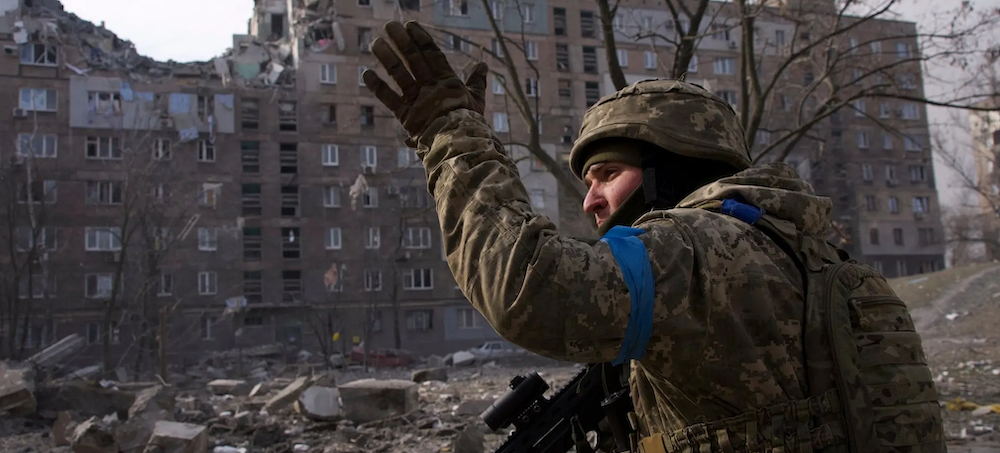 A Ukrainian soldier guards his position in Mariupol, Ukraine. (photo: Mstyslav Chernov/AP)
The 36th brigade say they face ‘death for some of us, and captivity for the rest’ as Russian offensive continues
Writing on Facebook, the 36th brigade said its 47-day defence of Mariupol was coming to a tragic conclusion.
“We were bombed from airplanes and shot at by artillery and tanks. We have been doing everything possible and impossible. But any resource has the potential to run out,” it said.
Russian troops have been besieging the city on the Sea of Azov since the beginning of March. The territory controlled by Ukrainian forces has gradually shrunk to a few central areas. The surviving marines are now holed up in the Azovstal iron and steelworks next to the port.
“The enemy gradually pushed us back. They surrounded us with fire, and are now trying to destroy us,” the marines posted. The “mountain of wounded” amounted to nearly half of the brigade, they added, with those “whose limbs are not torn off” continuing to fight.
Their infantry soldiers had all been killed. The “shootings battles” against the Russians were now being conducted by artillerymen and anti-aircraft gunners, as well as radio operators, drivers and cooks. Even musicians from the orchestra were fighting, they said.
The desperate last bulletin came as Ukraine’s president Volodymyr Zelenskiy said Russia had “destroyed” Mariupol. “There are tens of thousands of dead. Even despite this the Russians are not stopping their offensive,” he told South Korea’s parliament.
Zelenskiy said it was too soon for Ukraine to declare it had won the battle for Kyiv, given the scale of the suffering of civilians living in Russian-occupied areas in the capital’s garden suburbs.
“Bucha, Irpin, Hostomel – if the people of those [towns] were wiped out, then did we win this battle? I’m not sure. We’ve withstood, and we did not give up what is ours. But whether we won, I can’t say,” he told CBS News.
The exact number of residents killed in Mariupol is unlikely to be known. Its Ukrainian-controlled council said the Russians had been collecting bodies – many of them lying in shattered streets – and incinerating them in a mobile crematorium.
After failing to seize Kyiv, Russia has refocused its military efforts on the eastern Donbas region. When Mariupol falls, Russian tactical battalions are expected to advance north and to try to link up with other military columns moving south from the city of Iyzum and the Kharkiv region.
Western officials said they expected Russia to try to “double or perhaps even treble” its forces in Donbas as it shifts forces from Kyiv and elsewhere in the coming weeks.
The first of those forces had begun to redeploy via Belarus, but the whole exercise would take “some considerable time” and it was unclear how many units could be effectively brought back into battle.
Ukraine’s defence ministry said a full-scale Kremlin attack is likely. “They have almost finished their preparations. We expect an offensive in the near future,” spokesman Oleksandr Motuzyanyk told the Guardian. Asked if the Russians could encircle Ukraine’s defending eastern army, he replied: “We are not going to let this happen.”
Ukraine’s high command faces an urgent tactical dilemma. Several Russian battalions retreated late last month from the Kyiv region to Belarus. Some are now making the long journey via Belgorod on the Russian side of the border, to redeploy into the south-east of Ukraine.
Other units have stayed put. If Kyiv moves the bulk of its forces to the Donetsk and Luhansk territories, this would leave the capital exposed to a second surprise Russian attack from Belarus.
In their message, the marines in Mariupol also say they feel “written off” by their commander in chief. They say repeated promises to relieve the crushing Russian blockade of the city, or to evacuate some of their wounded by helicopter, came to nothing. “There were chances. Due to silliness they were not implemented,” the brigade wrote.
Like Mariupol’s trapped civilian population, the soldiers have been living in hellish conditions. “For more than a month, we fought without resupplying our ammunition, without food, without water,” the marines posted, adding that they were forced to drink water from puddles.
The message ends: “It’s death for some of us, and captivity for the rest. Do not talk badly about the Marines. For we are FAITHFUL FOREVER!”
Russia has claimed it targeted Ukrainian air defence systems in airstrikes overnight on Sunday which completely destroyed the airport in the eastern city of Dnipro. Another attack wounded five people in the town of Zvonetsky, according to Ukrainian officials.
Emergency workers were also combing through an infrastructure facility in Zvonetsky that was attacked on Monday. Valentyn Reznichenko, governor of the Dnipropetrovsk region, said casualty figures would be given at a later point.
Reznichenko earlier said that the Dnipro attack had wounded one person, while rockets had sparked a fire that was eventually put out. A missile had also hit a building in the Pavlohrad district, he added.
Separately, the head of the Dnipro region council, Mykola Lukashuk, said five staff members of the state emergency service had been wounded by the strike on the airport.
Russia said that it had targeted an S-300 air defence missile system transported to Ukraine by Slovakia last week, a claim denied by Slovakia. Kyiv has repeatedly begged its western allies for long-range air defence systems to help it against the Russian invasion.
Dnipro, an industrial city home to 1 million people, has become a vital reception point for Ukrainians from farther east who have been told to evacuate in the face of both Russian advances on the ground and intensifying airstrikes and artillery attacks.
There seems little prospect Moscow will stop its Ukraine invasion anytime soon. Russia’s foreign minister, Sergei Lavrov, said negotiation talks with Ukraine would continue, but stressed in an interview with Itar-Tass there will be no pause in hostilities until a final agreement is reached and signed.
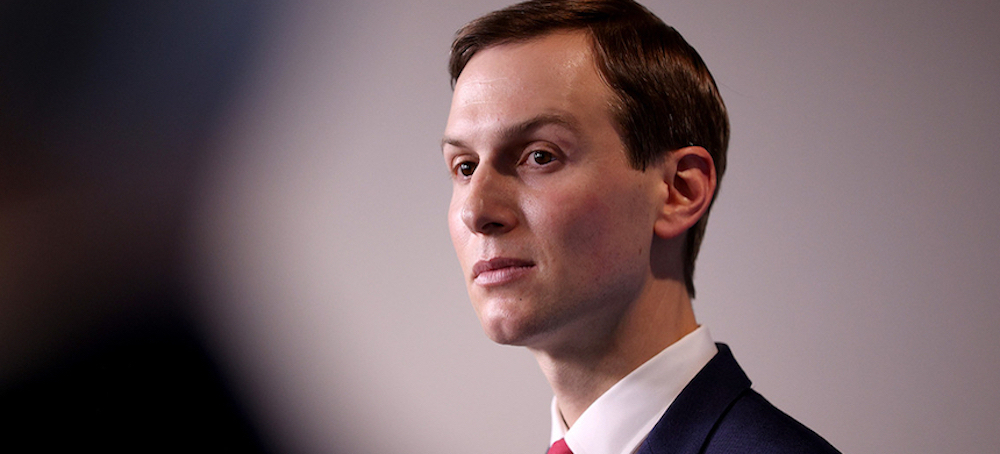 Jared Kushner. (photo: Win McNamee/Getty Images)
Advisers for the Saudi Arabian foreign wealth fund didn’t want to infuse Kushner’s private equity firm with cash. Crown Prince Mohammed bin Salman did it anyway
The $620 billion fund’s advisory panel was reportedly concerned that Kushner’s newly created firm, Affinity Partners, didn’t have much experience; that the firms operations were “unsatisfactory in all aspects”; and that Kushner posed a “public relations risk” because of his work in the Trump administration. The fund’s advisers discussed these issues during a meeting last June 30, days after which bin Salman overruled them and green-lit the payment.
The panel may have thought Kushner’s association with Trump was cause for concern, but bin Salman clearly sees it as an advantage — especially considering Kushner could be back in the White House if Trump runs and wins in 2024. The two political scions have become friendly, with bin Salman undeterred by the Trump family’s financial volatility — and potential criminality — and Kushner undeterred by the Saudi government’s gruesome murder of Washington Post columnist Jamal Khashoggi in 2018. The two chatted regularly before and after the murder, the Times reported in 2018, calling each other “Jared” and “Mohammed” in text messages.
“Affinity, like many other top investment firms, is proud to have PIF and other leading organizations that have careful screening criteria, as investors,” a spokesperson for Kushner’s firm told the Times of its relationship with the Saudi sovereign wealth fund.
The news of bin Salman overruling objections of the Saudi sovereign wealth fund’s advisers to send $2 billion to Kushner’s firm comes as Trump and other right-wing shit-stirrers have decided to once again the kick the tires on the idea that Hunter Biden received $3.5 million from the widow of the former mayor of Moscow. Trump tried to press Biden on the payment in the debates ahead of the 2020 election, and brought it up again last month when he asked Vladimir Putin to provide information on the transaction — despite the fact that Putin is murdering civilians by the thousand as he directs Russia’s invasion of Ukraine, a U.S. ally.
The only problem is that there’s no evidence this actually happened. Senate Republicans released a report before the 2020 election that alleged Yelena Baturina sent the sum to a Biden-connected firm called Rosemont Seneca Thornton in 2014. Trump tried to make hay out of the report’s findings, but The Washington Post recently dug into what the report said beyond its headline-worthy summary, and found that it does not actually claim that Biden received the money. The Post found no evidence Biden had anything to do with the transaction.
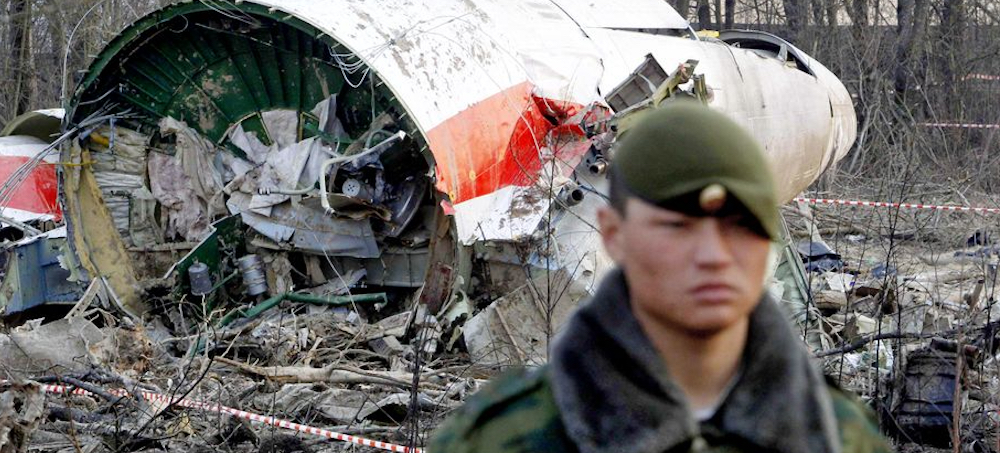 On April 10, 2010, the Tupolev Tu-154 aircraft carrying Polish president Lech Kaczynski and 95 others crashed in Smolensk, Russia. (photo: Sergei Karpukhin/Reuters)
The latest of the commission’s reports, released Monday, alleges that an intentional detonation of planted explosives caused the April 10, 2010 crash of Soviet-made Tu-154M plane that killed Kaczynski, the first lady and 94 other government and armed forces figures as well as many prominent Poles.
Their deaths were the result of an “act of unlawful interference by the Russian side,” the commission's head Antoni Macierewicz told a news conference.
"The main and indisputable proof of the interference was an explosion in the left wing ... followed by an explosion in the plane's center," said Macierewicz, who in 2015-2018 served as defense minister in Poland's right-wing government.
He denied that any mistakes were made by the Polish pilots or crew members, despite bad weather at the time of the crash.
The report repeats many previous allegations made by the commission, appointed by the government whose key figure is the main ruling Law and Justice party leader, Jaroslaw Kaczynski, the twin of the late president.
It comes at a time when Russia has unleashed a war on Poland’s neighbor Ukraine, and among the current tense relations between Warsaw and Moscow. Poland supports Ukraine in its struggle against Russia and is calling for very tough sanctions on Moscow for its Feb. 24 invasion of Ukraine.
The latest report once again drums up hostility toward Russia among some Poles, chiefly supporters of the nationalist government, it what seems to be an effort to consolidate the voter base of the Law and Justice party, which was founded by the Kaczynski twins in 2001.
Suspicions are additionally fuelled by Russia's refusal to return the wreckage, which has complicated Poland's investigation.
Earlier, two separate reports by Polish and Russian experts on aviation incidents said the crash on approach in dense fog to the Smolensk airport, which did not have sophisticated aviation equipment, was the result of human errors made in adverse weather conditions.
They found no proof of foul play.
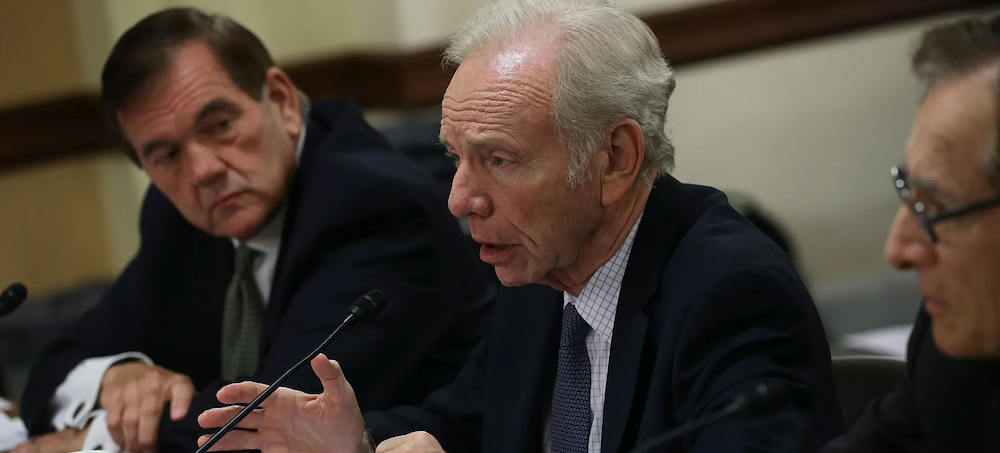 Bipartisan Commission on Biodefense co-chairs Tom Ridge and Joe Lieberman. (photo: Alex Wong/Getty Images)
2003’s most famous politicians are begging the US to stop ignoring biosecurity.
The Bipartisan Commission on Biodefense released a new report this morning urging policymakers to fund, and the executive branch to implement, what it calls the Apollo Program for Biodefense, a $100 billion, 10-year effort that would prepare the nation to meet any future viral threat head-on. The new report, called The Athena Agenda (they like Greek gods), takes the framework the Apollo report outlined and provides more detail on how to fund and achieve it. Commission deputy director Ambika Bumb, a medical scientist who served in the Biden White House and Trump State Department, told me that the new report aims to put the recommendations in terms that “Congress can directly take and put in legislation.”
Among other priorities, the plan includes funding for: creating vaccine candidates for each of the 26 families of viruses known to infect humans; developing antiviral medications that can work against a broad spectrum of viruses; building out manufacturing capacity for vaccines, antivirals, tests, and other countermeasures; deploying genomic sequencing as a way to track outbreaks; developing broadly useful diagnostic technologies and better regulatory processes for approving and disseminating plentiful rapid tests; and improving security in laboratories dealing with dangerous viruses.
The White House, to its credit, has already proposed funding around this level. Most recently, in its 2023 budget proposal, the Biden administration asked for $88.2 billion in funding over five years on pandemic preparedness. That includes $40 billion for the Office of the Assistant Secretary for Preparedness and Response (ASPR) at the Department of Health and Human Services to “invest in advanced development and manufacturing of countermeasures for high priority threats and viral families, including vaccines, therapeutics, diagnostics, and personal protective equipment (PPE),” as well as $12.1 billion in research funding for the National Institutes of Health for vaccine, therapeutics, and diagnostics development.
Bumb notes that the Biden proposal actually drew on the original Apollo plan put out by the bipartisan commission. That’s part of why the new commission report is so notable: This is a group that’s capable of driving policymaking at high levels.
That said, Congress has yet to appropriate money at the commission’s desired level to prevent the next pandemic. It’s barely interested in further funding response to the current, ongoing pandemic, which is still killing hundreds of Americans a day. A group of senators recently cut a deal for $10 billion to fund Covid-19 response, after slashing funding the White House wanted to help fight the pandemic abroad — only to have Republicans block the deal on the Senate floor over separate immigration concerns. Even if the funding eventually passes, it’ll have to wait until after the Easter recess ends on April 22.
The commission members are desperate for Congress to act
The biodefense commission is a bipartisan group that has existed since 2014 and aims to “provide for a comprehensive assessment of the state of US biodefense efforts, and to issue recommendations that will foster change.” Its initial report in 2015 called for heavy investment to “prevent, deter, prepare for, detect, respond to, attribute, recover from, and mitigate biological incidents.” That call was obviously not heeded in time for the Covid-19 pandemic.
The group is chaired by former Sen. Joe Lieberman and former Pennsylvania governor and Secretary of Homeland Security Tom Ridge. The other members include former Congress member and Secretary of Health and Human Services Donna Shalala; former Senate Majority Leader Tom Daschle; former Reps. Susan Brooks and James Greenwood; former FDA commissioner Peggy Hamburg; and former Justice Department official Kenneth Wainstein.
This is not some group of big-spending left-wing ideologues. It’s a collection of old-fashioned moderates, one of whom (Lieberman) is perhaps most famous for frustrating Democratic spending ambitions on health care. Theirs is a dying breed given the extent of partisan polarization in 2022.
We at Vox argued for a number of these measures in our recent series, Pandemic-Proof. And the commission notes that had the plan been in place before Covid-19 (for instance, after the commission’s initial 2015 report), the US response to the pandemic would’ve been vastly improved. “Had we created a vaccine for SARS-CoV-1,” the virus that caused the 2003 SARS outbreak, “we could have produced a vaccine for SARS-CoV-2,” which causes Covid-19, “even faster,” they write.
“This is not about some theoretical future threat only,” Bumb told me. It might have been theoretical when the commission first issued its 2015 report, but after Covid-19, the consequences of inaction should be incredibly vivid.
This Apollo program pales next to the budget of the original Apollo project aimed at putting a man on the Moon. That effort, the commission estimates, cost roughly $280 billion in today’s dollars; the International Space Station cost about $255 billion.
The federal government can make major investments like this when it wants to. The question when it comes to pandemic prevention is, does it want to?
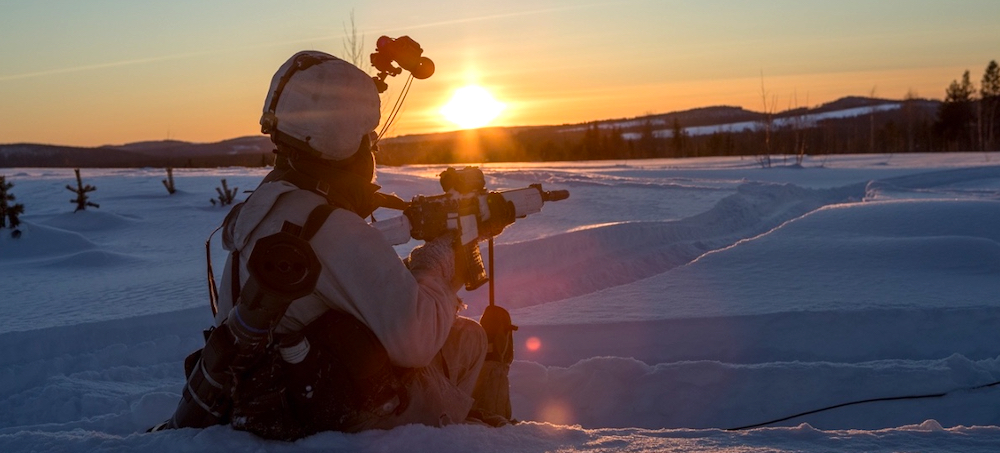 NATO Allies and partners participating in the Swedish exercise NORTHERN WIND 19 in northeastern Sweden. (photo: Swedish Armed Forces)
ALSO SEE: Sweden and Finland Make Moves to Join NATO
On Sunday, NATO Secretary General Jens Stoltenberg said that the alliance was now planning a much larger, permanent military presence on its borders with Russia. “Regardless of when, how, the war in Ukraine ends, the war has already had long-term consequences for our security,” he told Britain’s Daily Telegraph newspaper. “NATO needs to adapt to that new reality. And that’s exactly what we are doing.”
Indeed, one of the lasting legacies of the Russian invasion may be how the war spurred NATO’s strengthening and expansion. Finland and Sweden, two Nordic countries with deep histories of nonalignment, now appear on the precipice of joining the bloc. A report Monday in the Times of London suggested that both nations could clinch NATO membership in a matter of months.
“I think we will end the discussion before midsummer,” Finnish Prime Minister Sanna Marin told reporters on Friday, referring to imminent deliberations on NATO membership that would conclude by the June 25 holiday. “We will have very careful discussions, but we will also not take any more time than we have to in this process, because the situation is of course very severe.”
A statement Monday from Sweden’s Social Democrats, who lead a minority government in Stockholm, made clear that the center-left party was reevaluating its traditional opposition to NATO membership. “When Russia invaded Ukraine, Sweden’s security position changed fundamentally,” the party said.
Public opinion in both countries lurched dramatically in favor of joining NATO after the invasion began. For the first time, a majority of Swedes support entry to the bloc, while a poll this weekend found that 68 percent of Finns would back gaining membership and that an even greater number would support the endeavor if it had the public endorsement of the country’s President Sauli Niinisto and Marin’s government. (Consider that, just in 2019, more than half of Finns were opposed to joining NATO.)
The swing in sentiment has prompted parties in and out of power in both countries to announce ongoing reassessments of their policy positions on NATO. Parliamentary processes will play out over the coming months but the conclusion seems clear: No NATO member state — not even Putin-friendly Hungary — is expected to veto the Finnish and Swedish membership bids, whenever they formally materialize.
On Monday, Kremlin spokesman Dmitry Peskov warned the two Nordic countries against joining NATO, an alliance which he said “remains a tool geared towards confrontation.” Given the ongoing Russian campaign in Ukraine, Peskov’s admonishment — as well as a Russian foreign ministry threat in February of “serious military and political consequences” for Finland and Sweden — probably only strengthens the case to enter the alliance.
In one stroke, Finland joining NATO would more than double Russia’s existing land border with the member states of the Western military alliance, fencing in the Kremlin further. “How can this be anything but a massive strategic blunder for Putin?” a senior U.S. official scoffed to the Times.
Entry into NATO would be a historic move for both countries. Since the early 19th century, for reasons initially tied up in the geopolitics of the Napoleonic wars, Swedish governments maintained a studied neutrality that lasted through the end of the Cold War. After heroically resisting a Soviet invasion more than eight decades ago, tiny Finland settled for an uneasy status quo next to the Soviet juggernaut: It adopted a careful neutrality, accepted a degree of Soviet influence in its affairs, but avoided the same fate of Soviet domination experienced by countries in Eastern and Central Europe.
This arrangement became known as “Finlandization” — a nation converted into a process of geopolitical submission — and has been repeatedly mooted as a path through which Moscow and Kyiv can find some form of peaceful understanding. More than six weeks into the war, though, it’s hard to imagine Ukrainians accepting any kind of tacit subordination to Russia. Finlandization, meanwhile, has long been viewed as a pejorative term in Finland itself.
In practice, both Finland and Sweden already have close military ties with NATO partners and E.U. neighbors. According to the Economist, some experts even suggest that Finland’s military capabilities are “more ‘NATO interoperable’ — capable of conducting joint operations alongside other allies — than some actual members.”
The political journey toward NATO has taken longer. “It was only when Russia under Putin started to demonstrate that its threshold for using military force was lower than many had hoped — first with the war with Georgia in 2008 and then the invasions of Ukraine beginning in 2014 — that a debate on possible NATO membership started,” wrote former Swedish prime minister Carl Bildt in a Washington Post op-ed last month.
After Putin’s war on Ukraine, Bildt added, “there is no way back to a past of illusionary neutrality.”
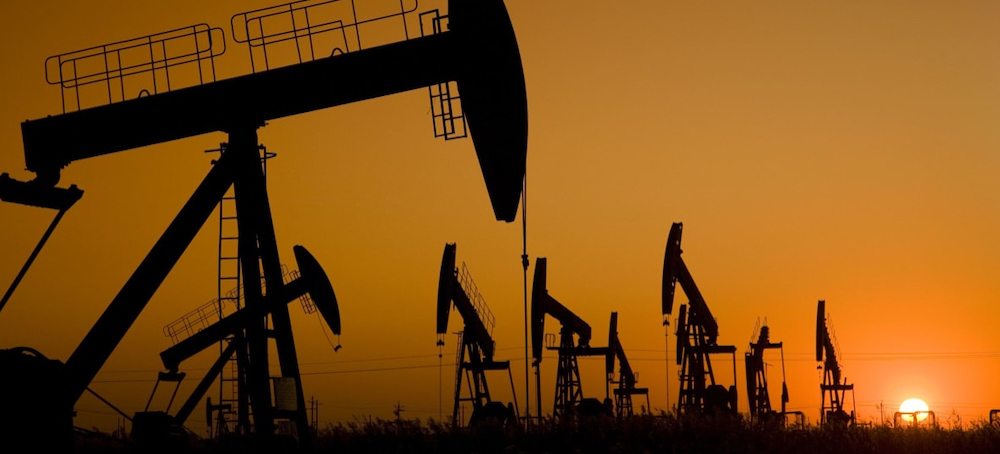 Oil pumps. (photo: History)
Uncontrolled gas leaks and flaring are pushing the planet toward catastrophe.
The new numbers come on the heels of the latest report from the Intergovernmental Panel on Climate Change, in which scientists warned that the world is on track for catastrophic warming, with fossil fuel emissions driving an “almost inevitable” breakdown of some of Earth’s life-supporting systems.
“Our data show that global emissions continue to move in the wrong direction at a rapid pace,” Rick Spinrad, NOAA’s administrator, said in a statement. “The evidence is consistent, alarming, and undeniable.”
Methane, a potent greenhouse gas, leaks out of oil wells and gas pipes, vents from rotting food in landfills, and escapes from cows in their burps and manure. It’s one of the main drivers of climate change, responsible for 30 percent of the warming since preindustrial times, second only to carbon dioxide. While methane doesn’t linger in the atmosphere as long as CO2, it’s much more powerful at heating the planet in the short term.
That makes cutting methane emissions a high priority. But as the new data from NOAA show, the world is heading in the wrong direction. Atmospheric levels of methane jumped 17 parts per billion in 2021, beating the previous record set in 2020.
This surge is happening just as methane is getting more recognition as a problem that requires urgent action. Last fall, the United States and European Union initiated an effort to cut methane emissions 30 percent by the end of the decade. Roughly 100 countries have joined the Global Methane Pledge since then, minus a few of the top emitters, like China and Russia. A new initiative called the Global Methane Hub launched this week to support these efforts, putting $340 million toward helping countries track and reduce emissions.
Measuring methane accurately has proven to be a challenge of its own. A report from the International Energy Agency in February found that governments were undercounting methane emissions from oil, gas, and coal, which satellite data showed were about 70 percent higher than previously estimated.
But on the bright side, the IEA said, many of these emissions could be trimmed relatively easily by installing leak-proof equipment and putting a stop to the common practice of burning surplus natural gas, known as flaring. Rapid cuts to global methane emissions, according to one study, could stave off half a degree Celsius (nearly 1 degree Fahrenheit) of warming by the end of the century. These reductions could have quick effects, as methane disappears from the atmosphere after about nine years.
Carbon dioxide, on the other hand, can continue to warm the atmosphere for thousands of years. 2021 marked the 10th year in a row that CO2 emissions had risen by more than 2 parts per million, “the fastest sustained rate of increase in the 63 years since monitoring began,” according to NOAA.
Today’s atmospheric concentration of carbon dioxide is as high as it was 4.3 million years ago — when the sea level was roughly 75 feet higher, the Arctic was covered in forests, and global temperatures were 7 degrees F hotter than right before the Industrial Revolution.
Special Coverage: Ukraine, A Historic Resistance
READ MORE
Follow us on facebook and twitter!
PO Box 2043 / Citrus Heights, CA 95611


