Showing posts with label VOTE COUNT. Show all posts

Friday, November 6, 2020

POLITICO NIGHTLY: How to swear in a pandemic president


POLITICO Nightly logo

BY RYAN HEATH AND THEODORIC MEYER

Presented by

With help from Renuka Rayasam and Myah Ward

WHAT TO DO WHEN THERE’S A CALL — Joe Biden is on the precipice of the White House. He holds narrow leads in Arizona, Nevada, Pennsylvania and Georgia. Head to POLITICO’s 2020 election homepage for the latest results.

WELL, SOMEBODY WILL GET INAUGURATED — The winner of the presidential election hasn’t been called, but one thing about Jan. 20, 2021, is all but certain: We won’t see the largest Inauguration Day crowds in the history of the National Mall.

If Joseph R. Biden is declared president-elect in the coming days — to repeat, still not a certainty — the ceremonies aren’t likely to match the massive inaugurations when Biden was sworn in as vice president in 2008 and 2012. What might the day look like? Here’s the view from eight inauguration experts who spoke to Nightly over the past few days:

There’s no constitutional requirement, except for an oath of office. But since 1901, a congressional committee — the Joint Congressional Committee on Inaugural Ceremonies — has planned a swearing-in ceremony at the Capitol. Sen. Roy Blunt (R-Mo.), the committee’s chair, said Wednesday that senators are still trying to figure out how to hold an inauguration during a pandemic.

“I’ve decided that one of the things we’d do is plan for a big inauguration,” Blunt said during an online event hosted by the law and lobbying firm BakerHostetler.

The committee decided June 30 to conduct the swearing-in ceremonies of the next president on the West Front of the U.S. Capitol, its traditional site since President Ronald Reagan’s inauguration in 1981. But even that plan is provisional. “It’s easier to scale back,” Blunt said, “and then do our best to meet the expectations of both the Congress and maybe more importantly on that day the person being sworn in as president. What do they want that day to look like and how do we do that as safely as we can?”

For a West Front ceremony to happen in January, construction on the massive 10,000 square feet wooden platform needed to start from scratch on Sept. 21. So it did. Even so, “due to the ever-changing circumstances, we are constantly assessing the situation,” said Paige Waltz, a committee spokesperson.

The Department of Defense, too, has 1,000 inauguration employees getting ready for Jan. 20. U.S. Army Colonel Robert Phillips, director of communication for Joint Task Force - National Capital Region, which coordinates the military’s inaugural support, said his team had been “planning pretty hard since August.” His message was stability and continuity: “The conditions may change, but that’s why we plan.”

But inaugurations can be simple and small: In 2013, because Jan. 20 fell on a Sunday, President Barack Obama took the oath for his second term in the Blue Room of the White House surrounded only by his family and Supreme Court Chief Justice John Roberts. The Jan. 21 public ceremony was just for show.

Biden could choose to repeat that setting, livestreaming it, or go for some other smaller scale inauguration. With the presidential race still uncalled, a potential inauguration hasn’t been top of mind for Biden’s team. A Biden transition official said all inaugural planning would be handled by the Presidential Inaugural Committee, which hasn’t been set up yet.

Clues are on the menu: Inaugural uncertainty shows in little details, like a non-committal answer on whether the traditional Inaugural luncheon at the Capitol would take place. “The JCCIC is committed to planning inaugural ceremonies that are as traditional, safe, and inclusive as possible,” is all Waltz would say.

The luncheon would ordinarily include the outgoing and incoming president and vice president, the House and Senate leadership, Supreme Court justices and incoming cabinet nominees. A lunch like that seems unlikely. Other recent events at the Capitol, such as the funeral of John Lewis during summer’s coronavirus surge, operated at less than 20 percent of the normal occupancy.

The Biden campaign’s current strict Covid protocols include everyone submitting to testing within 36 hours of being near him, everyone wearing N95 masks, no hand shaking, and no touching. That’s very difficult to manage in a traditional inaugural setting and scale. “The optics of having the inaugural be deemed a super-spreader event would tank the credibility of a new president who has vowed to tackle the virus head-on on day 1,” said one organizer of Obama’s 2013 inaugural.

The biggest wild card is President Donald Trump’s role, were he to lose reelection. Michael Chertoff, Secretary of Homeland Security under President George W. Bush, said successful transfers of power “start at the top.” In Chertoff’s case, he said, “President Bush wanted it to be well executed and it was.”

A small Biden inaugural could conceivably reduce or remove Trump’s role. Five outgoing presidents have skipped their successor’s swearing-in: John Adams (1800), John Quincy Adams (1829), Andrew Johnson (1869), Woodrow Wilson (1921), and just-resigned Richard Nixon in 1974.

Bad weather can also wreck the best-laid plans. It sent Reagan’s 1985 ceremony into the Capitol Rotunda and William Taft’s 1909 ceremony to the Senate.

What scope does a president-elect have to alter the arrangements? The Presidential Inaugural Committee, which forms after a new president is elected, can essentially take charge of events that occur outside of the Capitol complex, like parades, balls, and other celebrations. On the official ceremonies at the Capitol, Waltz predicted “vigorous discussions” with the president-elect and promised to “work to accommodate to the extent possible,” any requests of a new president.

Given the Biden campaign’s obsessive Covid-19 safety planning, multiple big inauguration events per day seem unlikely, according to two senior Obama supporters involved in the 2013 inaugural. If Biden is inaugurated in January, don’t expect a big concert in front of Lincoln Memorial, or anything designed to attract millions of visitors for multiple days.

Sign up for POLITICO Transition Playbook to track the appointments, the people and the power centers of the next administration.

Welcome to POLITICO Nightly. Reach out at rheath@politico.comtmeyer@politico.com and rrayasam@politico.com, or on Twitter at @politicoryan@theodoricmeyer and @renurayasam.

A message from Care in Action:

Right now, children are crying for their parents, because our government said “we need to take away children” - cruelly plotting to separate babies from their parents. How do we explain to our kids that families were separated on our watch? We need to reunite every family. Now.


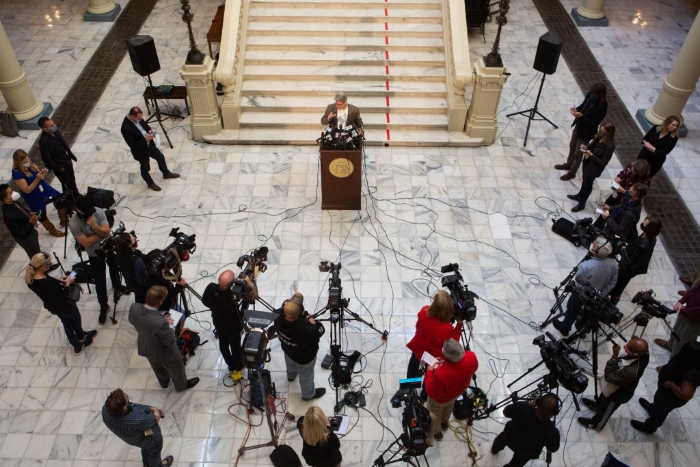
Gabriel Sterling, Voting Systems Manager for the Georgia Secretary of State's office, answers questions during a press conference on the status of ballot counting in Atlanta.

Gabriel Sterling, Voting Systems Manager for the Georgia Secretary of State's office, answers questions during a press conference on the status of ballot counting in Atlanta. | Getty Images

COVID-2020

IT’S STILL GOING — Biden seems to be closing in on a victory. But he’s staring at a deeply divided nation — and an opponent who may refuse to accept the results. In the latest POLITICO Dispatch, national correspondent Natasha Korecki breaks down how Biden is preparing for what would be a rocky transition.

Play audio

Listen to the latest POLITICO Dispatch podcast

‘SCAPEGOAT’ — Trump’s gains in South Texas among Mexican Americans and with Miami’s Cuban American population have raised alarms among many Democrats. But while Democrats are taking stock of their losses in those states, some are warning against pinning the blame on Latino voters, write Laura Barrón-LópezSabrina Rodríguez and Nightly’s Renuka Rayasam.

“The overall fixation on Latinos is a scapegoat,” Rep. Alexandria Ocasio-Cortez (D-N.Y.) told Laura.

Biden’s share of Latino voters across the country matched Hillary Clinton’s four years ago. In the Rio Grande Valley and Miami, however, Trump’s Latino outreach yielded tens of thousands of new Republican voters.

Some Democrats say the losses signal that the party needs to rethink its long-term messaging and strategy for Latinos — one more tailored to the unique experiences of Puerto Ricans, Mexicans, Venezulans, Cubans and more.

“I do think unless the Democratic Party as a whole really begins taking seriously this flight of Latinos from Democratic Party to the Trump party we could lose folks for a generation,” said Democratic Rep. Veronica Escobar, who was reelected on Tuesday in her El Paso district.


NEW EPISODES OF POLITICO'S GLOBAL TRANSLATIONS PODCAST: The world has long been beset by big problems that defy political boundaries, and these issues have exploded in 2020. Are world leaders and political actors up to the task of solving them? Is the private sector? Our Global Translations podcast, presented by Citi, unpacks the roadblocks to smart policy decisions and examines the long-term costs of the short-term thinking that drives many political and business decisions. Subscribe for Season Two, available now.


ON THE HILL

SPEAKER SPEAKS UP — Speaker Nancy Pelosi wants another two-year term running the House, cementing her role — for now — as the most powerful woman in Washington, John Bresnahan, Heather Caygle and Sarah Ferris write.

The 80-year-old Pelosi is coming off a disappointing Election Day, where her party lost at least five seats so far in the House, but the California Democrat intends to stay in the speaker’s chair during the 117th Congress, according to letters sent to her colleagues this morning. Pelosi has served as the Democratic leader since 2002, and the vast majority of her colleagues have never known anyone else running their caucus.

Pelosi also pledged to work closely with, in her words, “President-elect Joe Biden and Vice President-elect Kamala Harris,” who are now leading the race for the White House. House Democrats will formally begin choosing their leaders on Nov. 18. No challenger to Pelosi is expected to emerge, and none could defeat her, although a small number of disgruntled House Democrats want a change atop her caucus.


Advertisement Image 

 
NIGHTLY NUMBER

638,000

The number of jobs U.S. employers added in October, a solid pace though far fewer than needed to regain most of the jobs lost to the pandemic recession just as new viral cases are setting record highs.

PUNCHLINES

WONDER WHAT COMEDIANS ARE TALKING ABOUT THIS WEEK? After giving you the recipe for a Pink Trumptini, Matt Wuerker, in the Punchlines Weekend Wrap , takes you through the latest in political satire and cartoons on the election.

Video player for Punchlines Weekend Wrap with Matt Wuerker

PALACE INTRIGUE

OUTFOXED — Not all marriages of convenience end up in divorce court, but when they do, it’s easy pickings to find the forensic evidence that doom awaited the relationship, senior media writer Jack Shafer writes.

And so it is this week, as Trump and Rupert Murdoch’s Fox News Channel all but finalized their own conscious uncoupling, that we can see that the two weren’t really falling apart as they were never really together.

It’s true that Fox propped Trump up when other networks were treating him as a novelty, reliably televising his stemwinder speeches and letting his proxies spin away his blatant untruths and off-the-cuff insults. And it’s true that Fox was proud to have the president as Viewer Number One, taking his calls and often seemingly broadcasting directly to his bedroom TV.

The truest thing you can say about politics and the entertainment business is that eventually, every political career grinds to an ugly end and every show gets canceled. For the longest time, it seemed, the Trump show on Fox was looking at a four-year renewal. But audiences and voters — like husbands and wives —can be a fickle bunch.


KEEP UP WITH THE PEOPLE AND POLITICS DRIVING GLOBAL HEALTH IN GLOBAL PULSE: This year has revealed just how pivotal it is to keep up with the politics and policy driving global health. Our Global Pulse newsletter connects leaders, policymakers, and advocates to the people and politics making an impact on our global health. Join the conversation and subscribe today.


PARTING WORDS

GEORGIA ON MY MIND — Clayton County, south of Atlanta, is one of the keys to Biden’s tenuous lead in Georgia — and, therefore, to his lead in the race for 270 votes in the Electoral College. Renu grew up there. She emails us this dispatch about her childhood home:

My parents, who grew up and got married in South India, settled in Jonesboro, Ga., in 1979 in a community built around a man-made lake called Lake Spivey. This is the southern part of Clayton County. It shared more similarities with Macon, about an hour south, than with the northern part of the county, which is part of John Lewis’ former congressional district and is a 25-minute drive away.

In the 1980s Jonesboro residents had two things to brag about: Gone with the Wind was set in a fictionalized version of the area and Burt Reynolds filmed Smokey and the Bandit there. My brother and I still point out the house that Reynolds owned when we take friends out on our parents’ boat. As a kid, I was tasked with handing out the okra my mother grew in the backyard to our Southern neighbors, some of whom had Confederate flags flying on their doorsteps. My first Cabbage Patch Kid had blonde hair and blue eyes.

Forty years later my parents still live in Jonesboro. We talk more about how rapper T.I. owned a home (and carried out his house arrest) on the lake than we talk about Mr. Burt Reynolds. Over the summer Slutty Vegan, a very popular Black-owned meatless burger joint, opened up a Jonesboro location. There are plenty of Black professionals, and no Confederate flags, in the neighborhood where my parents live now. These days Jonesboro feels more like an Atlanta suburb than the rural outpost of my youth.

Still it came as a shock to me this morning when I woke up to see national reporters tweeting about Clayton County. Growing up in the 1980s, Jonesboro felt so far from the center of anything important that I fled the first chance I got.

Clayton County’s change from a white, rural area to a majority Black Atlanta suburb, from a county that voted for George H.W. Bush in 1988 to one that could deliver Georgia to Biden, seemed like a slow transition. But looking back, it happened really fast. It’s not the kind of fast-growing suburban transformation that typically gets attention in a presidential election year — it was just Black families leaving New York and other expensive places for areas with cheaper housing. A lot of white families left to move farther South to build a different bubble.

I saw it happening in my own lifetime, but I somehow missed its significance. Riding around the roads where I learned to drive, I remember the (sometimes traumatic) moments of my childhood. I see an area that suffers from poverty, unemployment and neglect. I missed other changes that have turned out to have national significance.

But, today, voters in Clayton County may have proved what my mom has been trying to convince me of for years: There’s something happening in Jonesboro.

A message from Care in Action:

Right now, children are crying for their parents, because our government said “we need to take away children” - cruelly plotting to separate babies from their parents. “I always tell my kids to treat others the way you want to be treated. How do I explain to our kids that families were separated on our watch?” We can make this a nation we’re proud to leave our kids. We need to reunite every family. Now.


Did someone forward this email to you? Sign up here.


Follow us on Twitter

Renuka Rayasam @renurayasam

Chris Suellentrop @suellentrop

Tyler Weyant @tweyant

Myah Ward @myahward


FOLLOW US


 POLITICO, LLC 1000 Wilson Blvd. Arlington, VA, 22209, USA


POLITICO NIGHTLY: How to know if Biden has won


POLITICO Nightly logo

BY DAVID SIDERS

Presented by

With help from Renuka Rayasam and Myah Ward

RE-RAISING ARIZONA  The election is in what you might call its quadrennial “ knowable but not callable” moment — except that instead of lasting for an hour or two, it has stretched out for two days.

The question of the moment is: When can you say, “Joe Biden has won the election”? How will we know?

To be clear, Joe Biden is not yet the president-elect. He may never be. President Donald Trump could draw the ace he needs in Pennsylvania, stave off Biden in Georgia, and hold serve in North Carolina.

But right now, that’s not what many people watching Pennsylvania think is going to happen. And Trump would also need one more state, either Nevada, where Biden’s lead is considered pretty solid, or one that has already been called by Fox News and the Associated Press for Biden: Arizona.

For Trump to win a second term, that call of Arizona would have to be reversed, in a kind of slow-motion replay of the night in 2000 when Florida was called for Al Gore, and then for George W. Bush, and then for no one.

Will that happen? Maybe.

Yet that leads to another factor, larger than this agreed-upon uncertainty about the facts. Right now, one of the two candidates — the sitting president — has made it clear that we no longer have a common set of facts to work with. And a large percentage of the country agrees with him.

So what is unfolding right now, in newsrooms and living rooms, in this moment of uncertainty is also a debate about what to do with information when it is known — and whether it matters that one of the two candidates is disputing it.

If Nevada is called for Biden before the questions around Arizona are settled, or before any recounts are finished, or before the electors have finalized the vote in the Electoral College, has he become the president-elect?

The answer has consequences that extend beyond the normal tension about being fast, but also right. Fox’s decision to call Arizona for Biden enraged Trump’s campaign, and also gummed up the visuals for his premature claim of victory on election night. Fox viewers could see the Electoral College vote count for themselves: at that point, Biden with 238 votes, Trump with 213.

If Biden wins Pennsylvania or, less likely, Georgia, then the mystery surrounding Arizona no longer matters. Biden will have won the presidency. But what if Nevada finishes counting first? Has Biden won? Or hasn’t he? How many licks are there in a Tootsie Roll pop? When you look at this image, do you see an hourglass or two faces?

No news outlet — this one included — wants to say Biden got to 270 if the projection in Arizona, or one of the other states, turns out to be wrong.

The flip side is that if Biden wins Nevada and the projections in Arizona are right, it’s inaccurate to say the race is still undecided.

But, right now, at least, that’s where things stand.

An anti-Trump protester argues with a Trump supporter in Detroit.

An anti-Trump protester argues with a Trump supporter in Detroit. | Getty Images

Welcome to POLITICO Nightly. Watch my colleagues break down this election tonight at 8 p.m. EST with the team from SHOWTIME’s The Circus. Reach out at dsiders@politico.com or rrayasam@politico.com, or on Twitter at @davidsiders and @renurayasam.

A message from Care in Action:

Right now, children are crying for their parents, because our government said “we need to take away children” - cruelly plotting to separate babies from their parents. How do we explain to our kids that families were separated on our watch? We need to reunite every family. Now.

 
AROUND THE NATION

THEY’RE COUNTING CASES TOO  At some point, the presidential election will be over, and the pandemic will have been here the whole time. The U.S. has breached 100,000 new cases a day, the most since July. Covid is wreaking havoc everywhere, and state and local leaders are in a bind as they battle both rising case numbers and political pressure to keep businesses open.

As the pandemic looms over an undecided presidential election, Nightly’s Myah Ward broke down the virus trajectory in the five states that have yet to distribute their electoral college votes — Alaska, Georgia, Nevada, North Carolina and Pennsylvania — using 7-day averages from the Covid Tracking Project.

Alaska

Population: 731,545

Daily cases: 378.9

Daily deaths: 1

Currently hospitalized: 96.43

Daily cases and hospitalizations have more than doubled since Oct. 5, and deaths are up from one every five days or so. Alaska was one of the first states to fully reopen this spring. Despite Republican Gov. Mike Dunleavy’s efforts to control travel into the state and Alaska’s robust testing program, cases reached a new high in late October — and spread to Alaska’s remote villages. The governor has encouraged masking and social distancing but has stopped short of new shutdowns.

Georgia

Population: 10,617,423

Daily cases: 1,646

Daily deaths: 29.29

Currently hospitalized: 1,746

Cases and hospitalizations have increased since Oct. 5, but deaths are down slightly from a month ago. Georgia was one of the earliest states to reopen, and Republican Gov. Brian Kemp has kept it that way. In mid-August, he amended an executive order that allowed local leaders to issue their own mask mandates and has continued to extend the state of emergency, this time through Dec. 9.

Nevada

Population: 3,080,156

Daily cases: 972

Daily deaths: 7.86

Currently hospitalized: 653.3

Cases and hospitalizations have spiked since Oct. 5, with new daily cases more than doubling. Deaths are up slightly. Nevada Gov. Steve Sisolak, a Democrat, reopened Nevada this spring but slowed reopening as cases rose this summer. In September, the governor allowed bars to reopen statewide. He urged Nevadans last week to practice social distancing and wear masks so he doesn’t have to shut down the economy again.

North Carolina

Population: 10,488,084

Daily cases: 2,377

Daily deaths: 37.86

Currently hospitalized: 1,172

Cases, deaths and hospitalizations have risen since Oct. 5. Gov. Roy Cooper, a Democrat, moved the state into Phase 3 reopening in early October, allowing movie theaters to reopen at limited capacity, while bars and entertainment venues were allowed to open outdoors. The governor extended Phase 3 on Oct. 21, citing an increase in cases.

Pennsylvania

Population: 12,801,989

Daily cases: 2,527

Daily deaths: 25

Currently hospitalized: 1,383

Cases and hospitalizations have surged since Oct. 5, both more than doubling. Deaths have increased, too, from 17.1 on Oct. 5. All Pennsylvania counties are in the final phase of reopening, though there are still restrictions in place for bars, restaurants and large gatherings. A judge struck down business closures and gathering limitations imposed by Democratic Gov. Tom Wolf on Sept. 14, but an appeals court ruled the governor could restore gathering restrictions on Oct. 1.


NEW EPISODES OF POLITICO'S GLOBAL TRANSLATIONS PODCAST: The world has long been beset by big problems that defy political boundaries, and these issues have exploded in 2020. Are world leaders and political actors up to the task of solving them? Is the private sector? Our Global Translations podcast, presented by Citi, unpacks the roadblocks to smart policy decisions and examines the long-term costs of the short-term thinking that drives many political and business decisions. Subscribe for Season Two, available now.


COVID-2020

NEW HUES — A majority of the voters in South Texas and South Florida counties cast their ballots for Biden, but at the same time those areas saw a dramatic shift in support toward Trump. Other areas with notable increases in Trump support: Arkansas, New York, western Utah and southeastern Ohio. In contrast, support for Biden strongly increased in urban and suburban counties, as well as in New England, the Mid-Atlantic states, Colorado, Arizona and along the West Coast. Even a majority of counties in Montana and Wyoming — which overwhelmingly voted for Trump — experienced a slight blue shift.

“It’s bizarre to me to be honest with you,” Gilberto Hinojosa, chair of the Texas Democratic Party, told Nightly’s Renuka Rayasam about the swing towards Trump in South Texas. Hinojosa said his party stayed focused on health care and education, two issues that typically rank high among the largely Mexican American population along the border. But he thinks Trump gained support among the area’s immigration officials and oil and gas industry workers. And even though Covid was rampant in the Rio Grande Valley, Hinojosa said people opposed business closures. “It’s not something any of us saw coming.”

Map showing change  in margins between President Donald Trump and his Democratic opponents from 2016 to 2020

Patterson Clark | POLITICO

TRANSITION 2020

THE JANUARY EFFECT — Even without a winner, both parties are in post-election mode.

— Trump is starting his second term early, writes White House reporter Nancy Cook. Trump and his aides have settled on a plan for him to take full advantage of his existing perch at the White House to look as presidential as possible, according to three people briefed on the strategy. He may fire a few Cabinet members and top aides, including FBI Director Chris Wray and Defense Secretary Mark Esper. He could sign a slew of base-pleasing executive orders. He might even resume his travel schedule.

— Democrats are still holding out hope they can control all three branches of government, write Heather Caygle and Sarah Ferris. Speaker Nancy Pelosi and her top lieutenants issued a stark warning for Democrats today, saying if they swing too far left they’re all but certain to blow their chances in the Georgia runoff that will determine which party controls the Senate. Congressional Democrats are collectively pinning their hopes on a pair of Senate races in January in Georgia, one of the most competitive states in the nation — an outcome that could determine whether Democrats hold all levers of power in Washington next year, despite a disappointing night on Tuesday.


Advertisement Image 

 
FROM THE HEALTH DESK

COVID WAS ON THE BALLOT  Biden is inching his way toward a win, but Congress is on track to be more divided than ever. In the latest POLITICO Dispatch, health care reporter Dan Diamond explains how the coronavirus pandemic split the nation — and how polarized views of Trump’s response shaped results up and down the ballot.

Play audio

Listen to the latest POLITICO Dispatch podcast


KEEP UP WITH THE PEOPLE AND POLITICS DRIVING GLOBAL HEALTH IN GLOBAL PULSE: This year has revealed just how pivotal it is to keep up with the politics and policy driving global health. Our Global Pulse newsletter connects leaders, policymakers, and advocates to the people and politics making an impact on our global health. Join the conversation and subscribe today.


NIGHTLY NUMBER

76 days

The number of days until the presidential inauguration on Jan. 20, 2021. The still-uncertain election results are presenting new obstacles for the dozens of Democratic officials who have been working for months to set up a government in the event of a Biden win.

PARTING WORDS

GENERATION 2000 — Nightly’s Tyler Weyant writes:

It’s Nov. 7, 2000, and Ms. Houck is passing out maps to my fourth-grade social studies class. Tonight’s homework, she says, is to watch the presidential election returns and color in the states red and blue as they are called. By the time we turned them in a week later, my map had Florida as a grey-purple amalgam of numerous over-colorings.

The vast array of 20- and 30-somethings working in political journalism right now have the memories of the 2000 election bored into their psyches much differently than do the veterans of the profession. While our top editors were covering the Brooks Brothers Riot or chatting off the record with Donna Brazille, we were in the lunch line deciding between regular or chocolate milk.

Yet living through the 2000 maelstrom as children may have better prepared us for this moment. The world of the 2020 election is the only direct political reality we have ever known.

Twenty years is a long time. My fourth grade classmates and their ilk have families and bills to pay now. We are watching this election not with shock but with nodding familiarity and deep-seated knowledge of the country’s political divisions. For those of us who decided, in the 21st century, to get into journalism as a career, the concept of two Americas, divided almost 50-50, speaking two different political languages is our baseline.

So, as this election unfolds across an indeterminate time frame, I will trust the scores of millennials on the front lines of this story even if we were fast asleep by the time Tim Russert wrote “Florida, Florida, Florida” on a whiteboard. For all the Gen X and Boomer journalists out there tweeting that 2000 made this a cakewalk, I kindly ask that you spare me your Werther’s Originals and storytime.

A message from Care in Action:

Right now, children are crying for their parents, because our government said “we need to take away children” - cruelly plotting to separate babies from their parents. “I always tell my kids to treat others the way you want to be treated. How do I explain to our kids that families were separated on our watch?” We can make this a nation we’re proud to leave our kids. We need to reunite every family. Now.


Did someone forward this email to you? Sign up here.


Follow us on Twitter

Renuka Rayasam @renurayasam

Chris Suellentrop @suellentrop

Tyler Weyant @tweyant

Myah Ward @myahward


FOLLOW US


 POLITICO, LLC 1000 Wilson Blvd. Arlington, VA, 22209, USA


Thursday, November 5, 2020

RSN: FOCUS: Nate Cohn | Biden Appears to Hold Edge in the Key Votes Left to Be Counted


Reader Supported News
05 November 20

It's Live on the HomePage Now:
Reader Supported News


THE WING-NUTS WILL FUND THEIR ORACLES, YOU CAN BE SURE: The right wing will fund their oracles that's a given. We are told that we will always be without means, never know stability, never be able to provide. One more lie, after another. We know what to do with a budget. We know how to apply it, how to grow something of value to the community with it. Let's give them something to talk about. Thank you all sincerely. / Marc Ash, Founder Reader Supported News

Sure, I'll make a donation!


FOCUS: Nate Cohn | Biden Appears to Hold Edge in the Key Votes Left to Be Counted
Poll workers preparing mail-in ballots for tabulation in Lansing, Mich., on Monday. Vote counting cannot legally begin until Election Day in Michigan. (photo: Bryan Denton/The New York Times)
Nate Cohn, The New York Times
Cohn writes: "Joe Biden looks to be on the cusp of winning the election. Here's a look at where the vote count stands in the key states."

Pennsylvania

President Trump’s lead in Pennsylvania has plummeted to two percentage points as of Thursday morning, as the mail absentee ballot count proceeded briskly across the state.

There is every indication that Mr. Biden remains on track to pull ahead when all of the votes are in and counted, whenever that may be.

So far, Mr. Biden has been winning absentee votes, 77 percent to 22 percent, according to the Pennsylvania secretary of state. At that pace, he needs only 288,000 more mail votes before taking the lead. By my count, there are about 500,000 mail ballots left. The secretary of state reported a total of 2.6 million absentee ballots cast as of Tuesday, and so far 2.1 million absentee votes have been counted. If Mr. Biden won those 500,000 ballots by the same 77-22 pace, he would end with a lead of about 100,000 votes in the state. That’s a pretty decent cushion.

READ MORE


Contribute to RSN

Update My Monthly Donation


This Weekend in Politics, Bulletin 441.

                                                                               LOTS OF POSTS IGNORED BY BLOGGER..... OR REMOVED ON THEIR WHI...