Gaza & UN Veto Power
With an eye on future U.N. Security Council resolutions concerning Gaza, Dan Becker discusses a possible mechanism in the U.N. Charter to force the U.S. to abstain from voting.
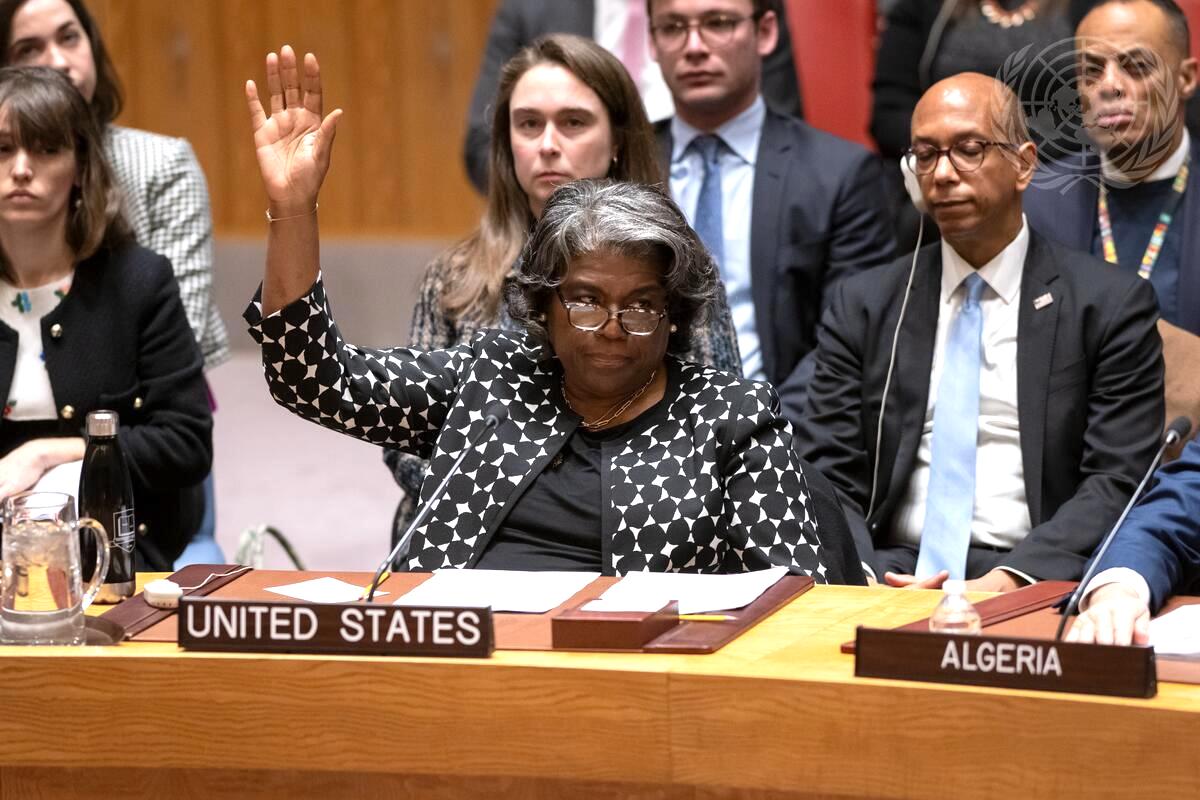
U.S. Ambassador to the U.N. Linda Thomas-Greenfield voting against Algeria’s ceasefire in Gaza resolution on Feb. 20. (UN Photo/Manuel Elías)
By Dan Becker
PassBlue
 In the United Nations Charter, the very sentence that establishes the Security Council’s permanent-five veto power ends — surprisingly — in these nine words: “. . . a party to a dispute shall abstain from voting.”
Let’s allow the phrase to sink in for a moment before acknowledging that there is indeed a host of conditions, requirements, litmus tests and hoops to jump through before the phrase can be invoked and applied to a resolution.
But at the same time, it’s also crucial and a bit remarkable to remember that the five permanent members (P5) of the Security Council — Britain, China, France, Russia and the United States — are not exempt. They must abstain as well.
So there it is, this little-known mechanism hiding in plain sight in Article 27 (3). It’s the Rodney Dangerfield of the U.N. Charter. It gets no respect.
An abridged history, according to Security Council Report, an independent publication, explains the requirements needed to invoke this clause:
“Abstentions under Article 27 (3) are mandatory only if all of the following conditions apply: the decision falls under Chapter VI or Article 52 (3) of Chapter VIII; the issue is considered a dispute; a Council member is considered a party to the dispute; and the decision is not procedural in nature.”
The Ramadan-related ceasefire of March 25 show how these conditions can be met. First, by all accounts, it fell under Chapter VI, which concerns the peaceful settlement of disputes as opposed to resolutions that might require “hot actions,” such as economic sanctions or the use of force (Chapter VII). A future resolution — such as demanding humanitarian aid be let into Gaza via the Rafah gate — could very well fall under Chapter VI as well.
Second is the claim that the U.S. is a “party to the dispute” in Gaza. This is usually invoked because of the sheer mass of arms provided to Israel by Washington (in addition to other arguments). The issue is hotly debated. But some of the many studies regarding this topic are quite exhaustive and keep the claim quite reasonable.
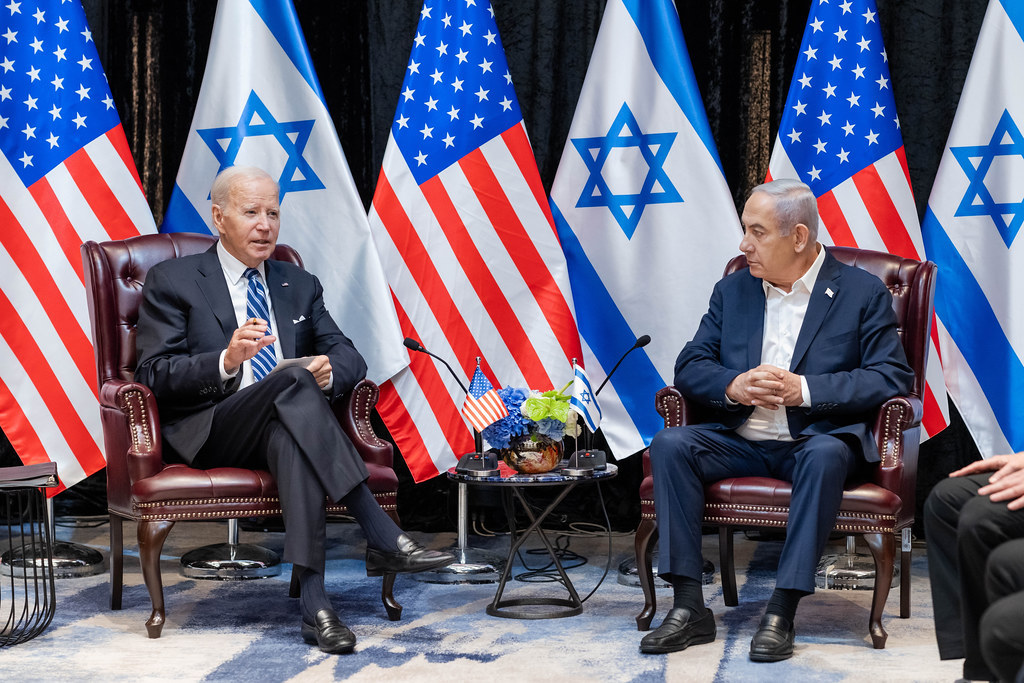
U.S. President Joe Biden and Israeli Prime Minister Benjamin Netanyahu meeting in Tel Aviv on Oct. 18, 2023. (White House, Cameron Smith)
During politically quieter times, discussing this matter might be a thought experiment. But the time is June 2024. The wars in Gaza and Ukraine rage on, as does the civil war in Sudan.
So it’s not an academic exercise. Any ability to force a P5 member to abstain should be examined carefully. All eyes are on the U.S. right now, and the suspense is palpable.
Since the Hamas massacre of Oct. 7, the U.S. vetoed three resolutions proposed by others, then presented its own on March 22, which was vetoed by Russia and China. It then finally abstained on a new resolution on March 25, enabling a Ramadan-focused ceasefire resolution to pass.
That resolution fit, arguably, all the criteria listed above. A future resolution may very well do the same.
The International Court of Justice (ICJ) ordered Israel on May 24 to immediately end its military operations in Rafah in southern Gaza and to open that border crossing for humanitarian aid.
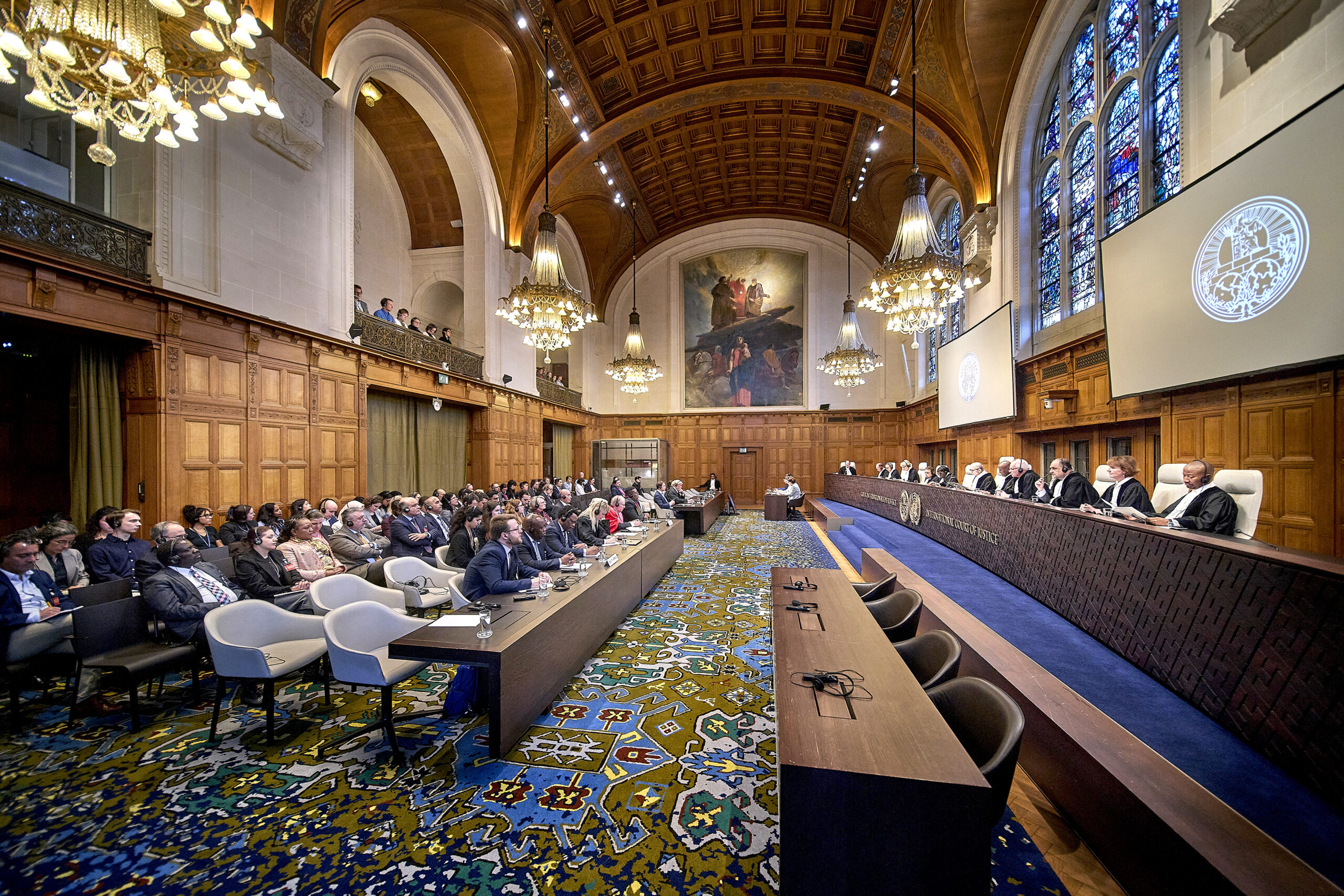
The International Court of Justice at The Hague, on May 24, when it ordered Israel to stop its assault on Rafah. (ICJ)
Very soon, a Security Council member could draft a resolution supporting the ICJ ruling, especially since Israel is not honoring the court’s order.
The question is whether the U.S. will abstain from or veto such a resolution. Most suspect a veto.
So, if there’s a chance the U.S. could be forced to abstain — if it meets the requirements of the Article 27 (3) provision — why not raise and examine the issue now? If it’s close or even mildly ambiguous, isn’t it worth taking the fight to the Council chamber? Is there a good reason for not preparing for the possible?
The principle behind this mechanism is clear to any school child. It appeals to our ultimate common sense. If you’re involved in a dispute, under certain situations you should be required to abstain from voting for resolutions about the dispute. If violating this core value of fairness doesn’t shock the conscience, it certainly frustrates it.
It’s not as if the clause hasn’t been used in the past, most often in the early years of the U.N.
Further examination of the Security Council Report document above clearly shows 12 times that the mandate has been successfully invoked, and 14 times where it was raised or considered but failed. Nevertheless, at one time it was alive and kicking.
So why has the provision been ignored and exiled?
The quick answer is that it’s a combination of neglect, geopolitical self-interest, entropy, avoidance and issues of legality halfheartedly invoked. In other words: it’s just too much trouble.
Many of the reasons given for its ghostlike status are full of loopholes that any interested person with a sense of commitment — and time — can find and call out:
- The most cynical but perhaps the most honest reason that this provision has been avoided is that no P5 nation wants to set a precedent that might be used against them in the future. Why would France, for example, want to help force Russia to abstain on a resolution and thereby open the door to suffer the same fate down the line? So the result is collective silence.
- One argument is that it would create a fuss, bring in the lawyers, but good! It would get attention, show that the status quo isn’t quite as impervious as everyone thought. Nothing might happen, but every straw on the camel’s back will pay off at some point in the future.
- The most esoteric reason lies in the legal principle of “desuetude,” which simply means that a lack of use over decades dilutes the legal force of a provision because it creates a “common consent among the parties” that this provision in the Charter does not need to be applied.
After seemingly endless analysis, the accumulation of opinions affirm that the abstention provision of Article 27(3) is ambiguous and unresolved. It is a phrase filled with mystery and possibility that should be brought into the light of day. It should be known, discussed, argued and debated.
Regarding those with power in the U.N.: while the messiness created by invoking Article 27(3) would indeed require a heavy lift, that’s the job of the organization and its diplomats.
The power of digging into this issue has the potential to reap large rewards now and down the line. It could change the calculus in the Council. But it needs real commitment and real energy applied. Goethe wrote about the power of creative commitment: “Boldness has genius, power and magic in it. Begin it now.”
So let’s dust off this phrase in Article 27(3): ” . . . a party to a dispute shall abstain from voting,” carefully study its limits and restrictions, and then make a noise sooner rather than later.
Dan Becker is a composer, educator and board member of the United Nations Association-San Francisco chapter.
This article is from PassBlue.
Views expressed in this article and may or may not reflect those of Consortium News. CONSORTIUM NEWS
Please Donate to the
Spring Fund Drive!