The catalyst for the backlash against educational institutions and the accompanying wave of legislation can be traced back to an executive order signed by former President Trump in September 2020 as well as to the right-wing operative who set it into motion. Executive Order 13950 made it illegal for federal agencies to incorporate “divisive concepts,” “race or sex stereotyping,” and “race or sex scapegoating” into their training protocols. Notably, Trump issued the executive order three weeks after right-wing activist Christopher Rufo, a senior fellow at multiple conservative think tanks, appeared on Tucker Carlson Tonight to disparage the concept of critical race theory (CRT) and call for an executive order banning professors from teaching it. The day after that appearance, Trump called Rufo to discuss the specifics of the executive order.
Though less well-known to the mainstream at the time, Rufo was already a relatively established figure on the right who has held (or currently holds) positions at the Claremont Institute, Heritage, the Pacific Research Institute, The Federalist Society, and the Manhattan Institute. A recent investigation by the Center for Media and Democracy (CMD) and Important Context revealed the handful of right-wing billionaires and major foundations funding these think tanks. Rufo’s existing ties to both these groups and the donors behind them presaged the key players at the center of the full-fledged assault on higher education.
With millions of dollars in financial backing, right-wing and libertarian think tanks mobilized around promoting a reactionary legislative response to the “liberal excesses” of higher education. The legislative backlash began with “academic gag orders,” or bills seeking to ban CRT and other so-called “divisive concepts.” The AAUP white paper found that all but 19 of the 99 academic gag orders introduced in state houses between 2021 and 2023 drew on language taken directly from EO 13950, or from two model bills: the “Model School Board Language to Prohibit Critical Race Theory” drafted by the Center for Renewing America (CRA) and Heritage’s “Protecting K-2 Students from Discrimination.” This includes Florida’s infamous “Stop WOKE Act” (HB 7), which was signed into law in April 2022 and includes the definition of “divisive concepts” outlined in the Trump executive order and the CRA model bill.
Academic gag orders and anti-DEI bills have undoubtedly been the centerpieces of the right’s manufactured backlash against higher education.
Despite enthusiastic support from Republican politicians for these academic gag orders, only 10 of the 99 initially introduced passed between 2021 and 2023. As a result, conservative activists refocused their efforts and shifted their framing. During the 2023 legislative session alone, anti-diversity, equity, and inclusion (DEI) bills were introduced in various states 40 separate times, and all of them addressed a combination of the same four objectives: ending mandatory DEI training, preventing the use of diversity statements in job applications and promotion materials, prohibiting hiring practices designed to increase diversity, and ending state funding for DEI offices and personnel altogether.
One example is Texas SB 17, which made it illegal for colleges and universities to “establish or maintain a diversity, equity, and inclusion office” or to “hire or assign an employee of the institution or contract with a third party to perform the[se] duties,” among other measures. The bill drew from model legislation produced by the Manhattan Institute and co-written by Rufo, Ilya Shapiro of the Manhattan Institute, and Matt Berenberg of the Goldwater Institute. Texas Public Policy Foundation (TPPF) Senior Fellow Sherry Sylvester, TPPF’s Richard Johnson, Heritage’s Adam Kissel, and prominent Black conservative academic and politician Ben Carson testified in favor of the bill before the state Senate Subcommittee on Higher Education. TPPF’s Daniel Bonevack and a University of Texas professor who regularly works with TPPF testified in support of the same bill before the House Committee on Higher Education. Despite more than 100 witnesses who testified against the bill in either the Senate or House committee hearings, the small number of think tank employees proved to be sufficiently persuasive that SB 17 passed along party lines.
Florida Gov. Ron DeSantis and other Republican politicians in the state proved to be just as receptive. There HB 931 redefined “loyalty tests” as including a commitment to “diversity, equity, and inclusion,” which effectively ended general consideration of diversity during the hiring process. Sections of the bill were taken directly from the model legislation known as “End Political Litmus Tests in Education Act,” which was co-written by Stanley Kurtz, a senior fellow at the Ethics and Public Policy Center, along with fellows from the Martin Center and the Goldwater Institute. In March 2023, a month after HB 931 was introduced in the state legislature, DeSantis held a roundtable discussion titled “Exposing the Diversity, Equity, and Inclusion Scam.” Speakers at the event included Rufo, Claremont’s Scott Yenor, and Carrie Scheffield from the Independent Women’s Forum.
Academic gag orders and anti-DEI bills have undoubtedly been the centerpieces of the right’s manufactured backlash against higher education. However, other types of bills have also been promoted and introduced in state legislatures, including ones that weaken tenure and accreditation standards, and others that undermine existing academic governance. Between 2021 and 2023, bills attacking tenure for faculty were introduced 20 times in various state legislatures, with three of them passing. The original version of one of those bills, Texas SB 18, would have eradicated tenure for faculty members hired after September 1, 2023. Although this version didn’t pass, 2 of the 3 advocates to testify in favor of it were Thomas Lindsay of TPPF and Adam Kissel of Heritage.
The aforementioned Florida HB 931 includes provisions to institutionalize “intellectual diversity” by establishing an Office of Public Policy at each of Florida’s public colleges and universities, which undermines academic governance. This section comes directly from a model bill published by the National Association of Scholars and written by Kurtz. Similarly, Ohio’s SB 117 appropriated $24 million over two years to create “intellectual diversity” centers at the state’s public universities. Representatives from the American Council of Trustees and Alumni, the National Association of Scholars, Speech First, the Jack Miller Center, and Heritage all spoke in favor of the bill, which was ultimately passed during the 2023 legislative session.
“It is important to follow the money when examining the culture war attacks on higher education,” Kamola told CMD. “The goal of plutocrats and billionaires has been to paint all higher education as threatening to American values because the end goal is defunding all public goods. Attacking higher education not only scores short-term political points but also paves the road for delegitimizing all public institutions.”
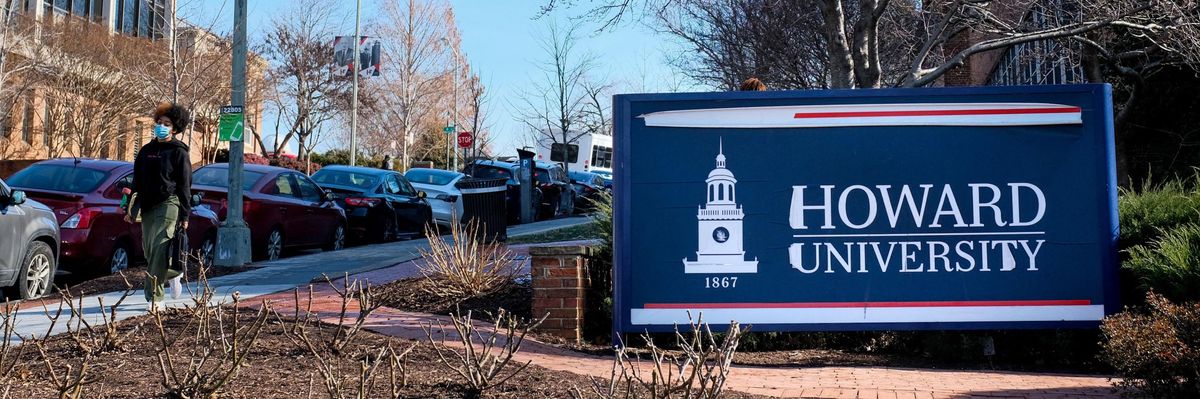
A sign welcomes visitors to Howard University in Washington, D.C., on February 1, 2022.
(Photo: Mandel Ngan/AFP via Getty Images)