PATRICK LAWRENCE: ‘Vote Joy’ — a Delusion of Nostalgia
September 6, 2024
Those populating the vice president’s joy-and-vibes crowd can pretend to celebrate a state of elation while acquiescing to their candidate’s approval of mass murder.
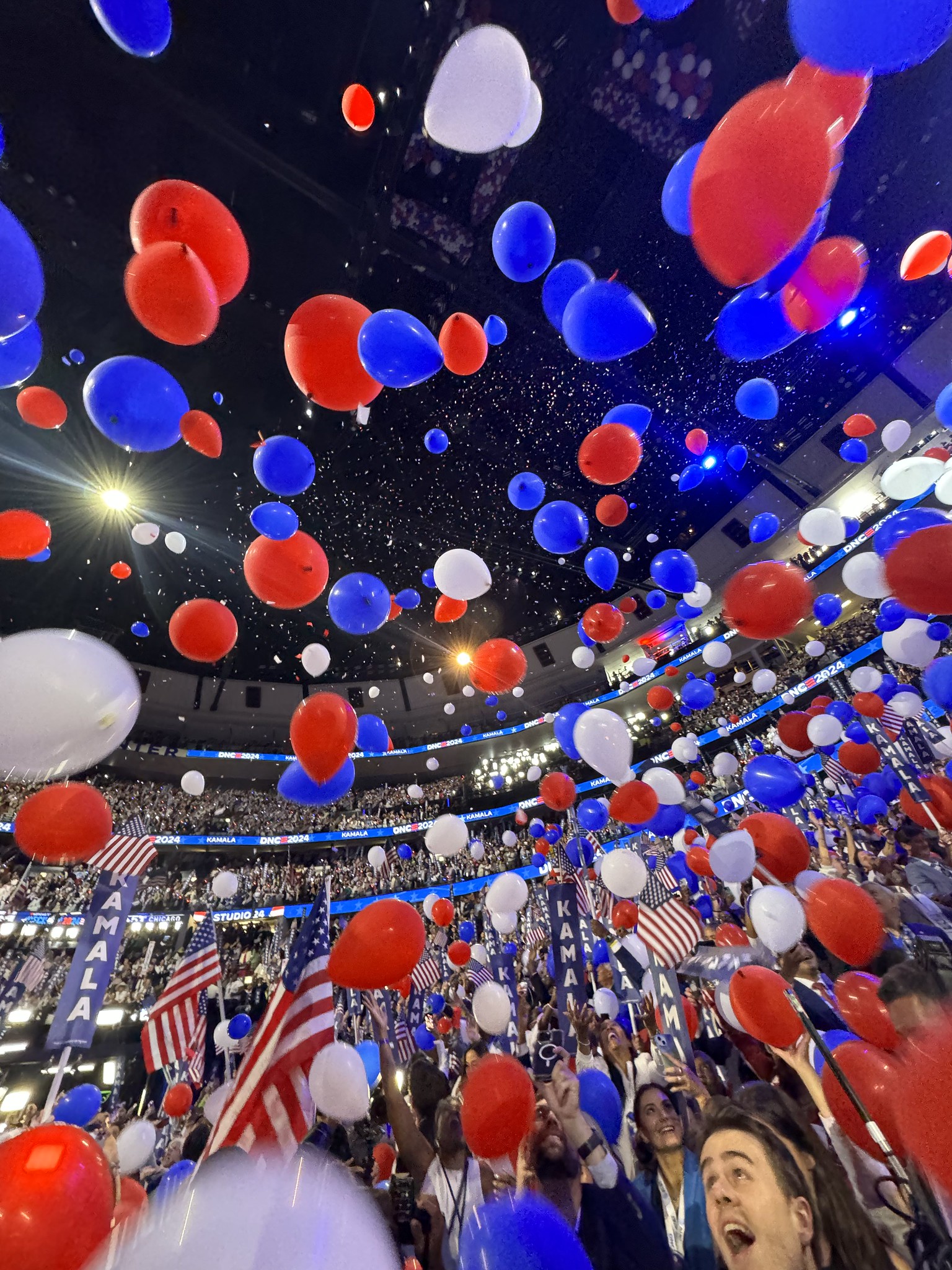
Balloons fall after Vice President Kamala Harris’ speech at the Democratic National Convention last month. (Chris Bentley, Flickr, CC BY-NC-ND 2.0)
By Patrick Lawrence
Special to Consortium News
 Many commentators have attempted to describe the astonishing devolution of Democratic Party politics into sheer marketing: Kamala Harris as product, “new and improved” like a laundry detergent or a frozen dinner.
Vanessa Beeley calls it “cartoon theatrics,” and it’s as good as I’ve seen. In two words the British journalist captures from a useful distance the infantilism of the Harris-for-president campaign and the Hollywoodization of American politics.
I thought I’d seen everything in this line until a few days ago, but in this, the most unserious political season of my lifetime, it is incautious to make any such assumption.
There is always more — something worse — another step down into a sort of political nihilism that leaves the electorate stupefied as the imperium conducts its violent, illegal business.
A truly vulgar graphic artist named Kii Arens now gives us a Kamala Harris campaign poster that is a beyond-belief case in point.
This is “Kamala” against a pastel field, no surname necessary, the presidential candidate as a striding figure out of the 1960s counterculture, an heroic hippie. I hope you are ready for the tag line. It is “Vote Joy 2024.”
My mind was on other things when I first came across this poster. And it landed abruptly as an assault and an insult all at once.
Just glance at it for now: This is how some Democratic voters, and I suspect many, want to imagine a candidate who supports and advances, among various other late-imperial crimes, a genocide of world-historical significance.
The imagery seems, somehow, an almost criminal violation of human intelligence.
“There is always more, something worse, another step down into a sort of political nihilism that leaves the electorate stupefied as the imperium conducts its violent, illegal business.”
Kii Arens makes his living doing pop-art graphics — logos and such — for a lot of show business people and credits Saturday morning children’s television as his primary inspiration. Out in California he owns and runs the La La Land Gallery, which seems about right.
Kii Arens seems to take himself very seriously indeed. And it goes this way: Either Kii Arens has overestimated the gullibility, self-delusions and unconsciousness of liberal voters, especially those who consider themselves “progressive” or “left,” or I have underestimated the same.
I fear Kii Arens may have me on this one. “People are really excited about this poster,” he said in a brief video interview after giving away copies of it at the Democrats’ convention in Chicago. “People are connecting emotionally to my art.”
When I first saw the “Kamala” poster it was via a social media message Katrina vanden Heuvel sent out, with cheerful approval, on “X.”
Vanden Heuvel, as many readers will know, is the editorial director of The Nation. It is important to take note. In “Vote Joy 2024” we find the denouement of the long, pitiful story of what has become of the American “left” and why this term now requires quotation marks.
I have long thought politics can be usefully read as an expression of antecedent cultural and psychological phenomena.
Psychic Journey
This is how I view the Kii Arens poster and why I think it merits careful scrutiny: It is a window, or maybe a Rosetta Stone, in which we can read the coded interiority of the “left’s” psychic journey from the honorable commitments of earlier times to… to what?… to a state of willful political and intellectual immaturity.
Now study the poster for a good few minutes.
There is Harris, of course, in her standard pantsuit and pearls — the political candidate with whom we are familiar. She is serious and altogether credible, but wears that having-fun, sorority-sister smile that endears her to many Democratic voters.
There are the flowers splashed across the whole of the graphic. These are essential to the overall effect. They are the kind of flowers you see on the walls of grade-school art classes.
And they are “flower power” flowers. They bathe Harris in an aesthetic of innocence, with a subliminal suggestion of a childlike guiltlessness. Note Harris’s stride in this connection: It is purposeful, but with the air of a carefree girl walking in a garden.
And then the typefaces. The “Vote Joy 2024” in the lower right immediately draws the eye. It is subtly but unmistakably a reference to the posters associated with the late – ’60s rock scene — a variation on Psychedelic Fillmore West and Psychedelic Fillmore East (which, believe it or not, are two recognized typefaces).
Kii Arens has added a couple of small touches I must mention for the sheer fun of them. He has inscribed a faint paisley pattern into Harris’s presidential pantsuit. Paisley. Dwell upon paisley for a sec and see what you think this means.
And beneath the pantsuit he has Kamala Harris wearing canvas sneakers — those flimsy black Converse things favored by young people who are, to put it charitably, casually dressed.
Sheer fun: and if you think about it, a very pure case of pointedly manipulated imagery.
If I were a certain kind of columnist, I would say the poster Kii Arens has made to express his enthusiasm for the Harris campaign (which he now sells for $47, extra for framing) is, as was just shouted to me from across the room, “a complete mind-fuck.”
But I am not that kind of columnist. I will not say this poster, with all its flower power iconography in behalf of a warmonger, is a complete mind-fuck.
I would say the physiologically ambitious intent of this poster is to perform the act of love on the cerebral cavity. Way more acceptable for a family publication such as Consortium News.
I do not know whether the Harris campaign commissioned this thing. I suspect they like it well enough but did not order it up. In the video interview mentioned above, Kii Arens comes over as an averagely guileless, averagely indoctrinated liberal with no clue of the diabolic cynicism with which the Democratic Party is inventing Kamala Harris of whole cloth.
My read: “Vote Joy 2024” comes straight out of Kii Arens’s unconscious, and this is what makes it interesting. It is fair enough, and useful, if we think of Arens as the id of those “progressive” and “left”–inclined voters the Harris campaign must seduce if “Kamala” is to win in November.
I do not know how many Democratic voters buy into the various signifiers Arens has inscribed into his poster. I suspect he speaks for very many — someone should check his sales — but let us set this aside.
His work is certainly a disturbing measure of the extent to which those who could well propel Harris to the White House in November are prepared to delude themselves into seeing things in Kamala Harris that are simply not there.
“My art is supposed to reflect positivity, hope, and joy,” Arens says in the videoed interview. There are a lot of Democrats looking for just these things in the figure of Kamala Harris. But this is not the remark of an aware or self-aware American in the late-summer of 2024. It is the remark of someone who is determinedly neither.
Kii Arens has slathered on the semiology in his “Vote Joy 2024” poster with a trowel. Semiology is the science of signs, of significations. In what signs is Kii Arens trafficking?
As an aesthetic object the Arens poster is crude, but this is of no matter. It is dense with many-layered signifiers, and these are what matter.
There are important insights to be gained as we examine these layers and discover what, taken together, they have to say — about the long regression at the left-hand end of America’s politics, about liberal and “left” voters’ fears, fantasies, and failures of nerve.
Here is the Brittanica definition of “flower power.” It is a good place to begin.
“Flower power: the belief that war is wrong and that people should love each other and lead peaceful lives — used especially to refer to the beliefs and culture of young people (called hippies) in the 1960s and 1970s.”
Instantly we learn something.
We have heard daily talk of “joy” and “vibes” since the Democratic Party’s elites and donors undemocratically imposed Kamala Harris as their 2024 candidate.
And now we find, via an admittedly goofy but probably representative Harris voter with an amateur gift for social psychology, that beneath all this compulsive “positivity” there seems to lie a strong streak of nostalgia.
Why, the obvious question, do the liberal voters for whom Arens speaks, or to whom he speaks, or both, indulge in a nostalgia for a time they never knew?
Why is it important that they identify so strongly with those whose political and cultural commitments, however gauzily recalled, gave the 1960s the reputation the decade has in the public consciousness.
Nostalgic Retreat
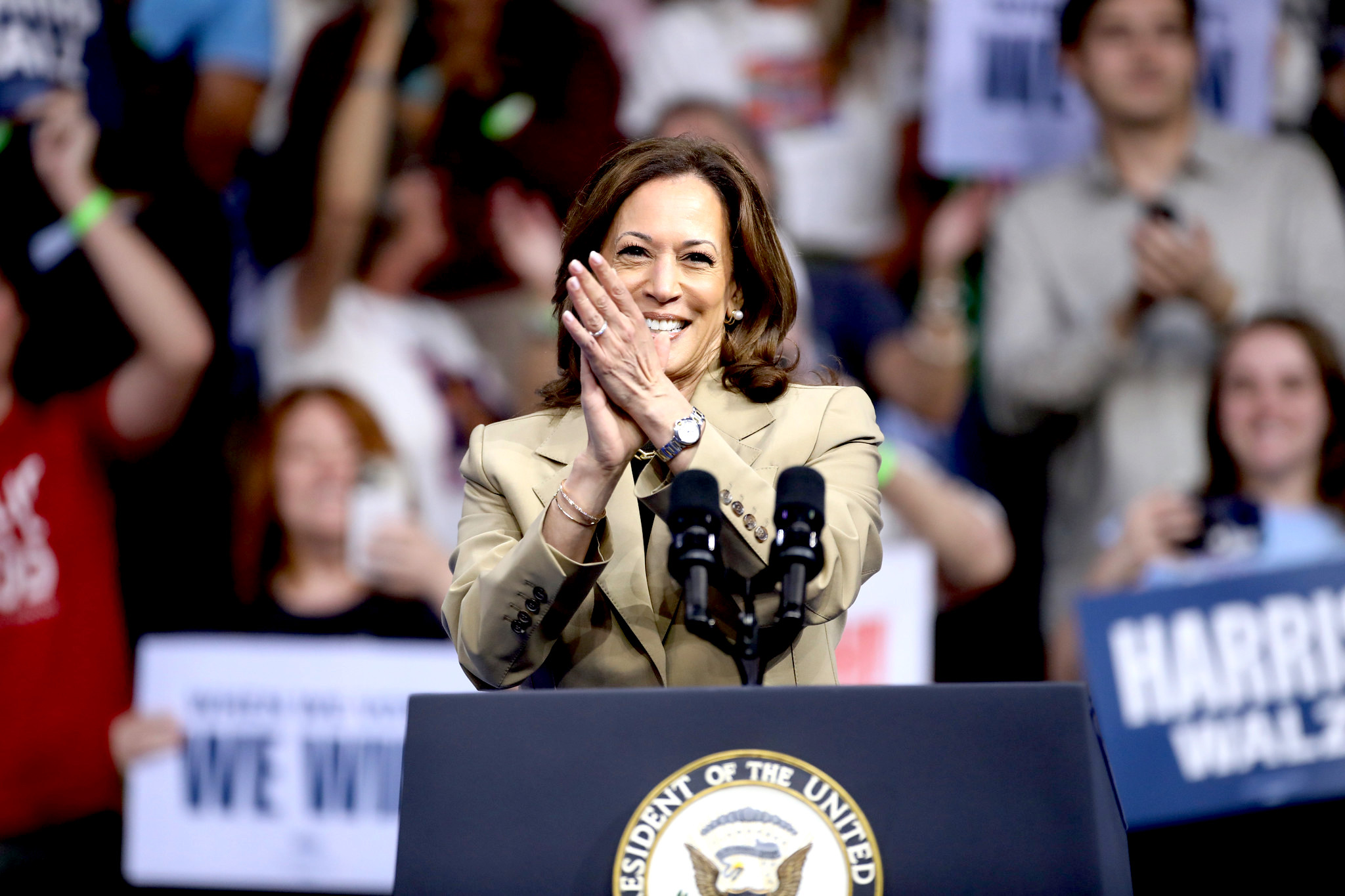
Harris at a campaign rally in Glendale, Arizona, in August. (Gage Skidmore, Flickr, CC BY-SA 2.0)
Why the historical reference? Answer this and we can see into the strange dynamic driving the wave of enthusiasm for the Harris campaign as it floats along on puffy clouds of joy and good vibes.
Nostalgia, I have long argued, is at bottom a symptom of depression. Nostalgists are those who retreat into the past as a refuge from a present they find in one or another way unbearable.
And here I offer a corollary thought: The sensation of powerlessness is a primary cause of depression. Any good psychiatrist would confirm this.
With this in mind, think about all those people “connecting emotionally” to Kii Arens’s iconography, and then all the others who may not have not seen it but would similarly identify with it. That these people are in some inchoate way nostalgic is beyond argument.
The follow-on conclusion seems to me equally evident: All the talk of joy and vibes is at bottom a mask for a more or less prevalent depression people cannot admit to themselves they suffer.
As the Britannica notes in its stuffy, wooden fashion, “peace” and “love” were among the totemic terms that characterized the 1960s counterculture Arens unsubtly references. But you cannot, plain and simple, walk around today talking of either and expect to be taken seriously.
Ours is not a polity that gives any credence to notions of peace and neighborly love. This is absolutely out.
Propagandists and ideologues have long since transformed mainstream American culture — since the Reagan years, I would say — into a culture of war and animus.
And so we return to joy and vibes. These are excellent terms for those given to fantastic readings of Kamala Harris.
To stand for peace and love 50 or 60 years ago was to challenge what people used to call “the establishment.” They had meanings, however angelic were those professing these things.
“Joy” and “vibes” have no meanings. This is why they have caught on like fires in a dry forest. They do not signify challenges to anything; they license an extraordinary flinch from everything.
Everything: American participation in a genocide, the proxy war in Ukraine, the incessant and increasingly dangerous provocations of China, the brutalizing sanctions against Iran, Venezuela, Syria, Cuba, and all such serious matters of policy.
“’Joy’ and ‘vibes’ have no meanings. This is why they have caught on like fires in a dry forest.”
There is no need to think about any of this. There is, indeed, an unwritten code that the crises of our time, America’s leaders responsible for all of them, are neither to be thought about nor mentioned.
It is brilliant, I would say, this mutilation of logic and reasoning. There is something for everyone in it.
For the Harris campaign the childish nonsense of joy and vibes is a diabolically effective blind. Behind it Harris’ people — and Kamala Harris is nothing more than the sum total of her advisers — can commit to the imperium’s foreign policies without the bother of public scrutiny.
Just leave all that to us: This is the message the Harris people have as they flatly refuse to take up any of the questions that matter most to the imperium’s citizens.
And for those subscribing to the joy-and-vibes ethos, from Katrina vanden Heuvel on down, this is a twofer.
They can persuade themselves they will stand against the established order by voting for the established order. Tell me you know anyone who has deceived himself or herself so cleverly as this.
And while arranging the wilted flowers in their hair, those populating the joy-and-vibes crowd can pretend to celebrate a state of elation while acquiescing to their candidate’s approval of mass murder.
This is important to these people, for they must at all costs avoid facing their utter powerlessness, and so their subliminal depression, as they succumb once more to voting for an evil it is a stretch to consider the lesser of anything.
Sacrifice & Risk
One question lingers as I glance again at the Kii Arens poster. What under the sun happened to the American left between its years at the barricades in the service of honorable causes and this, its time of weak-minded gutlessness?
When did it pass from left to “left”? There is a book in the answer to this, the interior history of several generations, but I will keep this brief.
One of the remarkable features of the antiwar and anti-imperialist movements of the 1960s and 1970s, along with the principled feminists of those years, was the willingness of so many people to accept the necessity of sacrifice. Sacrifice and risk, I would say.
“What … happened to the American left between its years at the barricades in the service of honorable causes and this, its time of weak-minded gutlessness?”
Such people understood: If you cannot stand for what you think is right and accept all the consequences attaching to being authentically who you are, your thoughts and being are of no use. You understood the necessity of living beyond the fence posts, having concluded nothing of worth could get done within them if your intent was to work for genuine change.
And so one gave up well-paid employment, or life in a good neighborhood, or holidays along the coast of Maine, or whatever else comprised one’s version of middle-class privilege.
A certain precarity often accompanied these choices. Your car was a clunker. The heat pipes clanked.
Gradually over many years, the energy and commitment — the commitment to committing, let’s say — faded.
I saw this in people younger than I as early as the mid–1970s. People wanted to think of themselves as “activist,” as “committed,” as standing for “change,” as — totemic word here — as “movement.” But careers came first. The thought took hold that one could get the worthy work done inside the fence posts and without taking any risks.
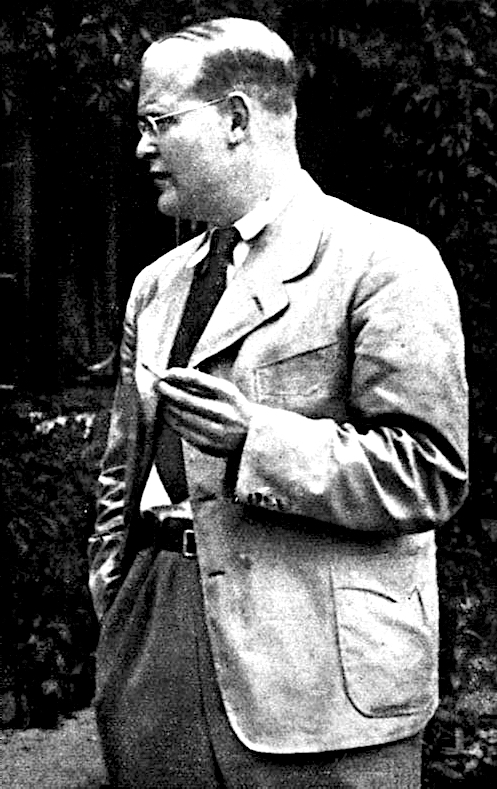
Dietrich Bonhoeffer in 1939. (Bundesarchiv, Wikimedia Commons, CC-BY-SA 3.0)
Deitrich Bonhoffer, the celebrated German pastor who paid with his life for his resistance to the Reich, used to speak and write of cheap grace and costly grace.
The former means, in secular terms, the pretense of an honorable life without sacrifice. The latter is the opposite: To earn costly grace means to live and work honorably and paying whatever price one must for it.
I am talking about the difference between the two as this came to be at the left-hand side of the garden over the past 50 or so years.
A book I began reading last spring bears very well on this question. Anne Dufournmantelle, a greatly respected psychoanalyst who died tragically at 53 in 2017, published Éloge du risque (Payott & Rivage) in 2011; Fordham University Press brought it out as In Praise of Risk eight years later. After sitting on my shelf for several years, this has made its way among the most important books of my life.
We cannot live authentic lives unless we accept the constant presence of risk, Dufourmantelle argued over the course of 51 brief chapters (which do not have to be read in order).
She means the risks inherent as we make all our choices — risks in relationships, risks in our victories and surrenders, risks in our public lives as well as our private, the risks altogether in how we live.
And the greatest of all risks, Dufourmantelle writes, is the first one we must take if we are to take all the others. This is the risk we take when we overcome our fear of life and determine to live.
It is, she says, “the risk of not dying.” And by not-dying she means refusing the death in life to which most people succumb as they surrender to conformity, or to inaction, or to our paranoiac addiction to total certainty.
And so to my concluding point.
Kii Arens is merely a product of his moment, not to be singled out as anything more. His poster is a cultural text. This is testimony to the vulgarization of American public discourse, but it nonetheless — or maybe for this reason — bears interpretation.
Among other things, the iconography of his poster reminds us that the Harris-for-president campaign is in considerable measure a psychological phenomenon.
I read “Vote Joy 2024” not as a celebration of the Harris-for-president project but as an implicit admission of what is absent from it. It is a document recording, in the simplest terms, the regret of those who have refused the risk of not dying while envying those before them who took it.
Patrick Lawrence, a correspondent abroad for many years, chiefly for The International Herald Tribune, is a columnist, essayist, lecturer and author, most recently of Journalists and Their Shadows, available from Clarity Press or via Amazon. Other books include Time No Longer: Americans After the American Century. His Twitter account, @thefloutist, has been permanently censored.
TO MY READERS. Independent publications and those who write for them reach a moment that is difficult and full of promise all at once. On one hand, we assume ever greater responsibilities in the face of mainstream media’s mounting derelictions. On the other, we have found no sustaining revenue model and so must turn directly to our readers for support. I am committed to independent journalism for the duration: I see no other future for American media. But the path grows steeper, and as it does I need your help. This grows urgent now. In recognition of the commitment to independent journalism, please subscribe to The Floutist, or via my Patreon account.
The views expressed are solely those of the author and may or may not reflect those of Consortium News.


