
Showing posts with label NAOMI KLEIN. Show all posts

Sunday, September 14, 2025

Naomi Klein | Wealth and Power Shape the Climate Emergency – the Most Important Tool We Have to Defend Ourselves Is the Facts


Reader Supported News
13 September 25

VERY SERIOUS PROBLEM WITH DONATIONS RIGHT NOW — RSN is getting killed on donations in September. Donations to RSN have fallen sharply this month. We do not have the cash reserves to sustain this. Very serious situation on funding now.
Marc Ash • Founder, Reader Supported News

Sure, I'll make a donation!

Naomi Klein. (photo: Ed Kashi)
Naomi Klein | Wealth and Power Shape the Climate Emergency – the Most Important Tool We Have to Defend Ourselves Is the Facts
Naomi Klein, Guardian UK
Klein writes: "The corporate-financed backlash to calls for global climate progress has been greatly empowered by the Trump administration. It’s never been more critical to challenge the misinformation that could turn a crisis into a catastrophe."

The corporate-financed backlash to calls for global climate progress has been greatly empowered by the Trump administration. It’s never been more critical to challenge the misinformation that could turn a crisis into a catastrophe


Alittle over a decade ago I published a book, This Changes Everything, which explored the reality of the climate crisis as a confrontation between capitalism and the planet. For a few years after the book came out, it seemed like we might just win a breakthrough. A cascade of large and militant mobilisations pressed the case for keeping warming below 1.5C as global calls for a green new deal grew louder and louder. Countries across the world announced long-term plans to reduce emissions and to hit net-zero targets; so did some of the largest corporations on the planet.

And then … well, we all know what happened. A corporate-financed backlash on all fronts. In the first 100 days of Trump’s second term, his administration took more than 140 actions to roll back environmental rules and push for greater use of fossil fuels. He signed executive orders to ease restrictions on their extraction and export, filled his cabinet with oil industry supporters, gutted federal agencies on the forefront of the climate crisis, and cancelled life-saving environmental justice projects.

Empowered by the world’s most powerful man’s assault on the planet, the banks and corporations that have financed our climate disaster – those with an apocalyptic fear of regulation eating into their super-profits – have let their masks slip, dropping their stated renewable ambitions and ploughing money into fossil fuels.

Meanwhile, climate misinformation – amplified by far-right and rightwing populist politicians – is now so virulent online that one comprehensive study says it is likely to help turn a crisis into a catastrophe.

I write for the Guardian because it continues to challenge and expose these forces – even as the financial conditions for producing this kind of work become more challenging by the day.

For the past fortnight the Guardian has been reminding its readers about the role it is playing in exposing the threat to climate and environmental progress – and, as always, it has been naming names.

The reason the Guardian is free to do this kind of vital work is simple: it is not beholden to corporations or billionaires. In 2020, it even banned advertising from fossil fuel companies – the first major news organisation to do so. Most of its funding comes directly from a small percentage of readers who believe in the importance of independent journalism

Wealth and power shape every aspect of this emergency. The most important tool we have to defend ourselves is the facts.

The second most important tool is hope: the Guardian’s journalism plays an important role in highlighting the actions we, as a society and as individuals, can do against this barrage.


New Bill Would Give Marco Rubio “Thought Police” Power to Revoke US Passports
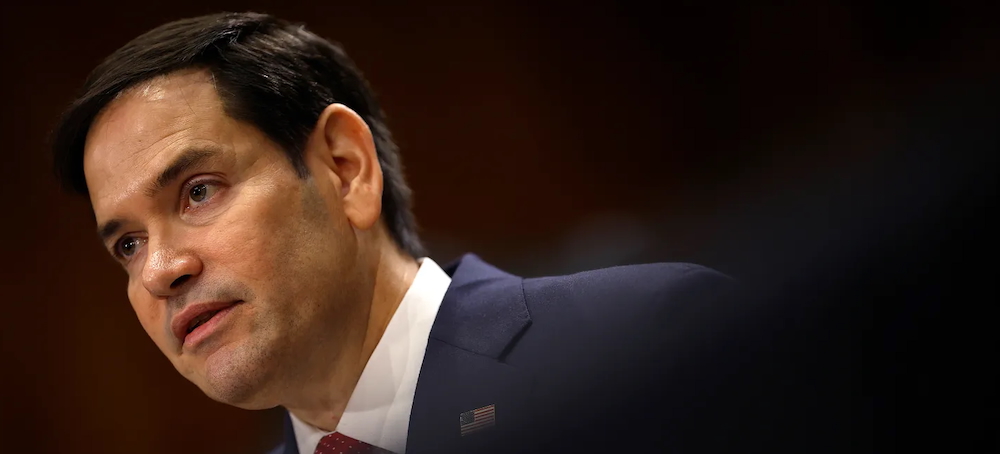
New Bill Would Give Marco Rubio “Thought Police” Power to Revoke US PassportsSecretary of State Marco Rubio. (photo: Kevin Dietsch/Getty Images)


Matt Sledge, The Intercept
Sledge writes: "Rubio has already sought to punish immigrants for speech. New legislation might let him do it for U.S. citizens."

Rubio has already sought to punish immigrants for speech. New legislation might let him do it for U.S. citizens.

In March, Secretary of State Marco Rubio stripped Turkish doctoral student Rümeysa Öztürk’s of her visa based on what a court later found was nothing more than her opinion piece critical of Israel.

Now, a bill introduced by the chair of the House Foreign Affairs Committee is ringing alarm bells for civil liberties advocates who say it would grant Rubio the power to revoke the passports of American citizens on similar grounds.

The provision, sponsored by Rep. Brian Mast, R-Fla., as part of a larger State Department reorganization, is set for a hearing Wednesday.

Mast’s legislation says that it takes aim at “terrorists and traffickers,” but critics say it could be used to deny American citizens the right to travel based solely on their speech. (The State Department said it doesn’t comment on pending legislation.)

Seth Stern, the director of advocacy at Freedom of the Press Foundation, said the bill would open the door to “thought policing at the hands of one individual.”

“Marco Rubio has claimed the power to designate people terrorist supporters based solely on what they think and say,” Stern said, “even if what they say doesn’t include a word about a terrorist organization or terrorism.”

Vague “Terrorist” Designations

Mast, for his part, has publicly voiced his support for “kicking terrorist sympathizers out of our country.” At the time, he was talking about deporting Mahmoud Khalil, a Palestinian green-card holder who the Trump administration detained and attempted to deport based on what critics of the move said were his pro-Palestine views.

Mast’s new bill claims to target a narrow set of people. One section grants the secretary of state the power to revoke or refuse to issue passports for people who have been convicted — or merely charged — of material support for terrorism. (Mast’s office did not respond to a request for comment.)

Kia Hamadanchy, a senior policy counsel at the American Civil Liberties Union, said that language would accomplish little in practice, since terror convictions come with stiff prison sentences and pre-trial defendants are typically denied bail.

The other section sidesteps the legal process entirely. Rather, the secretary of state would be able to deny passports to people whom they determine “has knowingly aided, assisted, abetted, or otherwise provided material support to an organization the Secretary has designated as a foreign terrorist organization.”

The reference to “material support” disturbed advocates who have long warned that the government can misuse statutes criminalizing “material support” for terrorists — first passed after the 1996 Oklahoma City federal building bombing and toughened after the 9/11 attacks — to punish speech.

Some of those fears have been borne out. The Supreme Court ruled in 2010 that even offering advice about international law to designated terror groups could be classified as material support.

The government even deemed a woman who was kidnapped and forced to cook and clean for Salvadoran guerrillas a material supporter of terrorism, in order to justify her deportation.

Since the October 7 Hamas attacks, pro-Israel lawmakers and activists have ratcheted up attempts to expand the scope and use of anti-terror laws.

The Anti-Defamation League and the Louis D. Brandeis Center for Human Rights Under Law suggested in a letter last year that Students for Justice in Palestine was providing “material support” for Hamas through its on-campus activism.

Lawmakers also tried to pass a “nonprofit killer” bill that would allow the Treasury secretary to strip groups of their charitable status if they are deemed a “terrorist-supporting organization.” The bill was beaten back by a coalition of nonprofit groups, most recently during the debate over the so-called Big, Beautiful Bill.

Mast’s bill contains eerily similar language, Stern said.

“This is an angle that lawmakers on the right seem intent on pursuing — whether through last year’s nonprofit killer bill, or a bill like this,” Stern said.

The provision particularly threatens journalists, Stern said. He noted that Sen. Tom Cotton, R-Ark., in November 2023 demanded a Justice Department “national security investigation” of The Associated Press, CNN, New York Times, and Reuters over freelance photographers’ images of the October 7 attacks.

Rubio also revoked Öztürk’s visa on what appears to be nothing more than an op-ed she wrote for the Tufts University student newspaper in 2024 — which did not mention Hamas — calling on the school to divest from companies tied to Israel.

Since taking office, Rubio has also added groups to the State Department’s list of foreign terrorist organizations at a blistering pace, focusing largely on gangs and drug cartels that were previously the domain of the criminal legal system.

Free Speech Exception?

There is an ostensible safety valve in Mast’s bill. Citizens would be granted the right to appeal to Rubio within 60 days of their passports being denied or revoked.

That provided little comfort to the ACLU’s Hamadanchy, who is helping rally opposition to the bill.

“Basically, you can go back to the secretary, who has already made this determination, and try to appeal. There’s no standard set. There’s nothing,” he said.

Hamadanchy said the provision granting the secretary of state discretionary power over passports appeared to be an attempt to sidestep being forced to provide evidence of legal violations.

“I can’t imagine that if somebody actually provided material support for terrorism there would be an instance where it wouldn’t be prosecuted — it just doesn’t make sense,” he said.

While the “nonprofit killer” bill drew only a smattering of opposition on the right from libertarian-minded conservatives such as Rep. Thomas Massie, R-Ky., Stern said Republicans should be just as concerned about the potential infringement of civil liberties in the passport bill.

The law, he said, would also grant nearly unchecked power to a Democratic secretary, he said.

“Lately, it appears that the right is so convinced that it will never be out of power that the idea that one day the shoe might be on the other foot doesn’t resonate,” Stern said. “What is to stop a future Democratic administration from designating an anti-abortion activist, a supporter of West Bank settlements, an anti-vaxxer to be a supporter of terrorism and target them the same way? The list is endless.”


Prosecutors’ ‘Cop City’ Case Collapses as Judge Tosses RICO Conspiracy Charges
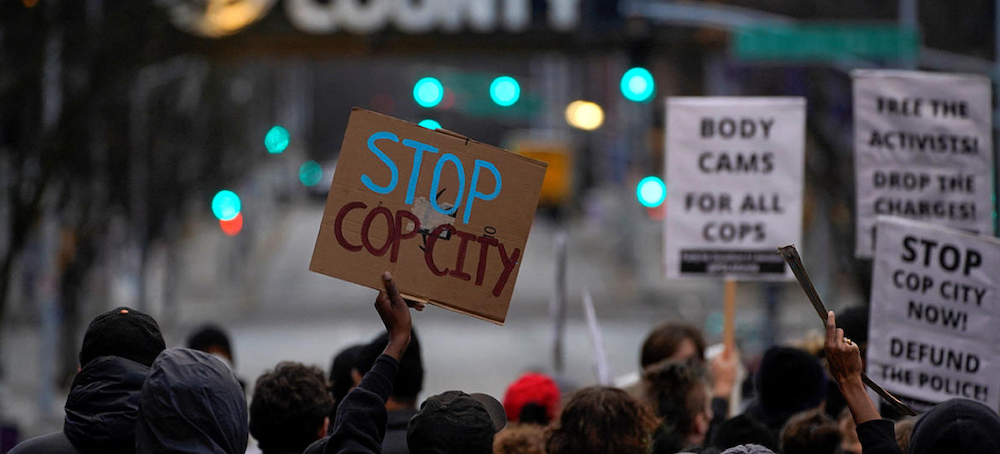
Prosecutors’ ‘Cop City’ Case Collapses as Judge Tosses RICO Conspiracy ChargesA demonstration in response to the death of Manuel Terán, who was killed during a police raid inside Weelaunee People's Park, the planned site of a "Cop City" project, in Atlanta. (photo: Cheney Orr/Reuters)


Timothy Pratt, Guardian UK
Pratt writes: "Georgia prosecutors are facing what one expert called 'probably the highest-profile failure of using conspiracy charges to indict a protest movement' in US history, after a two-year attempt to prosecute a criminal conspiracy in connection with opposition to the police training center known as Cop City."


Two-year attempt to prosecute opponents of police training center on criminal conspiracy charges ends in failure


Georgia prosecutors are facing what one expert called “probably the highest-profile failure of using conspiracy charges to indict a protest movement” in US history, after a two-year attempt to prosecute a criminal conspiracy in connection with opposition to the police training center known as Cop City.

Fulton county superior court Judge Kevin Farmer announced his decision to dismiss charges against the case’s 61 defendants during hearings this week on a handful of defense attorney motions.

The hearings came after several years of delays in the case centered on Rico, a law created to go after the mafia and usually associated with organized crime, not protest movements. Farmer’s decision responded to a motion filed on behalf of defendant Thomas Jurgens, an attorney acting as a legal observer for the National Lawyers Guild at a music festival on 5 March 2023 in a forested public park near the police training center site.

Jurgens was one of dozens arrested that day and charged in connection with damage done to construction machinery at the site.

After an hour-plus of discussion in this week’s hearing, Farmer came back from a break and used only 18 words to stymie the state’s prosecution, nearly three years after arrests: “At this time I do not find the attorney general had the authority to bring this Rico case.”

The decision dismisses charges in 100 pages of the state’s 109–page indictment. It also covers one count of arson against five defendants, and the judge is expected to issue a separate ruling on domestic terrorism charges against the same five defendants.

Farmer said he will soon issue the orders in writing.

The state has announced its intention to appeal. “The attorney general will continue the fight against domestic terrorists and violent criminals who want to destroy life and property,” Georgia attorney general Chris Carr’s office said in a statement.

Carr is running for governor of Georgia in next year’s race.

Opposition to the $109m center, which opened this spring, has come from a wide range of local and national organizations and protesters, and is centered on concerns around police militarization and clearing forests in an era of climate crisis. Atlanta police say the center is needed for “world-class” training and to attract new officers.

This week’s decision “exposes that the indictment was fundamentally flawed from the outset”, said Brad Thomson, one of the case’s dozens of defense attorneys and a member of the People’s Law Office, a Chicago-based civil rights firm.

Farmer’s ruling from the bench was based on Carr’s office having pursued the case after district attorneys for Dekalb and Fulton counties had declined to do so. This was an action for which the state had no authority, and for which the attorney general would have required special permission from Georgia Governor Brian Kemp, the judge said. No such permission was sought or given.

The decision shows “what critics said all along – that the state of Georgia was in such a rush and panic to stop the ’Stop Cop City’ movement that they violated their own rules,” said social movement historian Dan Berger. “They acted inappropriately and without justification, to bring what seemed from the beginning as dramatically overblown and patently absurd charges.”

Although certainly the most dramatic, the state’s procedural negligence leading to the judge’s decision was not the only example of prosecutorial sloppiness during the last two years.

Deputy attorney general John Fowler, the case’s lead prosecutor, was found last year to have obtained emails between defendants and their attorneys, then including them in discovery materials and sharing them with police investigators, thereby violating attorney-client privilege.

Fowler also denied in court that police sent messages about Cop City using Signal, despite being presented, in another motion from defense attorneys, with evidence from the Guardian of law enforcement leadership ordering officers last year to download the encrypted phone app for that very purpose.

At one point this week, the judge noted that he had read all the defense’s motions, but had received no responses from the state. “I have nothing to read from the state – and it’s been two years,” Farmer said.

Representing members of Atlanta Solidarity Fund – a bail fund whose three members are mentioned more than 120 times in the indictment – veteran attorney Donald Samuel told the judge this week, “the [criminal] enterprise is defined as a movement – can you imagine that? The civil rights movement would be defined as an enterprise according to the attorney general!”

Joseph Brown, a political scientist who has written about the movement against Cop City, said that Georgia “was so hellbent on criminalizing a protest movement that was strong, resilient and popularly-supported … [it] decided to use the law as a political tool.”

Brown compared the case to the so-called J20 protesters, more than 200 of whom were arrested at a 2017 protest in Washington, targeting Donald Trump’s first presidential inauguration. They faced felony riot and conspiracy charges of conspiracy. In a case drawn out over more than a year, the state was found to have withheld evidence as well as committing other irregularities. Ultimately, nearly all the cases were dismissed, and only one person served jail time.

“We see examples of prosecutorial overreach in highly politicized cases,” Brown said.

Farmer’s decision makes the Cop City case “probably the highest-profile failure of using conspiracy charges to indict a protest movement”, he added.

Brown said the two cases also have in common that defendants stuck together, and didn’t “point fingers” at each other for plea deals. “In a political movement” like this, he said, “people care about each other”.

Will Potter, author of the recently released Little Red Barns, a decade-long investigation of factory farms and fascism, said the lessons of the case could be important under Trump’s second term, which has seen the US slide towards authoritarianism.

“The playbook–stretching laws like Rico to cast dissent as organized crime won’t vanish, especially amid a surge of authoritarian and openly fascist politics,” Potter said.

Trump’s Excuse for Firing Fed Governor Doesn’t Hold Water
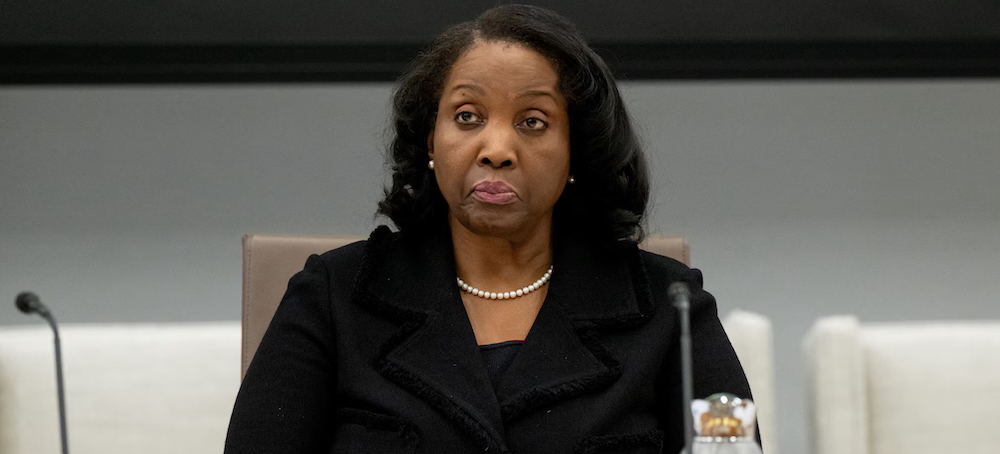
Trump’s Excuse for Firing Fed Governor Doesn’t Hold WaterFederal Reserve governor Lisa Cook at a meeting in June. (photo: Saul Loeb/AFP/Getty Images)


C.K. Smith, Salon
Smith writes: "Records confirm the Fed governor followed the rules, undermining the case used to justify her firing."
 

Newly obtained documents reviewed by Reuters undermine the central allegation that Federal Reserve Governor Lisa Cook committed mortgage fraud — the sole justification cited by former President Donald Trump for firing her from the Fed Board last week.

The accusation, first raised by Federal Housing Finance Agency Director Bill Pulte, claimed that Cook simultaneously designated two properties — her Michigan home and an Atlanta condominium — as “primary residences” in order to secure favorable loan terms. That allegation triggered a Justice Department probe and was used by Trump to argue she had engaged in conduct unbecoming a Fed governor. There is also a condo in Massachusetts that they are now adding to the complaint.

But a 2021 loan estimate for the Atlanta property shows Cook explicitly declared it as a “vacation home.” Additional disclosures on her 2021 SF-86 security clearance form list the condo as a “second home,” and county tax records confirm she never sought a primary-residence exemption for the Atlanta address. These records directly contradict the claim that she treated the properties as her primary residence. She previously taught at Michigan State University and Harvard University and is originally from Georgia.

Legal experts say the new evidence makes it far harder to substantiate mortgage fraud charges. Documentation indicating that Cook consistently listed the Atlanta property as a second home makes it difficult to claim she misrepresented her intent to the lender, according to a housing law expert cited by Reuters.

Cook, a key voice on the Fed’s interest rate policy, has denied wrongdoing and called her removal a politically motivated attack. The Justice Department’s investigation remains ongoing, but these revelations are likely to intensify scrutiny of the decision to oust her — and could set up a legal fight over her firing.


We Escaped Certain Death': Israel Intensifies Gaza City Bombardment, Forcing Families to Flee
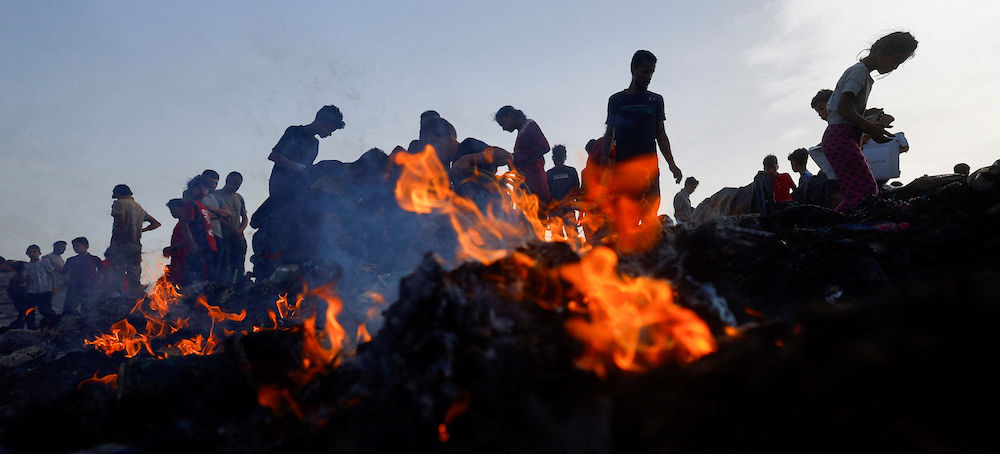
'We Escaped Certain Death': Israel Intensifies Gaza City Bombardment, Forcing Families to FleePalestinians search for food among burning debris in the aftermath of an Israeli strike. (photo: Mohammed Salem/Reuters)


Rushdi Abualouf and Dearbail Jordan, BBC News
Excerpt: "Israeli forces have stepped up their assault on Gaza City with a wave of heavy air strikes, marking a sharp escalation from previous military operations."

Israeli forces have stepped up their assault on Gaza City with a wave of heavy air strikes, marking a sharp escalation from previous military operations.

Unlike earlier phases of the war, the current offensive has relied heavily on aerial bombardments, with entire apartment blocks and large concrete structures reduced to rubble.

The intensification of strikes in recent days has triggered a surge in civilian displacement.

Israel has warned all residents of Gaza City to leave immediately in anticipation of a huge ground offensive.

On Saturday, the Israeli Defense Forces (IDF) said about 250,000 people had left the city and moved south. It also said it had destroyed a high-rise building that it said had been used "to advance and execute terrorist attacks" against its troops.

Israeli Prime Minister Benjamin Netanyahu says the city is Hamas's last major stronghold. But the plan to occupy Gaza City has brought international criticism.

The UN has warned an intensification of the offensive on an area where a famine has already been declared will push civilians into an "even deeper catastrophe". Gaza City is the largest urban centre in the territory and a historic heart of Palestinian political and social life.

Residents say the Israeli military has been targeting schools and makeshift shelters, often issuing warnings only moments before bombardments.

Many families have been forced to flee in darkness toward western Gaza.

"We escaped certain death, my husband, our three children and I," said Saly Tafeesh, a mother sheltering in the city. "My brother died in my arms after being shot by a quadcopter drone. We ran in the dark to the west of Gaza."

The Israeli military has told residents to evacuate to the south of the territory - but many families say they cannot afford the journey, which costs up to $1,100 (£800). Hamas, meanwhile, has intensified its calls for residents to stay put and resist leaving the city.

Rubein Khaled, a father-of-nine preparing to move south, expressed frustration.

"The Hamas preacher at Friday prayers accused anyone leaving Gaza City of being a coward running from the battlefield," he said.

"But why doesn't he tell Hamas leaders to surrender and release the Israeli hostages so this war can stop? We don't want to leave either, but we have no choice."

Israeli forces have not yet reached some eastern neighbourhoods that have remained largely intact since earlier raids in January, but the current campaign suggests they may now be seeking to dismantle entire districts.

Meanwhile, a Qatari foreign ministry spokesman strongly criticised Israel's prime minister in an interview with the BBC following this week's Israeli strike on Hamas officials in the Qatari capital Doha.

Foreign Ministry spokesman Majed Al-Ansari told the BBC that the international community had "to deal with a Netanyahu problem".

"He is not somebody who is listening to anybody right now, who is listening to any reason, and we have to collectively stop him in his tracks," the official said.

He argued the strike in Doha showed the Israeli leader "never intended to sign any peace deal" to end the war in Gaza and instead "believes he can re-shape the Middle East in his own image".

Five of the group's members and a Qatari security officer were killed in Tuesday's strike - though the Palestinian armed group claimed no senior leaders had been killed. Hamas members had been in Doha to discuss the latest US proposal for a ceasefire in Gaza.

Israel has faced widespread condemnation, including at the UN Security Council. Benjamin Netanyahu said Israel targeted the "terrorist masterminds" behind the 7 October 2023 Hamas attack on Israel.

Qatar's Prime Minister Mohammed bin Abdulrahman al-Thani earlier said that Qatar did not get advance warning of the strike, only receiving a call from a US official 10 minutes after the attack had started.

On Friday, al-Thani had dinner with US President Donald Trump and his envoy Steve Witkoff in New York, having earlier met Vice President JD Vance and Secretary of State Marco Rubio at the White House.

Rubio is travelling to Israel this weekend in a show of solidarity with Israel ahead of a UN meeting later this month at which France and the UK are expected to formally recognise a Palestinian state.

On Saturday, the Hamas-run health ministry in Gaza said the bodies of 47 people killed by the Israeli military had arrived at its hospitals over the previous day.

Since UN-backed global food security experts confirmed a famine in Gaza City on 22 August, the ministry has reported that at least 142 people have died from starvation and malnutrition across the territory. Israel has said it is expanding its efforts to facilitate aid deliveries and has disputed the health ministry's figures on malnutrition-related deaths.

The Israeli military launched its campaign in Gaza in response to the Hamas-led attack on southern Israel on 7 October 2023, in which about 1,200 people were killed and 251 others were taken hostage.

At least 64,803 people have been killed in Israeli attacks in Gaza since then, according to the territory's health ministry.


Students, Schools Race to Save Clean Energy Projects in Face of Trump Deadline
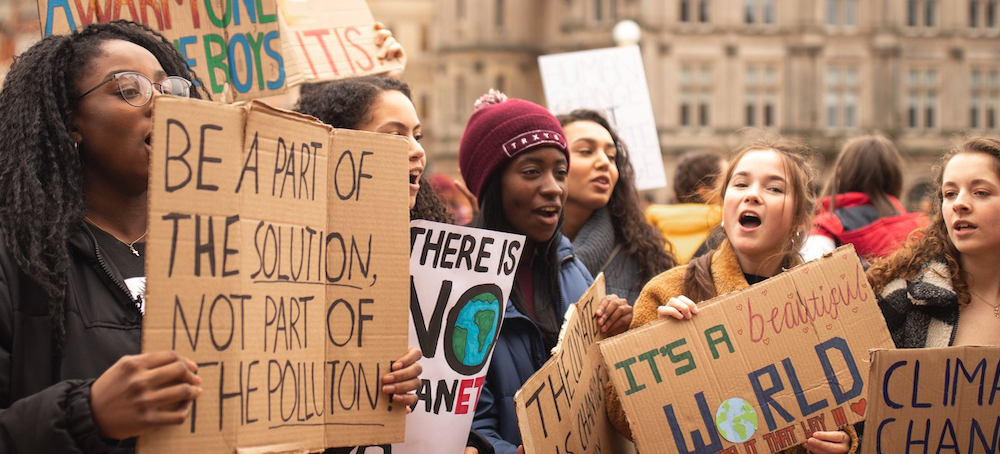
Students, Schools Race to Save Clean Energy Projects in Face of Trump DeadlineGentin writes: "Many projects such as solar panels and electric school buses may not meet new deadlines for tax credits under the 'big, beautiful bill.'"


Julia Gentin, The Hechinger Report
Gentin writes: "Many projects such as solar panels and electric school buses may not meet new deadlines for tax credits under the 'big, beautiful bill.'"


Tanish Doshi was in high school when he pushed the Tucson Unified School District to take on an ambitious plan to reduce its climate footprint. In Oct. 2024, the availability of federal tax credits encouraged the district to adopt the $900 million plan, which involves goals of achieving net-zero emissions and zero waste by 2040, along with adding a climate curriculum to schools.

Now, access to those funds is disappearing, leaving Tucson and other school systems across the country scrambling to find ways to cover the costs of clean energy projects.

The Arizona school district, which did not want to impose an economic burden on its low-income population by increasing bonds or taxes, had expected to rely in part on federal dollars provided by the Biden-era Inflation Reduction Act, Doshi said.

But under HR1, or the “One Big Beautiful Bill Act” passed on July 4, Tucson schools will not be able to receive all of the expected federal funding in time for their upcoming clean energy projects. The law discontinues many clean energy tax credits, including those used by schools for solar power and electric vehicles, created under the IRA. When schools and other tax-exempt organizations receive these credits, they come in the form of a direct cash reimbursement.

At the same time, Tucson and thousands of districts across the country that were planning to develop solar and wind power projects are now forced to decide between accelerating them to try to meet HR1’s fast-approaching “commence construction” deadline of June 2026, finding other sources of funding, or hitting pause on their plans. Tina Cook, energy project manager for Tucson schools, said the district might have to scale back some of its projects unless it can find local sources of funding.

“Phasing out the tax credits for wind and solar energy is going to make a huge, huge difference,” said Doshi, 18, now a first-year college student. “It ends a lot of investments in poor and minority communities. You really get rid of any notion of environmental justice that the IRA had advanced.”

The tax credits in the IRA, the largest legislative investment in climate projects in U.S. history, had marked a major opportunity for schools and colleges to reduce their impact on the environment. K-12 school infrastructure releases an estimated 41 million metric tons of emissions per year, according to an analysis from the New Buildings Institute. The K-12 school system’s buses — some 480,000 — and meals also produce significant emissions and waste. Clean energy projects supported by the IRA were helping schools not only to limit their climate toll but also to save money on energy costs over the long term and improve student health, advocates said.

As a result, many students, consultants, and sustainability leaders said, they have no plans to abandon clean energy projects. They said they want to keep working to cut emissions, even though that may be more difficult now.

Sara Ross, co-founder of UndauntedK12, which helps school districts green their operations, divided HR1’s fallout on schools into three categories: the good, the bad, and the ugly.

On the bright side, she said, schools can still get up to 50 percent off for installing ground source heat pumps — those credits will continue — to more efficiently heat schools. The network of pipes in a ground source pump cycles heat from the shallow earth into buildings.

In the “bad” category, any electric vehicle acquired after September 30 of this year will not be eligible for tax credits — drastically accelerating the IRA’s phaseout timeline by seven years. That applies to electric school buses as well as electric vehicle charging stations at schools. EPA’s Clean School Bus Program still exists for two more years and covers two-thirds of the funding for all electric school buses districts acquire in that time. The remaining one-third, however, was to be covered by federal and state tax credits.

The expiration of the federal tax credits could cost a district up to $40,000 more per vehicle, estimated Sue Gander, director of the Electric School Bus Initiative run by the nonprofit World Resources Institute.

Solar projects will see the most “ugly” effects of HR1, Ross said.

Los Angeles Unified School District is planning to build 21 solar projects on roofs, carports, and other structures, plus 13 electric vehicle charging sites, as part of an effort to reduce energy costs and achieve 100 percent renewable energy by 2040. The district anticipated receiving around $25 million in federal tax credits to help pay for the $90 million contract, said Christos Chrysiliou, chief eco-sustainability officer for the district. With the tight deadlines imposed by HR1, the district can no longer count on receiving that money.

“It’s disappointing,” Chrysiliou said. “It’s nice to be able to have that funding in place to meet the goals and objectives that we have.”

LAUSD is looking at a small portion of a $9 billion bond measure passed last year, as well as utility rebates, third-party financing and grants from the California Energy Commission, to help make up for some of the gaps in funding.

Many California State University campuses are in a similar position as they work to install solar to meet the system’s goal of carbon neutrality by 2045, said Lindsey Rowell, CSU’s chief energy, sustainability, and transportation officer.

Tariffs on solar panel materials from overseas and the early sunsetting of tax credits mean that “the cost of these projects is becoming prohibitive for campuses,” Rowell said.

Sweeps of undocumented immigrants in California may also lead to labor shortages that could slow the pace of construction, Rowell added. “Limiting the labor force in any way is only going to result in an increased cost, so those changes are frightening as well,” she said.

New Treasury Department guidance issued August 15 made it much harder for projects to meet the threshold needed to qualify for the tax credits. Renewable energy projects previously qualified for credits once a developer spent 5 percent of a project’s cost. But the guidelines have been tightened — now, larger projects must pass a “physical work test,” meaning “significant physical labor has begun on a site,” before they can qualify for credits. With the construction commencement deadline looming next June, these will likely leave many projects ineligible for credits.

“The rules are new, complex, [and] not widely understood,” Ross said. “We’re really concerned about schools’ ability to continue to do solar projects and be able to effectively navigate these new rules.”

Schools without “fancy legal teams” may struggle to understand how the new tax credit changes in HR1 will affect their finances and future projects, she added.

Some universities were just starting to understand how the IRA tax credits could help them fund projects. Lily Strehlow, campus sustainability coordinator at the University of Wisconsin, Eau-Claire, said the planning cycle for clean energy projects at the school can take 10 years. The university is in the process of adding solar to the roof of a large science building, and depending on the date of completion, the project “might or might not” qualify for the credits, she said.

“At this point, everybody’s holding their breath,” said Rick Brown, founder of California-based TerraVerde Energy, a clean energy consultant to schools and agencies.

Brown said that none of his company’s projects is in a position where it’s not going to get done, but the company may end up seeing fewer new projects due to a higher cost of equipment.

Tim Carter, president of Second Nature, which supports climate work in education, added that colleges and universities are in a broader period of uncertainty, due to larger attacks from the Trump administration, and are not likely to make additional investments at this time: “We’re definitely in a wait and see.”

For youth activists, the fallout from HR1 is “disheartening,” Doshi said.

Emma and Molly Weber, climate activists since eighth grade, said they are frustrated. The Colorado-based twins, who will start college this fall, helped secure the first “Green New Deal for Schools” resolution in the nation in the Boulder Valley School District. Its goals include working toward a goal of “zero net energy” by 2050, making school buildings greener, creating pathways to green jobs, and expanding climate change education.

“It feels very demoralizing to see something you’ve been working so hard at get slashed back, especially since I’ve spoken to so many students from all over the country about these clean energy tax credits, being like, ’These are the things that are available to you, and this is how you can help convince your school board to work on this,’” Emma Weber said.

The Webers started thinking about other creative ways to pay for the clean energy transition and have settled on advocating for state-level legislation in the form of a climate superfund, where major polluters in a community would be responsible for contributing dollars to sustainability initiatives.

Consultants and sustainability coordinators said that they don’t see the demand for renewable energy going away. “Solar is the cheapest form of energy. It makes sense to put it on every rooftop that we can. And that’s true with or without tax credits,” Strehlow said.


donate  •  support 

PO Box 2043 / Citrus Heights, CA 95611

Monday, June 3, 2024

Bernie: The Podcast | Episode 8: Naomi Klein


Bernie Sanders

590K subscribers


In this episode, I talk to Naomi Klein, a professor, author, social activist, and filmmaker known for her criticism of the climate crisis, uber-capitalism and war, and for books like the Shock Doctrine, No Logo and most recently, Doppelganger. Naomi has also been an outspoken critic of the ongoing war in Gaza. We discuss the intersecting crises of oligarchy, militarism and climate change, how the left can best combat right-wing extremism, and how a Donald Trump presidency would be a disaster for Palestinians. https://www.dropbox.com/scl/fi/i694to...


Friday, September 22, 2023

'How to beat fascism': Author Naomi Klein on Steve Bannon, Joe Biden & Cornel West


Author Naomi Klein gets confused all the time with conspiracy theorist Naomi Wolf. Klein sits down with Mehdi to break down why she used her latest book project to chart her doppelganger’s – and millions of other Americans’ – descent into the “mirror world” of far-right politics and conspiracy theories.


Thursday, October 20, 2022

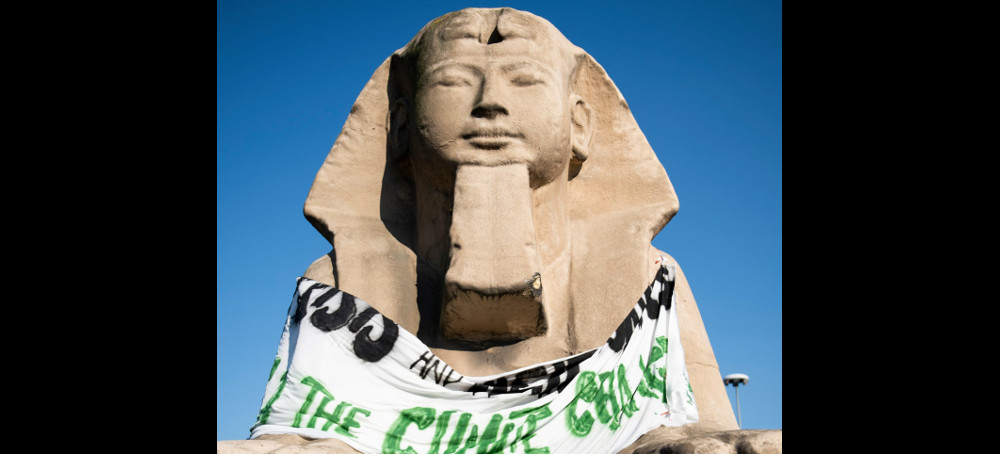
RSN: FOCUS: Naomi Klein | Greenwashing a Police State: The Truth Behind Egypt's Cop27 Masquerade


Reader Supported News
20 October 22

Live on the homepage now!
Reader Supported News

WHERE HAVE THE DONATIONS GONE? We are desperately scrambling for the basic donations we have always had and that we absolutely need to run RSN. Why? Only 178 of our readers have seen fit to make a donation this month. 178 people come to RSN every 30 minutes. That’s wrong and everyone here knows it. Hit the donation link please. It matters. / Marc Ash, Founder Reader Supported News
Marc Ash • Founder, Reader Supported News

Sure, I'll make a donation!


A demonstration against Egypt's government in Cairo in 2015. (photo: Getty)
FOCUS: Naomi Klein | Greenwashing a Police State: The Truth Behind Egypt's Cop27 Masquerade
Naomi Klein, Guardian UK
Klein writes: "No one knows what happened to the lost climate letter. All that is known is this: Alaa Abd El-Fattah, one of Egypt's most high-profile political prisoners, wrote it while on a hunger strike in his Cairo prison cell last month."


Sisi’s Egypt is making a big show of solar panels and biodegradable straws ahead of next month’s climate summit – but in reality the regime imprisons activists and bans research. The climate movement should not play along

No one knows what happened to the lost climate letter. All that is known is this: Alaa Abd El-Fattah, one of Egypt’s most high-profile political prisoners, wrote it while on a hunger strike in his Cairo prison cell last month. It was, he explained later, “about global warming because of the news from Pakistan”. He was concerned about the floods that displaced 33 million people, and what that cataclysm foretold about climate hardships and paltry state responses to come.

A visionary technologist and intellectual, Abd El-Fattah’s first name – along with the hashtag #FreeAlaa – have become synonymous with the 2011 pro-democracy revolution that turned Cairo’s Tahrir Square into a surging sea of young people that ended the three-decade rule of Egypt’s dictator Hosni Mubarak. Behind bars almost continuously for the past decade, Abd El-Fattah is able to send and receive letters once a week. Earlier this year, a collection of his prison writings was published as the widely celebrated book You Have Not Yet Been Defeated.

Abd El-Fattah’s family and friends live for those weekly letters. Especially since 2 April, when he started a hunger strike, ingesting only water and salt at first, and then just 100 calories a day (the body needs closer to 2,000). Abd El-Fattah’s strike is a protest against his imprisonment for the crime of “spreading false news” – ostensibly because he shared a Facebook post about the torture of another prisoner. Everyone knows, however, that his imprisonment is intended to send a message to any future young revolutionaries who get democratic dreams in their heads. With his strike, Abd El-Fattah is attempting to pressure his jailers to grant important concessions, including access to the British consulate (Abd El-Fattah’s mother was born in England, so he was able to obtain British citizenship). His jailers have so far refused, and so he continues to waste away. “He has become a skeleton with a lucid mind,” his sister Mona Seif said recently.

The longer the hunger strike wears on, the more precious those weekly letters become. For his family, they are nothing less than proof of life. Yet on the week he wrote about climate breakdown, the letter never made it to Abd El-Fattah’s mother, Laila Soueif, a human rights defender and intellectual in her own right. Perhaps, he speculated in subsequent correspondence to her, his jailer had “spilled his coffee over the letter”. More likely, it was deemed to touch on forbidden “high politics” – even though Abd El-Fattah says he was careful not to so much as mention the Egyptian government, or even “the upcoming conference”.

That last bit is important. It’s a reference to the fact that next month, beginning on 6 November, the resort of Sharm el-Sheikh in Egypt will play host to this year’s United Nations climate summit, Cop27. Tens of thousands of delegates – world leaders, ministers, envoys, appointed bureaucrats, as well as climate activists, NGO observers and journalists – will descend on the city, their chests bedecked in lanyards and colour-coded badges.

Which is why that lost letter is significant. There is something unbearably moving about the thought of Abd El-Fattah – despite the decade of indignities he and his family have suffered – sitting in his cell thinking about our warming world. There he is, slowly starving, yet still worrying about floods in Pakistan and extremism in India and crashing currency in the UK and Lula’s presidential candidacy in Brazil, all of which get a mention in his recent letters, shared with me by his family.

There is also, frankly, something shaming about it. Because while Abd El-Fattah thinks about the world, it’s not at all clear that the world heading to Egypt for the climate summit is thinking much about him. Or about the estimated 60,000 other political prisoners behind bars in Egypt, where barbaric forms of torture reportedly take place on an “assembly line”. Or about the Egyptian human rights and environmental activists, as well as critical journalists and academics, who have been harassed, spied on and barred from travel as part of what Human Rights Watch calls Egypt’s “general atmosphere of fear” and “relentless crackdown on civil society”.

The Egyptian regime is eager to celebrate its official climate “youth leaders”, holding them up as symbols of hope in the battle against warming. But it’s hard not to think of the courageous youth leaders of the Arab spring, many of them now prematurely aged by more than a decade of state violence and harassment from systems that are lavishly bankrolled by military aid from western powers, particularly the US. It’s almost as if those activists have just been substituted by newer, less troublesome models.

“I’m the ghost of spring past,” Abd El-Fattah wrote about himself in 2019. That ghost will haunt the coming summit, sending a chill through its every high-minded word. The silent question it poses is stark: if international solidarity is too weak to save Abd El-Fattah – the symbol of a generation’s dreams – what hope do we have of saving a habitable home?

Mohammed Rafi Arefin, assistant professor of geography at the University of British Columbia, who has researched urban environmental politics in Egypt, points out that “every United Nations climate summit presents a complex calculus of costs and benefits”. There is the carbon spewed into the atmosphere as delegates travel there, the price of two weeks in hotels (steep for grassroots organisations), and the public relations bonanza enjoyed by the host government, which invariably positions itself as an eco-champion, never mind evidence to the contrary.

Yet there are also benefits: the fact that, for those two weeks, the climate crisis makes global news, often providing media platforms for powerful voices on the frontlines, from the Brazilian Amazon to Tuvalu. And there is the international networking and solidarity that takes place when local organisers in the host country stage counter-summits and “toxic tours” to reveal the reality behind their government’s green posturing. And, of course, there are the deals that get negotiated and funds that are pledged to the poorest and worst affected. But these are non-binding, and as Greta Thunberg so memorably put it, much of it has amounted to little more than “Blah, blah, blah”.

With the upcoming climate summit in Egypt, Arefin tells me, “The usual calculus has changed. The balance has tipped.” In addition to the carbon and the cost, the host government – who will get the chance to preen green before the world – is not your standard double-talking liberal democracy. “It is,” he says, “the most repressive regime in the history of the modern Egyptian state.” Led by Gen Abdel Fatah al-Sisi, who seized power in a military coup in 2013 (and has held on to it through sham elections ever since), the regime is, according to human rights organisations, one of the most brutal and repressive in the world. Since taking power less than a decade ago, it has built more than two dozen new prisons.

Of course, you’d never know it from the way Egypt is marketing itself ahead of the summit. A promotional video on the Cop27 official website welcomes delegates to the “green city” of Sharm el-Sheik and shows young actors – including men with scruffy beards and necklaces clearly meant to look like environmental activists – enjoying non-plastic straws and biodegradable food containers as they take selfies on the beach, enjoy outdoor showers and drive electric vehicles to the desert to ride camels.

While I was watching the video, it struck me that Sisi has decided to use the summit to stage a new kind of reality show, one in which actors “play” activists who look remarkably like the actual activists who are suffering under torture in his rapidly expanding archipelago of prisons. This summit is going far beyond greenwashing a polluting state – it’s greenwashing a police state.

The Egyptian communities and organisations most affected by environmental pollution and rising temperatures will be nowhere to be found in Sharm el-Sheikh. There will be no toxic tours, or lively counter-summits, where locals get to school international delegates about the truth behind their government’s PR. Organising events like this would land Egyptians in prison for spreading “false news” or for violating the protest ban.

International delegates can’t even read up much on current pollution and environmental despoliation in Egypt in academic or NGO reports because of a draconian 2019 law that requires researchers to get government permission before releasing information considered “political”. (The whole country is gagged, and hundreds of websites are blocked, including the indispensable and perennially harassed Mada Masr.) Human Rights Watch reports that groups have been forced to rein in and scale back their research under these new constraints, and “one prominent Egyptian environmental group disbanded its research unit because it became impossible to work in the field”. Tellingly, not a single one of the environmentalists who spoke to Human Rights Watch about censorship and repression was willing to use their real name because reprisals are so severe.

Arefin, who conducted extensive research on waste and flooding in Egyptian cities before this latest round of censorious laws, told me that he and other critical academics and journalists “are no longer able to do that work. Egypt’s environmental harms now happen in the dark.” And those who break the rules and try to turn on the lights end up in dark cells – or worse.

Abd El-Fattah’s sister Mona Seif, who has spent years lobbying for her brother’s release and for the release of other political prisoners, wrote recently on Twitter: “The reality most of those participating in #Cop27 are choosing to ignore is … in countries like #Egypt your true allies, the ones who actually give a damn about the planet’s future are those languishing in prisons.”

So, unlike every other climate summit in recent memory, this one will have no authentic local partners. There will be some Egyptians at the summit claiming to represent “civil society”. And some of them do. The trouble is that, however well-intentioned, they too are bit players in Sisi’s beachside reality show; in a departure of usual UN rules, almost all have been vetted and approved by the government. That same Human Rights Watch report, published last month, explains that these groups have been invited to speak only on “welcome” topics.

What, for the regime, is welcome? “Trash collection, recycling, renewable energy, food security, and climate finance”. What topics are unwelcome? “Those that point out the government’s failure to protect people’s rights against damage caused by corporate interests, including issues relating to water security, industrial pollution, and environmental harm from real estate, tourism development, and agribusiness,” according to the report. Also unwelcome: “The environmental impact[s] of Egypt’s vast and opaque military business activity … are particularly sensitive, as are ‘national’ infrastructure projects such as a new administrative capital, many of which are associated with the president’s office or the military.” And definitely don’t talk about Coca-Cola’s plastic pollution and water use – because Coke is one of the summit’s proud official sponsors.

In short, if you want to put up solar panels or pick up litter, you can probably get a badge to come to Sharm el-Sheikh. But if you want to talk about the health and climate impacts of Egypt’s coal-powered cement plants, or the paving over of some of the last green spaces in Cairo, you are more likely to get a visit from the secret police – or from the Ministry of Social Solidarity. And if, as an Egyptian, you question Sisi’s credibility to speak on behalf of Africa’s poor and climate-vulnerable populations, given the deepening hunger and desperation of his own people, you had better do it from outside the country.

So far, hosting the summit has proved nothing short of a bonanza for Sisi, a man Donald Trump reportedly referred to as my “favourite dictator”. There is the boon to coastal tourism, which crashed in recent years, and the regime is clearly hoping its videos of outdoor showers and camel rides will inspire more. But that’s just the beginning of the green gold rush. Late last month, British International Investment (BII), which is backed by the UK government, giddily announced that it was “investing $100m to support local startups” in Egypt. It is also the majority owner in Globeleq, which ahead of Cop27 has announced an $11bn deal to build up green hydrogen production in Egypt. At the same time, the BII stressed its “commitment to strengthen its partnership with Egypt and increase climate finance to support the country’s green growth”.

This is the same government that appears to have done very little to secure the release of Abd El-Fattah, despite his British citizenship and his hunger strike. Unfortunately for him, Abd El-Fattah’s fate was for months in the hands of Liz Truss who, before becoming Britain’s spectacularly callous and inept prime minister, was its spectacularly callous and inept foreign secretary. She could have used some of those billions in investment and development aid to leverage the release of a fellow citizen. (Last week, Gillian Keegan, minister for Africa at the Foreign, Commonwealth and Development Office, reported that she had met Egypt’s ambassador to the UK for the first time, and “raised the case of Alaa Abd El-Fattah”.)

Germany’s moral failures are equally dismal. When Green party co-leader Annalena Baerbock became the country’s first female foreign minister last December, she announced a new “values-based foreign policy” – one that would prioritise human rights and climate concerns. Germany is one of Egypt’s major donors and trading partners, so, like the UK, it certainly has a card to play. But instead of pressure on human rights, Baerbock has provided Sisi with priceless propaganda opportunities, including co-hosting the Petersberg Climate Dialogue with him in Berlin in July, at which the ruthless dictator was able to rebrand himself as a green leader.

And given the difficulties caused by Germany’s reliance on Russian gas, Egypt is eagerly positioning itself to provide replacement gas and hydrogen. Meanwhile, German giant Siemens Mobility has announced a “historic” multibillion-dollar contract to build electrified high-speed trains across Egypt.

The international injections of green cash are flowing just in time for Sisi’s troubled regime. Facing a tsunami of global crises (inflation, pandemic, food shortages, increased fuel prices, drought, debt) on top of its systemic mismanagement and corruption, Egypt is on the edge of defaulting on its foreign debt – a volatile situation that could well destabilise Sisi’s rule. In this context, the climate summit is not merely a PR opportunity – it is a lifeline.

Though reluctant to give up on the process, most serious climate activists readily concede that these summits produce little by way of science-based climate action. Year after year since they began, emissions keep going up. What, then, is the good of supporting this year’s summit when the one thing it is set to absolutely accomplish is the further entrenchment and enrichment of a regime that, by any ethical standard, deserves pariah status?

As Arefin asks: “At what point do we say ‘enough’?”

For months, Egyptians in exile in Europe and the US have been pleading with NGOs to put their country’s political prisoners on the agenda of negotiations leading up to the summit. But that was never prioritised.

They were told that this is “Africa’s Cop” (Cop stands for Conference of the Parties, or signatories to the UN Framework Convention on Climate Change); and that, despite all the prior failures, this Cop, the 27th, would finally get serious about “implementation” and “loss and damage” – UN-speak for the hope that the wealthy, high-polluting countries will finally pay what they owe to poor nations, like Pakistan, that have contributed next to nothing in carbon emissions, yet are bearing the bulk of the soaring costs.

The clear implication has been that the summit is too serious and too important to be sidetracked by the supposedly small matter of the host country’s human rights record. But is Cop27 really going to champion climate justice? Is it going to bring green energy and clean transit and food sovereignty to the poor? Will the summit truly confront climate debt and reparations, as many are claiming? If only.

The case for climate reparations is obvious, writes Egyptian journalist, film-maker, and novelist Omar Robert Hamilton, in a magisterial essay. “The harder question is how to design a system of reparations that does not entrench authoritarian state powers” – one that ensures that the funds actually contribute to genuinely post-carbon policies. “This should be at the core of Cop negotiations between southern and northern countries – [but] the ones doing the negotiating for the south tend to be authoritarian state powers whose short-term interests are even more graspingly fragile than those of oil executives.”

In short, despite the talk in climate circles of this being the “implementation” Cop, Egypt’s summit will probably achieve as little by way of real climate action as all the others before. But that does not mean it won’t achieve anything: when it comes to propping up a torture regime, showering it with cash and image-cleansing photo ops, Cop27 is already a lavish gift.

Abd El-Fattah has long been a symbol of Egypt’s violently extinguished revolution. But as the summit approaches, he is becoming symbolic of something else, too: the “sacrifice zone” mentality at the heart of the climate crisis. This is the idea that some places and some people can be unseen, discounted and written off – all in the name of progress. We’ve seen the mentality at work when communities are poisoned to extract and refine fossil fuels and minerals. We’ve seen it when those communities are sacrificed in the name of getting a climate bill passed that does not protect them. And now we are seeing it in the context of an international climate summit, with the rights of the people living in the host country sacrificed and unseen in the name of the mirage of “real progress” in the negotiations.

If last year’s summit in Glasgow was about “blah, blah, blah”, this one’s meaning, even before it starts, is more ominous. This summit is about blood, blood, blood. The blood of the roughly 1,000 protesters massacred by Egyptian forces to secure power for its current ruler. The blood of those who continue to be assassinated. The blood of those beaten in the streets and tortured in prisons. The blood of people like Abd El-Fattah.

There may still be time to change that script, and for the summit to become a searchlight that illuminates the connections between surging authoritarianism and climate chaos around the world – like the way far-right leaders such as Italy’s Giorgia Meloni stoke fear of refugees, including those fleeing climate breakdown, to fuel their rise, and how the EU showers brutal leaders such as Sisi with cash so that he continues to prevent Africans from reaching their shores. There is still time to make the case that climate justice is impossible without political freedoms.

“Unlike me, you have not yet been defeated.” Alaa Abd El-Fattah wrote those words in 2017. He had been invited to deliver a speech to RightsCon, the annual confab about human rights in the digital age sponsored by all the big tech companies. The conference was taking place in the US, but because Abd El-Fattah was behind bars in the notorious Tora prison (it had been four years at that point), he sent a letter instead. It’s a brilliant text, about the imperative to protect the internet as a space of creativity, experimentation and freedom. And it is also a challenge to those who are not (yet) behind bars, who have the freedom to do things like travelling to conferences to talk about justice and democracy and human rights. In that freedom lies responsibility. A responsibility not just to be free, but also to act free, to use freedom to its full transformational potential, before it’s too late.

As tens of thousands of relatively free Cop27 delegates prepare to fly to Sharm el-Sheikh, checking the average November temperatures (highs of 28C), packing appropriately (light shirts, sandals, a bathing suit – because you never know), Abd El-Fattah’s words about the responsibilities that come with being undefeated take on a new urgency. Given the intensive surveillance and threat that Egyptians attending the summit will be facing, how will the foreigners attending deploy their freedom? Their state of being not yet defeated?

Will they behave as if Egypt is merely a backdrop, not an actual country where people just like them have fought and died for the same freedoms they have, and against the same economic interests that are destabilising our planetary and political climates? Or will they find ways to bring some of the gruesome truths of Egypt’s prisons into the green glitz of the conference centre? Speak some of the names of the prisoners? Will they search out the few remaining civil society organisations in Cairo – such as those who came together under copcivicspace.net – and see how they can help?

Abd El-Fattah would be the first to say that what’s needed is neither pity nor charity. Rather, as a committed internationalist who has stood in solidarity with many struggles, from Chiapas to Palestine, he called for comrades in a battle that has fronts in every nation. “We reach out to you,” he wrote in that RightsCon letter from prison, “not in search of powerful allies but because we confront the same global problems, and share universal values, and with a firm belief in the power of solidarity.”

Anti-democratic and fascistic forces are surging around the world. In country after country, freedoms are precarious or slipping away. And all of this is connected. Political tides move in waves across borders, for better and for worse – which is why international solidarity can never be sacrificed in the name of expediency for some greater goal of “progress”. Egypt’s revolution was inspired by Tunisia’s, and in turn, “the spirit of Tahrir” spread around the world. It helped inspire other youth-led movements in Europe and North America, including Occupy Wall Street, which in turn helped birth new anti-capitalist and eco-socialist politics. In fact, you can draw a pretty straight line from Tahrir to Occupy, to Bernie Sanders’s 2016 US presidential campaign, to Alexandria Ocasio-Cortez’s election to Congress and her championing of the Green New Deal.

Where human rights are under attack, so too is the natural world. After all, the communities and organisations facing the most severe state repression and violence around the world – whether they live in the Philippines or Canada or Brazil or the US – are overwhelmingly made up of Indigenous peoples trying to protect their territories from polluting extractive projects, many of which are also driving the climate crisis. Defending human rights, wherever we live, is therefore inextricable from defending a liveable planet.

Moreover, the extent to which some governments are finally introducing meaningful climate legislation is also bound up with political freedoms. The US Senate and the Biden administration have finally been dragged into passing the Inflation Reduction Act – flawed as it is. This happened as a direct result of public pressure, investigative journalism, civil disobedience, sit-ins in legislative offices, lawsuits and every other tool available in the nonviolent arsenal. And, ultimately, lawmakers got together to pass the act because they feared what would happen when they faced voters in November if they came to them empty-handed. If US politicians did not have to fear the public, because the public had a greater fear of them, none of this would have happened at all.

One thing is certain: we will not win the kind of change that the climate crisis demands without the freedom to demonstrate, sit in, shame political leaders and tell the truth in public. If demonstrations are banned and inconvenient facts are criminalised as “false news”, as they are in Sisi’s Egypt, then it’s game over. Without the strikes, the protests and the investigative research, we would be in far worse shape than we are. And any one of those activities would be enough to land an Egyptian activist or journalist in a dark cell next to Abd El-Fattah’s.

When news came that the next UN climate summit would be taking place in Sharm el-Sheikh, Egyptian activists, inside the country and in exile, could have called on the climate movement to boycott it. They chose not to, for a variety of reasons. But they did ask for solidarity. The Cairo Institute for Human Rights Studies, for instance, called on the international community to use the summit “to shed more light on the crimes being committed in Egypt and urge the Egyptian authorities to change course”. There were high hopes that North American and European activists would push their governments to make their attendance and participation conditional on Egypt meeting basic human-rights requirements – including amnesty for prisoners of conscience in jail for “crimes” such as organising a demonstration, or posting an unflattering statement about the regime, or receiving a foreign grant.

So far, with less than a month before the summit starts, the response from the global climate movement has been muted. Many groups have added their names to petitions; a handful of articles about the human rights situation during the summit have appeared; climate activists in Germany, many of them Egyptian exiles, have held small protests with signs saying “No Cop27 Until Alaa is Free” and “No Greenwashing Egypt’s Prisons”. But we have seen nothing like the kind of the international pressure that would worry Egypt’s rulers.

It’s hard to overstate the totalising nature of Sisi’s war on civil society. Human Rights Watch reports that, “In 2014… Sisi amended, by decree, the penal code to punish with life in prison or death sentence anyone requesting, receiving, or assisting the transfer of funds, whether from foreign sources or local organisations, with the aim of doing work that harms a ‘national interest’ or the country’s independence or undermining public security or safety.” The death sentence for receiving a grant. And yet all of the major US and European foundations will be in Sharm el-Sheikh, meeting with groups that they fund, and others that they might consider funding, inside a country where taking any of that money to tell the truth about environmental despoliation in Egypt can cost you your life.

This is all a bit baffling. Why invite funders and green groups to Egypt when the regime has such obvious hostility toward these very activities domestically? The truth – uncomfortable for all who will be in attendance – is that nothing would serve Sisi more than to turn Sharm el-Sheik into a kind of nonprofit petting zoo, where international climate activists and funders can spend two weeks shouting about north-south injustice before the cameras, with a few state-approved local groups thrown in for authenticity’s sake. Why? Because then Egypt would look like something it most emphatically is not: a free and democratic society. A good source for your natural gas. Or a country suitable to entrust with a new IMF loan.

By all accounts, the Egyptian government is frantically building a bubble in Sharm el-Sheikh, where it will impersonate something that looks sort of like a democracy. The question facing civil society groups is: will you play along – or will you do what you can to disrupt the show?

In all the plans for next month’s Coca-Cola-sponsored climate summit, the most chilling detail is surely the announcement that this will be the first such gathering to have a Children and Youth Pavilion inside the official venue: a dedicated space that “will provide a convening place of talks, education, creativity, policy briefings, rest and relaxation, bringing together the voices of young people across the world”. This will allow youth to – get this – “speak truth to power”.

I have no doubt that many young people in that pavilion will deliver powerful speeches, as they did in Glasgow and at climate summits before. Young people have become true climate leaders, and they have injected desperately needed urgency and moral clarity into many official climate spaces. That same moral clarity is needed now.

A decade ago, young Egyptians didn’t have a state-sanctioned pavilion. They had a revolution. They flooded Tahrir Square demanding a different kind of country, one without the ever-present shadow of fear, one where teenagers didn’t disappear into police dungeons and reappear dead, their faces swollen and bloodied. That revolution overthrew a dictator who had ruled since before they were born. But then their dreams were crushed by political betrayals and violence. In one of his recent letters, Abd El-Fattah wrote of how painful it is to share his cell with teenagers who were arrested when they were children: “They were underage when they were put in prison and are fighting to get out before they reach legal adulthood.”

One of the teens who helped take over the square in 2011 was Abd El-Fattah’s extraordinary younger sister Sanaa Seif. Just 17 at the time, Sanaa co-founded a revolutionary newspaper, Al Gornal, which published tens of thousands of copies and became a kind of voice of Tahrir. She also was an editor and camera person on the Oscar-nominated 2013 documentary film The Square. She has herself been imprisoned multiple times for speaking out against human rights abuses and for demanding her brother’s release. In an interview, she told me that she has a message for the young activists headed for that pavilion: “We tried. We did speak truth to power.” Now, she says, many activists are spending their 20s in prison. “When you go, remember that you can be the voice of other young people … Please, let’s maintain that heritage. Please do actually speak truth to power. It will have impact … eyes are on you.”

But as the climate summit draws near, and Abd El-Fatah’s hunger strike wears on, Sanaa is losing patience with the large green groups that have so far been silent, seemingly out of fear of losing their badges or being stopped at the border. “Honestly I’m fed up with the hypocrisy of the climate movement,” she wrote on Twitter last week. “Outcries have been pouring from Egypt for months warning that this #COP27 will go far beyond greenwashing, that the ramifications on us will be horrible. Yet most are choosing to ignore the human rights situation.”

This, she pointed out, is why climate activism is often seen as an elite exercise, disconnected from people with urgent daily concerns – such as getting their family members out of jail. “You’re guaranteeing that #ClimateAction remains an alien notion exclusive to the few who have the luxury to think beyond today,” she wrote. “Mitigating climate change and fighting for human rights are interlinked struggles, they shouldn’t be separated. Especially since we’re dealing with a regime that is propped up by companies like BP and Eni. And really, how hard is it to raise both issues? #FreeThemAll #FreeAlaa.”

It isn’t hard – but it does take courage. The message activists should bring to the climate summit, whether they travel to Egypt or engage from afar, is simple: unless political freedoms are defended, there will be no meaningful climate action. Not in Egypt, nor anywhere else. These issues are intertwined, as are our fates.

The hour is late, but there is still just enough time to get this right. Human Rights Watch argues that the UN Framework Convention on Climate Change secretariat, which sets the rules for these summits, should “develop human rights criteria that countries hosting future Cops must commit to meeting as part of the host agreement”. That’s too late for this summit, but it’s not too late for all of those who are concerned about climate justice to show solidarity with the revolutionaries who inspired millions around the world a decade ago, when they toppled a tyrant. There might even be time to scare Sisi enough with the prospect of a green PR nightmare by the Red Sea that he could decide to open the doors of some of his dungeons before all those cameras arrive. Because, as Alaa Abd El-Fattah reminds us from the desperation of his cell, we have not yet been defeated.


READ MORE


Contribute to RSN

Follow us on facebook and twitter!

Update My Monthly Donation

PO Box 2043 / Citrus Heights, CA 95611


Your Signature Needed: Brutal hunter violently murders entire gray wolf pack

                                             LOTS OF POSTS IGNORED BY BLOGGER..... OR REMOVED ON THEIR WHIM! ALL POSTS ARE AVAILABLE ON MIDD...