
13 September 25

The corporate-financed backlash to calls for global climate progress has been greatly empowered by the Trump administration. It’s never been more critical to challenge the misinformation that could turn a crisis into a catastrophe
And then … well, we all know what happened. A corporate-financed backlash on all fronts. In the first 100 days of Trump’s second term, his administration took more than 140 actions to roll back environmental rules and push for greater use of fossil fuels. He signed executive orders to ease restrictions on their extraction and export, filled his cabinet with oil industry supporters, gutted federal agencies on the forefront of the climate crisis, and cancelled life-saving environmental justice projects.
Empowered by the world’s most powerful man’s assault on the planet, the banks and corporations that have financed our climate disaster – those with an apocalyptic fear of regulation eating into their super-profits – have let their masks slip, dropping their stated renewable ambitions and ploughing money into fossil fuels.
Meanwhile, climate misinformation – amplified by far-right and rightwing populist politicians – is now so virulent online that one comprehensive study says it is likely to help turn a crisis into a catastrophe.
I write for the Guardian because it continues to challenge and expose these forces – even as the financial conditions for producing this kind of work become more challenging by the day.
For the past fortnight the Guardian has been reminding its readers about the role it is playing in exposing the threat to climate and environmental progress – and, as always, it has been naming names.
The reason the Guardian is free to do this kind of vital work is simple: it is not beholden to corporations or billionaires. In 2020, it even banned advertising from fossil fuel companies – the first major news organisation to do so. Most of its funding comes directly from a small percentage of readers who believe in the importance of independent journalism
Wealth and power shape every aspect of this emergency. The most important tool we have to defend ourselves is the facts.
The second most important tool is hope: the Guardian’s journalism plays an important role in highlighting the actions we, as a society and as individuals, can do against this barrage.
New Bill Would Give Marco Rubio “Thought Police” Power to Revoke US Passports
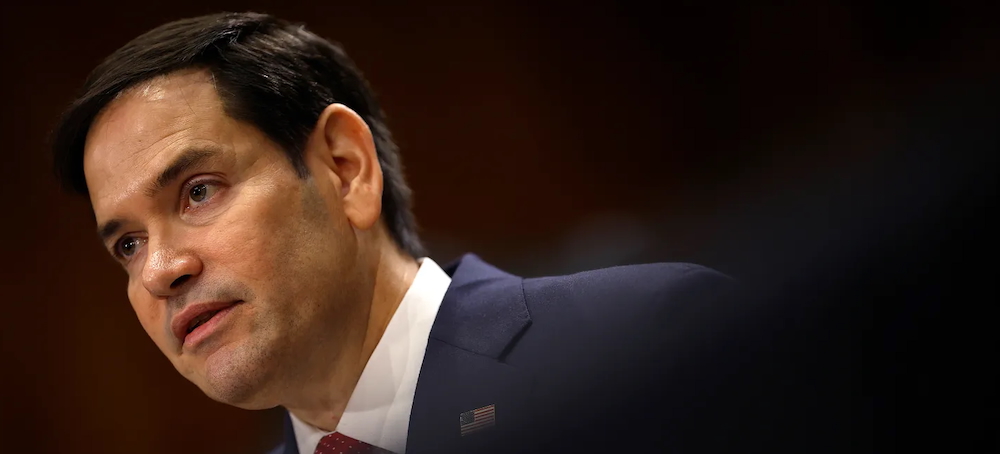 Secretary of State Marco Rubio. (photo: Kevin Dietsch/Getty Images)
Rubio has already sought to punish immigrants for speech. New legislation might let him do it for U.S. citizens.
Now, a bill introduced by the chair of the House Foreign Affairs Committee is ringing alarm bells for civil liberties advocates who say it would grant Rubio the power to revoke the passports of American citizens on similar grounds.
The provision, sponsored by Rep. Brian Mast, R-Fla., as part of a larger State Department reorganization, is set for a hearing Wednesday.
Mast’s legislation says that it takes aim at “terrorists and traffickers,” but critics say it could be used to deny American citizens the right to travel based solely on their speech. (The State Department said it doesn’t comment on pending legislation.)
Seth Stern, the director of advocacy at Freedom of the Press Foundation, said the bill would open the door to “thought policing at the hands of one individual.”
“Marco Rubio has claimed the power to designate people terrorist supporters based solely on what they think and say,” Stern said, “even if what they say doesn’t include a word about a terrorist organization or terrorism.”
Vague “Terrorist” Designations
Mast, for his part, has publicly voiced his support for “kicking terrorist sympathizers out of our country.” At the time, he was talking about deporting Mahmoud Khalil, a Palestinian green-card holder who the Trump administration detained and attempted to deport based on what critics of the move said were his pro-Palestine views.
Mast’s new bill claims to target a narrow set of people. One section grants the secretary of state the power to revoke or refuse to issue passports for people who have been convicted — or merely charged — of material support for terrorism. (Mast’s office did not respond to a request for comment.)
Kia Hamadanchy, a senior policy counsel at the American Civil Liberties Union, said that language would accomplish little in practice, since terror convictions come with stiff prison sentences and pre-trial defendants are typically denied bail.
The other section sidesteps the legal process entirely. Rather, the secretary of state would be able to deny passports to people whom they determine “has knowingly aided, assisted, abetted, or otherwise provided material support to an organization the Secretary has designated as a foreign terrorist organization.”
The reference to “material support” disturbed advocates who have long warned that the government can misuse statutes criminalizing “material support” for terrorists — first passed after the 1996 Oklahoma City federal building bombing and toughened after the 9/11 attacks — to punish speech.
Some of those fears have been borne out. The Supreme Court ruled in 2010 that even offering advice about international law to designated terror groups could be classified as material support.
The government even deemed a woman who was kidnapped and forced to cook and clean for Salvadoran guerrillas a material supporter of terrorism, in order to justify her deportation.
Since the October 7 Hamas attacks, pro-Israel lawmakers and activists have ratcheted up attempts to expand the scope and use of anti-terror laws.
The Anti-Defamation League and the Louis D. Brandeis Center for Human Rights Under Law suggested in a letter last year that Students for Justice in Palestine was providing “material support” for Hamas through its on-campus activism.
Lawmakers also tried to pass a “nonprofit killer” bill that would allow the Treasury secretary to strip groups of their charitable status if they are deemed a “terrorist-supporting organization.” The bill was beaten back by a coalition of nonprofit groups, most recently during the debate over the so-called Big, Beautiful Bill.
Mast’s bill contains eerily similar language, Stern said.
“This is an angle that lawmakers on the right seem intent on pursuing — whether through last year’s nonprofit killer bill, or a bill like this,” Stern said.
The provision particularly threatens journalists, Stern said. He noted that Sen. Tom Cotton, R-Ark., in November 2023 demanded a Justice Department “national security investigation” of The Associated Press, CNN, New York Times, and Reuters over freelance photographers’ images of the October 7 attacks.
Rubio also revoked Öztürk’s visa on what appears to be nothing more than an op-ed she wrote for the Tufts University student newspaper in 2024 — which did not mention Hamas — calling on the school to divest from companies tied to Israel.
Since taking office, Rubio has also added groups to the State Department’s list of foreign terrorist organizations at a blistering pace, focusing largely on gangs and drug cartels that were previously the domain of the criminal legal system.
Free Speech Exception?
There is an ostensible safety valve in Mast’s bill. Citizens would be granted the right to appeal to Rubio within 60 days of their passports being denied or revoked.
That provided little comfort to the ACLU’s Hamadanchy, who is helping rally opposition to the bill.
“Basically, you can go back to the secretary, who has already made this determination, and try to appeal. There’s no standard set. There’s nothing,” he said.
Hamadanchy said the provision granting the secretary of state discretionary power over passports appeared to be an attempt to sidestep being forced to provide evidence of legal violations.
“I can’t imagine that if somebody actually provided material support for terrorism there would be an instance where it wouldn’t be prosecuted — it just doesn’t make sense,” he said.
While the “nonprofit killer” bill drew only a smattering of opposition on the right from libertarian-minded conservatives such as Rep. Thomas Massie, R-Ky., Stern said Republicans should be just as concerned about the potential infringement of civil liberties in the passport bill.
The law, he said, would also grant nearly unchecked power to a Democratic secretary, he said.
“Lately, it appears that the right is so convinced that it will never be out of power that the idea that one day the shoe might be on the other foot doesn’t resonate,” Stern said. “What is to stop a future Democratic administration from designating an anti-abortion activist, a supporter of West Bank settlements, an anti-vaxxer to be a supporter of terrorism and target them the same way? The list is endless.”
Prosecutors’ ‘Cop City’ Case Collapses as Judge Tosses RICO Conspiracy Charges
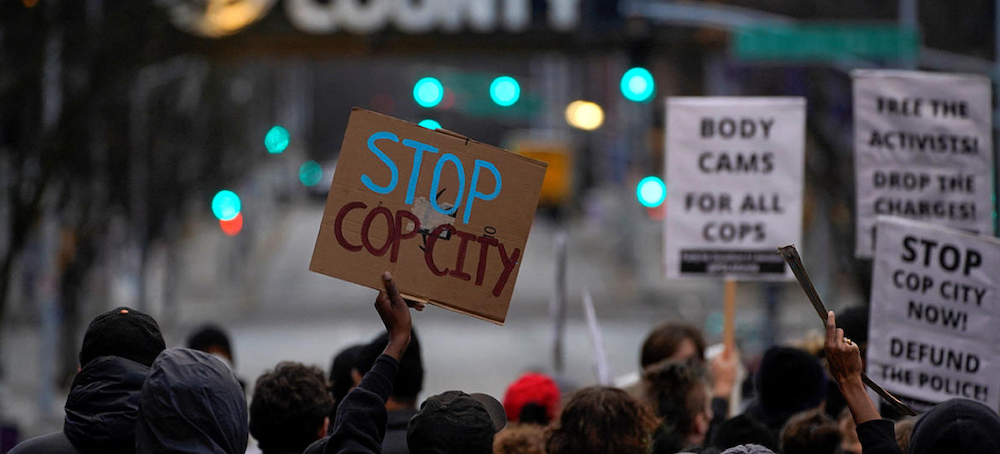 A demonstration in response to the death of Manuel Terán, who was killed during a police raid inside Weelaunee People's Park, the planned site of a "Cop City" project, in Atlanta. (photo: Cheney Orr/Reuters)
Two-year attempt to prosecute opponents of police training center on criminal conspiracy charges ends in failure
Fulton county superior court Judge Kevin Farmer announced his decision to dismiss charges against the case’s 61 defendants during hearings this week on a handful of defense attorney motions.
The hearings came after several years of delays in the case centered on Rico, a law created to go after the mafia and usually associated with organized crime, not protest movements. Farmer’s decision responded to a motion filed on behalf of defendant Thomas Jurgens, an attorney acting as a legal observer for the National Lawyers Guild at a music festival on 5 March 2023 in a forested public park near the police training center site.
Jurgens was one of dozens arrested that day and charged in connection with damage done to construction machinery at the site.
After an hour-plus of discussion in this week’s hearing, Farmer came back from a break and used only 18 words to stymie the state’s prosecution, nearly three years after arrests: “At this time I do not find the attorney general had the authority to bring this Rico case.”
The decision dismisses charges in 100 pages of the state’s 109–page indictment. It also covers one count of arson against five defendants, and the judge is expected to issue a separate ruling on domestic terrorism charges against the same five defendants.
Farmer said he will soon issue the orders in writing.
The state has announced its intention to appeal. “The attorney general will continue the fight against domestic terrorists and violent criminals who want to destroy life and property,” Georgia attorney general Chris Carr’s office said in a statement.
Carr is running for governor of Georgia in next year’s race.
Opposition to the $109m center, which opened this spring, has come from a wide range of local and national organizations and protesters, and is centered on concerns around police militarization and clearing forests in an era of climate crisis. Atlanta police say the center is needed for “world-class” training and to attract new officers.
This week’s decision “exposes that the indictment was fundamentally flawed from the outset”, said Brad Thomson, one of the case’s dozens of defense attorneys and a member of the People’s Law Office, a Chicago-based civil rights firm.
Farmer’s ruling from the bench was based on Carr’s office having pursued the case after district attorneys for Dekalb and Fulton counties had declined to do so. This was an action for which the state had no authority, and for which the attorney general would have required special permission from Georgia Governor Brian Kemp, the judge said. No such permission was sought or given.
The decision shows “what critics said all along – that the state of Georgia was in such a rush and panic to stop the ’Stop Cop City’ movement that they violated their own rules,” said social movement historian Dan Berger. “They acted inappropriately and without justification, to bring what seemed from the beginning as dramatically overblown and patently absurd charges.”
Although certainly the most dramatic, the state’s procedural negligence leading to the judge’s decision was not the only example of prosecutorial sloppiness during the last two years.
Deputy attorney general John Fowler, the case’s lead prosecutor, was found last year to have obtained emails between defendants and their attorneys, then including them in discovery materials and sharing them with police investigators, thereby violating attorney-client privilege.
Fowler also denied in court that police sent messages about Cop City using Signal, despite being presented, in another motion from defense attorneys, with evidence from the Guardian of law enforcement leadership ordering officers last year to download the encrypted phone app for that very purpose.
At one point this week, the judge noted that he had read all the defense’s motions, but had received no responses from the state. “I have nothing to read from the state – and it’s been two years,” Farmer said.
Representing members of Atlanta Solidarity Fund – a bail fund whose three members are mentioned more than 120 times in the indictment – veteran attorney Donald Samuel told the judge this week, “the [criminal] enterprise is defined as a movement – can you imagine that? The civil rights movement would be defined as an enterprise according to the attorney general!”
Joseph Brown, a political scientist who has written about the movement against Cop City, said that Georgia “was so hellbent on criminalizing a protest movement that was strong, resilient and popularly-supported … [it] decided to use the law as a political tool.”
Brown compared the case to the so-called J20 protesters, more than 200 of whom were arrested at a 2017 protest in Washington, targeting Donald Trump’s first presidential inauguration. They faced felony riot and conspiracy charges of conspiracy. In a case drawn out over more than a year, the state was found to have withheld evidence as well as committing other irregularities. Ultimately, nearly all the cases were dismissed, and only one person served jail time.
“We see examples of prosecutorial overreach in highly politicized cases,” Brown said.
Farmer’s decision makes the Cop City case “probably the highest-profile failure of using conspiracy charges to indict a protest movement”, he added.
Brown said the two cases also have in common that defendants stuck together, and didn’t “point fingers” at each other for plea deals. “In a political movement” like this, he said, “people care about each other”.
Will Potter, author of the recently released Little Red Barns, a decade-long investigation of factory farms and fascism, said the lessons of the case could be important under Trump’s second term, which has seen the US slide towards authoritarianism.
“The playbook–stretching laws like Rico to cast dissent as organized crime won’t vanish, especially amid a surge of authoritarian and openly fascist politics,” Potter said.
Trump’s Excuse for Firing Fed Governor Doesn’t Hold Water
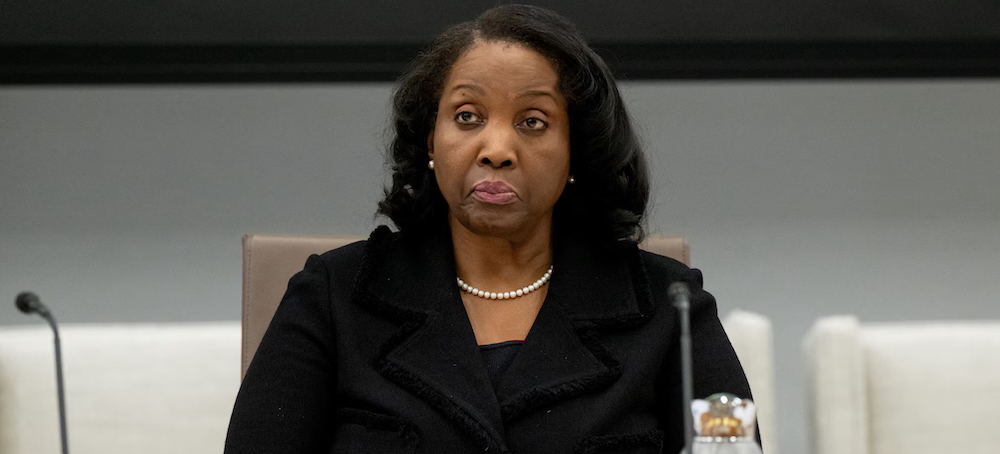 Federal Reserve governor Lisa Cook at a meeting in June. (photo: Saul Loeb/AFP/Getty Images)
The accusation, first raised by Federal Housing Finance Agency Director Bill Pulte, claimed that Cook simultaneously designated two properties — her Michigan home and an Atlanta condominium — as “primary residences” in order to secure favorable loan terms. That allegation triggered a Justice Department probe and was used by Trump to argue she had engaged in conduct unbecoming a Fed governor. There is also a condo in Massachusetts that they are now adding to the complaint.
But a 2021 loan estimate for the Atlanta property shows Cook explicitly declared it as a “vacation home.” Additional disclosures on her 2021 SF-86 security clearance form list the condo as a “second home,” and county tax records confirm she never sought a primary-residence exemption for the Atlanta address. These records directly contradict the claim that she treated the properties as her primary residence. She previously taught at Michigan State University and Harvard University and is originally from Georgia.
Legal experts say the new evidence makes it far harder to substantiate mortgage fraud charges. Documentation indicating that Cook consistently listed the Atlanta property as a second home makes it difficult to claim she misrepresented her intent to the lender, according to a housing law expert cited by Reuters.
Cook, a key voice on the Fed’s interest rate policy, has denied wrongdoing and called her removal a politically motivated attack. The Justice Department’s investigation remains ongoing, but these revelations are likely to intensify scrutiny of the decision to oust her — and could set up a legal fight over her firing.
We Escaped Certain Death': Israel Intensifies Gaza City Bombardment, Forcing Families to Flee
 Palestinians search for food among burning debris in the aftermath of an Israeli strike. (photo: Mohammed Salem/Reuters)
Unlike earlier phases of the war, the current offensive has relied heavily on aerial bombardments, with entire apartment blocks and large concrete structures reduced to rubble.
The intensification of strikes in recent days has triggered a surge in civilian displacement.
Israel has warned all residents of Gaza City to leave immediately in anticipation of a huge ground offensive.
On Saturday, the Israeli Defense Forces (IDF) said about 250,000 people had left the city and moved south. It also said it had destroyed a high-rise building that it said had been used "to advance and execute terrorist attacks" against its troops.
Israeli Prime Minister Benjamin Netanyahu says the city is Hamas's last major stronghold. But the plan to occupy Gaza City has brought international criticism.
The UN has warned an intensification of the offensive on an area where a famine has already been declared will push civilians into an "even deeper catastrophe". Gaza City is the largest urban centre in the territory and a historic heart of Palestinian political and social life.
Residents say the Israeli military has been targeting schools and makeshift shelters, often issuing warnings only moments before bombardments.
Many families have been forced to flee in darkness toward western Gaza.
"We escaped certain death, my husband, our three children and I," said Saly Tafeesh, a mother sheltering in the city. "My brother died in my arms after being shot by a quadcopter drone. We ran in the dark to the west of Gaza."
The Israeli military has told residents to evacuate to the south of the territory - but many families say they cannot afford the journey, which costs up to $1,100 (£800). Hamas, meanwhile, has intensified its calls for residents to stay put and resist leaving the city.
Rubein Khaled, a father-of-nine preparing to move south, expressed frustration.
"The Hamas preacher at Friday prayers accused anyone leaving Gaza City of being a coward running from the battlefield," he said.
"But why doesn't he tell Hamas leaders to surrender and release the Israeli hostages so this war can stop? We don't want to leave either, but we have no choice."
Israeli forces have not yet reached some eastern neighbourhoods that have remained largely intact since earlier raids in January, but the current campaign suggests they may now be seeking to dismantle entire districts.
Meanwhile, a Qatari foreign ministry spokesman strongly criticised Israel's prime minister in an interview with the BBC following this week's Israeli strike on Hamas officials in the Qatari capital Doha.
Foreign Ministry spokesman Majed Al-Ansari told the BBC that the international community had "to deal with a Netanyahu problem".
"He is not somebody who is listening to anybody right now, who is listening to any reason, and we have to collectively stop him in his tracks," the official said.
He argued the strike in Doha showed the Israeli leader "never intended to sign any peace deal" to end the war in Gaza and instead "believes he can re-shape the Middle East in his own image".
Five of the group's members and a Qatari security officer were killed in Tuesday's strike - though the Palestinian armed group claimed no senior leaders had been killed. Hamas members had been in Doha to discuss the latest US proposal for a ceasefire in Gaza.
Israel has faced widespread condemnation, including at the UN Security Council. Benjamin Netanyahu said Israel targeted the "terrorist masterminds" behind the 7 October 2023 Hamas attack on Israel.
Qatar's Prime Minister Mohammed bin Abdulrahman al-Thani earlier said that Qatar did not get advance warning of the strike, only receiving a call from a US official 10 minutes after the attack had started.
On Friday, al-Thani had dinner with US President Donald Trump and his envoy Steve Witkoff in New York, having earlier met Vice President JD Vance and Secretary of State Marco Rubio at the White House.
Rubio is travelling to Israel this weekend in a show of solidarity with Israel ahead of a UN meeting later this month at which France and the UK are expected to formally recognise a Palestinian state.
On Saturday, the Hamas-run health ministry in Gaza said the bodies of 47 people killed by the Israeli military had arrived at its hospitals over the previous day.
Since UN-backed global food security experts confirmed a famine in Gaza City on 22 August, the ministry has reported that at least 142 people have died from starvation and malnutrition across the territory. Israel has said it is expanding its efforts to facilitate aid deliveries and has disputed the health ministry's figures on malnutrition-related deaths.
The Israeli military launched its campaign in Gaza in response to the Hamas-led attack on southern Israel on 7 October 2023, in which about 1,200 people were killed and 251 others were taken hostage.
At least 64,803 people have been killed in Israeli attacks in Gaza since then, according to the territory's health ministry.
Students, Schools Race to Save Clean Energy Projects in Face of Trump Deadline
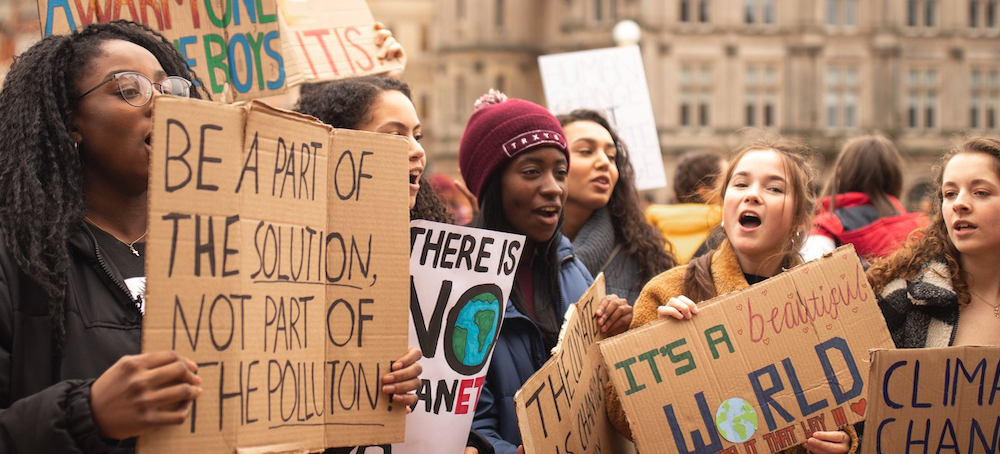 Gentin writes: "Many projects such as solar panels and electric school buses may not meet new deadlines for tax credits under the 'big, beautiful bill.'"
Now, access to those funds is disappearing, leaving Tucson and other school systems across the country scrambling to find ways to cover the costs of clean energy projects.
The Arizona school district, which did not want to impose an economic burden on its low-income population by increasing bonds or taxes, had expected to rely in part on federal dollars provided by the Biden-era Inflation Reduction Act, Doshi said.
But under HR1, or the “One Big Beautiful Bill Act” passed on July 4, Tucson schools will not be able to receive all of the expected federal funding in time for their upcoming clean energy projects. The law discontinues many clean energy tax credits, including those used by schools for solar power and electric vehicles, created under the IRA. When schools and other tax-exempt organizations receive these credits, they come in the form of a direct cash reimbursement.
At the same time, Tucson and thousands of districts across the country that were planning to develop solar and wind power projects are now forced to decide between accelerating them to try to meet HR1’s fast-approaching “commence construction” deadline of June 2026, finding other sources of funding, or hitting pause on their plans. Tina Cook, energy project manager for Tucson schools, said the district might have to scale back some of its projects unless it can find local sources of funding.
“Phasing out the tax credits for wind and solar energy is going to make a huge, huge difference,” said Doshi, 18, now a first-year college student. “It ends a lot of investments in poor and minority communities. You really get rid of any notion of environmental justice that the IRA had advanced.”
The tax credits in the IRA, the largest legislative investment in climate projects in U.S. history, had marked a major opportunity for schools and colleges to reduce their impact on the environment. K-12 school infrastructure releases an estimated 41 million metric tons of emissions per year, according to an analysis from the New Buildings Institute. The K-12 school system’s buses — some 480,000 — and meals also produce significant emissions and waste. Clean energy projects supported by the IRA were helping schools not only to limit their climate toll but also to save money on energy costs over the long term and improve student health, advocates said.
As a result, many students, consultants, and sustainability leaders said, they have no plans to abandon clean energy projects. They said they want to keep working to cut emissions, even though that may be more difficult now.
Sara Ross, co-founder of UndauntedK12, which helps school districts green their operations, divided HR1’s fallout on schools into three categories: the good, the bad, and the ugly.
On the bright side, she said, schools can still get up to 50 percent off for installing ground source heat pumps — those credits will continue — to more efficiently heat schools. The network of pipes in a ground source pump cycles heat from the shallow earth into buildings.
In the “bad” category, any electric vehicle acquired after September 30 of this year will not be eligible for tax credits — drastically accelerating the IRA’s phaseout timeline by seven years. That applies to electric school buses as well as electric vehicle charging stations at schools. EPA’s Clean School Bus Program still exists for two more years and covers two-thirds of the funding for all electric school buses districts acquire in that time. The remaining one-third, however, was to be covered by federal and state tax credits.
The expiration of the federal tax credits could cost a district up to $40,000 more per vehicle, estimated Sue Gander, director of the Electric School Bus Initiative run by the nonprofit World Resources Institute.
Solar projects will see the most “ugly” effects of HR1, Ross said.
Los Angeles Unified School District is planning to build 21 solar projects on roofs, carports, and other structures, plus 13 electric vehicle charging sites, as part of an effort to reduce energy costs and achieve 100 percent renewable energy by 2040. The district anticipated receiving around $25 million in federal tax credits to help pay for the $90 million contract, said Christos Chrysiliou, chief eco-sustainability officer for the district. With the tight deadlines imposed by HR1, the district can no longer count on receiving that money.
“It’s disappointing,” Chrysiliou said. “It’s nice to be able to have that funding in place to meet the goals and objectives that we have.”
LAUSD is looking at a small portion of a $9 billion bond measure passed last year, as well as utility rebates, third-party financing and grants from the California Energy Commission, to help make up for some of the gaps in funding.
Many California State University campuses are in a similar position as they work to install solar to meet the system’s goal of carbon neutrality by 2045, said Lindsey Rowell, CSU’s chief energy, sustainability, and transportation officer.
Tariffs on solar panel materials from overseas and the early sunsetting of tax credits mean that “the cost of these projects is becoming prohibitive for campuses,” Rowell said.
Sweeps of undocumented immigrants in California may also lead to labor shortages that could slow the pace of construction, Rowell added. “Limiting the labor force in any way is only going to result in an increased cost, so those changes are frightening as well,” she said.
New Treasury Department guidance issued August 15 made it much harder for projects to meet the threshold needed to qualify for the tax credits. Renewable energy projects previously qualified for credits once a developer spent 5 percent of a project’s cost. But the guidelines have been tightened — now, larger projects must pass a “physical work test,” meaning “significant physical labor has begun on a site,” before they can qualify for credits. With the construction commencement deadline looming next June, these will likely leave many projects ineligible for credits.
“The rules are new, complex, [and] not widely understood,” Ross said. “We’re really concerned about schools’ ability to continue to do solar projects and be able to effectively navigate these new rules.”
Schools without “fancy legal teams” may struggle to understand how the new tax credit changes in HR1 will affect their finances and future projects, she added.
Some universities were just starting to understand how the IRA tax credits could help them fund projects. Lily Strehlow, campus sustainability coordinator at the University of Wisconsin, Eau-Claire, said the planning cycle for clean energy projects at the school can take 10 years. The university is in the process of adding solar to the roof of a large science building, and depending on the date of completion, the project “might or might not” qualify for the credits, she said.
“At this point, everybody’s holding their breath,” said Rick Brown, founder of California-based TerraVerde Energy, a clean energy consultant to schools and agencies.
Brown said that none of his company’s projects is in a position where it’s not going to get done, but the company may end up seeing fewer new projects due to a higher cost of equipment.
Tim Carter, president of Second Nature, which supports climate work in education, added that colleges and universities are in a broader period of uncertainty, due to larger attacks from the Trump administration, and are not likely to make additional investments at this time: “We’re definitely in a wait and see.”
For youth activists, the fallout from HR1 is “disheartening,” Doshi said.
Emma and Molly Weber, climate activists since eighth grade, said they are frustrated. The Colorado-based twins, who will start college this fall, helped secure the first “Green New Deal for Schools” resolution in the nation in the Boulder Valley School District. Its goals include working toward a goal of “zero net energy” by 2050, making school buildings greener, creating pathways to green jobs, and expanding climate change education.
“It feels very demoralizing to see something you’ve been working so hard at get slashed back, especially since I’ve spoken to so many students from all over the country about these clean energy tax credits, being like, ’These are the things that are available to you, and this is how you can help convince your school board to work on this,’” Emma Weber said.
The Webers started thinking about other creative ways to pay for the clean energy transition and have settled on advocating for state-level legislation in the form of a climate superfund, where major polluters in a community would be responsible for contributing dollars to sustainability initiatives.
Consultants and sustainability coordinators said that they don’t see the demand for renewable energy going away. “Solar is the cheapest form of energy. It makes sense to put it on every rooftop that we can. And that’s true with or without tax credits,” Strehlow said.
PO Box 2043 / Citrus Heights, CA 95611


No comments:
Post a Comment
Note: Only a member of this blog may post a comment.