Showing posts with label Dr. Deborah Birx. Show all posts

Monday, August 3, 2020

POLITICO NIGHTLY: Sick, hot American summer


POLITICO Nightly: Coronavirus Special Edition
Presented by
With help from Myah Ward
AMERICAN HOLIDAY — Americans treasure their chance to trade in sweltering heat for breezy beaches every August. This year, the regular rhythms of the traditional summer are colliding headfirst into peak Covid season: About 1.9 million of the country’s 4.7 million infections occurred in the month of July, according to data from Johns Hopkins University.
Travel is down broadly this summer, the first decline in more than a decade, according to AAA . But that data point isn’t slowing the pandemic: Many Americans are still traveling, and the coronavirus has become an unfortunate part of their baggage.
An interstate rest stop in Kansas has been a hub of cases. Out-of-state travelers have been blamed for virus surges in Myrtle Beach, S.C. A dozen cases in the Philadelphia suburbs were traced to Jersey Shore house parties.
America’s travel bug, heightened after months of being cooped up, undermines the competing desire to be done with the virus. Over the weekend, White House coronavirus task force coordinator Deborah Birx warned the country is in a “new phase” with hotspots around the country not just in crowded urban centers, but also in rural areas.
“The situation on the ground is much worse today,” said Marta WosiƄska, deputy director at the Duke-Margolis Center for Health Policy. “What is dangerous about this: If people get into the holiday mindset and let their guard down, that’s a concerning combination.”
Some popular summer holiday destination spots have already clamped down on out-of-state visitors and partiers. Maine and Rhode Island are among the states that require proof of a negative Covid test or a 14-day quarantine. Short-term rentals have been shut down in Miami. Beaches in Chicago are mostly closed.
New Jersey’s Democratic Gov. Phil Murphy today placed new restrictions on indoor venues, capping capacity at the lesser of 25 percent or 25 people, New Jersey health care reporter Sam Sutton emailed your host today. Murphy attributed a spike in new cases to young revelers who’ve packed beach houses and party rentals. Jackson Township, the site of one such event that attracted roughly 700 partiers, is now exploring banning short-term rentals in an attempt to ward off travelers carrying the virus.
“Unfortunately, however, the actions of a few knuckleheads leave us no other course. We have to go back and tighten these restrictions once again."
NEW JERSEY GOV. PHIL MURPHY
But the measures haven’t completely kept Covid out. Without a coordinated national response, states are still struggling to contain the virus within their borders. Officials at a Bar Harbor, Maine hospital blamed out of towners for spreading the virus in their town, saying they didn’t learn about the positive test results that travelers took in their home state because of delayed test results.
And the patchwork of state and local policies will lead to Covid spikes in places with less restrictive policies, said Marynia Kolak, assistant director for health informatics at the University of Chicago’s Center for Spatial Data Science. She said that hotspots have already cropped up in border areas between states with different policies, like along the Arizona and California border.
Now, with cabin fever setting in, she said holiday revelers will opt to travel to places where bars and restaurants and beaches are open or that don’t have strict quarantine requirements. Midwesterners are flocking to one Lake Michigan beach as others remain closed.
People cross state lines to pay less for cigarettes or alcohol, said Kolak. It’s no different with Covid.
“Areas that have laxer policies right now might get the brunt of infections in a few weeks,” she said.
Welcome to POLITICO Nightly: Coronavirus Special Edition. Wow: This obituary of a Texas man who died from Covid written by his wife. Reach out rrayasam@politico.com or on Twitter at @renurayasam.

A message from PhRMA:
America’s biopharmaceutical companies are sharing their knowledge and resources more than ever before to speed up the development of new medicines to fight COVID-19. They’re working with doctors and hospitals on over 1,100 clinical trials. Because science is how we get back to normal. More.

FIRST IN NIGHTLY
MORE MONEY, FEWER PROBLEMS — The last time Washington debated how much stimulus to inject into a moribund economy, the mantra inside the White House was: The more, the better. Former President Barack Obama agreed to go big, and in his first month in office, he signed an unprecedented $800 billion economic recovery bill — twice as large as a public request by hundreds of liberal economists, four times as large as Obama’s own campaign plan, writes senior magazine staff writer Michael Grunwald. In retrospect, most economists agree, more would have been better.
Now Washington is considering a fifth package that could add at least another trillion dollars to the tab. But with unemployment still in double digits, expanded benefits to laid-off workers expiring at the worst possible time, and the virus still on the rampage, economists are warning that far more stimulus will be needed to lift the country out of the abyss.
Nevertheless, stimulus fatigue seems to be spreading on Capitol Hill, especially among Republicans, and negotiations over the next package seem to be going nowhere fast. There’s a tension between massive relief bills and President Donald Trump’s message that the recovery is already rocking — and Republican senators like Rand Paul of Kentucky, Ron Johnson of Wisconsin and Ben Sasse of Nebraska are starting to express ideological discomfort with Big Government spending bills at a time of record-shattering deficits.
“How long can we just keep throwing money at the problem?” asked one Republican staffer on the Senate side. He then answered his own question: “Not forever.”

HAPPENING 8/4 @ 10 a.m. EDT - ECONOMIC RECOVERY IN THE MIDST OF A PANDEMIC: The coronavirus has caused a record-setting economic decline and tens millions of Americans have lost their jobs. Join POLITICO chief economic correspondent Ben White for an interview with LinkedIn chief economist Karin Kimbrough to discuss prospects for economic growth, the uptick in jobless claims after weeks of decline and how extending unemployment benefits could help in the economic recovery. REGISTER HERE.
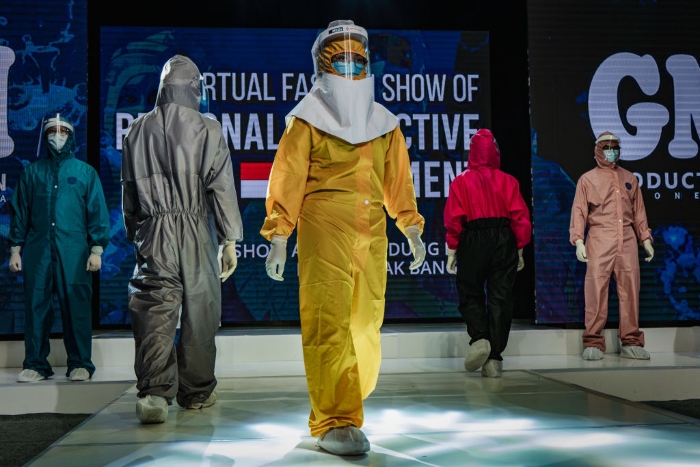

Medical workers showcase designs during a virtual fashion show of personal protective equipment in Yogyakarta, Indonesia.
Medical workers showcase designs during a virtual fashion show of personal protective equipment in Yogyakarta, Indonesia. | Getty Images
ON THE ECONOMY
END RUN AROUND CONGRESS — The chairman of the Senate Banking Committee is calling on federal agencies to extend the eviction moratorium and looser lending rules that Congress established in March, as lawmakers and the Trump administration struggle to reach a deal on the next round of aid, financial services reporter Zachary Warmbrodt writes.
In a letter to housing and bank regulators that was obtained by POLITICO, Senate Banking Chair Mike Crapo (R-Idaho) urged the officials to use their existing authority to continue eviction protections and less burdensome lending rules — in effect doing an end run around Congress.
"Although there are already early, encouraging signs that the U.S. economy is beginning to heal, federal financial regulators must remain diligent, and continue to provide relief in light of a pandemic and economic conditions that continue to evolve," he said in the letter sent Friday. The letter has not been publicly released.

Advertisement Image 

FROM THE HEALTH DESK
Trump’s attack comes shortly after top White House officials admonished House Speaker Nancy Pelosi for undermining trust in Birx.
“So Crazy Nancy Pelosi said horrible things about Dr. Deborah Birx, going after her because she was too positive on the very good job we are doing on combatting the China Virus, including Vaccines & Therapeutics,” Trump wrote on Twitter. “In order to counter Nancy, Deborah took the bait & hit us. Pathetic!”
Trump did shift his tone during his daily coronavirus news briefing at the White House later today, saying that Birx is “a person I have a lot of respect for.“ He also said Pelosi was “very nasty” toward Birx.
At the briefing Trump again split with scientists on his coronavirus task force by endorsing the use of hydroxychloroquine. When asked why he still supports the drug despite pushback from task force members Anthony Fauci and Adm. Brett Giroir, Trump took the opportunity to distance himself from Fauci. “I don't agree with Fauci on everything,” Trump said, citing Fauci’s earlier resistance to mask-wearing and banning travelers from China. “It doesn't mean he's a bad person, because he's not. He's a good person, I like him. But we disagree on things.”
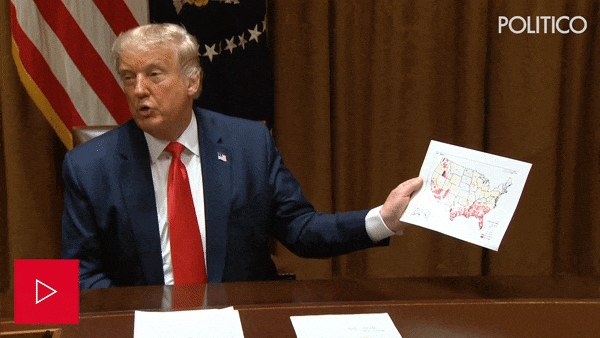
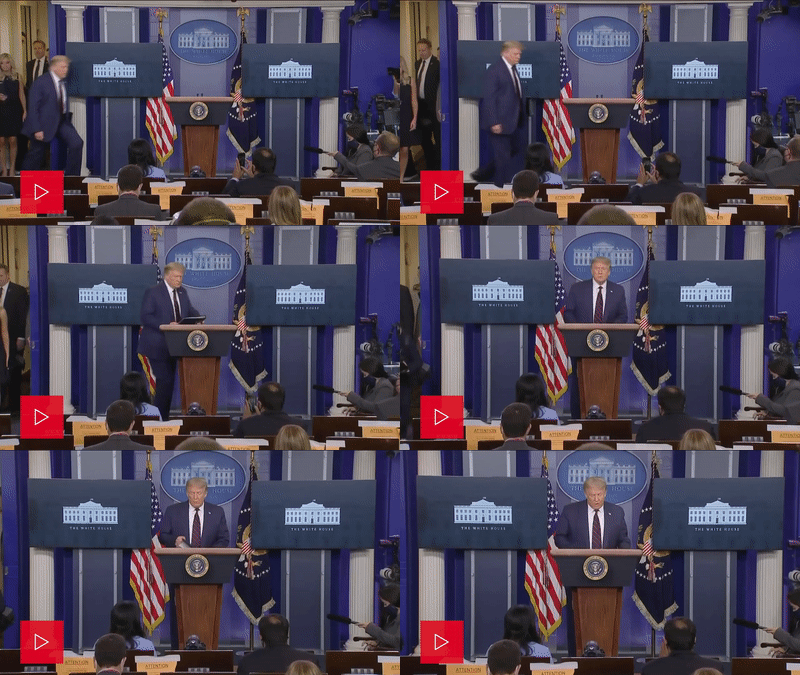
Video player of President Donald Trump showing a map in Cabinet meeting
WHERE THERE ARE ZERO ICU BEDS — More than half of all rural low-income communities in the U.S. have zero ICU beds, forcing local hospitals to rely on transfers to wealthier communities for their sickest coronavirus patients, according to a new study.
The findings, published in Health Affairs, underscore the economic disparities shaping the nation’s coronavirus response, especially as the virus shifts from wealthier coastal metros to rural communities in the Southeast and West that have historically struggled with access to care, health care reporter Tucker Doherty writes.
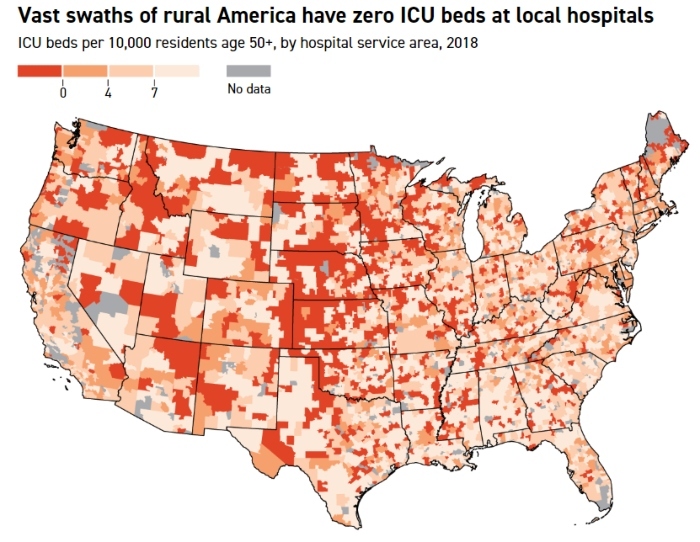
Map of ICU beds per 10,00 residents age 50+, by hospital service area, 2018
Tucker Doherty | POLITICO
AROUND THE NATION
‘A HORRIBLE POSITION’ — States are preparing to pull thousands of National Guard troops off the front lines of coronavirus relief efforts with federal funding set to expire later this month and no response from the White House on governors' pleas to extend the deployments for the rest of the year, Alice Miranda Ollstein and Lara Seligman write.
State officials and lawmakers have been pressing the White House and Defense Department for months for an extension of the troops' federal status, maintaining that as the virus surges across dozens of states, they cannot support the Guard members who have been running virus testing sites, assisting with contact tracing, building field hospitals, sanitizing nursing homes and stocking food banks.
Federal support for the Guard response to the public health crisis is set to end on Aug. 21. That means states will have had to pull Guard personnel from their duties by Aug. 7 to give them two weeks to quarantine before returning to their home communities. While some states, including Washington and Arizona, have vowed to fully fund the troops' missions with state dollars if federal support disappears, other states cannot afford to do so.
Today, the National Governors Association released a statement slamming the administration for “unnecessary delays” that are creating “significant challenges for states and territories, which are amplified in the middle of a crisis.”
“Every day counts," said one Defense official, who requested anonymity to speak about ongoing discussions. "We are getting very close to when all the guardsmen and women have to start shutting down."
COVID-2020
THREE MONTHS TO GO — Time may have lost all meaning for most of us. But when it comes to the presidential election, the clock is still ticking. In the latest episode of POLITICO Dispatch, chief Washington correspondent Ryan Lizza brings us inside of Trump's and Biden's campaigns as they enter the final stretch — under circumstances unlike any election in U.S. history.
Play audio

POLITICO'S "FUTURE PULSE" - THE COLLISION OF HEALTH CARE AND TECHNOLOGY : As the United States remains stuck in a screening crisis, a worldwide competition has been launched to find the top Covid-19 rapid testing solutions. The contest aims to find a system with a painless sample and quick turnaround for results. When will a breakthrough come? From Congress and the White House, to state legislatures and Silicon Valley, Future Pulse spotlights the politics, policies and technologies driving long-term change on the most personal issue for voters: Their health. SUBSCRIBE NOW.


NIGHTLY NUMBER
83 percent
The proportion of New York City bars and restaurants that were unable to pay their full rent for July, according to a survey released today by the NYC Hospitality Alliance. Thirty-seven percent of these establishments paid no rent at all, as restaurants and bars, which were shut down except for takeout for months, have continued to struggle since outdoor dining started on June 22.
PARTING WORDS
TESTING GOES RANDOM AT 1600 — As Trump continues to downplay the need for increased Covid-19 testing across the country, White House officials were told today they will now be subjected to random testing for the virus.
According to an email sent to executive branch employees, which POLITICO obtained, the new policy will require “random mandatory Covid-19 testing” for officials working inside the White House complex. Limited exceptions are available to aides who have spent the last 30 days working remotely or are on previously approved leave, White House reporter Gabby Orr writes.
It was not immediately clear whether there would be consequences for aides who decline to be tested for the virus or fail to show up when summoned to the White House Medical Unit.
“As part of our ongoing efforts to protect the health and safety of the entire White House Complex, randomized testing of Executive Office of the President staff, which has been ongoing for several months, will become mandatory rather than voluntary,” a White House spokesperson said in a statement to POLITICO. “Failure to report to testing will be considered a refusal to test,” the email stated.

A message from PhRMA:
America’s biopharmaceutical companies are sharing their knowledge and resources more than ever before to speed up the development of new medicines to fight COVID-19. They’re working with doctors and hospitals on over 1,100 clinical trials.

And there’s no slowing down. America’s biopharmaceutical companies will continue working day and night until they beat coronavirus. Because science is how we get back to normal.

See how biopharmaceutical companies are working together to get people what they need during this pandemic.

Did someone forward this email to you? Sign up here.

Follow us on Twitter
Renuka Rayasam @renurayasam

FOLLOW US

 POLITICO, LLC 1000 Wilson Blvd. Arlington, VA, 22209, USA


Tuesday, July 21, 2020

POLITICO NIGHTLY: He’s back


POLITICO Nightly: Coronavirus Special Edition
Presented by
With help from Myah Ward
SEASON TWO — When the novel coronavirus didn’t “go away” or “fade away” or “like a miracle” “sort of just disappear,” when the case count kept going up and his poll numbers kept going down, when his rally in Tulsa was an embarrassing flop and the next one was nixed because it was threatening to be another, it was inevitable that Donald Trump was going to resurrect the briefings that became, at least for a time early this spring, something of a hit show.
This president doesn’t like to cede or share the spotlight, and immediately conspicuous in the briefing room at the White House tonight was the absence of Mike Pence, of Tony Fauci and Deborah Birx, of any of the other collection of public health pros and administration officials who were recurring characters in these sessions back in March and April. “I alone can fix it,” Trump said in Cleveland, on July 21, 2016, and here he was, exactly four years later, alone.
Trump believes that appearances are paramount, “that how you look is more important than how you sound,” as Roger Stone once said to me, and “how you come across is more important than the words you use.” The stage in the White House is about as important as it gets. The person front and center there can’t help but look like he or she’s in charge. Trump gave it up some three months back — and ever since his standing has sunk.
The importance he places on visuals might be why, on that stage this evening, as he talked more than he ever has about the importance of wearing a mask, he didn’t wear one. He took his mask out of his suit pocket to show it to reporters — but he didn’t put it on.
And lastly, and this is one of Trump’s most deep-seated convictions, he believes he can make something so simply by saying it enough times and with enough force. He is ever endeavoring to bend reality to his will, to succeed without actually having to succeed, channeling the relentless, practically blind optimism of Norman Vincent Peale. Yet tonight, at times, he sounded uncharacteristically realistic. “It will, probably, unfortunately,” he said, “get worse before it gets better — something I don’t like saying, but that’s the way it is.”
But Peale won out in the end. Trump reiterated his contention that “the virus will disappear.” And one of the last things he said? It had nothing to do with the coronavirus. “The stock market,” he said, “had another good day.”
So it went in the less-than-a-half-hour episode of the second season of Trump’s coronavirus briefings. When it comes, though, to second seasons, it’s worth recalling that Trump’s track record isn’t good. It was the first season of “The Apprentice” that was by far the most successful. And this, needless to say — managing this pandemic, or even the public perception of how he’s doing — is a hell of a lot harder than making reality TV.
Nightly video player of President Donald Trump's coronavirus briefing

A message from Emergent BioSolutions:
Our global team is going full speed to develop potential therapies that may help treat COVID-19. At the same time, we’re collaborating on innovative vaccine candidates that can be made by the millions. Discover what we’re doing right now.

Welcome to POLITICO Nightly: Coronavirus Special Edition. Wish me luck — I’m off for the next few days while I attempt a cross state move. I’ll be back next Tuesday. Reach out rrayasam@politico.com or on Twitter at @renurayasam .
THE NIGHTLY DEBATE
Nightly asked: If you were in charge of your school district or university, how would you design the fall semester? If you have children in school or college, what are your plans for their education this year? Answers have been edited and emphasis added in bold.
“If a vaccine can reach us by December, I would postpone the start of the school year by those three months. Worst case, it buys time to prepare the district for a potential return.
“If for some reason we are compelled to have school, I would focus on online classes for a daily period of time, but also would schedule recess/playground time/social activities for small groups that bring kids back to school on a staggered schedule that is optimized to have as few people on campus at a single time as possible.
“The greatest issue is for working parents. How do they keep their jobs and care for their kids at home? One way to attempt to address this is by having trusted groups of families that can support multiple kids at one home. A better solution would be to offer Caretaker Basic Income that pays a parent $2,000 to $2,500 per month, depending on their cost of living, to stay at home during the period kids are required to take at-home and online classes. I would also add a broadband stipend to make sure that kids have access to sufficient internet for their classes and potentially even to buy a low end laptop.
“As far as my kids: 10, 13 and 16. What I wrote is exactly what I suggested when I was asked.” — Mark Cuban, owner of the Dallas Mavericks
“My kids, 3 and 6 years old, are slated to go back to day care and school in a few weeks. It’s clear that they need more socialization and stimulation, and working full-time while parenting isn’t sustainable. But I still feel deeply ambivalent about sending them back, even though I live in a state that currently has low community spread. It’s infuriating that the federal government’s failure to respond to the pandemic has put parents, teachers and kids in this impossible position.” — Julia Marcus, epidemiologist at Harvard Medical school
“In my ideal world, school districts would shift to providing flexible resources for those families, up to and including refunding or voucherizing some of the money the system would have spent educating their children in person. Some parents desperately need someone to keep their children safe and supervised during the day and are being offered Zoom tutorials on how to make dioramas instead. Meanwhile, parents of older or more independent children may have less need for oversight, but are utterly at sea when it comes to administering trigonometry lessons.
"For many households, an education rebate of a few thousand dollars — a small fraction of the amount that the average public school district spends per student — could mean the ability to buy computers and textbooks or hire tutors and babysitters they otherwise couldn't afford. The vouchers or rebates could create a large market for innovative solutions, and maybe restore some sense of control to the millions of parents who feel battered by circumstance under coronavirus.” — Katherine Mangu-Ward, editor-in-chief, Reason magazine
“What I have heard about school reopening is alarming. Remote learning is hugely challenging for parents and teachers who have young kids. But by saying that we're going to reopen without having achieved a certain metric or achieved safety based on data and science seems very dangerous to me. Thankfully, my son graduated from college but my daughter is going to remote learn. Reopening and pretending that we're not facing a deadly global pandemic that has been completely mishandled by the White House and in my state by the governor is a recipe for disaster.” — Rep. Veronica Escobar (D-Texas)
“My children are going back to school on time and in full — as they should, and as all of America should. I would encourage all schools to go back, adopting whatever standards they deem appropriate, so long as it’s in person and fully functioning. Parents and kids need it — and science demonstrates we can open safely.”
— REP. CHIP ROY (R-TEXAS)
“If our public schools open, we’ll send our kids. But now they’re planning to start online, so I wish we could focus less on this debate and more on designing a virtual classroom experience that isn’t a total joke. Last spring was basically two days of homework and three days of Fortnite — I’m pretty sure we can do better than that. Plus I suck at algebra.” — Matt Bai, contributing columnist for The Washington Post
“I would use alternative learning spaces to maximize the amount of face-to-face learning children have with a teacher and would demand substantial investments from our federal government so our school district can hire more teachers. I would also encourage cities to repurpose unused spaces like theatres , office spaces, and design spaces to classrooms. I would fight to increase experiential and outdoor learning opportunities for kids. Outdoor spaces are much safer for kids making this pandemic an opportune time for children to learn more about their relationship to the environment and work on outdoor science experiments. I would encourage parks department personnel to become a major contributor to outdoor experiential learning.
“We need to ensure every child and teacher has access to Wi-Fi and stipends for any books. For any in-person activities, I would make masks and gloves mandatory, consistently encourage Covid testing amongst staff and students, and make cleaning and ventilation services mandatory.
“Our own kids will be returning to school on a part-time basis in accordance with our local department of education.” — Jamaal Bowman, Democratic New York congressional candidate
“I would have the children come into school on rotating days, and I would provide businesses with tax credits if they give unused space to schools so that the kids can separate more. I’d require masks, improve ventilation, and I would also experiment with pooling corona tests: If possible, have multiple people contribute to one sample so that you can cheaply and easily see if anyone has tested positive before going through the expense of testing individuals.” — Nicholas Thompson, editor-in-chief, Wired magazine
“The risks and feasibility of opening schools will hinge on the prevalence of Covid-19 in their community. If we were to open schools in Austin today, we estimate that a school with 500 students might have three students show up infected during the first week alone. The more we are able to slow spread and reduce cases, the more feasible and safe opening schools will be.” — Lauren Ancel Meyers, a professor of integrative biology at the University of Texas at Austin
“The decision on whether to reopen schools in person, online or with a mix is ultimately up to local school districts, teachers and public health officials. I am committed to supporting schools by pushing for passage of the Coronavirus Child Care and Education Relief Act. This legislation provides $430 billion to assist child care facilities, K-12 school districts and institutions of higher education with reopening costs.” — Sen. Tim Kaine (D-Va.)
“Let 1,000 vouchers bloom. Schools face very difficult choices this fall, between higher risks of infection and worse learning outcomes. We should admit we don’t know how to make these choices well collectively, and empower parents to choose instead. Take the per-student school budget and offer a big fraction of it to parents as a voucher, to pay for home schooling they run themselves, for a neighbor to set up a one-house schoolhouse, for a larger private school, or to use at a qualifying local public school. Each option would set its own learning policies and also policies on distancing and testing. Let parents weigh family infection risks against learning quality risks, using what they know about available options, and their children’s risks, learning styles and learning priorities.
“Yes, schools may suffer a large initial revenue shortfall this way; maybe they could rent out some rooms to new private school ventures. Yes, some children will end up with regretful schooling outcomes, though that seems inevitable no matter what we do. Yes, there should be some limits on teaching quality, but we should be forgiving at first; after all, public schools don’t know how to ensure quality here either. And maybe let any allowed option start a month or two late, if they also end later next summer; after all, we aren’t giving them much time to get organized.”  Robin Hanson, economist at George Mason University
“As a pediatrician and parent, I know how important it is to get students back in the classroom. We all want that. And with each day that passes, we know that communities of color — and students in those communities — likely will suffer disproportionately, just as we’ve seen with Blacks, Latinos and Native Americans across the nation in the first six months of this pandemic. In America, property taxes provide a large part of the funding for schools, so wealthy communities may be able to make the necessary changes while schools in lower income communities are left behind. We immediately need federal and state resources in place so that schools can reopen safely and equitably. Without adequate funding and better control of this pandemic, we’re setting ourselves up for failure. And tragically, we’ll be failing the students who can least afford this lost time to learn and thrive.”
— RICHARD BESSER, PRESIDENT AND CEO ROBERT WOOD JOHNSON FOUNDATION
“I’d set in-person education back to start as soon as community transmission is under control, we have highly accessible universal Covid testing and the most vigorous contact tracing program possible. If we were to issue stay at home orders in Texas now, and then use the time while we are at home to put these pieces in place, we could open up for in-person education as early as October.
“We have three kids who attend public schools in El Paso. They will be starting 8th, 7th and 4th grades this fall. Our school district has given us the choice between hybrid (in-person and distance learning) and distance learning only. We will choose distance learning only until the conditions are in place to protect the teachers, support staff and other educators, the kids, and the parents and grandparents of kids.” — Beto O’Rourke, former Texas congressman and former presidential candidate
I say, without a hint of sarcasm, that I have never been happier about not being in charge of our school district or my university. Going back in person seems very unlikely in parts of the country experiencing a spiking pandemic. I suspect most K-12 districts and colleges will be online sooner rather than later, and we need to focus tremendous energy and resources on improving that experience for young, low-income and other disadvantaged students — in other words, those who will be hurt the most by a lack of face-to-face learning this fall.
“I have a high school and a college student, my wife is an early childhood teacher, and I teach at the college level. The college student will be online through the fall if not all year; the high schooler has the option for f2f or online and wants to try f2f. My school of education is online through the fall, except for one program that will need to be at least partially f2f … and guess which program I teach in this fall? Every day we read reports that all basically say (1) You’re probably fine to go back, (2) but the science is still all over the place, (3) so use your best judgment. We all want to get back to f2f as soon as possible, but at what cost? It’s a constant source of anxiety for us.” — Jonathan Plucker, professor in the Johns Hopkins School of Education
“Had I been in charge of a school district in May, our team would’ve set as our goal having all students in class full-time in September. Then we would’ve figured out all of the things necessary to get that done safely; and if full-time and in-person wasn't possible, we would’ve gradually worked back from there. The idea would be to return to normal schedules as swiftly as conditions allow — but no swifter. Having said that, we have to realize that even if each of America's 13,500 school districts set that very same goal, they’d reach very different conclusions. District to district, there are big differences in how crowded schools are, how many buses are needed, the prevalence of Covid cases, the views of parents, the views of teachers and more. This is where America's highly decentralized system of schools shows its value.
“America is big and diverse, and conditions and sentiments will change. So the national picture that emerges this fall might look completely unintelligible when viewed from the nation’s capital, but it could well be intelligent from viewed from each particular district." — Andy Smarick, senior fellow, Manhattan Institute
“I think it is important to have community transmission controlled before you can discuss having in-person education. We still don’t understand enough about the transmission dynamics between kids and from kids to adults. We know that asymptomatic transmission is a problem and do not know enough about how children with asymptomatic (or even symptomatic disease) do long term. We would feel horrible in 6 months if we found out that putting kids in a setting and they were to get this disease put them at risk for long term medical problems.” — Krutika Kuppalli, infectious diseases physician and vice chair of the Global Health Committee at the Infectious Diseases Society of America
“The name of the game is options and adaptability. Options for parents and staff for online, hybrid and in-person learning. Adaptability to respond to local and individual health and educational issues. We must not underestimate the educational urgencies for students in our quest for good health and safety. We all need to come to terms with levels of risk, make personal decisions for our health, family and educational needs, and wear masks damnit!” — Margaret Spellings, secretary of Education under President George W. Bush
“I have zero new ideas about this but one. It teaches patience. It teaches ‘This too shall pass.’ Free cars take every school kid every day to a drive-in movie about vaccine development. The current catastrophe would make watching the boring PowerPoints and medical exams more exciting. As soon as the vaccine is approved, and the first 100 million doses made, the kids get their shots, sleep off the side effects, and head into winter break dreaming of spring semester and what we will pretend is normal.” — Virginia Heffernan, the host of “Trumpcast” and a columnist for the Los Angeles Times, Wired and the Economist’s 1843

DON'T MISS - POLITICO'S NEW "FUTURE PULSE" NEWSLETTER: The coronavirus pandemic accelerated long-simmering trends in health care technology and one thing is certain: The health care system that emerges from this crisis will be fundamentally different than the one that entered. From Congress and the White House, to state legislatures and Silicon Valley, Future Pulse spotlights the politics, policies, and technologies driving long-term change on the most personal issue for voters: Our health. SUBSCRIBE NOW.


FIRST IN NIGHTLY
CHILD CARE’S COVID CRISIS — The collapse of the child care industry is threatening to stoke racial and gender inequities and putting pressure on Congress to address the crisis in its new round of coronavirus aid.
Black and Latina women are suffering a double-barreled blow as coronavirus-induced shutdowns batter the industry, Eleanor Mueller writes, because they dominate the ranks of child care providers and have long struggled to gain access to the services for their own kids.
The sector, which saw 60 percent of its programs close at the height of the pandemic before rebounding slightly, is still down some 237,000 workers from last year — a number that’s likely to grow as states shut down again, economists say. Some projections show the industry could permanently lose half its programs. Two in 5 child care providers this month said they will shut for good without an infusion of federal funding.

A message from Emergent BioSolutions:
Advertisement Image 

COVID-2020
THE HAGGLING CONTINUES — Senate Republicans and the White House remain plagued by deep ideological divides over major elements of the next coronavirus relief package, creating an opening for Democrats as the pace of negotiations accelerates, John Bresnahan, Marianne LeVine and Andrew Desiderio write.
With coronavirus cases soaring across the country, the U.S. economy in near tatters, and elections just over 100 days away, senior White House officials and the Senate GOP leadership have yet to find agreement on big portions of the soon-to-be-released Republican proposal. They’re still undecided on whether to propose a payroll tax cut or how to respond to the end of enhanced unemployment payments for millions of Americans. Those $600-per-week unemployment checks begin to phase out in a few days.
ASK THE AUDIENCE
Nightly asks you: Have you gotten tested for Covid-19? Do you want to get tested but are unable to? Tell us your testing experience. Send us your story with our form and we’ll include some of the responses in Friday’s Nightly.
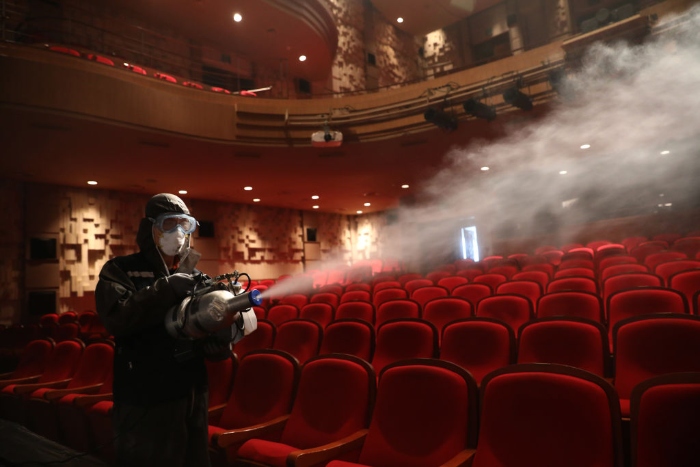
A disinfection worker sprays anti-septic solution in a theater in Seoul.
A disinfection worker sprays antiseptic solution in a theater in Seoul. | Getty Images
THE GLOBAL FIGHT
COVID FUNDING WITH STRINGS ATTACHED — With governments at risk of sinking under massive Covid-related debt, and demand for financial support from international organizations outstripping supply, the terms of public relief funding are tightening around the world, Ryan Heath writes.
After more than 90 hours of negotiating among European national leaders, the EU’s executive arm (the European Commission) this morning won permission to borrow $865 billion from financial markets to help the most beleaguered EU countries — including Italy and Spain — recover from Covid-19. The breakthrough came only after a group of frugal EU countries insisted that half the funds be delivered as loans rather than grant payments, and that $350 billion be tied to policy reforms. A separate push to attach rule of law conditions to the funding failed amid questions around how it could be enforced.
The International Monetary Fund is shifting to attaching green conditions to its next round of Covid-19 support, after more than 100 countries have asked, now that emergency support has been delivered. Meanwhile, national governments are applying strict conditionality on business aid: no dividends or share buybacks for example, and nothing for businesses registered in tax havens. NGOs are joining the pile-on, arguing for green conditions and human rights due diligence as Covid funding conditions.

JOIN THURSDAY AT 1:30 p.m. EDT – A GLOBAL RALLYING CRY: The Black Lives Matter movement has gone global with anti-racism protests sweeping cities around the world. What does the racial reckoning look like abroad? Join Global Translations author Ryan Heath for a conversation on how the fight for equality has become a worldwide rallying cry following the killing of George Floyd. REGISTER HERE.


NIGHTLY NUMBER
31
The number of states on the New York and New Jersey list from which travelers are subject to a two-week quarantine upon arrival. An additional 10 states were added to the list today as Covid-19 caseloads continue to surge in much of the country, which is updated weekly.
PARTING WORDS
SUMMER RETURNS IN MOSCOW — It wasn’t that long ago, in early June, that Russia’s capital Moscow was eerily quiet as the Kremlin enforced one of the world’s harshest coronavirus lockdowns. With the capital reporting more than 10,000 new cases a day, residents needed special permission via QR codes on their phones for trips outside, and most Muscovites cowered fearfully in their flats.
Flash forward nearly two months and the contrast couldn’t be greater, Vijai Maheshwari writes: Parks, restaurants, museums, gyms, night clubs — even strip clubs — are open once again. Ever since Russian President Vladimir Putin jolted the city out of its corona slumber with a massive June 24 Victory Day parade to celebrate the 75th anniversary of World War II, Moscow is churning at full blast again. The cavalier attitude toward wearing masks and social distancing among most Russians makes a deadlier second wave in the fall — or sooner — even more likely. But for now, the corona nihilists have the upper hand in Russia: A survey by Moscow’s Higher School of Economics found that a staggering third of Russians don’t believe in the coronavirus pandemic and consider the threat to be exaggerated.

A message from Emergent BioSolutions:
We go after public health threats. In the fight against COVID-19, we are going full speed to develop potential new therapies and vaccine candidates.
We go for critical innovations. We are developing two potential hyperimmune treatments for severe hospitalized COVID-19 patients and individuals at risk. Based on proven technology, the research and testing are underway.
We go in partnership with others. We are working with industry innovators to bring COVID-19 vaccine candidates to market. We have the capacity to manufacture vaccines in the tens to hundreds of millions, and we are propelling development forward.
We go. And go. From fighting anthrax to helping prevent smallpox and developing vaccine candidates, we go all in. Because public health threats will never stop. And neither will we.

See how we go all in.

Did someone forward this email to you? Sign up here.

Follow us on Twitter
Renuka Rayasam @renurayasam

FOLLOW US

 POLITICO, LLC 1000 Wilson Blvd. Arlington, VA, 22209, USA


Sunday, May 24, 2020

RSN: Covid-19 Profiteers Are Making a Killing


Reader Supported News
24 May 20


Donations are way down this month, a 40% drop in funding from only 30 days ago. It’s late in the month and we still have no traction on donations. Lots of people are coming but very few are donation.

Situation, very bad.

Marc Ash
Founder, Reader Supported News


If you would prefer to send a check:
Reader Supported News
PO Box 2043
Citrus Hts
CA 95611


Reader Supported News
24 May 20

It's Live on the HomePage Now:
Reader Supported News


Covid-19 Profiteers Are Making a Killing
Amazon founder Jeff Bezos. (photo: Andrew Harrer/Getty Images)
Amber Colon Nunez, In These Times
Nunez writes: "Two months after the World Health Organization (WHO) declared coronavirus a global pandemic, the United States stands as the nation with the most confirmed cases. The WHO warns that the worst is yet to come."


Here are some of the most outrageous capitalist responses to the pandemic.

wo months after the World Health Organization (WHO) declared coronavirus a global pandemic, the United States stands as the nation with the most confirmed cases. The WHO warns that the worst is yet to come. Yet President Donald Trump has signaled that he wants the economy to reopen as soon as possible, despite countless warnings from public health experts that opening too soon can cause a spike in deaths.
Big corporations and their head honchos have joined the president in downplaying the dangers and gunning for a reopening. Elon Musk told SpaceX employees that it's more dangerous to drive a car than to be exposed to coronavirus. Hobby Lobby founder David Green made headlines when he claimed keeping his stores open was a part of God’s plan, and initially defied state shutdowns. Corporate-funded conservative groups like FreedomWorks are lobbying federal and state legislators and orchestrating astroturf anti-lockdown protests at state capitols. In April, Amazon CEO Jeff Bezos and Facebook CEO Mark Zuckerberg joined the president on phone calls to discuss reopening the economy as soon as possible.
Perhaps denial is easy when you can afford to sequester yourself.
While Amazon workers across the country are now fighting to keep their $2 hazard pay raise, the nation’s wealthiest are hiding out in apocalyptic bunkers and making requests for private, at-home doctor’s visits that cost upwards of about $1,500. In mid-April, when doctor’s offices nationwide still faced a shortage of testing kits, Florida residents of Fisher Island—the richest ZIP code in the nation—purchased 1,800 antibody tests for themselves just in case Covid-19 penetrated their very gated community. In New York, 40% of residents were unable to pay rent in April, according to The New York Times. In New York City, the most affluent fled in droves, emptying out well-to-do neighborhoods like the Upper East Side, the West Village, SoHo and Brooklyn Heights by 40%.
It’s clear that the 1% are playing by an entirely different set of rules.
84-year-old billionaire Ken Langone, co-founder of Home Depot, called up his buddies at NYU Langone in February to get a feel for the severity of coronavirus. “What I’ve been told by people who are smarter than me in disease is, ‘As of right now it’s a bad flu,’” Langone told Bloomberg News from the comfort of his North Palm Beach, Fla., home.
But it’s become clear that the coronavirus is very, very different from the common flu. The WHO has determined that Covid's reproductive number is significantly higher: One infected individual can infect 2 to 2.5 more people than the flu, whose sufferers typically only infect up to 1.3 others. (Langone has since changed his tone on reopening, telling CNBC, “Our part as citizens should be stay home, obey separation.” Home Depot has instituted temperature checks for workers, shorter hours, customer limits, paid leave, hazard pay and no-co-pay healthcare.)
Due to the nationwide shortage of testing kits, it’s hard to know exactly how many people this pandemic is affecting. America’s top infectious disease expert, Anthony Fauci, is certain the approximately 80,000 reported Covid-related deaths is a significant undercount. Some experts estimate that total deaths in the U.S. may be twice as high as reported.
What can be more easily measured are the ways some companies are profiting from the changes wrought by the virus. As Americans eagerly sanitized every nook and cranny of their homes, cars and shopping carts, sales of Clorox cleaning supplies rose by 32% in the first quarter of 2020. Zoom and Slack Technologies have also seen increases in their profits as working from home has become the new normal. Slack has added 80% more customers compared to the previous quarter, while Zoom hosts more than 300 million participants each day—boosting its stock price by 150%. In the first 23 days after the initial lockdowns began, America’s billionaire class raked in over $282 billion in personal wealth, according to the Institute for Policy Studies.
Profiteering on Covid began almost as soon as the crisis hit. The makers of air purifier Molekule proclaimed in February they were “very confident that this technology will destroy coronavirus,” and rival Airpura claimed on its website in March that its devices are 99.99% effective in removing coronavirus. However, scientists hadn’t tested the purifier’s efficiency at eliminating coronavirus molecules—only that of similar diseases, like smallpox and Ebola. Experts say that coronavirus particles are too small to be blocked by the filters in air purifiers. (Airpura later removed the claim).
In March, third party sellers on Amazon began jacking up the prices on hand sanitizer. Sniffing out the opportunity for a windfall, profiteers bought out scarce supplies at grocery stores and resold them at exorbitant rates. It wasn’t long before Amazon curtailed the practice by banning new listings for masks and sanitizer. But Amazon happily continued to turn its own profit: The company’s earnings increased by $33 million every hour of the first quarter, even as its warehouses suffered coronavirus outbreaks and workers walked out over unsafe conditions. Bezos, the world’s richest man, has accumulated an additional $25 billion since the beginning of this year, putting him on track to become the first-ever trillionaire.
With a vaccine a year or more off and a president who keeps dismissing the severity of the pandemic, U.S. consumers will continue to pour their money into empty or uncertain promises. Online sales have spiked over the last several weeks. In-store sales have declined while online shopping has peaked to almost 40% after the first round of stimulus checks went out.
DoorDash, whose drivers are paid with a tipped minimum wage, is holding its foot on the necks of other meal-delivery services like HelloFresh and Blue Apron. Instacart is coming out on top and leaving major companies like Amazon and Walmart in the dust with a nearly 500% increase in sales in mid-April. Still, Instacart workers said the company was slow to hand out PPE.
Meanwhile, with “non-essential” businesses ordered closed in many states, more than 33 million Americans have filed for unemployment since early March. The billionaires who own many of those businesses are panicking. As they push for the economy to reopen, they’ve made one thing very clear: They aren’t the ones making their own wealth, their workers are.


The motorcade for President Trump arrives at Trump National Golf Club on Saturday in Sterling, Va. (photo: Alex Brandon/AP)


America (President Trump) Is Ready to Get Back to Normal (Playing Golf)
Philip Bump, The Washington Post
Bump writes: "Of all of the times that White House coronavirus task force member Deborah Birx has said things clearly intended for President Trump’s benefit, few were as transparent as her comments on Friday afternoon."
READ MORE


President Trump’s press secretary, Kayleigh McEnany, did not appear to use a mock check as others have done. (photo: Andrew Harrer)


Donald Trump Press Secretary Inadvertently Reveals President's Bank Details
Melissa Davey, Guardian UK
Davey writes: "Efforts to highlight Donald Trump's largesse during his time in office have backfired after his press secretary appeared to display the US president’s personal bank details to the world."
READ MORE


Great Clips in Missouri. (photo: KY3)


Two Missouri Hairstylists Potentially Exposed 140 Clients to Coronavirus
Faith Karimi, CNN
Karimi writes: "Two Missouri hairstylists potentially exposed 140 clients to coronavirus when they worked for up to eight days this month while symptomatic, health officials said."
READ MORE


Doctor giving a vaccine to a patient. (photo: INGIMAGE)


The US Anti-Vax Movement Could Pose a Major Threat to Any Future Coronavirus Vaccine Campaign
Andrew Romano, Yahoo! News
Romano writes: "According to a new Yahoo News/YouGov poll, 44 percent of Republicans believe that Bill Gates is plotting to use a mass COVID-19 vaccination campaign as a pretext to implant microchips in billions of people and monitor their movements — a widely debunked conspiracy theory with no basis in fact."
READ MORE


El Salvador president Nayib Bukele talks at the Great Hall of the People on December 3, 2019 in Beijing, China. (photo: Noel Celis/Getty Images)


El Salvador's Neoliberal Populism Runs Into Coronavirus
Jonah Walters, Jacobin
Walters writes: "For a few brief moments in March, it looked like El Salvador might be stumbling towards a relatively orderly period of mandatory self-isolation."
READ MORE


U.S. Fish and Wildlife Service officers confiscated these illegally imported reptile skin boots. (photo: Kate Brookes/Redux)


Luxury Fashion Brands Chanel, Gucci, and Coach Used Illegal Wildlife Materials in Thousands of Products
Rachel Nuwer, National Geographic
Nuwer writes: "Famous luxury fashion brands — Ralph Lauren, Gucci, Michael Kors, and dozens of others — had more than 5,600 items made from illegal wildlife products seized by the United States Fish and Wildlife Service at U.S. ports of entry from 2003 through 2013, National Geographic has learned from researchers who recently published their work in the journal EcoHealth."


A report finds that companies including Chanel, Gucci, and Coach had thousands of imported exotic leather goods seized by U.S. law enforcement from 2003 through 2013.

The analysis doesn’t implicate luxury fashion companies in intentionally smuggling illegal goods, nor does it say which companies may be linked to more recent illegal imports; since 2013 the U.S. government no longer discloses to the public the names of businesses importing wildlife products, a move that's been challenged in court.
But lead researcher Monique Sosnowski, a doctoral student in criminal justice at the City University of New York (CUNY), says the seizures spotlight a lack of adequate controls throughout the entire supply chain. “We’re not trying to point out Gucci and be like, ‘You’re so awful for using these things,’ but [rather] point out this mass system failure,” she says. “There’s all these protections in place, but these companies [were] still somehow importing goods that are illegal.”
For their analysis, Sosnowski and Gohar Petrossian, a criminologist at CUNY, used the Freedom of Information Act (FOIA) to obtain seizure records from the U.S. Fish and Wildlife Service from 2003 through 2013. They identified 474 luxury fashion-related seizures comprising 5,607 individual items, nearly 70 percent of which were exotic leather products. Reptiles accounted for 84 percent of all items, many of which were belts, watch bands, wallets, shoes, and purses.
Those numbers almost certainly understate the gravity of the problem. Law enforcement studies routinely find that U.S. officials manage to interdict fewer than one in 10 illegal wildlife shipments, notes Bruce Weissgold, a former reptile trade intelligence analyst and senior international trade specialist at the U.S. Fish and Wildlife Service.
The CUNY study, published in January, reveals that despite multiple layers of control by countries and companies, illegal wildlife products have tainted the supply chains of some of the most prominent fashion brands in the world, whether or not the fashion companies were aware. Though the study focuses on law enforcement records from 2003 through 2013, aggregate figures from 2008 through 2019 analyzed by Sosnowski indicate that wildlife trafficking remains a serious problem in the U.S. More than 4,000 shipments of illegal wildlife products were seized last year.
Molly Morse, a spokesperson for LVMH, which owns a number of companies on the list—including Louis Vuitton, Loro Piana, Marc Jacobs, Christian Dior, Givenchy, and Fendi—said in an email that the seizures connected to LVMH “were many years ago and generally related to paperwork and labelling processes.”
“We have rigorous internal training and processes in order to comply with all regulations...and we are in ongoing contact with regulators around the world regarding emerging laws,” Morse said.
Neha Wadhwa, a spokesperson for Ralph Lauren, called the company’s inclusion on the list of seizures “misleading and flawed,” adding in an email, “We have a long history and commitment to animal welfare. We were one of the first luxury brands to ban fur nearly 15 years ago, and remain committed to ensure all species are sustainably sourced.”
Representatives from Michael Kors, Jil Sander, and Coach did not respond to requests for comment about the seizures. The Kering Group, which owns Gucci and other companies cited, including Alexander McQueen, Bottega Veneta, and Yves Saint Laurent, acknowledged National Geographic’s query, but ultimately did not provide comments.
Though most companies did not comment on the seized products, many have corporate social responsibility policies in place that promote traceability, animal welfare, and sustainable use of wildlife, and some have banned the use of certain wildlife products.
Household names
The CUNY team omitted the names of the companies linked to the seizures from their paper published in EcoHealth because, Sosnowski said, the purpose of sharing research in scientific journals is not to name or shame parties who may have been associated with illegal activities—whether they’re countries, companies, or individuals—but rather to identify larger trends. Sosnowski says she shared the list with National Geographic exclusively to “bring the issue closer to home” for consumers.
According to the official seizure records, Ralph Lauren accounted for 29 percent of the seized items, followed by Gucci (16 percent), Michael Kors (10 percent), Jil Sander (6 percent), and Coach (5 percent). Gucci had the highest number of individual seizure incidents—50—followed by Yves Saint Laurent at 41.
International trade data shows that 11.7 million products made from reptiles were imported into the U.S. from 2003 to 2013, meaning that the 5,607 luxury fashion seizures reported in the study represent just 48 out of every 100,000 imported items made from reptiles, says Daniel Natusch, a conservation biologist at Macquarie University, in Australia, and member of several reptile specialist groups and the Sustainable Use and Livelihoods Specialist Group at the International Union for Conservation of Nature (IUCN), the body that sets the conservation status of wild animals.
Wildlife products, including exotic leathers and fur, are often used in high fashion, though an increasing number of companies have sworn off their use in response to pressure from consumers concerned about animal welfare and conservation. Diane von Furstenberg, Chanel, and Jil Sander, among others, no longer use exotic leathers. Stella McCartney, Versace, Michael Kors, and Gucci are among brands that no longer use fur. The fashion industry often defends its use of legal wildlife products by saying those goods support livelihoods. They also say their efforts are crucial for conservation because they provide an economic incentive to manage and protect species and their habitats for sustainable use.
As in many industries engaged in the trade of wildlife and wildlife products—which range from exotic pets and timber to health supplements and traditional medicines—the legal and illegal often exist side by side. And there are many ways that illegal products or practices can enter the supply chain in the fashion industry.
In some exporting countries where animals used in the fashion industry originate, including Indonesia and Malaysia, there is ample evidence of corrupt officials giving cover to illegally acquired wildlife by issuing legal permits to exporters. That makes it “virtually impossible to know whether the shoes in the shipping crate are of legal origin,” says Weissgold, the former reptile trade intelligence analyst at the U.S. Fish and Wildlife Service.
Another common violation is when animals illegally captured in the wild are mislabeled as “captive bred.”
While some companies have made efforts to improve their wildlife-related practices, Weissgold says more must be done. “Given their resources, reach, and expertise, I believe it is incumbent upon fashion companies to be good corporate citizens,” Weissgold says. “They have a unique position to influence their suppliers.”
Some seized products are from endangered animals
Nearly 58 percent of the seizures documented in the EcoHealth report pertained to animals caught in the wild rather than those bred in captivity on farms.
The Convention on International Trade in Endangered Species of Wild Fauna and Flora (CITES), which regulates country-to-country wildlife trade, strictly bans the trade in 13 of at least 60 species that were identified in the seizures. They include Nile crocodiles and broad-snouted caimans, unless they’re captive-bred with proper permits. Two species—the saiga antelope and the Siamese crocodile—are critically endangered. Researchers estimate that only between 500 and 1,000 Siamese crocodiles remain in the wetlands of Southeast Asia.
CITES affords different levels of protection for species depending on how threatened they are. In cases where trade is allowed, countries are supposed to grant export permits only if scientific evidence shows that trade won’t undermine the animals’ survival in the wild.
Thirty-six of the species, including reticulated pythons, are listed as species of “least concern”—in other words, not in danger of extinction—but most of the others, including African rock pythons, sunbeam snakes, and several species of cobra, have not been assessed by the IUCN or granted protections under CITES. It’s not known how many of these animals are left in the wild, whether their populations are increasing or decreasing, or whether trading them is sustainable.
“The fact that more than 50 percent of the seizures made were of animals taken from the wild should set off some alarm bells,” says Chris Shepherd, executive director of Monitor, a nonprofit group that works to reduce illegal and unsustainable wildlife trade. “Very little is known of the status of many of these species in the wild, and therefore the impact of the illegal trade—and the legal trade, for that matter—is largely unknown.”
The data also revealed the international nature of wildlife trade, Sosnowski says, and the fact that illegal products often cross multiple borders before being discovered. More than half the U.S. seizures were imports from Italy, France, and Switzerland, though most of the animal products originated in Southeast Asia.
Only a fraction of illegal products get caught
U.S. enforcement officials estimate that only 10 percent of illegally imported wildlife products are even confiscated, according to Weissgold, the retired Fish and Wildlife Service agent. As a result, “It’s a ‘buyer beware’ world,” he says. “You can never be 100 percent sure that the product you’re purchasing has been legally acquired.”
Natusch disagrees. “These are some of the world’s largest and most responsible companies, with a significant brand image to protect,” he says.
Natusch believes most of the 5,607 seizures cited in the study were likely mistakes by the exporting or importing companies—“paper violations, clerical errors, or simple and perfectly reasonable misunderstandings,” such as a company forgetting to declare shell buttons on a blouse.
Weissgold, for his part, says that based on his nearly 25 years of experience working as an intelligence analyst at a federal enforcement agency, paperwork violations are “quite symbolic of large-scale fraud in the industry.”
When you pair that with a U.S. judicial system that has high standards of proof, “wildlife inspectors are frequently just staring into a crate without any idea what can be done about it,” Weissgold says.
Animal welfare concerns
Even when trade in animal products for the fashion industry is legal, there are still animal welfare concerns, Weissgold says. A 2016 investigation carried out by People for the Ethical Treatment of Animals (PETA), an advocacy organization known for sometimes controversial tactics, concluded that Vietnamese farms that allegedly supplied crocodile skins to a tannery owned by LVMH confined crocodiles for up to 15 months in small concrete cages before slaughtering them for skins. PETA investigators videotaped tannery workers severing the crocodiles’ spines—paralyzing them but not killing them—before skinning them alive.
Asked about the PETA investigation for this story, LVMH did not dispute the findings, but said that by 2016, Heng Long, the Singapore-based tannery in question, no longer sourced crocodiles from the Vietnamese farms featured in the PETA video.
Shepherd, of the Monitor group, says inhumane treatment and suffering is the norm for captured wildlife in Southeast Asian countries. Another investigation, carried out by PETA, found that snakes are commonly skinned alive. Karl Ammann, an investigative filmmaker, documented large-scale “laundering” of wild-caught reptiles, a process in which suppliers falsely passed off wild animals as captive-bred in Laos, Malaysia, and Vietnam. Ammann also recorded pythons and water monitors being hit on the head with hammers and skinned alive in Indonesia. A 2013 report by the Swiss Federal Veterinary Office on the reptile skin trade concluded that many methods for killing the animals—including decapitation, freezing, heating, suffocation, drowning, and cutting jugular veins—were inhumane.
In 2019, LVMH launched a certification system for crocodile farms in an attempt to strengthen its ability to trace skins and track animal welfare. Other companies have gone even further.
In 2018, Diane von Furstenberg banned the use of exotic skins in its products, and Chanel did the same two months later, citing the difficulty of obtaining ethically sourced products. Jil Sander followed suit.
In several opinion pieces, Natusch and others, however, have condemned exotic skin bans as well-meant but “too simplistic” and “not supported by evidence.” He and other researchers are working with companies including the Kering Group, which owns Gucci and other luxury fashion houses, in an effort to better control the supply chain.
In 2017, the Kering Group opened a python farm in Thailand, to provide a sustainable, more humane source of skins, a company representative told the Guardian at the time. The group also continues to source animals from the wild.
Four years earlier, the Kering Group teamed up with the IUCN’s Boa and Python Specialist Group and the International Trade Center, a multilateral agency with joint mandates from the World Trade Organization and United Nations, to launch a group called the Python Conservation Partnership. The Partnership’s mission is to improve sustainability of the python trade and promote transparency, animal welfare, and local livelihoods.
The first of several reports commissioned by the Python Conservation Partnership between 2014 and 2016 recommended replacing all the methods used to kill pythons in China, Thailand, and Vietnam—including decapitation, drowning, and taping snakes’ mouths and anuses shut and then using an air compressor to pump air into their bodies—with less cruel practices. Another report from Indonesia and Malaysia by the same group in 2016 concluded that assertions about inhumane python-slaughter practices in in those countries “cannot be substantiated” because traders destroy snakes’ brains before skinning them.
All three of the reports concluded that wild harvesting and farming of pythons can be sustainable and support local livelihoods, aiding conservation by giving people who catch pythons in the wild an incentive to protect reptiles and their habitats.
“Without the luxury industry, many of the species being used would be in a much worse position,” says Natusch, who co-authored the Python Conservation Partnership reports. “The benefits of this trade far outweigh any negatives.”
The Indonesia and Malaysia report did confirm, though, that python skins are illegally traded between Southeast Asian countries at significant levels, and that misuse of international permits allows for laundering wild-caught animals by labeling them as “captive-bred.” The study found that the high levels of illegal trade are fueled by poverty and the opportunity presented by abundant python populations. The authors also said that the trade quotas are excessively restrictive and suggest either increasing or eliminating them.
Jon Paul Rodriguez, chair of the IUCN’s Species Survival Commission, defends the group’s funding from industry groups as a common practice in science. The sustainable use of wildlife is one of his organization’s pillars, he says, and IUCN researchers are required to adhere to an evidence-based approach, regardless of who funds the study. “You cannot buy the science,” he says. “My mantra as chair is always evidence first.”
All IUCN publications, including those funded by the Kering Group, also undergo an internal peer review, he adds. “Like any scientific paper, [these are] available for others to contradict if they have better evidence.”
Critics counter that the IUCN’s focus on “sustainable use” has gone too far, to the point that “even the use of endangered species has been advocated by the IUCN,” says Mark Auliya, a herpetologist at the Zoological Research Museum Alexander Koenig, in Bonn, Germany. Auliya is one of those critics and also a member of the IUCN’s Boa and Python Specialist Group. He says studies, including IUCN’s, commonly underestimate the complexity of the wildlife trade and its frequent ties to organized crime; findings about sustainable trade often don’t reflect the reality on the ground for species.
The Boa and Python Specialist Group’s industry-funded reports, Auliya continues, were published without consulting the entire group—something Auliya says he’s been critical of in internal meetings. “Not every scientist with field experience would support those studies’ findings,” he says.
Concealed company names
The CUNY study doesn’t shed light on whether measures taken by Diane von Furstenberg, Chanel, Jil Sander, the Kering Group and others have reduced luxury fashion-related seizures at U.S. borders. That’s because after 2013, the Fish and Wildlife Service started redacting the names of importers linked to seizures documented in public records requests.
Weissgold, who was working at the service when the restrictions went into effect, says he asked many times for an explanation, but never received an adequate answer. He suspects that the decision was at least partly spurred by companies complaining that competitors could glean trade secrets from seizure records.
Whatever the reason, the lack of transparency in all government wildlife import and export records “is absolutely handcuff[ing] the conservation and criminality communities from evaluating the trade data,” Weissgold says.
The Fish and Wildlife Service and the Department of the Interior, which oversees the service, did not provide a comment about why the service began redacting companies’ names from seizure records.
Weissgold adds that he has no reason to believe that illegal imports tied to luxury fashion have declined since 2013. Monitor’s Chris Shepherd also believes that the problem is ongoing. For him, the message for consumers is clear: “Buying wildlife products may be contributing to the decline of a species in the wild and may be contributing to the illegal trade. If in doubt, do not buy.”
Sosnowski hopes the study provides an opportunity for greater transparency and improvements in the supply chain and legal enforcement from source to finished product. “We want people to see that these are the brands we all know and love, so they see that they as consumers can help move the industry towards more sustainable practices,” she says.
Ultimately, consumer demand is what makes companies take animal welfare and conservation into consideration, Weissgold says.
“I think if buyers knew that the python skin used in their handbag may have been pulled off of a live animal, some might squirm or slither away from the retailer,” he says. “But let's face it, many only look at it as a handbag.”


This Weekend in Politics, Bulletin 441.

                                                                               LOTS OF POSTS IGNORED BY BLOGGER..... OR REMOVED ON THEIR WHI...