| | |
"The Republican tax law has proven to be a callous bill that punishes working families to reward billionaires," said one critic.
As Republicans rammed their so-called One Big Beautiful Bill through Congress last year on the way to President Donald Trump’s desk, opponents of the legislation sounded the alarm over the pain it would inflict upon working families for the benefit of the wealthiest Americans. One year in, those warnings have borne out—and experts say the worst is yet to come. The GOP budget reconciliation package that Trump signed into law last July 4 ushered in the biggest cuts to Medicaid and the Supplemental Nutritional Assistance Program (SNAP) in the programs’ histories in order to fund trillions of dollars in tax reductions that disproportionately benefit the wealthiest Americans. Senate Democrats said Wednesday that “Republicans stole from the working class to give to the rich,” highlighting how “millions of families are going hungry and how the law’s cuts ”are endangering lives.“ “When Republicans passed their ‘Big, Ugly Bill,’ they chose the wealthy elite over working Americans,” US Senate Minority Leader Chuck Schumer (D-NY) said Wednesday in a statement marking the law’s looming anniversary. “It wasn’t beautiful; it was a betrayal.” “Republicans gutted healthcare, SNAP, and low-cost clean energy to benefit billionaires and big corporations,” he added. “Now, Americans are dealing with a cost-of-living crisis, and they have Donald Trump and Republicans to thank for it. While Trump says, ‘I love the inflation’ and affordable housing is ‘a big yawn’ between rounds of golf, Democrats are fighting tooth and nail to lower costs, expand housing, and make life more affordable.” The law’s Medicaid eligibility restrictions and paperwork requirements are expected to dramatically increase the number of uninsured Americans. The advocacy group Protect Our Care estimates that, since the passage of the GOP legislation, 3.8 million people have lost coverage they previously had under Medicaid and the Children’s Health Insurance Program. Combined with the loss of Affordable Care Act (ACA) subsidies that Trump and congressional Republicans let expire late last year, approximately 8 million more people are now uninsured.
Wrong on Kavanaugh “A mind-boggling number of Americans have found themselves joining the ranks of the uninsured. And this is just the beginning,” Protect Our Care president Brad Woodhouse said on Tuesday. “As working families continue to get squeezed left and right by GOP-driven healthcare cost hikes and bureaucratic red tape, millions more Americans will lose the care they rely on to stay alive and healthy.” Meanwhile, more than 3.5 million people have lost food assistance, including 770,000 children, due at least in part to the law’s SNAP cuts. According to a Center on Budget and Policy Priorities analysis of SNAP caseload data, enrollment in the crucial food aid program plummeted by 4 million between the OBBBA’s enactment and March 2026. The result has been what the New York Federal Reserve Bank in late May called a “remarkable increase in food insecurity, particularly among lower-educated and lower-income households and households with young children.” Lindsay Owens, executive director of the progressive economic advocacy group Groundwork Collaborative, said Wednesday that “President Trump promised to lower costs. Instead, his signature legislative achievement has left Americans to foot the bill for tax cuts for his wealthy friends and donors.” “Millions have lost healthcare coverage and food assistance, hundreds of nursing homes and clinics have shuttered, and the prices for basics like groceries continue to climb,” Owens added. “One year later, the Republican tax law has proven to be a callous bill that punishes working families to reward billionaires.” There is much more pain to come. The research organization RAND estimates that impending Medicaid cuts under the OBBBA will result in 7.6 million fewer program enrollees by 2034. Overall, roughly 15 million people are projected to lose health coverage and become uninsured by 2034 due to Medicaid and ACA marketplace cuts in the OBBBA, according to estimates from the nonpartisan Congressional Budget Office. “We weren’t being hysterical. We knew this would happen,” Congresswoman Sara Jacobs (D-Calif.) said this week. “When Republicans passed the Big Ugly Bill and cut funding for healthcare, they literally signed away millions of Americans’ ability to afford health insurance. And now it’s happening.” On Tuesday, the Washington Center for Equitable Growth published an analysis examining the OBBBA’s impacts on the overall economy. The research nonprofit noted that the legislation “makes enormous cuts to critical income supports on which Americans depend to survive,” while at the same time “is a windfall for corporations and wealthy households, making it the most regressive tax and budget law in at least 40 years.” As Common Dreams reported, the OBBBA is expected to give the wealthiest 1% of Americans $1 trillion in tax cuts while adding $4.6 trillion to the federal deficit over the next decade. “Even so, its tax cuts were not paid for,” the Washington Center said of the law. “By increasing the federal budget deficit, the law not only limits the nation’s ability to invest in future needs but also drives up interest rates on mortgages, car loans, and business loans.” “Thus far, implementation guidance from the Trump administration has been faster and harsher than anticipated, with looming consequences for state budgets—which will necessitate further cuts to state initiatives that support families and that lead to longer-term state economic growth,” the center added. The American Federation of State, County, and Municipal Employees (AFSCME)—a union representing 1.3 million public sector workers and retirees—said Monday that the year of harm wrought by the OBBBA “is only the beginning.” “Some of the law’s cuts hit immediately, while extreme changes and cuts to Medicaid, for example, won’t happen until after November this year. But working families are already feeling its impact,” the union said. “You feel it when you ask yourself whether the energy bill gets paid or the rent does—because you can’t always do both,” AFSCME continued. “You feel it when you watch your health insurance premiums climb while your neighborhood clinic cuts its hours.” “For AFSCME members, you feel it at work too—when you talk to families and have to break it to them that new policies mean they will lose food assistance, Medicaid, and other life-sustaining support,” the union said. “You feel it when low pay drives high turnover, so you’re forced to work mandatory overtime. And you feel it when states, cities, and towns say they don’t have the resources to compensate you fairly for your work or invest in our schools, hospitals, and roads.” AFSCME asserted that the Republican law and its harms should sound “a nationwide call to action for working families to get organized and demand more.” “The labor movement is how working people have always asserted that we are not spectators in our own lives,” the union added. “That we have a voice, a vote, and the power to drive change.” |
|
| Know someone who would enjoy the Common Dreams newsletter?Help us spread the word by forwarding this email to your family and friends. |
|
| "Anything short of a full lifting of sanctions will hobble the overall response before it gets off the ground," said a letter sent to Trump and Rubio by a coalition of advocacy groups.
As death and injury tolls from Venezuela’s pair of devastating earthquakes last week continue to rise, a coalition of human rights and anti-war groups called on President Donald Trump and Secretary of State Marco Rubio on Wednesday to lift the US sanctions that have crippled the nation’s economy. “As long as sweeping economic sanctions remain in place and Venezuelan assets remain frozen abroad, reconstruction will be unnecessarily delayed, and millions of people will continue to suffer,” said the letter, which was written by Just Foreign Policy, the Latin American Working Group, and Venezuelan American Community Action and shared exclusively with Common Dreams. It has been signed by more than a dozen other groups, including the Center for Economic and Policy Research (CEPR), the Quincy Institute for Responsible Statecraft, Peace Action, and the Presbyterian Church’s Office of Public Witness. The earthquakes have killed nearly 2,300 people as of Wednesday, a death toll that is expected to rise, with the number of missing people greater than 40,000, according to an unofficial estimate. The United Nations’ resident coordinator said the UN was preparing more than 10,000 body bags for the country “in anticipation of the death toll rising further.” The quakes caused $6.7 billion in damage, the equivalent of 6% of the country’s gross domestic product, the UN Development Program estimated last week. In the letter sent Wednesday, the groups welcomed the State Department’s mobilization of support for Venezuela, which has included search and rescue teams, military personnel for disaster relief, and at least $150 million in humanitarian assistance through aid partners and the UN. But they said, “It is clear that emergency relief alone will not be enough.” “Venezuela’s recovery will require access to its own financial resources and the ability to import the equipment, construction materials, medicine, fuel, spare parts, and other goods needed to rebuild homes, hospitals, schools, roads, ports, and critical infrastructure,” they said. They said acquiring these needs has been made vastly more difficult by US sanctions that have “deliberately crushed Venezuela’s economy, restricting the government’s ability to import goods, maintain infrastructure, and deliver basic services to its population.” Even before the earthquakes, they pointed out, nearly a third of Venezuela’s population was in need of humanitarian assistance in May, according to the UN Office for the Coordination of Humanitarian Affairs. They said US “responsibility” for the state of Venezuela’s economy has only grown since Trump’s operation in January to topple and abduct President Nicolás Maduro. Despite Venezuela’s oil exports rising 25%, its economic growth plummeted to an annual rate of just 2.5% in the first quarter of 2026, according to an analysis of bank data by Francisco Rodríguez, a senior research fellow at CEPR, who said it was “the lowest rate of growth observed since the second quarter of 2021.” “The data suggests the US may be holding Venezuelan oil revenues in deposit accounts and not disbursing them to the Venezuelan government,” the letter said, “currently leaving ordinary Venezuelans with too little of the promised economic improvement and directly contradicting the Trump administration’s claim that Venezuelans are doing better than ever.” Given the US role in creating these conditions, as well as the role of US sanctions in turning Venezuela’s economic crisis in the 2010s into one of the worst depressions of the last 50 years, the coalition said the Trump administration must not continue using economic warfare to force political concessions. They also condemned calls from Democrats, including Senate Foreign Relations Committee Ranking Member Jeanne Shaheen (NH) and House Foreign Affairs Committee Ranking Member Gregory Meeks (NY) earlier this month, for the Trump administration to “exercise its leverage” on Venezuela’s current government, led by President Delcy Rodriguez, to push for democratic elections. “The primary leverage the US has long held over Venezuela includes indiscriminate economic sanctions, alongside threats of military action that are illegal under US and international law,” the coalition said. “Using economic pressure against a civilian population as a political tool was unconscionable before this earthquake,” they continued. “In its aftermath, any call to tighten that leverage, or to attach political conditions to aid or in exchange for a lifting of economic sanctions must be recognized for what it is—an act of collective punishment against long-suffering civilians who should not face further indiscriminate harm due to US policy.” The coalition said that the Trump administration’s limited, temporary unfreezing of some sanctions to allow humanitarian relief transactions was “wildly insufficient,” as it did not unfreeze other sanctions that have hamstrung Venezuela’s economy. “The Venezuelan government must be free to receive and allocate earthquake relief and to direct humanitarian support to those who need it most,” the letter said. “Anything short of a full lifting of sanctions will hobble the overall response before it gets off the ground.” They called for the US to provide “massive humanitarian assistance” without political strings attached. They also said the US must release Venezuelan oil revenues held in US accounts and pressure other countries like the UK and Portugal to do so as well. “This is Venezuela’s money, and it is now urgently needed,” the groups said. “Withholding it during a national catastrophe of this magnitude is indefensible.” They also called on the US to lift all sanctions on Venezuela, which they said “impede the delivery of humanitarian goods, reconstruction materials, and financial transfers needed for disaster response and economic recovery.” “The United States has a short window to demonstrate that its relationship with the Venezuelan people is not merely transactional,” the letter concluded. “The scale of aid must match the scale of the harm the United States has played a role in creating. Anything less would confirm what many Venezuelans already fear: that American concern for their welfare begins and ends where American geopolitical and economic interests do.”
|
|
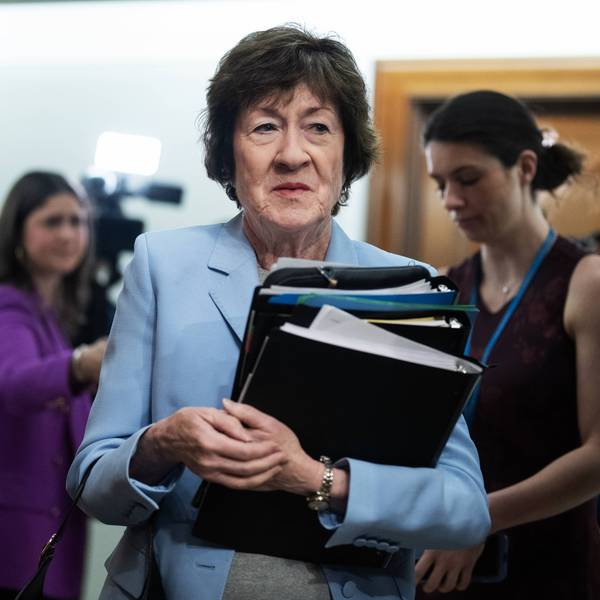
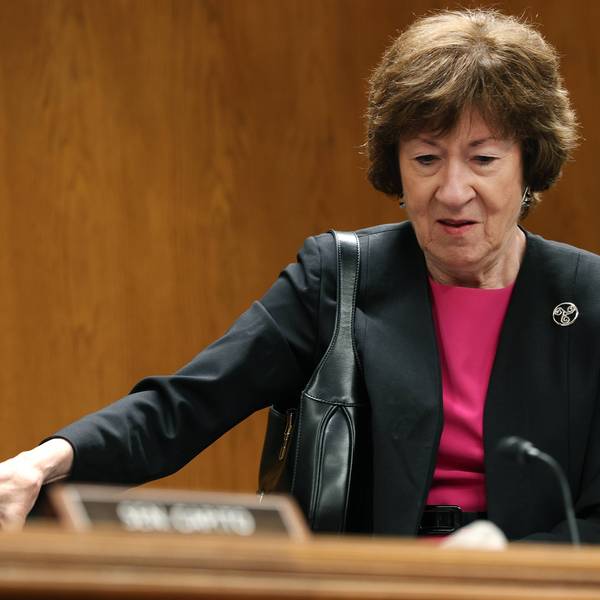
While Sen. Susan Collins "brags" that she's secured money for rural hospitals, the funding is a "pittance" compared to the billions in Medicaid cuts she helped push through, said her Democratic challenger in Maine.
|
|
Joined by medical professionals, patients, and local healthcare advocates outside a hospital in central Maine that was forced to shut down last year, Democratic US Senate candidate Graham Platner on Wednesday highlighted the human impact of the crisis that he said Sen. Susan Collins is actively making worse by prioritizing “health insurance companies, Big Pharma, and private equity firms” over Mainers—even as the Republican claims to bring crucial funds to the state’s struggling rural hospitals.Platner held a press conference outside the former Northern Light Inland Hospital in Waterville, Maine, which closed last May along with its associated primary care centers. The closure left roughly 5,000 patients without general practitioners and further away from an emergency department and inpatient care, as well as putting more than 300 local residents out of work. The hospital system said last May that it was closing Northern Light Inland due to rising operational costs, stagnant or reduced reimbursement rates, and a tight labor market with more competition for a smaller pool of qualified healthcare workers. A hospital official told Maine Public last year that the 48-bed facility was losing more than $1 million per month due to operating costs. Since Northern Light Inland closed, said Platner, “Waterville Fire and Rescue has tripled its out-of-city ambulance transports,” as there is no regular public transportation between Waterville and Augusta, where the nearest hospital is. Patients who were once charged $50 for a ride to the hospital now have to pay $400, the combat veteran and oyster farmer-turned-Senate candidate said, “and a ride that is longer means higher mortality rates.” One former patient of the healthcare center, Kyla Mihalovits, said her family was “thrown into a state of uncertainty regarding our access to healthcare” after Northern Light Inland closed and her primary care provider relocated to Unity, Maine. “When your community no longer has access to high-quality [healthcare], it doesn’t matter if you identify as a Democrat or a Republican or an Independent. You have lost something that your community needs to survive.” “We consider ourselves lucky to get an appointment once a year for our annual checkups. Many of my friends and neighbors lost their doctors and are on excruciatingly long waiting lists,” said Mihalovits, adding that she no longer has access to women’s healthcare and does not know where she will obtain her first mammogram after she turns 40 this year. “Because my hospital closed, I no longer have any semblance of continuity of care available for me at this crucial time in my life,” she said. “For women, especially since we are very often not listened to, dismissed, or even believed by certain healthcare providers, especially when we see them for the first time, continuity of care is crucial. Because our community hospital closed, it will take years for my family to establish care outside of our community.” Stories like Mihalovits’, said Platner, show that “rural healthcare is not collapsing sometime in the future. This isn’t some vague thing we talk about that may happen someday. It is happening now, but it is not an accident. No rural hospital closes by chance. It’s the outcome of policy, and it is a choice that people in places of political power like Susan Collins have made.” Rural hospitals in Maine are projected to continue closing due to nearly $3 billion in Medicaid cuts that are expected to hit the state over the next 10 years—cuts that were included in the One Big Beautiful Bill Act (OBBBA), a law that also included tax cuts for corporations and the wealthy and whose passage Collins helped ensure by casting a decisive vote to send it to the Senate floor. “Before the bill’s passage, nearly half of Maine’s rural hospitals were found to be at risk of closing while some, like the one here today, had already shuttered,” said Platner. “The One Big Beautiful Bill is doing exactly what the experts warned it would do. It is throwing gasoline on a crisis that was already raging in Maine’s rural hospitals.” The Senate candidate emphasized that Collins voted to advance the bill out of committee “one day after a private equity billionaire, Stephen Schwarzman, the chair of [Blackstone], and a man who will personally reap huge profits from the bill, gave $2 million towards her reelection campaign.” Collins frequently emphasizes that she ultimately voted against the OBBBA almost exactly a year ago—after Republican leaders had secured enough votes to pass the legislation without her—but Platner stressed that “her vote was pivotal to advancing it and paving the way for its eventual passage. She knew what she was doing. She was profiting off of her vote.” He also took particular issue with the five-term senator’s “bragging” about the Rural Health Transformation Program, a $50 billion fund also included in the OBBBA through which, Collins said in a recent ad, she secured $190 million for Maine rural health systems. “She likes to brag,” said Platner, “that she uses her power to bring money to Maine to help the state, except that the money she brings is a pittance. It is a pittance in comparison to the money sucked out of the state through tax cuts for corporations and billionaires that she happily goes along with. It is a pittance to the money sucked out of our system in the forever wars that we send trillions to year after year that she has always supported. A pittance toward the billions of dollars we continue to send to Israel to fund a genocide in Gaza.” The candidate, who is a proponent of Medicare for All, added that “people see through” Collins’ claims that she is a “moderate” Republican. “The idea that she stands up for the needs of Mainers over that of corporations is really laid bare with something just like the Rural Health Transformation Program,” Platner told Common Dreams. “The numbers don’t lie. It’s very obvious what she’s doing. And I am seeing in every single corner of the state and hearing from not just Democrats, but Independents and Republicans, who fundamentally understand that Susan Collins is someone who, for decades now, has represented not their interests, but the interests of those who donate the most money to her. And they’re sick and tired of it.” While Collins has boasted that the program included in the OBBBA is helping rural Maine residents, the law is already harming millions of people across the country and making it harder for them to access crucial healthcare a year after it was signed by President Donald Trump. According to Protect Our Care, 3.8 million Americans have lost coverage through Medicaid and the Children’s Health Insurance Program since the law was passed. Fifteen million people are projected to lose their healthcare by 2034. More than 1,000 hospitals, clinics, and nursing homes have shut down since the OBBBA was passed, as well as 40 maternity wards. “When your community no longer has access to high-quality [healthcare], it doesn’t matter if you identify as a Democrat or a Republican or an Independent,” said Platner. “You have lost something that your community needs to survive and you have lost it because establishment politicians like Susan Collins have for decades fought not for your community, have fought not for the needs of working Mainers, but have fought to protect the profits of health insurance companies, corporations, and private equity, and that must come to an end.”
"It should be a no-brainer: Our tax dollars should not fund a genocide," said Democratic Rep. Ilhan Omar, who supports an amendment to cut off $3.3 billion in military aid to Israel. |
|
"NPR’s reporting that Justice Alito is retiring was early. But it wasn’t wrong." |
|
The commission's upcoming first meeting will focus on "strengthening AI infrastructure, accelerating AI's impact on health, education, food security, and disaster response, and ensuring trust and safety," said its CEO co-chair. |
|
|
|
|
|
|
|
|












No comments:
Post a Comment
Note: Only a member of this blog may post a comment.