
25 March 22
Live on the homepage now!
Reader Supported News
STAND UP FOR READER SUPPORTED NEWS: Come on folks don’t just sit there and let RSN struggle financially. What we need to function is a drop in the bucket. When you get involved, when you take an ownership stake good things happen. Help RSN!
Marc Ash • Founder, Reader Supported News
Sure, I'll make a donation!

Charles Pierce | The Ginni Thomas and Mark Meadows Texts: This Damn Case Just Gets Stranger by the Hour
Charles Pierce, Esquire
Pierce writes: "A substantial portion of conservative Washington will believe - and act on - anything."
A substantial portion of conservative Washington will believe—and act on—anything.
Please check your entries. If you had, “Spouse of Supreme Court Justice Cheers Coup Attempt,” you’re a winner. Please pick up your Trump steaks at the cashier’s window and come back to see us again real soon.
From the Washington Post:
The messages – 29 in all – reveal an extraordinary pipeline between Virginia Thomas, who goes by Ginni, and President Donald Trump’s top aide during a period when Trump and his allies were vowing to go to the Supreme Court in an effort to negate the election results. On Nov. 10, after news organizations had projected Joe Biden the winner based on state vote totals, Thomas wrote to Meadows: “Help This Great President stand firm, Mark!!!...You are the leader, with him, who is standing for America’s constitutional governance at the precipice. The majority knows Biden and the Left is attempting the greatest Heist of our History.”
To which Meadows replied:
“This is a fight of good versus evil,” Meadows wrote. “Evil always looks like the victor until the King of Kings triumphs. Do not grow weary in well doing. The fight continues. I have staked my career on it. Well at least my time in DC on it.”
Meadows better hope that George Terwilliger, superstar DC attorney, is the King of Kings. Otherwise, he’s liable to do enough time to balance out his lost time in DC.
This damn case gets stranger by the hour. The congressional committee looking into the events of January 6 seems to have had Ginni Thomas in its sights for a while. After all, they picked through almost 2,400 of Meadows’ text messages to get these 29 between Meadows and Thomas to release to the media. And that adds more than a little je ne sais quoi to another of the texts that has come to light.
Thomas replied: “Thank you!! Needed that! This plus a conversation with my best friend just now… I will try to keep holding on. America is worth it!”
It is unclear to whom Thomas was referring.
Oh, but let’s guess, shall we? Is it possible that Ginni Thomas’ best friend might be seriously ill and incommunicado at the moment? And if so, what did they talk about back then?
It has become increasingly plain that the movement to overthrow the 2020 election results involved a substantial portion of conservative Washington, and also that a substantial portion of conservative Washington will believe—and act on—anything.
The first of the 29 messages between Ginni Thomas and Meadows was sent on Nov. 5, two days after the election. She sent him a link to a YouTube video labeled “TRUMP STING w CIA Director Steve Pieczenik, The Biggest Election Story in History, QFS-BLOCKCHAIN.”
Pieczenik, a former State Department official, is a far-right commentator who has falsely claimed that the 2012 massacre at Sandy Hook Elementary School in Newtown, Conn., was a “false-flag” operation to push a gun-control agenda. The video Thomas shared with Meadows is no longer available on YouTube. But Thomas wrote to Meadows, “I hope this is true; never heard anything like this before, or even a hint of it. Possible???” “Watermarked ballots in over 12 states have been part of a huge Trump … military white hat sting operation in 12 key battleground states,” she wrote.
Thomas and Meadows shouldn’t worry about the former president*, though. He’s fallen back on the strategy that has worked for him his entire public career: the completely meritless lawsuit. From CNN:
The lawsuit names a wide cast of characters that Trump has accused for years of orchestrating a "deep state" conspiracy against him -- including former FBI Director James Comey and other FBI officials, the retired British spy Christopher Steele and his associates, and a handful of Clinton campaign advisers.
"Under the guise of 'opposition research,' 'data analytics,' and other political stratagems, the Defendants nefariously sought to sway the public's trust," says the lawsuit, filed in federal court in Florida. "They worked together with a single, self-serving purpose: to vilify Donald J. Trump."
Over 108 pages, the lawsuit rails against many of Trump's political opponents and highlights the grievances that he has complained about for years. It claims Democrats and government officials perpetrated a grab bag of offenses, from a racketeering conspiracy to a malicious prosecution, computer fraud and theft of secret internet data. The lawsuit asks for more than $24 million in costs and damages.
The road goes on forever, and the party never ends.
READ MORE
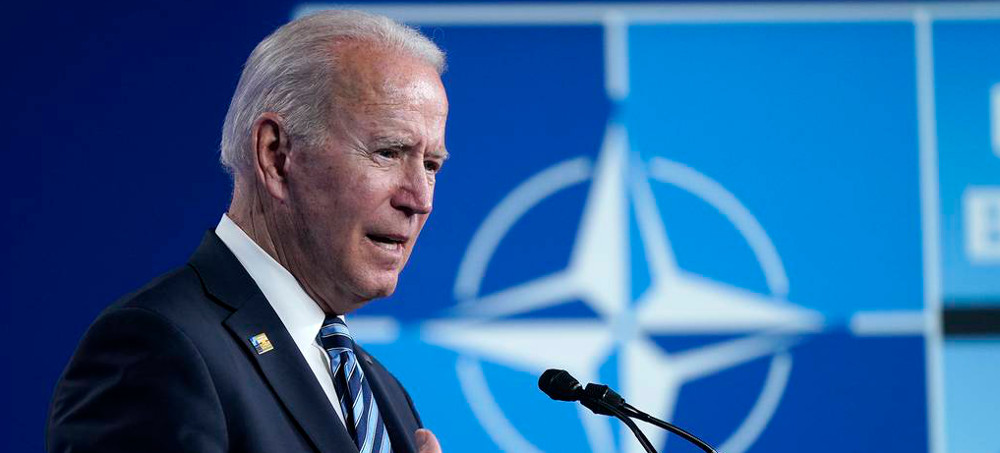 President Joe Biden speaks during a news conference at the NATO summit at NATO headquarters in Brussels, Monday, June 14, 2021. (photo: Patrick Semansky/AP)
Biden Travels to Poland as the Country Struggles With Ukrainian Refugee Influx
Shannon Pettypiece, NBC News
Pettypiece writes: "President Joe Biden on Friday traveled to southeastern Poland where he met with U.S. troops and aid workers assisting refugees in a country on the front lines of the humanitarian and military crisis unfolding in Ukraine."
The president met with U.S. troops before a scheduled meeting with aid workers assisting refugees in a country on the front lines of the crisis unfolding in Ukraine.
President Joe Biden on Friday traveled to southeastern Poland where he met with U.S. troops and aid workers assisting refugees in a country on the front lines of the humanitarian and military crisis unfolding in Ukraine.
“What you’re engaged in is much more than just whether or not you can alleviate the pain and suffering of the people in Ukraine. We’re in a new phase, your generation, we’re at an inflection point,” Biden told the troops.
Biden spoke with the U.S. troops in Rzeszow who began arriving at the military base there last month as part of U.S. deterrence efforts against Russia. The president made small talk and shook hands with a group of service members, whom he called the “finest fighting force in the history of the world," at one point sitting down to join them for a slice of pizza in the mess hall.
"You are the organizing principle around which the rest of the world, the free world, is moving," Biden said. "We’re in the midst of, and I don’t want to sound too philosophic here, but you’re in the midst of a fight between democracies and oligarchs."
The troops are based less than 100 miles from where Russian missiles struck a Ukrainian military post this month. The service members have been carrying out training exercises with their Polish and British counterparts, familiarizing themselves with the local terrain and Polish equipment.
The White House has firmly ruled out any possibility of sending U.S. troops to Ukraine, but has been bolstering the U.S. troop presence in Europe over the last two months to demonstrate Washington's commitment to defending NATO territory.
Before he returns to Washington on Saturday, Biden will meet with Ukrainian refugees, followed by a major address on the state of the war in Ukraine and where he sees it heading, national security adviser Jake Sullivan said Friday.
In a meeting with aid workers, Biden said he regretted that he wasn't able to travel to Ukraine to see the situation first hand, seeming to indicate it wouldn't be safe for him to enter the war-torn country.
Biden was joined in his meeting with aid workers by Polish President Andrzej Duda, who thanked the American leader for his visit and the help the U.S. has provided. But Duba said there is more help Poland needs. Biden and Duda will meet again on Saturday.
“The suffering that’s taking place now is at your doorstep," Biden said.
Poland has borne the brunt of the refugee crisis, with more than 2 million Ukrainians having flooded into the country. While Poland has welcomed the refugees with open arms, allowing them to work, and providing them with health care and schooling for children, the massive influx in just a month has begun to strain cities like Warsaw, where the population is estimated to have grown by 300,000.
“Poland is among the top countries that feel the most at risk over this ongoing invasion. You had bombs going off not far from their border,” said Barry Pavel, who was a defense policy adviser in the administrations of Presidents George W. Bush and Barack Obama. “This is a really, really important stop.”
Biden is visiting Poland after a series of meetings with world leaders Thursday in Brussels, where he sought to rally other countries to do more to support Ukraine and punish Russia.
Before departing Belgium, Biden noted how Putin has used Russia’s energy resources to “coerce” its neighbors, and announced measures — alongside European Commission President Ursula von der Leyen — to reduce Europe's dependency on Russian energy.
“I know that eliminating Russian gas will have costs for Europe. But it’s not only the right thing to do from a moral standpoint, it’s going to put us on a much stronger strategic footing,” he said before heading to Poland.
On Saturday, Biden also plans to meet with Polish President Andrzej Duda and deliver an address about the need for sustained unity and resolve in the face of the Russian aggression, Sullivan said.
The White House announced it would allow as many as 100,000 Ukrainians to enter the U.S., with a focus on those who are most vulnerable. The administration also plans to allocate more than $1 billion toward humanitarian assistance and $11 billion over the next five years to address worldwide food security threats after the disruptions to the Russian and Ukrainian agricultural industries.
The U.S. has provided $123 million to help the countries bordering Ukraine deal with the crisis, including $48 million to Poland, with U.S. officials working to set up programs that provide refugees with temporary assistance for food, accommodations and medical care, along with legal aid and mental health support, the White House said.
The White House on Thursday announced a package of new sanctions against Russia that would apply to more than 400 Russians and Russian entities, including the Duma and more than 300 of its members and more than 40 defense companies.
It also said it would take additional steps to prevent Russia from trying to prop up its economy, such as making it clear that any transactions involving gold related to banks there are prohibited, and calling on corporations to no longer conduct their activities with Russia in a business-as-usual manner.
READ MORE
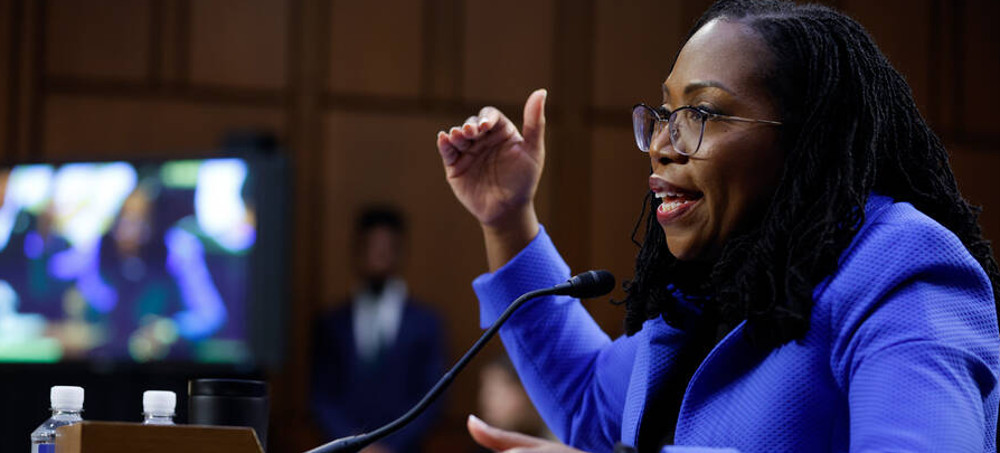 U.S. Supreme Court nominee Judge Ketanji Brown Jackson. (photo: Chip Somodevilla/Getty)
Republican Attacks on SCOTUS Nominee Ketanji Brown Jackson Show "Total Bankruptcy" of the GOP
Jessica Corbett, In These Times
Corbett writes: "As the Senate Judiciary Committee on Thursday began its fourth and final day of hearings for U.S. Supreme Court nominee Judge Ketanji Brown Jackson, criticism of how Republican senators have conducted themselves - and what that behavior reveals about their party - continued to grow."
Critics say the “childish political theater” is intended to keep the Republican base “in a constant state of frothing-at-the-mouth” so they show up at the ballot box.
As the Senate Judiciary Committee on Thursday began its fourth and final day of hearings for U.S. Supreme Court nominee Judge Ketanji Brown Jackson, criticism of how Republican senators have conducted themselves — and what that behavior reveals about their party — continued to grow.
“What should have been a historic moment for the first Black woman to be nominated to the U.S. Supreme Court, has become a scene of childish political theater, thanks to Senate Republicans,” Tayo Bero wrote Thursday for The Guardian.
She noted that not only is President Joe Biden’s first nominee to the high court “already being held up to far more scrutiny than any white man in her position would be, but the line of questioning from across the aisle has devolved into the absolutely ridiculous.”
The nominee’s response has been widely praised, with Alliance for Justice president Rakim H.D. Brooks saying that “while it has been challenging to watch Republican senators repeatedly disrespect Judge Jackson this week, it gave us an opportunity to observe Judge Jackson’s remarkable judicial temperament. At all times, she has comported herself with grace and dignity.”
While also applauding Jackson for remaining composed “in the face of intense and often ludicrous lines of inquiry,” Bero asserted that “the bad-faith questions, the baseless accusations, the time-wasting” from GOP senators all make clear that “Jackson’s interrogators do not see her as an equal, and are determined to undermine her however they can.”
Bero also agreed with Paul Waldman’s conclusion, in a Tuesday opinion piece for The Washington Post, that this week’s hearings have “become yet another forum for Republicans to claim victim status, given the absolutely central place this occupies in their political project.”
According to Waldman:
As conservatives have learned well in recent years, in the right circumstances, adopting the stance of victimhood can be thrilling, particularly if you don’t have to suffer any actual victimization along the way. You can take the normal unpleasantness that comes with politics — having people disagree with you, or watching as a figure you admire gets criticized in ways you consider unfair — and turn it into something noble, profound, even epic.
Are people calling me a jerk for something repugnant I said? I’m not a jerk, I’m a victim of cancel culture, persecuted for my devotion to free expression! Are people opposing my legislation to ban books and target the families of transgender kids? I’m a victim of the woke mob! Proclaim yourself a victim and not only do you become the hero of the story, you can claim moral absolution for your own grimy choices.
“It all culminates with Brett Kavanaugh, the victim to beat all victims, his name invoked again and again,” Waldman wrote, referring to former President Donald Trump’s second nominee to the court whose 2018 confirmation hearings featured credible sexual assault allegations.
Suggesting Thursday that “people should notice what kinds of nominees senators feel empathetic towards,” The Nation ’s justice correspondent, Elie Mystal, recalled that in 2018, Sen. Lindsey Graham (R‑S.C.) got emotional “in his defense of prep school bro Brett Kavanaugh, after he was accused of attempted rape by a credible, named witness who gave testimony before the Senate,” and this week, Sen. Ted Cruz (R‑Texas) “even derisively referred to the attempted rape allegations as an inquiry into his ‘teenage dating habits.’ ”
Graham and Cruz aren’t the only Republicans under fire for what Sherrilyn Ifill, president of the NAACP Legal Defense and Educational Fund, condemned as “vile antics” at Jackson’s hearings. Comments from GOP Sens. Marsha Blackburn (Tenn.), John Cornyn (Texas), Tom Cotton (Ark.), and Josh Hawley (Mo.) have also garnered widespread attention and criticism.
As Thom Hartmann summarized Wednesday for Common Dreams: “Lindsey Graham throws his trademark hissy fit and storms out, John Cornyn tries to sound erudite and fails, Marsha Blackburn outs herself as a fanatic, Ted Cruz thinks Black judges should vet children’s books about racism, and Josh Hawley and Tom Cotton just end up making fools of themselves.”
Hartmann argued that GOP senators had two goals for the hearings:
The first was to smear the Democratic nominee in a way that will guarantee that — over the next 24-hour news cycle — the name “Judge Jackson” will repeatedly occur in the same headline or sentence as “child porn,” “critical race theory,” or “terrorists from Gitmo.”
The second was to craft a short soundbite of their own performance art that Fox “News” and other hard-right media can play on a loop. White Republicans dressing down a Black woman? Perfect for conservative hate media.
…This is happening because the Republican Party is no longer interested in governing. They’ve become the mouthpiece for a faction of business and great wealth, and beyond that have no commitment to rebuilding or improving this country in any meaningful way.
The GOP’s priority is “doing anything they can to increase corporate profits (regardless of the harm to consumers, competition, or the planet) and to keep taxes low on their morbidly rich donors. And to winning the so-called ‘culture wars,’ ” he wrote. “All the sturm and drang about race, porn, drugs, religion, and gender identity” is a strategy that “keeps their base in a constant state of frothing-at-the-mouth” so they continue to show up at the ballot box.
As Joan Walsh, a national affairs correspondent for The Nation, put it: “This hearing reveals the total bankruptcy of the Republican Party.”
Noting that some of the “ridiculous, offensive questions” for Jackson came from Republican 2024 presidential hopefuls, Walsh wrote Wednesday that “too many GOP senators seemed hell-bent on turning her into a friend of child pornographers and pedophiles.”
“It was not hard to suss out a theme the afternoon of the first day: What used to be a fringe theory espoused by QAnon cultists, linking top Democrats (with no evidence, obviously falsely) to the vile abomination of child sex trafficking, has now become a GOP mainstay,” Walsh pointed out. “Polls show that half of all Trump supporters believe it; the 2024 wannabes see a key constituency.”
Sheryll Cashin, a law professor at Georgetown University and Politico Magazine contributing editor, also concluded that GOP senators acted with elections in mind.
“Republicans had an opportunity with Jackson’s nomination to do the right thing,” she wrote Thursday. “And yet this brilliant, even-handed jurist who has ruled for and against presidents and prosecutors was cast as a soft-on-crime, child-predator-enabling, critical-race-theory believing, left-wing activist by the GOP’s most arch political performers.”
“Why would Republicans do this when Jackson’s confirmation would not upset the current 6 – 3 conservative-leaning tenor of the court?” Cashin continued. “My guess is that dividing and conquering to win elections at any cost [has] become muscle memory for far too many members of Congress.”
While engaging in a “dangerous character assassination,” Republican panel members “offered the disturbing optics of mainly southern, white men lecturing, interrupting, and sometimes yelling at a gracious, poised Black woman,” she noted. “If no Republicans vote to confirm this eminently qualified Black female to the highest court, it will send a searing message about what the GOP has become.”
READ MORE
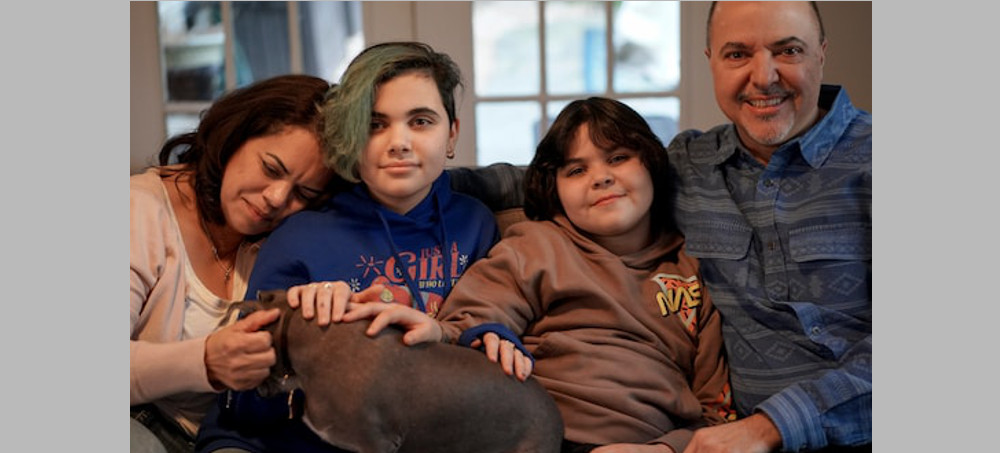 From left, Camille, Alexandra, Leon and Homero Rey at their home in Potomac, Maryland. Leon, 9, is transgender, and his family moved from Texas to protect his rights. (photo: Bonnie Jo Mount/The Washington Post)
GOP Lawmakers Push Historic Wave of Bills Targeting Rights of LGBTQ Teens, Children and Their Families
Kimberly Kindy, The Washington Post
Kindy writes: "Nationwide, GOP lawmakers have filed nearly two hundred state bills this year that seek to erode protections for transgender and gay youth or to restrict discussion of LGBTQ topics in public schools."
Nationwide, GOP lawmakers have filed nearly two hundred state bills this year that seek to erode protections for transgender and gay youth or to restrict discussion of LGBTQ topics in public schools.
The explosion of legislation is in part the culmination of efforts by a trio of conservative organizations, which are helping state legislators write and promote the bills. One of the most active — the Alliance Defending Freedom — has a decades-long history of fighting LGBTQ rights, including in battles to preserve state laws criminalizing consensual sex between gay adults, court records show.
Today, at least 166 measures to restrict LGBTQ rights are still pending in state legislatures across the nation — nearly quadruple the number of similar bills introduced just three years ago, according to data from Freedom for All Americans, an LGBTQ advocacy group.
Members of the LGBTQ community say the unprecedented legislative efforts are aimed at dismantling the hard-earned and tenuous civil rights of a vulnerable population and are causing psychological damage to children who are already struggling.
“This wave of bills has been staggering,” Florida state Rep. Anna Eskamani (D) said in an interview. “These painful state-level fights are proof positive that discrimination is still a very real threat that directly harms members of our most vulnerable communities, including and especially young people who are transgender.”
Lawmakers who are sponsoring the bills say parental authority is being undermined, sometimes in conflict with religious tenets taught at home, and they believe educators and health-care workers are attempting to convert children to becoming transgender or queer.
“Christian parents don’t think the schools should be evangelizing children into sexual ideologies they don’t agree with,” said Oklahoma state Sen. Rob Standridge (R), who introduced a bill this year that would enable parents to remove LGBTQ books from school libraries. “So that’s what the bill is about, to try to get schools to stop doing that … I’m empowering the parent that is directly affected by what they see as overriding their beliefs.”
Detailed tracking of this legislative movement can be difficult. This is due in part to lawmakers’ practice of not mentioning the words “transgender” or “LGBTQ” in bill text, either intentionally to escape detection or because they do not acknowledge the legitimacy of transgender or queer identity, advocacy groups and experts say. However, several LGBTQ organizations have teams of lawyers who track the bills, including Freedom for All Americans, the American Civil Liberties Union and the Human Rights Campaign.
About 75 of the new bills call for bans or severe restrictions on classroom discussions, curriculum and library books that mention LGBTQ issues, mostly but not exclusively in primary grades, according to Freedom for All Americans, which has among the most conservative legislative estimates among advocacy groups. Some of these bills are vaguely worded, making it unclear whether educators or students could even mention their own sexual or gender identity — or that of their parents — on school grounds. This issue has led critics to dub Florida’s bill, which passed the state legislature on March 8, the “don’t say gay” act.
Nearly 50 other bills seek to ban transgender youth from playing competitive school sports on teams that don’t align with the gender they were assigned at birth.
At least 29 seek to ban gender-affirming medical care for transgender youth, which primarily involves hormone therapy to delay the onset of puberty or to begin the process of transitioning. Some of the measures also seek to make it a crime to provide such care to children and young teens, or to make it a crime for parents to sign off on such care. (The American Medical Association, the American Academy of Pediatrics and other medical groups endorse the treatments, saying such care saves lives.)
There are also dozens of other bills focused on restricting LGBTQ rights, including at least 15 “bathroom bills,” which in 2016 kicked off this legislative movement by pushing to ban transgender students, and sometimes faculty, from using school bathrooms consistent with their gender identity.
Nearly two-thirds of the bills focus on transgender rights. There were 18 such bills introduced in 2019, compared with more than 100 last year. The number introduced so far this year has again surpassed 100.
The bills have found especially fertile ground as the GOP seeks to energize its base for midterm elections in a time when party leaders have shown new willingness to openly attack gay and transgender rights — a movement that runs counter to wider public sentiment on LGBTQ rights, according to several recent surveys. A Public Religion Research Institute survey released last week showed nearly 8 in 10 Americans support laws to protect LGBTQ people from discrimination in jobs, housing and public accommodations. The survey also found that 68 percent of Americans support same-sex marriage, a rise from 54 percent in 2014.
Michael Boucai, a law professor at the University at Buffalo who specializes in family law and gender and sexuality law, argues that the new bills are aimed to please partisan interests rather than to spark real debate about how to best help LGBTQ children.
“The laws are being drafted in such an extreme way, and with such potentially opportunistic motives, that is very easy for the left to reject them. The right doesn’t really want a debate on these issues,” Boucai said in an interview. “A lot of these bills involve parents’ rights to control their children’s health care and education, which has been galvanizing for a large segment of the American population, particularly among conservatives leading up to and going through the pandemic.”
For many parents of LGBTQ children, the wave of new bills have already had a significant impact on their lives. After watching a wave of anti-trans legislation cresting in the Texas Capitol last fall, Camille Rey decided to move with her husband and three children, including 9-year-old Leon, a transgender boy, from Austin to Potomac, Md.
“None of us should have to feel persecuted by our own government. None of us should have to feel like political refugees in our own country,” Rey said in an interview. “That’s literally what I feel like. I moved my whole family because of politics.”
Starting a landslide
In early 2020, as Republican Idaho state Rep. Barbara Ehardt worked to craft a ban on transgender athletes competing on public school sports teams, she turned to the Alliance Defending Freedom, a Christian conservative legal organization.
The Arizona-based advocacy group, founded in 1993, leverages the power of a national network of Christian lawyers for its legislative efforts and legal battles. It reported $78 million in assets in 2020 and has received funding from Christian, family and financial foundations. In recent years, it battled in court against abortion rights and in favor of religious practices in schools and drafted language for anti-transgender “bathroom bills” later used in multiple states.
Now, the group helped Ehardt craft the nation’s first successful ban on transgender female athletes.
“The Alliance Defending Freedom said, ‘We think we can strengthen this, maybe do something different,’ and then they shared with me some other language,” Ehardt said in an interview. “I thought it was definitely stronger and definitely better.”
That bill, which became law two years ago, helped set off a landslide of copycat legislation, with Ehardt traveling the country to testify in support of the bills — and with the Alliance Defending Freedom helping other legislators craft new bills to limit LGBTQ rights, according to lawmakers and advocates. Measures similar to Ehardt’s bill have since become law in at least 10 other states, according to the Human Rights Campaign.
The group has played a similar role in the proliferation of dozens of other anti-LGBTQ bills filed around the nation this year — helping lawmakers craft legislation and providing legal support.
Last year, it formed a coalition with two other conservative nonprofits, the Heritage Foundation and the Family Policy Alliance, that published a list of positions on transgender and gay rights that have repeatedly surfaced in the restrictive new state bills. It was released a month after President Biden signed an executive order in January 2021 in support of LGBTQ rights.
The website for the coalition, Promise to America’s Children, also invites lawmakers to provide their email addresses so the group can send sample bill language, which has since appeared in dozens of measures.
In the past, the Alliance Defending Freedom has taken some of the most aggressive stances in the fight against LGBTQ rights. It filed a Supreme Court amicus brief in the landmark Lawrence v. Texas case — and joined in another brief — which both unsuccessfully argued in 2003 in favor of the state’s right to maintain sodomy laws, court records show. High-ranking leaders of the organization have also publicly supported efforts in other countries to criminalize same-sex sexual acts. It also has defended parents’ right to have their LGBTQ children undergo conversion therapy, which uses psychological, physical, or spiritual interventions in an effort to make a person heterosexual or cisgender.
In a statement to The Washington Post, the group described its efforts regarding criminalizing LGBTQ sex as a “limited engagement” on the issue and said it is based on its “belief that marriage between on man and one woman is the best institution for human flourishing.” It also said it believes that the issue of whether to criminalize LGBTQ sex should be left to states.
As for conversion therapy, Alliance Defending Freedom said it “supports everyone’s freedom to seek the counseling they choose without interference from the government.”
The coalition of conservative nonprofit groups, which say their work on recent anti-LGBTQ state bills is aimed at restoring traditional family values, declined interview requests from The Post. The Alliance Defending Freedom said it is routinely involved in helping craft legislation, noting that groups like the ACLU regularly do the same.
“It is standard practice for lawmakers to work with groups with expertise as they craft and introduce legislation. This is true across the ideological spectrum,” the statement said. “ADF is regularly invited to draw upon our constitutional expertise to provide input into forthcoming bills.”
The Family Policy Alliance said that the political movement is driven by parents.
“In the wake of COVID, with children engaged in remote learning, parents gained a new window into what their children were learning in the classroom,” the group said in a statement. “For some parents, this revealed curriculum which not only taught viewpoints about sex and gender with which they disagreed, but taught them as fact to young children.”
LGBTQ advocates, though, say the groups — and smaller organizations with similar goals — have played a central role in elevating the legislation. Some groups have boasted of their fundraising and influence on these measures. Officials from the American Principles Project, a conservative think tank, described on Stephen K. Bannon’s “War Room” show a $750,000 “grassroots advocacy” campaign it organized to urge Texas Gov. Greg Abbott (R) to order the state to investigate parents of trans children who have received gender-affirming medical care.
Cathryn Oakley, the state legislative director and senior counsel for the Human Rights Campaign, the nation’s largest LGBTQ advocacy group, noted that many of the same groups had previously pushed bills to stop same-sex marriage and enact nationwide transgender bathroom and religious exemption laws.
“We had a flurry of those bills, 2017, 2018, 2019, but they weren’t really causing the kind of dramatic impact that opponents of equality wanted them to have, in terms of instilling fear about what LGBTQ+ equality could mean,” Oakley said in an interview. “So, they switched to targeting trans kids.”
Like Ehardt, other lawmakers behind more recent bills have publicly credited the groups with helping to achieve success. South Dakota state Rep. Fred Deutsch (R) introduced in 2020 a bill to ban gender-affirming medical procedures for transgender youth, after he attended an event hosted by the Heritage Foundation.
Deutsch said that, in crafting the bill, he sought out transgender youth and spoke to them as part of his research. The initial draft, he said in an email message, “was developed organically in the living room of my country home in South Dakota, surrounded by miles of corn fields.”
He then got input from the Alliance Defending Freedom and asked the Heritage Foundation if he could share the bill draft at an upcoming conference.
“Apparently people at the conference shared the draft with legislators from other states, since in the months following the conference, legislators from other states contacted me,” he wrote in an email.
Like Ehardt’s legislation, Deutsch’s medical-care bill was the first of its kind in 2020. Although it did not pass, it has been replicated and introduced in dozens of states. So far, at least two states have enacted such laws — Arkansas and Tennessee.
Morissa Ladinsky, associate professor of pediatrics at the University of Alabama at Birmingham, said those laws will force physicians like her who care for transgender youth to chose between violating the Hippocratic oath or breaking state law.
“To cease a course of successful medical therapy … is in grave violation of a huge tenet of medical ethics. It’s called medical abandonment,” said Ladinsky, who works in a state with a pending transgender medical care bill. “So, do I violate a major, major ethical tenet of health-care delivery, or do we risk a felony conviction? It’s a place no physician ever saw themselves being in.”
There’s no one reason these bills have found particular traction this year, advocates and experts said. Oakley said that pandemic burnout has led many Americans to tune out legislative sessions.
“I do think that to some degree, these attacks have flown under the radar because of the pandemic and because of the insurrection,” she said. “I don’t think that this has permeated their consciousness in the same way that previous attacks have permeated their consciousness.”
Hannah Willard, vice president of government affairs for Freedom for All Americans, said the bills are also a reaction to recent civil rights gains made by the LGBTQ community.
“You don’t get progress without backlash,” Willard said in an interview. “So it’s not a coincidence that we’re seeing these anti-trans bills in the states at the same time as we’re seeing growing support. They can feel like contradictory trends, but really they are two sides of the exact same coin.”
A wave of legislation
From coast to coast, bills that would drastically impact gay and trans children have advanced this year with startling speed.
In Alabama, the Senate passed a bill in February that calls for penalties of up to 10 years in prison and a $15,000 fine for anyone who provides gender-affirming care to a child or teenager. This includes hormone treatments that delay puberty, which are reversible.
In Idaho, a bill passed the House this month that would allow librarians to be jailed for up to a year and fined $1,000 each time they are found guilty of disseminating material that is “harmful to minors.” A meaning for this standard is not defined in the bill. Examples provided during legislative hearings included books that had LGBTQ themes or characters.
And in Florida, the “don’t say gay” bill would ban public schools from teaching about sexual orientation or gender identity in kindergarten through the third grade, and says educators at all grade levels should refrain from discussing LGBTQ issues that are not “age-appropriate or developmentally appropriate for students,” which is left open to interpretation. Parents who believe an educator has violated the law may sue.
When Texas lawmakers did not pass a transgender medical care ban, Abbott in February asked the public to turn parents in to state officials if they have provided gender-affirming medical care to their trans children so they can face criminal investigations and potential charges. Abbott and Texas Attorney General Ken Paxton (R) have called such care “child abuse.”
Paxton said in a February opinion that parents and guardians should be blocked from signing off on all transgender procedures — including hormone therapies — “[b]ecause children are legally incompetent to consent,” and said that hormone therapies can sometimes affect fertility and therefore “infringe on the child’s fundamental right to procreate.”
The ACLU has sued in an attempt to stop the investigations, and advocates have decried the state’s move as perhaps the most aggressive attack on trans youth in this multiyear campaign.
“They have gone after trans kids in every conceivable dimension,” Oakley said. “They’re trying to take their parents’ support away, they’re trying to take doctors’ support away, they’re trying to take teachers’ support away, and they’re trying to take their teams and coaches away.”
So far this year, six of the bills have been approved by five state legislatures — four of which specifically curtail the rights of trans children and their families, according to Freedom for All Americans.
The advocacy group said at least a dozen pending bills would also require medical care providers and educators who learn of a child’s LGBTQ status to notify parents. Many of these provisions to “out” transgender and other LGBTQ youth are not expected to survive.
The rise in the extreme penalties the measures call for — and the polarizing debates surrounding them — have started to garner the attention of major corporations and the general public. It’s not yet clear whether this could change the course of future state legislation, experts said.
This month, more than 170 major U.S. corporations, including PepsiCo, Johnson … Johnson and Macy’s, have signed a statement condemning the bills. Other large companies have felt a backlash in recent months, most notably Disney. CEO Bob Chapek formally apologized to employees this month for the company’s silence on the Florida bill restricting LGBTQ topics in elementary schools, announcing it would pause all political donations in the state after financial contributions showed the company gave to lawmakers who championed the legislation.
Court challenges to block the laws — including one in Arkansas that bans gender-affirming medical care for trans youth — have been successful in four instances but are being appealed by state officials, according to the ACLU. Several other lawsuits are still pending, the group said. Some Republican officials have also pushed back on the measures, with governors in both Indiana and Utah recently vetoing transgender sports bans.
The Biden administration is also now stepping in, vowing to take steps to block state actions that might discriminate against LGBTQ youth and their families — something the Trump administration did not do. Earlier this month, Health and Human Services Secretary Xavier Becerra condemned Abbott’s directive to investigate transgender parents and said his agency “will use every tool at our disposal to keep Texans safe.”
Whether the bills have succeeded, failed or are pending, parents and children caught up in the political drama say it has taken a psychological toll.
In Florida, Todd and Jeff Delmay — a gay married couple — say they worry for their 12-year-old son, Blake, because it’s unclear if the proposed “don’t say gay” law would prevent their son from being able to openly talk about his home life at school.
“I can’t imagine not being able to see your parents accepted like other parents because it makes you feel other,” said Todd Delmay, who testified against the Florida bill.
“It doesn’t matter how different your family is. It’s still called family,” said Blake, who expressed similar concerns and said he is also worried about being bullied. “You need to be able to talk about your family.”
Rey said her family’s decision to move from Texas was driven by the knowledge that even if a bill fails this year, a similar or new bill targeting transgender rights probably will be brought back next year. She said staying to continue battling the bills would have been too taxing on her family.
“There were parents who were fighting beside me who had fought two years earlier when the bathroom bill had been introduced,” she said. “This was their life. I didn’t want this to be my life. I had a different life in mind. I have a different life in mind for Leon.”
READ MORE
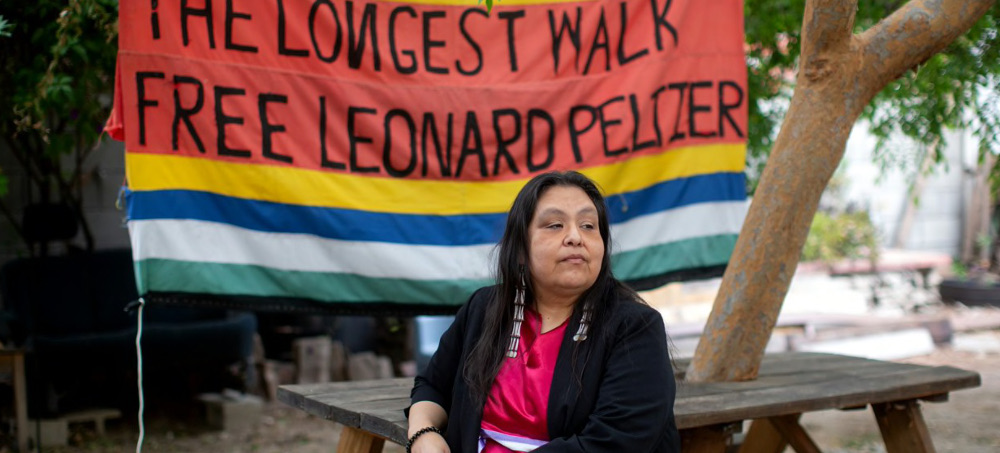 Kathy Peltier, the daughter of Leonard Peltier, in Burbank, California, on March 17. The banner was made for a march of several hundred Native American activists and supporters from San Francisco to Washington, D.C., in 1978. (photo: Allison Zaucha/NBC News)
Leonard Peltier, Imprisoned Native American Activist, Has New Message for Biden in Clemency Push
Erik Ortiz, NBC News
Ortiz writes: "Leonard Peltier, the Native American activist who has been imprisoned for nearly half a century for the murders of two FBI agents he has always maintained he didn't commit, is hopeful he'll have a chance to clear his name before he dies."
Peltier, 77, has been held since 1977 for the deaths of two FBI agents. He maintains his innocence, and supporters say he deserves to be released on compassionate grounds.
Leonard Peltier, the Native American activist who has been imprisoned for nearly half a century for the murders of two FBI agents he has always maintained he didn't commit, is hopeful he'll have a chance to clear his name before he dies.
Peltier, 77, wants President Joe Biden to review his case and grant him clemency so he won't die in prison.
He's not looking for a presidential pardon, because it would be granted for a crime he insists he is innocent of.
Instead, he wants a new trial.
“If I get into court, if the judge is fair, how are they going to answer all of that?” he said of evidence that was withheld from the 1977 proceedings. “I want to get a trial."
Recent calls from Peltier's supporters and family for him to be released have noted his failing health, including a recent bout of Covid-19.
"They're going to try and make me die here," Peltier said by phone Wednesday from his federal prison in Central Florida, his first media interview since 2016. "I have a last few years, and I got to fight."
Peltier's family says he is struggling with diabetes, hypertension, partial blindness from a stroke and an abdominal aortic aneurysm and that he tested positive for Covid in late January at the Federal Correctional Complex Coleman’s high-security facility.
Peltier said he was vaccinated against the coronavirus before he tested positive and that his chest, neck and head had hurt for a few days. He got a booster shot after he left 10 days of quarantine, he said.
The roughest part, he said, was being isolated and not receiving adequate care. He felt "cold," and "the food was bad," he said, adding, "That was worse than getting Covid."
Having spent years in prison mulling over his case and the various legal rulings, Peltier said there is evidence he'd like to present to show he didn't fire the bullets that killed the agents in a chaotic shootout on the Pine Ridge Indian Reservation in South Dakota in June 1975.
"My lawyer said if I were tried today, they would never get away with it," he said.
His attorney, Kevin Sharp, a former federal judge, said Peltier has exhausted his appeals and that there remains no actual process for him to get a new trial unless federal prosecutors decide to reopen the case.
"They wouldn't do that, because there's no evidence to convict him on," Sharp said. "He was convicted on aiding and abetting murder, but who did he aid and abet? His co-defendants were acquitted based on self-defense."
Over the decades, criminal justice reform advocates have continued to highlight his arrest and conviction, saying it symbolizes systemic problems with how Native Americans are treated in the justice system, as well as imprisoned at higher rates by the federal government compared to other racial groups.
Human rights organizations and prominent political and religious figures, including Pope Francis and the Dalai Lama and other Nobel Peace Prize recipients, such as Nelson Mandela and Bishop Desmond Tutu, are reported to have called for Peltier's release.
Peltier's case has drawn scrutiny from those living on the Pine Ridge reservation, as well as members of his tribe, the Turtle Mountain Band of Chippewa. Other Native American activists and groups also believe Peltier is innocent and was made a scapegoat by the federal government in its pursuit to hold someone accountable for the agents' deaths.
But he has consistently been denied parole — in 2009, federal prosecutors said he was "an unrepentant, cold-blooded murderer" — and he isn't eligible again until 2024. In October, 11 members of Congress petitioned the Biden administration to grant clemency based on compassionate grounds.
Rep. Raúl Grijalva, D-Ariz., a clemency supporter, said he spoke with Peltier by phone after he learned Peltier had Covid. Grijalva's office said last month that Peltier described "difficulties receiving adequate medical attention and gaining access to basic needs, like water."
The Justice Department's Bureau of Prisons declined to comment on Peltier's case, citing privacy and security reasons. It said that it makes "every effort" to ensure the safety of inmates and that at Coleman, every inmate is given access to drinking water, adequate medical care and food.
Sharp said he believes Peltier's age, health and recent illness make him a prime candidate for release and that his clean and nonviolent prison record also indicates he isn't a threat to the public.
The number of inmates with Covid at federal prisons reached its peak around the time Peltier contracted the coronavirus, with close to 10,000 of them testing positive, according to Justice Department data. Active cases have dropped to about 100 this week, but Sharp believes Peltier is still at risk.
"Leonard Peltier is incapable of protecting himself. And if you're not going to do it, BOP, let him go home," Sharp said, referring to the Bureau of Prisons. "This is where justice and mercy meet. Grant him clemency and send him home."
It's unclear how familiar Biden is with Peltier's case, which has spawned hundreds of pages of FBI files; several books, including his own memoir, published in 1999; and the 1992 documentary "Incident at Oglala," which was narrated by Robert Redford.
The FBI said in a statement Thursday that it remains "resolute against the commutation of Leonard Peltier's sentence" and that "we must never forget or put aside that Peltier intentionally and mercilessly murdered these two young men and has never expressed remorse for his ruthless actions."
The White House did not respond to a request for comment.
Asked in January whether Biden was reviewing a request to commute Peltier's sentence, White House press secretary Jen Psaki told reporters, "I don't have anything to predict for you."
In recent weeks, Democrats have tried to appeal to Biden. The Democratic National Committee's Native American Caucus wrote in a letter last week that Peltier's continued incarceration "symbolizes the decades-old racial injustice towards Native Americans," HuffPost reported.
The encounter that led Peltier to prison involved a pair of FBI agents, Jack Coler and Ron Williams, who went onto a compound on the Pine Ridge reservation to arrest a man on a federal warrant in connection with the theft of a pair of cowboy boots, according to the agency's investigative files.
Peltier was a member of the American Indian Movement, a grassroots activist organization that began in Minneapolis in the 1960s to challenge police brutality and the oppression of Native Americans' rights. He was at Pine Ridge in 1975 in the wake of a drawn-out protest two years earlier at Wounded Knee, South Dakota, where armed American Indian Movement activists and Oglala Sioux tribal members had occupied the town and clashed with federal law enforcement officers. Two activists were killed.
On the day Coler and Williams were at Pine Ridge, they radioed that they had come under fire. It's unclear who pulled the trigger first; the FBI said the men were in a shootout that lasted 10 minutes. Both men were killed by bullets fired at close range. According to the FBI, Peltier was identified as the only person in possession of a weapon that could fire the type of bullet that killed them.
Dozens of people participated in the gunfight; at trial, two co-defendants were acquitted after they claimed self-defense. When Peltier was tried separately in 1977, no witnesses were presented who could identify him as the shooter, and unbeknown to his defense lawyers at the time, the federal government had withheld a ballistics report indicating the fatal bullets didn't come from his weapon, Sharp said.
"My co-defendants were found not guilty in self-defense, and I'm the one doing all this time," Peltier said.
The FBI maintains his conviction was "rightly and fairly obtained" and "has withstood numerous appeals to multiple courts, including the U.S. Supreme Court."
The incident is seen as an emblematic struggle between Native Americans and the federal government, particularly on Indigenous lands, and it has long rankled Indigenous activists who say the killing of a Native American man in the shootout was never formally investigated.
Over the years, former FBI agents have pushed back against Peltier's claim of innocence and bid for clemency. When Peltier's family sought help from President Bill Clinton, then-FBI Director Louis Freeh wrote in a letter that "ignoring for a moment, the extreme and remorseless brutality of the acts themselves, our employees see Peltier's crimes as a complete affront to our cherished system of government under the rule of law."
In a rare public demonstration by members of the FBI, about 500 active and retired agents and staff members marched to the White House to protest any action by Clinton.
But last year, retired federal prosecutor James Reynolds, who supervised Peltier's post-trial sentencing and appeals, broke from the federal government's position.
He wrote in a letter to Biden that "we were not able to prove that Mr. Peltier personally committed any offense on the Pine Ridge Reservation." He also underscored a long-held belief that Peltier was treated differently at the time because of a "broken relationship between Native Americans and the government" and that he was prosecuted with "minimal evidence" that "I strongly doubt would be upheld in any court today."
Peltier said Wednesday he was grateful for Reynolds' letter.
"If I could say to him: 'Thank you for finally coming forward. ... I thank you for your courage, and I hope that you can prevent this from ever happening to anyone else.'"
Two of Peltier's adult children said in interviews that they would like a meeting with the White House now so Biden can understand his case and why they believe his release is warranted.
"I know that Joe and Jill Biden are compassionate to the Native peoples," said his daughter Kathy Peltier, who lives in Los Angeles. "I think seeing the family would make them see him as a real person, and we can explain what he's facing so it hits a little harder for them."
Kathy Peltier said she had been hopeful that past administrations would listen. But the presidencies of Clinton, George W. Bush, Barack Obama and Donald Trump came and went.
In December 2016, Leonard Peltier's youngest son, Wahacanka Paul Shields-Peltier, died on a trip to Washington, D.C., advocating for his father's release. He was 41.
He died in the waning days of Obama's second term, when the family remained optimistic that the president would grant Peltier clemency.
With the loss of her brother and the realization that her father would never get to see him again, Kathy Peltier was in shock.
Kathy Peltier said that on the day Obama left office after having commuted hundreds of sentences — by far the most of any recent president — she turned off her phone and refused to leave her bedroom.
"I shut out the world," she said.
Kathy Peltier, 46, has known her father only as a federal prisoner. She said it has been difficult to come to terms with how he has missed out on his family's lives. He has six surviving children and a dozen great-grandchildren.
Peltier's oldest son, Chauncey Peltier, 56, who lives in Oregon, previously saw his father in 2015, when he visited him in prison. To channel his emotions, Leonard Peltier took up oil painting featuring Native American themes and iconography.
"The family prays every day and hopes he gets to go home, but some of us aren't hopeful it will ever happen," he said. "In his children's eyes, Leonard wasn't the only one robbed."
Leonard Peltier hasn't painted in a couple of years amid Covid restrictions in prison. But, he said, the art studio will be opening up again, and he hopes to pick up a brush in the next week.
To all of his supporters, including those who have helped with his legal defense, he said, he is thankful they haven't forgotten him and hopes their messages to the White House are heard.
"One of the elders, when I was convicted and I was going to leave the courtroom, she stood by the railing and said: 'They don't know who they did this to. We will be here the rest of our lives,'" Peltier said. "And they have been.
"I would love to go home," he added. "My family wants to take care of me. My tribe wants to take care of me."
READ MORE
 Smoke rises during an air strike on an army weapons depot on a mountain overlooking Yemen's capital Sanaa, April 20, 2015. Picture taken April 20, 2015. (photo: Khaled Abdullah/Reuters)
'We Are Lost': Yemenis Face Eighth Year of Struggle as War Grinds On
Reuters
Excerpt: "Khaled Rmeishi, 16, has spent half his life watching Yemen, and his hopes for the future, collapse under a war that has pushed millions in the long-impoverished Arabian peninsula country deeper into poverty and hunger."
Khaled Rmeishi, 16, has spent half his life watching Yemen, and his hopes for the future, collapse under a war that has pushed millions in the long-impoverished Arabian peninsula country deeper into poverty and hunger.
Rmeishi, who is in the ninth grade, helps his family by working at his father's car repair garage in the capital Sanaa and hopes later to have a trade job as a mechanic, plumber or electrician.
"When I first started my education, when I first went to school, all I saw was war ... It affected my schooling, my work, it affected everyone," he said at the garage, where he washed and polished a blue sedan and fixed a bumper.
"We've wasted enough years of our lives. I hope the war will stop and that we will live in peace and security."
The war between the Iran-aligned Houthi group and a coalition led by Saudi Arabia, which enters its eight year on Saturday, has killed tens of thousands of people and left 19 million people reliant on food assistance.
Some 22 million need support to access health services, 8.5 million children require education support and 16 million need help accessing potable water, according to the United Nations.
Fighting has displaced some 4 million people inside Yemen.
"We are lost, people are lost, it's as if we are buried underground," said Abdullah Hamzeh at Darwan camp near Sanaa. "My children and I are destitute, we have no income, nothing. We pray to God that this war will stop across all of Yemen."
Yemen's economy has collapsed and the flow of goods into the import-dependent country has been severely hindered by coalition restrictions on areas held by the Houthis, who ousted the Saudi-backed government from Sanaa in late 2014.
The United Nations has warned that the world's largest humanitarian operation in Yemen will be further scaled back, including food and health assistance, after a pledging drive raised less than a third of the $4.27 billion sought for 2022.
"Please don't forget the people of Yemen. We need your support as the international community, we need you to be active in the peace process," said Sami Fakhouri, head of the Yemen delegation to the International Federation of Red Cross and Red Crescent Societies, referring to U.N.-led peace efforts.
READ MORE
 The 2021 toll shows the killings span a Noah's Ark of species. About 64,000 coyotes were killed. (photo: Rory Merry/Shutterstock)
'A Barbaric Federal Program': US Killed 1.75 Million Animals Last Year - or 200 Per Hour
Oliver Milman, Guardian UK
Milman writes: "An obscure division of the US government had a busy - and ruthless - year in 2021, killing more than 1.75 million animals across the country, at a rate of about 200 creatures every hour."
Activists condemn Wildlife Services, a division of the USDA, which says deaths necessary to protect farmers and public health
An obscure division of the US government had a busy – and ruthless – year in 2021, killing more than 1.75 million animals across the country, at a rate of about 200 creatures every hour.
The latest annual toll of Wildlife Services, a department within the US Department of Agriculture, has further stoked the fury of conservation groups that have decried the killings as cruel and pointless. Wildlife Services maintains the slaughter is necessary to protect agricultural output, threatened species and human health.
The 2021 toll shows the killings span a Noah’s Ark of species, including alligators, armadillos, doves, owls, otters, porcupines, snakes and turtles. European starlings alone accounted for more than 1m of the animals killed. A single moose was shot, along with a solitary antelope and, accidentally, a bald eagle.
Wildlife Services targets certain invasive species that it considers a threat to ecosystems, such as feral hogs and a type of giant swamp rodent called nutria, but it also, controversially, kills vast numbers of America’s native species.
Last year, 404,538 native animals were killed by the agency, a compendium of snuffed out life that included 324 gray wolves, 64,131 coyotes, 433 black bears, 200 mountain lions, 605 bobcats, 3,014 foxes and 24,687 beavers.
Plenty of animals are killed unintentionally, too, with 2,746 unfortunate creatures, including bears, foxes and dogs, exterminated by accident last year. This is partly down to the methods used by Wildlife Services, which deploys leg hold traps, snares and poisons to target animals. The agency uses a variety of other approaches too, such as rounding up and gassing geese or shooting coyotes from helicopters or aircraft.
“It’s stomach-turning to see this barbaric federal program wiping out hundreds of thousands of native animals,” said Collette Adkins, carnivore conservation director at the Center for Biological Diversity. “Killing carnivores like wolves and coyotes to supposedly benefit the livestock industry just leads to more conflicts and more killing. This is a truly vicious cycle, and we’ll continue to demand change from Wildlife Services.”
Last year’s death toll was, in fact, fairly low by the standards of recent years. In both 2008 and 2010, Wildlife Services killed 5 million animals, and as recently as 2019 it killed around 1.3m native animals, a total much higher than last year. Wildlife Services, which has a mission to “resolve wildlife conflicts to allow people and wildlife to coexist”, often acts at the behest of ranchers, state agencies and airports to eradicate animals considered to be damaging to the environment, economic activity or public safety.
But this approach has long been opposed by conservationists who argue the killings are indiscriminate and degrade America’s environment.
The targeting of predators such as coyotes and bears, for example, can disrupt ecosystems and even aid the spread of invasive species. Various and pieces of legislation have failed to curb Wildlife Services’ activities, however, although opposition has placed restrictions in some states, such as California and Washington.
Most contentious is the department’s use of M-44 cyanide “bombs” to kill certain animals. The devices, described by Wildlife Services as an “effective and environmentally sound wildlife damage management tool”, are essentially canisters placed in landscapes that eject a cloud of sodium cyanide when tugged at by animals. It will typically kill foxes, coyotes and other targeted species within five minutes.
The use of M-44 canisters can go awry, however, such as when pet dogs inadvertently trigger them. In 2017, a 14-year-old boy, Canyon Mansfield, was covered by the toxic powder when he encountered one of the devices while walking his dog Kasey behind his home in Pacatello, Idaho. The incident injured Mansfield and killed his dog, prompting calls by environmentalists, so far rebuffed by the federal government, to ban the use of M-44s.
“M-44 cyanide ejectors jeopardize animals and people alike, and a nationwide ban is long overdue,” said Carson Barylak, campaigns manager at the International Fund for Animal Welfare (IFAW).
READ MORE
Special Coverage: Ukraine, A Historic Resistance
READ MORE
Contribute to RSN
Follow us on facebook and twitter!
Update My Monthly Donation
PO Box 2043 / Citrus Heights, CA 95611


