To the scientists who knew him well, the red wolf "Airplane Ears" was notable for more than just his distinctive appearance. He was also a dedicated father.
Over the course of two years, he and his partner raised 11 red wolf pups, a desperately-needed addition to the critically endangered red wolf population.1 However, one day in 2023 Airplane Ears took a risk by crossing the nearby highway. His limp, dead body was found soon after.
Now his pups will have to find their way in a dangerous world without their father. With fewer than 20 red wolves remaining in the wild, we can't allow any more to be killed in preventable traffic accidents.2
Red wolves are among the most endangered of all mammals. Yet we continue to allow them to be killed in traffic accidents. How many more irreplaceable red wolves will have to be horribly killed before we do something?
The solution is simple. We need to give the red wolves a safer path by building wildlife crossings. These are special bridges or tunnels that allow wildlife to cross roads without risk of collision. Effective wildlife crossings have reduced animal-vehicle collisions by up to 97%.3
Had Airplane Ears had access to a crossing, his pups would likely still be able to nuzzle up to their father.
With the help of our national allies, we've already successfully advocated for $350 million in wildlife crossing infrastructure projects across the country.4 If enough people join our movement, we know that we can make our voices heard.
If the red wolf is going to survive on this planet, we have to give red wolf moms and dads the chance to see their pups grow into adults. Help prevent more families from being broken apart by donating to our movement of wolf defenders today.
Your donation will be used to stand up for wildlife and the wild places they call home, and to support all of our campaigns to protect our environment. The generosity of people just like you is what makes all of our work possible.
She said, “What it is, is Satan’s controlling the church. The church is not doing its job, and it’s not adhering to the teachings of Christ, and it’s not adhering to what the word of God says we’re supposed to do and how we’re supposed to live.”
In many ways the success of the contemporary Republican Party depends on an Evangelical-Catholic political alliance against abortion rights and the sexual revolution. Evangelicals in Congress have been willing to vote six Catholics onto the Supreme Court for this reason. Greene’s vitriolic diatribe, however, raises the possibility that the QAnon white nationalists who are taking over the Republican Party are breaking with the Church over some of its social policies, which are often liberal or at least humanitarian.
She later said that foreign aid should be cut to countries from which refugees are fleeing to the US and that “If the bishops were reading the Bible and truly preaching the word of God to their flock and not covering up child sex abuse and pedophilia, loving one another would have the true meaning and not the perversion and the twisted lie that they’re making it to be.”
She had said that the Christian principle of “loving one another” should not involve surrendering to a “globalist agenda” to make “America become something that we are not supposed to be.”
I have thought about her diction here and I can’t make it mean anything other than “we Christian white people are supposed to love one another but that doesn’t mean we have to love brown or Black people, and certainly doesn’t mean we have to minister to non-white refugees. And if the Roman Catholic Church interprets Christianity as requiring charity to all, then it has itself become a tool of Satan.”
In other words, she views Christianity only through the lens of white nationalism.
But the (literal) demonization of Catholicism stands out in her remarks because it resonates with a long-term strand of Protestant white nationalism, as with the mid-19th century “Know-Nothing Movement,” a conspiratorial hate group that burned Catholic churches and attacked Catholic Americans.
Although Greene was brought up Catholic, she says she fell away from the church.
Being an army brat, I traveled around the world growing up, but in between postings we would spend time in Northern Virginia. I can’t remember now how it happened, but somebody once dragged me to a Baptist revival meeting when I was a kid and I was given a pamphlet about how the Pope was the antichrist and had 666 sewn into his mitre. Our branch of the Coles are fallen-away Catholics, but I remember being appalled. My generation had a positive impression of Pope John XXIII and the reforms of Vatican II. In fact, the latter helped inspire my BA thesis, the field work for which I conducted in Beirut, about the inter-religious dialogue it kicked off with Muslims.
The vicious anti-Roman Catholic sentiments expressed by Greene, as I said, evoke an ugly side of American history.
Three decades ago, historian Bryan Le Beau wrote in his address “Saving the West from the Pope”: Anti-Catholic Propaganda and the Settlement of the Mississippi River Valley,”
“Arthur M. Schlesinger, the elder, once told John Tracy Ellis, dean of the historians of American Catholicism, that he regarded prejudice against Roman Catholics to be “the deepest bias in the history of the American people.” By this, he did not intend to suggest that it was the most violent, though at times it certainly was; or that it was the most consistent, as it tended to wax and wane throughout American history; but rather, that the roots of anti-Catholicism lay buried in the depths of the American consciousness, bearing fruit over time across the American cultural landscape.”
On the East Coast from the 1820s forward, as German and Irish Catholics came to the country, the slogan of “no popery” was raised and riots were staged against the latter. In 1844 St. Michael’s Catholic Church in Philadelphia was burned and 20 people were killed. Between 1800 and 1840 a million Roman Catholics immigrated. (My paternal ancestor Georg Kohl [Anglicized as Cole] arrived in 1830, so he and his family would have known that atmosphere.) A Protestant riot greeted papal nuncio Archbishop Gaetano Bedini when he came to Cincinnati in 1853, Le Beau reminds us.
Catholic associations that had begun in Austria and France were attacked as threats to Republican liberties, since, it was alleged, the Church supported royal absolutism and opposed the idea of a Republic with the sort of individual rights adumbrated in the US constitution. Although it is true that the 19th-century Church profoundly disliked the French Revolution and its ideals, and much preferred monarchies that would back Catholicism, it isn’t the case that American Catholics were seditious. Some did object to Protestant hegemony, especially in public schools, and one man burned some King James Version Bibles, which made a bad impression.
It is ironic that in the 19th century Catholic Americans were attacked for being too conservative, and now Greene is attacking them for being too liberal. I pointed out some time ago that some right-wing Catholics make a big deal of their faith but completely ignore or even oppose the contemporary church’s social teachings.
The 19th century hate groups, however, did associate Catholics with immigration and saw a danger that they would convert the other immigrants, so that Nativist concern is common to our moment and the 1840s.
If Greene’s anti-Catholic sentiment becomes widespread in today’s GOP, it could be fatal to the party, since of the 72 million Catholic Americans, about half now vote Republican.
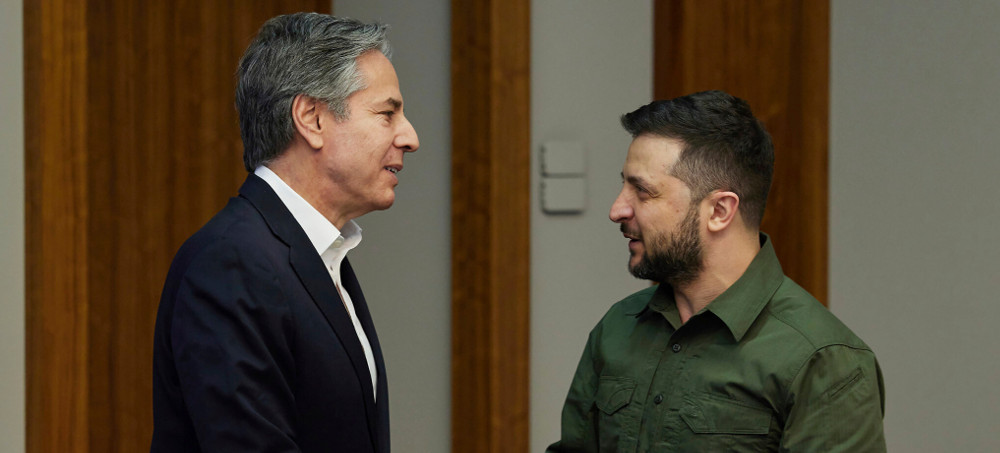
In this image from video provided by the Ukrainian Presidential Press Office on Monday, April 25, 2022, Ukrainian President Volodymyr Zelensky, right, and U.S. Secretary of State Antony Blinken shake hands during their meeting in Kyiv, Ukraine. (photo: AP)
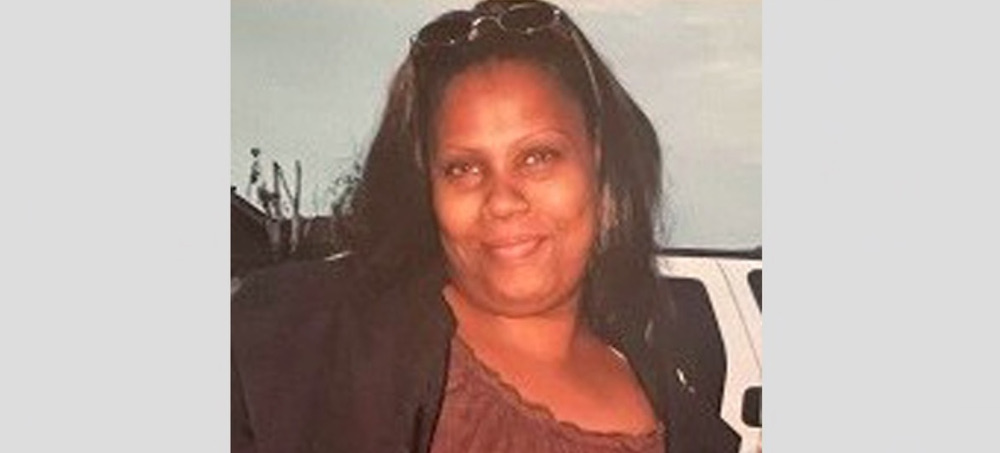
Tracy Gaeta, 54, was shot and killed by a Stockton police officer after backing her car into a police vehicle, reported NBC News. Lawyers for her family say the officer used excessive force and that she never threatened anyone nor was she armed.
K-9 officer Kyle Ribera fired more than 30 shots into her car Feb. 22. The body camera footage of the incident was released April 7. The police department said the incident began when Gaeta was seen on surveillance striking a police SUV at a red light. She was pursued by Ribera, stopped at a dead end and backed into his car.
More on the incident from NBC News:
According to the body camera video, Ribera then fired 18 shots into Gaeta’s car.
Her vehicle’s reverse lights remained on, and Ribera fired several more shots. After changing his service weapon’s clip, Ribera yelled for the driver to raise their hands, according to the video.
Gaeta began driving, pulling forward several feet, then reversing away from Ribera. He opened fire again, shooting more than a dozen times, according to the video.
Gaeta was taken to a local hospital, where she was pronounced dead, the department said.
According to a policy adopted by the Stockton Police Department in 2019, officers are “generally” prohibited from firing at fleeing vehicles.
Gaeta’s family attorney Gary Gwilliam said the officer acted against the department policies on firing at moving vehicles. “No matter what was going on with her — even if she had committed a heinous crime — he didn’t have the right to shoot her. She never threatened him,” he said via NBC.
A spokesman from the Stockton Police Department told NBC News a review of the incident was underway which will end in a decision by the local district attorney’s office on whether to place criminal charges against Ribera.
Gaeta’s daughter, Tressie, called her a “loving, caring grandmother” in a statement from Gwilliam’s office. “I hope that we can find justice because she did not deserve to die like that,” she said.
Willard O'Neal hugs Tiffany Gobble, an investigator with the Innocence Project, after his release from prison. Testing on evidence from the crime scene failed to find his DNA. (photo: Ian Maule/AP)
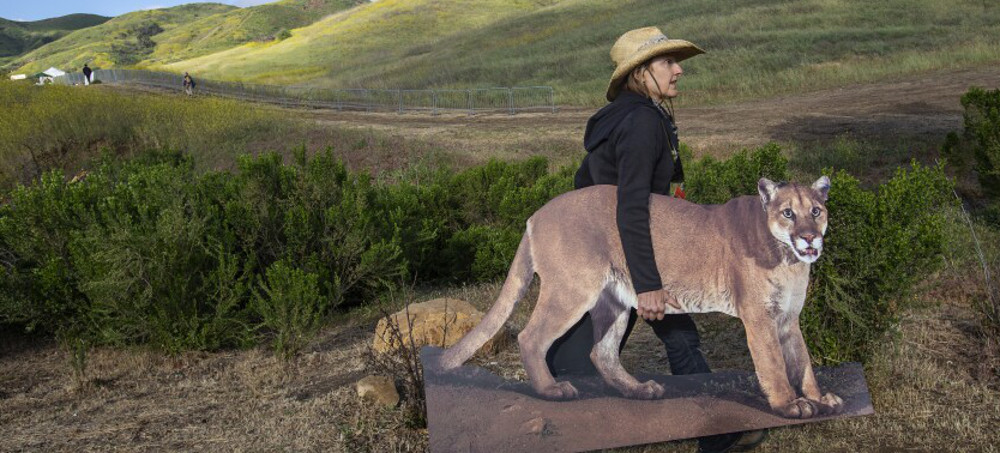
Shellie Collier, lead volunteer for the National Wildlife Federation, makes her way with a cardboard cutout of a mountain lion known as P-22 while walking near the location of the future Wallis Annenberg Wildlife Crossing in Agoura Hills. (photo: Mel Melcon/LA Times)
When conservationists first announced plans to raise $30 million for a wildlife crossing over a deadly 10-lane stretch of the 101 Freeway in Agoura Hills, critics snickered and said “good luck.”
Now, 10 years later, the dream of building a bridge that would help mountain lions escape an “extinction vortex” by providing them safe passage to food and mates is becoming a reality.
On Friday, Earth Day, hundreds of conservationists and legislators gathered with joy and a sense of triumph on a weedy hill overlooking the Liberty Canyon Road exit to break ground on the Wallis Annenberg Wildlife Crossing.
“We did it!” shouted Beth Pratt, regional executive director of the National Wildlife Federation. “For years to come, this wildlife crossing will be admired and studied as proof that humans and wild animals can co-exist,” she said as she raised her voice over the din of traffic streaking past.
With completion scheduled for 2025, the wildlife crossing ranks among the most ambitious apolitical campaigns ever waged in Southern California.
More than 5,000 individuals, foundations, agencies and businesses from around the world contributed expertise and donations that, as of Friday, totaled more than $87 million — including a $25-million challenge grant from Wallis Annenberg and the Annenberg Foundation.
“What we are doing here today goes beyond conservation,” said Annenberg, who received a standing ovation from the crowd assembled just a stone’s throw from a stretch of freeway that carries 300,000 vehicles each day.
“Today we begin to reconnect the land and its wildlife,” she said, “which never should have been fractured in the first place.”
In a broadside to congressional opposition to wildlife protections that was met with boisterous applause, Gov. Gavin Newsom said, “This project will inspire the world — eat your heart out, Washington!”
Partners include the National Wildlife Federation, the National Park Service, Caltrans, Mountains Recreation and Conservation Authority, the California Department of Fish and Wildlife, the Santa Monica Mountains Conservancy, the Resource Conservation District of the Santa Monica Mountains, and the architectural firm Living Habitats LLC, among many others.
Because the project spans an interstate, Caltrans will oversee design and construction — but the transportation agency is not providing funding.
The 200-foot-long, 165-foot-wide bridge will be the largest of its kind in the world and will serve as a lifeline for small, isolated populations of cougars in the Santa Monica Mountains to the south, and in the Simi Hills and Santa Susana Mountains to the north.
These 12 to 15 mountain lions have the lowest genetic diversity documented for the species aside from the critically endangered Florida panther. Scientists say they face extinction probabilities of 16% to 28% over the next 50 years.
“We know the harm done to wildlife by the nation’s highways — and how to fix it,” said Tiffany Yap, a biologist at the Center for Wildlife Diversity.
“Beyond overpasses,” she said, “we can upgrade existing culverts to be more wildlife-friendly, install roadside fencing to guide animals to existing underpasses, and consider mistakes of the past when proposing new development.”
Roads that are deadly for wildlife can also be dangerous for drivers. More than 44,000 wildlife-vehicle collisions were reported on California roads from 2018 to 2020, resulting in human deaths and damage totaling about $1 billion, according to the UC Davis Road Ecology Center.
The notion of helping the solitary, elusive predators cross the freeway was inspired, in part, by the 2012 discovery of an extraordinarily wayward 3-year-old, 140-pound lion lurking in the shadows of the populated hillsides and attractions in and around Griffith Park.
In his 20-mile odyssey eastward from the Santa Monica Mountains, P-22 had dodged commuter traffic, traversed backyards and maneuvered through an obstacle course of culverts, bridges and roads before making a home in the park’s rugged backcountry.
With P-22 as its poster puma, the nonprofit #SaveLACougars campaign kicked off in 2014 after the National Wildlife Federation and the Santa Monica Mountains Fund joined forces to raise funding for a wildlife crossing unprecedented in scope and cost.
Skeptics doubted that Americans would decide Southern California’s imperiled predators were worth the money. Or were they just another fad?
It was a question that Pratt pondered after taking on the job of managing the campaign, and having a likeness of P-22 tattooed on her upper left arm.
Wildlife crossings, she soon learned, are a hard sell: You need money to get past the blueprints, but you need blueprints to generate donations.
By 2020, the campaign still needed to raise tens of millions of dollars to avoid costly delays and complete construction on schedule by 2025.
Around the same time, biologists began to see physical manifestations of extremely low genetic diversity among several of the cougars who roam 275 square miles in and around the Santa Monica Mountains — a kinked tail like the letter “L,” only one descended testicle and abnormal sperm.
The dire prognosis — what biologists call an extinction vortex — raised an urgent question: How long before it is too late to save them?
“It’s a pivotal moment for conservation and our park,” said Seth Riley, wildlife branch chief for the Santa Monica Mountains National Recreation Area. “It’s super exciting to see the science that we’ve worked so hard on for so many years result in concrete action to benefit wildlife.”
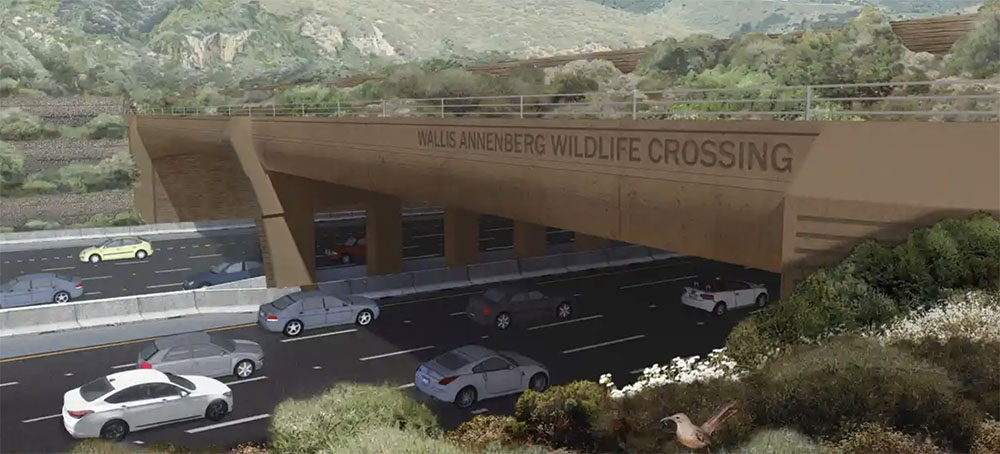
As envisioned by architects and Caltrans, cougars will move — unseen by motorists — over a reinforced concrete-and-steel crossing landscaped with irrigated native vegetation, including oak and willow trees. Sound walls and light deflectors will dampen the noise and headlights of the hundreds of thousands of vehicles that pass through the area daily.
Fencing up to 12 feet high would funnel wildlife including mountain lions, bobcats, deer, coyotes, skunks, badgers, squirrels, mice and lizards over the passage. To reduce roadkill, fencing would also extend several miles in both directions from the project footprint.
Though the project is driven largely by the need to connect landscape, another challenge involves development of “natural-looking” abutments, approach slopes and walls expected to provide potential homes for small animals, birds and insects.
Safety netting will be installed to stop anything from dropping to the road.
It remains to be seen whether prey animals such as deer that venture onto the bridge will be able to avoid becoming unnaturally easy meals for hungry lions.
In the meantime, Southern California is watching its mountain lions decline steadily in the Santa Ana, San Gabriel, San Bernardino, Santa Monica, Santa Cruz and Tehachapi ranges.
Habitat fragmentation by urban development and highways, extremely low levels of genetic diversity, disease, territorial battles, rodenticide poisoning, and human-caused wildfires are serious problems shared by lions in each of those ranges.
Roadkill is also taking a toll. Since National Park Service biologists began researching mountain lions in the Santa Monicas in 2002, motorists have struck and killed at least 20 of the big cats in the study area, federal officials said.
A mountain lion was struck and killed by a driver on the 405 Freeway early Thursday morning, a day before the wildlife crossing groundbreaking ceremony.
Mountain lions as a species are not threatened in California. But a recent petition submitted to the state Fish and Game Commission by the Center for Biological Diversity and the nonprofit Mountain Lion Foundation argues that six isolated and genetically distinct cougar clans from Santa Cruz to the U.S.-Mexico border make up a subpopulation that should be listed as endangered.
A final determination by the commission is expected later this year.
In the meantime, news that the wildlife crossing has entered the construction phase drew mixed reactions from residents of nearby Mediterranean-style duplexes and leafy gated communities.
One woman who has lived in the area for 32 years called it “a monstrosity,” adding a thumbs down gesture for emphasis.
Then there was Teri Francovic, a resident of 50 years, who sees it as a welcome addition to the Agoura Hills community.
“It sure is expensive — and some people are grumbling about that,” Francovic said as she prepared to hike with friends. “But the mountain lions were here first, and they need to breed.”
While the war in Ukraine is far from over, from a pure battlefield assessment perspective the Ukrainian defenders have far out-preformed the Russian invaders. In the war’s first major pivotal battle, the Battle of Kiev the far larger Russian force was routed and those who were not slaughtered fled for their lives. Another major engagement looms in the Donbas and its story is yet to be told but the Russians will have to preform at a far higher level if they are to prevail there or anywhere else in the land of the Ukrainians. Nonetheless after retreating the Russians would say that they had, “Achieved all of their objectives.” It seemed laughable, until the world saw Bucha.
The scenes are apocalyptic, villages, towns and entire cities reduced to rubble. Innocent, unarmed civilians deliberately targeted and executed en masse. Not just shot and killed but violated in a manner reminiscent of the world's most deranged and heinous serial killers, with a quantity multiplied by thousands.
The destruction rather than random or indiscriminate is chillingly calculated and purposeful. Precisely targeted are social support institutions. Schools, nurseries, hospitals, transportation hubs are systematically destroyed. It is madness with a most diabolical methodology. The purpose is to destroy Ukraine’s infrastructure, to make the entire country uninhabitable. The damage wrought in six short weeks will take generations to repair and rebuild. But the targeting of civilians has an even darker more cynical purpose.
Full military strikes on civilians cause widespread terror and panic. It is the worst, most illegal kind of warfare. The result is that fleeing populations themselves become a weapon of war. Evacuating communities, providing humanitarian aid compromising defensive military strategies to avoid further civilian suffering all are an advantage to the aggressors. The weaponization of human slaughter is not necessarily confined to the immediate region of conflict. It creates an assault on secondary regions and nations as the terrorized and wounded stream across international boarders. In this way Putin’s war on Ukraine is exported to all of Europe and soon far beyond. It is no longer just a proxy war with Europe, all of Europe is now the war zone.
Putin’s War Goes Worldwide
Andriivka, Ukraine, April 6, 2022: A cat sits amid live artillery ammunition left behind by hastily retreating Russian soldiers. (photo: Vadim Ghirda/AP)
The calamity spiraling out of control in Ukraine is far too big to be contained by its boarders nor will it be confined to NATO territory. The effects and impacts of Putin’s war are moving around the world as efficiently as the Coronavirus. No continent or country is exempt from the economic shrapnel. Ukraine is a global supplier of agricultural food products, particularly wheat. While the direct impact on food security for Western nations would probably be limited the resulting food shortages in the Middle East and Africa should the conflict drag on have the potential to be catastrophic, literally millions might die from famine.
While food shortages may not directly threaten more affluent Western nations, global financial instability likely will, possibly in extreme ways. Prices can spike, markets can crash, credit ratings can be downgraded and entire economies can contract significantly. By the time this is over Putin’s war on the West may do more economic harm to Western nations than their sanctions do to Russia.
The Price of Western Timidity
Politicians and bureaucrats do not make war well. It’s not something they believe in, practice for or instinctively understand how to cope with. Within the NATO alliance there are 30 heads of state and 30 legislative bodies, not counting sub categories. It is not impossible to efficiently organize a military strategy within such a complex organizational structure, but decisive action is often difficult to achieve even when critical threats arise.
Regardless of what NATO leaders say to reporters they are dreading the prospect of a direct confrontation with Putin’s army. An army that appears to be as deranged as he is. But as dangerous as Putin’s army is the threat to Western nations posed by their own inaction is actually significantly greater. With each, executed civilian, each raped woman, each murdered child, each destroyed village Putin’s campaign of terror and horror metastases anew growing stronger through its very ability to continue.
Each day NATO nations chose not to use their superior military capabilities to end this war and they surely can, is a day that Putin grows stronger, the position of Western nations becomes weaker and the threat to global security becomes greater. Putin cannot win this war militarily but through inaction the West can win it for him. The West is hesitating and Putin is acting. So even though his army is performing very poorly Putin is winning, on a global scale. The inaction actually encourages a furtherance of the violence. The only meaningful deterrent is a sufficient counterforce.
More dead Ukrainian civilians won’t make the West more secure, it will make Putin more confident and aggressive. The West can confront this threat now or later. Now is by far the better option. This is a war Western nations insist they are not engaged in. In reality is is a war they dare not lose.
Marc Ash is the founder and former Executive Director of Truthout, and is now founder and Editor of Reader Supported News. On Twitter: @MarcAshRSN
Reader Supported News is the Publication of Origin for this work. Permission to republish is freely granted with credit and a link back to Reader Supported News.
Two women from Texas talk to each other about their travel to Okalahoma as they wait in the recovery room following their abortions at Trust Women clinic in Oklahoma City, December 6, 2021. Picture taken December 6, 2021. (photo: Evelyn Hockstein/Reuters)
Police in Starr County on the Texas-Mexico border have arrested and charged a woman with murder for allegedly performing what they called a “self-induced abortion.”
The Starr County Sheriff's Office arrested 26-year-old Lizelle Herrera on Thursday. TPR confirmed Friday night that Herrera was in the custody of the Starr County Sheriff’s Office with bond set at $500,000. By Saturday night, Herrera was released from custody.
The Starr County grand jury's indictment, dated March 30, stated that Herrera "did then and there intentionally and knowingly cause the death of an individual J.A.H. by a self-induced abortion."
“This is a developing story and we don’t yet know all the details surrounding this tragic event," said Rockie Gonzalez, founder and board chair of Frontera Fund. "What we do know is that criminalizing pregnant people’s choices or pregnancy outcomes, which the State of Texas has done, takes away people’s autonomy over their own bodies, and leaves them with no safe options when they choose not to become a parent."
Members of the Rio Grande Valley-based abortion assistance fund protested Saturday morning outside the Starr County Jail.
Melissa Arjona, who co-founded South Texans for Reproductive Justice, was also at the protest. She said the arrest is a consequence of Senate Bill 8, which criminalized abortion as early as five weeks and deputized private citizens to sue anyone who provides an abortion or “aids and abets” a procedure.
“I mean, they they criminalized pregnancy, basically, and abortion access," she said. "And so we knew something like this was bound to happen eventually.”
“We want people to know that this type of legislation impacts low-income people of color communities the most when state legislators put restrictions on our reproductive rights,” Gonzalez told TPR.
By Saturday evening, the specific details of Herrera's case — and the strength of the case against her — were still not clear.
"So there's a question of whether this actually qualifies as a murder?" said Jessica Brand, founder of the WREN Collective, a research firm that specializes in criminal justice issues. "I would say no. Everybody who's ever looked at a case like this, has has decided to say 'no' in the end. That's why these prosecutions haven't worked in states like Tennessee or Indiana, where they've been tried before."
Lynn Paltrow, founder and executive director of National Advocates for Pregnant Women, said Texas law actually exempts her from a criminal homicide charge.
"When Texas law explicitly says that their murder statutes that do include the unborn child do not apply to the death of an unborn child if the conduct charged is 'conduct committed by the mother of the unborn child,'" she explained. "So this person who's been arrested has been arrested based on a law that does not permit exactly this kind of prosecution."
At least 71 death row inmates in China had their vital organs removed, to be used for transplants, before they were officially declared dead, according to a study published in the American Journal of Transplantation.
"We found that the physicians became the executioners on behalf of the state, and that the method of execution was heart removal," an author of the study, Matthew P. Robertson, said in a statement to Al Jazeera.
For decades, per the study, Chinese surgeons have broken a crucial transplant donor rule: Don't remove organs from a live body.
The authors of the study, Australian National University researcher Matthew P. Robertson and cardiac surgeon Jacob Lavee, reviewed 2,838 cases to determine that 348 "surgeons, nurses, anesthesiologists, and other medical workers or researchers" who participated in the executions of inmates between 1980 and 2015 had removed the organs of death row inmates prior to "legitimate determination of brain death."
The World Medical Association, which maintains ethical guidelines for physicians in more than 100 countries, specifies that organ removal should not be the cause of death for transplant donors.
"The dead donor rule is fundamental to transplant ethics," the study reads. "The rule states that organ procurement must not commence until the donor is both dead and formally pronounced so, and by the same token, that procurement of organs must not cause the death of the donor."
The cases showed that medics did not accurately check that inmates were brain dead — unable to be brought back by ventilation or other means. The study authors were able to determine this by manually reviewing 310 papers that mentioned the word "donor."
"If the reports we examine are accurate, they indicate that heart and lung procurement by the surgeon was the proximate cause of the prisoner's death, thus directly implicating the surgeon in the execution," the study reads.
"This was one of the strongest pieces of evidence of failure to adhere to the dead donor rule because ventilation via intubation is a key step in being able to diagnose brain death," Lavee said in a statement to Newsweek.
"There were several other problematic features of these clinical case reports. For instance, the donors did not have intravenous lines established until moments before surgery, and several papers referred to acute brain death. This evidence suggests that the donors' organs were procured before they could have been properly diagnosed as brain dead," Lavee added.
Dr. Frank Montgomery, Chair of Council of the WMA, told Insider via email that it "has always denounced organ harvesting from executed prisoners as unethical," adding that their interventions helped China outlaw the organ harvesting of inmates in 2015.
"We are now awaiting a clear commitment of our Chinese member organization that this unethical practice is no longer performed in China," Montgomery added.
Yaqiu Wang, senior China researcher at Humans Right Watch, is also seemingly skeptical about whether the country has ceased the practice.
"The Chinese authorities have a history of dubious claims with regard to organ transplantation: They said they had taken organs from executed prisoners but insisted the prisoners had always had consented, despite evidence to the contrary," Wang said in an email to Insider.
"Authorities also claimed that they have ended the practice of using organs of executed prisoners, but there is a lack of evidence on that. The Chinese government's organ donation registry also lacks transparency and there have been reported data discrepancies," Wang added.
China's death row is shrouded in secrecy. It keeps its figures on executions secret, but Amnesty International estimates that it killed thousands of prisoners from 2016 to 2020. The US government, conversely, killed 13 prisoners during that time period following a 17-year hiatus that former President Trump ended.
"The findings are disturbing, and the Chinese government should respond to these new allegations," Wang said.
The Embassy of the People's Republic of China in the United States of America, Amnesty International, and Lavee did not immediately respond to Insider's request for comment.
CNN reports Trump’s eldest son texted chief of staff two days after 2020 election to say ‘we have multiple paths … we control them all’
Two days after the 2020 election, Donald Trump Jr texted the White House chief of staff, Mark Meadows, with strategies for overturning the result, CNN reported.
“This is what we need to do please read it and please get it to everyone that needs to see it because I’m not sure we’re doing it,” Trump Jr reportedly wrote, adding: “It’s very simple … We have multiple paths[.] We control them all.”
One leading legal authority called the text “a smoking rifle”.
CNN said the text was sent on 5 November 2020, two days before Joe Biden was declared the winner of the election and the next president.
Two months after 5 November, on 6 January 2021, supporters Trump told to “fight like hell” in his cause attacked the US Capitol. A bipartisan Senate report connected seven deaths to the riot.
According to CNN, in his texts to Meadows, Trump Jr laid out strategies the Trump team went on to pursue as they disseminated lies about election fraud and pressured state and federal officials.
Such tactics included lawsuits in swing states, the overwhelming majority of which were rejected, and “having a handful of Republican state houses put forward slates of fake ‘Trump electors’”.
CNN also said Trump Jr suggested that if such measures didn’t work, lawmakers in Congress could dismiss the electoral results and vote to keep Trump in office.
In the immediate aftermath of the Capitol riot, 147 Republicans in Congress voted to object to results in key states.
Trump Jr’s lawyer, Alan Futerfas, told CNN: “After the election, Don received numerous messages from supporters and others. Given the date, this message likely originated from someone else and was forwarded.”
CNN said the Trump Jr text had been obtained by the House committee investigating the Capitol attack. This week, the committee interviewed Trump Jr’s sister, Ivanka Trump, and her husband, Jared Kushner, both former senior White House advisers. Their testimonies are the closest lawmakers have come to the former president.
Spokespeople for Meadows and the House January 6 committee did not comment to CNN.
In political circles, the subject of criminal culpability for both the attempt to overturn the election and the assault on the Capitol is a raw one.
Around 800 people have been charged over the Capitol attack but so far only Steve Bannon among close Trump advisers has faced a criminal charge.
The former White House strategist pleaded not guilty to criminal contempt of Congress, after refusing to co-operate with the January 6 committee. This week, the House voted to recommend the same charge for Dan Scavino, Trump’s social media aide, and Peter Navarro, a trade adviser who became the president’s bulldog on election subversion, describing the scheme in detail.
Last month, a federal judge said Trump appeared to have committed multiple felonies.
“Based on the evidence the court finds that it is more likely than not that President Trump and Dr [John] Eastman [a law professor who advised Trump] dishonestly conspired to obstruct the joint session of Congress on January 6 2021,” Judge David Carter ruled.
Carter also described Trump’s scheme as “coup in search of a legal theory”.
Responding to news of Donald Trump Jr’s communication with Meadows, Laurence Tribe, a Harvard law professor, said on Twitter: “This text is a smoking rifle.”
Glenn Kirschner, a former federal prosecutor now an analyst for NBC, went further.
“The ‘subject’ line of Don Jr’s email might as well have been, ‘I’m a member of my father’s criminal conspiracy to overturn the election.’ How long do we have to endure this open, treasonous criminality by Trump and company before someone gets indicted?”
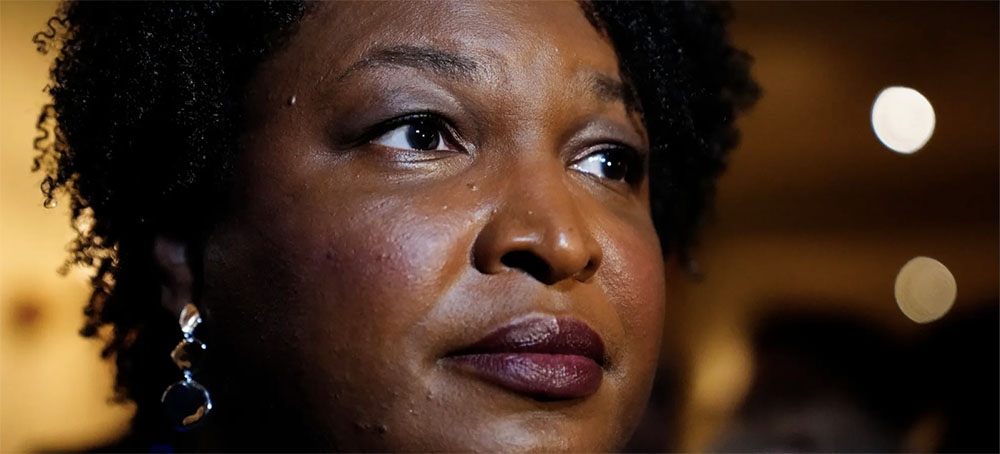
Georgia gubernatorial Democratic candidate Stacey Abrams talks to the media after qualifying for the 2022 election on Tuesday, March 8, 2022, in Atlanta. (photo: Brynn Anderson/AP)
When she ended her first bid to become Georgia governor in 2018, Stacey Abrams announced plans to sue over the way the state’s elections were managed. More than three years later, as she makes another run at the governor’s mansion, the lawsuit is going to trial.
Filed in November 2018 by Abrams’ Fair Fight Action organization, the suit alleged that state officials “grossly mismanaged” the election, depriving some citizens, particularly low-income people and people of color, of their right to vote. The lawsuit originally called for a sweeping overhaul of the state’s elections, but its scope was considerably narrowed after the state made changes that addressed some allegations and others were dismissed by the court. The trial is set to begin Monday.
Even if U.S. District Judge Steve Jones sides with the plaintiffs, it’s unclear whether that will affect elections this year. Jones and other federal judges have been reluctant to order last-minute changes, noting that the Supreme Court has repeatedly said federal judges shouldn’t alter rules “on the eve of an election.”
In the months preceding the 2018 election, Abrams, a Democrat, accused her Republican opponent in the governor’s race, then-Secretary of State Brian Kemp, of using his position as Georgia’s chief elections officer to promote voter suppression, an allegation Kemp has vehemently denied.
In the more than three years since that fiercely fought contest captured national attention, the focus on Georgia’s elections has only intensified. Problems during the 2020 primary drew sharp criticism. Later that year, former President Donald Trump hurled insults at state officials who declined to overturn his narrow general election loss in the state. And the nation watched closely in January 2021 as a pair of Democrats unseated the state’s two incumbent Republican U.S. senators.
Numerous GOP-led state legislatures passed election bills last year after Trump stoked false claims that widespread fraud led to his 2020 defeat. Georgia’s bill, which Kemp signed into law a year ago, was one of the broadest. Among other things, the state’s measure reduced the window to request an absentee ballot, stripped power from the secretary of state and sharply curtailed the use of absentee ballot drop boxes in populous and Democratic-voting metro Atlanta counties. Voting rights groups and the U.S. Department of Justice promptly sued; those lawsuits are pending.
Republicans in Georgia this year passed legislation to let the Georgia Bureau of Investigation initiate probes into alleged election wrongdoing.
Meanwhile, Abrams, a state lawmaker who was little known outside Georgia when she ran four years ago, has become a household nameand Democratic Party star. The only Democrat running for governor, she’ll face Kemp again in November if he fends off a primary challenge from former U.S. Sen. David Perdue.
Secretary of State Brad Raffensperger accused Abrams and her allies of trying to undermine the integrity of Georgia elections.
“Her 3-year ‘stolen election’ campaign has been nothing more than a political stunt to keep her in the national spotlight, and it’s a disservice to Georgia voters,” he said in an emailed statement.
Fair Fight says it works to promote voting rights and support progressive candidates around the country, and its PAC has raised more than $100 million since its founding. It filed the lawsuit along with Care in Action, a nonprofit that advocates for domestic workers. Several churches have also joined as plaintiffs.
Fair Fight collected statements from people who said they had problems voting. The lawsuit cited multiple alleged problems, including the purging of eligible voters from voter rolls under a “use it or lose it” policy; the state’s so-called exact match voter registration rules; an insufficient number of voting machines at some precincts; and a lack of sufficient training for election officials. It asked a federal judge to find that Georgia’s elections processes violated the U.S. Constitution and federal law.
“Since the start of this lawsuit, we have highlighted real voters and their challenges because we believe that is one of the most effective ways to demonstrate the barriers in Georgia’s elections system,” Fair Fight executive director Cianti Stewart-Reid said in an emailed statement. She added that voters from around the state will testify at trial about obstacles faced while trying to vote.
Some of the alleged problems were addressed by changes in state law. For example, a 2019 law called for replacing the state’s outdated voting machines. The new system was implemented statewide in 2020.
In February 2021, Jones threw out parts of the lawsuit, saying some allegations were made irrelevant by changes in state law or the plaintiffs’ lack of standing. Among them were some of the claims about voting machines and election technology, as well as the security of voter lists and polling place issues. The following month, Jones dismissed claims targeting the “use it or lose it” policy and some allegations of inadequate training of poll workers. He also dismissed some claims relating to provisional and absentee ballots.
The issues remaining for the trial have to do with the “exact match” policy, the statewide voter registration list and in-person cancellation of absentee ballots. The plaintiffs claim that Georgia’s secretary of state and State Election Board members are “denying and abridging Georgians’ right to vote” in violation of the Voting Rights Act of 1965 and the U.S. Constitution.
Under the “exact match” policy, information from voter registration applications is checked against information held by the state Department of Driver Services or the federal Social Security Administration. If there’s a discrepancy, the would-be voter must show identification to county officials before being able to cast a regular ballot.
The plaintiffs say data entry errors or differences as minor as a missing hyphen or apostrophe can trigger a non-match and that naturalized citizens can also be wrongly flagged as noncitizens if records are outdated. These problems disproportionately affect people of color and can depend on where a person lives because counties do things differently, the plaintiffs say.
The statewide voter registration database is “error-ridden,” the plaintiffs say, resulting in the erroneous deletion of eligible voters’ registration or critical information being incorrect. That can prevent eligible voters from being able to vote or force them to overcome undue burdens to do so, the plaintiffs say.
The plaintiffs also say election officials aren’t sufficiently trained on canceling an absentee ballot if someone chooses to vote in person instead, which can cause voters to be turned away or forced to cast a provisional ballot.
Lawyers for the state argue the claims in the lawsuit “are not supported by the evidence.” The number, geographic scope and severity of the alleged problems experienced by voters identified by the plaintiffs “do not rise to a level sufficient to demonstrate an unconstitutional burden on voting in Georgia,” state lawyers wrote in a filing. Additionally, they argue, the alleged problems cited are not the responsibility of the state officials named in the lawsuit.
Lyrics Zombie by The Cranberries from the 1994 album, No Need to Argue
Another head hangs lowly Child is slowly taken And the violence, caused such silence Who are we mistaken?
But you see, it's not me It's not my family
In your head, in your head, they are fighting With their tanks, and their bombs And their bombs, and their guns In your head, in your head they are crying In your head, in your head Zombie, zombie, zombie-ie-ie What's in your head, in your head Zombie, zombie, zombie-ie-ie, oh
Du, du, du, du Du, du, du, du Du, du, du, du Du, du, du, du
Another mother's breaking Heart is taking over When the violence causes silence We must be mistaken
It's the same old theme Since nineteen-sixteen In your head, in your head, they're still fighting With their tanks, and their bombs And their bombs, and their guns
In your head, in your head, they are dying In your head, in your head Zombie, zombie, zombie-ie-ie What's in your head, in your head Zombie, zombie, zombie-ie-ie Oh oh oh oh oh oh oh, ay, oh, ya ya
Rendering of the Wallis Annenberg wildlife crossing, which will span a busy section of highway near Los Angeles, allowing animals to pass safely. (photo: Living Habitats and National Wildlife Federation)
Unprecedented overpass will allow fauna of the Santa Monica mountains to safely cross a dangerous 10-lane stretch
Imagine cruising down a 10-lane highway and knowing that, high above your head, a mountain lion is quietly going along its way. This remarkable image could soon be reality for drivers on one of California’s busiest roads, as the world’s largest wildlife overpass begins construction this month.
The history-making project will comprise a green bridge built across the 101 highway near Los Angeles, creating a corridor between two parts of the Santa Monica mountains. Stretching 210ft long and 165ft wide, the overpass will allow safe passage for lizards, snakes, toads and mountain lions, with an acre of local plants on either side and vegetated sound walls to dampen light and noise for nocturnal animals as they slip across.
The project, nearly a decade in the making, comes at a crucial time. Highways in this car-heavy landscape crisscross critical habitat for the protected mountain lions and other animals, forcing them to make what can be deadly crossings. At least 25 of the big cats have been killed on Los Angeles freeways since 2002. The latest death was just weeks ago, on 23 March, when a young lion was struck and killed on the Pacific Coast highway.
Beth Pratt, an urban ecologist with the National Wildlife Federation, feels as if she is running the last mile of a marathon. Pratt has spent most of the last decade planning the project, persuading transportation officials of its importance, and bringing together stakeholders and donors to fund it. “I’m a little dizzy still, but I feel relieved: we have the chance to give these mountain lions a shot at a future.”
A groundbreaking ceremony to mark the start of construction for the $90m crossing – called the Wallis Annenberg wildlife crossing – will take place on Earth Day, 22 April. Construction will mostly happen at night and the project isn’t expected to be complete until early 2025.
The bridge’s price tag will be covered by about 60% private donations, with the rest coming from public funds set aside for conservation purposes. California’s Governor Gavin Newsom has called the project an “inspiring example” of public-private partnership.
‘A symbol of connection’
The project is breaking the mold in many ways: not only is it the largest crossing in the world, stretching over 10 lanes of one of the busiest roadways in the country, but it’s also an engineering marvel. The crossing is designed to seamlessly integrate into the mountains, offering big cats, coyotes, deer, lizards, snakes and other creatures a safe way to travel to different parts of open territory in the Santa Monica mountains recreation area – a 150,000-acre space.
Robert Rock, a landscape architect with Living Futures in Chicago who led the design, says this nature-centered type of construction makes it unusual among other wildlife bridges and underpasses around the world, which are typically made of cement and steel. This one is designed to seamlessly glide into the environment on both sides – and send a message to the people driving below.
His team includes a soil scientist – who collected samples nearby that are specific to the local trees – and a mycologist, who is studying the fungi of the area and how they can help the seamless flow of plants and animals across the overpass. Docents will be posted nearby to discourage people from exploring the overpass. (Pratt says that planting poison oak and posting signs about rattlesnakes are also effective tools to keep humans off the bridge.)
Rock says he is optimistic that the investment could serve as a precedent for how design can play a restorative role in the natural world. “As both a tool for and a symbol of connection, it will stand as an alluring challenge to future generations to pick up the mantle of design to bridge the gaps elsewhere in our world,” he says.
Approximately 300,000 cars pass through this area each day, and Pratt calls it an opportunity for millions of Angelenos to see how humans can live more harmoniously with nature. “Someone could be in rush-hour traffic, and there could be a mountain lion right above them,” she says. “I think that’s such a hopeful image, and one that inspires me that we can right some of these great wrongs.”
Pratt says the plight of the region’s mountain lions caught the eye of donors from around the world. People sent money from London. A couple from Kansas who had visited the city only once donated $675,000. Leonardo DiCaprio’s foundation chipped in $300,000. Pratt points to the local celebrity mountain lion P22, whose exploits around the city have captured headlines, as a catalyst for it all. “People really took his plight to heart, and this is not just a California story: the world has come together around his cause.”
P22 won’t actually be the intended user of this crossing, since he lives in a part of Los Angeles far east of the mountain range. But his symbol helped raise the money that will fund the bridge. And most of the area’s 100 mountain lions live in the area that the bridge will span.
The scientists say there is a learning curve for animals, and they will slowly begin to explore the bridge. For wary creatures, it may take up to five years to use the crossing successfully. Cats will follow smaller prey species, who generally more quickly adapt to the new territory.
“It’s not just a solution for P22 to get across the road, as much as P22 is the face of the campaign,” says Rock. “This is restoring a piece of lost habitat, putting it back across the mountains.”
More projects in the future
Wildlife crossings are picking up speed across the country, and the world. They make economic sense – most pay for themselves in a decade or two, and a study in Banff, Canada, whose national park has more than 40 wildlife underpasses and overpasses, found a 90% decrease in wildlife-vehicle collisions, which saved the park money.
But it’s only recently that the wildlife science and infrastructure communities have come together to understand the problem deeply. Joe Biden’s $1.2tn infrastructure bill earmarked $350m for animal-friendly infrastructure like bridges, underpasses and roadside fences.
Pratt says the project struggled to raise money in the early days of planning. Luckily the team was able to find some people who recognized the importanceof this project.
But perhaps the bigger challenge was philosophical: naysayers told her the project shouldn’t or couldn’t be done – “that we shouldn’t waste money on saving mountain lions in an urban area, that we would never be able to raise the funds.” She was undeterred. “I wasn’t going to take no for an answer, not when a population of mountain lions was at stake.”