Dear Friend,
Massive uncontrolled unprecedented wild fires are consuming portions of the Amazon rainforest and several regions of the Arctic. Somebody somewhere must be asking why all of a sudden in unison, all over creation, two of the planets largest ecosystems are going up in smoke. It’s eerily spine chilling.
If you think the contents of this news letter are critical for the dignified living and survival of humanity and other species on earth, please forward it to your friends and spread the word. It's time for humanity to come together as one family! You can subscribe to our news letter here http://www.countercurrents.org/news-letter/.
In Solidarity
Binu Mathew
Editor
Countercurrents.org
The World on Fire
by Robert Hunziker
Massive uncontrolled unprecedented wild fires are consuming portions of the Amazon rainforest and
several regions of the Arctic. Somebody somewhere must be asking why all of a sudden in unison, all over creation, two of the planets largest ecosystems are going up in smoke. It’s eerily spine chilling.

Massive uncontrolled unprecedented wild fires are consuming portions of the Amazon rainforest and several regions of the Arctic. Somebody somewhere must be asking why all of a sudden in unison, all over creation, two of the planets largest ecosystems are going up in smoke. It’s eerily spine chilling.
“Major fires have hit the Amazon and the Arctic for the second year in a row.” (Source: NewScientist, June 26, 2020)
Where’s the world’s largest fire alarm when so desperately needed?
Sure, all of mainstream press covers the fires and people hear about the fires and read about the fires. But that’s the end of any sort of impact because the sensationalism of reading about and hearing about massive fires thousands of miles away in vast wilderness areas doesn’t move the needle enough for people to express serious concern or even go so far as to panic. Maybe they should.
These are not regular ole run of the mill fires. Rather, these are firestorms so powerful that they create their own wind systems and self-perpetuate. More to the point, the world is on a biblical fire alert that posits the Book of Revelations 16:8 smack dab into contemporary society, to wit: Then the fourth angel poured out his bowl on the Sun, and power was given to him to scorch men with fire, and men were scorched with great heat.
For example, recent bushfires in Australia (2019) were not just unprecedented. They were “deadly catastrophic,” thus leaving some ecosystems “forever changed.” The conflagrations obliterated landscapes, not just patches of landscape but entire landscapes.
Why obliteration? Climate change is the villain. It supercharged the wildfires by turning landscapes into tinder. As such, and contrary to political opinions by right-wing whacko nutcases, climate change does not constitute surreal events in thin air, rather, it’s power-packed hard-hitting damage to our “one and only” planet. It’s authentic.
Australia’s wildfires convulsed above and beyond any known scale of normal fires, from which animals are usually able to escape. They didn’t. They couldn’t run fast enough! The fires took out entire landscapes, not patches of landscape that leave behind pockets of safety untouched for scampering animals. Nothing was left untouched by the hot lapping flames.
The wildfires permanently crippled iconic habitats that make Australia an ecological wonder for all to behold. From loss of crucial plant life to decimation of species that serve as a meal for a higher species, the ripple effects remain unaccountable, extensively beyond human calculation.
Now, two of the world’s largest, and most significant, ecosystems are on fire like never before, similar to Australia’s biblical fires of a year ago, as more, and more, precious natural resources suffer waves of obliteration. Of course, normal fires in the wild are healthy; however, these fires are anything but normal. They’re truly biblical in scale.
“Six months of record-breaking temperatures have sparked massive fires in the Siberian Arctic this year. Great plumes of smoke were visible on satellite… temperatures more than 5°C above average over much of Siberia… A Met Office-led international study has concluded this period of exceptional weather would have been impossible had the world not been warmed by man-made greenhouse gas emissions. (Source: New Warning Over Climate Change From Siberian Arctic, BBC News, July 15, 2020)
“What we’re seeing really is unprecedented… we’ve never seen the probability of a change of an event of more than 600 times. We’ve never seen a result like that, Professor Peter Stott, Met Office,” Ibid.
“Looking at the geologic record, we don’t think we’ve ever seen CO2 levels this high in about 5 million years… We are in uncharted territory, Dr. Katharine Hendry,” Ibid.
Meanwhile, bad vibes with strong undertones of contempt upend civilized society, as follows: America’s president Don Trump has tweeted 120 posts that variously poke fun at, and ridicule, climate change. Moreover, he has issued dozens of tweets claiming that “cold weather” disproves climate change. It should be noted that 62 million people voted for Trump in 2016 and many “live by his words.”
At the same time, in the real world of the Amazon rainforest, Brazil’s National Institute for Space Research reported 6,803 fires in the Amazon in July 2020 alone, nearly 30% more than July 2019 when the Western world went bananas over the loss of rainforest due to human-set fires. When in fact fires are not a regular feature of rainforests.
Now, environmentalists are going batty because August is traditionally the start of the human-generated fire season, but it already has a roaring head of steam. Not only that, but according to INPE data, the first six months of 2020 are already the worst on record for deforestation. Yes, “the worst on record.”
Sure enough, the Amazon rainforest, similar to landscapes in Australia in 2019, is subjected to obliteration forces, and it’s not just deforestation as the root cause. Climate change has kicked into high gear all across the magnificent rainforest with devastating drought conditions galore!
Excessive drought conditions, in part, originate early in the morning in garages around the world as fossil-fueled gasoline engines crank up, spewing out CO2, and the whir of a jet engine igniting, the blast of a diesel train engine cranking up, the murmur of a jet ski, ignition of hot coals for an electricity-generating plant, a furnace blast molding steel, all are the basis, the origin, of greenhouse gases that blanket the atmosphere, in turn, enhancing devastating severe droughts.
According to a landmark Amazonian rainforest in-depth analysis: “Several studies indicate that the region has been suffering severe drought since the end of the last century, as in 1997/1998, 2005, 2010 and 2015. The intensity and frequency of these extreme drought episodes in the AB during the last years, approximately one episode every five years with a significant increase in the coverage area, is remarkable.” (Beatriz Nunes Garcia, et al, Extreme Drought Events Over the Amazon Basin: The Perspective from the Reconstruction of South American Hydroclimate, Departamento de Meteorologia, Instituto de Geociências, Universidade Federal do Rio de Janeiro, Nov. 7, 2018)
Back-to-back-to-back-to-back 100/yr. drought events, every 5 years, are not normal, meaning something somewhere is horribly wrong. After all, major ecosystems that profoundly influence all aspects of the planet’s health and well-being are burning, collapsing, melting like there’s no tomorrow. The message is clear.
Along the way, Brazilian President Jair Bolsonaro feigns attempts to limit rainforest damage, but experts say the government’s response has been largely ineffective, more symbolic than real. In truth, he’s the primary driving force behind record-setting deforestation. Similar to Trump, on the world stage he’s a laughing stock and archenemy of the planet.
According to NASA, this year’s dry season will be more prone to fires than last year’s record-setting affair. Moreover, according to NASA, warmer ocean surface temps in the North Atlantic (global heating at work) create conditions for more extreme drought in the Amazon, as excessive ocean heat brings on far-flung damage. Everything in nature is somehow connected.
“The world on fire” is merely a prelude to a climate “gone berserk” disaster scenario that’s almost certain to eventually take civilization down to its knees, by all appearances sooner than mainstream science suggests, but frankly scientists don’t make such predictions.
Yet, isn’t a climate gone berserk scenario already playing out in real time, e.g., in Siberia, in the Amazon, in Australia?
Meanwhile, climate-related crises on a grand scale never before recorded throughout human history continue building to a crescendo, in earnest, right before society’s “eyes wide shut.”
Postscript: Reports out of the London School of Economics claim one-half of the Arctic fires are peat soil, normally too wet and too cold to burn, but now burning because of powerful intense heat… peat soil is carbon-rich and can burn for months/years, emitting carbon dioxide (CO2) and methane (CH4). (Source: Arctic Fires Released More Carbon in Two Months Than Scandinavia Will All Year, Grist, Aug. 4, 2020)
Speechless, once again!
Robert Hunziker, MA, economic history DePaul University, awarded membership in Pi Gamma Mu International Academic Honor Society in Social Sciences is a freelance writer and environmental journalist who has over 200 articles published, including several translated into foreign languages, appearing in over 50 journals, magazines, and sites worldwide. He has been interviewed on numerous FM radio programs, as well as television.
SIGN UP FOR COUNTERCURRENTS DAILY NEWSLETTER
The Likud Conspiracy: Israel in the Throes of a Major Political Crisis
by Dr Ramzy Baroud
Protests against Israeli Prime Minister, Benjamin Netanyahu, have raged on for weeks, turning violent sometimes. Israelis are furious at their government’s mediocre response to the coronavirus pandemic, especially as COVID-19 disease is experiencing a massive surge throughout the country.

Protests against Israeli Prime Minister, Benjamin Netanyahu, have raged on for weeks, turning violent sometimes. Israelis are furious at their government’s mediocre response to the coronavirus pandemic, especially as COVID-19 disease is experiencing a massive surge throughout the country.
Netanyahu warned protesters, thousands of whom have been rallying outside his residence in Jerusalem, against “anarchy (and) violence”. Scenes of utter chaos and violent arrests have been a daily occurrence in a country that is already in the throes of a political crisis, largely, if not exclusively, linked to the Prime Minister himself.
Desperate to create any distractions from his many woes at home, Netanyahu has been pushing for a confrontation with the Lebanese resistance group, Hezbollah. But that, too, has failed, as Israeli media has denied earlier claims that a violent confrontation was reported at the Israel/Lebanon border.
Hezbollah insists that it would be the group, not Netanyahu, that will determine the time and place for its response to Israel’s recent killing of Hezbollah’s influential member, Ali Kamel Mohsen.
Mohsen was killed in an Israeli aerial raid targeting the vicinity of the Damascus International Airport, likely another desperate attempt by Netanyahu to deflect attention from his troubled coalition government and his corruption trial to an issue that often unifies most Israelis.
The turmoil in Israel is not just about an obstinate, divisive leader who is manipulating public opinion, the media and the various political groups to remain in power and to avoid legal accountability for his corruption.
The Disunited Coalition
Israel is suffering a crisis of political legitimacy, one that goes beyond the embattled Netanyahu, and his coalition with the head of the Kahol Lavan (Blue and White) centrist party, Benny Gantz.
The political marriage between Netanyahu’s Likud and Gantz’s Kahol Lavan last April was fundamentally odd and unexpected. The announcement that Gantz – who endured three general elections in less than a year to finally oust Netanyahu – was uniting with his archenemy has devastated the anti-Netanyahu political camp, forcing Gantz’s partners, Yair Lapid and Moshe Ya’alon, to abandon him.
But the new coalition government between the right and center became dysfunctional immediately after it was formed. Israel’s political marriage of convenience is likely to end in an ugly divorce.
The war between Netanyahu and his main coalition partner is now manifest in every aspect of Israel’s political life: in the Knesset (parliament), in media headlines and on the streets.
When the new government assumed its duties after one of the most tumultuous years in Israel’s political history, the mood, at least immediately, was somewhat calm; both Netanyahu and Gantz seemed united in their desire to illegally annex nearly a third of the occupied Palestinian West Bank. Israel’s rightwing camp was delighted; the center tagged along.
However, the international response to the annexation scheme forced Netanyahu to rethink his July 1 deadline. Now that annexation has been postponed indefinitely, Netanyahu is being denied a major political card that could have helped him replenish his fading popularity among Israelis, at a time when he desperately needs it.
On July 19, Netanyahu’s corruption trial resumed. Although the Prime Minister did not attend the opening session personally, his image – that of a strong commanding figure – was tarnished, nonetheless.
Gantz, who already agreed to the annexation plan, was too clever to fully associate himself with the risky political endeavor. That task was left to Netanyahu who knew the risks affiliated with a failed political scheme, but with no option except to follow through with it.
Awaiting the right opportunity to pounce on his beleaguered ‘partner’, Gantz found his chance in a report published by the Israeli daily newspaper, Haaretz.
The Budget Conspiracy
On July 22, Haaretz reported that, “Netanyahu decided to not pass the budget for 2020 and to call a general election to take place on November 18,” to avoid the possibility of being forced to “handing over the keys to Defense Minister and Kahol Lavan Chairman, Benny Gantz” so that he, Netanyahu, may “attend legal proceedings” related to his corruption trial.
According to this claim, Netanyahu only agreed to swap the Prime Minister seat with Gantz come November 2021 just to buy time and to avoid a fourth election that would leave him vulnerable to an electoral defeat and to a corruption trial without a political safety net.
Despite the risk of yet another election, Netanyahu is keen to wrestle the Justice Ministry from Kahol Lavan’s hands, because whoever controls the Justice Ministry controls Netanyahu’s fate in Israeli courts. Leaving Gantz with such a powerful card is neither an option for the Likud nor for Netanyahu.
Hence, the Likud is insisting that the budget agreement can only last for one year, while Kahol Lavan is adamant that it must cover a period of two years. The Likud conspiracy, as revealed in Israeli media, suggests that the Likud Finance Minister, Israel Katz, plans to use the next budget negotiations as the reason to dismantle the right-center coalition and demand another election, thus denying Gantz his chance to serve his term as a prime minister, per the unity government agreement.
Crisis of a Fake Democracy
However, the crisis is larger than the dispute between Netanyahu and Gantz. While Israel has long prided itself on being “the only democracy in the Middle East”, the truth is that Israeli ‘democracy’ was, from the start, fraudulent, in that it catered to Israeli Jews and discriminated against everyone else.
In recent years, however, institutionalized racism and apartheid in Israel were no longer masked by clever political discourses. Netanyahu, in particular, has led the charge of making Israel the right-wing, chauvinistic, racist haven that it is today.
The fact that Netanyahu recently became Israel’s longest-serving Prime Minister, elected repeatedly by Israel’s Jewish citizens, indicates that the Israeli leader is but a reflection of the larger ailments that have afflicted Israeli society as a whole.
Reducing the discussion to Netanyahu’s many failures might be convenient, but the demonstrable truth is that corrupt leaders can only exist in corrupt and unhealthy political systems. Israel is now the perfect example of that truism.
Ramzy Baroud is a journalist and the Editor of The Palestine Chronicle. He is the author of five books. His latest is “These Chains Will Be Broken: Palestinian Stories of Struggle and Defiance in Israeli Prisons” (Clarity Press, Atlanta). Dr. Baroud is a Non-resident Senior Research Fellow at the Center for Islam and Global Affairs (CIGA), Istanbul Zaim University (IZU). His website is www.ramzybaroud.net
SIGN UP FOR COUNTERCURRENTS DAILY NEWSLETTER
Foiled at Toronto: The Tiger Squad’s Canadian Outing
by Dr Binoy Kampmark
Silencing Saudi journalist Jamal Khashoggi in Istanbul was a feat of primeval brutality that sent a shudder through even the
most hardened officials. The House of Saud, and in particular certain members of it, had gotten a taste for blood. Soon after Khashoggi’s slicing and dicing in the Saudi consulate in Istanbul at the hands of a specially assembled hit squad, another was sent ostensibly to do away with Saad al-Jabri, a former Saudi Arabian intelligence official.

Silencing Saudi journalist Jamal Khashoggi in Istanbul was a feat of primeval brutality that sent a shudder through even the most hardened officials. The House of Saud, and in particular certain members of it, had gotten a taste for blood. Soon after Khashoggi’s slicing and dicing in the Saudi consulate in Istanbul at the hands of a specially assembled hit squad, another was sent ostensibly to do away with Saad al-Jabri, a former Saudi Arabian intelligence official.
The plot was foiled. The curiosity of Canadian border agents about the squad was piqued as they attempted to enter the country at Toronto’s Pearson International Airport. The group denied knowledge of knowing each other. The discovery of a photo showing them in company suggested otherwise.
Such cases have led Jabri to file a 107-page complaint in the federal court in the District of Columbia, accusing Crown Prince Mohammed bin Salman of attempted murder in violation of the US Torture Victim Protection Act and international law. The lawsuit claims that “a team of Saudi nationals travelled across the Atlantic Ocean from Saudi Arabia … with the intention of killing Dr Saad.”
The list of accusations against the crown prince include corruption and deploying a team of mercenaries dubbed the Tiger Squad (Firqat el-Nemr), a unit with a record of conducting assassinations. According to Mustafa Abu Sneineh of the Middle East Eye, the “squad’s mission is to covertly assassinate Saudi dissidents, inside the kingdom and on foreign soil, in a way that goes unnoticed by media, the international community and politicians”.
There was very little in the way of being covert or quiet in the way the Tiger Squad went about its dastardly business in October 2018 in the grounds of the Kingdom’s consulate in Istanbul. Khashoggi’s killing was extravagantly cruel, vicious and indulgently brutal. The manner of doing away with Jabri promised to be similar, with a member of the squad drawn from the same department who had supplied personnel responsible for dismembering Khashoggi. Two bags of forensic tools kept them company.
The language of the filed lawsuit is ostentatious, even dramatic. “Few places hold more sensitive, humiliating and damning information about defendant bin Salman than the mind and memory of Dr Saad – except perhaps the recordings Dr Saad made in anticipation of his killing.” For those reasons, “defendant bin Salman wants him dead” and had been working “to achieve that objective over the last three years.” The extrajudicial killing would have also serve to sever access to “a uniquely knowledgeable partner vital to US national security, and, in turn, to eliminate any threat posed to Defendant bin Salman by virtue of that partnership [with the US].”
The lawsuit should not be shrugged off as the ravings of an ex-security official hungering for notoriety. Jabri has good reasons to fear being knocked off. For a time, he was close to Prince Mohammed bin Nayef, the go-between for the Kingdom with the “Five Eyes” (US, UK, Canada, Australia and New Zealand) intelligence agencies. In 2015, the royal furniture shifted through death and design. King Abdullah’s passing saw the coming to power of his half-brother Salman. Mohammed bin Salman took over the reins as defence minister and immediately got busy. In only two years, Prince Mohammed bin Nayef found himself usurped in his line to the throne in a palace coup engineered by bin Salman, who became crown prince. Jabri took his cue to leave, fleeing to Canada.
The lawsuit argues the bin Salman threatened Jabri at various times in an effort to compel his return to the Kingdom “where you will be placed under house arrest” or become the subject of a global manhunt, beginning with filing “bogus corruption allegations through INTERPOL” to encourage his surrender to the men of the crown prince. This included a menacing WhatsApp message promising the use of “all available means” to silence him. Bin Salman would personally “take legal measures, as well as other measures that would be harmful to you.”
The response from the Kingdom to this unveiling is bound to be more cautious this time around. To Khashoggi’s murder, it was amateurishly bumbling: first, abject, implausible denial, followed by the “accidental killing” thesis – that the journalist perished in a fist fight – followed by an acceptance, some three weeks later, that his killing was always intended. Care was taken to distance the crown prince and the royal family from the bloody episode, a stratagem aided by the sentencing of five squad members to death and three others to prison terms in closed proceedings. Being a member of the Tiger Squad has its drawbacks.
The paw prints of the crown prince were, however, found to be credibly large by Agnes Callamard, UN Special Rapporteur on extrajudicial, summary or arbitrary killings. As her 2019 report noted, “The circumstances of Mr Khashoggi’s death have led to numerous theories and allegations, but none alters the responsibility of the Saudi Arabia state.” Fifteen men had “acted under the cover of their official status and used state means to execute Mr Khashoggi.” His murder “was the result of elaborate planning involving extensive coordination and significant human and financial resources. It was overseen, planned and endorsed by high-level officials. It was premeditated.”
Bin Salman has shown himself to be a dedicated dissembler. He has charmed, wooed and warmed the hearts of many leaders. He has even given that lie of being a reformer some stuffing, an anti-corruption warrior keen to give the Kingdom a modernising lick of paint. In the meantime, he has set about eliminating and isolating his enemies. A man of such ilk will know that a certain quantum of hypocrisy in international relations will always tolerate murder and blood soaked hands, especially for a Kingdom possessing – at least for the moment – abundant natural resources.
Dr. Binoy Kampmark was a Commonwealth Scholar at Selwyn College, Cambridge. He lectures at RMIT University, Melbourne. Email: bkampmark@gmail.com
SIGN UP FOR COUNTERCURRENTS DAILY NEWSLETTER
Is Indian Big data collection for Israel’s Covid-19 Rapid Test kits development ethical?
by Prem Anand Murugan
As said by the Israeli health minister, the plan by Israeli R&D is to collect tens of thousands of samples within a span of 10 days for analysis using AI. We are not sure what about how the consent will be obtained from such huge number of patients and normal people as control group. With no transparency from Indian government officials, most Indians might not even understand for what their data being
used for in the name of Covid-19 testing
Understanding the Spirit of Quit India Movement
by Dr Prem Singh
The 78th anniversary of the Quit India Movement, famously known as the August Revolution in the history of India’s freedom movement, falls on August 9, 2020. The movement was inspired by the intense desire of freedom of the Indian people. According to a letter written by Dr. Ram Manohar Lohia to the Viceroy Linlithgow, the British government had killed fifty thousand patriots and injured much more people during the movement. On the occasion of the 75th anniversary of the movement, celebrated three years ago on 9 August 2017, almost all political parties had organized a number of programs in memory of the martyrs of the August Revolution.
Documentary Evidence of the Betrayal of Quit India Movement by Savarkar, Syama Prasad Mukherjee and RSS
by Shamsul Islam
On the eve of 78th anniversary of the glorious Quit India Movement [QIM] we must evaluate the role of the Hindutva gang in India’s anti-colonial freedom struggle. QIM also known as ‘August Kranti’ (August Revolution) was a nation-wide Civil Disobedience Movement for which a call was given on August 7, 1942 by the Bombay session of the All-India Congress Committee. It was to begin on August 9 as per Gandhi’s call to ‘Do or Die’ in his Quit India speech delivered in Mumbai at the Gowalia Tank Maidan on August 8. Since then August 9 is celebrated as August Kranti Divas.
Such A Temple Would Not Have Been Acceptable To Ram And Should Not Be Acceptable To A Common Hindu
Co-Written by Arundhati Dhuru and Sandeep Pandey
The futuristic religious places would be where followers of every religion would be welcome. In the post coronavirus world human beings will have to evolve a culture of co-existence. In Ayodhya itself there is a Ram Janki temple which has a vision of converting itself into a multi-faith harmony centre. A Sarva Dharm Sambhav Trust has been created to build such a futuristic religious place which will welcome followers of any religion under the Sun as well as atheists. This trust has the Mahant of this temple Acharya Yugal Kishore Shashtri, who is known for his steadfast opposition to communal politics, Faisal Khan, who revived the historic Khudai Khidmatgar organisation, a Dalit scholar from Bihar Harinarayan Thakur, a transgender Reshma from Patna and one of the writers of this article as its Trustees. A langar, similar to the one run at Gurudwaras,
has already begun at this temple where people of all religions and castes are welcome to come and partake the serving. The langar committee is headed by a Muslim Danish Ahmad and has a few Dalit members. The Sarva Dharm Sadbhav centre intends to be a symbol of syncretic culture.
Democracy is not about Detention and Suppressing Dissent: Release political prisoners and restore trust
by Ravi Nitesh
As the Kashmir issue was already complex and a conflicting one due to different narratives, now it has been made more complicated with addition of more narratives, fear of speaking, sense of confusion and uncertainty of future. No one knows where this all will go. Government must start restoring trust and instead of confidence building measures, there is a strong need for trust building measures. And as nothing can be predicted, only hope exists,
where one can hope that things will be settling down one day.
Human Rights: Feminism Inside The Womb
by Sufyan Khan
Salute to the women who are still fighting against hate and facing to the phobia.
Two Language formula –mother tongue and English medium best suits
by Manas Jena
Language policy in NEP is not suitable to present context.
India-China Border Conflict: Need For A change In Attitude Of Indian Polity
by Dr S Jatin Kumar
It is the rulers and polity of India who need to change their attitude and work for the interests of India and its people.
A nuclear-free world is crucial for sustainable development
Co-Written by Anjali Roy, Ankit Kumar, Anurag Ratan, KS Lakshmi
Naraayan, Kaustubh Jain and Sartaj Singh
What comes out of this insightful session of Dr Udaykumar is that the world is in need to reconsider the risks of nuclear power plants. A very obvious question that arises here is – if not nuclear power plants then what? Can other renewable sources of energy like wind and solar energy prove to be alternative resources for nuclear energy? We have to trust human innovation and focus on creating new sources of clean energy.
Co-Written by Anjali Roy, Ankit Kumar, Anurag Ratan, KS Lakshmi Naraayan, Kaustubh Jain and Sartaj Singh

“Most people are completely, blissfully ignorant about the situation, and those of us who believe in sustainable development are not able to do anything”, this is how Dr SP Udayakumar describes the current situation relating to nuclear power and its uses throughout the world. Dr Udayakumar is a writer and anti-nuclear activist from Tamil Nadu, India. He is the convener of the People’s Movement Against Nuclear Energy (PMANE), which has been at the forefront of the anti-nuclear struggle in Kudankulam, . He also co-founded the South Asian Community Center for Education and Research (SACCER).
Nuclear power has proven to be more bane than boon
He points out that the UN Security Council’s five permanent countries (the P5), which include China, France, Russia, United Kingdom, and the United States, along with Germany as the plus one, must be held accountable to the world about their use of nuclear power, as this source of power is very unstable and gives way to catastrophic results if misused or mishandled. Since a large number of countries are in possession of nuclear arms, a war even between two smaller countries can escalate into nuclear warfare. Even though the number of nuclear warheads might be lesser than what used to be a few decades ago, those that still exist have enough power to wipe out the earth several times over as nuclear technology has advanced multiple times than the warheads that were used in Hiroshima and Nagasaki in 1945. Furthermore, existing nuclear sources require constant servicing and maintenance, taking a huge amount of human and financial resources.
In the case of nuclear war, many have put forward the Deterrence theory which holds that nuclear weapons are intended to deter other countries from attacking with their nuclear weapons, through the promise of retaliation and possibly mutually assured destruction of the countries involved. However, this theory has been proved wrong to a great extent, one such example being the Kargil War between India and Pakistan in 1999, which happened despite both the countries being in possession of nuclear power. So, it would only make sense for the world to abandon the concept of nuclear power, and not just nuclear bombs, since the plutonium used in these bombs directly comes from the nuclear power plants. Aside from this, the nuclear energy produced by these bombs comes at a great cost to the environment which is seriously affected by its production and waste disposal, as well as the irreparable health damage to people who live around the zones near the plants.
In popular parlance it is a common misconception that nuclear energy does not result in carbon dioxide (CO2) being released as a byproduct, as is the case in many fossil fuels, and also that it causes zero emissions. This has garnered the support of some advocates who tout nuclear power a popular choice for the future of clean energy. In fact, the Nuclear Energy Institute situated in Washington reports that there are 104 nuclear reactors in the United States which do not emit any carbon dioxide, and many studies have been done and expert opinions have been taken which suggest the same. However, most of these studies are sponsored by a company advocating for nuclear energy use, which also employs these experts.
It would be simply unrealistic to believe that nuclear sources do not emit carbon dioxide, as every kilowatt-hour of nuclear energy is responsible for CO2 emissions. And while it is true that greenhouse gas emissions from nuclear sources are much lower than that produced by fossil fuel plants, it can also be argued the greenhouse gas emissions from nuclear sources are more substantial in comparison.
Dr Udaykumar has explained this whole situation very aptly with the help of an analogy of a plane with peaceful passengers and hijackers. He compares the citizens to the peaceful passengers of the plane which is hijacked and describes its hijackers as the nuclear technocrats and politicians of the real world.
Dr Udaykumar is against the concept of the possession of nuclear weapons even as a measure of defense by the countries as that might result in a nuclear war between countries which in turn might have the potential to leave behind its traces for generations.
The question here arises why is he against the whole idea of nuclear energy which includes nuclear power plants- a great source for producing electricity? The answer to this is reflected in one of his talks around the Kudankulam struggle, wherein he presented his concerns about the ill-effects and the industrial accidents that might occur- like the Bhopal Gas Tragedy or the very recent Visakhapatnam accident. He raised a voice against the Kudankulam nuclear power project. But this resistance was ultimately taken down by the govenment alleging false accusations on Dr Udaykumar and his supporters which however were never really proven. The accident was not the only thing he was concerned about. Setting up nuclear power plants also requires a tremendous amount of money- people’s money, which is being invested in the making of nuclear power plants on the coasts of India that would end up harming the people themselves. It would lead to the contamination and thermal pollution in the sea that will, in turn, affect the aquatic animals and seafood and endanger the food and nutrition security. Moreover the harmful effects arising out of the improper disposal of nuclear waste generated in the power plants, can linger on for a very long time.
This very money can be used for mitigating many other problems that humanity/ world faces as a whole such as poverty, hunger, health inequity etc. The public’s hard-earned money which people pay as tax to the government needs to be invested in usable and effective manner rather than spending on nuclear arms and/or power plants.
In the functioning of the nuclear power plants, there have been accidents which have led to huge loss of lives and property, and some have even impacted the well-being of future generations. One such accident was the Three Mile Island accident in Pennsylvania, on March 28, 1979, that resulted in a partial meltdown of reactor number 2 of Three Mile Island Nuclear Generating Station. It was the most serious accident in US nuclear power plant history. On a scale of seven, it was rated a five as an ‘accident with wider consequences’.
The Chernobyl Nuclear Power Plant disaster in 1986 in Ukraine and the Fukushima Daiichi nuclear plant disaster in 2011 in Japan were rated at seven- the maximum severity on the International Nuclear Event Scale- and resulted in uncontrolled radioactive release into the environment, leading to not only huge loss of human lives but also in radioactive contamination of food and water supplies.
Even in the rare event that throughout the life of the nuclear power plant, there is no accident, when it is decommissioned there is radiation leakage from the plant.
In the indian context, there have been accidents at almost every Indian site of a nuclear power plant or uranium mining or dumping facility from Kudankulam to Jadugora. In many researches they have been termed as extreme as “Nuclear Graves of India”.
What comes out of this insightful session of Dr Udaykumar is that the world is in need to reconsider the risks of nuclear power plants. A very obvious question that arises here is – if not nuclear power plants then what? Can other renewable sources of energy like wind and solar energy prove to be alternative resources for nuclear energy? We have to trust human innovation and focus on creating new sources of clean energy. Dr Udaykumar also said that the country needs to get united irrespective of the caste and religion. The country has to shift focus on better education, health, and other issues. When the country stands in unison, no power can hurt its people. This particular statement’s deepness and real strength should be understood which would go miles for that nation’s building.
After all, arms don’t kill people, people do.
Anjali Roy, Ankit Kumar, Anurag Ratan, KS Lakshmi Naraayan, Kaustubh Jain, Sartaj Singh
(authors are students of Indian Institute of Management (IIM) in Indore, India and were part of the internship at CNS)
– Shared under Creative Commons (CC)
SIGN UP FOR COUNTERCURRENTS DAILY NEWSLETTER
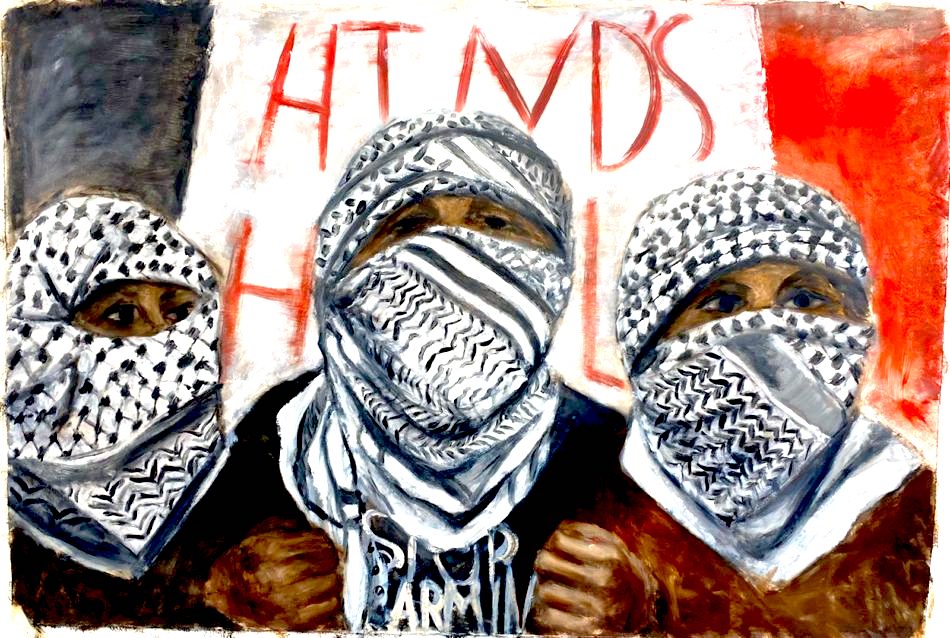
 In a chapter from Frantz Fanon’s Black Skin, White Masks (1952), called “The Fact of Blackness,” Fanon writes about the despair that racism produces, the immense anxiety about living in a world that has decided that certain people are simply not human or not sufficiently human.