| | |  | BY SAM STEIN | Presented by |  |
|
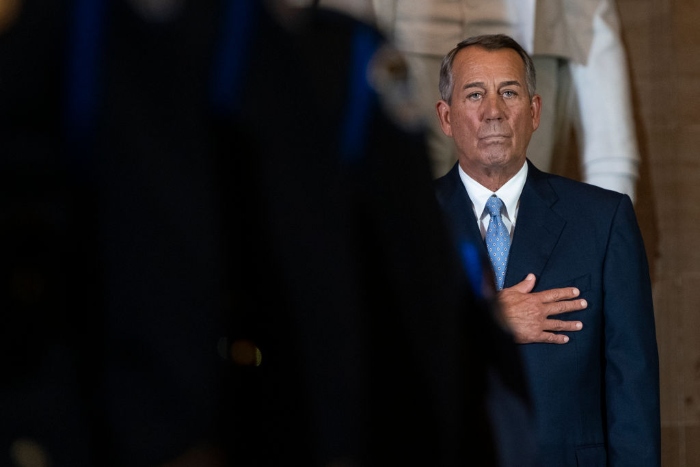
| With help from Renuka Rayasam and Myah Ward DECAFFEINATED — Top Republicans make no secret of their frustration in having Joe Biden as their foil. The president is well regarded by voters, a reputation that’s proved hard to dislodge, no matter his verbal flubs or big-spending policy pursuits. Even Donald Trump, the Triumph the Insult Comic Dog of electoral politics, has had troubles landing a punch. His latest nickname for the president — “Saintly Joe Biden” — was debuted to donors over the weekend. It was meant as derisive … we think. For the Republican Party, coming up with a quippy Biden moniker is a minor matter. The bigger one is figuring out how to mobilize against the Biden presidency. On this front, the GOP is stumbling too. Three months in, there is no grassroots movement emerging to confront the White House. And while it may seem painfully early to expect such things, by recent historical standards, it’s late. This very week in 2009, the Tea Party movement hosted a series of nationwide events around tax day attacking Barack Obama. It all seemed extremely quixotic at the time. Then press secretary Robert Gibbs claimed that Obama was unaware of it. But GOP leadership certainly was. John Boehner — who is currently on a book tour going off on several Tea Party lawmakers as “morons” — attended one such event in California. Michael Steele, the Republican National Committee chair at the time, asked activists to send one of four different “virtual tea bags” to Democratic leaders. By the end of the spring, the Tea Party movement was expanding its focus from bank bailouts to health care. Town halls became minefields for Democrats. It kept building through the midterms. Republicans who were there at the time say today’s landscape doesn’t lend itself to that kind of movement, for a variety of reasons. Biden’s perceived benignness — the difficulty in actually getting people to despise the guy — is just one of them. Former Gov. Mark Sanford of South Carolina (often described as a Tea Partier before the Tea Party existed) told Nightly that unlike in 2009, “You don’t have that anger bubbling up where people are agitated and mad” that the banks got off easy and politicians helped them. Even if they were mad right now, he added, there isn’t a logical vehicle through which they’d channel that feeling. “The Republican Party of late has lost its mind and lost its way,” Sanford said. “People who used to believe in some rock solid conservative ideas have bought into a cult of personality phenomenon with Trump and are less ideologically vocal than they were 10-plus years ago.” As Sanford sees it — and, keep in mind, he’s no Trump fan — a movement like the Tea Party emerges when people galvanize around ideas. When they galvanize around an individual, they’re really just waiting for that individual to act or guide them. Put another way: While the Tea Party exploited a GOP leadership vacuum in 2009, there is a need for a vacuum in 2021. That may very well be the gift that Trump has given Biden. As the former president sits in Mar-a-Lago, plotting his next move, he has brought stasis to the Republican Party. That’s plainly visible on the 2024 presidential plane. On Monday, one of the more likely Repulican candidates, former South Carolina Gov. Nikki Haley, skipped no beats when she said she would not run if Trump decided to. But it also is evident on the grassroots level. Jenny Beth Martin, who co-founded the Tea Party Patriots and was a delegate to the 2020 RNC convention, conceded that there wasn’t as much mobilization now compared to 12 years ago. She said the Covid pandemic was a big part of that, preventing conservatives from congregating, holding their own events or disrupting those of others. But implicit in her analysis was that Trump was still setting the direction for the activists. “He certainly is a leader and people are looking to him for leadership,” she said. The bigger tell came when she described what she called “the animating issue in the country” for her organization. “Faith in the elections,” she said, without skipping a beat. A group that was founded in opposition to government spending and higher taxation, which cut its teeth going after bank bailouts and health care overhauls, was now focused on recruiting poll watchers. Beth Martin described it as a logical extension of the organizational mission, that they were pushing back once more on government overreach, this time in local management of elections. Either way, it’s Trump’s brand of tea. Welcome to POLITICO Nightly. Reach out with news, tips and ideas for us at sstein@politico.com and rrayasam@politico.com, or on Twitter at @samstein and @renurayasam.
| |
A message from the SEIU: President Biden is investing $400 billion in care workers — largely women of color & immigrants working on the frontlines of this pandemic. We have a once-in-a-generation opportunity to create millions of sustainable union care jobs of the future. It’s time for Congress to pass President Biden’s jobs plan! Learn more | | | | | | 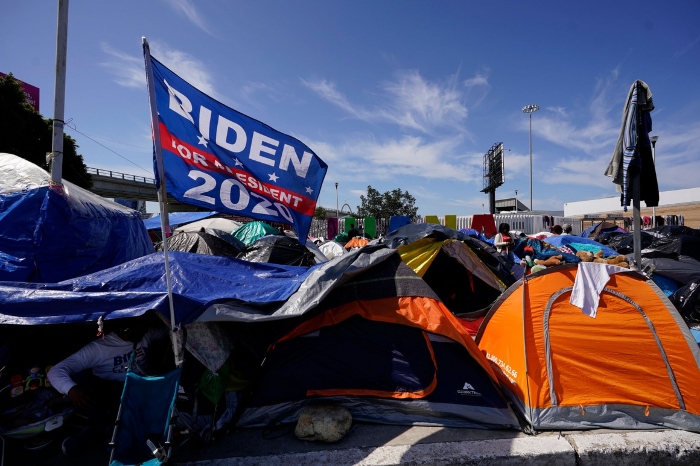
A campaign flag for President Joe Biden flies over tents at a makeshift camp of migrants at the border port of entry leading to the United States in Tijuana, Mexico. | AP Photo/Gregory Bull | ‘WE ARE HERE, ALL OF US, WAITING’ — In the weeks after Biden’s inauguration, migrants across the city of Tijuana began to leave the various shelters and apartments where they’d been living in favor of an open-air encampment just north of the city’s center. It’s not a cheerful place; people have little to eat and there’s no running water. But it has a crucial location: It’s right next to the El Chaparral Point of Entry, the nearest legal crossing into the United States. Anticipating that the doors to the U.S. might soon open, they set up at the very foot of the country’s entrance. In February, Rosemeri, an asylum seeker from El Salvador, said she pitched a tarp next to just two others. By early March, it had grown into a shantytown of more than 1,000 people, and today as many as 2,000 migrants — most of them families with children — brave the elements each day and night. Together, the makeshift community decided on a name for the tent city: La Esperanza, The Hope. Rosemeri, like most people in the camp, is not a new arrival to Tijuana. She left her home in El Salvador in 2019, fleeing threats against her life from the gang that controls her neighborhood. Her plan was to request asylum in the U.S. But by the time she arrived at the southern border last April, a month into the Covid pandemic, it had been closed indefinitely to asylum seekers by a Trump administration public health order. Since then, she and tens of thousands of others have had no choice but to wait in northern Mexico, shuffling from shelter to shelter for months, hoping for a change in policy. “We are Salvadorans, Hondurans, Haitians, Cubans, Mexicans, Nicaraguans,” she told Jack Hererra of the residents of La Esperanza. “We are here, all of us, waiting.” The early months of Biden’s administration have been shadowed by a major increase in immigration , with border agents encountering more than 100,000 people attempting to cross unauthorized in February and more than 170,000 in March, a 15-year high. Critics on the right blame the president’s welcoming rhetoric, saying that after Trump’s hardline tack toward the border, it’s no wonder migrants are rushing in under softer leadership. But migrants themselves have a very different view, Hererra writes in POLITICO Magazine: The issue isn’t Biden extending a hand; it’s that he hasn’t figured out what he wants to do — and has kept the legal pathway closed in the meantime.
| |
| | SUBSCRIBE TO "THE RECAST" TO JOIN AN IMPORTANT CONVERSATION: Power is changing, in Washington and across the country. More people are demanding a seat at the table, insisting that all politics is personal and not all policy is equitable. Our twice-weekly newsletter "The Recast” breaks down how race and identity are shaping politics and policy in America and we are recasting how we report on it. Get fresh insights, scoops and dispatches on this crucial intersection from across the country and hear from important new voices that challenge business as usual. Don't miss out, SUBSCRIBE . Thank you to our sponsor, Intel. | | | | | | | | 
| THE LONG GOODBYE — Biden announced today that the U.S. would withdraw all of its troops from Afghanistan by Sept. 11, 2021. The decision comes just weeks before a May 1 troop withdrawal deadline set by Trump and after an intelligence report dunked on the prospect of a peace deal between the Taliban and the Afghan government. Nightly’s Renuka Rayasam reached out to defense reporter Lara Seligman today over Slack to chat about what it means to end a forever war. This conversation has been edited. Seems like a lot of Republicans who supported Trump’s May 1 withdrawal are now criticizing Biden’s Sept. 11 deadline. The basic truth is that Biden’s Afghanistan policy is very much a continuation of Trump’s. One difference, though, that Republicans are pointing out is that the Trump agreement was supposedly based on conditions on the ground, i.e. if the Taliban did not meet certain requirements the withdrawal would not go forward. The Trump administration did not hold to this in practice (i.e. continuing the withdrawal despite spikes in violence and no progress in the intra-Afghan peace talks), but the principle was there. We’ve been in Afghanistan for two decades. People in college today don’t even have memories of how the war started in the first place. Few people do! I think that may be part of the thinking. The perception is that the war sucks up money and has not had much positive impact, though many soldiers and experts who have been on the ground there would dispute that — women have more rights and more children are in school today, for example. But more important, I think, is Biden’s personal belief that we should get out of Afghanistan, and more broadly that we should stay out of foreign wars and stop trying to nation-build. Is it inevitable that the Taliban will take over once the U.S. leaves? Militarily the Taliban has the upper hand and has been making gains in key urban populations in recent months. So to some extent it seems inevitable that the Taliban will become stronger. But on the other hand, the Taliban has shown that they want to be taken seriously on the world stage, no longer labeled as terrorists, and that they want to be a legitimate government. Perhaps they will have incentive to, if not compromise with the Afghan government, to at least govern with the needs of the people in mind. Ashraf Ghani’s government is seen as weak, and he will probably be forced to give up power, in my opinion. But that doesn’t automatically mean Afghanistan goes back to the way it was pre-9/11. Should we be worried about another attack on U.S. soil once Americans leave Afghanistan? People involved in the planning do not see a reason to be worried about another attack on the homeland, at least not yet. The concern is that once we leave, bad actors such as AQ and ISIS will seize the opportunity to use the vast ungoverned spaces in Afghanistan to recoup. The worry is more long term. Plus, the terrorist fight is global now. The military is fighting terrorists across the globe, from Africa to Afghanistan to Indonesia. If anything, the withdrawal could allow the U.S. to move the 3,500 troops in Afghanistan to other places in the world where they are more needed.
| |
| | A message from the SEIU:  
| | | | | ASK A DOCTOR: SHOULD I GET J&J? — Nightly’s Myah Ward emails: I know someone who’s scheduled to get the Johnson & Johnson vaccine Wednesday morning in North Carolina. Today’s news that the FDA and CDC recommended a pause in the use of J&J’s Covid vaccine rattled him a bit. He hasn’t received an email saying he would instead get a Pfizer or Moderna shot, and he hasn’t been told his appointment would be rescheduled. He’s a young man in his twenties who hasn’t had Covid. But he’s eager to get a jab as new variants attack younger, unvaccinated bodies across the country. So far, the CDC and FDA have recommended only a pause in the vaccine. And it seems that the blood clots have affected only women below 50. Should he still get the shot? I know my friend is not the only one facing a similar predicament, so I decided to call one of our go-to Nightly experts, Abraar Karan, an internal medicine physician at Harvard Medical School’s Brigham and Women’s Hospital, to discuss how to assess the risk. This conversation has been edited. Tell me what this pause means. We need to contextualize why the FDA and CDC would say to pause it. We need to study and understand a little bit better what the best way to look out for this is and what we should do to monitor and treat patients who have this. The vast majority of people will not have this extremely rare adverse event. If you’re a young, healthy male, like the person I mentioned above, how would you weigh the risks? You’re basically talking about less than a one in a million chance, just per what we know. Now it’s obviously possible that we could have more cases of this. And so what we’re faced with is a very, very low, extremely rare adverse event versus the chance of getting Covid. And from Covid, even if you say the case fatality rate is exceptionally low for a young, healthy man, we know there are other consequences, including long Covid symptoms or risk of transmission to others. And in many parts of the country, we still have thousands and thousands of cases in the community setting. It’s to be expected that you have an adverse event like this eventually. And that’s the entire point of having safety monitoring. I would say that the risk benefit still is in favor for a young, healthy person to get the vaccine. Would your perspective change if this was a woman in the scenario above? We’ve detected six cases, and we will detect more. The complication seems to occur a week to two weeks after the vaccine is given, and then you’d have to pick it up clinically. I would still say that the vast majority, we’re talking 99 percent, will not have this as a complication. And so I’d say that the risk benefit probably is still in favor of getting the vaccine. With that being said, if you’re somebody who’s largely staying at home and doesn’t have to be out in high-risk public settings, you wear a mask consistently, and you think you can get vaccinated soon with one of the mRNA vaccines that are not on pause, then the calculation becomes, Well if I can wait briefly, I will. Because there is a potential complication. But again, it’s extremely rare. Even though it’s a very rare complication, because it’s a serious complication, we’ll misattribute the probability of it happening to us. It’s a very well-known phenomenon that high-risk, low-probability events are ones that we overestimate the probability in our minds that it will happen to us.
| | | 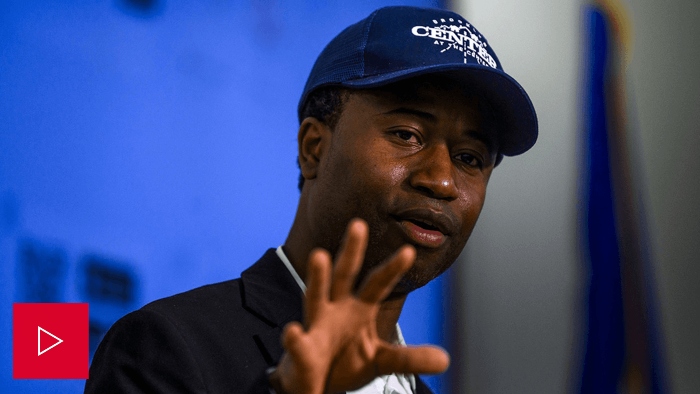
| — Mayor asks for Minnesota attorney general to take up Daunte Wright shooting case: The request from Brooklyn Center Mayor Mike Elliott is the latest development since Wright was killed on Sunday , sparking two consecutive nights of unrest in the Minneapolis suburb — a short distance from where George Floyd was killed by police last May and where former Minneapolis Police Officer Derek Chauvin is now standing trial on murder and manslaughter charges. — GOP edges back from filibuster on hate crimes bill: The bill, a modest piece of legislation from Sen. Mazie Hirono (D-Hawaii) aimed at addressing a spike in hate incidents against Asian Americans during the pandemic, has faced headwinds in the Senate as Republicans weigh whether to mount a formal filibuster. Ahead of a vote Wednesday on whether to open debate, some in the GOP argued that the bill is unnecessary and a potential government overreach, but following their weekly lunch meeting Republicans opened the door to beginning debate and amending the legislation. — Biden tells family of Capitol Police officer killed in car attack: ‘He’s in your blood’: Biden eulogized fallen Capitol Police Officer William “Billy” Evans at a memorial service in the Capitol Rotunda today, reflecting on his own personal tragedies as he sought to comfort Evans’ surviving wife and children. — IRS chief says some $1T in taxes going uncollected annually: IRS Commissioner Chuck Rettig’s estimate goes far beyond the official $441 billion difference between taxes paid and taxes owed annually, the so-called tax gap, reported by the IRS, which is based on figures from 2011-2013. The next official estimate will come out next year.
| | Nightly asks you: If you have been working remotely since the pandemic began last year, have you visited your office even once? Tell us what it was like. Use the form to send your answers, and we'll include select responses in Friday’s edition.
| |
| | YOUR GUIDE TO THE BIDEN ADMINISTRATION: As the Biden administration closes in on three months in office, what are the big takeaways? Will polls that show support for infrastructure initiatives and other agenda items translate into Republican votes or are they a mirage? What's the plan to deal with Sen. Joe Manchin? Add Transition Playbook to your daily reads for details you won't find anywhere else that reveal what's really happening inside the West Wing and across the executive branch. Track the people, policies and power centers of the Biden administration. Subscribe today. | | | | | | | | |
17 The number of members of New York’s 19-strong Democratic House delegation who said in a letter to House leaders today that they won’t back tax hikes to fund Biden’s infrastructure package without a full repeal of the $10,000 cap on state and local tax deductions. |
| | | TOUGH ADDRESS TO WRITE A LETTER TO — Facebook has 99 problems, and the French town of Bitche is one. According to local broadcaster Radio Mélodie, the Facebook page for the small town in northeastern Moselle was taken down on March 19, forcing Valérie Degouy, Bitche’s comms official, to create a new page on Monday named after its postal code: Mairie 57230. Degouy told Radio Mélodie on Monday that she appealed the decision the same day the town’s page was taken down, but hadn’t heard back from the tech giant. “I tried to reach out to Facebook in every possible way, through different forms, but there’s nothing [I could] do,” she said, adding that she had “already had issues when I first created the page.” Facebook restored the page after this article was published this morning. Another town in the region, Rohrbach-lès-Bitche, took preventive measures and renamed its page Ville de Rohrbach on Monday. “Facebook seems to be hunting a term associated with Rohrbach … we’ll let you imagine the reason,” the town said in a post announcing the move.
| |
A message from the SEIU: President Biden’s plan to invest $400 billion in essential care infrastructure is a commitment to America’s future. It means millions of good union jobs for women of color and immigrant workers. It means accessible and affordable home care for all families — so our parents, grandparents and people with disabilities can live at home with dignity and independence. It means thriving, resilient communities.
Congress must meet the president’s commitment to invest in care infrastructure and care workers as a cornerstone of the American economy. Learn more and join us! | | | Did someone forward this email to you? Sign up here. | |
|
| | Follow us on Twitter | | | FOLLOW US
|
| |