Monday, September 2, 2024

Informed Comment daily updates (09/02/2024)


Massive Demonstrations, National Strike in Israel as Crowds blame PM Netanyahu for deaths of Hostages

Massive Demonstrations, National Strike in Israel as Crowds blame PM Netanyahu for deaths of Hostages

Ann Arbor (Informed Comment) – Basil Maghrebi at the Israeli newspaper Arab 48 reports that tens of thousands of Israelis participated on Sunday evening in massive demonstrations unprecedented since the October 7 Hamas terrorist attack, especially in Tel Aviv and Jerusalem. They were demanding a deal of the exchange of hostages that would lead to […]

Climate Change has deep historical Roots – Amitav Ghosh explores how Capitalism and Colonialism fit in

Climate Change has deep historical Roots – Amitav Ghosh explores how Capitalism and Colonialism fit in

By Julia Taylor, University of the Witwatersrand and Imraan Valodia, University of the Witwatersrand | – (The Conversation) – Amitav Ghosh is an internationally celebrated author of 20 historical fiction and non-fiction books. The Indian thinker and writer has written extensively on the legacies of colonialism, violence and extractivism. His most famous works explore migration, […]

200 UN Teams Begin Drive to immunize 600K Palestinian Children in Gaza, Warn that Ceasefire is Essential

200 UN Teams Begin Drive to immunize 600K Palestinian Children in Gaza, Warn that Ceasefire is Essential

UN News reports that the initial stage of a UN-led polio immunization initiative commenced Sunday in the central regions of Gaza. The undertaking aims to vaccinate 600,000 youngsters in the upcoming days. To curb the polio outbreak in Gaza and avert an international spread of the virus, health workers need to immunize at least 90 […]

Old posts you may have missed

India outstrips Japan in Solar Energy

Tech Giants criticized for Silencing Pro-Palestinian Narratives

Is Iran’s anti-Israel and -American Rhetoric all Bark and no Bite?

Israeli PM Netanyahu says Recovering Hostages not a Priority, Occupies Philadelphi Corridor Instead

Lebanon has made Survival an Art Form, after decades of War and Unrest

Rebuking New York University for trying to Outlaw Criticism of Israel by Conflating Zionism with Judaism

Muslims’ favorability Rating Falls this Year among Americans, as Gaza casts a Shadow and Biden spreads Misinformation

200 UN Teams Begin Drive to immunize 600K Palestinian Children in Gaza, Warn that Ceasefire is Essential


Health Care

200 UN Teams Begin Drive to immunize 600K Palestinian Children in Gaza, Warn that Ceasefire is Essential

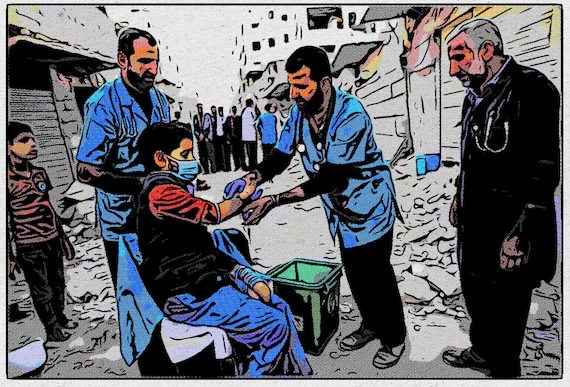
UN News reports that the initial stage of a UN-led polio immunization initiative commenced Sunday in the central regions of Gaza. The undertaking aims to vaccinate 600,000 youngsters in the upcoming days. To curb the polio outbreak in Gaza and avert an international spread of the virus, health workers need to immunize at least 90 percent of children in each round.

Although Israeli authorities pledged to implement pauses in fighting in vaccination hubs, UN officials say that these measures are insufficient and that a more extensive pause in fighting or even a ceasefire is necessary to safeguard the lives of the vaccination workers and of the parents and children lining up for the shots.

The campaign will be executed in phases, spanning three days each, and covering three different areas of Gaza. Vaccination coverage will be tracked and analyzed daily, and the vaccination drives will be extended by an additional day if required. The Middle East Monitor writes, “Richard Peeperkorn, the WHO’s representative in the occupied Palestinian territories, stated that the polio vaccination campaign would consist of ‘two rounds.'”

Speaking to global media on Sunday, Sam Rose, a spokesperson for UNRWA, the UN agency for Palestinian refugees, announced that over 200 teams are delivering the vaccine in 25 locations across the central regions of Gaza, in a race against time.

MEMO adds, “The WHO announced that the vaccination campaign in Deir al-Balah, located in central Gaza, would continue until Sept. 4. In Khan Younis, a city in southern Gaza where Israeli attacks continue, the polio vaccination campaign for children under 10 began Saturday evening.”

UNRWA posted on “X”:

    Today, our teams went to @unrwa health centres, mobile medical points and tent to tent to provide #polio vaccinations to children in the middle area of the #GazaStrip

    Tomorrow, they will do the same.

    We are doing everything possible to help all children under 10 years of age receive the vaccination.

    Temporary area pauses are critical to provide these vaccinations. Beyond the pause, these children need a long overdue #Ceasefire

Numerous Gazan families have been lining up to await their children’s turn to receive a polio immunization since early Sunday morning, in a campaign that aims to halt the resurgence of a virus driven by unsanitary conditions.


“Gaza Vaccination,” Digital, Dream / Dreamworld v3 / Clip2Comic, 2024

Responding to the launch on social media, Philippe Lazzarini, the head of UNRWA, wrote at “X”:

    ““I am relieved” says a mother in #Gaza after her baby girl receives the two drops of vaccines in @UNRWA
    clinic. 1st phase of the #polio campaign kicks off in the middle areas.

    This is a race against time to reach just over 600,000 children across the Gaza Strip in the coming days.

    For this to work, parties to the conflict must respect the temporary area pauses. For the sake of children across the region a lasting ceasefire is overdue.”

The vaccination effort – orchestrated by UNRWA, the World Health Organization (WHO), the UN Children’s Fund (UNICEF), and the Palestinian Ministry of Health – will proceed in the forthcoming days if the temporary ceasefire between Hamas and Israeli forces endures.

The head of the World Health Organization posted at “X,”

About the Author

Juan Cole is the founder and chief editor of Informed Comment. He is Richard P. Mitchell Professor of History at the University of Michigan He is author of, among many other books, Muhammad: Prophet of Peace amid the Clash of Empires and The Rubaiyat of Omar Khayyam. Follow him on Twitter at @jricole or the Informed Comment Facebook Page


INFORMED COMMENT

Climate Change has deep historical Roots – Amitav Ghosh explores how Capitalism and Colonialism fit in


Climate Crisis

Climate Change has deep historical Roots – Amitav Ghosh explores how Capitalism and Colonialism fit in

By Julia Taylor, University of the Witwatersrand and Imraan Valodia, University of the Witwatersrand | –

(The Conversation) – Amitav Ghosh is an internationally celebrated author of 20 historical fiction and non-fiction books. The Indian thinker and writer has written extensively on the legacies of colonialism, violence and extractivism. His most famous works explore migration, globalisation and commercial violence and conquest during the colonial period, against the backdrop of the opium trade in the 1800s.

Caroline Southey, from The Conversation Africa, asked economics professor Imraan Valodia and climate and inequality researcher Julia Taylor about the significance of his work.

What has Ghosh contributed to our understanding about the root causes of climate change?

Julia Taylor: In Ghosh’s recent non-fiction book, The Nutmeg’s Curse: Parables for a Planet in Crisis, he used his storytelling prowess to outline the roots of climate change within two systems of power and oppression: imperialism and capitalism.

Imperialism is the expansion of influence over other countries through military force and colonisation. It usually entails the destruction of the environment to support imperial interests.

Capitalism is the dominant economic system where ownership of the means of production (industry) is private. Private actors are driven by profit and growth, which has relied on combustion of fossil fuels.

What Ghosh makes clear is that violence and destruction of the environment are key to capitalism, as they were to colonialism.

Imraan Valodia: Ghosh challenges us to think more deeply about the role of conquest and violence in shaping the planetary crisis we’re facing. And the need to reshape our economic and social relations to address climate change. He does this with remarkable acumen and clarity in another of his works of non-fiction, The Great Derangement. In the book he seeks to explain our failure to address the urgency of climate change. He asks very powerfully whether the current generation is deranged by our inability to grasp the scale, violence and urgency of climate change.

He uses the history of nutmeg to illustrate some of his main points. What does he draw from this history?

Julia Taylor: The story of the nutmeg is one among many of conquest of both people and land during colonisation which led to the industrial revolution and the explosion of greenhouse gas emissions.

In the present day these conquests take different forms. But they continue, particularly in the context of mining and extractivism.
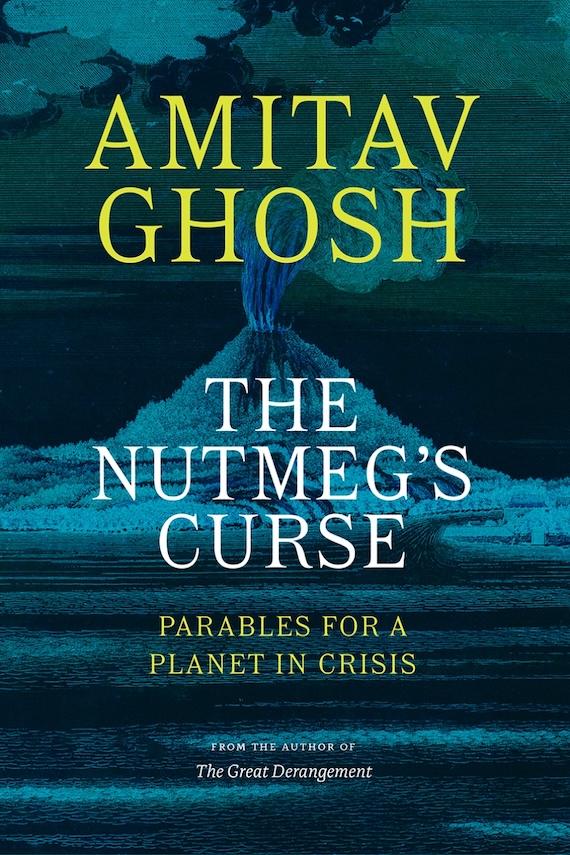

Amitav Ghosh, The Nutmeg’s Curse: Parables for a Planet in Crisis. The University of Chicago Press. Click here to Buy.

Imraan Valodia: Ghosh traces the history of the household spice – nutmeg – all the way to its origins in the Banda Islands of Indonesia. He uses the analogy of the nutmeg to explain how colonisation of land and people has led to the climate disaster.

The nutmeg was harvested from trees in the Banda Islands and traded by the Bandanese for centuries. With the growth in value of spices, various European countries sought to claim exclusive rights to the nutmeg trade in the Banda Islands. The local population resisted. However, in 1621, representatives of the Dutch East India Company chose to destroy the settlements of the Bandanese population and massacre or enslave anyone who could not escape, to gain control over the nutmeg trade.

Ghosh explains these horrifying events in the context of Anglo-Dutch tensions and the trend of empire in Europe, sanctioned by religious beliefs of racial superiority.

A major theme of his work is the link between imperialism and the planetary crisis. What’s his main line of argument?

Julia Taylor: Ghosh argues in The Nutmeg’s Curse: Parables for a Planet in Crisis that

the discussion of climate change, as of every aspect of the planetary crisis, tends to be dominated by the question of capitalism and other economic issues; geopolitics, empire, and questions of power figure in it far less. (p116)

However, he highlights that

the era of Western military conquests predates the emergence of capitalism by centuries. Indeed, it was these conquests, and the imperial systems that arose in their wake, that fostered and made possible the rise to dominance of what we now call capitalism … colonialism, genocide and structures of organised violence were the foundations on which industrial modernity was built. (p116)

Imraan Valodia: This argument forces us to grapple with both capitalism and the dominance of the west in our understanding of climate change. It highlights the power dynamics and violence which enabled the destruction of many lands in the form of deforestation, industrial agriculture, mining and more.

To respond to climate change, we need to rethink these dominant systems and relationships with land and the environment. This can be linked to the need to address inequality and power dynamics if we are to have any hope of addressing climate change.

Professor Valodia will be hosting Amitav Ghosh for a series of events at the University of the Witwatersrand in South Africa from 10 to 12 September 2024. The university has partnered with the Presidential Climate Commission, the Wits Institute for Social and Economic Research (WiSER) and the University of Pretoria to host the sessions.

Julia Taylor, Researcher: Climate and Inequality, University of the Witwatersrand and Imraan Valodia, Pro Vice-Chancellor: Climate, Sustainability and Inequality and Director: Southern Centre for Inequality Studies., University of the Witwatersrand

This article is republished from The Conversation under a Creative Commons license. Read the original article.

About the Author

The Conversation is an independent, not-for-profit media outlet that works with academic experts in their fields to publish short, clear essays on hot topics.


INFORMED COMMENT

Massive Demonstrations, National Strike in Israel as Crowds blame PM Netanyahu for deaths of Hostages


Featured

Massive Demonstrations, National Strike in Israel as Crowds blame PM Netanyahu for deaths of Hostages

Ann Arbor (Informed Comment) – Basil Maghrebi at the Israeli newspaper Arab 48 reports that tens of thousands of Israelis participated on Sunday evening in massive demonstrations unprecedented since the October 7 Hamas terrorist attack, especially in Tel Aviv and Jerusalem. They were demanding a deal of the exchange of hostages that would lead to the release of the nearly 100 Israeli hostages in the hands of Hamas, only 60 or so are thought to remain alive.

Israel’s most powerful labor union, Histadrut, announced a national strike for Monday, beginning some labor stoppages as early as Sunday evening. Some retail chains also said they would close in support of the families of the hostages. Ben Gurion International Airport will close, as will schools and universities. Opposition leader Benny Gantz supported closing down the economy in protest.

(The furor was provoked by the discovery of the bodies of six Israeli hostages in Gaza by Israeli troops on Saturday night. Three of them had been designated as part of a hostage exchange with Hamas that the Hamas leadership had agreed to on August 3, but in the implementation of which Israeli Prime Minister Benjamin Netanyahu had placed obstacles. Among them were his military occupation of the Philadelphi Corridor just south of the Rafah crossing into Egypt, which is an Egyptian prerogative, and to which Hamas objected. Many Israelis believe that if Netanyahu had accepted the hostage deal in early August, the six who were killed on Saturday would still be alive. It is alleged that an Israeli military unit was approaching a Hamas hideout where the hostages were being kept, and that Hamas terrorists killed them before fleeing. Israeli reporter Noga Tarnopolsky wrote, “Now it’s official, @IDFSpokesperson
confirms hostages Hersh Goldberg-Polin, 23; Eden Yerushalmi, 24; Ori Danino, 25; Alex Lubanov, 32; Carmel Gat, 40; and Almog Sarusi, 25, ‘were murdered by their Hamas captors a short time before being located by IDF forces in Gaza yesterday.'”)

Arab 48 reports that The Crowd Solutions firm estimated that 280,000 demonstrators came out Sunday evening in Tel Aviv alone.

Some 100,000 protesters in Tel Aviv closed Kaplan Street for several hours. Others stopped traffic on the Ayalon Highway, a freeway in Tel Aviv, until police reopened it. Some of the protesters were families whose members are held hostage in Gaza. In Jerusalem, demonstrators rallied in front of the prime minister’s residence and then completely closed an entrance to the city for two hours. Police sprayed them with water canons and arrested 5. In Beersheba crowds closed off the city’s central street, and protesters came out in Rehovot (12 miles south of Tel Aviv) and in Karmiel north of Akka.

Al Jazeera English Video: “Israelis hit the streets en masse to demand captive deal”

One of the protesters, a woman, mocked Netanyahu’s attempt to blame Hamas. He had said, “Whoever wants a deal doesn’t kill hostages.” But the demonstrator said he was speaking of himself, not Hammas, and was speaking of his cabinet members who voted, she alleged, to sacrifice the hostages. She underscored that “it was possible to get them back home alive.” She added, “The Israeli government and its leader deliberately sacrificed the hostages, leading to their deaths.” She pointed out that the six hostages had been left there eleven months, and killed only a week ago. The hostage families said they want a deal “now!”

Arab 48 reports, that Israeli Finance Minister Bezalel Smotrich threatened to “reduce the area of ​​the Gaza Strip and cleanse the area two kilometers deep along the Strip.”

Netanyahu pledged he would make the Hamas fighters pay the price for killing the hostages.

Hamas for its part falsely alleged that the hostages were killed by Israeli fire. (The bodies showed that they were executed at short range.) The terrorist organization said that if US President Joe Biden really cared about the lives of the hostages he would pressure the Israeli government for an immediate end to its war on Gaza.

Hamas had previously announced that heavy Israeli bombardment of Gaza had resulted in the deaths of hostages.

Members of the Hamas al-Qassam Brigades and of the Palestinian Islamic Jihad mowed down over 600 innocent civilians on October 7, 2023, and abducted 251 persons, mostly civilians. During a temporary ceasefire last fall, Hamas released 117 of the hostages.

About the Author

Juan Cole is the founder and chief editor of Informed Comment. He is Richard P. Mitchell Professor of History at the University of Michigan He is author of, among many other books, Muhammad: Prophet of Peace amid the Clash of Empires and The Rubaiyat of Omar Khayyam. Follow him on Twitter at @jricole or the Informed Comment Facebook Page


INFORMED COMMENT

Trump Supporter Realizes He Looks STUPID In Real-Time

290
Mondale Robinson

by Rebel HQ 


Rebel HQ

961K subscribers


Morning Digest: California voters could make major changes to recall elections this fall

                                                                   LOTS OF POSTS IGNORED BY BLOGGER..... OR REMOVED ON THEIR WHIM! ALL POSTS...