In a wide-ranging conversation at his compound in Kyiv, Ukrainian President Volodymyr Zelensky tells The Atlantic what Ukraine needs to survive—and describes the price it has paid.
Kyiv is halfway normal now. Burnt-out Russian tanks have been removed from the roads leading into the city, traffic lights work, the subway runs, oranges are available for purchase. A cheerful balalaika orchestra was performing for returning refugees at the main rail station earlier this week, on the day we arrived to meet Volodymyr Zelensky, the president of Ukraine.
The normality is deceiving. Although the Russians botched their opening campaign, they continue to bombard the capital and are now gathering in the east for a renewed attack on Ukraine. Zelensky has to prepare his country, and the world, for battles that could be deadlier than anything seen so far. The general in charge of the defense of Kyiv, Alexander Gruzevich, told us during a tour of the ravaged northwestern suburbs that he expects the Russians to try to return to the capital using intensified “scorched earth” tactics along the way: total destruction by ground artillery and air strikes, followed by the arrival of troops.
When we met Zelensky in Kyiv on Tuesday night, he told us the same thing: The optimism that many Americans and Europeans—and even some Ukrainians—are currently expressing is unjustified. If the Russians are not expelled from Ukraine’s eastern provinces, Zelensky said, “they can return to the center of Ukraine and even to Kyiv. It is possible. Now is not yet the time of victory.” Ukraine can win—and by “win,” he means continue to exist as a sovereign, if permanently besieged, state—only if its allies in Washington and across Europe move with alacrity to sufficiently arm the country. “We have a very small window of opportunity,” he said.
It was late in the evening when we met Zelensky at his compound. The surrounding streets were barricaded and empty, the building itself almost entirely blacked out. Soldiers with flashlights led us through a maze of sandbagged corridors to a harshly lit, windowless room adorned only with Ukrainian flags. There was no formal protocol, no long wait, and we were not told to sit at the far end of an elongated table. Zelensky, the comedian who has become a global icon of freedom and bravery, entered the room without fanfare.
“Hi!” he said, brightly, and then proceeded to complain about his back. (“I have a back, and that’s why I have some problems, but it’s okay!”) He thanked us for not filming the interview: Even though he’s been a professional television performer for all of his adult life, it’s a relief to occasionally go unfilmed.
On or off camera, Zelensky conducts himself with a deliberate lack of pretense. In a part of the world where leadership usually implies stiff posture and a pompous manner—and where signaling military authority requires, at a minimum, highly visible epaulets—he instead evokes sympathy and feelings of trust precisely because he sounds, in the words of a Ukrainian acquaintance, “like one of us.” He is a kind of anti-Putin: Rather than telegraphing a cold-eyed, murderous superiority, he wants people to understand him as an Everyman, a middle-aged dad with a bad back.
We started the interview by reminding Zelensky, the Jewish president of a mostly Orthodox Christian and Catholic country, that his words were going to appear on Good Friday on the Western calendar and just before the first seder of Passover, a holiday that marks the liberation of an enslaved nation from an evil dictator.
“We have pharaohs in neighboring countries,” Zelensky said, smiling. (The Belarusian president, Alexander Lukashenko, is, in the minds of many Ukrainians, a sort of deputy pharaoh to Putin.) But although Ukrainians face a formidable enemy, they are not longing for an exodus: “We’re not going anywhere.” Nor does Zelensky plan to spend 40 years wandering in the desert. “We already have 30 years of our independence. I would not want us to fight for our independence for another 10 years.”
Russia’s invasion has caused him to doubt whether it is still possible to associate religion with morality. “I do not understand when religious representatives of Russia”—here he meant the pro-Putin patriarch of the Russian Orthodox Church—“say they are faithfully empowering soldiers to kill Ukrainians.” Worse, “I cannot understand how a Christian country, the Russian Federation, with the largest Orthodox community in the world, will be killing people on these very days.” During the Easter season, the Russians are planning “a great battle in Donbas,” the Russian-occupied region in Ukraine’s far east. “This is not Christian behavior at all, as I understand it. On Easter they will kill, and they will be killed.”
As a result, many Ukrainians are going to spend the holy season under siege, hiding in basements. Others will not live to see the holiday at all. Just a few hours ago, early Friday morning, Russian bombs struck Kyiv again. “Ukraine is definitely not in the mood for celebration,” Zelensky said. “People usually pray for the future of their families and their children. I think that today they will pray for the present, just to save everyone.”
Much of Zelensky’s time is spent on the telephone, on Zoom, on Skype, answering the questions of presidents and prime ministers—often the same questions, repeated to a maddening degree. “I like new questions,” he said. “It’s not interesting to answer the questions you already heard.” He is frustrated, for instance, by repeated requests for his wish list of weapons systems. “When some leaders ask me what weapons I need, I need a moment to calm myself, because I already told them the week before. It’s Groundhog Day. I feel like Bill Murray.”
He says he has no choice but to keep trying. “I come and say that I need this particular weapon. You have it and here it is; we know where it is stored. Can you give it to us? We can even fly our own cargo planes and pick it up; we can even send three planes per day. We need armored vehicles, for example. And not one per day. We need 200 to 300 per day. These aren’t personal taxis, just for me; our soldiers need transport. Flights are available, the whole thing can be organized, we can do all the logistics.”
Later that night, one of Zelensky’s advisers texted us with a list of what, exactly, Ukraine needs to repel the invasion from the east:
Artillery, 155 millimeters
Artillery shells, 152 millimeters as many as possible
Multiple Launch Rocket Systems (“Grad”, “Smerch”, “Tornado” or M142 HIMARS)
Armored vehicles (armored personnel carriers, infantry fighting vehicles, others)
Tanks (T-72 tanks or similar tanks from the USA or Germany)
Air defense systems (S-300, “BUK” or western equivalents)
Military aircraft—MUST HAVE—to deblock our cities and save millions of Ukrainians as well as millions of Europeans)
It’s not that the various presidents and prime ministers who profess sympathy for the Ukrainian cause don’t want to help, Zelensky said: “They are not against us. They just live in a different situation. As long as they have not lost their parents and children, they do not feel the way we feel.” He makes the comparison to the conversations he has with the extraordinary defenders of Mariupol, the besieged port city where 21,000 civilians may have been killed so far. “For example, they say, ‘We need help; we have four hours.’ And even in Kyiv we don’t understand what four hours are. In Washington for sure they can’t understand. However, we are grateful to the U.S., because the planes with weapons are still coming.”
Zelensky’s chief of staff, Andriy Yermak, spoke with us later that evening, and also expressed his confusion about the pace at which the Biden administration moves. Washington is providing new weapons every day, and President Joe Biden just made an additional $800 million commitment to the defense of Ukraine. Yermak told us that he and Zelensky have strong relationships with many key American players—a break from the previous administration, which withdrew its ambassador just before Donald Trump’s “perfect phone call” with Zelensky (the call that triggered the first impeachment) and never replaced her. Biden, Yermak said, is “a man who can be trusted, not just a politician.” He had compliments for the secretaries of state and defense, and for leaders of Congress. And he praised Biden’s national security adviser, Jake Sullivan: “There is not a single minute when we did not speak specifically or in substance,” he said.
So everybody is great, but the weapons don’t come fast enough?
“Please tell me with whom else I should speak,” Yermak said.
Zelensky understands that his task is not merely to issue weapons requests and express urgency, but also to overcome old stereotypes of Ukraine as corrupt and incompetent, as well as the Russian propaganda that denies Ukraine the right to statehood. He wants to present an image of Ukraine as a modern and liberal state, one unified by a civic, as opposed to a purely ethnic, nationalism.
“The U.S., Britain, the EU, and European countries have always been skeptical of our development, of our ‘Europeanness,’” he said. But now “many of them have changed their view of Ukraine and see us as equals.” He has no time at all for international institutions. When he is asked about the role of the United Nations in defending Ukraine, one of its member states, from Russia, a member of the UN Security Council, he rolls his eyes and grimaces tragicomically. “Good thing we don’t have a video,” he says. “Just describe with words what you see on my face.” Both Zelensky and Yermak have been thinking and talking about what alternative international institutions might look like. Perhaps there should be a list of human-rights violations or war crimes that trigger automatic responses, Yermak suggested to us. Right now, the process of issuing statements, announcing sanctions, providing responses of any kind is too complex, too bureaucratic, and above all too slow.
But if Western leaders can frustrate Zelensky, Russians send him careering toward despair. He has, from time to time since the war began, spoken in Russian and addressed Russian audiences, something he is accustomed to doing: It’s what he once did for a living. His film and television production company was one of the biggest in the region, with an office in Moscow and viewers across the former Soviet Union.
His productive relationship with Russia and Russians came to an end in 2014, when people he had known for years stopped talking to him: “I just did not expect that people, a lot of partners, acquaintances—I thought they were friends, but they were not—just stopped picking up the phone.” Since then, many people he knows have changed, “become more brutal.” As Russia has shut down alternatives to state media—closing independent newspapers, television channels, and radio stations—Zelensky has found that his old acquaintances retreated further. “Even that small share of intelligent people, which was there, began to live in this informational bubble,” and he finds it very difficult to break through. “It’s the North Korean virus. People are getting absolutely vertical integrated messages. People don’t have any other way; they live in it.” He is clear about the author of the messages: “Putin has invited people into this information bunker, so to speak, without their knowledge, and they live there. It is, as the Beatles sang, a yellow submarine.”
Now, as Russian propaganda grows more baroque, he sometimes has trouble knowing how to process it. Perhaps that’s why he often leans on pop-cultural analogies: “The way they say that we’re eating people here, that we have killer pigeons, special biological weapons … They make videos, create content, and show Ukrainian birds supposedly attacking their planes. Putin and Lukashenko—they make it sound like some kind of political Monty Python.”
If Ukraine is to have a secure future, he says, the Russian information barrier will have to be broken. Russians don’t just need access to facts; they need help understanding their own history, what they have done to their neighbors. At the moment, Zelensky says, “they are afraid to admit guilt.” He compares them to “alcoholics [who] don’t admit that they are alcoholic.” If they want to recover, “they have to learn to accept the truth.” Russians need leaders they choose, leaders they trust, “leaders who can then come in and say, ‘Yes, we did that.’ That’s how it worked in Germany.”
Throughout the conversation, Zelensky displayed his gifts for spontaneity, irony, and sarcasm. He didn’t tell jokes, exactly, but he said that he cannot part with humor altogether. “I think that any normal person cannot survive without it. Without a sense of humor, as surgeons say, they would not be able to perform surgeries—to save lives and to lose people as well. They would simply lose their minds without humor.”
The same is true now for Ukrainians: “We can see what a tragedy we have, and it’s hard to live with it. But you have to live with it … You can’t be serious about what Russian politicians and Lukashenko say every day. If you take it seriously, you might as well go and hang yourself.”
Is Putin afraid of humor?
“Very much so,” Zelensky said. Humor, he explained, reveals deeper truths. The famous television series in which Zelensky starred, Servant of the People, mocked the pomposity of Ukrainian politicians, attacked corruption, and presented the little guy as a hero; many of his sketches were clever satires of political leaders and their attitudes. “Jesters were allowed to tell the truth in ancient kingdoms,” he said, but Russia “fears the truth.” Comedy remains “a powerful weapon” because it is accessible. “Complex mechanisms and political formulations are difficult for humans to grasp. But through humor, it’s easy; it’s a shortcut.”
Humor in Ukraine is now mainly of the darkest kind. At certain moments, Zelensky appeared stunned by the cruelty of it all. He tried to explain why he cannot feel—why most Ukrainians cannot feel—much sense of satisfaction in their underdog battlefield victories. Yes, they expelled the mighty Russian army from the northern part of the country. Yes, they killed, by their count, more than 19,000 Russian soldiers. Yes, they claim to have captured, destroyed, or damaged more than 600 tanks. Yes, they say they’ve sunk the flagship of the Russian Black Sea Fleet. Yes, they changed the image of their country, and their understanding of themselves. But the price has been colossal.
Too many Ukrainians, Zelensky told us, died not in battle, but “in the act of torture.” Children got frostbite hiding in cellars; women were raped; elderly people died of starvation; pedestrians were shot down in the street. “How will these people be able to enjoy the victory?” he asked. “They will not be able to do to the Russian soldiers what [the Russians] did to their children or daughters … so they do not feel this victory.” Real victory, he said, will come only when the perpetrators are tried, convicted, and sentenced.
But when will that be? “How long do we have to wait? It’s a long process, these courts, tribunals, international courts.”
Abruptly, he made it personal. He has two children, he reminded us. “My daughter is almost 18. I don’t want to imagine, but if something had happened to my daughter, I would not have been satisfied if the attack had been repelled and the soldiers had run away,” he said. “I would have looked for these people and I would have found them. And then I would feel victory.”
What would he have done when he found them?
“I don’t know. Everything.”
Then, as if remembering the role history has given him, as an avatar of democratic civilization confronting the cruelty of a lawless regime, he became reflective. “You realize that you want to be a member of a civilized society, you have to calm down, because the law decides everything.”
But he feels, viscerally, what so many Ukrainians feel. “There will be no complete victory for people who lost their children, relatives, husbands, wives, parents. That’s what I mean,” he said. “They will not feel the victory, even when our territories are liberated.”
New research sheds light on the Global Climate Coalition’s efforts to block legislation.
In 1989, just as leaders around the world were starting to think seriously about tackling global warming, the National Association of Manufacturers assembled a group of corporations — utilities, oil companies, automakers, and more — united by one thing: They wanted to stop climate action. It was called, in Orwellian fashion, the Global Climate Coalition.
With 79 members at its height in 1991, the coalition helped lay the groundwork for efforts to delay action on climate change for decades to come. It would not just deny the science, but also argue that shifting away from fossil fuels would hurt the economy and the American way of life. The coalition lobbied key politicians, developed a robust public relations campaign, and gave industry a voice in international climate negotiations, all to derail efforts to limit carbon emissions. Its arguments were so successful that they’re still employed today, or, more perniciously, simply taken for granted.
“This was all developed in the 1990s, and we can prove it,” said Robert Brulle, a sociologist at Brown University. In a new paper published in the peer-reviewed journal Environmental Politics, Brulle details the untold history of corporate America’s earliest efforts to block climate legislation, supported by recently uncovered documents.
Based on conversations with lawyers, Brulle believes his report could be helpful in lawsuits to hold corporations responsible for heating up the planet. “It would be used to basically document that this has been a long-term, corporate objective and that they should be held liable for the damages — that their political actions resulted in the fact that we didn’t deal with climate change,” he said.
Before the Global Climate Coalition formed in 1989, chemical companies had been ordered to phase out substances that were damaging the ozone layer under the Montreal Protocol, signed by the United States in 1987. They hoped to avoid a repeat with carbon dioxide. In the summer of 1988, James Hansen, then the NASA Administrator, had testified before Congress, raising the alarm that the “greenhouse effect” was already having discernible effects, with much worse to come.
The Global Climate Coalition wasn’t the only organization trying to thwart climate action in the late 1980s. There was the similarly named Global Climate Council and the International Petroleum Industry Environmental Conservation Association led by Exxon — but it was the first and largest to do so. The coalition included oil giants like Shell and Chevron as well as other companies that had a stake in keeping fossil fuels alive, such as the railroads that transported coal and the steelmakers that used it in production. Utilities like Duke Power Company were heavily dependent on coal and made up the biggest share of members. General Motors, Ford, and Chrysler manufactured internal combustion engines that ran on petroleum, so they joined the coalition, too. The roster also included the National Mining Association, Dow Chemical Company, and the U.S. Chamber of Commerce.
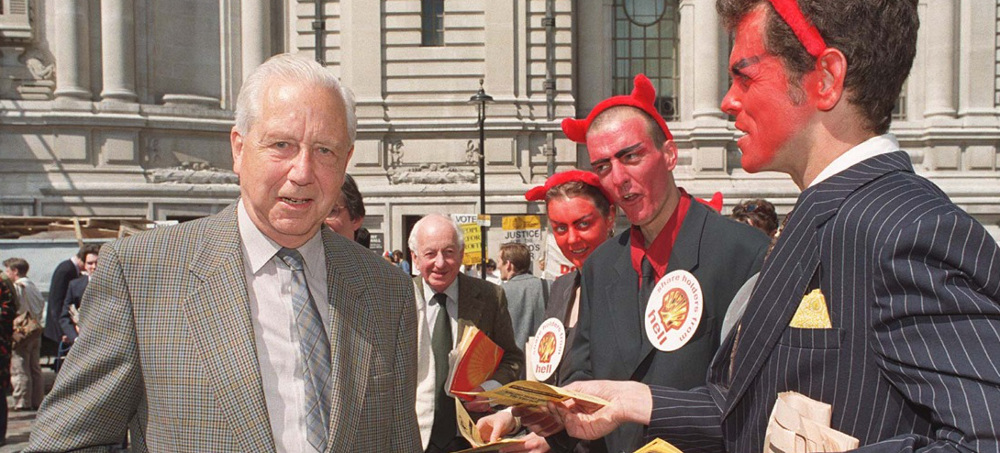
A newly unearthed, undated document from E. Bruce Harrison — a public relations expert who helped the coalition tailor its messages to avoid environmental regulations — describes how the Global Climate Coalition’s “aggressive campaign” influenced the debate and watered down policies. Brulle calls it a “brag sheet.”
“GCC has successfully turned the tide on press coverage of global climate change science, effectively countering the ecocatastrophe message and asserting the lack of scientific consensus on global warming,” Harrison wrote.
He claimed that the coalition had “actively influenced” congressional debates over carbon taxes to avoid “strict energy taxes,” and had affected the Clinton administration’s decision “to rely on voluntary (rather than mandatory) measures” to reduce emissions in its 1993 National Action Plan, required under an international climate treaty hashed out in Rio de Janeiro the year before. The Global Climate Coalition had influenced the Rio treaty, too — a National Association of Manufacturers business activity report in 1992 congratulated itself on a “strong and effective presence” during the Rio negotiations and celebrated that the final product did not include binding emissions reductions.
The new documents show how close the international community came to regulating carbon emissions. At the first Conference of Parties in Berlin in 1995, for instance, world leaders agreed to institute mandatory emissions requirements in two years. Corporations saw this as an impending disaster. “Dozens of UN agencies, international organizations and environmental special interest groups are driving events — regardless of economic costs and remaining scientific uncertainties — toward a conclusion that is inimical to the interests of the GCC and the U.S. economy,” read the coalition’s communications plan for 1994-1995.
In 1997, the coalition worked with Senators Robert Byrd, a Democrat from West Virginia, and Chuck Hagel, a Republican from Nebraska, to pass an amendment setting strict criteria for an international climate accord. The Senate unanimously supported the resolution, which stipulated that any agreement would need to include emissions reductions from developing countries (a nonstarter for international negotiations) and could not cause serious harm to the U.S. economy. It was essentially a rejection of the Kyoto Protocol, which would have required countries to cut carbon emissions to 5 percent below 1990 levels by 2012. The treaty was signed by President Bill Clinton in 1997, but the Senate refused to ratify it, and President George W. Bush withdrew from the accord after he took office in 2001.
A few months later, White House staff met with the Global Climate Coalition and congratulated the corporate group. “POTUS rejected Kyoto, in part, based on input from you,” said the talking points prepared for Paula Dobriansky, at the time the Under Secretary of State for Global Affairs and the lead negotiator on U.S. climate policy. Its mission accomplished, the Global Climate Coalition disbanded in 2002.
“This is a really skillfully executed public relations and influence campaign that ran a good 12 years, and it achieved enormous success,” Brulle said. “And it set a template for how to do this, and how to win, on climate change.” The coalition accomplished all this on a budget of between $500,000 and $2 million a year.
Part of the strategy was to emphasize the economic cost of acting on climate change without the broader context. In 1989, the first year of its existence, the Global Climate Coalition commissioned an economic analysis that calculated that cutting carbon emissions 20 percent within a decade would push up Americans’ power bills by 15 percent. It was the start of a tried-and-true approach to blocking restrictions on carbon emissions by exaggerating upfront costs: a calculus that ignores the health benefits, as well as the long-term savings of not turning the planet into an oven.
Similar arguments are still stalling climate legislation today. Senator Joe Manchin of West Virginia, a Democrat, has said he can’t support Build Back Better, President Joe Biden’s package of climate and social policy programs because of the trillion-dollar sticker price. This narrow kind of economic analysis of costs and benefits has become the dominant way politicians assess climate policy. “Only now are we starting to show its historical basis as a kind of a rhetoric to counter environmentalism,” Brulle said.
The Global Climate Coalition was also an early adopter of what has been called the “China excuse” — the idea that the United States, the world’s largest historic emitter of carbon dioxide, shouldn’t cut emissions unless developing countries like China and India did too. The coalition used this argument as far back as 1990, when it argued during a congressional testimony that any global agreement should require developing countries to reduce emissions.
Another element of the Global Climate Coalition’s messaging strategy was to paint fossil fuels as a symbol of abundance, integral to the American way of life. While the coalition was working to derail the Kyoto Protocol in 1997, it put out an advertisement with a large photo of smiling children alongside the line “Don’t risk our economic future.” It warned that signing the global agreement “would force American families to restrict our use of the oil, gasoline, and electricity — that heats and cools homes and schools, gets us to our jobs, and runs our factories and businesses.”
It’s similar to a recent ad from Energy Transfer Partners, the company behind the Dakota Access pipeline. The commercial follows two people getting ready for a date and meeting outside a bar — and then rewinds the whole thing, missing key elements. “That connection was brought to you by petroleum products,” a man says. “But what if we lived in a world without oil and natural gas?” With a poof, hair gel disappears, contacts fade away, and the frame of the car hits the cement without its tires. On the game playing on a screen behind the couple in the restaurant, the football vanishes a second before getting kicked.
Such advertisements could be considered the legacy of the Global Climate Coalition. “When you look at the propaganda and the amount of studies that they put in, yeah, they attack science,” Brulle said, “but I think they did a lot more talking about the economic impacts and the threats to the American way of life that all of this represented.”


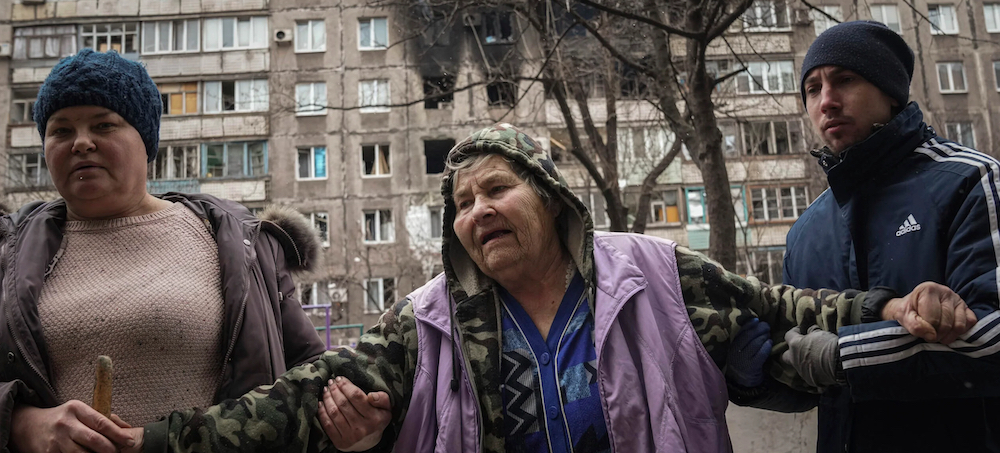 People help a woman, with an apartment building hit by shelling in the background in Mariupol, Ukraine. (photo: Evgeniy Maloletka/AP)
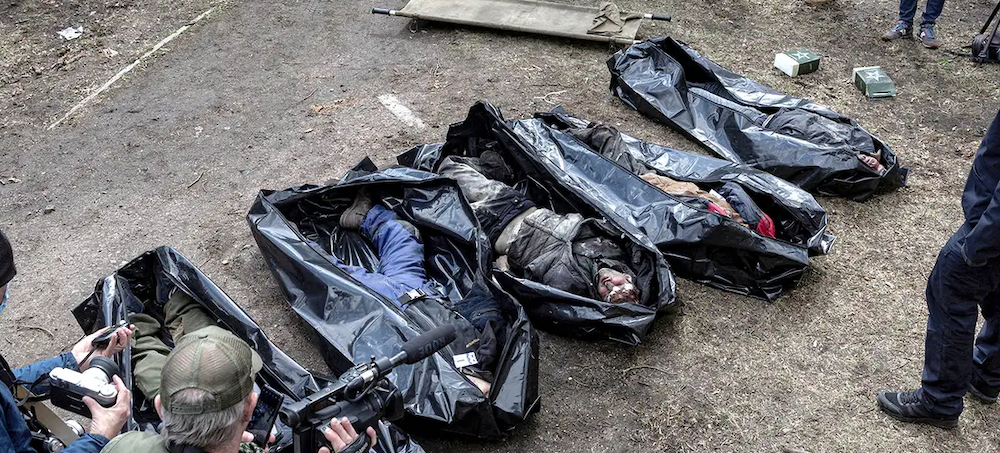 Dead bodies of Ukrainian civilians in Bucha. (photo: Insider)
 Rep. Rashida Tlaib. (photo: Paul Sancya/AP)
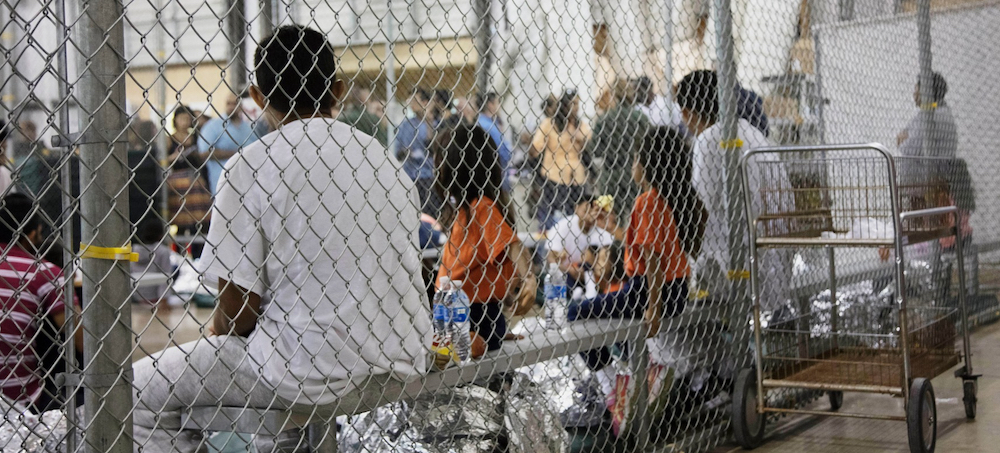 People who’ve been taken into custody related to cases of illegal entry into the United States, sit in one of the cages at a detention facility. (photo: AP)
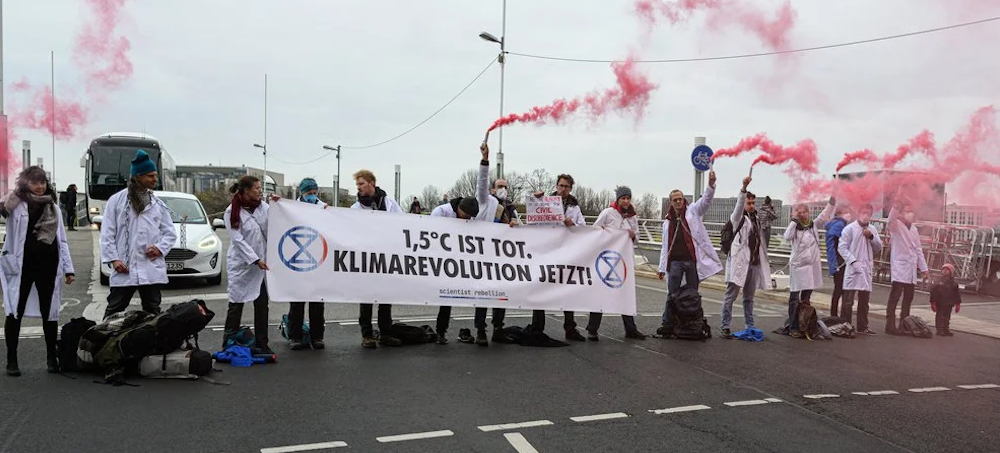 Scientist Rebellion protesters in Berlin, Germany. (photo: Scientist Rebellion)