
19 April 23
Live on the homepage now!
Reader Supported News

The country deserves a lengthy trial that lays bare the depth of Fox’s hypocrisy, venality, and insincerity.
On Tuesday, Dominion accepted a $787.5 million payment from Fox effectively ending their two-year defamation case against the disinformation network that knowingly promoted conspiracy theories and lies about the voting company’s role in the 2020 election. “We acknowledge the court’s rulings finding certain claims about Dominion to be false,” Fox said in a statement.
For those worried about the future of capitalism, the Dominion-Fox lawsuit is a good reminder that bad-faith right-wing actors with money can still trump accountability. Although temporarily weakened, Fox remains healthy enough to continue being a platform for white nationalist talking points—and is free to double down on its attack on our democracy, marginalized communities, the environment, and the truth.
Thanks in part to Fox, a majority of Republican voters now believe the “big lie” that President Trump won the 2020 election, which he actually lost by 7 million votes. These lies, amplified by Trump and Fox, radicalized thousands of individuals to take part in a failed, violent insurrection against our free and fair election. This act of terror ultimately led to the death of several people, including a Capitol Hill police officer.
The lie also recently radicalized Dave DePape, who decided to visit Nancy Pelosi’s home and continue the failed coup by nearly killing her husband. By using its network to promote this lie, along with the “deep state” and “replacement theory” conspiracies, Fox has effectively engaged in stochastic terrorism by placing a target on law enforcement, elected officials, poll workers, media institutions, educators, doctors, and Dominion itself.
In light of such destructive behavior, the hope for America’s beleaguered majority was that Dominion’s lawsuit would not only expose Fox’s role and hypocrisy in fomenting chaos for sake of profit, but finally punish it as well. Unlike so many corporate institutions that continue bending the knee to bad-faith right-wing actors, and engaging in “both sides” coverage for the sake of profit and access, Dominion was rare in that it fought back. They took a play from Trump’s litigious playbook and decided to fight Fox in court. The defamation trial could have extracted a giant piece of financial flesh from Fox, but the real coup de grace would have been a lengthy trial that lays bare the depth of Fox’s hypocrisy, venality, and insincerity—which would have weakened their credibility and stature ahead of the 2024 election.
The discovery process already revealed stunning quotes that have tainted the network. Rupert Murdoch, one of the worst villains of the 21st century, admitted that even though he knew some Fox hosts were spreading lies about the election, he chose not to intervene. Under oath, he said that Fox was “trying to straddle the line between conspiracy theories on one hand, yet calling out the fact that they are actually false on the other.” Well, they failed on both accounts, thanks in part to Fox’s star hosts.
Tucker Carlson and Laura Ingraham went along with promoting the lie, giving a platform to the most unhinged conspiracy theorists even as they privately ridiculed them. “Sidney Powell is lying by the way. I caught her. It’s insane,” Carlson texted Laura Ingraham on Nov. 18, 2022. Ingraham responded by calling her a “complete nut.” Even though Carlson admitted in a text that his viewers will “believe it,” the network continued promoting the big lie because the right-wing base they helped radicalize was moving on to more unhinged pastures, such as Newsmax and OANN, that were all too happy dispensing bat-shit nonsense 24-7.
Carlson’s text messages also revealed what MAGA’s greatest culture warrior actually thought about Trump. Carlson referred to him as a “demonic force, a destroyer,” whom he hates “passionately” and who “could easily destroy us if we play it wrong.” Despite all their best efforts, right-wing donors and Murdoch have not been able to elevate pudding-loving Ron DeSantis, who has failed to dislodge Trump as GOP voters’ number one choice as a Presidential candidate.
As such, Fox, just like GOP politicians like Sens. Lindsey Graham, Marco Rubio and Ted Cruz, must sacrifice whatever morsel of decayed dignity that was left in their rancid souls, and transform into pathetic masochists to retain relevance and credibility with the MAGA base. On cue, Carlson was forced to humiliate himself last week in a groveling interview with Trump where the former reality TV star completely took over the conversation and made Carlson look like a weak, impotent simp.
If Dominion had continued its lawsuit, this brazen hypocrisy—and, I’ll admit it, beautiful entertainment—would be played out publicly. We’d have Fox executives and hosts on the stand confronted with their texts, emails, and messages. There would be more discovery and subsequent revelations. In order to protect themselves, some Fox employees would have to call out the nuts they have on their networks, including hosts and guests. They’d twist, squirm, and contort when forced to explain why they chose to promote lies. Tucker would be asked if he really believes that Trump is a “demonic force,” a day after possibly praising him on his show. Also, Dominion might have actually won the case and walked out with a bigger bag, possibly more than a billion dollars.
All of this exposure would significantly weaken, humiliate, and compromise Fox ahead of the 2024 elections. But, all of that is for naught with this settlement.
Sure, some damage is done. The texts are out and can’t be forgotten. $787 million is no small chunk of change. It’s more than a flesh wound, but it’s not a grave injury.
Is there real accountability? No. Most importantly, is this a deterrent to stop future bad behavior? I don’t think so. They’ll just be more clever and subtle with their dog whistles and throw in some disclaimers here and there with a wink and nudge. And if that doesn’t work, well, they can just do what they’ve always done when confronted with accountability for their horrific actions: they can just buy their troubles away.
READ MORE 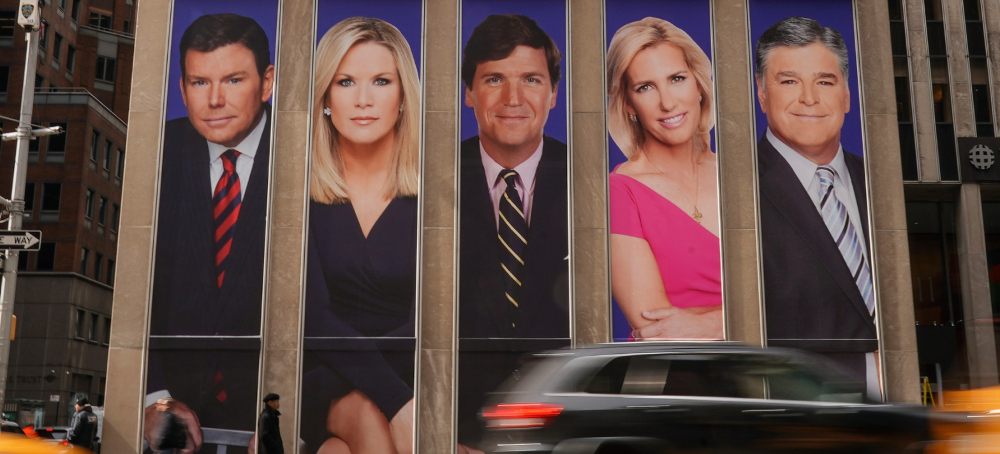 Fox News personalities Bret Baier, Martha MacCallum, Tucker Carlson, Laura Ingraham, and Sean Hannity (from left). (photo: AFP)
Fox’s prime-time stars may have just cost the network $787.5 million, and they have no plans to acknowledge it on air
The outcome of the lawsuit was not mentioned once between the hours of 7 and 11 p.m. on Tuesday night — a block of time that includes network headliners Tucker Carlson, Laura Ingraham, and Sean Hannity, all figures who were implicated in Dominion’s case against Fox.
Over the course of pretrial discovery, internal Fox News communications released to the public revealed the extent to which anchors and executives knew that the conspiracies about Dominion’s role in carrying out fraud in the 2020 election were false.
In text exchanges obtained by Dominion, Carlson, Hannity, and Ingraham mocked the claims being shopped out by Trump lawyers Sidney Powell and Rudy Giuliani, and questioned the legitimacy of their assertions against Dominion.
“Sidney Powell is lying by the way. I caught her. It’s insane,” Ingraham wrote. Carlson responded that “Sidney is a complete nut. No one will work with her. Ditto with Rudy,” and added his feeling that the whole circus was “unbelievably offensive to me. Our viewers are good people and they believe it.”
Despite their disbelief of Powell and Giuliani, the trio called for their co-worker, White House correspondent Jacqui Heinrich, to be fired after she fact-checked a tweet from Trump that included a reference to prime-time host Hannity’s discussions of Dominion on his show.
In another text exchange, Ingraham attacked Fox News reporter Bryan Llenas for publicly stating that he’d found no evidence substantiating claims of voter fraud.
Separately, Hannity complained to Fox & Friends host Steve Doocey that efforts by some of the network’s on-air talent to fact-check election fraud claims were only serving to “piss off the base.”
So what did Fox News cover in prime time instead of the biggest settlement in the company’s history? Highlights include imagined attacks by climate activists against rice (yes, like the food), a discussion with Elon Musk about the dangers of AI and the merits of making lots of babies, and routine criticisms of the Biden administration — featuring a poorly timed chyron.
In one notable moment on ratings–grabber The Five, which did not mention the settlement, contributor Joey Jones criticized election fact-checkers as biased and complained that AI could be exploited to misinform people about political news.
The only network anchors who actually mentioned the settlement were those who have previously been criticized — and even punished by Fox — for pushing back on Trump. Daytime host Neil Cavuto, who in 2020 incurred the ire of the former president, discussed the outcome of the suit with Fox Business anchor Howard Kurtz.
Subbing in for Brett Baier, correspondent Gillian Turner presented viewers with a segment on the suit that once again featured Kurtz. In the course of the lawsuit, viewers learned through texts introduced into evidence that Turner believed her on-air appearances had intentionally been cut down as a result of her critical coverage of the allegations of election fraud.
In a statement following the agreement, Fox indicated that the settlement “reflects Fox’s continued commitment to the highest journalistic standards. We are hopeful that our decision to resolve this dispute with Dominion amicably, instead of the acrimony of a divisive trial, allows the country to move forward from these issues.”
Unfortunately, a return to journalistic standards would require the network to acknowledge that it lied to viewers about Dominion and the former president’s claims of election fraud — something Fox hasn’t prioritized in a while.
READ MORE 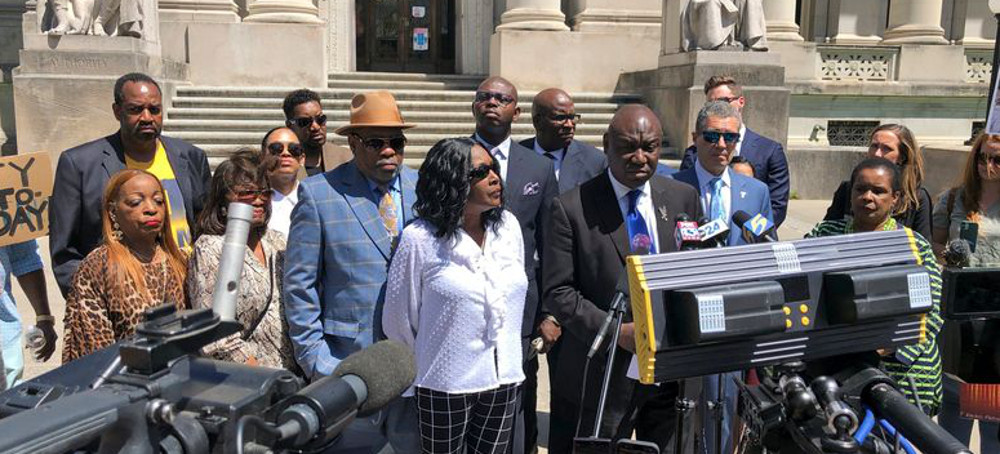 Attorney Ben Crump, and relatives for Tyre Nichols, discuss a lawsuit filed against the city of Memphis and police officers, Wednesday April 19, 2023, in Memphis, Tenn. (photo: Adrian Sainz/AP)
The 139-page complaint filed in the U.S. District Court for the Western District of Tennessee describes the beating as a “foreseeable product of the unconstitutional policies, practices, customs, and deliberate indifference of the City of Memphis and Chief Davis."
The suit compares the beating to the 1955 killing of Emmitt Till and describes the officers involved as a “modern-day lynch mob.”
Civil rights attorney Ben Crump, who represents the family, this week announced plans to discuss the lawsuit at a news conference later Wednesday. The complaint does not specify a dollar amount being sought in damages.
Nichols’s death sparked widespread outrage, fueled by the horrific nature of his injuries and the graphic video footage from police body cameras and surveillance cameras. Five officers directly involved in the beating were quickly fired and have been charged with second-degree murder and other crimes.
Joanna C. Schwartz, a UCLA School of Law professor and author of “Shielded: How the Police Became Untouchable,” said the lawsuit filed Wednesday stands out from most police misconduct cases because of the media attention the attack garnered; the clear and comprehensive video evidence released by the city afterward; and the immediate condemnation by city officials of the officers’ actions.
“There are many people who are killed by police who never had any public attention paid to what’s happened to them, so the lawsuit is the public’s introduction to the case,” Schwartz said. “But this is a case that has already been litigated in some manner on the international stage, and there’s been widespread agreement that what the officers did was wrong — criminal, even.
“I would be surprised if the case didn’t settle relatively quickly.”
Payouts for high-profile police misconduct cases have increased nationwide in recent years, studies show. Minneapolis settled a lawsuit filed by George Floyd’s family for $27 million in 2021, and the city of Louisville settled a lawsuit filed by Breonna Taylor’s family for $12 million in 2020. Smaller settlements often fly under the radar but account for the bulk of money cities spend on police misconduct, according to a 2022 Washington Post analysis.
The city of Memphis earmarked $1.25 million of its police budget for lawsuits in 2023; any resolution of the Nichols case would probably be significantly larger, experts said.
The fired Memphis officers told department officials they pulled Nichols over on Jan. 7 for reckless driving, an allegation Davis has said was not clearly substantiated in the days that followed. After officers attempted to physically restrain Nichols, he fled the stop on foot and was apprehended several minutes later. Body camera and surveillance footage depicts officers punching, kicking and swinging a baton at Nichols during the arrest. He died in a Memphis hospital on Jan. 10.
The officers — Tadarrius Bean, Demetrius Haley, Emmitt Martin III, Desmond Mills and Justin Smith — pleaded not guilty in February to the murder charges and other counts. They are due back in court May 1.
Since the beating, the Justice Department has announced an investigation into the Memphis Police Department, and the city council has passed an ordinance — the Tyre Nichols Driving Equality Act — that forbids traffic stops for what the council described as “secondary violations” such as expired tags or broken taillights. Civil rights activists are pushing for similar legislation in Shelby County, where Memphis is located, which would apply to the sheriff’s office as well.
“I feel really good about the progress we’ve made so far," said Amber Sherman, president of the Shelby County Young Democrats. “I think the key thing here is accountability and making sure these ordinances are actually implemented and there’s oversight.”
READ MORE 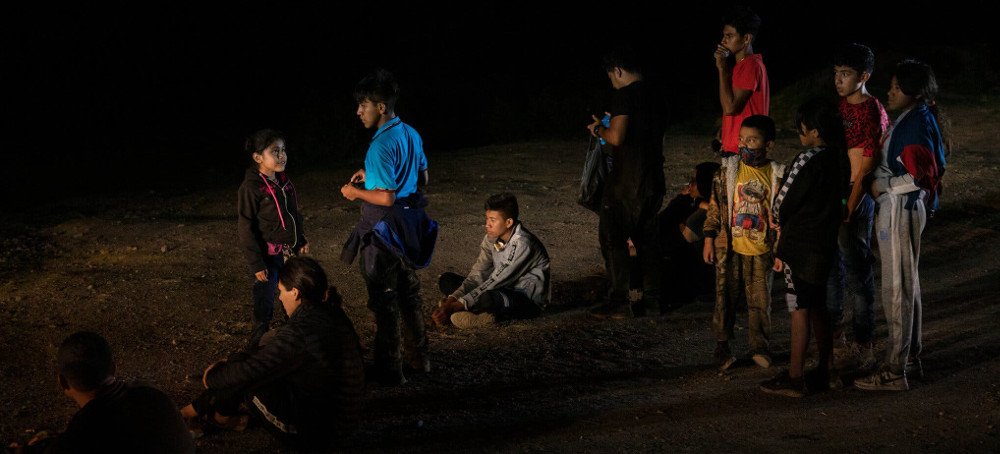 Over the past two years, more than 250,000 migrant children have come alone to the United States. (photo: Kirsten Luce/The New York Times)
Our guest Hannah Dreier, a Pulitzer Prize-winning reporter at The New York Times, has published a bombshell new investigation headlined “As Migrant Children Were Put to Work, U.S. Ignored Warnings.” It reports that the Biden administration has repeatedly ignored or missed warnings about a surge of migrant children as young as 12 working in factories across the United States under grueling and often dangerous working conditions in serious violation of child labor laws. “People were punished for bringing this to the attention of their supervisors,” says Dreier.
In February, the Times published a blockbuster report about child labor based on accounts by over 100 unaccompanied migrant children, mostly from Central America, who described grueling and often dangerous working conditions, including having to use heavy machinery, being subjected to long hours and late-night shifts at facilities that manufacture products for major brands and retailers, like Hearthside Food Solutions, the makers of Cheerios, Fruit of the Loom, Whole Foods, Target, Walmart, J.Crew, Frito-Lay and Ben & Jerry’s. Others were forced to work as cleaning staff at hotels, at slaughterhouses, construction sites, car factories owned by General Motors and Ford, in serious violation of child labor laws.
On Tuesday, Homeland Security Secretary Alejandro Mayorkas was grilled about the Biden administration’s response to forced child labor. This is Republican Senator Josh Hawley of Missouri.
SEN. JOSH HAWLEY: You’re not going to take any responsibility for the indentured servitude and exploitation of children that is happening on your watch. A moment ago, you were crowing about the fact that you treated children so well, and yet we find tens of thousands of children who are forced to work as slaves because of your policies, and you turn around and blame a prior administration.
Mr. Secretary, this is par for the course for you. You do it every time you appear before this committee. You do it every time you appear before Congress. I, for one, am sick and tired of it. And thousands of children are in physical danger — danger — because of what you are doing. You should have resigned long ago. And if you cannot change course, you should be removed from office. Thank you, Mr. Chairman.
AMY GOODMAN: We’re joined now by Hannah Dreier, Pulitzer Prize-winning reporter at The New York Times. Her new investigation is headlined “As Migrant Children Were Put to Work, U.S. Ignored Warnings.” Dreier’s earlier piece was headlined “Alone and Exploited, Migrant Children Work Brutal Jobs Across the U.S.”
Hannah Dreier, welcome back to Democracy Now! We had you on for your first blockbuster exposé showing children as young as 12 working across the United States. Now you’re reporting that the Biden administration knew about this — not only knew about this and didn’t do anything, they actually did do something: They pushed out those within the administration who were raising alarms. Can you talk about what you found?
HANNAH DREIER: It’s great to be with you, Amy.
And yeah, just as you say, people were punished for bringing this to the attention of their supervisors. People say that they were fired, they were demoted. I spent a year talking to children who came to this country and are working in the most exploitative conditions in factories, in slaughterhouses. I found these children in every single state in this country. And so, after that story came out, I began asking, “How could it have been that the Biden administration didn’t know about this?”
And what I found was that, actually, they were given evidence. They were given warnings. There was sign after sign that this was happening for two years, and the administration really didn’t spring into action until just last month.
JUAN GONZÁLEZ: And, Hannah, I was particularly struck by the information about Susan Rice, the White House head of domestic policy, and her reaction to the reports that there were problems in terms of how these children were being treated. Could you talk about that? Because Susan Rice has been a person who has been in every Democratic administration over the last 30 years — Bill Clinton, Barack Obama and now Joe Biden.
HANNAH DREIER: Right. Susan Rice is a hugely important figure, and she is Biden’s top point person on immigration. So it’s not, you know, some junior staffer at the White House who maybe got a warning one time, and it didn’t get, you know, channeled in the appropriate way. What I found was that Susan Rice’s team was told about this again and again. And the kind of evidence we’re talking about are clusters of children found to be working in different parts of the country, repeatedly, in these very industrial jobs. So these are children making car parts. These are children using caustic chemicals and acids to scrub a chicken plant. And those messages got to Susan Rice’s level. Memos airing concerns about these issues got to Susan Rice’s level. Her team was told, going back to the summer of 2021, that people were very worried about this.
And what the White House has basically said is, “Well, maybe we saw these signs, but we didn’t put it all together.” What their response has been is sort of a lack of curiosity or a lack of conscientious thinking to realize that if we’re seeing kids in all these different places who are doing these jobs, maybe there is a larger trend here; maybe there’s thousands of these kids out there.
JUAN GONZÁLEZ: Well, they did put it together sufficiently to force out five Health and Human Services staff members. Could you talk about those — some of those staff members and the alarms that they raised?
HANNAH DREIER: So, these are the people who were running the unaccompanied minor program for Health and Human Services. One of the women who I spoke with, Jallyn Sualog, she helped build this program. She started working for the government in 2010, right when we first started to see these waves of children coming over, and she was in charge of this program for years and years. She was the highest official running the program when Biden took over.
And what she says is she raised alarms. We’ve seen her emails where she’s saying something catastrophic is going to happen, and pleading with somebody to pay attention. When her emails went unanswered, she went to Congress, and she talked to Congress staffers and said again, “I’m really worried about what’s happening here. These children are in danger.”
And she was pushed out. She was one of five people who I spoke to who filed complaints, who showed me their emails where they were saying, you know, something really wrong is happening here. And they say that instead of being listened to, they were demoted, and people just did not want to hear these warnings.
AMY GOODMAN: I wanted to turn to the White House press secretary, Karine Jean-Pierre, who was speaking on Tuesday.
PRESS SECRETARY KARINE JEAN-PIERRE: This administration moved swiftly to crack down on violators and are more rigorously vet — more vigorously vet sponsors of unaccompanied minors. DOL and HHS launched a new task force to heighten cooperation and better share information. We also called on Congress to provide the resources this administration has long requested to help us crack down on companies that exploit children for labor. The actions we’ve taken since February make clear that we will continue to investigate and hold companies accountable, but we also need Congress to provide the resources we need to enforce. And we’ve been very clear. Again, DOL, HHS have taken actions. But we need Congress to also — to also give the — give DOL and HHS the resources that they need to broaden these actions that they’ve put forward.
AMY GOODMAN: So, that’s the White House response. If you could respond to that? And particularly, talk about who is responsible for what. I mean, we saw this dramatic confrontation between Senator Hawley and Alejandro Mayorkas, who’s head of Homeland Security. Talk about what Homeland Security is responsible for — he was particularly angry that Mayorkas was blaming the Trump administration for separating children — what Homeland Security is responsible for, what HHS is responsible for. And tell us more about these whistleblowers who made clear, time and again, what was happening, and were not just not listened to, as was just pointed out, but were pushed out, one after another after another.
HANNAH DREIER: So, in fairness to the Biden administration, they have taken rapid action after our first story came out a month ago. And the Department of Labor is really ramping up the way that they’re going to try to go after these companies that exploit migrant children. And Health and Human Services has also taken some steps. What’s been just so shocking to me is that these steps were not taken earlier.
And one dynamic that people often point out is that a lot of this came in response to the crisis at the border, where children were coming in in record numbers right when Biden took office. And a lot of them were sort of languishing in Customs and Border Protection jails, because there wasn’t enough room in the shelter system to take them in. And so, there was wall-to-wall coverage of children sleeping on the floor, children under those tin blankets, and the Biden administration was really getting slammed on: “Why are these kids languishing in jails? I thought you were going to take care of them.” And so there was all this pressure in the administration to move those kids out quickly, because it was so visible when they were ending up sleeping on the floors, sleeping in these terrible conditions.
And what happened after that, with all these kids working, was much less visible. You know, nobody is going to go and have a big newsreel about children who are working in the poultry plant, because you can’t get in there. And so, it was sort of a trade-off, as it’s been explained to me, between this very visible crisis, where kids weren’t moving out of the shelters quickly enough, and this hidden crisis, where kids are now working these terrible jobs and often sort of languishing in debt bondage. And that’s just part of this dynamic that sort of comes up again and again.
The agencies that are responsible here are really Department of Labor and Health and Human Services. I know Mayorkas has been getting questioned about this, I think sort of as a proxy for the Biden administration. But the agency that is, you know, in charge of migrant children is Health and Human Services. It’s not like the regular immigration system. Children go to this different agency that’s supposed to be a child welfare agency. And it’s Health and Human Services that’s then responsible for releasing them to sponsors and protecting them from trafficking and exploitation.
JUAN GONZÁLEZ: And yeah, that’s what I wanted to ask you about, the role of Health and Human Services, because, obviously, we can understand the pressure that the Biden administration was under to get children out of the detention facilities, but then the responsibility had to fall on the agency that kept seeing one or another individual repeatedly offering to sponsor children, to monitor and check up what these — who was — what these sponsors were actually doing with the children. So, wouldn’t that fall largely on Health and Human Services?
HANNAH DREIER: Yes, that is Health and Human Services. And these staffers, who had to try to connect children with sponsors and move them out of shelters, tell me that, to them, this often felt worse than even during, you know, child separation under Trump. The people who work in this agency, they’re mostly Democrats. They mostly are in this work because they really believe that migrant children are important, and want to watch out for them. And they say that they felt this huge pressure to just get kids out of the shelter, to send them to whoever, to sent them to people who had already sponsored multiple children.
I spoke with one of these workers in Texas, who said that just in two weeks doing this job for Health and Human Services, she found six cases where children were being sent to people who said that they were intending to put the children to work or who had already sponsored other kids who were not their relatives. She flagged the case of one 14-year-old who was being sent to a nonrelative. And she said, “I’m really worried about this kid. I think this kid is being trafficked. I think this kid is going to have to pay off some kind of debt.” And as far as we can tell, nothing ever happened. I caught up with that kid two years later, and, sure enough, he was put to work. He had to drop out of middle school. He had to pay his own rent. He had to pay off thousands of dollars in debt. And he was just completely on his own, even though his case had been flagged by a whistleblower.
AMY GOODMAN: Finally, Hannah, we just have 30 seconds. What you were most shocked by in reporting this second exposé?
HANNAH DREIER: I just could not believe that this wasn’t flagged earlier. I mean, with something this widespread, thousands and thousands of children, you want to believe that people at the highest level of government are going to pay attention when they’re shown evidence of the worst kind of child labor exploitation.
AMY GOODMAN: Hannah Dreier, Pulitzer Prize-winning reporter at The New York Times. We’ll link to your new investigation, “As Migrant Children Were Put to Work, U.S. Ignored Warnings,” and your previous piece, “Alone and Exploited, Migrant Children Work Brutal Jobs Across the U.S.”
READ MORE 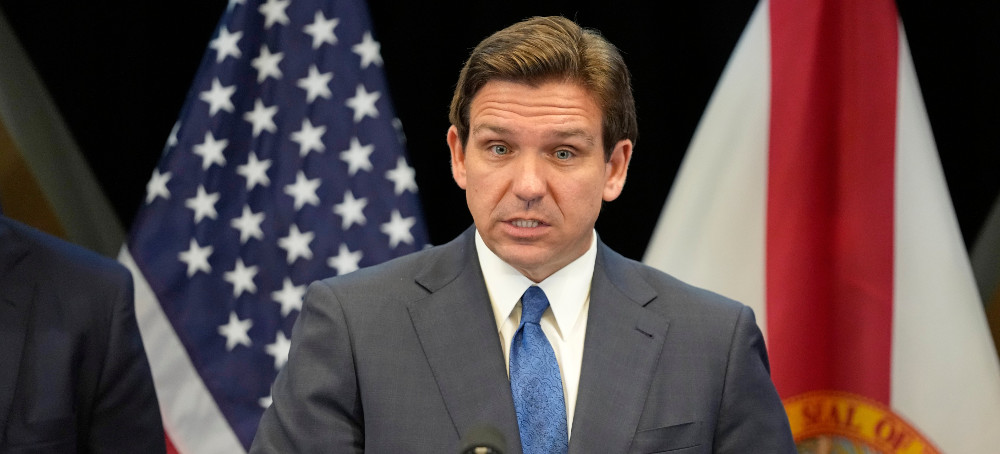 Florida governor Ron DeSantis speaks at a news conference at the Reedy Creek Administration Building Monday, April 17, 2023, in Lake Buena Vista, Fla. (photo: AP)
Classroom instruction on sexual orientation and gender identity is limited.
"This amendment prohibits classroom instruction to students in pre-kindergarten through Grade 3 on sexual orientation or gender identity. For Grades 4 through 12, instruction on sexual orientation or gender identity is prohibited unless such instruction is either expressly required by state academic standards ... or is part of a reproductive health course or health lesson for which a student’s parent has the option to have his or her student not attend," according to the amendment.
This rule would build on the Parental Rights in Education law Florida Gov. Ron DeSantis signed in March 2022. The law bans classroom instruction on sexual orientation or gender identity for students in kindergarten through third grade.
It also states that any instruction on those topics cannot occur "in a manner that is not age-appropriate or developmentally appropriate for students in accordance with state standards," according to the legislation.
Critics of these restrictions argue that "everyone has a sexual orientation and a gender identity. It looks like this rule would make it impossible to do much instruction at all," Laura McGinnis, of the LGBTQ advocacy group PFLAG, previously told ABC News.
The law was dubbed "Don't Say Gay" by critics for aiming to restrict curriculum that includes history, literature and more that touch on LGBTQ identities.
Supporters of the rules argue that "there is no reason for instruction on sexual orientation or gender identity to be part of K-12 public education. Full stop," according to a spokesperson for DeSantis, who has backed restrictions on education about race, gender identity and sexual orientation and more in his war on "woke."
Woke is defined by the DeSantis administration as "the belief there are systemic injustices in American society and the need to address them," according to DeSantis' general counsel, as reported by The Washington Post.
READ MORE 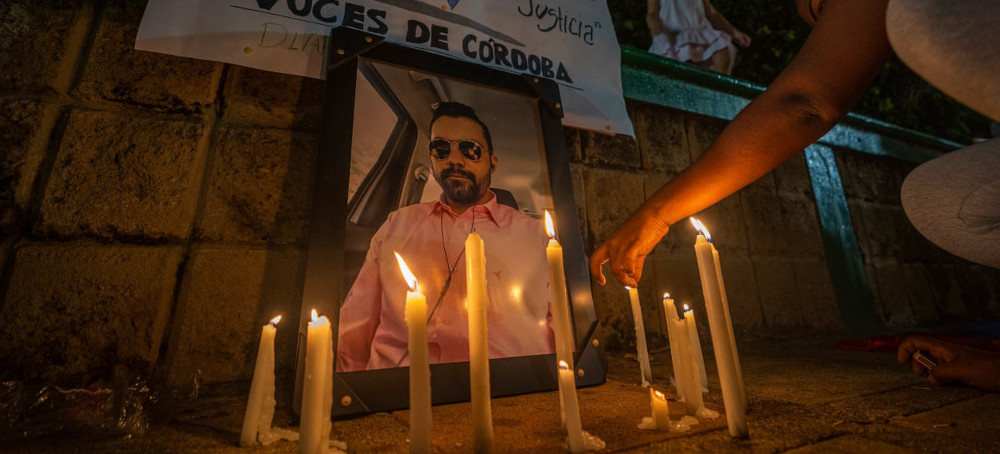 People attend a vigil for Rafael Moreno in October 2022. (photo: Diego Cuevas/El Pais)
After posting a video denouncing alleged corruption, Rafael Moreno was fatally shot – but thanks to documents he left behind, he wasn’t silenced
In the recording, Moreno denounces alleged corruption in the surrounding region of Córdoba, one of the poorest and most violent parts of the country, and a strategic corridor for drug smuggling.
He recites a litany of accusations: inflated contracts, unfinished public works, embezzlement. “They’re stealing,” he claims. “Somebody has to point out the corruption in this region.”
In his reporting – which he published on two Facebook pages – Moreno spared no one, from powerful local politicians and mining companies to paramilitary groups and other journalists.
And his accusations seemingly did not go unnoticed.
In the video, Moreno reads out a note he had recently found on his motorbike – alongside a bullet. “We know all your movements: where you go, when you wake up, when you go to sleep … We know everything about you and we are not going to forgive you.”
Like many local reporters in Latin America, Moreno was unable to make a living from his journalism, and had recently opened a grill and car wash in the town of Montelíbano.
Three months after posting the video, on 16 October, he was closing the bar when a man wearing a baseball cap entered the restaurant, pulled out a revolver and shot him three times.
Moreno died immediately. But thanks to the documents he left behind, he was not silenced.
Days before his assassination, Moreno had contacted Forbidden Stories, the French nonprofit whose mission is to pursue the work of assassinated, threatened or jailed reporters. He joined the SafeBox Network, which allows threatened journalists to upload sensitive information for safekeeping, and he started sharing his findings.
After his death, a consortium of reporters from around the world came together to continue Moreno’s work. They analysed hundreds of documents, emails and public contracts obtained through freedom of information requests.
Together with on-the-ground reporting and interviews with dozens of sources, they explored his claims of a system of clientelism in the province of Córdoba in which several million dollars were allegedly embezzled.
The team also examined three mines in the region, confirming many of the allegations Moreno had made, including environmental damage, failures to consult with Indigenous communities and non-licensed operations.
Today the Guardian joins 31 media partners around the world to publish the consortium’s work – and highlight the investigations that may have cost Rafael Moreno his life.
‘Anybody could have killed him’
Between 1992 and 2022, 95 journalists have been killed in Colombia, many of them caught in the crossfire of a brutal civil conflict between leftwing guerrillas, rightwing paramilitaries and state forces.
A series of peace deals removed many of the conflict’s factions from the battlefield, but new criminal groups have sprung up, and the country’s reporters are often most at risk when investigating drug trafficking, local politics and corruption.
According to his friends and family, Moreno was relentless in his pursuit of alleged corruption. “He was constantly throwing banana skins,” said Rafael Martínez, cabinet secretary of the nearby town of Puerto Libertador, and a longtime friend. “Anybody could have killed him.”
His last investigation focused on accusations of environmental crimes in the basin of the Uré River. Moreno had discovered that someone was using a backhoe and heavy trucks to systematically strip sand from a river beach for use in public construction works.
The beach sits next to a national park and inside a protected area, and Moreno alleged that the project did not have an environmental licence. He also claimed the scheme was linked to one of the most powerful political dynasties in the region: the Calle family.
Gabriel Calle, the family patriarch, is a former regional deputy and mayor of Montelíbano currently under investigation for several offences, including irregularities in drawing up contracts and illicit enrichment. He denies the charges.
In the 10 days before his murder, Moreno had submitted four freedom of information requests, including one requesting documents about the Uré River. The response came two days after his death.
In an interview with the consortium, Calle denied all responsibility for the sand extraction, and said the trucks were on a public road, although the land registry does not mention any public road in this location.
He denied having any involvement in or knowledge of Moreno’s death. “I had a good friendship with Rafael – we never even had an argument. I wasn’t worried about what he said because it wasn’t true,” he told the consortium.
Moreno’s new career: investigative journalist
Moreno was born in the village of Puerto Libertador, and after leaving school at 15 worked in a gold mine, picked coca leaves and completed his military service.
When he returned to the region aged 20, he met Espedito Duque, a charismatic upcoming politician, and went to work for his mayoral election campaign in Puerto Libertador.
“Rafael was his right-hand man, he was practically his head of communications,” said Moreno’s sister, Maira.
After two failed attempts, Duque was elected in 2015, and Moreno went to work for the new mayor. But people close to Moreno say that he was becoming disillusioned with his political mentor.
Moreno felt that the changes Duque had promised were slow to arrive, and he believed the mayor relied on the same allegedly corrupt functionaries who had served past administrations.
After the peace deal between the Colombian government and leftwing Farc rebels, public money had become more easily accessible in areas like Puerto Libertador which had been were particularly hard hit by the decades-long conflict.
Since 2016, more than $100m has been invested in the five municipalities that make up the region. The resources were earmarked for more than 130 public works projects, including road repairs, education and healthcare, as well as housing and energy infrastructure.
But activists say many projects were never completed. “Many of these works were unfinished or not even started,” said Enyer Nieves Pinto, president of a civil oversight group in the region.
So in December 2018, Moreno launched a new career as an investigative journalist.
His method was simple: he would log on to a government website listing public contracts, download the documents, pore over the budgets and proposals, and then visit the location to see if the work had been carried out. He published the results on his two Facebook pages: “Rafael Moreno Investigator” and “Voices of Córdoba”.
One case involved the renovation of the municipal stadium in Puerto Libertador, which – despite a budget of more than $1m – was abandoned unfinished.
In a poor region still haunted by decades of violence, many locals were revolted by allegations that money had gone astray.
But Moreno’s reporting also led to threats from local crime factions which routinely take a cut from public budgets. In 2019, he was named as a “military target” by one gang; in 2021, he was briefly kidnapped by the country’s most powerful crime group, the Gulf Clan.
Moreno regularly shared these threats with the National Protection Unit, which provides countermeasures including panic buttons, armoured vehicles and bodyguards to threatened activists and reporters. But the protection he received was irregular, and he had none on the day of his murder.
Still, Moreno continued to publish articles and submit legal complaints and freedom of information requests.
The consortium partners were able to consult Moreno’s email, where among the thousands of emails and attachments, they discovered a formal complaint Moreno filed on 5 January 2021 against Duque and his associates, alleging “acts of corruption, embezzlement of public funds, influence trafficking and clientelism”.
The 21-page document alleges that Duque’s close friends and family set up dozens of NGOs which then won contracts to “facilitate the appropriation of public resources”.
The document never received an official response. But an analysis by the Colombian investigative outlet Cuestión Pública and the Latin American Investigative Journalism Centre (Clip) shows that between 2016 and 2022, the Duque administration and its successor appear to have signed 99 contracts with 13 people close to the mayor’s family – contracts worth a combined $3m.
Many of the contracts were awarded by mutual agreement, meaning they were never offered for public tender.
In a statement to the consortium, Duque denied all accusations of wrongdoing, saying that the allegations of corruption were “absolutely false” and adding: “It is untrue that I supported the creation of entities to benefit from contracts with the municipality.”
Duque said: “[Moreno’s] accusations were due to resentment, but all my actions [in office] took place in public, and any complaints were examined by control bodies.”
He strongly denied any involvement in or knowledge of Moreno’s death, saying: “I swear by God and my family that I had nothing to do with the assassination of Rafael Moreno, and I need you to keep investigating that cruel murder until you get to the truth. Because on the day of his murder the politicians who were supposedly his friends didn’t cry, they celebrated and toasted in the street, and put the blame on me and my family.”
He added: “May he rest in peace. His passing caused me great pain.”
Threats, murder and journalists going quiet
Up until his death, Moreno kept posting updates on his Facebook pages, building up his allegations of corruption and clientelism. He was also investigating an alleged rape case implicating the son of a powerful local figure.
But the threats were also gathering pace, and on the night of 16 October 2022, he was shot dead.
Since then, other reporters in the region have stepped back from investigations. Yamir Pico, Moreno’s cousin and fellow journalist, temporarily closed down his media outlet in November after receiving threats. He later restarted it but said he would not pursue any more investigations. Another local journalist has decided to focus on sports and cultural coverage. A third has left the region and is currently in hiding.
More than six months after Moreno’s death, nobody has been arrested in the murder case. Duque is planning to run for mayor again this October.
READ MORE 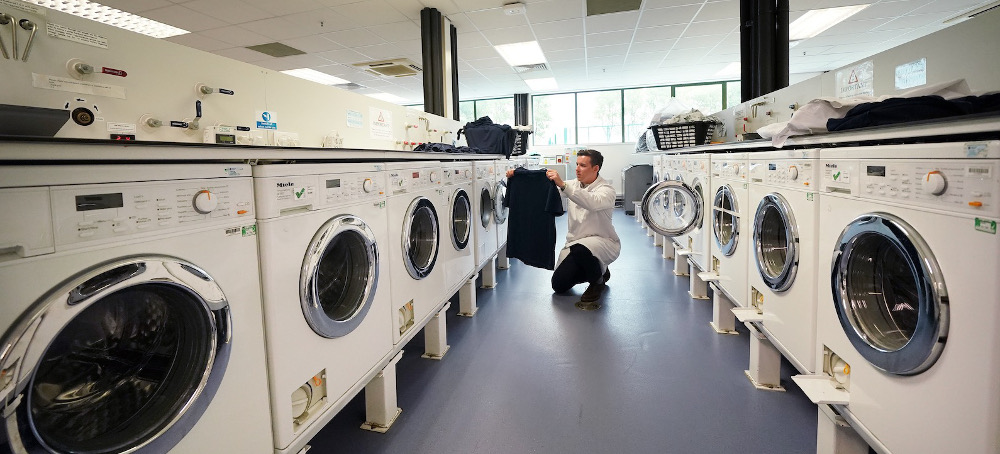 Simple filters could help remove microfiber pollution from your laundry. (photo: Owen Humphreys/PA Images)
Simple filters could help remove microfiber pollution from your laundry. But experts say a broader portfolio of solutions is needed to address the problem.
Today a growing body of science suggests the tiny strands that slough off clothes are everywhere and in everything. By one estimate, they account for as much as one-third of all microplastics released to the ocean. They’ve been found on Mount Everest and in the Mariana Trench, along with tap water, plankton, shrimp guts, and our poo.
Research has yet to establish just what this means for human and planetary health. But the emerging science has left some governments, particularly in the Global North, scrambling to respond. Their first target: the humble washing machine, which environmentalists say represents a major way microfiber pollution reaches the environment.
Late last month a California State Assembly committee held a hearing on Assembly Bill 1628, which would require new washing machines to include devices that trap particles down to 100 micrometers — roughly the width of human hair — by 2029. The Golden State isn’t alone here, or even first. France already approved such a requirement, effective 2025. Lawmakers in Oregon and Ontario, Canada have considered similar bills. The European Commission says it’ll do the same in 2025.
Environmental groups, earth scientists and some outdoor apparel companies cheer the policies as an important first response to a massive problem. But quietly, some sustainability experts feel perplexed by all the focus on washers. They doubt filters will achieve much, and say what’s really needed is a comprehensive shift in how we make, clean and dispose of clothes.
The wash is “only one shedding point in the lifecycle of the garment. To focus on that tiny, tiny moment of laundry is completely nuts,” said Richard Blackburn, a professor of sustainable materials at the University of Leeds. “It would be much better to focus on the whole life cycle of the garment, of which the manufacturing stage is much more significant in terms of loss than laundering, but all points should be considered.”
Today, some 60 percent of all textiles incorporate synthetic material. Anyone who’s worn yoga pants, workout gear or stretchy jeans knows the benefits: These materials add softness, wicking and flexibility. Under a microscope, though, they look a lot like plain old plastic. From the moment they’re made, synthetic clothes — like all clothes — release tiny shreds of themselves. Once liberated these fibers are no easier to retrieve than glitter tossed into the wind. But their size, shape, and tendency to absorb chemicals leaves scientists concerned about their impacts on habitats and the food chain.
Anja Brandon is an associate director for U.S. plastics policy at the Ocean Conservancy who has supported the California and Oregon bills. She concedes that filters won’t fix the problem, but believes they offer a way to get started. She also supports clothing innovations but said they could be years away. “I for one don’t want to wait until it’s a five-alarm fire,” she said.
Studies suggest a typical load of laundry can release thousands or even millions of fibers. Commercially available filters, like the PlanetCare, Lint LUV-R and Filtrol, strain the gray water through ultra-fine mesh before flushing it into the world. It’s the owner’s job, of course, to periodically empty that filter — ideally into a trash bag, which Brandon said will secure microfibers better than the status quo of letting them loose into nature.
Washing machine manufacturers in the U.S. and Europe have pushed back, saying the devices pose technical risks, like flooding and increased energy consumption, that must be addressed first. University experiments with these filters, including an oft-cited 2019 study by the University of Toronto and the Ocean Conservancy, haven’t found these issues, but it’s not a closed case yet: Last year a federal report on microfibers, led by the Environmental Protection Agency and National Oceanic and Atmospheric Administration, called for more research in this vein.
Manufacturers also argue that microfibers originate in a lot of places, but washers are a relatively modest one. As self-serving as that sounds, people who study the issue agree there’s a huge hole in the available science: While we know clothes shed microfibers throughout their lives, we know surprisingly little about when most of it happens.
Some evidence suggests that the friction of simply wearing clothes might release about as many microfibers as washing them. Then there are dryers, which some suspect are a major source of microfiber litter but have been barely studied, according to the federal report. There is also limited knowledge about how much microfiber pollution comes from the developing world, where most people wash by hand. (A recent study led by Hangzhou Dianzi University in Hangzhou, China pointed to this knowledge gap – and found that hand-washing two synthetic fabrics released on average 80 to 90 percent fewer microfiber pollution than machine-washing.)
To Blackburn, it’s obvious that most releases occur in textile mills, where it’s been known for centuries that spinning, weaving, dyeing and finishing fabric spritzes lots of fiber. “Where do you think it goes when we get it out of the factory?” he said. “It goes into the open air.”
He calls filter policies “totally reactionary,” arguing that they would at best shave a few percentage points off the total microfiber problem. But there is one area where Blackburn is in broad agreement with environmentalists: In the long run, tackling the issue will take a lot of new technology. No silver-bullet solution has appeared yet, but a slew of recent announcements reveals a vibrant scene of research and development attacking the problem from many angles.
Some best practices already are known within the industry. For example, more tightly woven clothes, and clothes made of long fibers rather than short ones, fray less. But for years, popular brands like Patagonia and REI have said what they really need is a way to experiment with many different materials and compare their shedding head to head. This has been tricky: Microfibers are, well, micro, and there’s no industry standard on how to measure them.
That might be changing. In separate announcements in February, Hohenstein, a company that develops international standards for textiles, and activewear brand Under Armour revealed new methods in this vein. Under Armour is targeting 75 percent “low-shed” fabrics in its products by 2030.
These approaches would at best reduce microfiber emissions, not eliminate them. So another field of research is what Blackburn calls “biocompatibility”: making microfibers less harmful to nature. California-based companyIntrinsic Advanced Materials sells a pre-treatment, added to fabrics during manufacturing, that it claims helps polyester and nylon biodegrade in seawater within years rather than decades. Blackburn’s own startup, Keracol, develops natural dyes, pulled from things like fruit waste, that break down more easily in nature than synthetic ones.
New ideas to dispose of clothes are also emerging, though some will cause arched eyebrows among environmentalists. This year U.S. chemical giant Eastman will start building a facility in Normandy, France that it claims “unzips” hard-to-recycle plastics, like polyester clothes, into molecular precursors that can be fashioned into new products like clothes and insulation. Critics charge that such “chemical recycling” techniques are not only of dubious benefit to the environment, they’re really just a smokescreen for fossil-fuel corporations trying to keep their product in demand.
Lest anyone forget about washing machines, there’s R&D going after them, too. In January Patagonia and appliance giant Samsung announced a model that they claim cuts micro plastic emissions up to 54%. It’s already rolled out in Europe and Korea. At around the same time, University of Toronto researchers published research on a coating that, they claim, makes nylon fabric more slippery in the wash, reducing friction and thus microfiber emissions by 90 percent after nine washes. In a press release the researchers tut-tutted governments for their focus on washing-machine filters, which they called a “Band-Aid” for the issue.
One continuous thread through all these efforts, of course, is that everyone is working with imperfect information. The emerging science on microfibers – and microplastics in general – suggests they’re a gritty fact of modern life, but doesn’t yet show the magnitude of their harm to humans and other species. For the moment environmentalists, policymakers and manufacturers aren’t just debating whether to put filters on washing machines, but whether we know enough to act. In 20 years, when scientists know a lot more, it’ll be easier to judge whether today’s policies represented proactive leadership on an emerging environmental problem — or a soggy Band-Aid.
Follow us on facebook and twitter!
PO Box 2043 / Citrus Heights, CA 95611


