
27 March 22
Live on the homepage now!
Reader Supported News
YOU ARE HERE, YOUR CHOICE — We are “Reader Supported News” that’s how we do it, and we do it well. We answer to you. You Like that. We raise money from our readers to pay the bills. You don’t like that. You can’t have it both ways. If you hang out, chip in. (And we need that now.)
Marc Ash • Founder, Reader Supported News
Sure, I'll make a donation!

Garrison Keillor | One Day Last Week: The Best and Worst Clearly Visible
Garrison Keillor, Garrison Keillor's Website
Keillor writes: "Minnesota is the land of slow talkers and so when I sit down to dinner with New Yorkers, I think of intelligent things to say about two minutes too late, and I sit quietly, hands folded, and probably get a reputation as a dimwit, but it doesn't matter."
One day last week: the best and worst clearly visible
A dear friend came visiting last week with her three-year-old daughter and it was fascinating to see motherhood up close, having never been one myself. It is a conjoined relationship, a grown-up woman taking leave of the adult world to eat, sleep, talk, walk, with a tiny hand clasping her leg. I was an absentee father, ambitious to pursue my own purposes and as a result, when my daughter calls, her first question is, “Where is my mom?” She loves me but she doesn’t count on me. I watch my friend mothering her three-year-old and I admire this, as I would admire someone levitate in midair.
My friend had no time to watch Judge Jackson’s Senate confirmation hearings, but I watched, and the question that never got asked was, “How did you ever pursue this remarkable legal career while raising two daughters?” She sat with great poise and calmly listened to Republican senators who wanted to toss the terms “child pornography” and “sex offender” as many times as humanly possible — senators who are lawyers themselves and know perfectly well the sleazeball game they were playing.
When her parents were born, segregation was lawful in America, and here was a Black woman of unquestioned qualifications nominated to the U.S. Supreme Court, and against that heroic background, Senators Cruz, Cotton, Hawley, Graham, and Cornyn performed shameless acts in broad daylight before millions of people. These men should not be allowed to eat in public restaurants. They should go to the drive-up window and eat in the parking lot.
I’m an old man now and my ambition is all burned away and I lead a rather small life in New York City far from my home in Minnesota, because my wife loves walking in the city, going to theater, concerts, art museums, and she can get on the subway and see America. In Minnesota, people prefer automobiles. I owe her this for having raised our girl. It’s just as simple as that.
Minnesota is the land of slow talkers and so when I sit down to dinner with New Yorkers, I think of intelligent things to say about two minutes too late, and I sit quietly, hands folded, and probably get a reputation as a dimwit, but it doesn’t matter. This is one good reason for getting old. You are ignored and it’s perfectly okay. My goal is to avoid receiving a lifetime achievement award, a symbolic death sentence, and to stay in the game, thank you very much. Thanks to personal cowardice, I skipped contact sports and so I don’t have lower back problems, plus which my wife feels tenderly toward me, and spring is here and I am grateful for independence from a job, a schedule, an organization chart, meetings chaired by a pretentious numbskull talking about incentivization. Instead I sit in the sun and write a limerick:
In August I’m turning fourscore
And before I go out the door
As a non sequitur,
One more dance with her
And I’ll mix us a nice metaphor.
I sit at the table, reading about war in Europe, glaciers melting, a tornado in New Orleans, and playground bullies in the U.S. Senate trying to torment someone and get her to take a swing at them, and back in Minneapolis teachers are on strike for increased wages and smaller class sizes and the state looks at a $7.7 billion budget surplus and the kids sit home and what is a working mother to do? I put the paper down and I listen to a Chopin étude and this piano piece restores some sense to the world. I listen to it and recall my own recent encounters with competence and compassion, the dental hygienist, the kindness of the ophthalmologist’s assistant on the phone, the woman on Columbus Avenue who told me my shoelace was untied, and my friend and her child walk into the room, the tiny hand clasping the mother’s pantleg, and sanity is restored.
This is where we absorbed whatever kindness and decency we possess, holding onto our mother as she goes about. Apparently you don’t learn it in law school. Probably by the time you go off to the first grade, you have some manners or you’re a kicker and biter and need reconstructive training. I’m sorry if the senators’ mothers were hardened streetwalkers or burlesque dancers in carnival tent shows, but why avenge yourself on a woman whose devotion to the law makes you look small? To put it bluntly, you are not a credit to your race or gender and I personally resent it. That is all. Class dismissed.
READ MORE
 Rep. Jeff Fortenberry's attorneys are seeking to show that the congressman was simply confused, rather than lying to government agents. (photo: Andrew Burton)
US Congressman Jeff Fortenberry Resigns After Conviction for Lying to FBI
Guardian UK
Excerpt: "The Nebraska congressman Jeff Fortenberry has resigned from office after a California jury convicted him of lying to federal authorities about an illegal campaign donation from a foreign national."
Nebraska Republican Jeff Fortenberry stepped down after concerted pressure from both Washington and his own state
The Nebraska congressman Jeff Fortenberry has resigned from office after a California jury convicted him of lying to federal authorities about an illegal campaign donation from a foreign national.
In a letter to the House on Saturday, nine-term Republican Fortenberry said he was resigning from Congress, effective 31 March.
“It has been my honor to serve with you in the United States House of Representatives,” he said in the letter. “Due to the difficulties of my current circumstances, I can no longer effectively serve.”
Fortenberry’s announcement followed concerted pressure from political leaders in Nebraska and Washington for him to step down. House speaker Nancy Pelosi and House minority leader Kevin McCarthy on Friday urged Fortenberry to resign.
Nebraska’s Republican governor, Pete Ricketts, said Fortenberry should “do the right thing for his constituents” and leave the office he has held since 2005.
Fortenberry was indicted in October after authorities said he lied to FBI agents in two separate interviews about his knowledge of an illegal $30,000 contribution to his campaign from a foreign billionaire. Fortenberry was interviewed at his home in Lincoln, and then again with his lawyers present in Washington DC.
At trial, prosecutors presented recorded phone conversations in which Fortenberry was repeatedly warned that the contributions came from Gilbert Chagoury, a Nigerian billionaire of Lebanese descent. The donations were funnelled through three strawmen at a 2016 fundraiser in Los Angeles.
According to court documents reviewed by the Washington Post, Chagoury was accused of making illicit campaign contributions worth up to $180,000 to four American political candidates, including Fortenberry.
One of Chagoury’s associates gave $30,000 to “an individual at a restaurant in Los Angeles, who, along with others, later made campaign contributions” to Fortenberry’s re-election campaign, according to officials.
Chagoury had connections to Defense of Christians, a nonprofit that combated the persecution of Christians and other minorities in the Middle East, court documents revealed. He attempted to funnel money to “politicians from less-populous states because the contribution would be more noticeable to the politician and thereby would promote increased donor access,” said federal prosecutors.
Fortenberry’s sentencing is set for 28 June, with each count carrying up to five years of federal prison time. Fortenberry has said that he would immediately appeal.
The timing of Fortenberry’s resignation is expected to trigger a special election. Governors aren’t able to appoint a person to the seat.
Under Nebraska state law, the governor has to schedule a special election within 90 days once a congressional seat becomes vacant. Each political party gets to pick a nominee who will run to serve the remainder of the congressional member’s term.
Fortenberry’s resignation letter opened with a poem, Do It Anyway, which is associated with fellow Catholic Mother Teresa. One line says: “What you spend years building, someone could destroy overnight. Build anyway.”
READ MORE
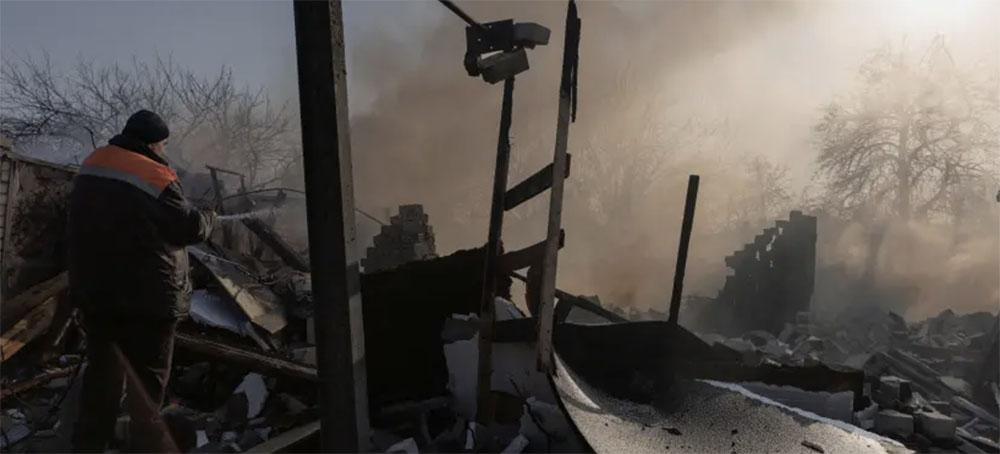 A resident extinguishes a fire after a bombing destroyed a family home in a northern district of Kharkiv as Russia's attack on Ukraine continues, Ukraine, March 24, 2022. (photo: Thomas Peter/Reuters)
Here's What Russia in Ukraine Did While You Were All Squabbling Over Biden's 'Attack' on Putin
Allison Quinn, The Daily Beast
Quinn writes: "While many in the West were busy debating Biden's words, Putin's troops were using white phosphorus munitions and snatching up civilians."
While many in the West were busy debating Biden’s words, Putin’s troops were using white phosphorus munitions and snatching up civilians.
Joe Biden’s off-the-cuff declaration on Saturday that Vladimir Putin “cannot remain in power,” almost immediately walked back by the White House, has dominated Western news coverage this weekend as it stepped on the message the president was trying to put out while giving a boost to the Kremlin’s fanatical propaganda claims about a “fifth column” supposedly working towards regime change in Russia.
But don’t let the wall-to-wall coverage of Biden’s “rhetorical escalation” distract you from the very literal, bloody escalations by Putin’s shock troops.
You may have heard about the six missiles Russia fired at the Ukrainian city of Lviv even as Biden was speaking just across the border.
But what about the reports of white phosphorus munitions being used by Russian troops on Saturday night—just as much of the Western world was in a tizzy over Biden’s assessment of Putin. Ukrainian forces in Avdiivka shared photos of the white phosphorus raining down, days after President Volodymyr Zelensky had warned the world that Russia was using “phosphorus bombs against peaceful people in Ukraine.”
Using a highly toxic chemical substance known for its ability to burn, as one chemical weapons expert put it, “very vigorously” through human flesh—that’s an escalation the whole world should be talking about.
Want another one?
The mayor of Slavutych on Saturday announced at least three civilian deaths as he said the northern city had been taken over by Russian troops. He said the decision to surrender was made to save civilian lives—and pleaded with relatives to come identify the bodies.
Imagine how many Ukrainians were agonizing over whether their missing loved ones were dead or alive while so many in the West focused on Biden’s speech, acting as if his comments might somehow drastically alter the trajectory of the war.
Their stories were pushed on the back burner as Western commentators speculated on how Russia might respond to Biden’s remark.
The story of survivors in Mariupol forced to bury their loved ones—or even complete strangers—in hastily dug graves in courtyards of apartment buildings.
The story of the funeral home there literally giving out empty coffins because there are so many dead bodies on the street.
“When burying the dead, put in the coffin at least some kind of information about the person,” the funeral home director, Nikolai Saparov, flatly advised on Facebook.
Ukrainians who said they’d made it out of Mariupol alive took to social media to vent about the nightmares they’d witnessed there playing on loop in their minds—and the fear that people in the West no longer want the realities of the war looping in their media feeds. That maybe it’s easier instead to nitpick over Biden’s remarks.
“Unfortunately, not many people want to hear about ripped off legs, fecal matter in buckets, and dead children with ashes instead of lungs,” one Twitter user wrote after she said she fled the devastated city.
It’s hard to look directly at what is happening in Ukraine for too long, and on some level people are probably getting tired hearing about all the dead children.
But don’t we owe it to the people standing up to Putin on behalf of the whole world to stay focused on what’s important there?
On the real escalation. On the war crimes. On the cities wiped off the face of the earth.
In case you missed it amid all the Biden-straight-talk-drama, Russian forces abducted hundreds of staff and sick patients from a Mariupol hospital on Saturday, according to local authorities.
The soldiers found the civilians taking shelter from the incessant bombing in the basement of the building, and snatched them “by force.” Sick people in need of urgent treatment. Taken away at gunpoint, presumably to somewhere in Russia.
But yes, by all means, let’s all keep bickering about the fallout over Biden pointing out that Putin’s a bad man.
READ MORE
 Yanis Varoufakis at his holiday home on the Greek island of Aegina: 'My commitment to my voters was that I'm not going to abandon them.' (photo: Nikos Pilos)
Yanis Varoufakis: The West Is "Playing With Fire" If It Pushes Regime Change in Nuclear-Armed Russia
Democracy Now!
Excerpt: "I cannot predict the future. But can the critics, who are, as you said, chastising me for adopting and promoting the neutrality solution - can they tell me what the alternative is?"
A month after the Russian invasion of Ukraine, more than 3.6 million Ukrainians have left the country as refugees, and the war risks becoming “an Afghanistan-like quagmire,” warns Greek lawmaker Yanis Varoufakis, founder of the Progressive International with U.S. Senator Bernie Sanders. He says the West’s sweeping sanctions on Russia and bottomless military aid to Ukraine risk escalating the conflict and foreclosing chances of a peaceful resolution. “What is exactly the aim? Is it regime change in Russia?” asks Varoufakis. “Well, whenever the United States tried regime change, it didn’t turn out very well and has never been tried with a nuclear power. This is like playing with fire.”
The European Union has signed a new deal to import more liquefied natural gas from the United States, in the latest move by NATO allies to further isolate Russia following its invasion of Ukraine. The gas deal was announced a day after President Biden took part in emergency meetings of NATO, the G7 and the European Council. During a press conference in Brussels, Biden announced new sanctions against Russia.
PRESIDENT JOE BIDEN: We’re also announcing new sanctions of more than 400 individuals and entities, aligned with — in alignment with the European Union: more than 300 members of the Duma, oligarchs and Russian defense companies that fuel the Russian war machine.
AMY GOODMAN: President Biden is in Poland today, where he’s scheduled to meet with U.S. troops, as well as Ukrainian refugees. According to the United Nations, more than 3.6 million Ukrainians have fled the country since the Russian invasion began a month ago. On Thursday, President Biden announced the United States will accept up to 100,000 Ukrainian refugees.
In the latest news from the battlefield, Russia is claiming it’s destroyed a military fuel depot outside Ukraine. It’s one of Ukraine’s largest.
Meanwhile, local officials in the besieged city of Mariupol say they fear 300 people died last week in a Russian airstrike on a theater, which was being used as a shelter. Outside, the words “child” were on either side of the building facing upward; the words were written in Russian.
This comes as the Ukrainian government is asking the United States to start providing 500 Javelin and 500 Stinger missiles a day to help Ukrainian forces fight the Russian invasion.
We begin today’s show with Yanis Varoufakis, member of the Greek Parliament, former finance minister of Greece, founder of the Progressive International with U.S. Senator Bernie Sanders. He’s joining us from Athens.
It’s great to have you with us. Thanks so much for joining us, Yanis. If you can respond to this triple summit yesterday in Brussels — of NATO, of the EU, the European Union, and of the G7 — of the increased sanctions and, overall, what this war means?
YANIS VAROUFAKIS: There is an unprecedented show of unity within the West, but what is lacking are two things, Amy, if I may say — firstly, an appreciation of the fact that the rest of the world is not showing complete alignment with the West. This is an understatement. Even though the majority of countries in the United Nations voted against Russia, if you look at the countries that didn’t, they contain more than half of the population of the world, including not just China but also India and many other countries.
The second thing that’s missing from this show of strength, and the impressive sanctions that have been agreed against Putin and his henchmen, is a game plan. Exactly what is President Biden aiming for? Yes, it is important for him and for his government, for his administration, to show support for the Ukrainians, to provide Stinger missiles, to provide economic sanctions for Putin, which of course we know are not going to debilitate the Putin regime. But what is exactly the aim? Is it regime change in Russia? Well, whenever the United States tried regime change, it didn’t turn out very well, and has never been tried with a nuclear power. This is like playing with fire, or nuclear fire, I should say. If it’s not regime change, what exactly is it?
And so, allow me to just say this, that the famed philosopher and military strategist from China, Sun Tzu, once said that if you are faced with a formidable enemy whose total defeat is going to kill many or most of your people, as well, what you should do, Sun Tzu said, was to build a golden bridge behind your enemy from which your enemy can escape, to give him an opportunity to withdraw while claiming that he has achieved something. Now, Biden, by proclaiming that Putin is a war criminal — I have no doubt that Putin is a very nasty piece of work; I’ve called him a war criminal 20 years ago over his massacre of Chechens in Grozny — but what is the leader of the United States doing? What is he aiming at? Because if he is not leaving any room for a compromise, then he is effectively jeopardizing the interests of Ukrainians, because a quagmire in — an Afghanistan-like quagmire in the Ukraine is not exactly in the interests of any Ukrainian I know of.
AMY GOODMAN: So, if you could talk about specifically what’s being targeted and this commitment to end the reliance on Russian energy, that is so difficult for Europe right now? I mean, it seems like at this moment, this is the moment that so many green activists, like yourself, have felt could be a shift toward renewables, but instead it looks like: How can other countries, like the United States and Canada, fill in the fossil fuel emergency that’s taking place right now? But what this means for Russia, what this means for the rest of the world?
YANIS VAROUFAKIS: I think the West is inflicting major political and environmental damage on itself, whereas Mr. Putin, being a cynical agent that he is — a KGB strategist, let’s not forget — I have no doubt he was planning for all this. In the end, we’re going to damage the planet and the West more than we’re going to damage Putin, because Putin doesn’t really care much about Russians. He cares about himself.
And I can see a game plan here on behalf of Vladimir Putin. Let’s not forget that, as we speak, around $600 million to $700 million is being sent to Mr. Putin for the oil and gas that he’s selling the West. The plans that you mentioned for transporting liquefied natural gas from Texas and from Qatar to Europe, that concerns next winter, not this winter. Are we going to sacrifice the Ukrainians until next winter? This is the great question. And also, as we speak, Russia has found ways of bypassing the sanctions. We know that they’re dealing with counterparties in China, in India. A lot of dollar payments are being made to the Putin regime through these intermediaries.
I would very much have preferred for us to be discussing — you and me now, but the whole world — to be discussing President Biden’s proposals for a resolution that would mean an immediate ceasefire and an immediate withdrawal from the Ukraine in exchange for some kind of deal that Putin can sell to his own henchmen as something of a victory. Instead of that, Biden is doubling down, and he’s speaking in language which is consistent with regime change, which will be catastrophic for the people of Ukraine.
AMY GOODMAN: So, explain this further. You’re saying Biden should be sitting down with Putin, that Biden represents the United States, the world’s largest superpower, and could lead to a ceasefire. What isn’t he doing?
YANIS VAROUFAKIS: That. Look, I wish — as a European and a Europeanist and internationalist, I wish the European Union existed in substance, so that, you know, the president of the European Union could be sitting down with Putin. But we don’t have that. The European Union is a disunion, really. So, Biden is the only representative of NATO, of the West at the moment. I’m not going to pass judgment on the gentleman. He is, however, the only one who can sit down with Putin. They can talk on the phone, to begin with, before they actually sit down. Their foreign ministers will have to come to these exchanges.
But the idea must be really very simple: Putin must be given a golden bridge from which to escape his conundrum. He must be given something he can sell to his own people as mission accomplished. The only thing we can do, as democrats and internationalists, we should be able to tolerate, is the neutrality of the Ukraine, because this is a tiny, tiny, nonexistent price to pay for ending the war, having Russian troops evacuate the Ukraine, some kind of arrangement to be established for the Donbas area — we could kick into the long grass the question of Crimea; it could be shelved, something to be discussed in 10 years or so — in order to stop the killing and to stop the toxicity which is spreading from Ukraine across Europe, across the United States. I’ve been hearing senators in the United States, members of parliament of various European countries calling for NATO to intervene — because we know what that will mean. It will mean that the nuclear threat is going to reach levels that we haven’t seen since the Cuban Missile Crisis. We should be moving towards a rational solution that will leave everybody slightly dissatisfied — the Ukrainians, the Russians, me, you, Biden, Putin — but which will end the killing and will lead to an independent, democratic Ukraine.
AMY GOODMAN: You write in a recent article headlined “Why Stop at the Russian oligarchs?” “Perhaps the only silver lining in the Ukrainian tragedy is that it has created an opportunity to scrutinize oligarchs not only with Russian passports but also their American, Saudi, Chinese, Indian, Nigerian, and, yes, Greek counterparts. An excellent place to start would be with the London mansions that Transparency International tells us sit empty. How about turning them over to refugees from Ukraine and Yemen?” Talk more about this.
YANIS VAROUFAKIS: For many, many years now, we’ve all known, through the Panama Papers, through a variety of leaks of Transparency International, that our oligarchs, the oligarchs of this planet — the Russians, the Qataris, the Saudis, the Americans, the Greeks — they have been absolutely abusing our societies, our states, our tax systems. Yes, the Russians are pretty ugly in what they’re doing. They have plundered, in a very short space of time, the mineral resources, the industries of Russia, after the collapse of the Soviet Union. And they have bought their mansions in London, football teams and so on.
So, you know, it’s a wonderful opportunity — the fact that the Ukraine has concentrated our minds on what the Russian oligarchs are doing — to contemplate moving beyond them, because Russian oligarchs, it has been estimated, have taken $200 billion out of Russia, you know, looted money, plundered money, but American oligarchs have taken $1,200 billion out of the jurisdiction of the United States of America, hiding it from the IRS. And they are not much nicer people than the Russian oligarchs, I have to say. They have not protested the massacres of Yemenis in Saudi Arabia. They have not protested the killing of journalists, like Khashoggi in the Saudi Arabian Embassy or Consulate in Constantinople — in Istanbul, I should say. They have not lifted their little finger to help us fund the green transition. Why should we not extend our newly found antipathy towards oligarchs, who have been defrauding and plundering our countries — why not extend it to people beyond Russia?
AMY GOODMAN: Let me ask you about some criticism that’s been leveled against your position right now, Yanis. I want to ask your response to a piece that was in The New Republic titled “'Neutrality' Won’t Protect Ukraine.” The authors mention you, writing, “An increasing number of international commentators are also arguing neutrality might be a reasonable way to end the bloodshed quickly, by offering Putin a face-saving ‘off-ramp’ for the invasion. Ostensibly progressive voices like former Greek Minister of Finance Yanis Varoufakis have called for the ‘Finlandization’ of Ukraine, referring to Finland’s quasi-forced neutrality during the Cold War; the Russians have suggested Austria, which was formally neutral but maintained trade relations with both the United States and the Soviet Union, as a model for Ukraine.” Can you respond to what they’re saying? Also right now Finland is talking about possibly joining NATO.
YANIS VAROUFAKIS: Well, let’s take Finland, shall we? Finland had a war with Russia, with the Soviets. There was a stalemate, very much like what we have now in Ukraine. And the result was neutrality. There was an agreement between Washington, on the one hand, and Moscow, on the other, that Moscow would not interfere with Finland, it would not invade, it would take its troops out, and Finland would be allowed to live an independent, Western, democratic lifestyle, as long as it doesn’t join NATO and it doesn’t host American or European armies in its territory. The result was a wonderful state, a country, you know, that in every ranking outranks your country, the United States, my country, Greece, when it comes to education, to democracy, to technological innovation. Remember Nokia and all the great companies that came out of Finland. Finland is a success story. Neutrality allowed Finland to have democracy, independence and success and shared prosperity, a social democratic country, similarly with Sweden, similarly with Austria. So it’s a well-tested and well-tried-out model.
The reason that Ukraine has not had the same opportunity so far — because some people will say that — it’s been said that they gave up their nuclear weapons, they were not in NATO, therefore they were neutral, and nevertheless they suffered incursions and now this invasion by Mr. Putin. Well, it wasn’t the same. What Ukraine lacks is a summit, a summit between the American president and the Russian president, a summit involving the government of the United States and the government of Russia. This is what Finland had, what Austria had. The two blocs, NATO and the Warsaw Pact, represented by the president of the Soviet Union, or the general secretary of Communist Party then, and the American president, or a series of American presidents, they agreed — they shook hands — that Finland, Sweden, Austria will be left alone, under conditions of neutrality, to prosper democratically and to be part of the West without being part of NATO.
Now, a similar arrangement, in my view, has a very good chance of granting the Ukrainians the space, the independence and the democracy they need. Now, there are no guarantees. I cannot predict the future. But can the critics, who are, as you said, chastising me for adopting and promoting the neutrality solution — can they tell me what the alternative is? Because the only alternative they can come up with is regime change in Moscow. Well, this will take 10 years, five years, eight years. What do we do with the Ukrainians who are dying until then? Are you — this is my question to them — prepared to sacrifice their lives and a fantastic chance of a successful neutrality outcome? Are you prepared to sacrifice all that for the purposes of regime change?
And I’ll say this once again, Amy — I’m addressing the people in the United States: How many times have an attempt by the American government to effect regime change anywhere in the world worked out well? Ask the women of Afghanistan. Ask the people of Iraq. How did that liberal imperialism work out for them? Not very well. Do they really propose to try this out with a nuclear power?
AMY GOODMAN: Yanis Varoufakis, I want to thank you for being with us — we’re going to have to leave it with that question — member of the Greek Parliament, former finance minister of Greece, founder of the Progressive International with U.S. Senator Bernie Sanders.
READ MORE
 'Some children have run away, punched employees and stopped eating. Others have tried to kill themselves.' (photo: Anuj Shrestha/ProPublica)
These Children Fled Afghanistan Without Their Families. They're Stuck in US Custody.
Melissa Sanchez and Anna Clark, ProPublica
Excerpt: "Nearly 200 Afghan children brought here without family by the U.S. government during the haphazard military pullout are languishing in federal custody."
Nearly 200 Afghan children brought here without family by the U.S. government during the haphazard military pullout are languishing in federal custody.
Seven months after the fall of Kabul, shelters in the U.S. caring for children evacuated without their parents are experiencing unprecedented violence while workers at the facilities have struggled to respond to the young Afghans’ trauma.
Some children have run away, punched employees and stopped eating. Others have tried to kill themselves. At one shelter, ProPublica has learned, some children reported being hurt by employees and sexually abused by other minors.
At least three shelters in Michigan and Illinois have shut down or paused operations after taking in large groups of Afghan children, prompting federal officials to transfer them from one facility to another, further upending their lives.
“This is not acceptable,” said Naheed Samadi Bahram, U.S. country director for the nonprofit Women for Afghan Women, which provides mentors to children in custody in New York. These children “left their homes with a dream to be stable, to be happy, to be safe. If we cannot offer that here in the U.S. that is a big failure.”
ProPublica reported in October on serious problems at a Chicago shelter that took in dozens of young Afghans. Since then, we’ve found that the troubles in the U.S. shelter system are more widespread.
This account is based on law enforcement records, internal documents and interviews with nearly two dozen people who have worked with or have talked with the children in facilities across the country, including shelter administrators and employees as well as interpreters, attorneys and volunteers.
Advocates for the children acknowledge that the Office of Refugee Resettlement — the federal agency responsible for overseeing the nation’s shelters for unaccompanied immigrant minors — is navigating an exceptional challenge. The haphazard evacuation of tens of thousands of people from Afghanistan last year as U.S. troops pulled out of the country left little time to prepare ORR facilities, which are accustomed to housing Central American children and teens. The COVID-19 pandemic created additional complications.
In all, some 1,400 unaccompanied Afghan minors were brought to the U.S. last year and placed in ORR custody. Of those, more than 1,200 have gone to live with sponsors, typically relatives or family friends.
Nearly all the remaining 190 are teenage boys with nobody here who can take them in. As of March 8, more than 80 Afghan children had been in ORR custody for at least five months, according to government data analyzed by the National Center for Youth Law. In a system that normally houses children for about a month, the young Afghans have been waiting in what seems like never-ending detention.
It’s unclear how or when children will be reunited with their families. The State Department is working to obtain travel documents for parents who remain in Afghanistan, a spokesperson said, but coordinating departures from Taliban-ruled Kabul has proven challenging.
The ORR said it has placed 56 of the 190 children in its custody into long-term or transitional foster care as of this week and is recruiting more families to take them in.
An ORR official, who spoke on the condition of anonymity, said the agency is doing its best to support the Afghan children by providing interpreters, mental health services, additional staffing and, in recent months, Afghan American mentors. But those efforts won’t “change the reality for a child that their parent is hiding from the Taliban or that their family has died or that they are grappling with some really terrible things that nobody should have to grapple with.”
“I do struggle to know what else we could be doing that we’ve already not been trying to do.”
And the ORR may soon face another challenge. With the Biden administration’s announcement Thursday that the U.S. will accept 100,000 Ukrainians fleeing war, people who work in the system are bracing for the children who may arrive without their parents.
On a cold and cloudy evening in early January, 19 boys were shuttled in vans to a shelter run by the nonprofit Samaritas in Grand Rapids, Michigan.
Employees at the shelter had heard that they might receive Afghan children but thought they’d have two or three weeks to prepare for their arrival.
Instead, they had 24 hours’ notice, according to one worker. (The ORR says it gave the shelter two weeks’ notice.) A federal emergency intake site that housed dozens of Afghan children almost 85 miles away in Albion, Michigan, had abruptly shut down, scattering children to facilities across the country, including Samaritas.
The shelter was not ready.
“Everything from the food to the reading material [to the] grievance procedures and the rules — everything that we had was set up for Central American kids,” one Samaritas employee said. “And now we were really screwed.”
On a given day, some 10,000 or so children and teens are in ORR custody around the country, the vast majority of them from Central America. Facilities that receive them tend to have employees who know their language and culture. Workers often speak Spanish or are Latin American immigrants or children of immigrants. They understand what motivates Central American teens to immigrate each year: pursuing a better education, fleeing gang violence and earning dollars to support families.
The children, too, often know what to expect because they’ve heard stories from friends and relatives who immigrated before them. They know it’ll be about 30 days in ORR custody before they’re sent to live with a sponsor.
“The Afghan kids were a completely different story,” said a former worker at a Pittsburgh shelter run by the nonprofit Holy Family Institute. “I felt so sorry for them. They’ve been there three, four months, and they still did not know if they would ever see their families again.”
The pivot to housing Afghan children left shelters flat-footed. Many needed prayer rugs, halal meat and connections to local Muslims who could lead Friday prayers. Even with interpreters who spoke Pashto or Dari, communication between children and employees was difficult, leading to misunderstandings and mistrust.
In the hours before the Afghan children arrived in Grand Rapids, the Samaritas worker said staff members were scrambling: “OK, like, what language do they speak? ... It was a culture shock for them. It was a culture shock for us.”
There were many “unexpected complications,” said Samaritas Chief Operations Officer Kevin Van Den Bosch, but “we looked at the challenge, and said, ‘If not us, who is going to do it?’”
Employees at several shelters described the trauma among the youths as more severe than anything they’d seen. Children are desperate to call home to check on their parents and other relatives, some of whom worked for the U.S. government or for contractors and are now potential targets for the Taliban.
Some feel guilty for being in the U.S. while their families fear for their lives in Afghanistan.
After the Afghan children arrived at Samaritas, Grand Rapids police responded nearly every other day to calls for incidents like missing persons, suicide threats, fights and assaults. The police reports were unavailable, but internal shelter records document many of those incidents.
One boy put a rope around his neck, “acting like he wanted to hang himself.” Another day, a boy tried to suffocate another child with a plastic bag. A few days later, a worker found a boy scratching his forearm. He told her that “when his body is in pain, it prevents his head from thinking about his problems.”
Meanwhile, Michigan’s Department of Health and Human Services, which oversees the state’s Children’s Protective Services, is investigating allegations related to Samaritas, though it’s not clear what the allegations involve. A department spokesperson, Bob Wheaton, said the agency was prohibited by law from disclosing details.
Samaritas officials said that, while the nonprofit could not provide information about the allegations, the agency follows robust safety protocols to protect the youth in its care. That includes background checks, cameras at the facility and safety plans for children at risk of self-harm. “We take every, every allegation, or everything that a youth says seriously,” Van Den Bosch said, “and everything gets reported.”
Advocates said the struggles of some of the Afghan children should have been anticipated.
“Even children who have no prior traumatic experiences would begin to show signs of distress at this point, being in shelter care for this long,” said Saman Hamidi-Azar, who visits children in ORR facilities as a volunteer with Afghan Refugee Relief, a community organization in California. “There is nowhere to pinpoint blame except for the manner in which Afghanistan is evacuated: way too fast. No one was prepared on the ground here. No one could have expected what happened.”
In Chicago, ProPublica reported last fall on how the challenges involving Afghan children at a shelter operated by Heartland Human Care Services were exacerbated by the lack of on-site interpreters.
After the story was published, lawmakers called for an investigation and Heartland received interpreters.
But in the months that followed, police were called repeatedly to the facility. In January, officers arrested a 16-year-old boy accused of kicking and punching two workers. According to the police report, the boy said he was upset about being separated from his friends.
In a statement, Heartland said it’s not equipped to provide the mental health support some Afghan children need. “Heartland is not alone in our experience of how the severe lack of access to mental health resources dramatically impacted unaccompanied Afghan youth who arrived in this country last fall,” an official wrote.
The official said it stopped taking in children “after the challenging past few months” to support front-line staff through team-building and training. Heartland recently resumed operations, though at a reduced capacity.
Starr Commonwealth, the emergency intake site in Albion, seemed to get off to a better start. It offered a welcoming setting with residential cottages on a lush green campus when Afghan children arrived last fall. Unlike Heartland, it had Dari and Pashto interpreters on site from the outset.
But attorneys who visited children at Starr raised red flags early on. The site was too restrictive, they said, and children complained about a lack of physical activity and phones to call their families.
What’s more, because of its status as a federal emergency intake site, Starr wasn’t licensed by the state. Immigration advocates have long criticized the government’s use of these emergency facilities because they operate without independent state oversight.
The federal government had begun leasing the campus from a nonprofit with the same name last spring in response to large numbers of Central American children crossing the border. Starr later shifted focus to housing Afghan children.
As the children remained long past the short stays Starr was designed to accommodate, the local sheriff’s office started fielding calls about fights, runaways and suicidal behavior. A volunteer who often visited the facility — and asked not to be identified to avoid the risk of losing access to children in ORR custody — said children would tell her they “were crying all night long” and ask for prayers to help with depression.
She told her husband the shelter reminded her of a prison.
Before Starr shut down in early January, the sheriff’s office in Calhoun County received referrals for at least five child welfare allegations in the final three weeks, records show. In one case, a 16-year-old said two workers shoved and yelled at him. When interviewed by a deputy, one of the workers acknowledged yelling out of frustration but said he “does not put his hands” on the children.
The other worker was separately suspended after being accused of kicking a boy who was praying, according to a report. Neither led to charges. In the case in which the 16-year-old said he was shoved, the Calhoun County prosecutor’s office determined an assault did not take place. In the second, the child who said that he was kicked could not be located because he had been transferred elsewhere, Prosecuting Attorney David Gilbert said.
There were other troubles. Authorities responded to three allegations of sexual abuse or inappropriate behavior between children, including one from an 8-year-old boy who told a counselor that a 13-year-old boy came into his room at night and touched him. “He is scared and does not feel safe,” according to a sheriff’s department report. But by the time the prosecutors got this case, too, the children were no longer at Starr and could not be located, Gilbert said.
It’s unclear who employed the workers, as Starr was mostly staffed by PAE Applied Technologies, a federal contractor. A company representative declined to comment. Other workers came from a variety of federal agencies that loaned their services to the ORR.
A spokesperson for Starr said the nonprofit “did share a number of concerns” with both ORR and PAE. But Starr was “purely serving as a landlord,” she added, and “the government, not Starr, is solely responsible for programming and caring for children through its ORR program.”
Wheaton, from the state’s Department of Health and Human Services, said the agency had no jurisdiction over Starr but forwarded allegations to local law enforcement and federal authorities.
The ORR official said that the agency has a “zero-tolerance policy for abuse of any kind” and that employees accused of abuse are immediately terminated or put on administrative leave. Facilities also send allegations to local law enforcement, child protective services, the U.S. Department of Health and Human Services’ inspector general and the FBI.
At Starr and shelters around the country, workers said that they were overwhelmed. Some expressed frustration, calling the youth “spoiled” for asking for more phone time and Afghan food — which, over time, they received. Other employees suspected their colleagues were afraid of the children. One volunteer called the situation inside a shelter a “pressure cooker.”
Workers and others at several facilities said they heard children say they'd been told that if they misbehaved, they’d be sent back to Afghanistan.
ORR officials said any threats against children are unacceptable, and employees accused of maltreatment are placed on leave until all the details of what happened are understood.
Staffing shortages exacerbated tensions. In recent weeks, Samaritas administrators offered workers a $500 bonus if they picked up an extra shift, according to emails obtained by ProPublica.
“The depth and breadth of the need, and the sudden nature of it ... put everybody in a really tough spot,” Sam Beals, Samaritas’ chief executive, said. “When I think of what these kids have gone through ... it’s shocking they don’t act out more.”
Last week, Samaritas paused operations at the Grand Rapids shelter to hire and train staff.
The decision was made by the Lutheran Immigration and Refugee Services, which holds Samaritas’ grant with the ORR, according to federal officials. Lutheran Immigration did not respond to requests for comment.
Less than three months after they arrived at Samaritas, the Afghan children were on the move again, transferred to new facilities. Employees made it a point to prepare the children by taking them on virtual or physical tours when possible. The last child left the Samaritas shelter last weekend.
Melissa Adamson, an attorney with the National Center for Youth Law who is authorized to interview children in U.S. immigration custody, said the repeated transfers of the Afghan youth “further destabilizes their already fragile sense of security.”
Last fall, the ORR began offering special training for staff at shelters serving Afghan children. The agency also began allowing volunteer mentors from the Afghan American community to visit and provide emotional support to children, federal officials said.
In January, the ORR began sending Muslim and Afghan American mental health specialists to shelters through a program with the U.S. Committee for Refugees and Immigrants.
The changes made a difference, said Hamidi-Azar — whose organization is part of a coalition of Afghan American community groups, advocates and others that mobilized last fall to assist evacuees in the U.S. “You have to give credit where it’s due,” she said. “From government agencies to community activists, we have all been trying to find a way to make the situation better.”
After visiting children at one shelter in California, one Afghan American volunteer realized she could do more: She became a foster mom and welcomed two small boys — cousins — to her home.
The woman, who asked not to be identified to protect the children’s privacy, took time off work to bond with the boys and enroll them in the neighborhood school.
“They have adjusted well and are so happy to be in a home environment,” she said. “Being able to experience many firsts has been pretty special” — including a trip to the beach and a ride on a carousel.
Theirs is the kind of story advocates around the country want for Afghan children languishing in ORR custody. But the foster care system is backlogged, and finding homes for teenage boys is especially difficult. Foster parents often prefer and are licensed to care for younger children.
The ORR has partnered with organizations like the Muslim Foster Care Association to recruit more foster families. Approximately 80 Afghan families are awaiting licensing, a process that varies by state.
The foster mom in California thinks often about all the children still waiting for what’s next.
“As happy as I was that these boys were placed [with me], there were kids at the shelter that were devastated,” she said. “I know that one kid was crying: ‘Why? Why didn’t a family want me? What did I do?’”
READ MORE
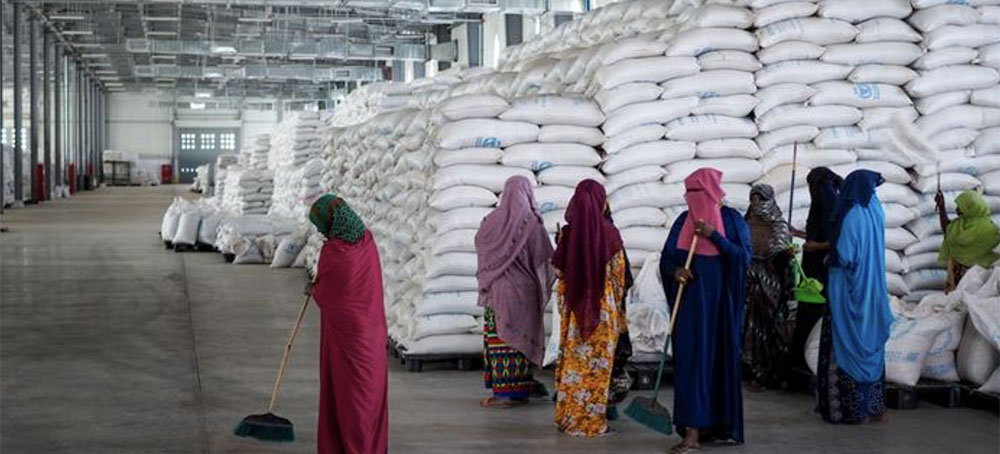 Three quarters of Tigray's population are using 'extreme coping strategies' to survive. (photo: AP)
Ethiopia: Tigray Forces Accept 'Humanitarian' Cease-Fire
Deutsche Welle
Excerpt: "The Tigray People's Liberation Front (TPLF) fighters on Friday agreed to respect a cease-fire in the northern Tigray region."
Tigray fighters have agreed to uphold a cease-fire in the war-ravaged Tigray region to allow for the delivery of aid. Hundreds of thousands of people in Tigray face starvation.
The Tigray People's Liberation Front (TPLF) fighters on Friday agreed to respect a cease-fire in the northern Tigray region.
The rebels told the AFP news agency they were "committed to implementing a cessation of hostilities effective immediately" and asked Ethiopian federal authorities to deliver emergency aid to the region.
On Thursday, the Ethiopian government called for an immediate, "indefinite humanitarian truce" that would help aid deliveries reach the populace and called on the Tigray rebels to observe the cease-fire.
Hundreds of thousands of people in the war-ravaged region face starvation.
"The government calls upon the donor community to redouble their generous contributions to alleviate the situation and reiterates its commitment to work in collaboration with relevant organizations to expedite the provision of humanitarian assistance to those in need," a statement issued by the Government Communication Service said.
"To optimize the success of the humanitarian truce, the government calls upon the insurgents in Tigray to desist from all acts of further aggression and withdraw from areas they have occupied in neighboring regions," the government added.
How bad is the situation in Tigray?
The government of Ethiopian Prime Minister Abiy Ahmed has faced increasing pressure to ensure humanitarian aid reaches the region. It has been largely cut off from food, aid, medical supplies, cash and fuel since June.
The Tigray region has a population of around 6 million. The United Nations said in January that as many as 40% of the people there are on the edge of famine. The World Food Program warned that three-quarters of Tigray's population "using extreme coping strategies to survive" and more than a third "are suffering an extreme lack of food."
The latest announcement comes shortly after US Special Envoy for the Horn of Africa, David Satterfield, visited the capital Addis Ababa.
Government forces have been fighting the Tigray People's Liberation Front for 16 months, after Tigray leaders broke away from the government.
Thousands of people have died, and many more have been forced to flee their homes as the conflict has expanded from Tigray to the neighbouring regions of Amhara and Afar.
READ MORE
 Forests, such as this one in Indonesia, do more than just store carbon. (photo: Xinhua/Rex/Shutterstock)
The World's Forests Do More Than Just Store Carbon, New Research Finds
Nina Lakhani, Guardian UK
Lakhani writes: "The world's forests play a far greater and more complex role in tackling climate crisis than previously thought, due to their physical effects on global and local temperatures, according to new research."
New data suggests forests help keep the Earth at least half of a degree cooler, protecting us from the effects of climate crisis
The world’s forests play a far greater and more complex role in tackling climate crisis than previously thought, due to their physical effects on global and local temperatures, according to new research.
The role of forests as carbon sponges is well established. But comprehensive new data suggests that forests deliver climate benefits well beyond just storing carbon, helping to keep air near and far cool and moist due to the way they physically transform energy and water.
The study, which is the first to pinpoint the non-carbon dioxide benefits of different forests, found that the band of tropical rainforests spanning Latin America, central Africa and south-east Asia generate the most local and global benefits.
Researchers from the US and Colombia found that overall forests keep the planet at least half of a degree Celsius cooler when biophysical effects – from chemical compounds to turbulence and the reflection of light – are combined with carbon dioxide.
In the tropics – from Brazil and Guatemala to Chad, Cameroon and Indonesia – the cooling effect is more than one degree. In short, while all forests provide multiple benefits, some are more important than others in keeping the climate stable.
“Despite the mounting evidence that forests deliver myriad climate benefits, trees are still viewed just as sticks of carbon by many policymakers in the climate change arena,” said Louis Verchot, principal scientist at the International Center for Tropical Agriculture (CIAT) and co-author of the study The Unseen Effects of Deforestation: Biophysical Effects on Climate. “Forests are key to mitigation, but also adaptation.”
Deforestation has devastating impacts on biodiversity, food security, and global heating. A recent report by the Intergovernmental Panel on Climate Change (IPCC) warned about catastrophic consequences humanity faces with rising temperatures.
The findings, published in the journal Frontiers in Forests and Global Change, suggest that forests are important to mitigation and adaptation, cooling the air and protecting us from droughts, extreme heat and floods caused by the climate breakdown.
Forest cooling is due to a range of biophysical effects such as the physical aspect of the trees’ wood, leaves and density, as opposed to biochemical factors such as the carbon.
Researchers found that forests emit chemicals called biogenic volatile organic compounds (BVOCs) which create aerosols that reflect incoming energy and form clouds – both are cooling effects. While they also lead to a buildup of two greenhouse gases – ozone and methane – on balance, the cooling outweighs the warming.
Deep roots, efficient water use and so-called canopy roughness also enable forests to mitigate the impact of extreme heat.
These physical qualities allow trees to move heat and moisture away from the Earth’s surface where we live, which directly cools the local area and influences cloud formation and rainfall – which has ramifications far away.
In the tropics, where forest carbon storage and sequestration rates are highest, the biophysical effects of forests amplify the carbon benefits. In other words, tropical deforestation immediately increases extreme heat locally and decreases regional and local rainfall.
“The biophysical factors don’t cool the planet, but they do change the way we experience heat, and that matters,” said Deborah Lawrence, professor at the University of Virginia and the lead author. “The heart of the tropics is at the heart of the planet and these forests are critical for our survival.”
Better protection, expansion and improved management of the world’s forests are considered by many experts as among the most promising nature-based solutions.
Michael Coe, the tropics program director at the Woodwell Climate Research Center and a study co-author, said: “Without the forest cover we have now, the planet would be hotter and the weather more extreme. Forests provide us defense against the worst-case global warming scenarios.”
READ MORE
Special Coverage: Ukraine, A Historic Resistance
READ MORE
Contribute to RSN
Follow us on facebook and twitter!
Update My Monthly Donation
PO Box 2043 / Citrus Heights, CA 95611


