
We have always said we never cut off any subscriber for not paying or donating and we don’t. But the service providers that keep RSN up and running are not so understanding.
To keep the process going some money is required.
Do what you can.
Marc Ash
Founder, Reader Supported News
If you would prefer to send a check:
Reader Supported News
PO Box 2043 / Citrus Heights, CA 95611
Follow us on facebook and twitter!

18 April 22
Live on the homepage now!
Reader Supported News

The article called for even more bloodshed in Ukraine.
Written by journalist and Kremlin-aligned political operative Timofey Sergeytsev and published in RIA-Novosti, the article answers the question posed by its headline: “What should Russia do with Ukraine?”
The answer, Sergeytsev writes, is total annihilation. He writes that “all who have associated themselves with Nazism should be liquidated and banned.”
Sergeytsev urges Russian soldiers to be merciless and force Ukraine to its knees and calls for more of the same inhumane tactics that took place in Bucha and the towns of Mariupul and Berdyansk.
As an academic focusing on Russian government, politics and society, I believe the article demonstrates what is foremost on the mind of President Vladimir Putin’s regime.
The silencing of independent Russian media
Sergeytsev’s piece merits close attention because RIA-Novosti is one of the three largest news agencies in Russia and has a mass circulation. It functions as a loyal mouthpiece of the Russian government and has an inordinate impact on what Russians see and hear about the war in Ukraine.
This is the result of the Russian government’s ever tightening control over independent media since 2000, when Putin became president. In his first year in power, Putin shut down companies of media businessman Vladimir Gusinsky.
Since then, Putin has used what is known as the Roskomnadzor, the Federal Service for Supervision of Communications, Information technology and Mass Media, a federal agency that monitors and censors Russian mass media and decides which need to be shut down.
In 2022 alone, Putin closed the last remaining independent sources of information in Russia: liberal radio station Ekho Moskvy, online television channel TV Rain, bilingual news site Meduza and Novaya Gazeta, whose editor, Dmitry Muratov, was awarded the Nobel Peace Prize in 2021.
The Russian government not only has total control over all media, but it dictates what can be seen and heard. The war in Ukraine, for instance, can only be referred to as “a special military operation.” Anyone who calls it a “war” is subject to a prison term of 15 years.
Given where it appeared, Sergeytsev’s article must have been published with the knowledge and approval of the Russian government.
Who is Sergeytsev?
Sergeytsev is an experienced Russian political operative who worked on behalf of the Russian government to prop up pro-Russian Ukrainian president Leonid Kuchma in 1991. He also supported Ukrainian President Viktor Yanukovych, whose questionable election victory, promoted by Putin, resulted in Ukraine’s Orange Revolution of 2004.
Sergeytsev is also a member of the Russian far right Zinoviev Club, named after Alexander Zinoviev. Zinoviev was a champion of Josef Stalin as a model leader, the murderous dictator who ruled the Soviet Union from 1928 to 1953.
Given this pedigree, it’s not surprising that it was Sergeytsev who wrote the answer to the question about what Russia should do about Ukraine.
A fight against Nazis?
In the invented world he describes in his article, Sergeytsev accuses both Ukraine’s former President Petro Poroshenko and current President, Volodymyr Zelensky, of using “total terror” against the Russian “anti-fascists in Odesa, Kharkov, Dnepropetrovsk, Mariupol and other Russia cities.”
As for the Donbass regions of Donetsk and Lukhansk in Ukraine’s east, where pro-Russian separatists have fought Ukraine over the past eight years, Sergeytsev says they have been bravely rebelling “against Ukrainian Nazism.”
Sergeytsev calls for the destruction of all “Nazis that have taken up arms” and that they “should be destroyed to the maximum on the battlefield.”
He includes the Ukrainian armed forces, the national battalions, the territorial defense forces and “a significant part of the masses, which are passive Nazis” and “are also guilty.”
All “are equally involved in extreme cruelty against the civilian population, equally guilty of the genocide of the Russian people, and do not comply with laws and customs of war,” Sergeytsev writes.
In this piece of bald disinformation, Sergeytsev further writes that the majority of Ukrainians have been drawn to the Nazi politics of their government and “this fact is the basis of the policy of denazification.”
The idea of Zelensky, the only Jewish president outside of Israel, subscribing to Nazi ideology along with his government has nothing to do with reality.
Russian propaganda
Sergeytsev’s choice of words, such as “de-Ukrainization” and “denazification,” are terms calling for the destruction of Ukraine. In his April 4 article of 1,700 words, Sergeytsev uses the word Nazi 69 times.
In order to achieve the ultimate goal of “de-Ukrainization,” Sergeytsev calls for a rejection of Ukrainian ethnicity and the peoples’ right to self-determination.
Echoing Putin, Sergeytsev writes that Ukraine has never been a nation state, adding that its attempts at becoming independent have led to “Nazism.”
Sergeytsev calls on all of Ukraine’s elite to be “liquidated” and “the social swamp which actively and passively supports it should undergo the hardship of war and digest the experience as a historical lesson and atonement.”
The constant use of the word “Nazi” triggers a visceral reaction among the Russian population. During World War II, the Soviet Union suffered horrible atrocities at the hands of the Nazis. In one example, the Nazi blockade of Leningrad lasted from September 1941 until January 1944, a total of 900 days. An estimated over 1 million people died from systematic starvation.
Using the word “Nazi” is bearing fruit for the Kremlin.
The independent polling center Levada showed in late March polls, one month into the invasion, that 83% of Russians approved of Putin.
But despite Russian media efforts to falsely portray Ukrainians as Nazis, there have been reports of Russian soldiers captured by Ukrainian military confused by the purpose of the war, saying they couldn’t find any Nazis or fascists.
Old and new boundaries
In addition to calling for the need for “de-Ukrainization,” Sergeytsev writes that Ukraine “must be returned to its natural boundaries.”
These boundaries were the ones formed between 1765 and 1783 after Russia’s Empress Catherine the Great defeated the Turks, annexed Crimea and incorporated the entire southern part of today’s Ukraine known as Novorossiya into the Russian empire.
Sergeytsev says that the five regions in western Ukraine, which he refers to as the “residual Ukraine in a neutral state,” are not likely to become part of the pro-Russian territories and will remain hostile to Russia. “The haters of Russia will go there,” he writes.
For Sergeytsev, compromising with the United States, NATO and other Western nations is not an option.
The reason, Sergeytsev concludes, is because the “collective West itself is the designer, source and sponsor of Ukrainian Nazism.”
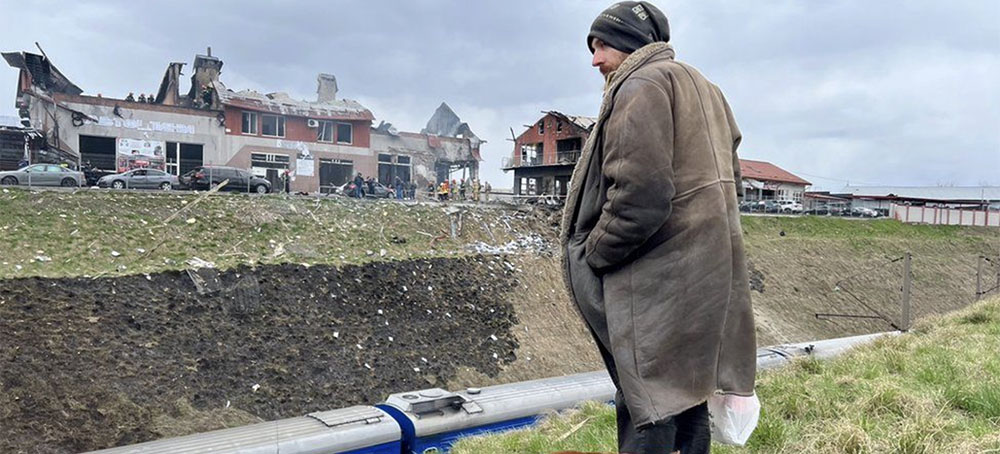 Ukrainian authorities said the Russians hit three warehouses and a car service station in Lviv. (photo: Jewan Abdi/BBC)
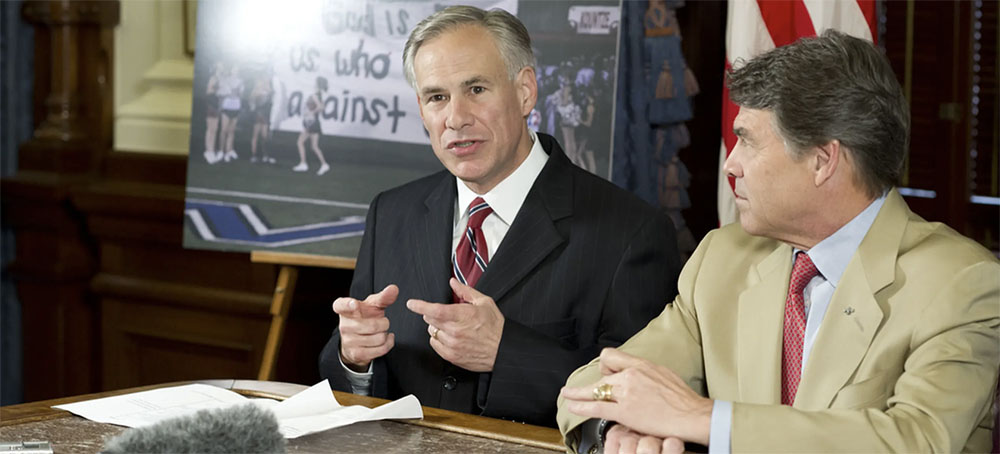 Attorney General Greg Abbott, left, and Gov. Rick Perry. (photo: Bob Daemmrich/Texas Tribune)
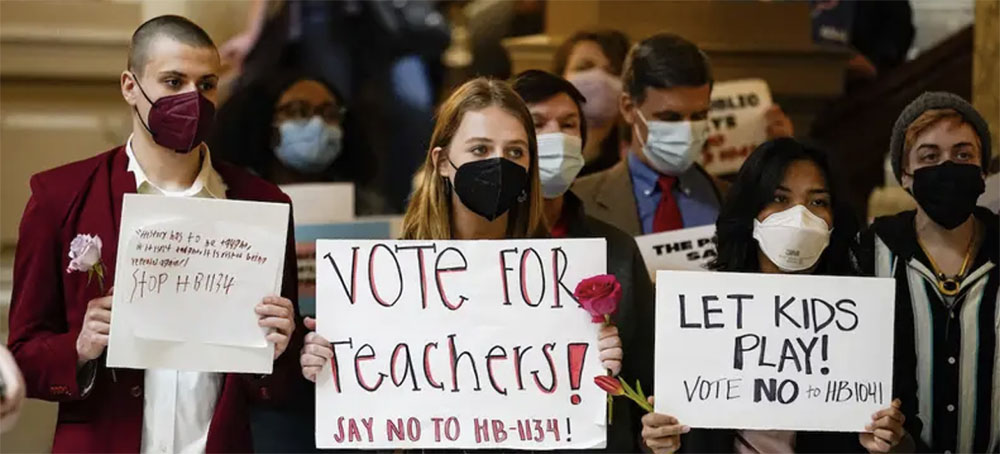 Protesters carry signs at a rally held in opposition to anti-LGTBQ bills being considered at the statehouse in Indianapolis, on Feb. 16, 2022. (photo: Michael Conroy/AP)
“They’ve stopped trying to pretend that they’re doing anything other than coming after LGBTQ people because they don’t like us.”
For those fighting against these laws, the onslaught has been overwhelming.
“It feels relentless and never-ending at this moment, which I haven’t felt in quite some time,” said Ricardo Martinez, CEO of Equality Texas. “It feels like we’re being attacked from many places. It feels like we’re being erased, or people are trying to erase us from schools.”
But these LGBTQ advocates are also clear-eyed when it comes to the political strategy they’re up against — one that centers on classrooms. Schools have been the subject of intense political fights since the start of the pandemic as angry parents vented about masks or vaccines at once sleepy school board meetings. Conservative strategists then weaponized that anger in nonsense fights over critical race theory, leading to school board elections that were suddenly fiercely partisan. Now, LGBTQ activists say, the same playbook is being used yet again.
“Folks have learned about what was most effective from previous cycles,” said Melanie Willingham-Jaggers, executive director of GLSEN, a national group advocating for LGBTQ students. “They’ve taken those little bits of what had been successful and gained traction, and they’ve pumped it full of steroids and they’ve unleashed it on all of us.”
“It’s a classic case of ‘We’ll throw this at the wall and see if it sticks.’ And when they do, they’re gonna run with it and they’re gonna keep going,” said Allison Scott, the director of impact and innovation at the Campaign for Southern Equality. “And they found that going after LGBTQ children and schools is something that they can make stick.”
Adam Polaski, CSE’s communications director, said the pandemic had served as a “throughline” or connecting theme in right-wing strategy, particularly when it comes to “activating” parents who attend school board meetings and hear discussions about curriculum that they also object to.
“You’re there to complain about the pandemic and complain about school closures or whatever…but you have this extreme and very engaged group of people who go and then they get activated on all the other issues too,” Polaski said.
Right-wing activists have been open about how influential schools and board meetings have been in engaging parents on issues beyond the pandemic. In an interview with BuzzFeed News last year, Sherronna Bishop, a right-wing activist in Colorado who previously served as campaign manager for Republican Rep. Lauren Boebert, also said that listening in on their children’s remote learning had shocked many parents.
“We started seeing what curriculum they were learning, we started hearing the lessons that were being taught to them, and we started realizing that we don’t really align with a lot of what’s being taught to them,” Bishop said.
Tim Miller, a gay man who served as communications director for Jeb Bush’s 2016 presidential bid before quitting the Republican party in 2020, said his old colleagues on the right were energized and inspired by Glenn Youngkin’s successful bid for the Virginia governorship last year on a campaign that emphasized parental sway over schools and curriculum.
“They see school and this frame of ‘We’re going to protect children from all this liberal propaganda that's being pushed in schools’ as a winning message,” Miller said. “And so it all kind of ties together: the COVID school closings, the CRT hysteria, and now these ‘Don’t Say Gay’ bills.”
In at least one state, the link between CRT and anti-LGBTQ policies is quite literal. Ohio House Bill 616 is overwhelmingly concerned with banning CRT and the 1619 Project in schools, but also sandwiches in restrictions on teachings about sexual orientation and gender identity.
“[Republicans] have been, as a strategic matter, pretty good at tying this all together, and having it support that broader message that they're looking at protecting kids. It’s preposterous, but I think that message is working,” Miller said. “And I think that’s why the gays just kind of got sucked up in this.”
As part of this recent legislative push, transgender Americans have come under the most intense assault — and the pace is quickening. In 2020, there were 79 bills introduced in state houses that targeted trans people, according to Cathryn Oakley, state legislative director and senior counsel at the Human Rights Campaign. Last year, that number jumped to 150 bills.
“This year, we’re at about 140 — and it’s just April,” Oakley said. “This will be the most anti-transgender legislative session of all time in the state legislatures.”
Polaski, with the CSE, said the number and nature of states going after LGBTQ people has also surprised him.
“It almost feels like the shift this year has been that some states where folks are like, ‘Oh, but they wouldn't pass anything anti-LGBT’ suddenly are,” said Polaski, pointing to Florida and its gay-friendly cities like Miami, Orlando, and Tampa. “It’s waking people up into the idea that, ‘Oh, the anti-LGBT sentiment hasn’t gone away.’”
What feels different for Oakley now is that she thinks her opponents have abandoned any pretense that their laws are designed to protect people, as they did by spreading the myth about trans women being predators in bathrooms.
“They crossed a line several years ago, but they have just crossed another line somehow,” Oakley said. “They’re no longer trying to mask the cruelty that is motivating them. They’ve stopped trying to pretend that they’re doing anything other than coming after LGBTQ people because they don’t like us.”
Things are certainly getting uglier. Suddenly, gays are again being equated to pedophiles, a disgusting trope that was revived when Christina Pushaw, press secretary to Florida Gov. Ron DeSantis, wrote on Twitter last month that his Parental Rights in Education Act was an “Anti-Grooming Bill.” The grooming term was suddenly everywhere, from Fox News to Congress.
Soon, people were arguing that merely being out as a teacher was a threat to children. “These are the people teaching your kids,” the right-wing Twitter account @LibsOfTikTok wrote to its 600,000 followers about a video of a fifth-grade teacher who told his class he was gay. “Any teacher who comes out to their students should be fired on the spot.”
The suggestion that gay people prey on children in order to “convert” them is not only a false claim but also a tired one that stretches back decades. The New York Times has dubbed it “vintage homophobia.” But much as the classroom strategy has been replicated and repackaged, so too have old anti-gay slurs.
“These are words that were used in the ’70s that were effective in messaging back then. I’m not surprised they’re being used now because a lot of the strategy is being replicated,” said Martinez, the Equality Texas CEO. “It’s meant to scare people. It’s meant to go back to the message of protection. You’re protecting someone from some scary bogeyman. It’s another fictitious moral emergency. It’s used to make people more afraid than they are right now.”
All of this is happening at a time when Americans’ support for LGBTQ people is at historic highs, but that context is important for understanding the aim behind this “nasty, drive-by homophobia,” Slate legal writer Mark Joseph Stern has argued.
“It seems to me that casual mockery of gay people and their families is on the rise among the conservative media figures whose job is to restore a cultural environment in which anti-gay legislation is deemed acceptable,” Stern said. “We are backsliding on gay rights with truly shocking speed.”
Both Miller and Oakley said they suspected that much of the ugliest rhetoric was directed at the Republican party’s die-hard fringes, as well as winking to believers of QAnon, the collective delusion that claims to be aimed at protecting children from secret sexual abuse by the powerful.
“If you incentivize making the most outrageous attacks on the libs,” Miller said, “and then a debate comes up where there’s discussion of grooming and pedophilia, obviously it’s going to be a popular attack for Republicans to use because their voters are rewarding them when they are as nasty and mean as possible to their perceived enemies.”
And while that may play well in the short term, it could backfire with the broader electorate.
“I think that by saying the quiet part out loud, they’ve abandoned any effort to sort of persuade a white suburban mom,” Oakley said. “I think it’s going to backfire because for lots of folks who maybe did have questions about what is fair for a 14-year-old trans girl who wants to play lacrosse — those people are going to be like, ‘Oh, the QAnon people are behind us? OK, maybe I’ll just not worry about this.’”
In the meantime, the five LGBTQ activists and organizers who spoke with BuzzFeed News for this story all stressed the critical need to educate people about LGBTQ issues and particularly what being transgender does and does not mean.
“Being gay is not contagious, being trans is not contagious, being nonbinary is not contagious,” Willingham-Jaggers of GLSEN said. “But what we are seeing legislatively is this assertion that ‘As a parent, I get to tell my child who to be,’ and that’s heartbreaking.”
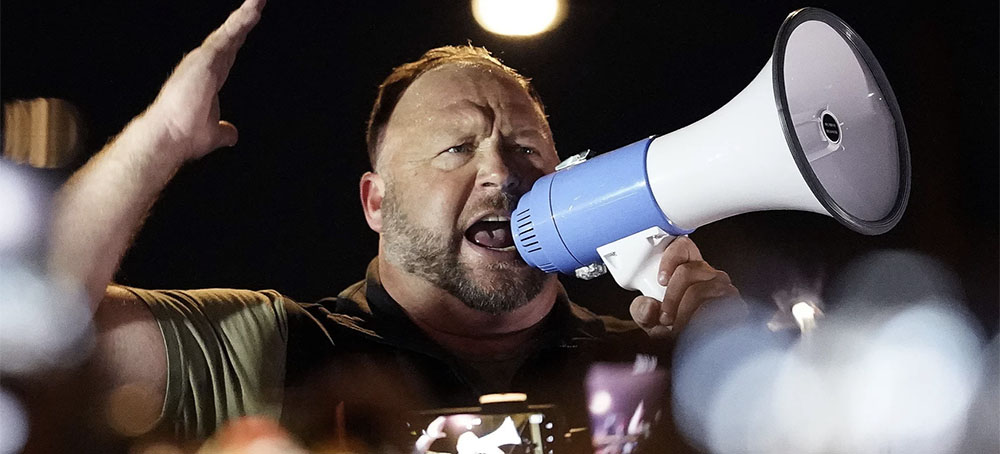 Infowars host and conspiracy theorist Alex Jones rallies pro-Trump supporters outside the Maricopa County Recorder's Office, on Nov. 5, 2020, in Phoenix. (photo: Matt York/AP)
Jones, who's repeatedly called the 2012 shooting at Sandy Hook Elementary School in Connecticut a hoax, has been sued several times by the victims' family members and others for defamation and emotional distress. Twenty children and six educators were killed in the attack.
His comments and similar ones made by other InfoWars employees are the primary cause of the "financial distress" now facing InfoWars and its related holding companies, according to the chapter 11 bankruptcy filing in U.S. Bankruptcy Court in the Southern District of Texas.
InfoWars, which described itself in court records as a "conspiracy-oriented website and media company," said it had $50,000 or less in assets and between $1 million and $10 million in liabilities.
Jones, InfoWars and related holding companies have so far spent $10 million on legal fees and costs, the filing said.
Courts in Connecticut and Texas have found Jones liable in several defamation cases brought by Sandy Hook families and others, though damages have not been determined in either case.
In its filing, InfoWars said that there is a "substantial likelihood" that once damages are determined in the Texas case, which is scheduled to begin jury selection next week, there will be nothing left for the Connecticut plaintiffs given the companies' "limited cash on hand."
InfoWars is also a defendant in several other lawsuits, including one involving an article written about the Marjory Stoneman Douglas High School shooting in Parkland, Fla., and another alleging that Jones diverted some of his assets to companies owned by himself or family members.
It was unclear what effect the bankruptcy filing would have on InfoWars. The company did not immediately respond to a request for comment from NPR.
The companies are asking the court to consider their application on an emergency basis by April 22.
 A group of migrants from Cameroon at the El Chaparral border crossing in Tijuana, Mexico. The Biden administration announced on Friday that it would offer temporary protected status to nationals of Cameroon. (photo: Mauricio Lima/NYT)
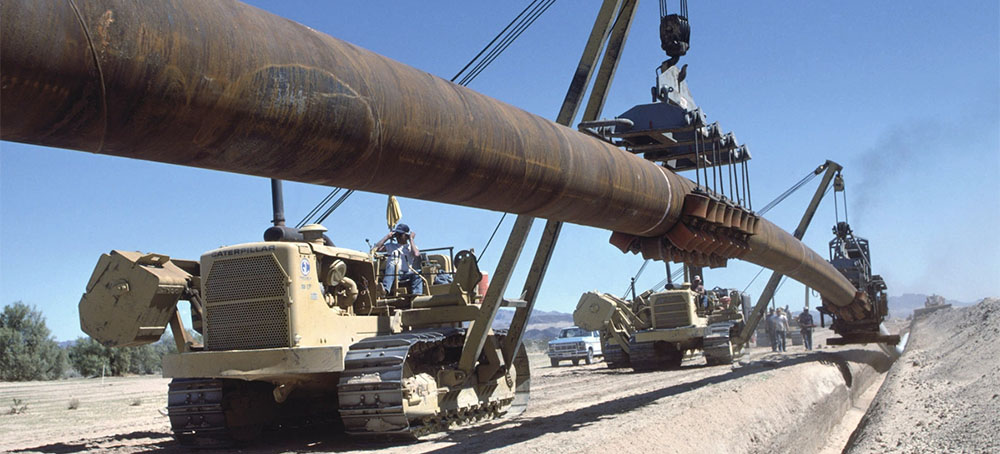 Pipeline construction. (photo: Larry Lee/Construction Photography/Avalon/Getty Images)
Companies want to build pipelines to capture and store carbon, but a new report warns that regulators aren’t prepared.
In the months since, two more companies have proposed similar CO2 pipeline projects in the Midwest, and another wants to expand an existing pipeline in the South. The sudden boom is being driven by federal and state incentives for carbon capture and storage, or CCS, as well as a new low-interest loan program for CO2 pipelines passed by Congress last year and general support from the Biden administration to grow the “carbon management” industry in an effort to reduce carbon emissions.
But as the number of pipeline proposals multiplies, a new report commissioned by the Pipeline Safety Trust, a nonprofit advocacy group, warns that CO2 pipeline regulations aren’t up to the task of keeping communities safe.
“The country is ill prepared for the increase of CO2 pipeline mileage being driven by federal CCS policy,” writes report author Richard Kuprewicz, an independent pipeline safety consultant hired by the Pipeline Safety Trust. “Federal pipeline safety regulations need to be quickly changed to rise to this new challenge, and to assure that the public has confidence in the federal pipeline safety regulations.”
Pipeline safety is overseen by the Pipeline and Hazardous Materials Safety Administration, or PHMSA, a subdivision of the U.S. Department of Transportation. The agency began regulating carbon dioxide pipelines in 1991. Today, there are just over 5,000 miles of CO2 pipelines in the U.S., most of which deliver CO2 to oil fields, where companies pump it underground to stimulate oil production. But researchers assert that capturing carbon dioxide from industrial facilities and sucking CO2 directly from the air will be essential tools to tackle climate change. In order to deliver that CO2 to sites where it can be permanently sequestered underground, they estimate the U.S. could need between 30,000 and 65,000 miles of pipeline.
The most concerning finding in the new report, according to Bill Caram, executive director of the Pipeline Safety Trust, is that regulations for assessing the potential impacts of a CO2 pipeline rupture were not developed specifically for CO2. Every pipeline developer has to identify potential “high consequence areas” where an accidental release would have significant negative impacts on human health or the environment. High consequence areas for oil and gas pipelines are well defined, but the report notes that CO2 has different considerations and likely a much larger radius of concern. CO2 is heavier than air, and a plume of CO2 can travel for miles, depending on wind and terrain, and settle into low-lying areas. The report warns that such an event would be difficult for people in the vicinity and first responders to detect, since CO2 is colorless, odorless, and nonflammable.
“If I had to pick one finding of the report that would keep me up at night as a public safety advocate, it’s that one,” said Caram.
The residents of Satartia, Mississippi, learned this the hard way in 2020 when a CO2 pipeline ruptured and a plume of CO2 settled over the town, causing people to feel dizzy, nauseous, and disoriented. Many passed out. Forty-nine people went to the hospital. PHMSA has yet to release an incident report detailing the cause of the rupture.
“That incident happened over two years ago,” said Caram. “It’s crazy that communities are being asked to bear the burden of the risk of these pipelines when this report sits unreleased with all these unanswered questions.”
In addition to urging PHMSA to update how potential impact areas are assessed, the Kuprewicz report recommends that PHMSA require pipeline operators to inject an odorant into CO2 pipelines, as is standard for natural gas pipelines, to help alert the public to potentially dangerous leaks. It proposes new requirements for informing and training local officials and emergency responders on the unique dangers posed by a CO2 release. It also recommends setting purity standards for the CO2 transported by pipelines, as impurities can introduce additional risks.
A spokesperson for PHMSA did not comment on the missing Satartia report or the concerns raised in Kuprewicz’s report. But the agency did say it was reviewing his findings and working on new measures to strengthen safety standards for CO2 pipelines, as the White House instructed PHMSA and other agencies that oversee CCS projects to do in interim guidance put out in February.
Similar to Kuprewicz, the White House guidance calls for CO2 pipeline-specific emergency planning and training. It cites a need for new tools to monitor and improve safety but stops short of describing which tools are needed. It also notes that the impacts of climate change, like flooding and storms, should be taken into account in the design, construction, and maintenance of CO2 pipelines.
Lee Beck, global director for carbon capture at the Clean Air Task Force, a nonprofit that advocates for CCS deployment, said the Pipeline Safety Trust report “provides important insights and raises really important questions.” But from her perspective the Biden administration’s guidance document shows it “is well aware of what needs to be done to ensure regulatory safety.” Beck also noted that since 2010, there have only been 66 reported CO2 pipeline incidents and no reported fatalities. According to PHMSA data, the incident rate per mile of CO2 pipeline in 2020 was about half that of crude oil pipelines.
But Caram is concerned that PHMSA does not have the funding or capacity to effectively make new rules. “I would consider them a notoriously underfunded and understaffed agency,” he said.
Rory Jacobson, the deputy director of policy at the nonprofit Carbon180, also raised this issue. “Ultimately, PHMSA will need Congress to enhance its regulatory capacity, funding, and jurisdiction to effectively and lawfully oversee the implementation of newly-passed carbon management policies,” he said in an email. Carbon180 advocates for policy to support carbon removal, a category of climate solutions designed to suck carbon directly out of the atmosphere, some of which would utilize CO2 pipelines.
Other pipeline proponents emphasized the industry’s track record on safety. “PHMSA and the natural gas and oil industry have decades of experience ensuring the safe transportation of CO2,” said Robin Rorick, the vice president of midstream policy at the American Petroleum Institute, in a statement. The oil and gas industry group has been a key player in developing regulations for CO2 pipelines, since oil companies buy CO2 for enhanced oil recovery. Rorick did not comment on the report’s findings.
Jesse Harris, a spokesperson for Summit Carbon Solutions, the company that is developing the Midwest carbon dioxide pipeline, said that PHMSA “clearly specifies multiple layers of protection for CO2 pipeline operations to ensure public safety.” He added, “We look forward to continuing to meet and in many cases exceeding all local, state, and federal requirements.”
Special Coverage: Ukraine, A Historic Resistance
READ MORE
Follow us on facebook and twitter!
PO Box 2043 / Citrus Heights, CA 95611


