Showing posts with label PARTICULATES. Show all posts

Saturday, December 21, 2024

As Big Oil Ally Trump Returns, Industry Set to Turn Lobbying Machine on US Consumers

THE U.S. ENERGY INFORMATION AGENCY REPORTS A GREAT DEAL OF INFORMATION: 

IMPORTS, EXPORTS, EXPLANATIONS,HISTORICAL INFORMATION..... 

TRUMP LIES INCESSANTLY ABOUT OIL & MUCH ELSE. 

LOOK UP FACTS!     EIA


ON THE RIGHT SIDE OF THIS PAGE THERE A CATEGORIES - LOOK UP CHINA....CHINA IS LEADING THE WORLD IN CHEAP CLEAN SOLAR - LARGEST OCEAN SOLAR FAR & A FUNCTIONING GRID... 

DIRTY FOSSIL FUEL IS NOT THE FUTURE!

DIRTY ENERGY KNEW FOR DECADES THE THREAT FOSSIL FUEL POSED, THE DEVASTATING HEALTH CONSEQUENCES OF PARTICULATES, BUT HAS FOUGHT TO CONTINUE TO POLLUTE! 


THERE ARE INSTANCES OF LAWMAKERS COLLUDING TO KEEP GAS PRICES HIGH..... 

DIRTY ENERGY CREATED CANCER ALLEY WITH HIGH RATES OF CANCER....


DON'T BELIEVE THE LIES! 

VEHICLES CAN BE MORE ENERGY EFFICIENT, SAVING YOU $$$!  
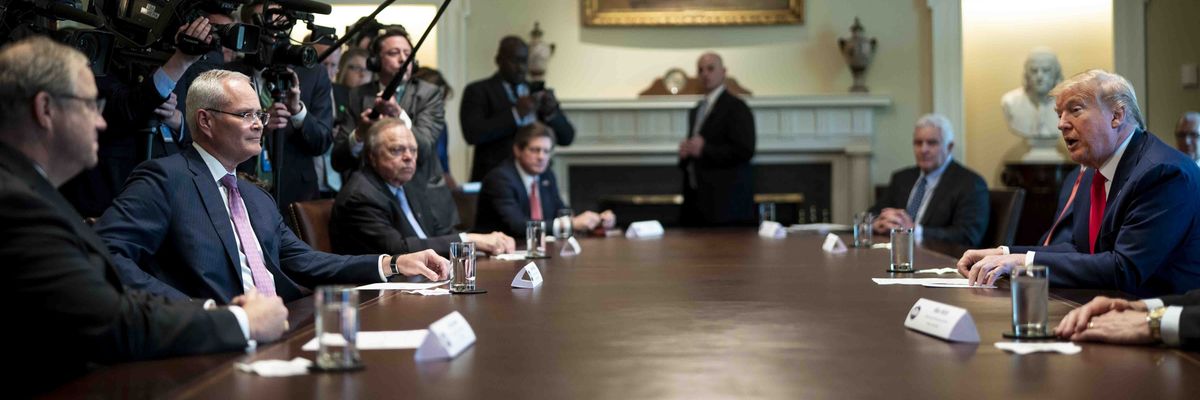


U.S. President Donald Trump speaks during a roundtable meeting with energy sector CEOs

U.S. President Donald Trump speaks during a roundtable meeting with energy sector CEOs on April 3, 2020 in Washington, DC.

 (Photo: Doug Mills Pool/Getty Images)


As Big Oil Ally Trump Returns, Industry Set to Turn Lobbying Machine on US Consumers

With "a supportive administration that has pledged to protect their interests," new analysis warns industry groups "may turn attention to influencing the public."

The first Trump administration was a boon for fossil fuel executives, and a new analysis shows the efforts the industry is already making to ensure it benefits when Trump takes office again in January, including by directing their lobbying efforts at the American public.

"Many of the tactics already being deployed by industry are reminiscent of the first Trump presidency, indicating a continuation of familiar fossil fuel tactics to shape climate policy and politics," reads the analysis by InfluenceMap.

The analysis shows fossil fuel companies have already revived three key tactics from the first Trump term ahead of the president-elect's inauguration:

  • Shifting from a defensive to offensive position as it lobbies for Trump to roll back specific climate policies;
  • Heavily advocating for permitting reform, and
  • Strategically using narratives to position themselves as "protecting" consumers—even as they continue to extract planet-heating fossil fuels and put communities at risk of devastating climate disasters.

"It is alarming to see the extent to which fossil fuel actors are gearing up to use their old tactics to roll back climate policy and present themselves as the 'good guys' ahead of the next presidency," said Kendra Haven, director of projects at InfluenceMap.

The report details how ahead of the first Trump term, fossil fuel interests like the U.S. Chamber of Commerce and the American Petroleum Institute (API) filed a number of lawsuits to challenge and weaken Obama-era climate regulations, many of them already weaker than experts said was necessary, including the Clean Power Plan.

But after Trump took office in 2017, the groups shifted their attention to lobbying for rollbacks which, according to Carbon Brief, would amount to "a staggering 4 billion tonnes of carbon dioxide equivalent by 2030, equivalent to the annual emissions of the EU and Japan combined."

Starting in January, InfluenceMap said, fossil fuel industry groups "will likely issue various statements and comments urging and supporting these moves," such as the "5-Point Policy Roadmap" API released just after the election on November 12, calling for the next Trump administration to repeal the Environmental Protection Agency's (EPA) tailpipe rules, retain the 21% corporate tax rate, and take other industry-friendly steps.

API's roadmap also called for a heavy focus on permitting reform, demanding changes to the National Environmental Protection Act (NEPA), which requires federal agencies to consider the environmental impacts of projects before approving them, and the Clean Water Act.

"In 2025 and the years following, issues of permitting, infrastructure, and the future of gas are likely to remain a focus of corporate advocacy," said InfluenceMap.

Fossil fuel companies have submitted numerous public comments regarding state-level efforts to phase out the use of fossil gas as an energy source, with WEC Energy Group submitted several comments "promoting the 'crucial role' of fossil gas" in Illinois and warning that "'forced electrification' would inhibit the competitiveness of the state's economy."

But while fossil fuel groups are expected to continue lobbying policymakers to support industry-friendly measures, InfluenceMap noted that oil and gas interests also spent a "vast amount of time and resources that fossil fuel companies invest in reaching the public to protect their 'social license' or public reputation."

With "a supportive administration that has pledged to protect their interests" taking office next month, industry groups "may turn attention to influencing the public."

The strategy for influencing the American people is evident in API's policy roadmap, which uses a phrase the InfluenceMap points to several times in its analysis: "consumer choice."

"In 2024 alone, there were over 100 instances of corporate interests centering the 'consumer choice' narrative in their public advocacy on autos," reads the analysis.

The American Fuel and Petrochemical Manufacturers (AFPM) criticized Vice President Kamala Harris' electric vehicle mandates as harming "consumer choice," and just after the election Toyota urged the incoming Trump administration to protect "consumer choice" by overturning federal greenhouse gas emissions standards.

"Recognizing industry narratives is a critical component of any action to confront industry influence over climate policy," said InfluenceMap, "particularly given that many fossil fuel interests are likely to publicly position themselves as proponents of climate action leading up to and throughout the new administration."

Haven said the group expects "industry associations to be at the forefront of the most negative advocacy in the U.S. going into 2025, just as they were during the first Trump term, providing essential cover for individual companies."

"The science is clear, as is the long-term harm this advocacy will cause to climate and communities," said Haven. "Misleading narratives from industry must be challenged accordingly."


Wednesday, June 14, 2023

FOCUS: Amy Westervelt | The Right-Wing War on Clean Air


Reader Supported News
13 June 23

Live on the homepage now!
Reader Supported News

YES WE ARE SERIOUS, BELIEVE IT : We are serious about being powerful voice social justice, we are serious about fighting for economic justice and we are serious about real meaningful reform. We are also serious about maintaining a stable organization. To do that we need dependable funding. And, yes we are absolutely serious about funding as well.
Marc Ash • Founder, Reader Supported News

Sure, I'll make a donation!


A man talks on his phone as he looks through the haze at the George Washington Bridge in Fort Lee, N.J., on June 7, 2023. (photo: Seth Wenig)
FOCUS: Amy Westervelt | The Right-Wing War on Clean Air
Amy Westervelt, The Intercept
Westervelt writes: "As wildfire smoke hit the East Coast, Fox News claimed it was 'perfectly healthy' to breathe."   


As wildfire smoke hit the East Coast, Fox News claimed it was “perfectly healthy” to breathe.

Steve Milloy, a longtime lobbyist for polluting industries from tobacco to coal to oil and gas, is back in the news thanks to the wildfire smoke that recently blanketed the U.S. East Coast. Milloy appeared on Fox News to tell people that there are “no negative health impacts” from breathing in wildfire smoke. It’s the latest salvo in a war he’s been waging against air pollution regulation since the 1980s.

For industry operatives like Milloy, air pollution, especially the regulation of particulate matter, has long been a greater concern than climate policy. Regulations on PM2.5 — fine inhalable particles generally smaller than 2.5 micrometers in diameter — would require many of the same reductions in the combustion of fossil fuels that climate policy would, but without any of the politicization that has obstructed climate action for decades. It’s never been easy for politicians to publicly fight against clean air and water, and it’s doubly hard when the country’s largest city is wrapped in smoke. So Milloy took to the conservative airways to dismiss concerns about wildfire smoke, which peer-reviewed public health research has linked to higher rates of heart attacks, strokes, and emergency respiratory and immune responses.

That research means little to Milloy, who claims that the peer-review process is biased against corporate interests. Although he has a degree in biostatistics from Johns Hopkins, Milloy is not, even by his own account, a medical expert. Nor is he an epidemiologist. But while it might be easy to dismiss him, Milloy has a knack for accessing power and attention. His recent media tour is a good predictor of where we’re likely to see conservatives headed should they regain control of the government in 2024. Spoiler alert: He’d like to see the Environmental Protection Agency go away.

In early 2020, Milloy was basking in the glory of multiple wins under President Donald Trump, posting pictures with his pals inside the EPA and bragging about “eating the greens’ lunch.”Trump’s EPA declined to tighten air pollution standards, rolled back mercury regulations, and disbanded the Particulate Matter Review Panel, or as Milloy put it: “blowing out that particulate matter sub-panel, another huge win.” Plus he finally got to introduce an idea he’d been trying to get into the EPA regulatory framework since the 1990s: the so-called secret science proposal. It would lend more weight to studies that make data available to the government and other researchers, which sounds good but would have the effect of discrediting most epidemiological studies because they include human test subjects and are subject to privacy laws. “I’ve got huge wins under my belt,” Milloy told me in a 2020 interview. “It’s been tremendously satisfying for me.”

That’s a lot of policy shifts coming from someone whose ideas have often been considered fringe by his fellow conservatives. As the Covid-19 pandemic hit, Milloy called public health officials “COVID creeps” and likened quarantine to communism. He criticizes oil companies for pandering to climate activists, whom he calls “bedwetters” or “watermelons”: green on the outside but “red” on the inside. In a 2017 presentation at the annual Heartland Institute climate conference, he compared the EPA to Auschwitz doctor Josef Mengele.

But the Trump EPA normalized a lot of previously fringe ideas, and Milloy was an adviser on the transition team. “I was the only person on the team with a background in EPA science, so I was brought on to write the science part of the transition plan,” he said. That meant he had real influence on environmental policy. And that influence is likely to grow if Republicans retake control of the government. In the meantime, Milloy works for Energy & Environment Legal Institute, a nonprofit law firm leading the charge against renewable energy projects and regulation of fossil fuels. Ultimately, the secret science proposal didn’t make it through the final approval process before Trump left office. When I asked Milloy if he thought a Republican-led EPA would take up the proposal again, he replied, “That is on my agenda.”

Also on the agenda: defunding the EPA and handing environmental regulation over to the states. But most of all, reclaiming his Trump-era wins on air pollution, particularly stalling or rolling back regulations on PM2.5. Those regulations are all the more critical to the climate fight today given the legal attack on the EPA’s ability to regulate greenhouse gas emissions. Particulate matter and greenhouse gas emissions are mostly generated by the same activity — the combustion of fossil fuels — so if the agency can’t regulate greenhouse gases under the Clean Air Act, it can accomplish similar goals by tightening restrictions on particulate matter, something Milloy has been pointing out to conservatives for decades.

After Trump left office, the EPA’s disbanded Particulate Matter Review Panel went ahead and published their work in the New England Journal of Medicine. “We unequivocally and unanimously concluded that the current PM2.5 standards do not adequately protect public health,” they wrote. Under President Joe Biden, the Clean Air Scientific Advisory Committee agreed, and the EPA is in the process of strengthening the standards.

Milloy is hoping a lawsuit before the D.C. District Court will roll those efforts back. His latest battle against air pollution regulations is happening amid not only an endless respiratory health pandemic, but also a steady stream of studies pointing to the millions of people around the world still dying early thanks to air pollution. According to Milloy, it’s all fraud.

“What I think the right wing has done is try to saw the legs off the infrastructure that holds up environmental decision-making,” Eric Schaeffer, an EPA employee-turned-whistleblower and executive director of the nonprofit Environmental Integrity Project, said. “It’s hard to attack clean air and clean water, they don’t want to do that, so they suggest the science is flawed. … We’re seeing right now the impacts of a decades-long campaign to undermine science.”

From Tobacco to Wildfire Smoke

Like many of the folks who went on to battle climate regulation, Milloy got his start working for the tobacco industry in the 1990s, particularly dealing with the issue of secondhand smoke. He ran the Advancement of Sound Science Coalition, or TASSC, a front group for Philip Morris that worked to counteract efforts to regulate air pollution. Memos outlining the creation of TASCC could pass as mission statements for Milloy’s enterprise today.

TASCC operated under the principle that if an economic argument can’t keep regulation at bay, the next best move is to undermine the science that regulation is based on. Almost as soon as he started working on air pollution, Milloy had new science to contend with: a 1993 epidemiological study that looked at 8,000 people across six American cities and found that exposure to fine particulate matter — PM2.5, or soot — was correlated to reduced life expectancy. Not what you want to hear when the companies you work for sell the products that produce PM2.5: cigarettes, cars, coal, oil.

Milloy started by picking apart the methodology: The subject group was too small, researchers hadn’t controlled for other factors, and epidemiology’s reliance on observational data made it suspect. He manufactured controversy around the researchers keeping their data private, producing a paper that would become the basis for the secret science proposal. And he targeted the scientists themselves, particularly lead researcher Steven Dockery and one of the statisticians involved, C. Arden Pope.

But it’s hard to discredit scientists who are cautious about the implications of their own findings. “It was a bit bigger than we expected, and we were a bit concerned about it,” Pope said of the correlation between exposure to PM2.5 and premature death. That led the scientists to ask the American Cancer Society to rerun the analysis with an independently collected cohort of subjects. The cancer society got similar results, as did the Health Effects Institute, an organization half-funded by the EPA and half-funded by the automotive industry. Milloy kept fighting, but nothing worked. In 1997, the EPA passed its first regulation on particulate matter. It tightened those regulations every eight years or so right up until Scott Pruitt became administrator of the agency under Trump. Milloy said he put the old secret science paper “in the transition plan and talked with Pruitt about it.”

It wasn’t new science or a new strategy that handed Milloy a win after 25 years; it was just access. Being on Trump’s EPA transition team enabled him to smuggle in all sorts of ideas from his pals, including James Enstrom, a tobacco industry-funded scientist who published one of the few studies contradicting the Six Cities data. While Milloy points to Enstrom’s study as proof that Pope et al. are peddlers of “junk science,” Pope points to the 25 years’ worth of additional studies that have consistently replicated the Six Cities result.

The obscure journal that put out Enstrom’s paper in 2017 is published by another friend of Milloy’s, toxicologist Ed Calabrese, whose research focuses on the idea that a little bit of pollution and radiation are actually good for you. When Pruitt announced in 2018 that the EPA would not strengthen the regulations on particulate matter, he cited Enstrom’s study as evidence that the science on PM2.5 was “too uncertain” to act upon.

Regulating Air Pollution

Almost as soon as the U.S. government began to mandate quarantine in response to the Covid-19 pandemic, Milloy took to Twitter to take aim at one of his favorite scientific targets, epidemiology, and warn that Covid lockdown would lead to climate lockdown. Aside from political ideology, there’s also a PM2.5 connection with Covid. Studies have found that both chronic exposure to particulate matter and short-term exposure are Covid-19 risk factors.

Milloy’s wins on PM2.5 under Trump illustrate just how much of the U.S. regulatory apparatus the administration was able to dismantle in a short amount of time, but they’re an indicator of something else too: a willingness to go further than conservatives ever have in the battle against environmental regulation, to actually attack clean air and water. Why? In a word, climate. Thanks to the Supreme Court’s decision in West Virginia v. EPA, the EPA’s hands are somewhat tied when it comes to regulating the emissions of power plants. One of the few remaining ways the agency can target CO2 is by regulating particulate matter, since both are emitted via fossil fuel combustion. As Milloy put it to me recently: “PM2.5 is the most important backdoor science scheme for regulating fossil fuel emissions.”

As New York and D.C. residents choked on wildfire smoke from Canada, many saw in the apocalyptic landscape a window into a climate-changed future. The link between climate change and wildfire is nuanced: Climate change doesn’t “cause” wildfires, but it does create the low-moisture, high-heat conditions that make fires more likely and keeps them burning longer. Irregular plant growth driven by climate change can also result in excess fuel for those fires, but forest management and building development choices matter too. The data is unclear on which of these factors played the largest role in Canada’s fires, but it is very clear that climate change will bring bigger fires more frequently in the future.

For Milloy, though, no matter what the data says, there can be no lines drawn between climate change and fire or smoke and respiratory illness. Such a connection would make his clients liable for tens of millions of dollars in health costs, and then they couldn’t afford to fund him anymore.


READ MORE


Contribute to RSN

Follow us on facebook and twitter!

Update My Monthly Donation

PO Box 2043 / Citrus Heights, CA 95611


Save 50% on TNR | How Did Trump Do on His Labor Day Report Card?

                                                                                                 LOTS OF POSTS IGNORED BY BLOGGER..... OR RE...