Tuesday, March 17, 2026
■ Today's Top News
These robots, known as "quadrupeds," are being used to patrol the sprawling energy-sucking complexes, which are increasingly being met with protest around the country.
By Stephen Prager
As Americans grow fed up with the rapid encroachment of artificial intelligence data centers into their communities, tech companies are embracing a novel solution to protect their energy-sucking behemoths from danger: Even more robots... robot dogs, to be exact.
According to a report from Business Insider on Monday:
As companies pour billions into sprawling industrial campuses for cloud and AI computing, some data center operators are experimenting with four-legged bots—about the size of large dogs—that can patrol fences, inspect equipment, and flag any issues before they turn into costly outages.
These robots, known as “quadrupeds,” are being used to patrol the complexes, which can sometimes reach the size of multiple football fields.
According to Fortune, tech companies are already pouring nearly $700 billion into building data centers across the US and are now spending hundreds of thousands of dollars more to enlist mechanical canines as security forces.
One model from Boston Dynamics, known as “Spot,” can cost anywhere from $175,000 to $300,000. And while the technology may seem futuristic, Spot and other quadrupeds like it have already been enlisted in law enforcement and public safety for years.
Another company—Ghost Robotics—advertises its quadrupeds for “reconnaissance, intelligence, and surveillance use by the military.”
With more than 5,000 data centers now in the US and 800-1,000 new ones in the process of being built, Michael Subhan, the chief growth officer for Ghost Robotics, told Business Insider he expects boom times are ahead for his industry.
As data centers expand their reach at breakneck speed, there may be more interlopers for the programmable pooches to sniff out.
Due to skyrocketing energy costs and water shortages in places where large data centers have been built, the sites of proposed projects from Illinois to Minnesota to South Carolina have drawn crowds of dozens and even hundreds of demonstrators in recent weeks.
"I’m extremely creeped out," said one journalist in response to the staged video between the Israeli prime minister and the US ambassador. "Just going to go ahead and say it."
By Brad Reed
Israeli Prime Minister Benjamin Netanyahu on Tuesday posted a video of himself showing off what he said was a list of kill targets to US Ambassador to Israel Mike Huckabee.
In the video, Netanyahu informs Huckabee that he recently “erased” two names off the punch card, while noting that there are “many more to go.”
Huckabee then expresses relief to Netanyahu that his name is not on the punch card, to which Netanyahu replies that the former Republican Arkansas governor was on a “list of the good, good guys.”
Netanyahu then says that he’s “proud to stand shoulder to shoulder” with the US military in “getting rid of these lunatics” that the two countries started bombing more than two weeks ago in Iran.
“We’re wiping them out,” the Israeli prime minister boasts.
“I love it,” Huckabee responds. “Thank you, mister prime minister.”
Journalist Noga Tarnopolsky expressed disgust at the two men being so jovial about matters of life and death.
“PM Netanyahu and US Ambassador Huckabee amuse themselves with a kill list,” she wrote. “Yes, really.”
Drop Site News reporter Julian Andreone expressed a similar sentiment.
“I’m extremely creeped out,” Andreone wrote. “Just going to go ahead and say it.”
"Maybe—and stick with me here, Marco—the fact that the United States has had a near-total embargo on Cuba since before the Beatles’ first album might have something to do with its struggling economy?" said one critic.
By Brett Wilkins
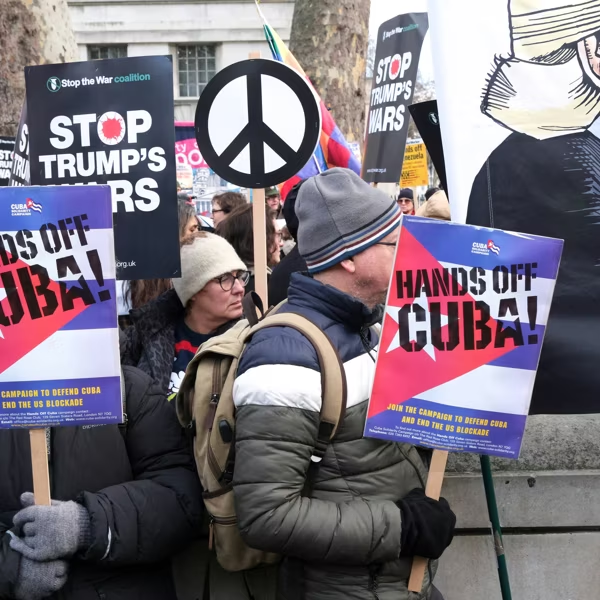
As Cuba works to restore electricity to millions of people plunged into darkness across the fuel-starved island, US Secretary of State Marco Rubio on Tuesday blamed Cuba’s socialist government for the nation’s economic crisis—a crisis largely caused by 65 years of US economic embargo and exacerbated by President Donald Trump’s tightened fuel blockade.
“Suffice it to say that the embargo is tied to political change on the island,” Rubio told reporters at the White House. “The law is codified, but the bottom line is, their economy doesn’t work. It’s a nonfunctional economy.”
“That revolution—it’s not even a revolution, that thing they have—has survived on subsidies,” he added. “They don’t get subsidies anymore, so they’re in a lot of trouble, and the people in charge, they don’t know how to fix it, so they have to get new people in charge.”
Rubio—whose parents fled the island during the rule of pro-US dictator Fulgencio Batista—dismissed Cuba’s proposed economic reforms, including opening the country to investment from Cubans living abroad.
“Cuba has an economy that doesn’t work in a political and governmental system that can’t fix it. So they have to change dramatically,” he said. “What they announced yesterday is not dramatic enough. It’s not going to fix it. So they’ve got some big decisions to make over there.”
Rubio added that although the Trump administration is currently focused on its war of choice in Iran—one of 10 countries attacked during the two terms of the self-proclaimed “president of peace”—the US would “be doing something with Cuba very soon.”
The US has been doing something with Cuba since the 19th century, when it invaded and seized the island from Spain. In the 20th century, it supported successive dictatorships and, after the Fidel Castro-led revolution ousted Batista, imposed an economic embargo on the island that has been perennially condemned by an overwhelming majority of United Nations member states for 33 years.
In addition to the embargo—which Cuba’s government says has cost the nation’s economy more than $200 billion in inflation-adjusted losses—the US tried to assassinate Castro many times and supported the militant Cuban exiles who launched the ill-fated Bay of Pigs invasion in 1961. Other Cuban exiles carried out numerous terror attacks targeting Cuba’s economy—and sometimes innocent civilians.
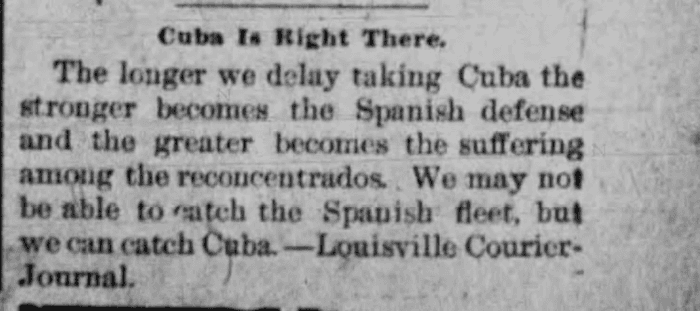
In language reminiscent of the US imperialists who conquered the island in 1898, Trump told reporters Monday, “I do believe... I’ll be having the honor of taking Cuba.”
President Donald Trump's talk of "taking Cuba" harkens back to the most aggressively imperialist period in US history.
This, after Trump said last month ahead of talks with Cuban officials that he might launch what he called a “friendly takeover” of the island. The president has also boasted about the tremendous economic suffering caused by his illegal embargo and fuel blockade, which is widely unpopular and has been called a form of “economic warfare.”
“Officials in the US must be feeling very happy by the harm caused to every Cuban family,” Cuban Deputy Foreign Minister Carlos Fernández de Cossío said Monday.
In Havana, residents hardened by decades of privation carried on the best they could without power. Some struggled in the dark.
“The power outages are driving me crazy,” 48-year-old Dalba Obiedo told The Associated Press. “Last night I fell down a 27-step staircase. Now I have to have surgery on my jaw. I fell because the lights went out.”
Cuban President Miguel Díaz-Canel last week acknowledged that high-level talks with US representatives were underway. Recent reporting by Drop Site News cited an unnamed White House official who accused Rubio—a longtime advocate for regime change in Cuba—of trying to sabotage the talks.
Some observers believe that Trump wants Díaz-Canel to face a similar fate as Venezuelan President Nicolás Maduro—who was kidnapped in January during a US invasion and is now jailed in the United States—while others warn that the United States cannot be trusted in talks, pointing to recent accusations by Oman’s foreign minister, who said American negotiators duplicitously scuppered an Iran peace deal that “was within our reach.”
However, instead of regime change, Trump may be seeking what some observers are calling regime compliance, which is likely why he did not move to oust Maduro’s subordinates. Unlike Venezuela, Cuba has no oil, but it was once was a magnet for US investment—both legal and otherwise.
Last week, a trio of Democratic US senators introduced a war powers resolution to stop Trump from attacking Cuba without the legally required authorization from Congress. Numerous war powers resolutions concerning Iran, Venezuela, and the dozens of boats Trump claims—without providing evidence—were transporting drugs from South America have all failed to pass the Republican-controlled Congress.
"We live in a country where we have one reality for everyday people and another for the rich, the well-connected, and the well-protected," Lee said. "And that cannot continue to be our reality."
By Stephen Prager
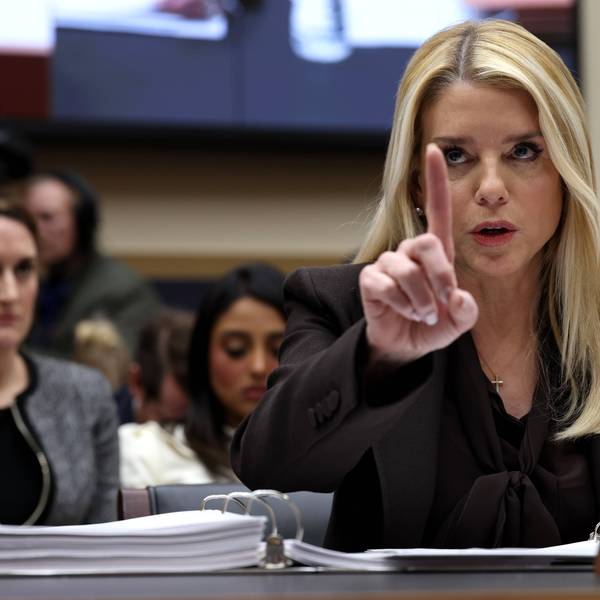
Democratic Rep. Summer Lee introduced articles of impeachment against US Attorney General Pam Bondi on Tuesday and accused the nation’s top prosecutor of “breaking the law to protect pedophiles” and prosecute President Donald Trump’s “political opponents.”
“We live in a country where we have one reality for everyday people and another for the rich, the well-connected, and the well-protected. And that cannot continue to be our reality,” Lee (D-Pa.) said in a video posted to her social media on Tuesday announcing the articles.
Two of the five articles pertain to Bondi’s conduct surrounding the Department of Justice’s (DOJ) release of files related to the late billionaire sex offender Jeffrey Epstein, which the DOJ has been accused of covering up to protect Trump.
One article accuses Bondi of obstruction of Congress for failing to comply with a subpoena in July 2025, which required the DOJ to release the full, unredacted files to the House Oversight Committee in August as part of a congressional inquiry.
“The Department of Justice refused to adhere to the subpoena and withheld substantial evidence; evidence logs indicate that amongst the withheld evidence are FBI interviews with a survivor who accused Trump of sexual abuse,” the article reads.
In February, Democrats on the House Oversight Committee announced that they were investigating the DOJ’s handling of an accusation made against Trump to the FBI in 2019. A woman accused the president of having sexually assaulted her at the age of 13 in the 1980s.
Another impeachment article accuses Bondi of violating the Epstein Files Transparency Act (EFTA), signed into law in November, which required the DOJ to release “all unclassified records, documents, communications, and investigative materials” pertaining to the Epstein case without redacting information to protect powerful figures from embarrassment.
The DOJ missed the December 19 deadline to release the files and has since released only about 3 million pages of documents as part of its “final” trove, while millions more remain unavailable.
The pages that have been released, the article says, “were heavily redacted” to scrub the names of Trump and other powerful figures, but sensitive information about many of Epstein’s victims—including identifying details and nude photographs—was released, even though the law said redacting this information was permitted.
Meanwhile, it says the DOJ “continues to withhold documents,” including FBI interviews with the Trump accuser.
Three of four memos detailing the interviews with the accuser were posted to the DOJ website in March. They include the victim’s graphic claims that Trump hit her after she bit his penis when he attempted to force her to perform oral sex.
Trump has denied the allegations, and White House Press Secretary Karoline Leavitt has called the alleged victim “disturbed.”
Approximately 37 pages of FBI records related to the accusation, including the fourth memo and pages of agent notes, remain unreleased to the public, according to Sen. Sheldon Whitehouse (D-RI).
“Pam Bondi is complicit in the most egregious cover-up in American history, hiding documents that reveal a young woman reported being sexually assaulted by Donald Trump when she was just a minor,” said Rep. Yassamin Ansari (D-Ariz.), a cosponsor of Lee’s impeachment articles. “Bondi’s actions are not only disgusting and wrong. They are also illegal.”
Another article accuses Bondi of having “abused” the DOJ and FBI’s powers in a partisan fashion—to target Trump’s enemies and shield his friends from accountability. It also cites Bondi’s attempts to criminalize protesters who express anti-Trump viewpoints by designating them as “domestic terrorism threats” and creating secretive lists of organizations and individuals to be targeted.
Bondi is also accused of misleading courts on several occasions—including in the cases against former FBI Director James Comey and the Salvadoran national Kilmar Ábrego García and says she presented “demonstrably false allegations in court to support baseless prosecutions against protesters.”
She is also accused of perjury before Congress during her confirmation hearing, where she pledged not to politicize her office or target journalists. It also accused her of lying during last month’s contentious hearing in which she claimed that there was “no evidence” in the Epstein files “that Donald Trump has committed a crime.”
No US attorney general has ever been impeached by the US House, which requires a simple majority. Trump was impeached twice by a Democratic-controlled House during his first term of office, though neither resulted in a conviction in the Senate, which requires a two-thirds majority.
Outgoing Homeland Security Secretary Kristi Noem had articles of impeachment filed against her in January by more than 80 cosponsors following the shooting of two US citizens by immigration agents.
Earlier this month, Noem became the highest-ranking Trump official to be fired in his second term, and earlier this week, Democrats on the House and Senate Judiciary Committees referred her to the DOJ for prosecution, also for perjury.
In addition to Ansari, Lee’s impeachment articles against Bondi are cosponsored by Reps. Valerie Foushee (D-NC), Dave Min (D-Calif.), Rashida Tlaib (D-Mich.), and Maxine Dexter (D-Ore.). Previous articles of impeachment against Bondi have been introduced by Rep. Shri Thanedar (D-Mich.) earlier this month.
Lee emphasized that while Bondi “deserves to be held accountable,” this “is also about what we want our government to be, and who we want it to work for.”
“This is our chance to get justice,” Lee said, “to hold people accountable who, time and again, have gotten away with screwing us over.”
A new analysis shows that over 40% of all US adults are unable to fully pay off their credit cards each month, leaving them trapped in "cycles of persistent debt."
By Jake Johnson
US President Donald Trump promised repeatedly during his 2024 campaign to temporarily cap credit card interest rates at 10%, but—in the face of Wall Street opposition—he has done nothing concrete to fulfill that pledge since returning to the White House.
That failure, according to an analysis released Tuesday, has so far cost Americans $134.5 billion in interest payments. Every day, The Century Foundation (TCF) and Protect Borrowers estimate, US credit card holders are accruing $368 million more in interest than they would have if rates were capped at 10%. The average interest rate for credit cards in the US is currently around 25%, according to a Forbes measure.
In January, Trump called on Congress to approve a 10% cap on credit card interest rates for one year, and bipartisan legislation has been introduced in both the House and the Senate. But the president has not pressured bank-friendly Republicans to back the measure, and he vowed earlier this month to refuse to sign any legislation that reaches his desk unless lawmakers approve a massive voter suppression bill that is likely dead in the Senate.
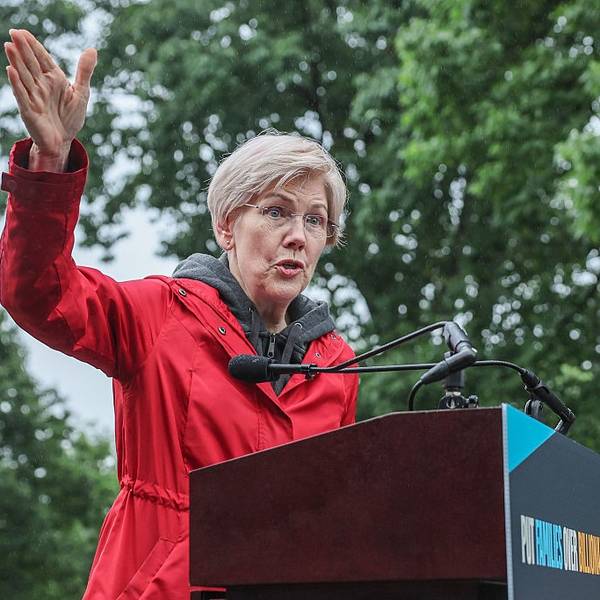
“Trump could work with Congress to deliver on his promise to cap credit card interest rates at 10%—saving the average American with credit card debt about $900 a year,” Sen. Elizabeth Warren (D-Mass.) said Tuesday. “But he is too busy siding with Wall Street.”
The new analysis by TCF and Protect Borrowers shows that over 40% of adults in the US are “unable to pay off their credit card bills each month, trapping them in cycles of persistent debt that balloons ever-higher due to record-high, industry-inflated interest rates and predatory fees.”
Collectively, around 111 million Americans carry more than $1 trillion in credit card debt month to month, according to the analysis, and more than 27 million Americans can’t afford more than the minimum monthly payment on their cards.
“Americans’ monthly credit card payments have grown by nearly 40% since 2018, a trend that is continuing unabated under President Trump,” TCF and Protect Borrowers found. “From 2018 to 2025, the average monthly credit card payment rose by $553, or 38% (from $1,441 to $1,994). This growth far outstrips inflation.”
“Since Trump’s inauguration alone, the average annual amount that Americans pay in credit card bills grew by an additional $1,177 (from $22,756 to $23,933),” the groups added. “The pace of this growth suggests that, in large part due to soaring interest rates, families today devote more income to credit card payments than at any point in history.”
The nation’s worsening credit card debt crisis comes amid a broader affordability crisis in an economy that Trump has hailed as the “greatest” in history, despite all the glaring evidence to the contrary.
A West Health-Gallup Center on Healthcare in America survey published last week found that roughly a third of respondents—equivalent to more than 80 million Americans—said they have had to skip a meal, borrow money, cut back on utilities, or make other painful trade-offs to afford healthcare expenses over the last 12 months as prices continue to rise across the economy.
“Grocery, utility, and healthcare bills are piling up, and Americans are increasingly turning to credit cards—some carrying interest rates exceeding 22%—just to make ends meet,” Jennifer Zhang, policy, research, and data Analyst at Protect Borrowers and co-author of the new analysis, said Tuesday.
“President Trump promised to tackle crushing credit card interest rates by January 20 of this year,” Zhang added, “but that deadline has come and gone.”
"Republicans don’t give a damn about the American people and will continue to make your life more expensive," said House Democratic leader Hakeem Jeffries (D-NY) in response.
By Brad Reed
White House National Economic Council Director Kevin Hassett caused a stir on Tuesday when he indicated that the prospect of US consumers getting hurt by a protracted conflict with Iran was not of particular concern to the administration.
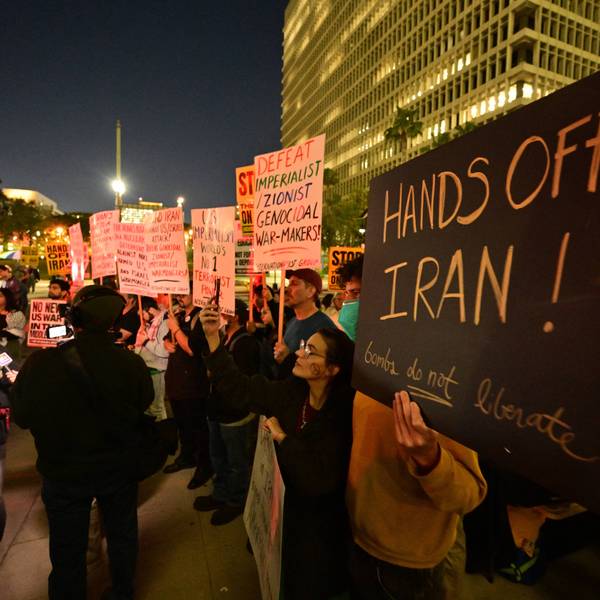
During an interview on CNBC, Hassett dismissed concerns about the Iran war, which is now in its third week, dragging on indefinitely.
“The US economy is fundamentally sound,” Hassett claimed. “And if [the war] were to be extended, it wouldn’t really disrupt the US economy much at all. It would hurt consumers, and we’d have to think about, you know, if that continued, what we would have to do about that, but that’s, like, really the last of our concerns right now... because we’re very confident that this thing is going ahead of schedule.”
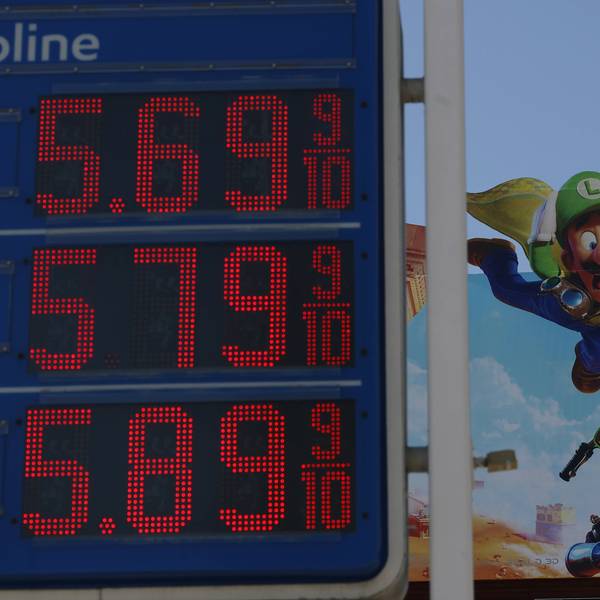
In fact, US consumers are already hurting financially from the effects of the Iran war, which has caused the price of both oil and gasoline to skyrocket. Petroleum industry analyst Patrick De Haan reported on Tuesday that the average price of gas in the US has reached $3.80 per gallon, while the average price for diesel fuel has reached $5.03 per gallon.
The war’s impact on oil and gas prices has been exacerbated by Iran closing down the Strait of Hormuz to shipping, and so far there is no indication that it will be reopening anytime soon.
Democratic lawmakers quickly pounced on Hassett’s admission that pain for US consumers was “the last of our concerns right now.”
“The Trump administration is saying the quiet part out loud,” said Sen. Elizabeth Warren (D-Mass.), “the higher costs you’re paying are the LAST of their concern.”
“Trump’s team of Epstein class advisors says it out loud more often than you’d think: ‘consumers are the last of our concern right now,’” commented Sen. Chris Murphy (D-Conn.).
“Well I’m not some sort of political expert but this feels like an unhelpful thing to say,” remarked Sen. Brian Schatz (D-Hawaii).
“Trump economic advisor says consumer pain is the last of their concerns,” commented Sen. Ruben Gallego (D-Ariz.). “Tell that to Americans paying almost twice as much for gas as they were a month ago.”
“The Trump administration has once again said the quiet part out loud,” said House Democratic leader Hakeem Jeffries (D-NY). “Republicans don’t give a damn about the American people and will continue to make your life more expensive. You deserve better.”















No comments:
Post a Comment
Note: Only a member of this blog may post a comment.