Friday, June 19, 2020

Meet The Confederados, The Confederate Loyalists Who Fled To Brazil After The Civil War


Didn't the Nazis largely flee to Argentina and Brazil as well? Maybe they learned it from their Confederate friends.
"Rather than accept defeat, up to 20,000 die-hard Confederates moved to the slaveholding Empire of Brazil to establish colonies of Confederados. Their descendents still honor them today."
ALLTHATSINTERESTING.COM
The unreformed Confederados, as local Brazilians called them, made every effort to preserve the illusion of life as it had been.


Published June 15, 2020

Rather than accept defeat, up to 20,000 die-hard Confederates moved to the slaveholding Empire of Brazil to establish colonies of Confederados. Their descendents still honor them today.
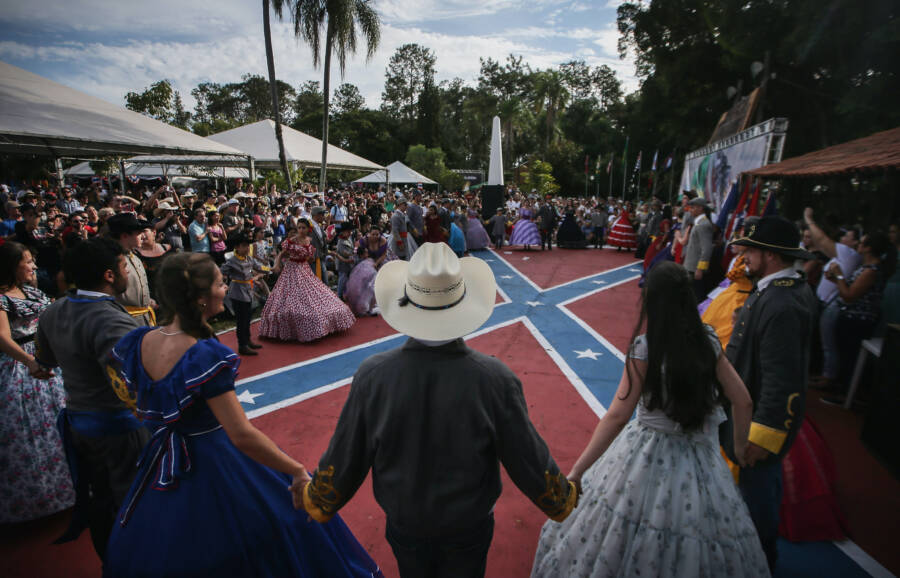
The Confederados
Mario Tama/Getty ImagesSanta Barbara d’Oeste, Brazil holds an annual Festa Confederada, or Confederate Party, like this one in 2016.
In April 1865, the American Civil War was over, and the former states of the Confederacy were in ruins. Astounding damage to infrastructure and the economy greeted Southern soldiers after the battle. As Confederate President Jefferson Davis languished in prison, his former cabinet members dispersed to their homes in defeat.
For die-hard Confederate loyalists like Col. William Hutchinson Norris and Maj. Lansford Hastings, this burden was too great. They couldn’t bear to live under what they saw as a foreign occupation, and decided instead to leave for the slaveholding Empire of Brazil and establish colonies of Confederados, Brazil’s odd Southern holdouts.
About 10,000 to 20,000 former Confederates followed them.

The Confederate Exodus
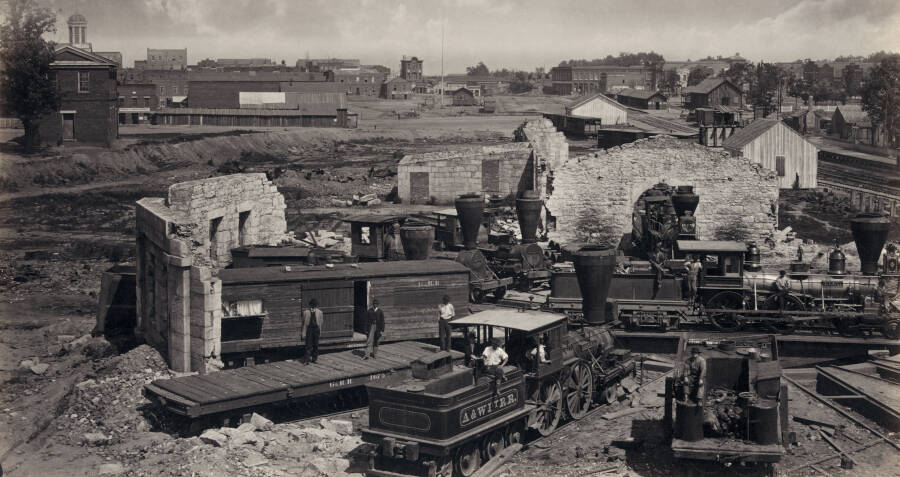
Ruins Of Atlanta Roundhouse
Wikimedia CommonsThe ruins of Atlanta’s rail depot were typical of the destruction that spurred many Confederados to emigrate.

Jefferson Davis and Robert E. Lee had urged Southerners to stay in the former states of the Confederacy and rebuild it, but those who were too proud to accept defeat, or whose land had been confiscated by federal authorities, felt they had little choice but to start over again abroad.
Popular destinations included Honduras, Mexico, and even Egypt, where former Confederate officers were invited to take up military commissions.
But for steady believers in white supremacy, only Brazil could offer them the haven they sought.
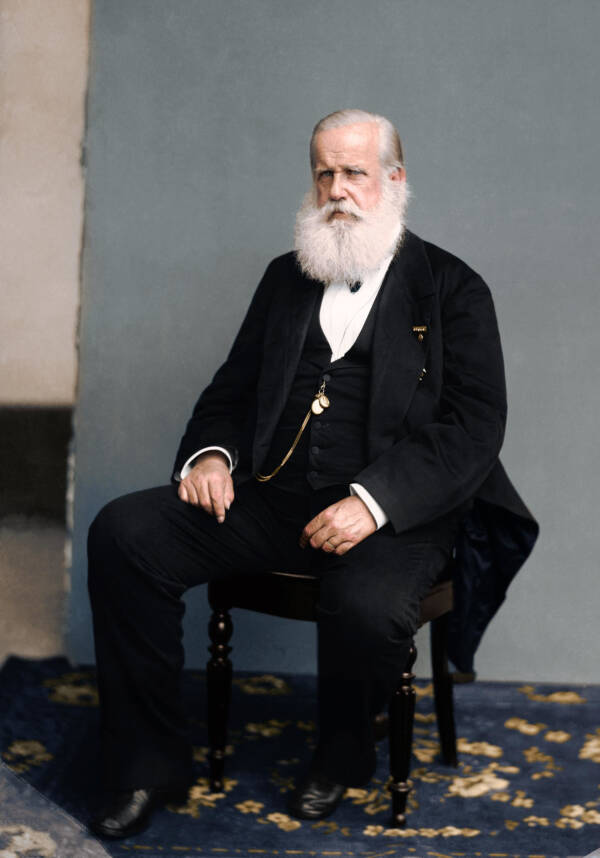
Dom Pedro II In 1889
Wikimedia CommonsBrazilian emperor Dom Pedro II encouraged the settlement of the Confederados even as he worked to abolish slavery in his empire.
In 1865, Brazil was ruled by Dom Pedro II, a descendant of the Portuguese royal family who was interested in attracting foreigners to his country.
He had offered safe harbors to Confederate ships during the war, and despite his personal opposition to slavery, had no qualms about inviting slaveholding rebel refugees to Brazil to cultivate cotton and help modernize Brazilian agriculture.


Taking out advertisements in newspapers across the former Confederacy, he countered the sober advice of the captive Davis and the defeated Lee by painting a picture of a wild and bountiful country ripe for settlement and friendly to slavery. To former Confederates, Dom Pedro offered subsidized transportation to Brazil and land available for as little as 22 cents per acre.
Thousands of Southerners were hooked. They immediately sold off their possessions and began to make their way to Dom Pedro’s realm.

William H. Norris, Founding Father Of The Confederados
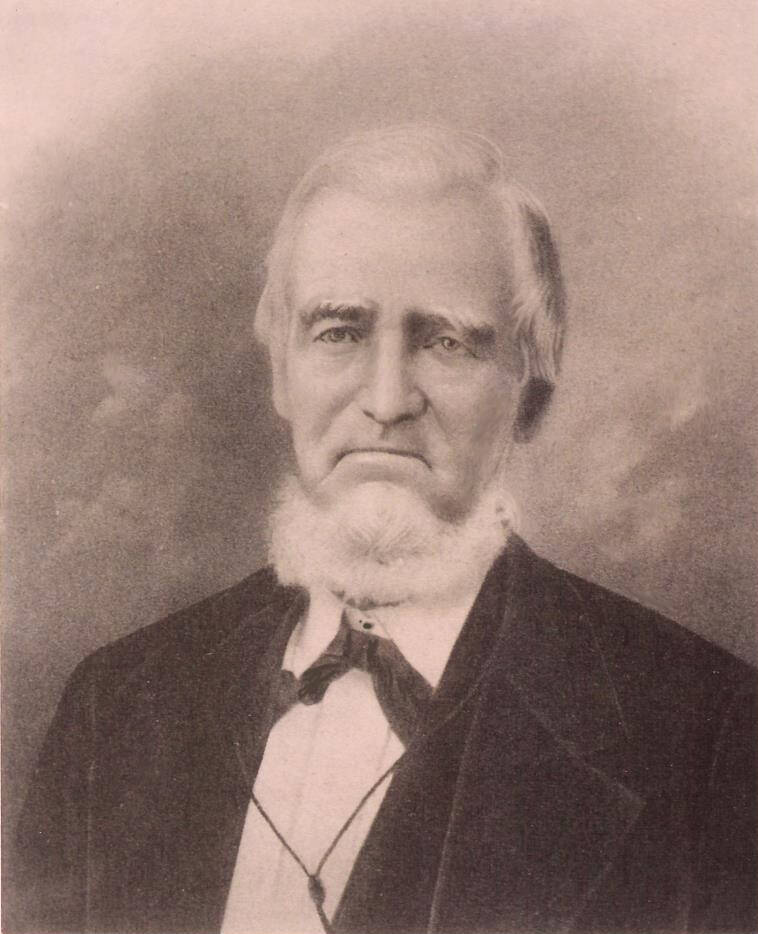
William Hutchinson Norris
Wikimedia CommonsCol. William Hutchinson Norris founded the sole surviving Confederado settlement in Brazil.
Col. William H. Norris was one of the most prominent men who led efforts to settle beyond the reach of the victorious Union. A former state senator from Dallas County, Alabama, a grand master of the masonic Grand Lodge in Alabama, and a veteran of the Mexican-American War, Norris decided that a free United States was no place for his family.
After securing a small fortune in gold kept safe in a hole in his yard throughout the war (according to legend, Norris’s wife had kept Union soldiers from stealing the gold by sharing a secret Masonic handshake with their commanding officer), Col. Norris and his son Robert arrived in São Paulo state in southeastern Brazil in December 1865. 
The Norrises purchased three slaves and 500 acres of land near Santa Bárbara d’Oeste. By April 1866, their families had also made the journey. William and Robert then began a letter-writing campaign urging their friends and former neighbors to join them.
Within a few years, more than half a dozen Confederate settlements were established in the states of Pará, Paraná, and São Paulo.
Maj. Lansford Hastings spread word of the Confederate outposts in Brazil. Hastings, an explorer whose guidance had led to the disastrous Donner Party incident, published The Emigrant’s Guide to Brazil in 1867, a sensational travel book that promised unlimited wealth to those Southerners brave enough to strike out for themselves in Dom Pedro’s empire.
As the United States moved on from the horror of the Civil War, the unreformed Confederados, as local Brazilians called them, made every effort to preserve the illusion of life as it had been.
They practiced Protestant Christianity, cooked Southern food, spoke English, and fiercely resisted the temptation to blend into the local population, steadfastly keeping themselves separate and distinct.

The Confederados Try, And Fail, To Revive Their Dreams Of Slavery
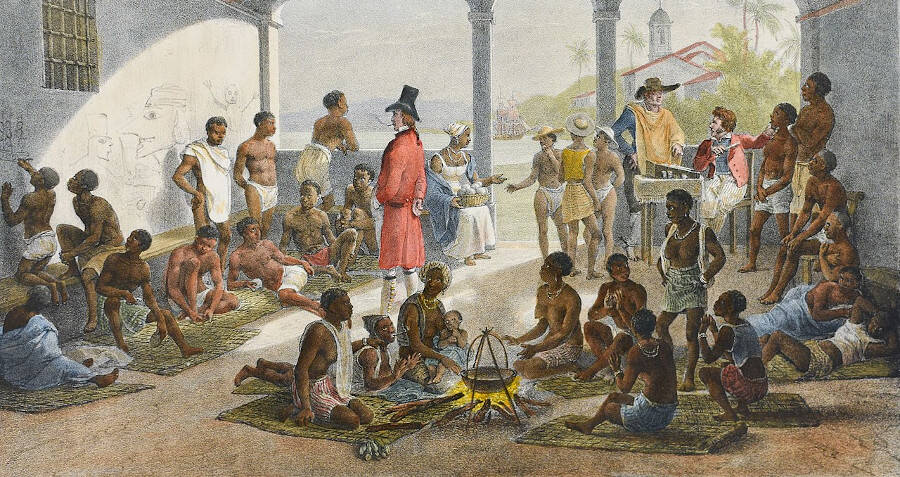
Confederados In Brazil
Wikimedia CommonsSlaves made up nearly half of the population of Brazil in the 19th century, attracting Southerners who sought to carry on the exploitation of slave labor.
From the beginning, the success and endurance of the Southerners’ colonies hinged on their ability to purchase and control slaves.
The South and Brazil had long held slavery in common. In fact, by the mid-19th century, more than 40 percent of the victims of the Atlantic slave trade had ended up in the vast sugarcane fields of Brazil, where the fruit of their labors was gathered to sweeten coffee and tea in houses and cafés across Europe and North America.
But even though Southern emigrants arrived in Brazil with the patronage of the emperor, they succeeded in buying very few slaves. The Confederados spoke little Portuguese, and with insufficient funds and no personal connections in Brazil, they failed to purchase enough human lives to succeed in resurrecting the plantation agriculture system.

The End Of The Confederado Settlements
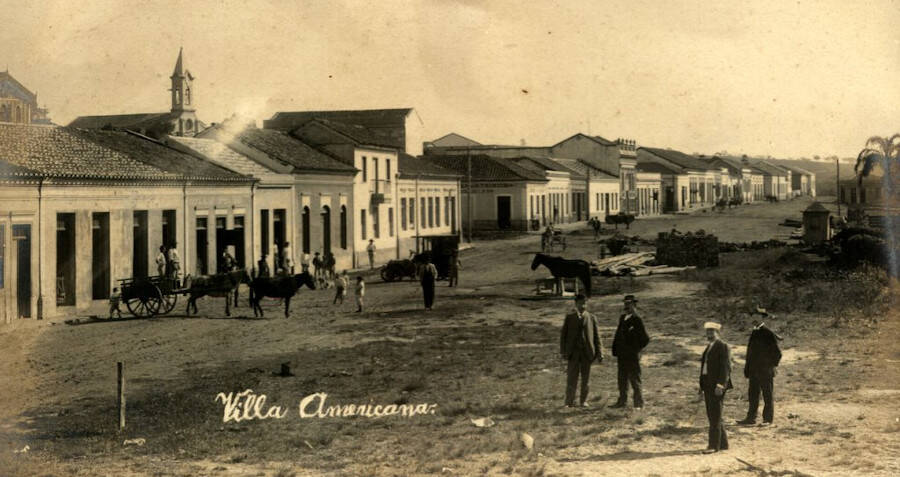
Villa Americana
Wikimedia CommonsNorris’s Villa Americana in 1906

As the heads of individual colonies failed financially or died from disease, their followers drifted to other colonies, especially Norris’s Villa Americana in São Paulo. But perhaps the most significant reason for the failure of the Confederate diaspora was the failure of the Reconstruction.
In 1877, federal troops were withdrawn from occupation duties in Southern states, taking with them the best protection freed black citizens had.
With federal authorities out of the way, Jim Crow began as Southern politicians regained their power and exacted revenge for their humiliation on their former slaves. To many struggling Confederados, this was more than they could have hoped for: the restoration of racist supremacy in the South.
It’s unknown how many exiled Southerners returned home in the years that followed. What is known is that many of the former settlements disbanded, and many either joined larger colonies or returned to a South eager to welcome them back. Those who remained became all the more close, intent on protecting their heritage even after Brazil abolished slavery in 1888.

The Legacy Of The Confederados
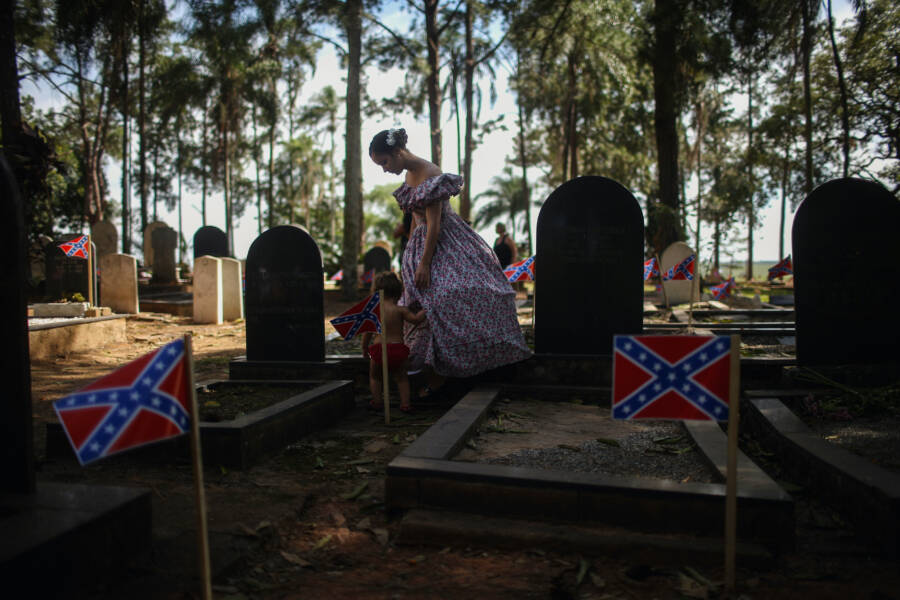
Confederate Graveyard In Brazil
Mario Tama/Getty ImagesA woman dressed in a traditional hoop skirt walks past graves marked with Confederate flags in the American Cemetery during the annual Festa Confederada in 2016.
Although the 10,000 to 20,000 Confederados failed to build their longed-for Confederate holdout, they nevertheless left a deep and lasting impression in the country they helped settle, with their contributions seen for years afterward in agriculture, technology, and society.
Many of their descendants claimed that Brazil would have stagnated without their help, and while this isn’t exactly true, they did help speed up the adoption of technologies and innovations that were arriving on Brazil’s shores, such as the metal-tipped plow and railroads.
It’s likely that Norris’s Villa Americana would have failed just as the other Confederado settlements did if not for the presence of one of Brazil’s earliest and most important railroads nearby, allowing the settlers to export their cotton and helping the country turn into a world leader in textile production.
In the years following their arrival, the Confederados were soon dwarfed by massive waves of immigrants from Germany, Italy, and Japan, each bringing their own contributions and leaving even more obvious impressions on Brazil as it developed into one of the most successful countries in South America.
But even today, as their numbers dwindle and their descendants speak more Portuguese and identify as Brazilian, the Confederados gather each year to celebrate their ancestry.
Dressed in antebellum hoop skirts and Confederate uniforms, they eat Southern food, dance to pre-war music, and fly the flag of the defeated South in a tribute to one of the strangest emigrations ever to take place in the Americas.
After learning about the Confederados’ attempt to keep the Confederacy alive in Brazil, see what the veterans of the Civil War looked like in these stunning photographs. Then, learn more about the enduring legacy of slavery in the life of Cudjo Lewis, the last victim of the Atlantic slave trade.


RSN: FOCUS: Supreme Court Blocks Trump From Shutting Down DACA


Reader Supported News
18 June 20
It's Live on the HomePage Now:
Reader Supported News


FOCUS: Supreme Court Blocks Trump From Shutting Down DACA
Immigration-rights activists at a rally in front of the US Supreme Court in Washington, DC, on November 12. (photo: Mandel Ngan/Getty)
Robert Barnes, The Washington Post
Barnes writes: "The Supreme Court on Thursday rejected the Trump administration's attempt to dismantle the program protecting undocumented immigrants brought to the country as children, a reprieve for nearly 650,000 recipients known as 'dreamers.'"

EXCERPT:
The administration has tried for more than two years to “wind down” the Deferred Action for Childhood Arrivals (DACA) program, announced by President Barack Obama in 2012 to protect from deportation qualified young immigrants. Former Attorney General Jeff Sessions advised the new Trump administration to end it, saying it was illegal.
But, as lower courts had found, Roberts said the administration did not follow procedures required by law, and did not properly weigh how ending the program would affect those who had come to rely on its protections against deportation, and the ability to work legally.
“We do not decide whether DACA or its rescission are sound policies,” Roberts wrote.
He added: “We address only whether the [Department of Homeland Security] complied with the procedural requirement that it provide a reasoned explanation for its action. Here the agency failed to consider the conspicuous issues of whether to retain forbearance and what if anything to do about the hardship to DACA recipients. That dual failure raises doubts about whether the agency appreciated the scope of its discretion or exercised that discretion in a reasonable manner.”
He was joined by Justices Ruth Bader Ginsburg, Stephen G. Breyer, Sonia Sotomayor and Elena Kagan in the most important parts of the opinion.
The court’s four most conservative justices dissented. Justice Clarence Thomas said the program was illegal, and that the court should have recognized that rather than extending the legal fight.
“Today’s decision must be recognized for what it is: an effort to avoid a politically controversial but legally correct decision,” Thomas wrote. “The court could have made clear that the solution respondents seek must come from the legislative branch.”


RSN: David Sirota | We've Always Had the Money for Medicare for All - We've Just Given It to Corporations Instead


Reader Supported News
18 June 20

When an organization is truly “100% Reader Supported,” bad fundraising days create immediate havoc. Like right away.
We’ve said it many times: We do not need a big cash flow to do this, we need reasonable donations. The only thing we fear are flat-out horrible fundraising days.
If we say we need it, we need it.
Marc Ash
Founder, Reader Supported News


If you would prefer to send a check:
Reader Supported News
PO Box 2043
Citrus Hts, CA 95611


Reader Supported News
18 June 20
It's Live on the HomePage Now:
Reader Supported News


David Sirota | We've Always Had the Money for Medicare for All - We've Just Given It to Corporations Instead
Medicare for All supporters. (photo: Win McNamee/Getty)
David Sirota, Jacobin
Sirota writes: "In recent weeks, we've seen health care industry CEOs report paying themselves $2.4 billion as twenty-seven million people were thrown off their health care coverage."
READ MORE


This screen grab taken from body camera video provided by the Atlanta Police Department shows Rayshard Brooks speaking with Officer Garrett Rolfe. (photo: Atlanta PD)


Former Atlanta Police Officer Who Shot Rayshard Brooks Charged With Felony Murder
Brakkton Booker, NPR
Booker writes: "The white Atlanta police officer who shot a 27-year-old black man in the back last week in the parking lot of a fast-food restaurant will face a charge of felony murder and 10 other charges, a Georgia county prosecutor announced Wednesday."

EXCERPT:
There is also reporting from the Atlanta Journal-Constitution and The Guardian indicating that Rolfe, the officer who killed Brooks, was previously reprimanded for his use of force.
The Atlanta Journal-Constitution reported that Rolfe received a written reprimand in 2017 for using his firearm. His file, according to the paper, included a dozen other incidents ranging from vehicular accidents to complaints from citizens.
"He was exonerated in nine of those internal investigations," the newspaper reported.
The Guardian reported on a 2015 incident in which Rolfe and two other officers shot at Jackie Jermaine Harris, who was caught driving a stolen vehicle. Harris rammed a law enforcement vehicle, the paper reported, and the officers shot at him multiple times.
"However, the shooting was not reported by the police involved," The Guardian added. "Harris, like Brooks, is African American."


Jamaal Bowman is a progressive primary challenger taking on 16-term congressman Rep. Eliot Engel. (photo: Bowman Campaign)

Top Democrats Are Trying to Stop This Man From Becoming the Next AOC
Jesse McKinley, The New York Times
McKinley writes: "The primary result was a visceral warning to Democratic leadership that it had better quickly reckon with the push for progressive change, and not underestimate the candidates behind it. The Democratic establishment has apparently heeded that lesson."

Representative Eliot Engel’s primary contest against Jamaal Bowman in New York is a test of the Democratic establishment’s ability to withstand its emboldened left wing.

wo years ago, Alexandria Ocasio-Cortez, then a young, untested democratic socialist, pulled off a shocking upset by defeating the No. 4 House Democrat, Representative Joseph Crowley. The primary result was a visceral warning to Democratic leadership that it had better quickly reckon with the push for progressive change, and not underestimate the candidates behind it.
The Democratic establishment has apparently heeded that lesson.

As the June 23 primary nears in New York, another long-tenured Democrat, Eliot L. Engel, is being threatened by a young progressive challenger, Jamaal Bowman. The race has become a focal point for the party’s directional battle, with money and marquee endorsements flying around in recent days.


READ MORE


President Donald Trump speaks to reporters spaced apart in the White House briefing room during a daily coronavirus news conference.  (photo: Alex Brandon/AP)
President Donald Trump speaks to reporters spaced apart in the White House briefing room during a daily coronavirus news conference. (photo: Alex Brandon/AP)

Mattis Speechwriter 'Confirms' Bolton's Claim Trump Wanted Journalists Imprisoned and Executed
Blake Montgomery, The Daily Beast
Montgomery writes: "A speechwriter for former Defense Secretary James Mattis took to Twitter late Wednesday to say he 'can confirm' a controversial claim in John Bolton's bombshell book The Room Where It Happened."
READ MORE


'Police departments systemically fail to make arrests in sexual assault cases.' (photo: Ragan Clark/AP)

'Who Will Protect You From Rape Without Police?' Here's My Answer to That Question
Moira Donegan, Guardian UK
Donegan writes: "As uprisings have spread through American cities in response to the killing of George Floyd in Minneapolis, a once fringe leftwing position has become rapidly mainstream: abolishing the police."
READ MORE


Children in a displaced persons camp in Yemen's western province of Hodeida on May 6 2020. (photo: Khaled Zaid/AFP)

Human Rights Orgs Condemn UN for Pulling Saudi Arabia From Blacklist of Groups Killing Children
Agence France Presse
Excerpt: "Campaigners reacted angrily on Monday to removal of the Saudi-led military coalition in Yemen from a list of groups violating children's rights, in a report by UN Secretary-General Antonio Guterres."
READ MORE


View from Albert Mountain on the Appalachian Trail at Nantahala National Forest. (photo: Getty)

US Supreme Court Clears Way for Pipeline to Cross Appalachian Trail
Lawrence Hurley, Reuters
Hurley writes: "Ruling against environmentalists, the U.S. Supreme Court on Monday decided that the federal government has the authority to allow a proposed $7.5 billion natural gas pipeline to cross under the popular Appalachian Trail in rural Virginia."

The 7-2 ruling was a victory for Dominion Energy Inc and President Donald Trump’s administration, both of which appealed a lower court ruling that halted construction of the 600-mile (965-km) Atlantic Coast Pipeline, which would run from West Virginia to North Carolina. 
The decision, written by conservative Justice Clarence Thomas, removes one of several obstacles facing the project. Two liberal justices, Sonia Sotomayor and Elena Kagan, dissented. 
“Today’s decision is an affirmation for the Atlantic Coast Pipeline and communities across our region that are depending on it for jobs, economic growth and clean energy. We look forward to resolving the remaining project permits,” Dominion said in a statement. 
Environmental groups including the Sierra Club and Southern Environmental Law Center had sued to stop the pipeline after the U.S. Forest Service gave the green light for the project to run through the George Washington National Forest. Dominion Energy leads a consortium of companies in the project that also includes Duke Energy Corp. 
After a protracted application process involving multiple federal agencies, the Forest Service granted the consortium a right of way under the trail in 2018. 
The Richmond-based 4th U.S. Circuit Court of Appeals found in 2018 that the Forest Service lacked the authority to grant a right of way for the pipeline where it crosses the Appalachian Trail in the national forest land because the trail was overseen by the National Park Service. 
In Monday’s ruling, the Supreme Court agreed with the Trump administration that the Forest Service retained the authority to approve rights of way across the trail. 
The park service’s authority over the trail “did not transform the land over which the trail passes into land within the National Park System,” Thomas wrote. 
Kelly Martin, who heads the Sierra Club’s Beyond Dirty Fuels Campaign, vowed to contest the remaining permit applications. 
“Nothing in today’s ruling changes the fact that the fracked gas Atlantic Coast Pipeline is a dirty, dangerous threat to our health, climate and communities, and nothing about the ruling changes our intention to fight it,” Martin added. 
The proposed pipeline would be 600 feet (180 meters) below a section of the 2,200-mile (3,500 km) trail, which stretches from Maine to Georgia. 
The Supreme Court’s ruling will also affect the proposed 300-mile (480-km) Mountain Valley Pipeline, which would run from West Virginia to southern Virginia and crosses the trail in the Jefferson National Forest. The pipeline is almost finished but construction was halted as a result of the ruling in the Atlantic Coast pipeline case before the crossing under the trail was completed. 
[For a graphic on major cases before the Supreme Court, click tmsnrt.rs/2mZn6MJ


How The Downballot reports on and analyzes polls

                                                                                                            LOTS OF POSTS IGNORED BY BLOGGER...