Monday, February 21, 2022

RSN: FOCUS: The Supreme Court Is Not Being Honest With You


Reader Supported News
20 February 22

Live on the homepage now!
Reader Supported News

RSN: ABSOLUTELY WORTH FIGHTING FOR - I am proud to write to you today and ask for your support. I am proud of our staff, our achievements and our commitment to making our country and our world better. I am proud of our readership and the community we have built. We are, “Reader Supported News.” Give us a hand please.
Marc Ash • Founder, Reader Supported News

Sure, I'll make a donation!


Supreme Court Justice Amy Coney Barrett whose nomination was rammed through the Senate in the waning days of Donald Trump's presidency. (photo: Rachel Malehorn/AP)
FOCUS: The Supreme Court Is Not Being Honest With You
Ian Millhiser, Vox
Millhiser writes: "Justice Amy Coney Barrett delivered a speech this week that echoed decades of conservative talking points about the proper, limited role of judges in a democracy. But that restrained vision is completely divorced from Barrett's own conduct as a conservative justice - not to mention that of the Republican majority she consistently votes with."

Justice Amy Coney Barrett appears to be quite unfamiliar with her own judicial record, and that of her colleagues.


Justice Amy Coney Barrett delivered a speech this week that echoed decades of conservative talking points about the proper, limited role of judges in a democracy. But that restrained vision is completely divorced from Barrett’s own conduct as a conservative justice — not to mention that of the Republican majority she consistently votes with.

Her remarks, which were offered at an academic symposium hosted by Notre Dame Law School, were grounded in the rhetoric of judicial restraint that Republican politicians have used to talk about the proper role of the courts at least as far back as Richard Nixon.

The Court’s youngest justice drew a distinction between “pragmatists,” judges who “tend to favor broader judicial discretion,” and “formalists,” who “tend to seek constraints on judicial discretion” and “favor methods of constitutional interpretation that demand close adherence to the constitutional text, and to history and tradition.” She placed herself in the latter camp.

As a justice, however, Barrett has behaved as an unapologetic pragmatist. Along with the Court’s other Republican appointees, Barrett supports flexible legal doctrines that give her Court maximal discretion to veto federal regulations that a majority of the justices disagree with — especially regulations promoting public health or protecting the environment. And she’s joined her fellow Republican justices in imposing novel limits on the Voting Rights Act that appear nowhere in the law’s text.

The rhetoric of judicial restraint is potent, so it is understandable why Barrett wants to tap into that potency. Formalist rhetoric enables the justices to claim that they didn’t roll back voting rights or strike down a key prong of President Joe Biden’s efforts to promote vaccination because they prefer weaker voting laws and a flaccid public health system — they simply did what the law requires.

And Barrett is hardly the only justice to engage in such rhetoric. Justice Neil Gorsuch recently published an entire book claiming that judges should rely almost exclusively on the text of a statute or constitutional provision while interpreting it. Justice Clarence Thomas frequently calls for radical shifts in the law, claiming they are necessary to restore the “original understanding” of the Constitution. Even Justice Samuel Alito, the Court’s most partisan justice, recently attributed his new, entirely atextual limits on the Voting Rights Act to having taken “a fresh look at the statutory text.”

The problem with this rhetoric, in short, is that it bears no resemblance whatsoever to the current Supreme Court’s actual behavior.

“Pragmatism” v. “formalism,” briefly explained

Barrett was at Notre Dame to deliver the keynote address at a symposium on “The Nature of the Federal Equity Power,” a topic that, as Barrett wryly acknowledged in her speech, “sounds like one that only a law professor could love.”

As Barrett explains, “equity” is a legal concept that arose in England as a way of mitigating harsh outcomes that were required by inflexible legal rules. The English system even had a special court, the Court of Chancery, which was a “place for litigants to come” when ordinary legal rules were “too harsh.”

This dual court system, Barrett explained, highlighted a “tension between the demands of the law, which constrains, and the demands of fairness, which is flexible.” Ordinary judges were more akin to mechanical dispensers of legal rules, while judges applying equitable principles had more leeway to reach results they deem fair.

If that tension sounds familiar, Barrett told an audience of mostly law students that it should. “It’s the same dispute that we see in a context that’s probably more familiar to you — the context of constitutional interpretation.”

According to Barrett, there are two opposing sides in this dispute. “Formalists,” such as herself and the late Justice Antonin Scalia, who “favor methods of constitutional interpretation that demand close adherence to the constitutional text, and to history and tradition.” Meanwhile, Barrett claims that “pragmatists” favor a more flexible approach that is less concerned with applying consistent legal rules, and more concerned about the harsh results that can arise from a too-rigid adherence to legal texts.

Most of what Barrett said at Notre Dame is uncontroversial. She fairly summarizes the development of English courts of equity. She is also correct that modern-day judges frequently divide into what she describes as the formalist and pragmatic camps.

But Barrett is wrong to label herself a formalist. In her brief tenure on the Supreme Court, she’s shown extraordinary willingness to join other Republican-appointed justices in opinions that bend the rules of the law in order to achieve results they deem to be just.

No one who joined the Court’s opinion in Whole Woman’s Health v. Jackson can claim to be concerned about the rule of law

Flexibility — what Barrett labels judicial “pragmatism” — is the hallmark of the Roberts Court, and especially the new, proudly conservative majority that Barrett’s confirmation brought into being. The Court’s most high-profile decisions will sometimes ignore the text of the Constitution, or of a major statute, altogether. And the Court frequently applies harsh legal rules to disfavored litigants that it would never apply to political conservatives.

As Scalia once explained, the formalistic demand that legal rules must apply universally to all similarly situated litigants is one of the most important constraints on judicial discretion. “When, in writing for the majority of the Court, I adopt a general rule,” the late justice wrote in 1989, “I not only constrain lower courts, I constrain myself as well.” Because “if the next case should have such different facts that my political or policy preferences regarding the outcome are quite the opposite, I will be unable to indulge those preferences.”

And yet, the current Court doesn’t seem to just indulge such a preference, it revels in it. The most blatant example is the 5-4 decision in Whole Woman’s Health v. Jackson (2021), which Barrett joined in full.

Jackson involved Texas’s anti-abortion law SB 8, a law that effectively bans all abortions after six weeks, in violation of the fetal viability standard established in Planned Parenthood v. Casey (1992). And SB 8 was, in Justice Sonia Sotomayor’s words, designed to “evade judicial scrutiny.

Ordinarily, when someone wishes to challenge an unconstitutional state law in federal court, they are not allowed to sue the state directly. Rather, such a plaintiff must sue the state official charged with enforcing that unconstitutional law. But Texas tried to design SB 8 so that no state official would be empowered to enforce its anti-abortion provisions — and thus no one could be sued to block the law.

SB 8 relies on a bounty hunter system. Under SB 8, “any person” except for an employee of the state of Texas may bring a lawsuit against any abortion provider accused of performing an abortion after the sixth week of pregnancy. If an abortion provider loses such a suit, they must pay the plaintiff a bounty of at least $10,000 — and there is no upper limit on this bounty.

SB 8, in other words, terrorizes abortion providers by potentially subjecting them to hundreds or even thousands of lawsuits if they are suspected of violating SB 8’s terms.

As Chief Justice John Roberts explains in a dissenting opinion in Jackson, Texas did not actually succeed in writing a law that is not enforced by state officials — and is therefore immune from federal judicial review. Because “the mere threat of even unsuccessful suits brought under SB 8 chills constitutionally protected conduct,” Roberts wrote, “court clerks who issue citations and docket SB 8 cases are unavoidably enlisted in the scheme to enforce SB 8’s unconstitutional provisions, and thus are sufficiently ‘connect[ed]’ to such enforcement to be proper defendants.”

But the five most conservative justices, including Barrett, all backed Texas’s play. Barrett joined an opinion by Gorsuch that effectively immunized SB 8 from any federal lawsuit challenging Texas’s bounty hunter system. (Technically, Gorsuch’s opinion allowed suits to move forward against state health officials who play a minor role in enforcing the law, but their role in doing so is so small than a hypothetical court order against these officials would be basically useless.)

The implications of this decision are staggering. As Roberts writes in dissent, quoting from an 1809 Supreme Court opinion, “if the legislatures of the several states may, at will, annul the judgments of the courts of the United States, and destroy the rights acquired under those judgments, the constitution itself becomes a solemn mockery.” Jackson provides every state with a roadmap that it can use to neutralize virtually any constitutional right.

So what’s really going on here? Would Barrett really vote to uphold a state law subjecting all gun owners to SB 8-style lawsuits? That seems unlikely. Among other things, Barrett is an outspoken proponent of more expansive gun rights. And a majority of the justices appeared inclined to expand the scope of the Second Amendment significantly during a separate case that was argued last November.

But the disagreement between the majority and dissenting opinions in Jackson can be explained by the distinction between formalism and pragmatism that Barrett draws in her Notre Dame speech.

In Jackson, Chief Justice Roberts — a conservative who typically opposes abortion rights — nevertheless takes the formalists’ position: The Constitution is the supreme law of the land. States must follow it. They also must follow Supreme Court decisions, like Roe v. Wade, that interpret the Constitution.

Meanwhile, Justice Barrett, an outspoken opponent of abortion rights, takes the pragmatist’s approach. The opinion she joined in Jackson makes no sense as a matter of legal formalism — taken seriously, it would allow a state government to nullify nearly any constitutional right, including rights that Barrett no doubt wishes to enforce. But the lead opinion in Jackson makes perfect sense if you believe that abortion is murder, and so the interests of justice must bend to the formal demands of the law.

The Court’s Republican majority is giving itself a flexible power to veto federal regulations

Barrett’s pragmatic approach to the law, and that of her Republican colleagues, is also on display in their decisions weighing the Biden administration’s power to protect public health.

Recall that Barrett defined a pragmatic judge as one who tends “to favor broader judicial discretion,” and formalistic judges as those who “tend to seek constraints on judicial discretion.” Since joining the Court, Barrett has sought to maximize her own discretion to veto federal regulations, while eliminating longstanding constraints on judicial power. And she’s largely succeeded in these efforts because she has five colleagues who share the same goal.

Consider the Court’s recent decisions in National Federation of Independent Business (NFIB) v. Department of Labor (2022), which struck down the Biden administration’s rule requiring most workers to either be vaccinated against Covid-19 or be regularly tested for the disease, and Alabama Association of Realtors v. Department of Health and Human Services (2021), which struck down the Centers for Disease Control and Prevention’s eviction moratorium in areas with substantial levels of Covid transmission.

Both cases questioned the power of federal agencies to write binding national regulations under long-existing federal statutes empowering those agencies to do just that. Before former President Donald Trump started remaking the judiciary, the Court’s decisions governing such rules urged judges to be deferential to both the agencies themselves and to the Congress that delegated such power to an agency.

In Mistretta v. United States (1989), for example, the Court held that judges should be exceedingly reluctant to strike down an act of Congress giving a federal agency the power to regulate. And Chevron v. Natural Resources Defense Council (1984) held that courts should typically defer to federal agencies, regarding the scope of the agency’s authority to regulate, if the statute permitting the agency to issue binding rules is ambiguous.

Thus, under Barrett’s distinction between formalist and pragmatic judges, both Mistretta and Chevron are formalistic decisions. Both impose “constraints on judicial discretion,” by requiring that judges defer to federal agencies.

In NFIB and Alabama Association of Realtors, however, the Court walked away from this more restrained approach to judging — with Barrett joining the majority in both decisions. Both cases relied on the so-called “major questions doctrine,” a doctrine that was invented entirely by judges, and that has no basis in any statute or in the Constitution’s text.

This doctrine places vague limits on federal agencies’ power to issue regulations that are likely to have a significant impact. “We expect Congress to speak clearly when authorizing an agency to exercise powers of ‘vast economic and political significance,’” the Court stated in both the NFIB and the Alabama Association of Realtors cases.

The problem with this major questions doctrine is, as federal appellate Judge Jane Stranch wrote in a lower court opinion upholding the Biden administration’s vaccination rules, “the doctrine itself is hardly a model of clarity, and its precise contours—specifically, what constitutes a question concerning deep economic and political significance—remain undefined.” The Court also hasn’t explained just how “clearly” Congress must “speak” if it wishes to delegate important powers to a federal agency.

The major questions doctrine, in other words, is an invitation to pragmatic judging. The major questions doctrine maximizes judicial discretion because it is so vague, and thus permits judges to invoke it whenever they disagree with a federal regulation and wish to strike it down. After all, if no one can say for sure “what constitutes a question concerning deep economic and political significance,” then the ultimate answer to this question will rest with Barrett’s court.

The same can be said about the nondelegation doctrine, a similarly vague constraint on federal agencies advanced by Barrett’s five Republican colleagues. (The Court’s most recent majority opinion discussing this doctrine, Little Sisters v. Pennsylvania, was decided a few months before Barrett joined the Court in 2020. So there is still a little uncertainty regarding Barrett’s views on nondelegation.)

The nondelegation doctrine would scrap the deferential approach that the Court advocated in Mistretta. In Gorsuch’s words, nondelegation calls upon judges to strike down federal laws permitting agencies to regulate, unless those laws were “‘sufficiently definite and precise to enable Congress, the courts, and the public to ascertain’ whether Congress’s guidance has been followed.”

Thus, like the major questions doctrine, the nondelegation doctrine is so vague that it maximizes the discretion of judges to restrict federal agencies. It is a fundamentally pragmatic doctrine under Barrett’s distinction between pragmatic and formalistic judges.

The Court needs to be more honest about what it’s actually doing

Opinions like JacksonNFIB, and Alabama Association of Realtors are quite disingenuous about what the Court is actually up to in those decisions.

Gorsuch’s opinion in Jackson, for example, tries to present his Constitution-destroying approach as a simple application of a formalistic rule prohibiting federal courts from issuing court orders against state courts. “If it caught on and federal judges could enjoin state courts and clerks from entertaining disputes between private parties under this state law,” Gorsuch wrote, “what would stop federal judges from prohibiting state courts and clerks from hearing and docketing disputes between private parties under other state laws?”

Similarly, the Court often justifies doctrines like nondelegation and major questions by claiming that they are necessary to restore the framers’ vision for how power would be shared between Congress and the executive branch. But, as law professors Julian Davis Mortenson and Nicholas Bagley explain in an important paper, this justification is ahistorical. The first Congress — a Congress made up of many of the Constitution’s drafters — enacted several laws delegating sweeping authority to federal agencies.

I could list more examples of the Court disguising pragmatic legal decisions with a patina of formalistic rhetoric. In Brnovich v. Democratic National Committee (2021), for example, the Court fabricated a bunch of new limits on the Voting Rights Act that appear nowhere in the law’s text — including a strong presumption that voting restrictions that were in place in 1982 are lawful, or a similar presumption favoring state laws purporting to prevent voter fraud. As Justice Elena Kagan wrote in dissent, Brnovich “mostly inhabits a law-free zone.”

But that didn’t stop Justice Samuel Alito, who wrote Brnovich, from claiming that his opinion would “start with a careful consideration of the text” of the Voting Rights Act. Nor did Brnovich’s profoundly pragmatic approach stop Barrett from joining Alito’s opinion.

It would be one thing if this Supreme Court were honest about what it is doing. It could write explicitly pragmatic opinions — which emphasize the justices’ desire to reach results that a majority of them deem to be fair, and which admit openly that these results cannot be justified by any provision of the Constitution or any federal statute.

But the Court is not being honest about what it is doing. Rather than admitting that they are engaged in an unfettered, pragmatic approach to judging, the conservative justices continue to wrap themselves in the rhetoric of judicial formalism. Barrett’s Notre Dame speech is only the most recent example.

READ MORE


Contribute to RSN

Follow us on facebook and twitter!

Update My Monthly Donation

PO Box 2043 / Citrus Heights, CA 95611


Sunday, February 20, 2022

Let's be brave enough to challenge the status quo

Email from Brand New Congress


This is Jessica Mason. Above all else, I’m a daughter of Dallas. South Dallas raised me, and Washington will never change me.

My community was set up to fail by design. From growing up housing insecure in a poor Black neighborhood, to enlisting in the Navy as the only way to complete my college degree, to working in public housing administration — I have experienced the socioeconomic barriers and challenges that far too many Americans face all because our leadership has failed them. 

I’m running to be the voice of Texas’ 30th Congressional District because I’m tired of seeing the people and the community I love hurting and left behind. And I know that if we are going to see meaningful change, we must be brave enough to demand better than the status quo. 

As the only true progressive in this race, I know that saying “accessible healthcare” isn’t enough without demanding Medicare for All. I know that saying “climate action” isn’t enough without demanding a Green New Deal. I know that we need REAL bold solutions, nothing less — and I’m not afraid to fight for them.  

For far too long, politicians and corporations have been putting profit and wealth over the lives of us and the people in our communities. We must break the pattern of electing status quo elites who were raised in complete comfort and are out-of-touch with real Americans — because they will never truly be fighting for us.

We deserve leaders who won’t cave to corporate special interests for personal or political gain. Leaders who understand the difficult decisions working families have to make just to get by. And leaders who will do everything they can to fight for justice and equity. 

Early voting in Texas has already started, and the primary election is less than two weeks away. If we’re going to stop the toxic cycle of corruption at the top, it’s critical that we elect representatives who reflect our people-first values and who deeply understand the struggles and needs of everyday Americans. 

It’s time for a Brand New Congress. It’s time for a New Deal.

We can’t do this without you.

Jessica Mason
Candidate for Congress, TX-30


FOLLOW US ON

facebook link facebook link twitter link instagram link 
Donate Button

Mailing Address:
Brand New Congress
P.O. Box 972
Pearland, TX 77588

©2022 BRAND NEW CONGRESS. ALL RIGHTS RESERVED.

PAID FOR BY BRAND NEW CONGRESS PAC.

Contributions are not tax deductible as charitable contributions for federal income tax purposes.


What you need to know about me


Ro Khanna

Hi, thank you for joining our campaign.

Whether you have been a supporter of this campaign for years, or you just made your first donation today, I want to make sure you know who I am and what I stand for. If you’re short on time, will you consider pitching in $3 to keep up our campaign’s momentum?

Let me start by introducing myself:

I’m Ro Khanna, the Representative for California’s 17th District in the 117th Congress. I am running for re-election to continue serving Silicon Valley — and your support means the world to me.

I was first elected to Congress in 2016, where I co-founded the NO PAC Caucus. Back in 2017, there were only three members of that caucus. It’s been five years and I am still one of only six members of Congress who does not accept PAC contributions. And I promise you I will never accept PAC money, continuing my efforts to keep politics and special interest money separate.

But my story begins much earlier.

My commitment to public service was inspired early on by my grandfather. When I was young he would tell me stories about participating in Gandhi’s independence movement in India and how he spent several years in jail for promoting human rights. My grandfather’s vision for human dignity and justice lives on in my belief that the American Dream should be attainable to all and should continue to inspire future generations.

Following that same dream, my parents immigrated to the United States — coming from India to seek opportunity and a better life for their children. I was born soon after they immigrated.

A young Ro at his school science fair

I learned the value of education and hard work from my parents and benefited from a quality public school education. My experiences as a student and as the son of a teacher are why I advocate for universal public education and the cancellation of student loan debt for working families.

I graduated Phi Beta Kappa with a B.A. in economics from the University of Chicago, and received a law degree from Yale University. After law school, I followed my mother’s example and became a lecturer in the Department of Economics at Stanford University and an Adjunct Professor at Santa Clara Law School.

Ro lecturing in front of a college class

In 2009, President Obama appointed me to serve as Deputy Assistant Secretary at the U.S. Department of Commerce. I broke new ground when I organized clean technology trade missions and expanded the Green Embassy program, which allows American clean technology firms to showcase their products in our embassies overseas. I also served on the White House Business Council, working with both business and labor for policies that promote bringing back American manufacturing jobs. Under my leadership, American exports grew dramatically.

Now, in Congress, I serve as Chairman of the Oversight Subcommittee on the Environment, a member of the Committee on Oversight and Government Reform, the Committee on Agriculture, and the Committee on Armed Services. In and out of Congress, I use my voice to share a progressive vision that promotes good jobs and wages for the 17th district and the United States of America.

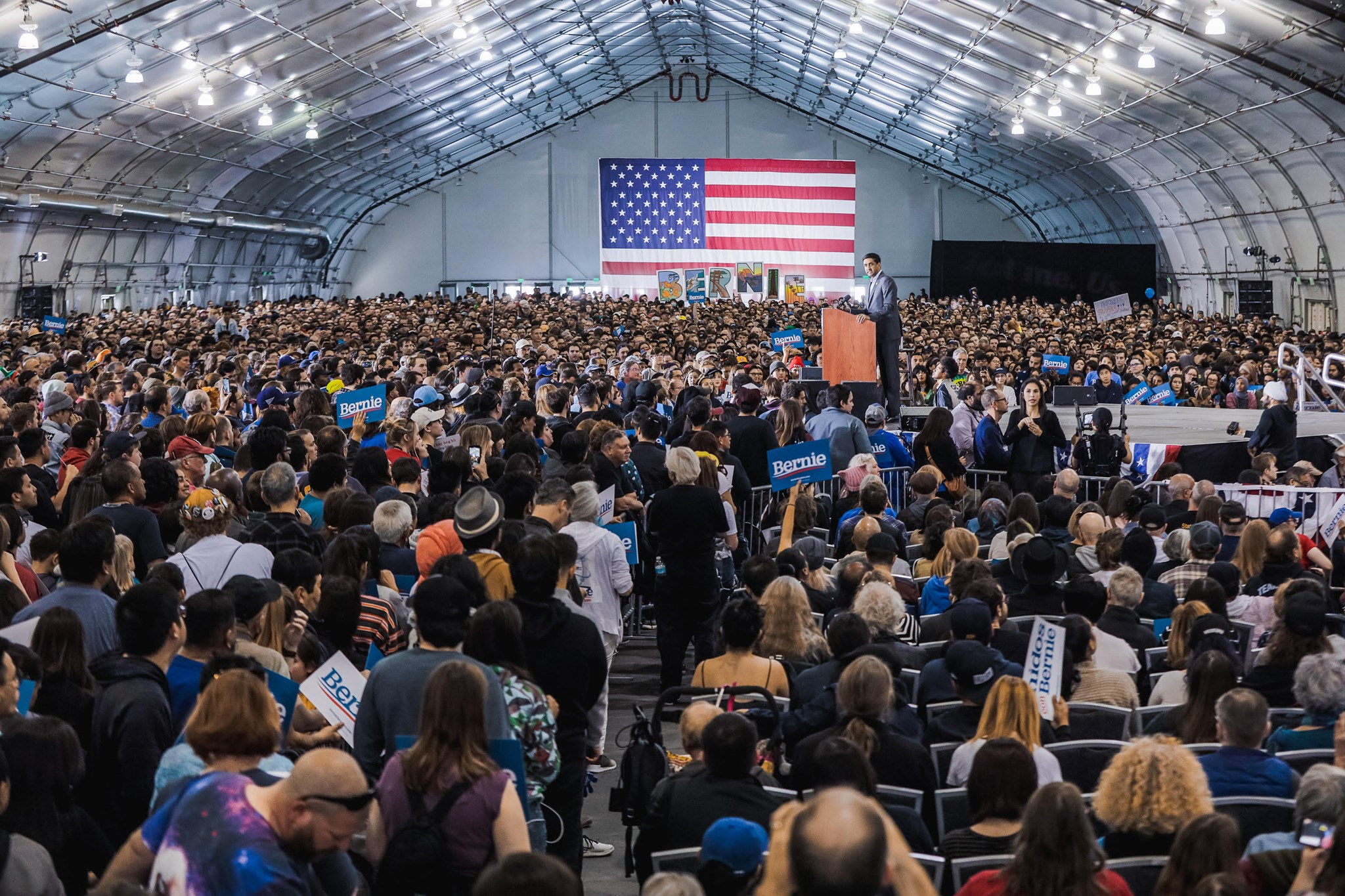
Ro speaking in front of a huge crowd at a Bernie Sanders rally

I am proud of my history of championing progressive values, advocating for workers and small businesses, and continuing to push for the policies that Americans deserve. I know we can win on key priorities like a Green New Deal, Medicare for All, and an Internet Bill of Rights, but we can’t do it without the support of people like you, Frank.

If you’re with me, and ready to further your support of my re-election campaign, please consider making your next donation today. Every dollar helps our campaign share our progressive vision with every voter in our district.

Thank you for putting your faith in me and the American Dream we all strive for. It’s an honor to serve the American people.

Together,

Ro Khanna


Like on FacebookFollow on Twitter

Email us: info@rokhanna.com

 Email is the most important way we keep in touch with people like you, so thank you for reading to the end. Small donors like you keep us going. 

To contribute via check, please address to Ro for Congress, PO Box 3513, Santa Clara, CA 95051.

Paid for by Ro for Congress


Nervous, Excited, Hopeful


Ayanna Pressley


My husband Conan and I just visited the Secretary of the Commonwealth to collect the nomination papers I need to get on the ballot and officially run for re-election to Congress:

Now, we need to collect 2,000 signatures from registered voters in MA-07, and we need the resources to support an inclusive, intentional organizing effort that engages people throughout the Massachusetts 7th district.

 I remember how Conan and I both felt — nervous, excited, hopeful — the first time we pulled papers in 2018. Those feelings are still there. But, looking back at the challenges we’ve faced these last three years, I’m proud of the progress we’ve made.

I’m so thankful for your support and faith. I hope to continue earning your trust and partnership — because our work is far from over. Our communities are still hurting. Justice has yet to be realized for too many. Change (still) Can’t Wait.

Our staff and volunteers are mobilizing to engage folks in every part of the MA-07. Please support our organizers and volunteers right now by contributing any amount that you can afford.

Thank you so much for your support. I am so grateful that you’re a part of this movement.

In Solidarity,
Ayanna


Like on FacebookFollow on TwitterFollow on Instagram

Paid for by the Committee to Elect Ayanna Pressley

 Email is the most important way we keep in touch with our supporters.  

To contribute via check, please address to Committee to Elect Ayanna Pressley, 

PO Box 240912, 

554 Washington Street, Dorchester Center, MA 02124.

Email us: info@ayannapressley.com


RSN: FOCUS: W.D. Ehrhart | Russians Rightly Unsettled by NATO's Eastward Creep


Reader Supported News
20 February 22

Live on the homepage now!
Reader Supported News

WE’RE NOT HERE TO ENTERTAIN YOU, WE’RE HERE TO PROTECT YOU — The mission of Reader Supported News is, take whatever steps are necessary to inform our readership of the threats that exist to democracy, the environment, social justice and international order. That gets messy and risky. When the budget disappears it gets exponentially more difficult. Nonetheless if we have to fight for a budget we can do that too. We must have a budget.
Marc Ash • Founder, Reader Supported News

Sure, I'll make a donation!


President Vladimir Putin of Russia. (photo: Sputnik/Mikhail Metzel/Reuters)
FOCUS: W.D. Ehrhart | Russians Rightly Unsettled by NATO's Eastward Creep
W.D. Ehrhart, Bucks County Courier Times
Ehrhart writes: "It's enough to keep you awake at night. Russia may no longer be the Soviet Union, but it's still the original Evil Empire."

ALSO SEE: Why Ukraine's Hope of NATO Membership
Drives Conflict With Russia

The headlines these days are ominous.

“Russia warns of retaliation if its demands are not met.”

“U.S. allies are stepping up to counter Russia’s Ukraine threats.”

“Blinken: No concessions in response to Russia on Ukraine.”

“Will there be a war over Ukraine?”

It’s enough to keep you awake at night. Russia may no longer be the Soviet Union, but it’s still the original Evil Empire: unrepentantly aggressive, a bully, eager to needle the West at every opportunity, willing to risk war to achieve its selfish aims.

Or so our government and our mainstream media would have us believe. But once again — as Americans have always been so adept at — we ignore the facts in order to present ourselves as the righteously aggrieved.

At the end of World War II, the Soviet Union quickly gobbled up all of eastern Europe, installing sympathetic governments and creating the Warsaw Pact. Proof positive of Communist aggression.

But during that war, the Soviet Union lost 27,000,000 soldiers and civilians — more than half of all casualties suffered by all of the nations involved in that war. I am not for a moment arguing that Joe Stalin was a nice guy, but he was protecting his country from future depredations by a hostile West by making sure that the next time the West attacked Russia, they’d have to kill a lot of other people before they actually got to the Russians.

And then there was the Cuban missile crisis. Imagine the gall of those war-mongering Russians (O.K., Soviets) to put nuclear missiles only 90 miles from our very shores. Talk about naked aggression. How much more blatant can you get?

Only years later did we learn that just prior to the Soviet introduction of missiles into Cuba, the U.S. had installed ballistic nuclear missiles in Italy and Turkey. So the U.S. is not threatening Russia with missiles on or near its borders, but when the Russians reciprocate, they’re obviously completely unjustified.

And what did Nikita Khrushchev ask for in return for removing the missiles from Cuba? Simply that the U.S. remove its missiles from Italy and Turkey. And he didn’t even demand that we admit we’d put missiles there in the first place. So the American missiles were quietly removed while the whole dangerous affair was portrayed as a great American victory and proof that we could and would stand up to the Russian bully.

And that brings us to the current crisis. There is a good deal of disagreement as to whether or not the U.S. promised Russia after the breakup of the USSR that NATO would not try to expand to include former members of the Warsaw Pact. But promise or not, it must surely be unsettling to anyone living in Russia that NATO now includes three former Soviet Socialist Republics, all with borders on Russia, and six former Warsaw Pact nations, several of these bordering directly on Russia.

Once again, don’t mistake me. I am not saying that Vladimir Putin is a nice guy. But I’d like to know how Americans in general and the U.S. government in particular would respond if Russia signed a military alliance with Canada and Mexico. By way of NATO, we’ve already done much the same thing to Russia, and now we want to include Ukraine in NATO as well?

Moreover, what purpose does NATO serve these days? NATO stands for the North Atlantic Treaty Organization. Turkey is in the North Atlantic? Albania is in the North Atlantic? And Bulgaria, Romania, Croatia? And then consider that nations like Poland, Hungary, Bulgaria, and Turkey make American democracy look like the Golden Age of Athens.

I have no illusions, and certainly no expectation, that the Biden administration will muster the courage to choose the sensible and reasonable course of action here: promise Putin that Ukraine will never be part of NATO in return for a Russian promise not to invade Ukraine.* After the pummeling Biden got for ending our forever war in Afghanistan, I expect he feels enormous pressure to demonstrate that he’s really a tough leader who won’t back down from aggression.

And of course, if we do go to war with Russia, most of you reading this won’t actually be doing anything or going anywhere at all. It’ll just be that tiny little 1% of our citizenry who will bear the blood price while the rest of us stand up and remove our hats for the Star-Spangled Banner at basketball games and hockey matches.

But I can tell you one bunch that's going to be really happy to see the U.S. and Russia go to war: that would be the Chinese. I just hope it doesn’t go nuclear.

*Here’s another fact few Americans know: ever since 1918, the Russians have never once broken any treaty they’ve signed with the U.S., though the U.S. has broken a number of the treaties it’s signed with the USSR/Russia.


READ MORE


Contribute to RSN

Follow us on facebook and twitter!

Update My Monthly Donation

PO Box 2043 / Citrus Heights, CA 95611



Some good news for you this Sunday morning


Adam Schiff for Congress

I can’t tell you how glad I am to share this right now.

The redistricting process is going... better than we expected. No, seriously.

Gerrymandered congressional district maps in key states like North Carolina, Pennsylvania, and Ohio are being struck down by state courts. Independent commissions have drawn very favorable districts in states like California. And in New York, the net effect of reapportionment may give us four new seats in that state alone. All of this gives Democrats a fighting chance at holding our majority. This is a big deal considering that pundits were predicting Democrats would get devastated by redistricting.

The maps still aren’t finalized nationwide, but this is reassuring news and it gives me good reason for optimism about the fall. I hope it does for you too.

Considering that it seemed almost certain that redistricting was going to cause Democrats to lose seats, this is a promising sign. We may end up netting a couple seats in the process, and have a fighting chance of protecting our slim Democratic majority in the House and growing that majority in the Senate.

Don’t get me wrong — this is not enough to guarantee we keep the House majority. But it should be enough to reinvigorate our efforts and give Democrats a needed boost. With the GOP raising millions of dollars to bolster Republican races, we need to keep fighting to help new and incumbent Democrats get elected.

With so much on the line, I’m personally asking — can you pitch in $10 right now to fuel our work protecting and expanding our slim Democratic majorities? 


I hope this piece of news provides you with just a little bit of hope this Sunday.

We press on,

— Adam

P.S. I know what you’re thinking after reading this email, and yes, Democrats still are fighting to end gerrymandering and pass national redistricting reform. We want to ensure that non-partisan commissions draw the lines in the future. But we also won’t unilaterally disarm in the face of GOP efforts to win at all costs.

150 E. Olive Ave., Suite 208 Burbank CA, 91502

WWW.ADAMSCHIFF.COM | CONTACT@ADAMSCHIFF.COM | PRIVACY POLICY

PAID FOR AND AUTHORIZED BY SCHIFF FOR CONGRESS


CORRECTED: Trump gives absurd defense for stealing classified docs

Today's Top Stories:

photo
Furious Trump says taking home classified documents was part of "routine" process

To be fair, patently criminal behavior is absolutely routine in the world of the disgraced ex-president.


Shelling intensifies along Russia-Ukraine border, two Ukrainian soldiers dead
Hundreds of artillery shells exploded along the contact line between Ukrainian soldiers and Russia-backed separatists, and thousands of people evacuated eastern Ukraine, further increasing fears Sunday that the volatile region could spark a Russian invasion.


photo
WATCH: Richard Ojeda exposes the "slow-motion coup" that could make Trump UNSTOPPABLE

OD Action partner: Trump's latest attack on democracy: Quietly buying election officials in key battleground states


Ukraine's president urges sanctions against Russia before a possible invasion, not after
Ukrainian President Volodymyr Zelensky told Western leaders he wants sanctions to be imposed against Russia before any potential invasion of his country, not after.


French modelling agent who founded agency with pal Jeffrey Epstein dies in police custody
Jean-Luc Brunel, who was detained in December 2020 as part of an inquiry into allegations of rape, sexual assault, and sexual harassment, was found dead in his cell on Saturday, the Paris prosecutor's office said.


photo
US now testing robot dogs to patrol US-Mexico border

What could possibly go wrong?


Ottawa police appear to end protesters’ hold of streets near Canada's Parliament
Interim Police Chief Steve Bell said "this unlawful occupation is over."


photo
Tucker Carlson's insidious on air plot exposed

No Lie with Brian Tyler Cohen: Disgusting.


GOP's new mail voter ID rules sow confusion in Texas with thousands of ballots at risk of rejection
Voters can still fix ballots to have them counted in the March 1 primary, but county officials are concerned about the sky-high rate of errors due to confusion over the new election restrictions ushered into law by state Republicans.


Black Florida senator spearheads vote-by-mail campaign ahead of midterm elections
Sen. Shevrin Jones has rolled out Operation BlackOut, a statewide effort to enroll "nontraditional" residents of color to vote by mail in Florida.


Fringe scheme to reverse 2020 election splits Wisconsin GOP
Wisconsin is closer to the next federal election than the last, but the Republican effort to overturn the election results is picking up steam rather than fading away — and spiraling further from reality as it goes.


Seriously?

Yes. Seriously.

Hope...


Sunday Funnies

Sunday Funny
Sunday Funny
Sunday Funny
Sunday Funny


How The Downballot reports on and analyzes polls

                                                                                                            LOTS OF POSTS IGNORED BY BLOGGER...