Inside Trump’s NSPM-7: The Secret Directive Targeting Americans as “Radical Threats”A new national security memorandum quietly signed by Donald Trump is being used to surveil and label millions of Americans as potential terrorists for their political and religious beliefs.
|
Showing posts with label KEN KLIPPENSTEIN. Show all posts
Showing posts with label KEN KLIPPENSTEIN. Show all posts
Wednesday, October 15, 2025
Inside Trump’s NSPM-7: The Secret Directive Targeting Americans as “Radical Threats”



Thursday, June 29, 2023
FOCUS: Ken Klippenstein | After Overturning Roe v. Wade, Scotus Treats Itself to Sprawling Security Detail

28 June 23
Live on the homepage now!
Reader Supported News
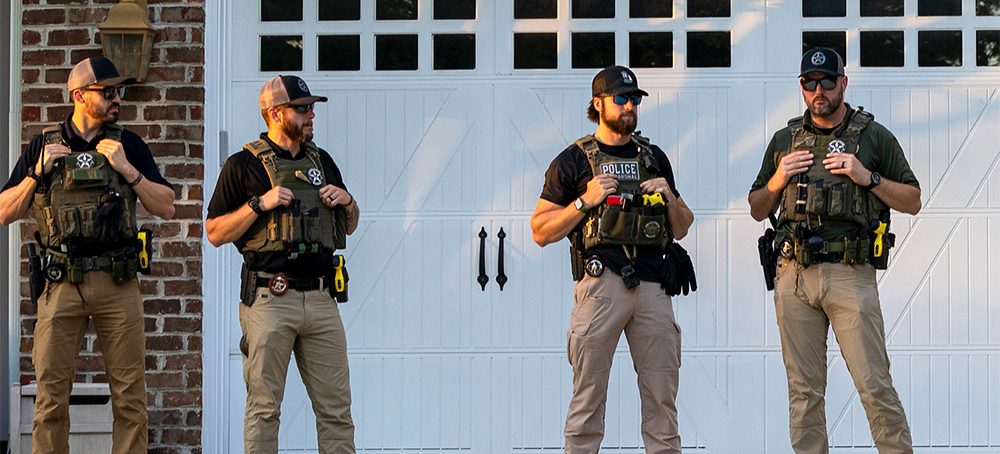
After the Dobbs decision leaked, the Supreme Court more than doubled its protective detail, despite no evidence of a heightened threat.
The Supreme Court sought millions for security last year, enlisting the U.S. Marshals to provide personal details for the justices. A year later, that security force hasn’t seen a significant increase in threats or attacks, according to documents reviewed by The Intercept, but the Supreme Court is asking to continue — and in some cases, even augment — the high level of security.
Last summer, hundreds gathered outside the homes of the conservative justices to protest the Dobbs decision, which effectively eliminated reproductive rights for millions. Top Republicans quickly cast the demonstrations as illegal, arguing that they were tantamount to an attempt to influence a judge, which is a crime.
“It is beyond dispute that far-left activists have launched a concerted and coordinated effort to intimidate the Court into changing the draft Dobbs decision,” Sen. Chuck Grassley, R-Iowa, ranking member of the Judiciary Committee, said in a letter to Attorney General Merrick Garland in May of last year. “I urge you to publicly commit to protecting the justices, and to condemn and prosecute anyone seeking to threaten and intimidate the Court into changing its decision.
Though the Supreme Court has its own police force, following Grassley’s letter, the Justice Department dispatched the U.S. Marshals Service to augment their security details. Congress passed the Supreme Court Police Parity Act, which extends security to Supreme Court justices’ immediate family members.
Yet, apart from one bizarre incident last June, when an armed California man traveled to Washington claiming an intent to assassinate Justice Brett Kavanaugh before turning himself in to authorities, there have been no acts of violence attempted or committed against justices. No protesters were arrested. Aggregate data, in fact, shows that threats to the judiciary in general went down in 2022.
In November, Justice Amy Coney Barrett even made light of the protests at a Federalist Society dinner after receiving a standing ovation. “Thank you. It’s really nice to have a lot of noise made that’s not by protesters outside my house,” Coney Barrett cracked.
The Supreme Court has continued to beef up security in response to perceived threats to justices from abortion activists anyway. In the past year, the Court expanded its security detail to include 400 U.S. Marshals through the new SCOTUS Special Security Officer Program, more than doubling the number of officers assigned to the security of the justices and their residences.
The Marshals’ annual report to Congress, released in April, sheds light on their response to the protests, which included “24-hour online threat screening coverage for the SCOTUS, all justices and their residences” as well as “real-time online research” into suspected threats at justices’ homes.
Although a year has passed since the Supreme Court overturned Roe on June 24, the Marshals this year requested an additional $21 million for 46 new positions, including 42 more Marshals, to bolster security to judges in the next fiscal year.
The Court specifically cited overturning Roe v. Wade as fueling an extra need. “As a result of the Dobbs decision,” the Marshals’ budget request explains, in reference to the case that overturned Roe, “SCOTUS contacted the [U.S. Marshals Service] to request assistance in securing their facility,” resulting in “additional security posts and Special Security officers to provide this enhanced level of on-site monitoring and presence of officers.”
During the Trump administration, the U.S. Marshals provided security details of questionable necessity. Former President Donald Trump’s education secretary, Betsy DeVos, faced criticism after her U.S. Marshals Service protective detail racked up over $24 million in costs, “the largest U.S. Cabinet-level protection detail in [U.S. Marshals Service] history.” Trump’s Environmental Protection Agency administrator, Scott Pruitt, ran up over $3.5 million, costs the EPA’s inspector general found were unjustified and were incurred without conducting a threat analysis to determine whether the protection was even necessary.
Earlier this year, the Supreme Court also separately requested a budget increase of $5.8 million over the previous year’s budget to augment its own police force, the Supreme Court Police. “This request would expand security activities conducted by Supreme Court Police to protect the Justices,” the budget document explains. “On-going threat assessments show evolving risks that require continuous protection.” The Supreme Court’s police force numbers about 125 officers, according to a 2018 report by Security Today.
But neither the Supreme Court police force nor the U.S. Marshals details the threats that are used to justify millions in extra security, and publicly available assessments point in the opposite direction.
The Marshals’ report cites 260 instances of “concerning communications” that were referred to the Supreme Court Police for further investigation. The previous year’s annual report did not identify any instances of “concerning communications” to the Supreme Court, instead focusing on “inappropriate communications” concerning DeVos, though no number is provided.
But threats against Supreme Court justices were not enough to dent the Marshals’ aggregate data on threats against its judiciary protectees, which actually reflect a decrease in the year of the Dobbs decision. (Annual data specific to threats against justices is not available.)
Though there was a raft of vandalism directed at churches and other anti-abortion facilities after the Dobbs ruling — in a recent case, the firebombing of a vacant anti-abortion clinic — experts say that violence has largely been directed at property.
“I am not aware of any serious bodily injury caused by pro-choice activists,” Michael German, a former FBI agent and fellow with the Brennan Center For Justice’s Liberty and National Security Program, told The Intercept.
Even in the case of the man who traveled from California with a plan to attack Kavanaugh, security did not intervene; he called the police and turned himself in. German said that he is not aware of anyone else being charged with making threats against a Supreme Court justice, a felony.
Not everyone in Congress intended their bill to be a blank check for the Court. Sen. Jeanne Shaheen, D-N.H., pressed Garland, the attorney general, about the Marshals’ protective detail in a March 28 Senate hearing, asking whether it would “continue indefinitely.”
“So you’re not anticipating this to go on long term then?” Shaheen asked.
“We’re hoping that it doesn’t go on long term,” Garland replied.
Follow us on facebook and twitter!
PO Box 2043 / Citrus Heights, CA 95611
Sunday, June 18, 2023
FOCUS: Ken Klippenstein | The FBI Is Hunting a New Domestic Terror Threat: Abortion Rights Activists

17 June 23
Live on the homepage now!
Reader Supported News

After GOP pressure, FBI abortion “terrorism” investigations increased tenfold, government data shows.
Last year, as the Supreme Court’s decision to overturn Roe v. Wade sparked major protests nationwide, the FBI opened nearly 10 times as many investigations into cases of abortion-related domestic terrorism as it had in 2021, a new internal report reveals. While the report doesn’t say how many of these incidents were motivated by support for reproductive rights and how many were anti-abortion, the uptick follows calls by top Republicans in Congress for the bureau to pursue “pro-abortion terrorism.”
“Pro-abortion terrorism is sweeping our nation,” Sen. Marco Rubio, R-Fla., wrote in a column last June, lamenting that “only after the outcry from the pro-life community did the FBI announce an investigation” into Jane’s Revenge — a small group of activists that firebombed an anti-abortion pregnancy center on June 7, 2021 — and that the attorney general “has yet to launch a wider DOJ investigation.” While conceding “no one has been killed or seriously injured,” Rubio said, “Things will only get worse before they get better.” (Facebook later quietly designated Jane’s Revenge a terrorist organization, as The Intercept reported.)
Rubio’s column cited roughly 50 attacks on anti-abortion activists and institutions, linking to a list posted by the anti-abortion Family Research Council. Apart from the actions of Jane’s Revenge, most of the cases enumerated describe simple vandalism.
Sen. Chuck Grassley, R-Iowa, similarly urged the bureau to go after so-called pro-choice extremists. “Responding to the current threat of pro-abortion violent extremism will require the FBI to continue its efforts to identify and investigate cases of abortion-related violence across our country at a high rate,” Grassley wrote in a June 27 letter to FBI Director Christopher Wray last year.
As vice chair of the Senate Intelligence Committee and then-ranking member of the Judiciary Committee, respectively, both of which oversee the FBI, Rubio and Grassley were both in a position to influence bureau leadership, and it appears the bureau listened.
The FBI’s abortion-related terrorism investigations jumped from three cases in the fiscal year 2021 to 28 in 2022, a higher increase than any other category listed, according to an audit published by the Department of Justice Office of the Inspector General on June 6. The number of abortion-related cases in 2022 far exceeds that of all previous years included in the audit, going back to 2017.
In the same time frame, FBI investigations into “racially or ethnically motivated extremists” decreased from 215 to 169; investigations into “anti-government / anti-authority” declined even more sharply, from 812 to 240. In fact, the only other category to see an increase in cases was “animal rights / environmental,” which underwent a modest increase from seven to nine cases.
Again, the report does not specify what proportion of the cases are motivated by support for reproductive rights or anti-abortion views. Asked about the specific breakdown, the FBI did not respond to a request for comment. But in testimony before the Senate on November 17, 2022, Wray revealed that the vast majority of the bureau’s investigations are focused on violence against anti-abortion individuals or organizations.
“Since the Dobbs Act decision, probably in the neighborhood of 70 percent of our abortion-related violence cases or threats cases are cases of violence or threats against pro-life,” Wray said. “Now we have quite a number of investigations as we speak into attacks or threats against pregnancy resource centers, faith-based organizations, and other pro-life organizations.”
But experts say the vast majority of serious violence in abortion-related cases is carried out by individuals trying to stop people from having abortions. From 1993 to 2016, 11 murders and 26 attempted murders were carried out by anti-abortion advocates, according to NARAL Pro-Choice California. In contrast, Michael German, a former FBI agent and a fellow with the Brennan Center for Justice’s Liberty and National Security Program, said that he was not aware of a single case of serious bodily injury caused by abortion rights advocates.
“There is a long history of deadly anti-abortion violence in this country,” German said. “The FBI should not devote counterterrorism resources to vandalism cases that don’t threaten human life out of some flawed notion of parity.
“Counterterrorism resources should be directed to the most serious threats,” German told The Intercept. While the Department of Homeland Security defines domestic terrorism such that it “must be dangerous to human life” or critical infrastructure, the FBI does not have this requirement. “Mere vandalism and property damage, while crimes that might deserve state and local police attention, should not be treated as terrorism.”
Since the bureau collapses both anti-abortion and abortion rights into the same abortion-related threat category and doesn’t collect data on specific incidents, they exercise considerable discretion in determining which side to investigate.
“That’s part of why the FBI resists collecting data on domestic terrorism incidents: it frees them to target by bias and ideologies they oppose rather than the data regarding actual acts of violence,” German said.
As the global war on terror draws down, the FBI is increasingly focusing its attention domestically. In 2021, the bureau more than doubled its domestic terrorism caseload according to Senate testimony by Wray, who warned that domestic terrorism was “metastasizing across the country.”
While the January 6 uprising is an obvious driver, as the bureau’s focus on individuals supporting reproductive rights makes clear, its domestic terrorism investigations are targeted at both the right and left alike. Wray’s Senate testimony noted that the uptick in their domestic terrorism investigations began in the spring of 2020, when civil unrest arose in response to George Floyd’s murder.
“I think there has been a big push in right-wing media to drum up a fear of pro-choice violence, like they did with ‘Antifa,’” German said. “Agents are probably influenced by it.”
Follow us on facebook and twitter!
PO Box 2043 / Citrus Heights, CA 95611
Saturday, May 6, 2023
FOCUS: Ken Klippenstein | The Government Created a New Disinformation Office to Oversee All the Other Ones

06 May 23
Live on the homepage now!
Reader Supported News

The new Foreign Malign Influence Center oversees efforts that span U.S. military, law enforcement, intelligence, and diplomatic agencies.
To oversee the growing efforts — which arose in response to concerns about the impact of Russian meddling in the 2016 election but have now expanded — the director of national intelligence has created a new office.
In testimony before the Senate Armed Services Committee Thursday, Director of National Intelligence Avril Haines for the first time mentioned the creation of the Foreign Malign Influence Center, or FMIC. “Congress put into law that we should establish a Foreign Malign Influence Center in the intelligence community; we have stood that up,” Haines said, referring to legislation passed last year. “It encompasses our election threat work, essentially looking at foreign influence and interference in elections, but it also deals with disinformation more generally.”
The FMIC was established on September 23 of last year after Congress approved funding, but its creation was announced publicly only after The Intercept’s inquiry. Because it is situated within the Office of the Director of National Intelligence, or ODNI, it enjoys the unique authority to marshal support from all elements of the U.S. intelligence community to monitor and combat foreign influence efforts such as disinformation campaigns.
The FMIC is authorized to counter foreign disinformation targeting not just U.S. elections, but also “the public opinion within the United States” generally, according to the law.
Haines also made clear that the effort to counter disinformation has expanded beyond not just elections and Russia, but also to other foreign adversaries: “What we have been doing is effectively trying to support the Global Engagement Center and others throughout the U.S. government in helping them to understand what are the plans and intentions of the key actors in this space: China, Russia, Iran, etc.” The GEC is a State Department entity tasked with countering foreign disinformation by amplifying America’s own propaganda.
Creation of the FMIC was debated in Congress for months, with senators questioning how its mission would differ from the bevy of entities that already exist. “We want to be sure that this center enhances those efforts rather than duplicating them or miring them in unnecessary bureaucracy,” Sen. Mark Warner, D-Va., chair of the Senate Intelligence Committee, said in January 2022, adding that there were “legitimate questions about how large such an organization should be and even about where it would fit.” Reached for comment, Warner’s office said the senator’s position hasn’t changed.
U.S. Air Force Reserves intelligence officer Maj. Neill Perry echoed the concerns in a 2022 piece in the Army’s Cyber Defense Review, a West Point-funded journal. “The decision to create a new agency is puzzling for two reasons,” Perry wrote. “First, the FMIRC [Foreign Malign Influence Response Center, an earlier name for the FMIC] duplicates the mission of the GEC. The GEC already produces assessments on influence operations, including a team of thirty data scientists who monitor the public information environment and share their analysis with the State Department and interagency partners.
“Second, Congress did not elaborate on how the FMIRC would work with the GEC. In passing this legislation, Congress did not eliminate the GEC or reduce its mission. Not only does the GEC continue to exist, it may soon wield greater resources,” he wrote. “In May 2021, the Senate passed legislation that would double the GEC’s annual budget,” Perry added. The GEC’s current budget is $12 million, and the State Department has requested a $14 million budget for the next fiscal year.
From its perch atop the intelligence community, the FMIC has been designated the U.S. government’s primary authority for analyzing and integrating intelligence on foreign influence, according to a brief entry on ODNI’s website. The FMIC’s acting director, Jeffrey K. Wichman, is a former CIA executive who previously served as chief of analysis for the agency’s Counterintelligence Mission Center.
“Exposing deception in defense of liberty” is the center’s motto, ODNI’s website says. It enjoys access to “all intelligence possessed or created pertaining to FMI [foreign malign information], including election security.”
Foreign disinformation became a focus of the U.S. government after Russia’s state-sanctioned attempts to interfere in the 2016 election, which relied in part on bots and trolls to amplify falsehoods disseminated through social media. Following the election, Congress passed a bipartisan law, the Countering Foreign Propaganda and Disinformation Act, which established the State Department’s GEC.
Since then, government entities charged with combating foreign disinformation have proliferated. In the fall of 2017, the FBI established the Foreign Influence Task Force. In 2018, the Department of Homeland Security established the Countering Foreign Influence Task Force — which in 2021 was updated to include a misinformation, disinformation, and malinformation team — as well as a Foreign Influence and Interference Branch and last year, the Disinformation Governance Board.
The rapid and disjointed creation of these entities prompted the Department of Homeland Security’s inspector general to issue a report calling for a more coherent, unified strategy to counter disinformation.
More recently, the Pentagon created the Influence and Perception Management Office to oversee its various counter-disinformation efforts. As is often the case, no press release accompanied the office’s creation or any reference by the administration aside from this year’s budget request, which appears to be the only publicly available U.S. government reference to the office.
That foreign governments such as Russia spread lies as part of propaganda to advance their own interests is not in dispute. But the efforts to counter disinformation have now become a cottage industry that critics suggest has grown far out of proportion to the threat.
Last month, a Pentagon-funded think tank concluded that Russia’s efforts as of 2019 were not well coordinated and overstated in their impact. “The Russian disinformation machine has been neither well organized nor especially well resourced (contrary to some implications in popular media), and the impact of Russian efforts on the West has been uncertain,” a detailed RAND Corporation study concluded last year. The report called for greater efforts to “reduce overattribution of disinformation on social media to Russia,” warning that “pointing the finger at Russia in every instance of activity on social media resembling Russian interference distorts the understanding of the threat.” The study also stressed that “algorithms that merely pick up bots, pro-Russian content, or both on social media are liable to overattribute.”
Given its inherently subjective nature, what constitutes disinformation — and which disinformation or propaganda actually poses a threat — can quickly take on a political valence, as The Intercept has previously reported.
In 2021, Sen. Susan Collins, a Republican member of the Senate Intelligence Committee, mistakenly believed that Iran was behind the January 6 storming of the Capitol, despite abundant publicly available evidence that Trump supporters had been planning it.
Then, following widespread criticism for failing to anticipate the storming of the Capitol, the Department of Homeland Security, like many agencies, tried to get out ahead of other disruptions. On January 19, 2021, an intelligence assessment obtained by The Intercept showed that the Department of Homeland Security’s Office of Intelligence and Analysis believed Iran might capitalize on the unrest ahead of Joe Biden’s inauguration. Titled “Iran Is Likely Seeking to Foment Inauguration Day Unrest,” the assessment cited “credible information,” according to a copy of the report. The next day, Biden was inaugurated with no issue.
“There was a big ramp-up in concern going into 2022 mostly because of a lot of foreign influence stuff in 2020, but then Election Day came and went without much incident as far as I saw,” a former Homeland Security contractor who worked with the misinformation, disinformation, and malinformation team told The Intercept, requesting anonymity to avoid professional reprisal. “There was very little midterm election-related disinformation coming from foreign actors from what I saw.”
Follow us on facebook and twitter!
PO Box 2043 / Citrus Heights, CA 95611
Wednesday, February 16, 2022
RSN: FOCUS: Ken Klippenstein | Saudi Arabia Rejects Biden Plea to Increase Oil Production as Midterms Loom

16 February 22
Live on the homepage now!
Reader Supported News

“High gas prices will almost certainly be blamed on the party in power, so it really seems like the Saudis are using the oil weapon against Democrats here.”
The Saudi readout uses similar language. “Regarding energy and oil markets, the Custodian of the Two Holy Mosques [Salman] stressed the importance of maintaining balance and stability in the oil markets,” it says. But it adds a key detail not mentioned in the White House’s version. The Saudi version says King Salman “highlight[ed] the role of the historic OPEC Plus agreement … and the importance of maintaining the agreement.”
Experts say that pointing to the Organization of the Petroleum Exporting Countries’ agreement — the arrangement by which oil-producing member countries set oil prices, and over which Saudi Arabia exerts major influence as the largest oil producer — is a signal that the kingdom again declined to increase production. Shortly after the call, the International Energy Agency attributed soaring gas prices to Saudi Arabia’s “chronic” refusal to increase production.
“My read of the difference is basically that what happened is that the White House pressed for OPEC/OPEC+ and/or Saudi Arabia to increase oil production,” Ellen Wald, senior fellow at the Atlantic Council, told The Intercept in an email. “Saudi Arabia’s response was that it is operating within the confines of its commitments to OPEC+. … I also don’t see Saudi Arabia pushing to renegotiate the deal to allow for greater production increases.”
As a result, high gas prices could persist into the midterm elections, where they have historically had an acute influence on voter behavior. Perhaps the most infamous example of this was during the 1979 oil crisis, when following the Iranian revolution, oil production slumped, sending gas prices skyrocketing. President Jimmy Carter, keenly aware of the effect of high gas prices on his reelection prospects, called the collapse in oil production “the moral equivalent of war.” (Carter would not win reelection.) Previously in the 1970s, Gulf countries, including Saudi Arabia, restricted oil exports as a political weapon in a contest against Israel.
“Saudi Arabia has historically played a vital role in ensuring global energy markets are well supplied to support strong and resilient economies,” an administration spokesperson told The Intercept. “The President noted that it is especially important now, during this time of geopolitical instability and global recovery.”
Even if the Saudis are genuinely concerned about adhering to OPEC Plus, there are other ways they could bring down oil prices but are refusing to do so, experts say. “[OPEC Plus is] not an issue,” Samir Madani, a Saudi oil analyst and co-founder of Tanker Trackers, told The Intercept. “The Saudis can make or break the oil market simply by deciding what to ship out to the U.S.” Without even touching production levels, the kingdom could simply choose to export larger quantities of oil that has already been produced to the U.S., Madani explained.
As it stands, gas prices are at their highest level in seven years. The issue has become such an acute concern to Democrats that White House and top Democratic lawmakers are reportedly considering a federal gas tax holiday. Despite the obvious concerns, Biden has largely avoided blaming Saudi Arabia publicly, but in October, he alluded to his refusal to meet directly with Crown Prince Mohammed bin Salman as connected to the refusal to pump more oil. “There’s a lot of Middle Eastern folks who want to talk to me. I’m not sure I’m going to talk to them,” Biden said at a CNN town hall. It’s no secret that MBS favored the Trump administration, having claimed to have Trump’s son-in-law and top aide Jared Kushner “in his pocket.” When President Donald Trump requested an increase in oil production just prior to the 2018 midterm elections and later to decrease oil production to protect the domestic shale industry, MBS complied.
In private, however, the frustration is evident. “High gas prices will almost certainly be blamed on the party in power, so it really seems like the Saudis are using the oil weapon against Democrats here,” a senior Democratic congressional staffer told The Intercept on the condition of anonymity, lacking authorization to speak publicly. “Given the enormous support the Biden administration has given the Saudis, breaking a key campaign commitment to reassess the relationship, you’d expect them to be more helpful.” The official went as far as characterizing the Saudis’ refusal to boost production as “economic sanctions” on the U.S.
Several days prior to Biden and King Salman’s call, Jared Kushner traveled to the Middle East, meeting with MBS and other top Saudi officials, including the CEO of Aramco, at the state oil company’s headquarters in Dhahran. It is not known what they discussed. Asked about the purpose of the meetings, neither Kushner nor his firm, Kushner Companies, responded to requests for comment.
If the refusal to increase oil exports is politically motivated, it’s unclear what the solution might be, short of quitting our fossil fuel habit. “The answer ultimately is, ultimately meaning the next three or four years, is investing in renewable energy,” Biden said at the October CNN town hall.
Trita Parsi, executive vice president of the Quincy Institute, said that the conflict underscores the importance of lifting sanctions on Iran — another major oil producer that Biden could work with to elide Riyadh’s refusal to boost oil exports.
“A major benefit of the JCPOA [Iran nuclear deal] is that it can help reduce American dependence on and vulnerability against Saudi Arabia and the UAE,” Parsi said. “Saudi Arabia will have less ability to hurt the U.S. with its oil weapon if Iranian oil is back in the markets.”
Follow us on facebook and twitter!
PO Box 2043 / Citrus Heights, CA 95611
Subscribe to:
Comments (Atom)
Trump gives DISASTER SPEECH before SILENT CROWD…in PHOENIX!!
LOTS OF POSTS IGNORED BY BLOGGER..... OR REMOVED ON THEIR WHIM! ALL POSTS ARE AVAILABLE ON MIDDLEBORO ...

-
04 April 23 Live on the homepage now! Reader Supported News Dahlia Lithwick | Let Donald Trump Cry It Out Dahlia Lithwick, Slate Lithwic...
-
LOTS OF POSTS IGNORED BY BLOGGER..... ALL POSTS ARE AVAILABLE ON MIDDLEBORO REVIEW AND SO ON We love making ice cream, but our mission has ...
-
LOTS OF POSTS IGNORED BY BLOGGER..... ALL POSTS ARE AVAILABLE ON MIDDLEBORO REVIEW AND SO ON We Got In Inside the Broadview ICE Facility De...


