Showing posts with label SNCC. Show all posts

Thursday, February 9, 2023

FOCUS: Mark Whitaker | The History of the Black Power Movement


Reader Supported News
08 February 23

Live on the homepage now!
Reader Supported News

IF WE SLIP ON FUNDING WE’RE TOAST — We get no margin for error on these donation drives. Zero. Every fundraising appeal, every donation matters. It’s a shame that raising what little we need absorbs so much of energy. That’s not right. Pitch in a bit. It absolutely matters.
Marc Ash • Founder, Reader Supported News

Sure, I'll make a donation!


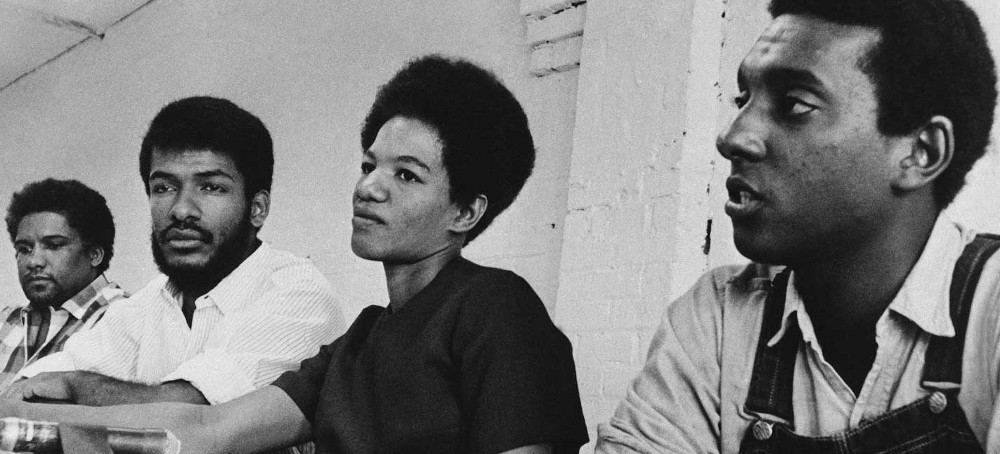
Officers of the Student Non-Violent Coordinating Committee in Atlanta on May 23, 1966. From left to right: James Forman, Cleveland Sellers, Ruby Doris Smith Robinson and Stokely Carmichael. (photo: Horace Cort/AP)
FOCUS: Mark Whitaker | The History of the Black Power Movement
Mark Whitaker, CBS News
Whitaker writes: "It began on a hot summer night in Mississippi, with a cry from a young Black activist named Stokely Carmichael." 

It began on a hot summer night in Mississippi, with a cry from a young Black activist named Stokely Carmichael. The birth of Black Power in 1966 also saw the spread of Afros, dashikis, and the first celebration of Kwanzaa. Seen as radical then, its pioneers highlighted issues that are still very much with us today.

To secure voting rights in Alabama, Carmichael pushed Blacks to form their own political party with a striking panther logo. Borrowing that symbol in California, Huey Newton and Bobby Seale created an armed patrol to monitor police.

Yet for white Americans, "Black Power" rang of menace. In polls, whites suddenly opposed even nonviolent Black protest by two to one. Rocks and racist taunts greeted Martin Luther King Jr. in Chicago.

Infighting also plagued the movement. At a chaotic retreat, Carmichael ousted John Lewis (the future Congressman) as leader of the Student Nonviolent Coordinating Committee, known as SNCC. SNCC militants pushed to expel all white members, leaving a trail of dried-up fundraising.

Asked to explain "Black Power," Carmichael often provoked more than persuaded. In a 1966 primetime special, "Black Power - White Backlash," he spoke with Mike Wallace of CBS News:

Wallace: "Mr. Carmichael, if you had the chance to stand up in front of the white community and say anything you desired, say to them, 'Understand me, white man,' what would you say?"
Carmichael: "I would say, 'Understand yourself, white man. You are the savages. Yes, it is you who have always been uncivilized. Civilize yourself.'"

For today's #BlackLivesMatter Movement, the tumultuous history of Black Power offers lessons, and warnings, about the importance of messaging, unity, and cross-racial alliances.

Yet beyond politics, Black Power had a deep personal meaning. In 1966, veteran journalist Vern Smith was a student at San Francisco State University, where the push for Black Studies began. For him and his Black friends, Vern said, "It was almost like a born-again experience. We were no longer Negroes."

And those African dashikis that remain a symbol of proud Black identity? Well, Vern admits, "we didn't even know what dashikis were before then."

READ MORE


Contribute to RSN

Follow us on facebook and twitter!

Update My Monthly Donation

                                                                    PO Box 2043 / Citrus Heights, CA 95611


Sunday, August 7, 2022

August 6, 2022 HEATHER COX RICHARDSON


On this day in 1880, the Republican candidate for president, James A. Garfield, spoke to thousands of supporters from the balcony of the Republican headquarters in New York City. Ten years before, in 1870, Americans had added the Fifteenth Amendment to the Constitution, making sure that Black men could vote by guaranteeing that “the right of citizens of the United States to vote shall not be denied or abridged by the United States or by any State on account of race, color, or previous condition of servitude.”

As soon as the amendment was ratified, though, white southerners who were dead set against their Black neighbors participating in their government began to say that they had no problem with Black men voting on racial grounds. Their objection to Black voting, they claimed, was that poor, uneducated Black men just out of enslavement were voting for lawmakers who promised them public services, like roads and schools, that could be paid for only with taxes levied on people with the means to pay, which in the post–Civil War South usually meant white men.

Complaining that Black voters were socialists—they actually used that term in 1871—white southerners began to keep Black voters from the polls. In 1878, Democrats captured both the House and the Senate, and former Confederates took control of key congressional committees. From there, in the summer of 1879, they threatened to shut down the federal government altogether unless the president, Republican Rutherford B. Hayes, agreed to end the federal protection of Black Americans in the South. 

The congressional leader who eventually forced them to back down was James A. Garfield (R-OH). Impressed by his successful effort to save the country, in 1880, party leaders nominated him for president. 

Garfield was a brilliant and well-educated man and had served in the Civil War himself. On August 6 in New York City, he singled out the veterans in the crowd to explain how he saw the nation’s future.

“Gentlemen,” he said, “ideas outlive men; ideas outlive all earthly things. You who fought in the war for the Union fought for immortal ideas, and by their might you crowned the war with victory. But victory was worth nothing except for the truths that were under it, in it, and above it. We meet tonight as comrades to stand guard around the sacred truths for which we fought.” 

“[W]e will remember our allies who fought with us,” he told them. “Soon after the great struggle began, we looked beyond the army of white rebels, and saw 4,000,000 of [B]lack people condemned to toil as slaves for our enemies; and we found that the hearts of these 4,000,000 were God-inspired with the spirit of liberty, and that they were all our friends.” As the audience cheered, he continued: “We have seen white men betray the flag and fight to kill the Union; but in all that long, dreary war we never saw a traitor in a black skin.” To great applause, he vowed, “[W]e will stand by these [B]lack allies. We will stand by them until the sun of liberty, fixed in the firmament of our Constitution, shall shine with equal ray upon every man, [B]lack or white, throughout the Union.” As the audience cheered, he continued: “Fellow-citizens, fellow-soldiers, in this there is the beneficence of eternal justice, and by it we will stand forever.” 

Garfield won the presidency that year, but just barely. The South went solidly Democratic, and in the years to come, white northerners looked the other way as white southerners kept Black men from voting, first with terrorism and then with state election laws using grandfather clauses that cut out Black men without mentioning race by permitting a man to vote if his grandfather had voted, literacy tests in which white registrars got to decide who passed, poll taxes that were enforced arbitrarily, and so on. States also cut up districts unevenly to favor the Democrats, who ran an all-white, segregationist party. In 1880, the South became solidly Democratic, and with white men keeping Black people from the polls, it would remain so until 1964.

But then, exactly 85 years after Garfield’s speech, on August 6, 1965, President Lyndon B. Johnson signed the Voting Rights Act. The need for the law was explained in its full title: “An Act to enforce the fifteenth amendment to the Constitution, and for other purposes.”

Black Americans had never accepted their exclusion from the vote, and after World War II, they and other people of color who had fought for the nation overseas brought home their determination to be treated equally. White reactionaries responded with violence, but Black Americans continued to stand up for their rights. In 1957 and 1960, under pressure from President Dwight Eisenhower, Congress passed civil rights acts designed to empower the federal government to enforce the laws protecting Black voting.

In 1961 the Student Nonviolent Coordinating Committee (SNCC) and the Council of Federated Organizations (COFO) began intensive efforts to register voters and to organize communities to support political change. Because only 6.7% of Black Mississippians were registered, Mississippi became a focal point, and in the “Freedom Summer” of 1964, volunteers set out to register voters. On June 21, Ku Klux Klan members, at least one of whom was a law enforcement officer, murdered organizers James Chaney, Andrew Goodman, and Michael Schwerner near Philadelphia, Mississippi, and, when discovered, laughed at the idea they would be punished for the murders.

That year, Congress passed the Civil Rights Act of 1964, which strengthened voting rights. On March 7, 1965, in Selma, Alabama, marchers led by John Lewis (who would go on to serve 17 terms in Congress) headed for Montgomery to demonstrate their desire to vote. Law enforcement officers stopped them on the Edmund Pettus Bridge and beat them bloody.

On March 15, President Johnson called for Congress to pass legislation defending Americans’ right to vote. “There is no constitutional issue here,” he told them. “The command of the Constitution is plain. There is no moral issue. It is wrong—deadly wrong—to deny any of your fellow Americans the right to vote in this country. There is no issue of states’ rights or national rights. There is only the struggle for human rights.” Congress passed the measure. And on this day in 1965, Johnson signed the Voting Rights Act into law. 

“Today is a triumph for freedom as huge as any victory that has ever been won on any battlefield,” he told the country. “I pledge [to] you that we will not delay, or we will not hesitate, or we will not turn aside until Americans of every race and color and origin in this country have the same right as all others to share in the process of democracy.” 

“[M]en cannot live with a lie and not be stained by it,” he said. “The central fact of American civilization…is that freedom and justice and the dignity of man are not just words to us. We believe in them. Under all the growth and the tumult and abundance, we believe. And so, as long as some among us are oppressed—and we are part of that oppression—it must blunt our faith and sap the strength of our high purpose.” 

Notes:

“Speech of General James A. Garfield delivered to the ‘boys in blue.’” New York, August 6, 1880, at Library of Congress: https://www.loc.gov/resource/rbpe.12900200/?sp=1.

https://millercenter.org/the-presidency/presidential-speeches/august-6-1965-remarks-signing-voting-rights-act

https://www.cnn.com/2022/08/06/us/voting-rights-by-the-numbers-2022/index.html



Saturday, July 4, 2020

RSN: Jeff Cohen | Politicians of Color Should Not Be Immune From Criticism


Reader Supported News
03 July 20
It's Live on the HomePage Now:
Reader Supported News

RSN: Jeff Cohen | Politicians of Color Should Not Be Immune From Criticism
Jim Clyburn endorses Joe Biden on Wednesday, February 26, 2020. (photo: Joshua Boucher/The State)
Jeff Cohen, Reader Supported News
Cohen writes: "To me, being an anti-racist activist means that one consistently challenges the structures of racist exclusion, exploitation, repression and incarceration."

It does not mean that one must defend or praise establishment politicians of color.
Forty years ago, I was an activist and leader in the battle against police racism, brutality, and repression in Los Angeles. At the time, L.A. had a black mayor, its first in history: former police officer Tom Bradley. He was a huge improvement over the previous mayor, who was an overt racist – and progressives and liberals of all colors had worked hard to get Bradley elected.
But in the fight against police murder and racism, Mayor Bradley was as much an obstacle as he was an ally. Being on the side of communities of color meant standing shoulder to shoulder with black and Latinx activists, not shoulder to shoulder with the mayor.
In Martin Luther King’s last book, written in 1967 a year before he was assassinated, he described how “the white establishment is skilled in flattering and cultivating emerging leaders.” Writing about “corruption” of a type of “Negro leader,” King declared: “Ultimately he changes from the representative of the Negro to the white man into the white man’s representative to the Negro. The tragedy is that too often he does not recognize what has happened to him." 
It was a blunt and blistering assessment, written at a time when there were few African American mayors, and a grand total of seven blacks in the U.S. Congress.
Let’s be clear: African American politicians have been no more – and usually less – corrupt than white politicians (even though law enforcement has often singled them out for corruption prosecution). It goes without saying that, as a whole, black elected officials have been more progressive than white officials not just on issues of race, but also economics, gender equality, militarism, civil liberties, etc.
Beginning a decade after King’s last book, we’ve experienced 40 years of corrupting neoliberal capitalism – a period in which racial and economic disparities have ballooned, as giant corporations have seized greater control over the economy and both major political parties. Using lavish campaign donations, ads, friendly media, think tanks, and astroturfing, it's been a special project of corporate interests to move the Democratic leadership to the right on issues of taxation, budget priorities, healthcare, jobs, trade, and corporate power in general.
In the last years of King’s life, he and other black leaders were unabashedly allied with reform and insurgent forces that challenged the Democratic Party establishment.
In recent years, many African American leaders have been on the establishment side of the Democratic Party, resisting progressive insurgencies. This development was on dramatic display in February 2016, when the Congressional Black Caucus PAC held a news conference to endorse Hillary Clinton over Bernie Sanders (AP video here). Congressman Cedric Richmond ridiculed Sanders’s healthcare and education policies as unaffordable and “too good to be true.” Wall Street-allied congressman Gregory Meeks hailed Clinton as a strong “partner” on “issues important to our constituents.”
At the news conference, Rep. John Lewis made a remarkable juxtaposition when he invoked his own heroic leadership of the Student Nonviolent Coordinating Committee “for three years, from 1963 to 1966.” Referring to Sanders, Lewis said: “I never saw him. I never met him.” But, he said, “I met Hillary Clinton.”
The grievously unfair comment sparked immediate pushback, since Sanders’s civil rights activism in Chicago is well documented, including his 1963 arrest (and his participation weeks later in the March on Washington, where both King and Lewis were speakers). By contrast, when Lewis chaired SNCC, Clinton was a self-described “Goldwater Girl” – a high school activist for Republican Barry Goldwater, who fervently opposed the landmark 1964 Civil Rights Act. Years later, as First Lady, Clinton spoke of “superpredators” while promoting the notorious 1994 Crime Bill.
Again, this election cycle, many influential black leaders endorsed corporate establishment candidate Joe Biden, despite a record on racial issues – from helping to write the Crime Bill to his collaboration with segregationist senators – worse than Hillary Clinton’s. These endorsements, like that of House Majority Whip Jim Clyburn of South Carolina, were crucial in Biden securing the nomination, especially in gaining the votes of older African Americans. No matter where these black leaders stand now on reform versus the corporate status quo, many, like Rep. Clyburn, are highly regarded for civil rights activism going back decades.  
As progressives in a country with a long, grim history of racism continuing to the present day, it’s our responsibility to fight racism everywhere we see it. It’s also our job to persist in demands for justice, even when some of the mayors or Congress members we will be persisting against are politicians of color. Given the horrific record of whites telling people of color “we know what’s best,” that persistence must be pursued with sensitivity and humility. But it must be pursued.
More than 50 years have passed since the death of Dr. King, when just seven members of Congress were African Americans. After decades of struggle by activists and leaders of color (and white allies), government is fortunately far more diverse today.
If King were with us, would he still be complaining about black leaders who change from being representatives of their community to the white establishment into the establishment’s representative to the black community?
Or would he be complaining even louder?


Jeff Cohen is co-founder of the activism group RootsAction.org and founder of the media watch group FAIR. In Los Angeles 40 years ago, he was one of four co-chairs of the Campaign for a Citizens’ Police Review Board, and an ACLU attorney challenging police spying.
Reader Supported News is the Publication of Origin for this work. Permission to republish is freely granted with credit and a link back to Reader Supported News.


Trump rips his own party in wild Memorial Day screed

  BLOGGER DIDN'T LIKE THIS POST -DON'T MISSS IT!     LOTS OF POSTS IGNORED BY BLOGGER..... OR REMOVED ON THEIR WHIM! ALL POSTS ARE A...