In San Francisco, thousands of anti-Trump activists gathered on a local beach to form a human sign that read, "Trump must go now! No ICE, no wars, no lies, no kings."
By Brad Reed
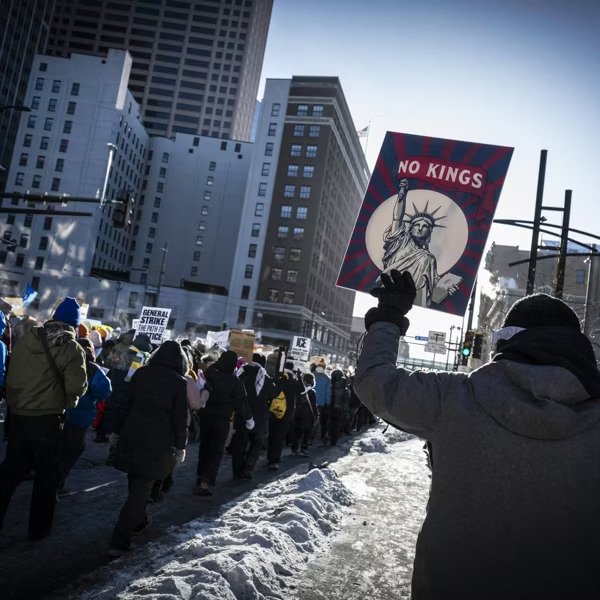
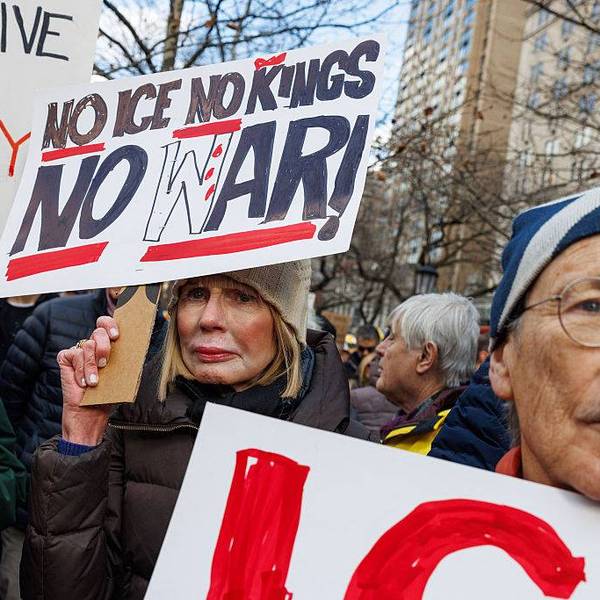
Millions of American across all 50 states on Saturday rallied against President Donald Trump and his authoritarian agenda during nationwide No Kings protests.
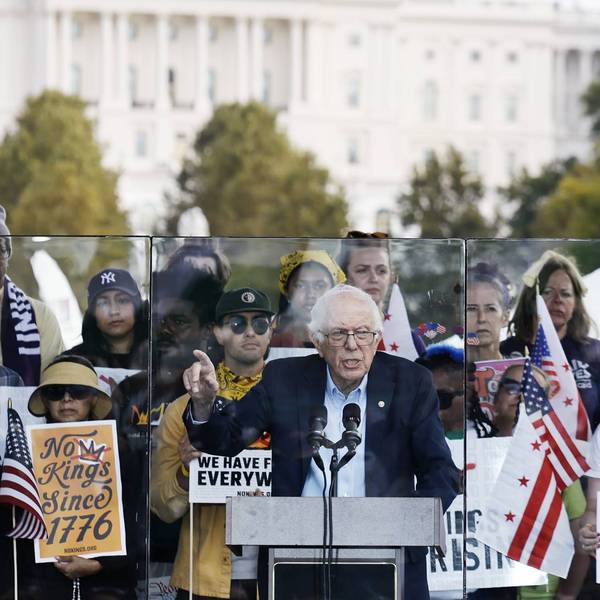
The flagship No Kings rally in Minneapolis, which organizers Indivisible estimated drew over 200,000 demonstrators, featured speeches from Minnesota Gov. Tim Walz and US Sen. Bernie Sanders (I-Vt.), Rep. Ilhan Omar (D-Minn.), and actress Jane Fonda, as well as a special performance from rock icon Bruce Springsteen, who performed “Streets of Minneapolis,” a song he wrote in tribute of slain protesters Renee Good and Alex Pretti.
Organizers called it “the largest single-day nationwide demonstrations in US history,” with an estimate 8 million people coming out for events in communities and cities nationwide.
From major cities to rural towns that have never seen mobilizations like this before, protesters made clear that in America, we don’t do kings,“ the No Kings coalition said in a statement.
“This is what it looks like when a movement grows—not just in size, but in reach, in courage, and in more people who see themselves as part of this movement,” the organizers said. “The American people are fed up with this administration’s power grabs, an illegal war that Congress and the public haven’t approved, and the continued attempts to stifle our freedoms. We’re not waiting for change; we’re making it.”
The rally in Minneapolis was one of more than 3,300 No Kings events across the US and internationally, and aerial video footage showed massive crowds gathered for demonstrations in cities including Washington, DC, New York City, Boston, Philadelphia, Chicago, and San Diego.
In San Francisco, thousands of anti-Trump activists gathered on a local beach to form a human sign that read, “Trump must go now! No ICE, no wars, no lies, no kings.”
However, No Kings rallies weren’t just held in major US cities. In a series of social mediaposts, Indivisible co-founder Leah Greenberg collected photos and videos of No Kings events in communities including Arvada, Colorado, Madison, New Jersey, and St. Augustine, Florida, as well as international No Kings events held in London and Madrid.
Attendance estimates for Saturday’s No Kings protests were not available as of this writing. Polling analyst G. Elliott Morris estimated that the previous No Kings event, held in October, drew at least 5 million people nationwide, making it likely “the largest single-day political protest ever.”
"No work, no school, no shopping. We're going to show up and say we're putting workers over billionaires and kings."
By Brad Reed
Ezra Levin, co-founder of Indivisible, said on Saturday that a nationwide general strike is being planned for May 1 that will be modeled on the day of action residents of Minnesota organized in January against the brutality carried out by federal immigration enforcement officials.
Appearing at the flagship No Kings rally in Minneapolis, Levin praised the strength shown by the Minnesota protesters in the face of the US Immigration and Customs Enforcement (ICE) siege of their city this year, and said his organization wanted to replicate it across the country.
“The next major national action of this movement is not just going to be another protest,” Levin said. “It is a tactical escalation... It is an economic show of force, inspired by Minnesota’s own day of truth and action.”
Levin then outlined what the event would entail.
“On May 1, on May Day, we are saying, ‘No business as usual,’” he said. “No work, no school, no shopping. We’re going to show up and say we’re putting workers over billionaires and kings.”
Levin added that “we are going to build on that courage, that sacrifice” that Minnesota residents showed during their day of action in January, and vowed “to demonstrate that regular people are the greatest threat to fascism in this country.”
In an interview with Payday Report published Saturday, Indivisible co-founder Leah Greenberg said that the goal of the nationwide strike action would be to send “a clear message: we demand a government that invests in our communities, not one that enriches billionaires, fuels endless war, or deploys masked agents to intimidate our neighbors.”
The No Kings protests against President Donald Trump’s authoritarian government, which Indivisible has been central in organizing, have brought millions of Americans into the streets.
Polling analyst G. Elliott Morris estimated that the previous No Kings event, held in October, drew at least 5 million people nationwide, making it likely “the largest single-day political protest ever.”
"You thought it was bad when Iran throttled the Strait of Hormuz?... The Houthis have already proven they can keep the Red Sea closed despite a year of US Navy skirmishing," said one journalist.
By Brad Reed
The Houthis on Saturday took credit for launching a ballistic missile at Israel, opening a new front in the war US President Donald Trump illegally started with Iran nearly one month ago.
As reported by Axios, the attack by the Houthis signals that the Yemen-based militia is joining the conflict to aide Iran, which has been under aerial assault from the US and Israel for the past four weeks.
Although the Houthi missile was intercepted by Israeli defenses, it is likely just the opening salvo in an expanding conflict throughout the Middle East.
Axios noted that while the Houthis entered the war by launching an attack on Israel, they could inflict the most damage on the US and its allies in the region by shutting down the strait of Bab al-Mandeb in the Red Sea.
“Doing that,” Axios explained, “would dramatically increase the global economic crisis that has been created due to the war with Iran” and its closure of the Strait of Hormuz, which has sent global energy prices skyrocketing.
Sky News international correspondent John Sparks reported on Saturday that the Houthis’ entrance into the war shows that “this crisis is expanding, it is escalating.”
Sparks argued that the Houthis’ decision to fire a missile at Israel signals that “the geographical spread of this conflict is expanding,” adding that “the Houthis have shown the ability to attack shipping in the Red Sea and the waters around the Arabian Peninsula.”
Sparks said that even though Trump and Secretary of State Marco Rubio “have been projecting confidence” about having the war under control, “it’s not playing out that way... on the ground.”
Danny Citrinowicz, senior researcher at the Institute for National Security Studies, argued that the Houthis’ main value to Iran isn’t launching strikes on Israel, but their ability to increase economic pressure on the US.
Citrinowicz also outlined ways the Houthis could further drive up the global price of energy.
“This raises a key question: whether the Houthis will escalate further by targeting Saudi infrastructure and shipping lanes more directly, or whether they will preserve this capability as an additional lever of pressure as the conflict evolves,” he wrote. “With each passing day of the conflict, particularly in light of its expanding scope against Iran, the likelihood of this scenario materializing continues to grow. It is increasingly not a question of if, but when.”
Journalist Spencer Ackerman similarly pointed to the Houthis’ ability to cause economic havoc as the biggest concern about their entrance into the conflict.
“You thought it was bad when Iran throttled the Strait of Hormuz?” he asked rhetorically. “The Houthis have already proven they can keep the Red Sea closed despite a year of US Navy skirmishing.”
"Messiah complexes, talk of revenge, and the use of force against journalists are just symptoms of what's been happening to the army over the past three years," said one Israeli journalist.
By Brad Reed
Soldiers in the Israel Defense Forces on Friday were caught on camera assaulting and detaining a crew of CNN journalists while they were reporting from the occupied West Bank.
A video of the incident posted on social media by CNN Jerusalem correspondent Jeremy Diamond shows the CNN crew walking near the Palestinian village of Tayasir, which in recent days has come under assault from Israeli settlers who established an illegal outpost in the area.
The crew are then accosted by armed members of the IDF, who order them to sit down. After the crew complies with their commands, the soldiers come to seize the journalists’ cameras and phones that are being used to record the incident.
A soldier then puts CNN photojournalist Cyril Theophilos in a chokehold and forces him to the ground. Writing about the assault later, Theophilos said that the soldier “pushed and strangled me,” adding that this kind of violence “is just a symptom of the IDF’s actions in the West Bank.”
According to Diamond, the CNN crew were subsequently detained for two hours. During that time, Diamond wrote, it became clear that the ideology of the Israeli settlers movement was “motivating many of the soldiers who operate in the occupied West Bank” and that the Israeli military regularly acts “in service of the settler movement.”
For instance, one IDF soldier acknowledged during conversations with the CNN crew that the settler outpost near Tayasir was unlawful under both international and Israeli law, but insisted “this will be a legal settlement... slowly, slowly.”
The soldier also said he wanted to exact “revenge” on local Palestinians for the death of 18-year-old Israeli settler Yehuda Sherman, who was killed last week by a Palestinian driver. Palestinians who witnessed Sherman’s killing have said that the driver was trying to stop Sherman from stealing sheep.
The IDF issued an apology to CNN over the incident, insisting that “the actions and behavior of the soldiers in the incident are incompatible with what is expected of IDF soldiers.”
However, this apology was deemed insufficient by Barak Ravid, global affairs correspondent for Axios.
“Apologies are not enough,” he wrote on social media. “There is a need for clear accountability. 99.9% of the time there is zero accountability.”
The soldiers’ actions also drew condemnation from Haaretz reporter Bar Peleg, who argued that problems in the IDF have only grown worse under the far-right government led by Prime Minister Benjamin Netanyahu.
“Messiah complexes, talk of revenge, and the use of force against journalists are just symptoms of what’s been happening to the army over the past three years,” Peleg said. “The chief of staff and the commanding general can write another thousand letters and wave flags all they want, but the process already seems irreversible.”
Palestinian human rights activist Ihab Hassan argued that incidents like the one captured by CNN are all too common for the IDF.
“The Israeli army arrests and assaults journalists, while settlers who commit horrific crimes against Palestinian civilians enjoy total impunity,” he wrote. “This is state-backed terrorism.”
More than 7 million borrowers booted from a Biden-era loan forgiveness program will have to quickly switch to a new plan using a system that's been backed up for months.
By Stephen Prager
After axing a Biden-era student loan repayment program, the Trump administration is threatening to kick its millions of mostly low-income beneficiaries onto the government’s most expensive plan unless they switch to a new one quickly.
The Washington Postreported on Friday that the Department of Education was beginning to email the more than 7 million people enrolled in the Saving on a Valuable Education (SAVE) program, telling them they needed to change their plan within the next 90 days.
Around 4.5 million of those borrowers earn incomes between 150% and 225%, allowing them to qualify for zero-dollar monthly payments under SAVE, which the Trump administration effectively killed in December after settling with Republican states who’d brought lawsuits against the program under former President Joe Biden.
Anonymous officials told The Post that those who do not switch plans within three months of receiving the email will automatically be re-enrolled in the Standard Plan. Unlike SAVE, which is income-based, the Standard plan has borrowers pay a fixed rate over 10 years.
Standard typically carries the highest monthly payments, and those transitioning to it from SAVE could pay more than $300 extra per month in some cases, with the poorest borrowers seeing the sharpest increases.
While 90 days may seem like plenty of time to switch to a less expensive repayment plan, it’s not nearly that simple.
Due to the large exodus of borrowers, the Department of Education has struggled to process all the forms, processing only about 250,000 per month. Many borrowers who have tried to transition have found themselves waiting months for a reply.
To make matters more confusing, many of these borrowers will have to switch programs againsoon, since all but one repayment program will be dissolved on July 1, 2028 as a result of last year’s Republican budget law. The remaining plan will also be income-driven, though it is still expected to cost borrowers more each month.
According to a report released last month by the Century Foundation and Protect Borrowers, two groups that support loan forgiveness, nearly 9 million student loan borrowers are in default. During Trump’s first year back in office, the student loan delinquency rate jumped from roughly zero to 25%, which it called “precedent-shattering.”
“Much of the rise in delinquencies can be linked to the Trump administration’s actions aimed at increasing student loan payments,” the report said. “The US Department of Education blocked borrowers from accessing more affordable payments through income-driven plans, having ordered a stoppage in application processing for three months and mass-denying 328,000 applications in August 2025. As of December 31, 2025, a warehouse’s worth of 734,000 applications sat unprocessed.”
Being in default has major ramifications for borrowers’ finances. Those with delinquent loans saw their credit scores decrease by an average of 57 points during the first three quarters of 2025, dragging around 2 million of them into “subprime” territory, which forces them to pay thousands of dollars more for auto and personal loans and makes them more likely to have difficulty finding housing and employment.
The report estimated that if those booted from SAVE defaulted at the same rate as other borrowers, the number of student loan borrowers in distress could rise as high as 17 million.
According to Protect Borrowers, the typical family will pay more than $3,000 per year in additional costs as a result of the end of SAVE.
The end of SAVE comes as oil shocks caused by Trump’s war in Iran have spiked gas prices and threaten to raise them throughout the economy, adding to the already elevated costs of food, housing, and transportation resulting from the president’s aggressive tariff regime.
“In the middle of an affordability crisis driven by Donald Trump,” said Sen. Elizabeth Warren (D-Mass.), “Trump is killing a plan that lowers student loan costs. It’s shameful.”
"The United States and Iran are trapped in a conflict in which each new escalation only deepens a shared, losing predicament... Sooner rather than later, both will confront the urgency of finding an off-ramp."
By Brad Reed
Multiple reports published in the last two days have indicated that President Donald Trump is seeking to wrap up his illegal war in Iran, which has significantly hurt his domestic political standing—partially by raising gas prices at a time when polls show US voters are primarily concerned about the cost of living.
While ending the Iran war will not be simple, some foreign policy experts believe that it can be done if both the US and Iran truly understand that deescalation is in both nations’ best interests.
George Beebe, director of grand strategy at the Quincy Institute for Responsible Statecraft and former director of the CIA’s Russia analysis, and Trita Parsi, executive vice president of the Quincy Institute, have written an essay published on Thursday by Foreign Policy outlining what an achievable Iran “exit plan” would look like.
The authors acknowledged the immense challenges in getting both sides to meet one another halfway, but said this option is preferable to a drawn-out war that will leave both nations poorer and bloodied.
On Iran’s side, argued Beebe and Parsi, a deal would involve renewing “its stated commitment to never pursue nuclear weapons,” re-opening the Strait of Hormuz to all shipping vessels, and making a commitment “to denominating at least half of its oil sales in US dollars rather than the Chinese yuan.”
The US, meanwhile, would “grant sanctions exemptions to countries prepared to finance Iran’s reconstruction” and “would also permit a specified group of states—such as China, India, South Korea, Japan, Turkey, Iraq, and others in the Gulf—to resume trade with Tehran and the purchase of Iranian oil, thereby easing global energy prices.”
Beebe and Parsi emphasized that this deal would only be a first step, and they said the next step would be restarting negotiations to establish a nuclear weapons agreement similar to the one previously negotiated by the Obama administration that Trump tore up during his first term.
“The United States and Iran are trapped in a conflict in which each new escalation only deepens a shared, losing predicament,” they wrote. “Neither can compel the other’s surrender. Sooner rather than later, both will confront the urgency of finding an off-ramp—one that does not hinge on the other’s humiliation.”
Even if Trump takes this course of action, however, there is no guarantee it will succeed, in part because of how much he has already damaged US alliances across the world.
In an analysis published Thursday, Sarah Yerkes, senior fellow at the Carnegie International Endowment for Peace’s Middle East Program, argued that even nations in the Middle East that stand to benefit from a weakened Iran are now thinking twice about their dependence on the US for their security needs, given that Trump’s war has resulted in Iran launching retaliatory strikes throughout the region.
Yerkes also highlighted how Trump’s handling of European allies is making it less likely that they will play a significant part in helping him end the conflict.
“Europe, which is not eager to enter what it sees as a war of choice, has refrained from proactively joining US and Israeli strikes,” Yerkes explained. “One of the clearest examples of the transatlantic rift was over the initial reaction to closures in the Strait of Hormuz, the shipping channel for approximately 20% of the world’s seaborne oil and LNG traffic. Multiple European countries refused to cow to Trump’s demand that they send warships to help keep the strait open, inviting public ire from Trump.”
The bottom line, warned Yerkes, is that “each day the war continues, without explicit goals or a clear exit strategy, opposition to the United States—from friends and foes, inside and outside—is also likely to grow, making America less safe and less secure.”
JOIN THE MOVEMENT
As a people-powered nonprofit news outlet, we cover the issues the corporate media never will.
Your contribution supports this bold media model—free, independent, and dedicated to reporting the facts every day. Stand with us in the fight for economic equality, social justice, human rights, and a more sustainable future.
“Today’s news isn’t an anomaly,” said leaders of the Democratic Women’s Caucus and Congressional Black Caucus, “it is a part of a coordinated and sustained strategy to undermine and erase women and people of color.”
US Secretary of War Pete Hegseth speaks during a Cabinet meeting at the White House on March 26, 2026 in Washington, DC.
(Photo by Chip Somodevilla/Getty Images)
In what’s being called an “exceedingly rare” move, US Defense Secretary Pete Hegseth is blocking the promotion of two Black and two female colonels to one-star generals,
The New York Times reported Friday that some senior US military officials are questioning whether Hegseth acted out of animus toward Black people and women after the defense secretary blocked the promotion of the four officers despite the repeated objections of Army Secretary Daniel Driscoll, who touted what the Times called the colonels’ “decadeslong records of exemplary service.”
Military officials told the Times that Hegseth’s chief of staff, Lt. Col. Ricky Buria, got into a heated exchange with Driscoll last summer over the promotion of another officer, Maj. Gen. Antoinette Gant—a combat veteran of the US invasions and occupations of Afghanistan and Iraq—to command the Military District of Washington, DC.
Such a promotion would have placed Gant in charge of numerous events at which she would likely be seen publicly with President Donald Trump. According to multiple military officials, Buria told Driscoll that Trump would not want to stand next to a Black female officer.
A shocked Driscoll reportedly replied that “the president is not racist or sexist,” an assessment that flies in the face of countless racist and sexist statements by the president, both before and during both of his White House terms.
Buria called the officials’ account of his exchange with Driscoll “completely false.”
White House Press Secretary Karoline Leavitt declined to discuss the matter beyond saying that Hegseth is “doing a tremendous job restoring meritocracy throughout the ranks at the Pentagon, as President Trump directed him to do.”
Military officials told the Times that one of the Black colonels whose promotion was blocked by Hegseth wrote a paper nearly 15 years ago historically analyzing differences between Black and white soldiers’ roles in the Army. One of the female colonels, a logistics officer, was held back because she was deployed in Afghanistan during the US withdrawal whose foundation was laid by Trump during his first term. It is unclear why the two other colonels were denied promotions.
Although more than 40% of current active duty US troops are people of color, military leadership remains overwhelmingly comprised of white men. Hegseth, who declared a “frontal assault” on the “whores to wokesters” who he said rose up through the ranks during the Biden administration, told an audience during a 250th anniversary ceremony for the US Navy that “your diversity is not your strength.”
Hegseth has argued that women should not serve in combat roles, although he later walked back his assertion amid pushback from senators during his confirmation process. Still, since Trump returned to office, every service branch chief and 9 of the military’s 10 combat commanders are white men.
Leaders of the Democratic Women’s Caucus and Congressional Black Caucus issued a joint statement Friday calling Hegseth’s blocking of the four colonels’ promotions “outrageous and wrong.”
“The claim that Hegseth’s chief of staff told the army secretary Trump would not want to stand next to a Black female officer at military events is racist, sexist, and extremely concerning,” wrote the lawmakers, Reps. Yvette Clarke (NY), Teresa Leger Fernández (NM), Emilia Sykes (Ohio), Hillary Scholten (Mich.), and Chrissy Houlahan (Pa.).
“Time and time again, Trump and his administration have shown us exactly who they are—attacking and undermining Black people and women in the military, public servants, and women in power,” the congressional leaders asserted. “It is clear they are trying to erase Black and women’s leadership and history.”
“Today’s news isn’t an anomaly, it is a part of a coordinated and sustained strategy to undermine and erase women and people of color,” their statement said.
“We’ve long known that Pete Hegseth is an unfit and unqualified secretary of defense appointed by Trump,” the lawmakers added. “So it is absurd, ironic, and beyond inappropriate that he of all people would deny these promotions to officers with records of exemplary service. America’s servicemembers deserve so much better.”
Sen. Jack Reed (D-RI), ranking member of the Senate Armed Services Committee, also issued a statement reading, “If these reports are accurate, Secretary Hegseth’s decision to remove four decorated officers from a promotion list after having been selected by their peers for their merit and performance is not only outrageous, it would be illegal.”
“Denying the promotions of individual officers based on their race or gender would betray every principle of merit-based service military officers uphold throughout their careers,” Reed added.
Several congressional colleagues weighed in, like Sen. Tammy Duckworth (D-Ill.), a decorated combat veteran who lost her legs when an Iraqi defending his homeland from US invasion shot down the Blackhawk helicopter she was piloting. Duckworth said on Bluesky: “He says he wants to bring meritocracy back to our military. He says he has our warfighters’ backs. But here he is, the most unqualified SecDef in history, denying troops a promotion that their fellow warfighters decided they’ve earned. Hegseth is a disgrace to our heroes.”
Other observers also condemned Hegseth’s move, with historian Virginia Scharff accusing him of “undermining national security with his racism and misogyny,” and City University of New York English Chair Jonathan Gray decrying the “gutter racist” who “should be hounded from public life for the damage he’s caused.”
“We should attract the best and brightest in our country to become teachers and pay them the decent wages that they deserve.”
US First Lady Melania Trump enters the East Room of the White House in Washington, DC with a humanoid robot named Figure 03 during the Fostering the Future Together Global Coalition Summit on March 25, 2026.
(Photo by Heather Diehl/Getty Images)
US Sen. Bernie Sanders on Friday rejected First Lady Melania Trump’s vision of a near-future in which artificial intelligence-powered humanoid robots do the work of human school teachers, arguing that society should instead do better by its human educators.
The wife of President Donald Trump entered Wednesday’s gathering of the Global First Ladies Alliance accompanied by Figure 03, an AI-powered “general purpose humanoid robot” developed by the Sunnyvale, California-based company Figure.
“The future of AI is personified,” Trump told attendees, who included Brigitte Macron of France, Sara Netanyahu of Israel, and Olena Zelenska of Ukraine. “It will be formed in the shape of humans. Very soon artificial intelligence will move from our mobile phones to humanoids that deliver utility.”
“Imagine a humanoid educator named Plato,” she said. “Access to the classical studies is now instantaneous: literature, science, art, philosophy, mathematics, and history. Humanity’s entire corpus of information is available in the comfort of your home.”
Responding to Trump’s remarks, Sanders (I-Vt.) said Friday on social media: “Call me a radical, but NO.”
“We should not be replacing teachers in America with robots,” the senator added. “We should attract the best and brightest in our country to become teachers and pay them the decent wages that they deserve.”
Trump and Macron also warned about the dangers technology poses to children in remarks that came the same week that a New Mexico jury ordered tech titan Meta to pay a $375 million penalty for endangering youth and jurors in a landmark social media addiction trial found that Meta and YouTube harmed a child user of their platforms.
The office of California Gov. Gavin Newsom—who is believed to be a likely contender for the 2028 Democratic presidential nomination—also slapped down the idea of robot teachers, as did ordinary social media users.
“They want to replace human beings. Where will we work? How do we make money?” asked one X account with tens of thousands of followers. “No one wants this. We did not ask for it. Fuck all of this shit.”
Mourners hold a portrait of a students during a funeral ceremony for children, who lost their lives after a primary school in Iranâs Hormozgan province was targeted in US and Israeli attacks, on March 3, 2026 in Minab, Iran.
(Photo by Stringer/Anadolu via Getty Images)
If the killing of children in Gaza, Lebanon, Syria, Iran, and across the Middle East is normalized, then it will become just another accepted feature of war. And since “war is hell,” we will all move on.
By Ramzy Baroud
Those who had the misfortune of growing up in a war zone require no explanation. War is hell, it is true—but for children, it is something else entirely: a confusing, disorienting fate that defies comprehension.
There are children who live only briefly, experiencing whatever life manages to offer them: the love of parents, the camaraderie of siblings, the fragile joys and inevitable hardships of existence.
There are over 20,000 children in this category who have been killed in Gaza over the span of roughly two years, according to figures released by the Gaza Health Ministry and repeatedly cited by United Nations agencies. Some were born and killed within the same short time frame.
Others remain buried beneath the rubble of the destroyed strip. According to humanitarian and forensic experts cited by the United Nations Office for the Coordination of Humanitarian Affairs (OCHA), thousands of bodies are still missing under collapsed buildings, with recovery efforts hindered by the scale of destruction and lack of equipment. In some cases, extreme heat, fire, and the use of heavy explosive weaponry have rendered identification nearly impossible, meaning that many of these children may never be properly accounted for, let alone mourned at a grave.
None of us had any understanding of who these men were or why they were hurting the people who cared for us.
These children will not have graves to be visited. And if they do, many will have no living parents left to pray for them. But we will always do.
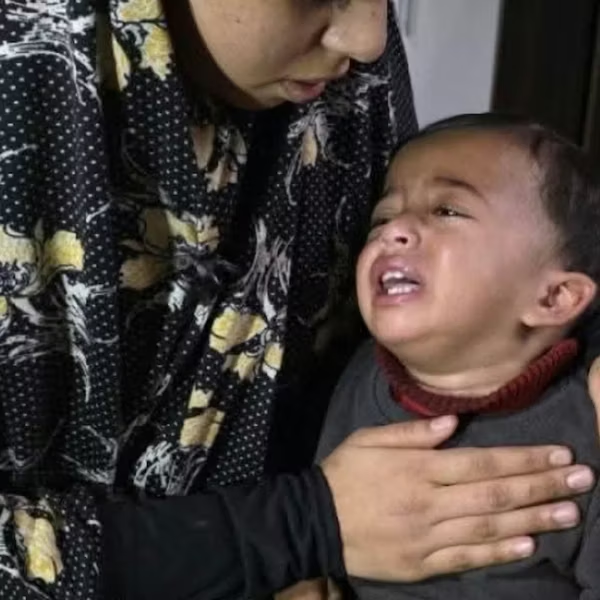
And then, there are those who are wounded and maimed—tens of thousands of them. Visiting Amro, the wounded son of a relative who perished along with his entire family in Gaza, I witnessed one of the most heartbreaking sights one could possibly endure: the wounded and maimed children of Gaza in a Turkish hospital.
There were a few teenagers, many without limbs. Hospital staff had adorned them with the beloved Palestinian keffiyeh. Those who could flashed the victory sign, and those who had no arms raised what remained of their limbs, as if to tell every wandering visitor that they stand for something deep and unyielding, that their losses were not in vain.
But then there were the little ones, who experienced trauma without fully comprehending even the magnitude of their tragedy. They stared in confusion at everyone—the unfamiliar faces, the incomprehensible languages spoken around them, the empty walls.
My nephew kept speaking of his parents, who were meant to visit him any day. They were both gone, along with his only brother.
I was in kindergarten in a refugee camp in Gaza when I witnessed my first military raid. The target was our school. I still recall our teachers pushing back against soldiers as they forced their way into the building. I remember them being physically assaulted, screaming at us to run toward the orchard.
We began running while holding hands with one another. We were all wearing matching red outfits with stickers on our faces—none of us had any understanding of who these men were or why they were hurting the people who cared for us.
If the killing of children in Gaza, Lebanon, Syria, Iran, and across the Middle East is normalized, then it will become just another accepted feature of war. And since “war is hell,” we will all move on, accepting that our children—anywhere in the world—now stand on the front lines of victimhood whenever it suits the calculations of war.
Everything we have said and done has failed Gaza, Lebanon, Syria, and much of our region.
I have thought about this often in recent years—during the devastation in Gaza, the wars across the region, and the killing of students at a school in the Iranian city of Minab.
Minab is not just an Iranian tragedy; it is our collective loss. Evidence from international investigations indicates that the strike on the Shajareh Tayyebeh school was not an accident, but the result of deliberate targeting within a broader military campaign.
Amnesty Internationalconcluded that the school building was directly struck with guided weapons. Investigations by major outlets, alongside US military sources, suggest the site had been placed on a target list despite being a functioning school. The result was devastating: children killed, families shattered, and yet another atrocity absorbed into the relentless rhythm of war.
The US administration may deny intent as often as it wishes. But we know that the killing of children is not incidental. It is evidenced in Gaza, where the scale alone defies any claim of accident. As UNICEF Executive Director Catherine Russell stated, “Gaza has become a graveyard for thousands of children.” That reality alone should end any debate.
I could pause here to tell you that all children are precious, that all lives are sacred, and that international law is unequivocal on this matter. I could invoke the Fourth Geneva Convention, which states that “protected persons… shall at all times be humanely treated,” and that violence against civilians is strictly prohibited.
Yes, I could do all of that. But I fear it would make little difference.
Everything we have said and done has failed Gaza, Lebanon, Syria, and much of our region. International law, once seen as a shield, has become little more than a point of departure for conversations about its ineffectiveness and hypocrisy.
Speaking to Palestinians about international law often generates not reassurance, but frustration and anger. So I will spare you that, too.
Instead, I want to make a call to the world.
A call on behalf of Amro, and the many others from our family who were killed, and the thousands more who perished; a call on behalf of the frightened children of the Flowers Kindergarten in my old refugee camp in Gaza: Please, do not allow them to normalize the killing of children.
Do not settle for indifference, or mere concern, or even moral outrage that is never followed by action.
Trump’s military aggression has displaced diplomacy and everyone on this planet is worse off for it.
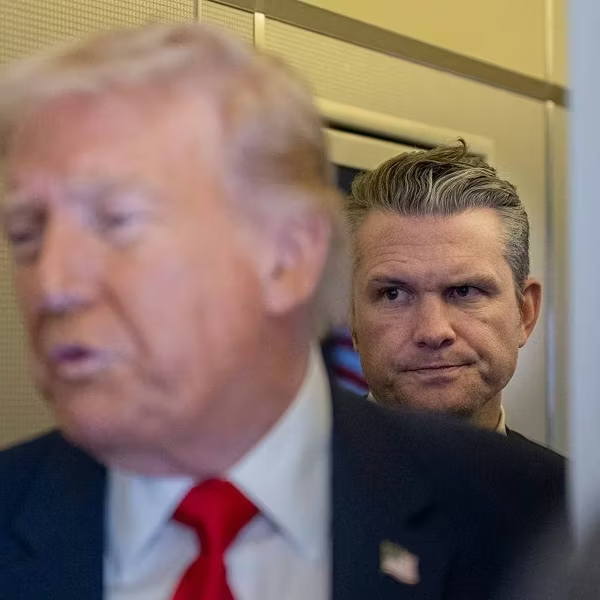
Secretary of Defense Pete Hegsethlooks on as USPresident Donald Trump speaks during a meeting of his Cabinet in the Cabinet Room of the White House on December 02, 2025 in Washington, DC.
(Photo by Chip Somodevilla/Getty Images)
Trump's military aggression has displaced diplomacy and everyone on this planet is worse off for it.
By John Ripton
Donald Trump’s imperial ambitions and aggressive use of military power push the world toward a perilous future. At this moment in history, when the world actually needs cooperation among nations to confront existential environmental, technological and socioeconomic crises, diplomacy must promote international collaboration in achieving shared goals. Trump’s administration, however, has completely abandoned diplomacy as a primary means of resolving international concerns and conflict. Military power is swiftly displacing it as the arbiter of competing interests. In a hostile and militarized international political environment “might makes right” is the operative principle. The consequence of policy based on this principle is international chaos and war.
The Trump administration’s foreign policy sends multiple ominous signals to the world. Questions that would seem unthinkable little more than a year ago now are central concerns of the international community. Will the US retreat from the North Atlantic Treaty Organization (NATO)? Will the US actually attempt to destabilize the economy of its neighbor Canada? Will the US favor Russia over Ukraine? Is Greenland in imminent danger of a US invasion? Is destroying dozens of boats and killing scores of people onboard—all without evidence and due process—justified under international law? Are invasion of another nation and abduction of a head of state an assault on territorial sovereignty and the United Nations Charter? Will billion-dollar seats on a Board of Peace chaired by Trump and displacing UN peacekeeping authority improve the lives of Palestinians in Gaza? Will the US employ tariffs as a universal political tool despite their destabilizing consequences for global economic growth and market predictability?
The hubris and ruthlessness of a leader who forces such questions to the surface, particularly when that leader is the commander-in-chief of the world’s most powerful military force, are more than menacing. These leadership character flaws are nevertheless amplified by Trump and Secretary of Defense Hegseth’s bellicose and callous use of language concerning war. In discussing the sinking of Iran’s naval force, for example, Trump recalled with obvious satisfaction that a general told him that he preferred destroying ships to capturing them “because it’s more fun to sink them.” In remarks about Kharg Island, Iran’s oil export hub in the Persian Gulf, Trump warned “I’ll knock the hell out of it,” and he, too, would do it “just for fun.” Referring without evidence to alleged drug smuggling into the US on boats, he characterized the extrajudicial murders of the boats’ occupants as “an act of kindness.” He mocked Greenland’s military defense as “two dog sleds.” Trump offered this justification for invading Venezuela: “They took our oil rights...and we want it back.” And, regarding Cuba, Trump declared, “I think I can do anything I want with it.”
Further, Defense Secretary Pete Hegseth demands that he be called Secretary of War, chief of the Department of War. Hegseth obsessively refers to soldiers as warriors. He gushes over US exploits in the war with Iran. “What it takes to [wage war] with the precision that we do is world class. No one else can do it. And it’s world class Americans... the engine of what makes our country great.” His predatory instincts and disregard for human suffering are deeply alarming: “This was never meant to be a fair fight, and it is not a fair fight. We are punching them while they’re down, which is exactly how it should be.”
Elsewhere he describes the American military operation in Venezuela as “spectacularly executed,” claiming it “reestablish[ed] the deterrent effect of the US armed forces.” Equally frightening as brandishing missiles and proclaiming that the greatness of America is its use of military force is Hegseth’s predilection for religious crusade. In his 2020 book American Crusade echoes of ‘holy war’ ring sharply: “Do you enjoy Western civilization? Freedom? Equal justice? Thank a crusader,” he exhorts Americans. “ If not for the Crusades, there would have been no Protestant Reformation or Renaissance. There would be no Europe and no America.”
In Hegseth’s apocalyptic vision those who resist American military dominance are less than human. He casts Iranian leaders as vermin, “desperate and hiding, they’ve gone underground, cowering. That’s what rats do.” His Old Testament wrath and venomous attitude toward Iranians with whom the US was in diplomatic discussion just three weeks ago suggests that he may be at least as dangerous as those he purports to be America’s enemies.
In retrospect, regarding the current war with Iran, diplomacy appears to have been “a ruse,” according to Brett Bruen, a former official of the Obama State Department and National Security Council. His view is supported by comments of the Omani foreign minister Badr bin Hamad Al Busaidi who mediated the negotiations. Appearing on CBS “Face the Nation” just hours before the US-Israeli attack on Iran, he expressed confidence that “the peace deal is within our reach.” He further emphasized that an agreement could be achieved “if we just allow diplomacy the space it needs to get there. Because I don’t think any alternative to diplomacy is going to solve this problem.” Later in the interview Al Busaidi explained that there had been a breakthrough in the central issue of the negotiations: “the agreement that Iran will never, ever have nuclear material that will create a bomb.” He then clarified just what he meant. “I think that there is agreement now that this [the enriched uranium] will be down blended to the lowest level possible, to a neutral level, a natural level...and converted into fuel, and that fuel will be irreversible.” Then, after the first attacks, the Omani foreign minister wrote on social media that “I am dismayed. Active and serious negotiations have yet again been undermined.”
The determined move away from diplomacy to war reflects the idea that weaker nations need to bend to the will of the United States if military invasion is to be avoided. Secretary of State Marco Rubio is influential in crafting this volatile and repressive brand of foreign policy. Edward Wong and Michael Crowley, veteran NY Times international news reporters who travel with Rubio, contend that a core aim of this is to create client states of authoritarian regimes. “It is regime compliance rather than regime change, a doctrine of destroy and deal.” In addition to massive aerial invasion or introduction of ground troops, an overwhelming threat of imminent military invasion or limited military intervention may be enough to exact concessions. This doctrine forces nations into asymmetrical transactions, arrangements where the dominant party (US) dictates the terms. The military action against Venezuela, the abduction of its president and now the pressure to compel new leadership to facilitate favorable oil concessions illustrate how full-scale military invasion underway in Iran may not always be necessary to achieve Rubio’s and Trump’s desired results.
The Trump administration’s campaign against immigrants in the US and international migration in general and its commitment to the defense and spread of Western values and civilization drive the ever-present specter of war. They are now both the national and international agenda of the United States. A militarized crusade, as discussed above, is an integral element of American foreign policy. These imperialist and autocratic designs are organic outgrowths of Trump’s “America first” political objectives. Trump administration officials and right-wing ideologues court ultra-conservative, illiberal and fascist counterparts in Europe. These hyper-nationalistic, anti-immigrant forces are challenging and destabilizing liberal institutions throughout the continent. In this climate no one, not non-European nations nor traditional allies, can trust a US led by Trump.
The pronouncements and policies of his administration are ever poised for military conflict to advance distorted and politically deranged ideas. The US now is demonstrably the most dangerous nation in the world. Its destruction of Iran, its armed intervention in Venezuela, its threatening of neighbors and allies and its military backing of Israel in Gaza, Iraq, Lebanon and beyond are just the beginning of a future that will haunt the world and Americans for generations. To mitigate the horrendous suffering Trump’s administration is inflicting abroad as well as at home, to turn back his pursuit of authoritarian power and to salvage the humanity of this nation, US voters must overwhelmingly reject Trump’s political supporters seeking office in the 2026 elections.
These former presidents should mobilize the citizenry from the grassroots to the Capitol and take on the unpopular Tyrant Trump; instead, they are living luxurious lives and are largely AWOL.


















No comments:
Post a Comment
Note: Only a member of this blog may post a comment.