LOTS OF POSTS IGNORED BY BLOGGER.....
ALL POSTS ARE AVAILABLE ON
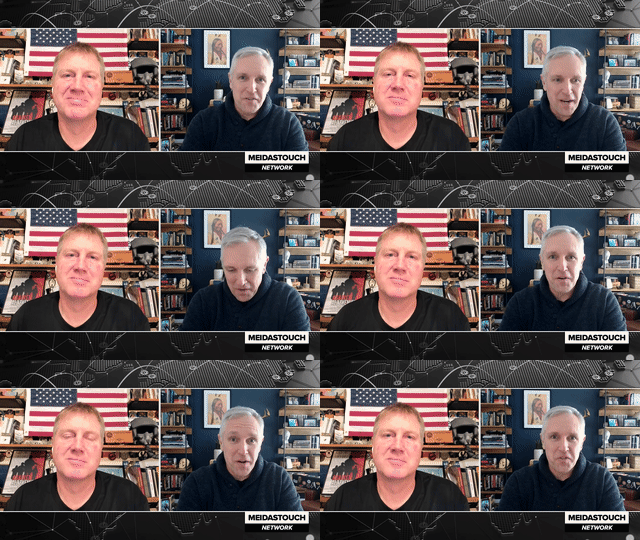
Meidas Defense: America Needs Strategy, Not a Reckless President, Crony Capitalism and Gunboat DiplomacyCongress must stop America’s slide back to imperial overreachHi Meidas Mighty, Ben here. I’m excited to announce the launch of a new series for subscribers to the Meidas+ Substack called Meidas Defense. Meidas Defense is spearheaded by veterans Ken Harbaugh and Joe Plenzler. Together, they will be writing original columns and conducting interviews with the world’s foremost experts in national security and global affairs. You can watch Episode 1 above and read their first column below. We hope you enjoy this latest expansion of the Meidas universe. By Ken Harbaugh and Joe Plenzler We’ve spent decades in uniform serving our great nation in the Navy and Marine Corps. And since leaving the military, we’ve spent decades thinking, writing, and speaking about U.S. national security policy— alongside fellow veterans and military professionals who have lived with the consequences of the poor political decisions that produced the “Forever Wars” in Iraq and Afghanistan. If 2026 has made anything clear, it is this: the greatest danger to American security is not a weak military, but a weak, complicit Congress, and an executive branch that treats American power as a tool of impulse rather than strategy. Across multiple theaters — from Tehran to Caracas, from Nuuk to Taipei — the Trump administration has favored dramatic gestures over disciplined strategy. Some actions generate headlines. Others deliver short-term tactical gains. But neither headlines nor tactics amount to an effective national strategy. And our history shows that when the United States wades into conflict head-first without a set end goal in mind, the results are costly, destabilizing, and long-lasting. President Donald Trump approaches foreign policy like a branding exercise: flashy pronouncements, public threats, and performative toughness. That approach may entertain his MAGA base, but it greatly diminishes global security and makes every American less safe. Our adversaries are smart and adaptive and are not deterred by rhetoric; they are deterred by coherence, credibility, and alliances that endure beyond a single personality - alliances like NATO that have largely prevented the large-scale savage bloodshed of WWI and WWII from re-occurring. What we are witnessing today is a troubling return to an older, discredited model of American power — one rooted in imperial overreach and gunboat diplomacy. From the end of the Civil War to the early 1930s, the United States relied on unilateral coercion and shows of force to impose outcomes abroad, often with little regard for second- and third-order effects. When U.S. business interests were threatened, or U.S. corporations wanted to exploit the natural resources of a smaller country, we sent the Navy and Marines in to act as the gangsters of capitalism. (For a great read on this, check out Jonathan Katz’s book by the same name.) During the Banana Wars, the United States intervened militarily and politically across the Caribbean and Central America — including Cuba, Nicaragua, Haiti, the Dominican Republic, Honduras, Panama, and Mexico — often to protect commercial interests rather than promote democratic governance. The historical record is clear: those approaches produced local resentment that still reverberates today, instability, poverty, and conflicts that outlived their political justifications. Modern strategy requires discipline. Serious national security planning begins with hard questions: What is the political objective? How does the use of military force advance it? What follows initial success? And what will it cost — including decades of healthcare for wounded, injured, and ill veterans? Will Congress approve it? Will the American people bear the costs? Too often today, those questions go unanswered. We see bold first moves and no follow-through, leaving allies uncertain, adversaries emboldened, international laws trampled, and service members placed in harm’s way without clarity of mission or end state. Consider NATO. The alliance is not a Cold War relic; it remains one of the most effective deterrent structures in modern history. Threatening abandonment or treating mutual defense as transactional does not project strength — it undermines deterrence and invites miscalculation. America cannot secure Europe alone, and Europe cannot secure itself without the United States. That interdependence is not charity; it is strategic leverage. While Trump complains that many NATO members have not contributed fully to the cost of the alliance, remember that for decades this was the American strategy - we didn’t want previously warring countries to rebuild large militaries. Instead we wanted them dependent on our protection and living under our security umbrella. The Indo-Pacific presents even higher stakes. China’s ambitions toward Taiwan are real, and failure of deterrence there would reverberate globally. Such a conflict would not be brief or contained. It would involve nuclear-armed powers, devastate global supply chains, and risk a much wider war. Yet too much public discourse treats this possibility as abstract theater rather than the human and economic catastrophe it would be. Meanwhile, the administration’s push toward massive defense spending — potentially approaching $1.5 trillion annually — risks mistaking size for strength. Without strategic prioritization, fiscal discipline, and force-structure reform, more spending may deepen America’s structural deficits without making the country safer. (As of publication, we are $36.7T in debt.) Our national misinvestment in the “Forever Wars” cost American taxpayers more than $6 trillion, and 6,927 dead servicemembers and 52,907 wounded - enough to fill a Superbowl stadium to maximum capacity. This is where Congress must act — decisively. The Constitution does not grant presidents unchecked authority to threaten, initiate, or escalate conflict at will. Congress has the power of the purse, the responsibility to authorize the use of force, and the obligation to conduct rigorous oversight. These are not ceremonial duties. They exist precisely to prevent impulsive or imperial uses of American power. Our founders believed that a standing military in the hands of a tyrant was the greatest threat to our freedom, which is exactly why they granted Congress these powers in the Constitution. Deference to the president in moments of crisis may feel patriotic. In reality, it is abdication. History offers a clear warning. After World War II, the United States paired power with restraint, building alliances and institutions that prevented another global war. When America has instead leaned into unilateralism and coercion, it has paid in blood, treasure, credibility, and decades of unintended consequences. American power remains formidable. What is missing today is not resolve, but wisdom — and congressional courage. Power without strategy is not protection. It is a gamble the nation, and those who serve it, cannot afford. Our sons and daughters who serve deserve better, and We the People deserve better. Ken Harbaugh is a former naval aviator, documentary filmmaker, and co-host of the Meidas Defense podcast. Joe Plenzler is a combat-decorated U.S. Marine Corps veteran, communication expert, entrepreneur, and co-host of the Meidas Defense Podcast.
|


No comments:
Post a Comment
Note: Only a member of this blog may post a comment.