Monday, September 22, 2025
■ Today's Top News
"We have spent the last days having thoughtful conversations with Jimmy, and after those conversations, we reached the decision to return the show on Tuesday," said Disney.
By Brad Reed
"As multiple courts have reaffirmed, the First Amendment safeguards the rights of individuals to choose whether and how they engage with religion, and that protection extends to every classroom," said one lawyer.
By Jessica Corbett
Recent data show the costs of groceries, healthcare, and electricity have all been rising faster than overall inflation.
By Brad Reed
"First they slashed food aid, and now they are canceling the USDA’s decades-old food insecurity survey so no one can measure the harm," said one critic.
By Brett Wilkins
Two months after President Donald Trump enacted the biggest-ever cut to federal food assistance, his administration ended a key yearly report on food insecurity, drawing widespread condemnation Monday from critics who accused the president of once again trying to hide the harms of his policies.
The US Department of Agriculture (USDA) announced Saturday that it will stop publishing its annual Household Food Security reports, claiming that the surveys—which are the federal government’s primary means of gauging hunger—“failed to present anything more than subjective, liberal fodder.”
“These redundant, costly, politicized, and extraneous studies do nothing more than fear-monger,” USDA added.
Experts warned that the USDA’s move will make it more difficult to track the harmful effects. Critics say that’s exactly the point.
“Step 1: Increase hunger with massive SNAP cuts, increase food prices with tariffs,” Congresswoman Shontel Brown (D-Ohio) said Monday on social media, referring to the Supplemental Nutrition Assistance Program, commonly known as food stamps. “Step 2: Abruptly end USDA hunger report.”
“The Trump administration doesn’t solve problems, it hides them,” Brown added.
Congresswoman Ayanna Pressley (D-Mass.) also posted about the matter Monday, calling the USDA move “shameful and cowardly.”
“Trump wants the USDA to stop collecting data on food insecurity because he knows hunger will spike after his Big, Ugly Bill kicks millions of families off food assistance,” she wrote, referring to the One Big Beautiful Bill Act the president signed on July 4.
The legislation approved the deepest cuts to Medicaid and SNAP in history while slashing billions from other essential social programs to fund massive tax breaks for billionaires and corporations. The law ends health coverage and food assistance for millions of Americans at a time when more than 47 million Americans—including 1 in 5 US children—are living in food insecure households.
“As grocery prices rise and Republicans’ cuts to food assistance drive more families into food insecurity, President Trump wants to disguise these devastating effects from the public,” Sen. Michael Bennet (D-Colo.) said Monday on social media. “This report is critical to our fight against hunger in America, and Trump has abandoned it just as he’s abandoned working families.”
As Common Dreams has reported, food banks and other lifelines—many of them severely underresourced—are bracing for a surge in hunger resulting from the Republican cuts.
The USDA’s move follows Trump’s August 1 firing of former Bureau of Labor Statistics (BLS) Commissioner Erika McEntarfer, baselessly accusing her of manipulating economic data to harm him politically after the agency published a report showing only 73,000 jobs added to the economy the previous month.
On Friday, the BLS announced that it is postponing publication of an annual report on consumer spending by more than one month.
“Trump promised transparency and life-changing prosperity for families, but instead of keeping his promise, his administration is burying economic data,” the liberal super political action committee American Bridge 21st Century said on social media on Monday. “When housing, food, and utility costs are rising faster than paychecks, hiding economic reports is an act of deception.”
“It’s astonishing that in the two years since countries agreed in Dubai to transition off fossil fuels, the US is leading the abandonment of affordable renewables for deadly oil and gas," said one advocate.
By Julia Conley
Climate advocates on Monday said a new report from three climate think tanks reveals how “just how reckless” some of the world’s biggest polluters are when it comes to oil, gas, and coal extraction—which they are planning to ramp up in the coming years despite pledging to take steps to avoid catastrophic fossil-fueled planetary heating a decade ago.
Ten years after the Paris agreement on keeping global warming well below 2°C and just two years after the 28th United Nations Climate Change Conference (COP28), where countries agreed for the first time to transition “away from fossil fuels,” the Stockholm Environment Institute (SEI) joined Climate Analytics and the International Institute for Sustainable Development in releasing its latest Production Gap Report—and revealed that powerful governments are in fact moving in the opposite direction.
“Governments plan to produce 120% the volume of fossil fuels in 2030 than would be consistent with limiting global warming to 1.5°C, and 77% more than would be consistent with 2°C,” the report found.
In their last analysis in 2023, the groups found a 110% and 69% gap over the 1.5°C and 2°C limits, respectively.
The groups analyzed the 20 largest producers of fossil fuels around the world—including the United States, United Kingdom, Australia, Russia, and Canada—that are responsible for 80% of fossil fuel extraction.
Only three of the countries—Norway, the UK, and Australia—currently have plans to reduce oil and gas production by 2030 compared with 2023 levels. Eleven of them—including the US, Germany, and Saudi Arabia—are planning for higher production of at least one type of fossil fuel.
“Trump is fulfilling his dream of petrostate authoritarianism, backed by oil and gas billionaires. Unless we fight to stop it, the whole world is going to pay the price.”
Derik Broekhoff, the lead author of the report and a senior scientist at SEI, said in a statement that “while many countries have committed to a clean energy transition, many others appear to be stuck using a fossil-fuel-dependent playbook, planning even more production than they were two years ago.”
The authors stressed that fossil fuel-producing countries are persisting in oil, gas, and coal extraction even as industries know “fossil fuels are on their last legs.”
“Clean energy attracted $2 trillion in investment last year—$800 billion more than fossil fuels, and a 70% increase since the Paris agreement,” reads the report. “In 2024, 92% of new global power capacity came from renewables, which undercut fossil fuels on price, efficiency, and emissions—even with subsidies artificially keeping fossil fuel prices down.”
Neil Grant, a senior expert at Climate Analytics, noted that less demand for fossil fuels could make them cheaper, which could prolong the transition to renewable energy that the vast majority of the world population supports, according to one poll last year.
“We are in the foothills of an energy transition that is going to reshape fossil fuel demand,” Grant told The Guardian. “But many governments are thinking in terms of a world where the energy transition happens very incrementally. There’s a lot of danger, [including that] the voice of the fossil fuel lobby only gets louder and holds us back from this change to a cleaner, better, greener economy. That would lead to climate chaos or significant negative economic impacts.”
“Governments are blundering backwards towards our fossil past,” said Grant in a statement, but “rapid reductions are possible, feasible, and they would make our lives better.”
Emily Ghosh, a program director at SEI, warned that to limit planetary heating to 1.5°C, “fossil fuel production should have peaked and started to fall.”
“Every year of delay significantly increases the pressure,” she told The Guardian, adding that a “course correction” is urgently needed.
Jean Su, director of the Energy Justice program at the Center for Biological Diversity, pointed to US President Donald Trump’s climate policy, including his move to end tax credits for solar panels and electric vehicles and to cancel the construction of an offshore wind farm.
“Trump is fulfilling his dream of petrostate authoritarianism, backed by oil and gas billionaires. Unless we fight to stop it, the whole world is going to pay the price,” said Su.
“This report shows just how reckless the U.S. and other countries are in doubling down on fossil fuels,” she added. “It’s astonishing that in the two years since countries agreed in Dubai to transition off fossil fuels, the U.S. is leading the abandonment of affordable renewables for deadly oil and gas.”
Kelly Trout, research director at Oil Change International, emphasized that “it is not yet too late to act.”
“With the US driving the majority of global projected oil and gas expansion over the next decade, governments must resist bowing to the Trump administration’s pro-fossil fuel agenda, and instead seize the chance to rapidly shift course,” said Trout. “Countries can still deliver the just energy transition away from fossil fuels they promised us two years ago, with other rich Global North producers taking the lead.”
The report was released as Colombia announced at the UN General Assembly its intention to host the First International Conference for the Phaseout of Fossil Fuels, aligning with the International Court of Justice’s historic advisory opinion this year recognizing countries’ legal obligation to protect the climate.
As advocates called for the Production Gap Report to be “both a warning and a guide,” Tzeporah Berman of the Fossil Fuel Non-Proliferation Treaty Initiative said Colombia had signaled “a bold and necessary step towards climate leadership.”
“This conference offers a vital opportunity to translate growing support into concrete action,” said Berman, “accelerating our shift towards a more sustainable and just energy future for all.”
"It is unconscionable that the agency charged with protecting Americans from environmental threats would consider rescinding policies based on years of evidence-based practice," said the head of one nursing group.
By Jessica Corbett
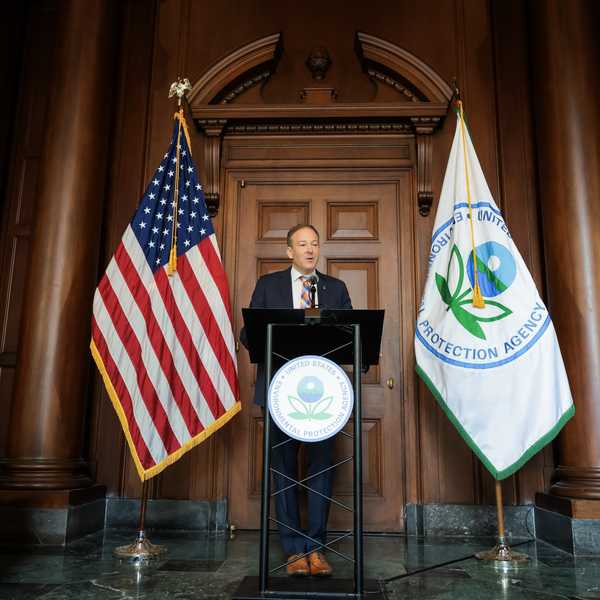
Over 120 top health and medical organizations on Monday joined the growing chorus of opposition to the Environmental Protection Agency’s attempt to roll back the landmark legal opinion that greenhouse gases endanger public health and the welfare of the American people.
“The Trump administration’s effort to rescind the EPA’s endangerment finding is not only dangerous—it’s an attack on science and on the health of the American people. Undoing the endangerment finding would remove the federal government’s main tool to combat climate change,” explained Katie Huffling, executive director of the Alliance of Nurses for Healthy Environments.
The alliance joined the American Thoracic Society (ATS) and Medical Society Consortium on Climate and Health (MSCCH) in writing a letter to EPA Administrator Lee Zeldin. Other signatories include national organizations such as the American College of Physicians, American Medical Association, and Physicians for Social Responsibility, along with scores of state groups.
“The science is clear: Climate change is real, driven primarily by human-caused emissions, and harming both our health and the
economy today,” the letter states. “The health harms of climate change caused by greenhouse gas (GHG) emissions are well understood and acknowledged by the American medical and scientific communities.”
The letter highlights various health impacts tied to the fossil fuel-driven climate emergency, which include an increased range for mosquitoes that spread diseases, worsening mental health, rising cardiovascular deaths, higher risks for respiratory conditions, and conditions that exacerbate chronic diseases. It emphasizes risks for pregnant people, children, and the elderly.
“No matter where they live, children are uniquely vulnerable to hazardous air pollution. Children are not little adults, and their lungs are still developing, putting them at greater risk for harmful impacts to their lifelong health and development,” noted American Academy of Pediatrics president Dr. Susan J. Kressly.
“The Environmental Protection Agency’s proposal to repeal the endangerment finding would jeopardize the progress we’ve made to protect child health and leave children susceptible to chronic illnesses, like asthma,” she warned.
Challenging the Trump administration’s argument for rolling back the 2009 finding, MSCCH executive director Dr. Lisa Patel stressed that “the administration’s claim that climate change is not a significant threat is contrary to what nurses, doctors, and pharmacists witness every day in our clinical practice.”
“Beyond the devastating toll of wildfires, unprecedented extreme heat, and superstorms and floods that decimate entire communities, we are seeing clinics and hospitals themselves damaged or destroyed, and critical supply chains disrupted,” Patel pointed out. “That means in times of crisis we cannot provide even the most basic care patients desperately need.”
National Association of Pediatric Nurse Practitioners president Felesia Bowen declared that “it is unconscionable that the agency charged with protecting Americans from environmental threats would consider rescinding policies based on years of evidence-based practice.”
The signatories are calling on the administration to not only withdraw its proposed rescission of the endangerment finding but also reaffirm the EPA’s obligation to regulate GHG pollution under the Clean Air Act and strengthen protections against climate-related health threats through ambitious emissions standards.
“The science is compelling—climate change is a clear and present danger for the health of our patients and communities,” said Dr. Alison Lee, Chair of the ATS Environmental Health Policy Committee. “Last week’s National Academy of Sciences, Engineering, and Medicine report confirms what the medical community already knows: Climate change is harming our patients and, absent urgent action, the harms will escalate.”
“Let us be clear—the medical community is standing together in its opposition to rolling back the EPA GHG endangerment finding,” she added.
Also citing the report released last week, David Arkush, who directs the climate program at the watchdog group Public Citizen, said in a Monday statement that “the EPA is proposing to move exactly opposite to the way that the law and its mission require—flouting overwhelming scientific evidence and ignoring required procedures to reach a predetermined political outcome on behalf of mass polluters.”
“The agency should reverse course and drop this misguided and unlawful action,” he argued. “Failing that, the courts should roundly reject it.”
His statement and the medical coalition’s letter come on the last day of the public comment period for the proposal, and after more than 1,000 scientists, public health experts, and economists sent another letter to Zeldin last week detailing why they “strenuously object” to his effort to repeal the legal opinion that underpins federal climate regulations.
The effort to repeal the endangerment finding is just one prong of Big Oil-backed President Donald Trump’s war on climate policies, which also includes ending the collection of pollution data, clawing back $7 billion in federal grants for low- and middle-income households to install rooftop solar panels, declaring a national energy emergency, and ditching the Paris Agreement.











No comments:
Post a Comment
Note: Only a member of this blog may post a comment.