■ Opinion
An immediate UN Security Council vote to grant Palestine permanent membership in the UN next month would put an end to Israel’s zealous delusions of permanent control over Palestine. It cannot happen without US backing.
By Jeffrey D. Sachs,Sybil Fares
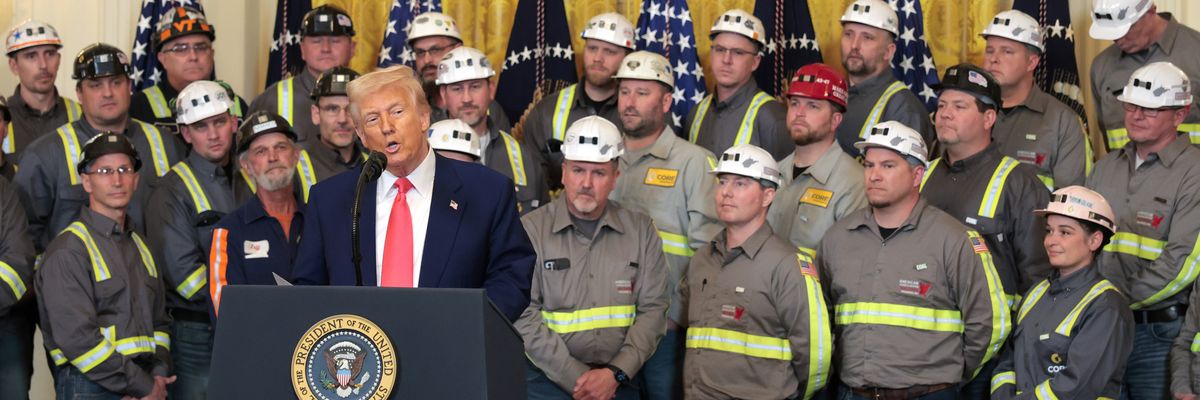
US President Donald Trump speaks alongside coal and energy workers during an executive order signing ceremony in the East Room of the White House on April 8, 2025 in Washington, DC
(Photo by Anna Moneymaker/Getty Images)
Team Trump has mishandled American energy policy in every possible way literally since day one, setting the stage for higher electric bills.
By Bill Mckibben
The next two elections should be decided on the great questions of democracy versus authoritarianism, openness versus racism, science versus ignorance. But my guess is that electric bills may play at least as large a role.
And that should be a good thing for the forces of virtue, because team Trump has mishandled American energy policy in every possible way literally since day one—they’re setting up a debacle. But as we should know by now, Democrats are particularly good at turning debacles into nothingburgers. So let me try and lay out the script right now.
Let’s go back to US President Donald Trump’s first day in office. He declared an “energy emergency” because the production and “generation capacity of the United States are all far too inadequate to meet our Nation’s needs. We need a reliable, diversified, and affordable supply of energy to drive our Nation’s manufacturing, transportation, agriculture, and defense industries, and to sustain the basics of modern life and military preparedness.” If we didn’t get more electricity in particular, the White House said, we would fall behind China in the AI race, with disastrous consequences.
You can debate whether or not we need new AI data centers (My guess is that the technology has been oversold, and that we’re actually going to see fewer of them developed than people think). But you can’t debate two things.
Trump’s crusade against clean energy is obviously idiotic—windmills don’t cause cancer. But it’s more than idiotic—it’s the reason you’re paying more for electricity.
One, the obvious way forward for this country was to develop more sun, wind, and batteries. We know this because it’s what this country, and every other country around the world, had been doing for the last two years. More than 90% of new electric generation around the world last year came from clean energy, momentum that continued through the first quarter of the year. This was not because everyone in the energy business had “gone woke.” Texas, after all, installed more renewable capacity than any other state last year. It was because you could do it cheaply and quickly—we live on a planet where the cheapest way to make power is to point a sheet of glass at the sun.
But, two, the Trump administration immediately began to do absolutely everything in in its power to stop this trend and to replace it with old-fashioned energy—gas, and coal. They have rescinded environmental regulations trying to control fossil fuel pollution, ended sun and wind projects on federal land, cancelled wind projects wherever they could, ended the Inflation Reduction Act tax credits for clean energy construction and instead added subsidies for the coal industry. Again—short of tasking Elon Musk to erect a large space-based shield to blot out the sun, they’ve done literally everything possible to derail the transition to cheap clean energy.
And as a result, electricity prices are starting to skyrocket. If you don’t believe me, listen to this excellent recitation of a power bill in the style of Faulkner from a fellow with an excellent beard. And they are skyrocketing because our power systems are not moving into the new world.
For example: Trump issued an executive order designed to “reinvigorate America’s Beautiful Clean Coal Industry,” which explained that:
Our Nation’s beautiful clean coal resources will be critical to meeting the rise in electricity demand due to the resurgence of domestic manufacturing and the construction of artificial intelligence data processing centers. We must encourage and support our Nation’s coal industry to increase our energy supply, lower electricity costs, stabilize our grid, create high-paying jobs, support burgeoning industries, and assist our allies.
This is nonsense on a cracker, of course, and a new independent report last week found that consumers will be paying an extra $3-$6 billion dollars a year for the privilege of keeping coal-fired power plants open past their expiration dates:
Forcing utilities to continue to operate unneeded and costly coal-fired power plants past their planned retirement increases the electric bills paid by homeowners and businesses. It also undermines the competitiveness of US businesses such as manufacturing by raising electric rates.
Anyone who pays an electricity bill in any region outside the Northeastern US could be footing the bill. Electricity costs could increase by tens if not hundreds of millions of dollars per year in most states.
If you want more detail on this topic, by the way, David Roberts has a very fine interview with the (very fine name) Frank Rambo, who also points out that the coal-fired power plants they’re trying to keep open are not just the most expensive possible source of electric but among the least reliable:
Now, the thing about coal, as it’s been circling the drain, the coal plants that are left are running much less. They’re not running as these baseload where you run it, you might dial it down at night when demand for electricity is lower, but you’re basically always running it.
They are now running much less. They’re running more where they’re having to cycle through, to cycle on and off. And a coal-fired boiler is not built to operate that way. Again, it’s a 20th-century resource for a 21st-century grid, and that causes a lot of maintenance issues. So that they have to—all of a sudden it’s called a "forced outage."
They have to take it offline. So it’s somewhat ironic they are relying on—the DOE is relying on —the one, one of the resources that’s becoming less and less reliable.
Anyway, this level of corruption and incompetence—remember, all this is happening because candidate Trump literally told the fossil fuel industry they could have anything they want if they gave massive contributions to his campaign, and then they did—should open up his party to scrutiny and to scorn. At some level Democrats are figuring this out—as the Washington Post said last week, they have lots to work with, beginning with Trump’s promises that electric bills would fall:
“Under my administration, we will be slashing energy and electricity prices by half within 12 months, at a maximum 18 months,” he told an audience in North Carolina in August 2024.
Trump’s first 12 months aren’t over yet. But so far, the data show prices trending in the wrong direction. And Democrats are keen to make Trump pay for that.
They are crafting an argument that not only have prices not come down but the sweeping tax and spending law Trump signed into law in July will make energy costs worse.
In fact, as NPR reported recently, electricity costs are now climbing twice as fast as inflation, which should give the Dems a huge opening. And indeed the Senate Dems have put together a bill that would cut those costs. But take a look at the press release from Sen. Chuck Schumer (D-N.Y.)—really, just look at the headline—and ask yourself if the Dems have really figured out the snappy rhetoric they need to take advantage of the situation.
I’d say the real danger is the GOP will go on the attack instead, blaming electricity price hikes on their favorite target, Joe Biden. You can already see it happening—here’s Murdoch’s New York Post trying to blame Biden (and New York Gov. Kathy Hochul and New Jersey Gov. Phil Murphy) for being Green New Dealers. (Ironic, since they’ve actually done much to disappoint enviros in their states). And here’sTrump’s Energy Secretary (and former fracking exec) Christ Wright yesterday moaning that it’s all Joe Biden’s fault:
“The momentum of the Obama-Biden policies, for sure that destruction is going to continue in the coming years,” Wright told Politico during a visit to wind- and cornrich Iowa. Still, he said: “That momentum is pushing prices up right now. And who's going to get blamed for it? We're going to get blamed because we're in office.”
This is all inane. Wright was standing in Iowa, which has some of the lowest electric rates in the country—the average Iowan will spend 39% less on electricity than the average American. Why? Because it produces 57% of its electricity from the wind, the second-biggest wind state in the country. The same thing is true across the country. Here’s Stanford professor Mark Jacobson, explaining the math in the Wall Street Journal:
How do the 12 highly renewable states rank in terms of electricity prices? Ten of them are among the 19 states with the lowest electricity prices. Seven are among the 10 states with the lowest prices. South Dakota, with renewables supplying 95% of demand, has the ninth-lowest electricity price. North Dakota (52% renewables) has the lowest. More renewables mean lower prices.
Only California and Maine have high renewables and high prices. Why? California’s industrial price of natural gas, needed for electricity backup, is routinely the third highest in the US and twice the US average. Plus, utilities have passed to customers the costs of wildfires from transmission-line sparks, undergrounding transmission lines, the San Bruno and Aliso Canyon gas disasters, retrofitting gas pipes following San Bruno, and keeping the Diablo Canyon nuclear-power plant open.
California’s use of more renewables and batteries in 2024 than in 2023 increased grid reliability, however, as evidenced by 52% lower spot electricity prices this March to June, versus the same period in 2023. This slowed retail electricity-price rises.
More renewable electricity generators and batteries reduce energy prices. Even in states with high electricity prices caused by other factors, renewables and battery storage keep prices lower than they otherwise would be.
So Democrats need to get good at saying this. They need props—solar panels, batteries. They need sound bites. They need lots and lots of solar installers speaking up, and lots of people with solar on their roofs holding up their teeny tiny bills for the camera. The Dems need to be on the offensive, and sometimes they need to be offensive. The basic line: Trump’s crusade against clean energy is obviously idiotic—windmills don’t cause cancer. But it’s more than idiotic—it’s the reason you’re paying more for electricity.
The Department of Energy literally put out a tweet last month with a picture of a hunk of a coal and the legend “She is the moment.” But in fact coal is 18th-century technology, and gas is 19th-century technology, and now we’re in the 21st century where people know how to intercept the rays of the sun and the breeze in the air and turn them into the cheapest electricity the world has ever seen. And Trump’s getting in the way of that.
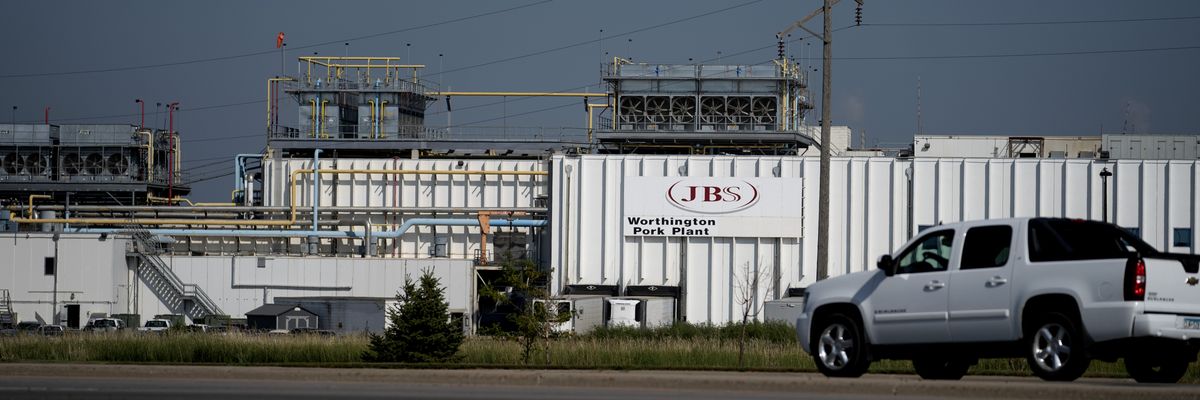
The expanse of JBS pork processing plant sits at the northeast corner of Worthington, Minnesota on September 4, 2019.
(Photo by Courtney Perry/For the Washington Post)
Even in industrial meat production, an industry known for its corruption and poor conditions, JBS stands out for the scope and severity of its violations.
By Cameron Harsh
Earlier this summer, JBS, the world’s largest meatpacking corporation, was approved to list on the New York Stock Exchange. The move was celebrated in business media as a milestone of corporate growth and a testament to the leadership of JBS’ 33-year-old CEO of their US division Wesley Batista Filho. But behind the headlines lies a far more troubling story, one of exploitation, impunity, and environmental devastation that should not be ignored.
Turning a blind eye to abuses at a company as large and powerful as JBS is dangerous, with the harms extending far beyond the meatpacking industry. Consumers, advocates, and investors must stop normalizing this behavior. We have the power and the responsibility to demand better.
JBS has built its empire not through innovation or sustainability, but through exploitation. Price fixing, child labor, wage theft, bribery, tax avoidance, deforest
Even in industrial meat production, an industry known for its corruption and poor conditions, JBS stands out for the scope and severity of its violations. The company recently agreed to pay over $80 million to settle a beef price-fixing lawsuit. Earlier this year, the company was cited for illegally employing migrant children, some as young as 13, on overnight cleaning shifts in its slaughterhouses. Meanwhile, workers across its global operations report being injured, silenced, or discarded when they speak up.
We must stop sending the message that corporations can endanger workers, break the law, and destroy the environment without consequence, as long as they remain profitable.
A recent federal lawsuit filed by Salima Jandali, a former safety trainer at JBS’ Greeley, Colorado plant, alleges that she faced racial and religious harassment, was retaliated against for raising safety concerns, and was pressured to falsify injury reports. Her allegations closely mirror a separate class action lawsuit filed by Black workers at another JBS facility in Pennsylvania who describe enduring racist slurs, being passed over for promotions, and working in unsafe conditions.
Beyond the factory floor, JBS has long been linked to illegal deforestation and environmental destruction in the Amazon, both directly through its supply chains and indirectly through pressure on local ecosystems. The company’s climate footprint is staggering, with greenhouse gas emissions that rival those of entire countries. And yet, instead of reckoning with this impact, JBS continues to expand production and avoid accountability.
In Brazil, where the company is headquartered, the recent passage of most of the so-called “devastation bill” further weakens environmental safeguards and accelerates the damage. Now that President Luiz Inacio Lula da Silva approved the bill, even with some environmental restrictions, it continues to grant free rein to agribusiness giants like JBS that profit from the destruction of forests and the displacement of Indigenous communities.
This is not a case of a few bad actors or isolated scandals. JBS has thrived because of weak enforcement, political influence, and a financial system that rewards short-term gains over long-term responsibility.
Just months before its New York Stock Exchange (NYSE) debut, JBS subsidiary Pilgrim’s Pride made a $5 million donation to the Trump-Vance Inaugural Committee. This is the context in which JBS was allowed to access US capital markets. Even though top proxy advisory firms, including Glass Lewis and Institutional Shareholder Services, urged shareholders to vote against the listing, citing serious governance concerns and lack of transparency, their warnings were ignored, and just this June, JBS began trading on the NYSE.
JBS now generates over $39 billion a year from its US operations alone, profits that are often routed through tax havens in Luxembourg, Malta, and the Netherlands. And when caught breaking the law, JBS often faces only minor consequences that rarely match the scale of the harm.
We must stop sending the message that corporations can endanger workers, break the law, and destroy the environment without consequence, as long as they remain profitable. There is another path forward. Consumers, advocates, and investors need to reject this status quo and demand change.
That starts with consumers actively choosing not to buy JBS products. Investors can divest from JBS and urge their asset managers to do the same. Universities, pension funds, and retirement plans can reexamine whether their portfolios are supporting a company with this kind of track record. At the same time, policymakers must push for stronger corporate accountability, not just in meatpacking, but across industries that harm people and the planet.
JBS should not be rewarded with more money, more access, and more influence. Instead, we must make JBS the example and let it serve as a warning about the costs of putting profit above all else. The future of our food system, our environment, and our communities depends on drawing the line and holding it.




No comments:
Post a Comment
Note: Only a member of this blog may post a comment.