tRUMP'S BLACKMAIL OF ZELENSKY RE-VISITED....
FROM
MARCH 3, 2022
Lt. Col. Alex Vindman: How Trump's Coup Attempt Encouraged Putin's Ukraine Invasion
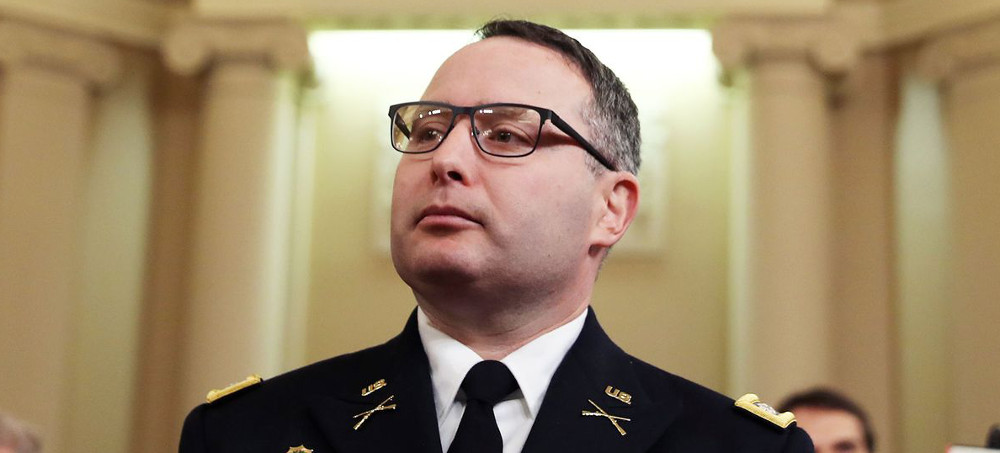 National Security Council Director for European Affairs Lt. Col. Alexander Vindman. (photo: Chip Somodevilla/Getty)03 march 22
Army officer who stood up to Trump: Disinformation from Fox News, GOP is "the reason Russia launched" invasion
That crime was part of a much larger pattern, in which Donald Trump and his regime consistently acted as vassals for Vladimir Putin's regime and Russia's strategic interests.
Writing at the Washington Post, Colbert King reminds us of further history in this regard:
Maybe now that the Russian invasion of Ukraine is well underway, the implications of President Vladimir Putin's actions against the United States in 2016 will finally sink in, especially for Republicans in Congress. The Vladimir Putin who planned, staged and launched a large-scale war on Ukraine is the same Vladimir Putin who ordered an aggressive, multifaceted, clandestine campaign to interfere in the 2016 U.S. presidential election.
Putin's Ukraine goal: pull that country from the West and back into Russia's sphere of influence. His U.S. goal in 2016: undermine the democratic process, disparage and undercut Hillary Clinton and her campaign for president, and help elect Donald Trump.
The outcome of his Ukraine campaign is yet to be decided. His U.S. effort found full success. … The simple truth is that Putin believed Russia would benefit from having Trump in the White House, and he pushed his intelligence services to help secure that outcome. Just as he perceives that a subjugated Ukraine benefits Russia and is now working to achieve that end.
How many people had privileged knowledge of the Trump administration's likely or certain criminal acts including and far beyond what took place with Ukraine? Was it dozens or hundreds? Yet, only a few have possessed the courage and personal integrity to speak up publicly as whistleblowers.
U.S. Army Lt. Col. Alexander Vindman, now retired, was one such person. While serving on the White House's National Security Council, Vindman filed formal reports in 2019 disclosing that Trump and his representatives were engaged in the aforementioned acts of political extortion or blackmail against the Ukrainian government. Vindman, a U.S. citizen who was born in Ukraine, would later testify during Trump's impeachment inquiry.
Vindman was formerly director for Eastern Europe, the Caucasus and Russia on the National Security Council, and before that served as political-military affairs officer for Russia for the chairman of the Joint Chiefs of Staff and as an attaché at the U.S. embassy in Moscow. He is now a doctoral student and senior fellow for the Foreign Policy Institute at the Johns Hopkins School of Advanced International Studies, a Pritzker Military Fellow at the Lawfare Institute, an executive board member for the Renew Democracy Initiative and senior adviser to the PAC VoteVets. His recent memoir, "Here, Right Matters: An American Story," was a New York Times bestseller.
For his acts of courage and patriotism, Vindman would lose his military career and become a target of violent threats and other acts of retaliation. Those threats have continued to the present. I recently spoke with Lt. Col. Vindman about his decision to speak out and about the extent to which he perceived the existential threat that Trump and his movement would represent to American democracy, as seen in the events of Jan. 6, 2021, and the Republicans' ongoing coup attempt.
In this conversation, Vindman argues that Trump's coup attempt and other assaults on American democracy and the rule of law gave Vladimir Putin encouragement to pursue his illegal and unprovoked invasion of Ukraine. Vindman also shares his concerns that the Trump regime's crimes against democracy are only a blueprint for a future fascist leader who will be much more effective and dangerous. Vindman also offers his thoughts about the possibility of a second American Civil War, and about what it means to be a patriot in a time of rising fascism and a worsening crisis of democracy.
This conversation has been edited for clarity and length.
Given the state of the world and this country, how are you feeling?
It depends on the day. In general, I remain optimistic. As a historian, I look at the scope of the challenges the United States has had to overcome. On the day to day, we are in the heat of battle, and it is hard to maintain that optimism. It is really disturbing that the events of Jan. 6 were not sufficient to correct the direction this country is going in terms of political polarization.
Your tone of voice suggests that even in the face of all these challenges that you are hopeful about the country. How do you maintain that?
America has faced many challenges. At the time it was hard to see that light at the end of the tunnel when we were in the midst of seismic events such as the Vietnam War, for example, or the 1960s more generally. But we persevered and made incremental progress as a country. We are on one of those trajectories where we make a few steps forward and then take a step back. The country has not been properly prepared for the changes and challenges of the 21st century. Large swaths of the population have been left behind and that has left fertile grounds for radicalization.
Nativism and racism and ethnocentric nationalism were able to gain purchase there. We find ourselves in a really difficult moment right now. What I find so fascinating about the American people is their deep sense of patriotism, especially when they perceive a threat to the country. At present, the country is so divided that those different audiences and groups see a completely different set of threats. Nefarious political actors, both domestically and overseas, have been able to exploit those differences to drive a wedge between us.
How did you decide to blow the whistle and reveal the truth about Trump and his administration's corruption, in terms of the illegal pressure campaign on the Ukrainian government?
There is a huge element of uncertainty. I had a military career that was thriving and that was derailed. But when it really counted and I was faced with the personal challenges that would greatly impact my life, I met the test and did what I thought was right.
How many military officers could pinpoint exactly the moment where they made a difference? Yes, it is true that over the broad scope of a career, you have an impact on soldiers and their lives. But for me this was a moment when American democracy was in peril. The president was trying to steal an election, and I lived up to my obligation to support and defend the Constitution against all enemies, foreign and domestic.
Why did you make the choice to speak out when so many of your peers and other colleagues did not?
In many ways, I believe that I am representative of the public servant class of the military. The weight of the decision was on my shoulders. I was the responsible officer in the White House and in a senior position of trust. If I didn't say anything, then nothing would have been said. I recognized that reality. There were many people that did something similar within their organizations to the best of their ability. The news media was not necessarily aware of those happenings.
Here is an example. The career public servants who testified alongside me during Trump's first impeachment are representative of the excellence of the people who serve in the American government. Every single one of them went up there and told the truth, regardless of personal consequences. There are plenty of such people who raised the alarm within their organizations and institutions.
One of the things I'm most adamant about is accountability. There has not been enough accountability for the corruption of the Trump administration and the insurrection on Jan. 6 and related events. The country needs a truth and reconciliation commission. We need to really understand the harm that was done to good governance in this country by the Trump administration. There is a perception that now, because Biden is president, the danger to the country has ended. That is incorrect. The danger is still there because of the erosion of institutions. There is a blueprint now about how to corrupt the country's governing institutions.
Donald Trump did an enormous amount of harm. But he is a fool, and he could only do so much harm. If there is a really sophisticated person like a Ted Cruz or Ron DeSantis, then America would be in a much more difficult situation in terms of the country's democracy.
For example, the Office of the Inspector General should at least conduct an audit where things went wrong in the most important departments and agencies within the intelligence community, within the State Department, within the Department of Homeland Security, within Department of Defense and so on to make sure we take the steps that are necessary to protect the country.
What is hard to legislate against is presidential corruption. Our system is not designed to have a corrupt president and that is where the existential dangers lie, as we saw with Donald Trump.
How did you make sense of Jan. 6, 2021? What were you thinking as it was happening?
As I watched the events unfold, I knew intellectually that such an outcome was possible. Several months prior, I had conversations with other national security experts where we explored worst-case scenarios. You could see that Donald Trump was prepared to do anything to stay in power. He was telegraphing it.
Watching that violence and the assault, and seeing the Capitol building being successfully breached, was something that was hard to fathom. You would think in a worst-case scenario that there might be some violence, but that the mob would have have been stopped from getting inside the Capitol building. That didn't happen.
Were you afraid that Trump would order the military to intervene on his side? That there would be a military coup?
I did not fear the military coming down on the side of Donald Trump. I trusted that the military was going to be principled and do the right thing, and not be immersed or dragged into domestic politics. But I did have some fears about the president successfully rallying a fringe, extremely right-wing radicalized portion of the public to cause real harm to the peaceful transition of power. And to a certain extent, that did happen. It lasted hours and failed. I have seen such things in other countries. These events leave me deeply worried about the health of our political system. Ultimately, I've tried to raise the alarm about the vulnerabilities in America's democracy and governing institutions without being an alarmist.
What about all this talk about a second American Civil War?
I am somewhere in the middle. I have looked at the polling and other data which suggests that there are perhaps tens of millions of right-wing Americans radicalized and prepared to take up arms. I've also read academic analyses about America and the possibility of a second civil war. But there is a difference between the academic analysis and theorizing and the reality of the situation, and I don't see the American public radicalized to that point — or at least not a significant portion of it.
Now, even if we're talking about a fraction of that larger number, say 2 million, then yes, they could do a huge amount of damage. But that's far from a civil war. It is disturbing. It could be a violent insurrection or something of that nature, but ultimately, I do not believe that the United States is on the brink of a civil war.
Why should the American people care about events in Ukraine?
There is a values argument and there is an interests argument. The values argument takes you only so far. This is a like-minded people fighting for their freedom, their homes and democracy.
But the interests side of the equation is oftentimes more compelling. The Ukrainians are fighting on freedom's frontier. They are warding off greater aggression by Russia in a region that is central to, if not the linchpin, for America's interests and democracy.
The other example is that Russia is more powerful with Ukraine than it is without it. America does not want to deal with a belligerent Russia, a country with a leader that has attempted to interfere with our elections, put bounties on American soldiers' heads and assassinated people on NATO territory. Do we want them to be even stronger?
There is that old saying from the Cold War that "politics stops at the water." What has happened with the Republican Party, the right-wing news media and other "conservatives"? How did things go so wrong?
That quote and advice has not been ironclad, but it's been generally consistent, especially so when critical United States interests or American lives are under threat. Donald Trump has taken the Republican Party in a disastrous direction. Again, everything Trump touches dies. He's his own worst enemy. He is a stubborn ass who latched onto this idea that he will not criticize Putin. It's a test of his manhood. Trump is now going to continue to press that issue. It looks like the Republican Party is going to follow him.
With Putin and the Ukraine invasion, it is almost like the Republicans stepped into a trap. You could see the trap from a mile away if you were paying attention. The Republicans were cheering on this vile tyrant as he attempts to destroy a peaceful country on his border, a democracy, and now they're going to own that decision.
In my opinion, this is going to be an important theme for the Democratic Party going into the 2022 and 2024 elections. The Tucker Carlsons, the Donald Trumps, the Mike Pompeos, they and other Republicans are going to have to own this issue because they are the reason that Russia launched this operation.
Putin could have done this at any time. The reason he acted now is not coincidental. Putin started building up his forces in the spring of 2021. This was weeks after the Jan. 6 insurrection. Putin, like Trump, smells vulnerability and exploits it. Vladimir Putin perceived that the United States was distracted and vulnerable. He's been testing our resolve. He's been getting positive signals in that regard.
There is blood on the Republican Party's hands. They were partially responsible for what is happening in Ukraine. Tucker Carlson and Donald Trump were basically as popular on Russian TV as they are here in this country. They're constantly being played there. What is the impression given? The United States is divided, and there's an opportunity there. So these folks now own it.
Why is Trump so enamored with Vladimir Putin? What does he represent for Trump?
It is about power for Donald Trump. Trump yearns for the kind of power that Vladimir Putin wields. Putin is who Trump wishes he could be. Donald Trump just doesn't have the capability. He's not smart enough. He doesn't have the fortitude for that kind of behavior. He doesn't have the determination. Donald Trump just doesn't have a lot of those skills that Putin has, but that is who Trump wishes he could be. It is also why Trump is so fond of other authoritarian rulers, such as Kim Jong-un and Xi Jinping. But Vladimir Putin is Trump's favorite.
What does it mean to be a patriot in this moment of democracy crisis?
It is important to reclaim the symbols of this nation. That is why I would wear my American flag lapel pin when I was out on my book tour. These symbols of our nation cannot be usurped by the far right. We also need to reclaim the term "patriot."
To me, a patriot is somebody who actually puts the interests of the nation above themselves. That is the exact opposite of what many in the Republican Party are today — the exact opposite of Tucker Carlson, the exact opposite of Donald Trump. These are people who put their own interests ahead of the nation's. Such people usurp the symbols of the country while undermining it.
Do you have a message for the Ukrainian people?
I have faith in the Ukrainian people. I have faith in their spirit and their resolve to live a life in which individuals have a say in their destiny. It's a struggle, but they're moving toward a system where the rule of law is sacrosanct. The Ukrainians aren't there yet, but they're moving in that direction. I've been impressed with how the Ukrainian people, under these very difficult circumstances, have held up.


