Tuesday, March 10, 2026
■ Today's Top News
New Mexico Sen. Martin Heinrich said the Mainer is "building a movement around folks who work hard for their family and community."
By Stephen Prager
US Senate hopeful Graham Platner’s momentum continues to grow, with yet another senator bucking the Democratic Party establishment to endorse him in Maine’s June primary.
“Graham Platner is focused on delivering for Mainers, not billionaire donors,” said Sen. Martin Heinrich (D-NM) on Tuesday in comments reported by Politico. “And he’s exactly the person the Democratic Party needs to win back working people.”
Polls show Platner, the progressive 41-year-old Marine-turned-oyster farmer, comfortably ahead of Maine’s centrist Democratic Gov. Janet Mills for the right to challenge the state’s five-term Republican incumbent Sen. Susan Collins in November.
The seat will be an essential pickup if Democrats hope to retake the chamber in 2026.
Senate Minority Leader Chuck Schumer (D-NY) has pushed for Mills to get the nomination over Platner. This is despite polling last week from Quantus Insights, which showed Mills trailing Collins by over 1%, and Platne leading the Republican by more than 5% among likely voters.
Platner—a backer of Medicare for All and a billionaire wealth tax who has fiercely opposed aggressive US military interventions—first received the backing of Sen. Bernie Sanders (I-Vt.).
Earlier this month, Sen. Ruben Gallego (D-Ariz.) became the first Democratic senator to endorse Platner, in defiance of party leadership, calling him “the candidate that can win.”
Heinrich, who has emphasized the necessity of making the Democratic Party a “bigger tent” and bringing in “new” and “younger” leadership, has admired Platner’s candidacy from afar for months.
Responding to Platner’s campaign launch video, in which he declared that “the enemy is the oligarchy,” Heinrich wrote on social media in October, “We need more candidates like this.”
New Mexico’s three-term senator is now the third member of the chamber to endorse Platner, who said he was “honored” to have him as a “future colleague.”
“He’s building a movement around folks who work hard for their family and community—folks who deserve a Senator fighting in their corner,” Heinrich said. “I’m proud to endorse and help send him to the Senate in November.”
“Pete Hegseth is a very dangerous person. He’s a white Christian nationalist and has the arsenal of the United States government at his disposal."
By Julia Conley
President Donald Trump’s top defense official appeared resolute Tuesday in pushing for continued chaos in the Middle Eastern country—and intensified concerns that the Trump administration is waging a religious “crusade” against Iran by praying at a press briefing.
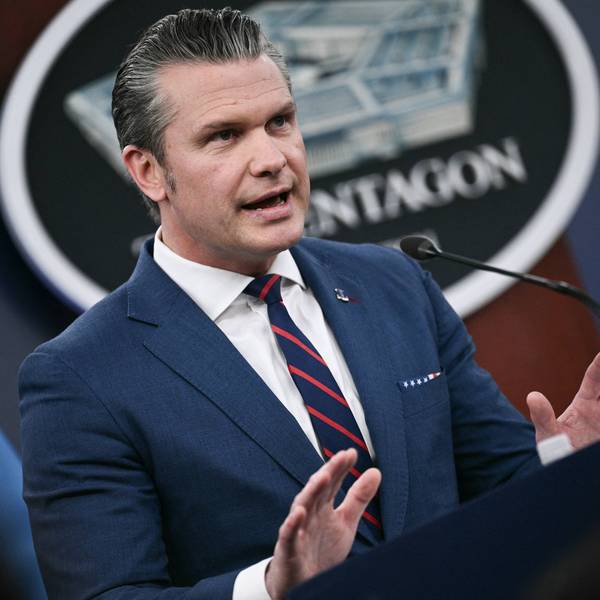
After telling reporters that Tuesday would “be yet again our most intense day of strikes inside Iran,” Defense Secretary Pete Hegseth bowed his head in prayer and said he was “drawing strength from Psalm 144.”
“Blessed be the Lord, my rock, who trains my hands for war and my fingers for battle,” said the defense secretary, who has backed Trumps’ assertion that the Department of Defense is called the Department of War. “May the Lord grant unyielding strength to our warriors, unbreakable protection to them and our homeland, and total victory over those who seek to harm them.”
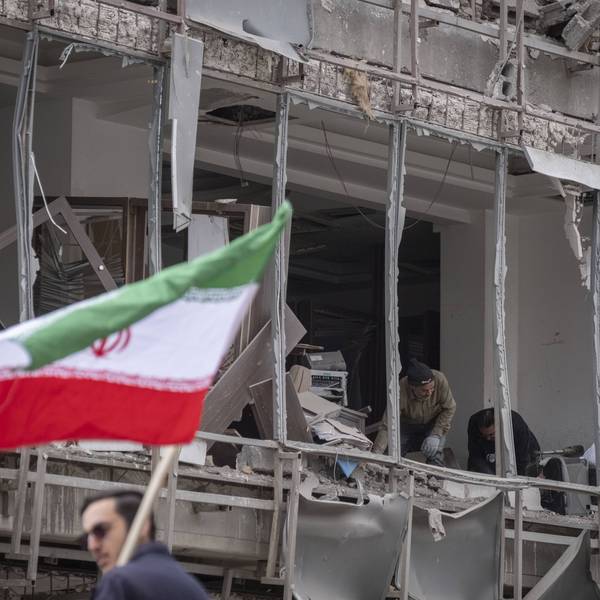
Hegseth and Dan Caine, chairman of the US Joint Chiefs of Staff, made no mention of efforts to return to diplomatic talks, which were reportedly making significant progress toward a deal on Iran’s nuclear program late last month when the US and Israel began bombarding Iran—striking civilian infrastructure including schools and healthcare facilities and killing more than 1,300 people so far, according to Iranian officials.
Hegseth said Trump has “maximum options” to conduct the war and said it is up to the president to determine whether “it’s the beginning, the middle, or the end” of the conflict, which has spread to Lebanon and other surrounding countries while the administration’s explanation of its objectives in Iran have shifted.
The defense secretary’s religious display came a week after the Military Religious Freedom Foundation (MRFF) said it had received more than 100 reports from noncommissioned officers who said commanding military officers have spoken about the war on Iran as though it’s a religious conflict.
The Pentagon has long-established rules prohibiting proselytizing within its ranks, but MRFF president Mikey Weinstein said commanders have appeared “especially delighted with how graphic this battle will be, zeroing in on how bloody all of this must become in order to fulfill and be in 100% accordance with fundamentalist Christian end-of-the-world eschatology.”
Hegseth has prayed at military briefings previously and invited Christian nationalist pastor Doug Wilson to preach at the Pentagon.
On Monday, MS NOW‘s Ali Velshi posited that without a clear objective or the support of a majority of the American public, observers are left wondering whether the religious displays of Hegseth and military commanders make clear what the goal of attacking Iran is: a religious battle led by Christian nationalists.
“It wasn’t that long ago that groups in parts of the Middle East invoked extremist interpretations of Islam to justify violence against the West... But that religious extremism did not arise in a vacuum. Crucially, it was sustained by a political bargain,” wrote Velshi. “Something eerily similar is now unfolding right here at home, and it has been building for some time.”
He continued:
More than two centuries after the framers warned about the dangers of merging faith with political power, we are now seeing a version of that same dynamic take hold at the highest levels of American government. It’s not just creeping in; it is actively shaping how this war is being understood and justified—from those advising the president to military commanders briefing troops before their deployment.
[...]
The US military was never meant to fight for a religious prophecy. In fact, the founding fathers were so concerned about the line between church and state—which includes the military—that they included it in the Bill of Rights.
But today, under Trump, Hegseth, and the Christian nationalist movement that surrounds them, that line is being erased in real time.
The price of that erasure will be paid for with the lives of innocent civilians abroad. It may be paid for with the lives of innocent civilians here at home. And it will surely be paid for by American soldiers, sailors and airmen and women, many of whom are being told they are carrying out God’s command.
At The Guardian on Sunday, David Smith emphasized how Hegseth has combined “bombastic” threats—asserting that Iranian leaders “are toast” and bragging that “we are punching them while they’re down” as evidence emerged that the US was behind a strike on a girls’ school—with his displays of Christian nationalist beliefs.
“Pete Hegseth is a very dangerous person,” Janessa Goldbeck of Vet Voice Foundation told Smith. “He’s a white Christian nationalist and has the arsenal of the United States government at his disposal and a permission slip from President Trump to deploy carnage wherever he wishes against whomever he wishes.”
Trump falsely claimed that Iran has “some” highly restricted Tomahawk missiles as additional evidence pointed to US culpability for the deadly strike.
By Brett Wilkins
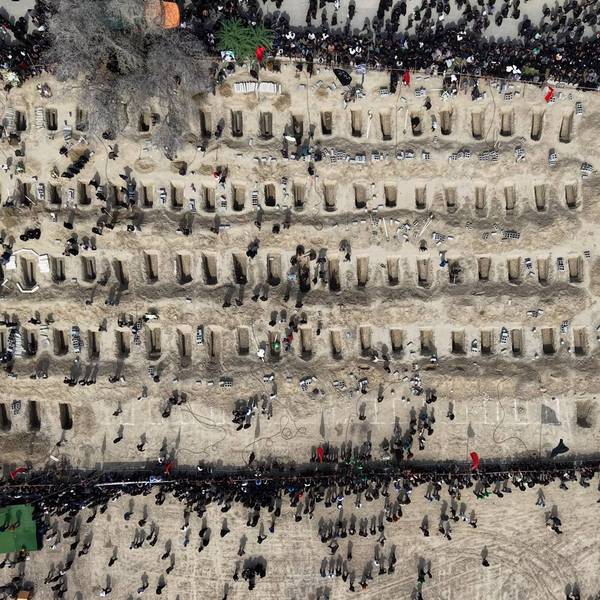
As Iranian officials displayed US-marked fragments of a missile believed to have been used in Saturday’s massacre of around 175 mostly school children in Minab, President Donald Trump on Monday doubled down on his unfounded claim that Iran carried out the strike.
The president suggested during a press conference at his Trump National Doral Miami resort that Iran may have used a US Tomahawk missile to carry out the February 28 attack on the Shajareh Tayyebeh girls’ elementary school in Minab.
Trump falsely claimed that Iran has “some” of the highly restricted cruise missiles after one of them was recorded hitting an Iranian military facility near the school just after Saturday’s strike there.
“A Tomahawk is very generic,” Trump added. “It’s sold to other countries.”
New York Times reporter Shawn McCreesh pressed Trump on his claim, asking, “You just suggested that Iran somehow got its hands on a Tomahawk and bombed its own elementary school on the first day of the war... Why are you the only person saying this?”
Trump replied: “Because I just don’t know enough about it. I think it’s something that I was told is under investigation, but Tomahawks are, are used by others. As you know, numerous other nations have Tomahawks. They buy them from us.”
Iran has no Tomahawks, which are not “generic.” Originally developed by General Dynamics and now manufactured by Raytheon, the BGM‑109 Tomahawk is a specific long-range cruise missile designed and produced in the United States. Only two other countries—Australia and the United Kingdom—are known to have Tomahawks in their arsenals, although Japan and the Netherlands have also agreed to buy them.
The US also does not sell weaponry to the Iranian government—with the extraordinary exception of the Iran-Contra Affair, in which the Reagan administration secretly sold arms to Iran in order to fund anti-communist Contra terrorists in Nicaragua.
Trump’s Monday remarks followed his Saturday comments to reporters aboard Air Force One, where he said that the bombing “was done by Iran.”
However, Defense Secretary Pete Hegseth, who was accompanying Trump, notably declined to back Trump’s claim, saying only that “we’re certainly investigating” the strike.
US Ambassador to the United Nations Michael Waltz also did not endorse the president’s assertion, telling ABC News’ Martha Raddatz Sunday that he would “leave that to the investigators to determine.”
Waltz—a former Army Special Forces officer who served in Afghanistan—also told NBC News’ Meet the Press Sunday that “we never deliberately attack civilians.”
More than 400,000 civilians in over half a dozen countries have been killed in US-led wars since 9/11, according to the Costs of War Project at Brown University’s Watson Institute for International and Public Affairs.
Hundreds of Iranian civilians have been killed by US and Israeli bombing since February 28. Israeli airstrikes have also killed hundreds of Lebanese civilians during the same period.
During Monday’s press conference, Trump said that he is “willing to live with” whatever the probe into the Minab school strike shows.
A preliminary US intelligence assessment reportedly concluded that the United States is “likely” responsible for the strike, although a probe is ongoing.
On Monday, the New York Times published photos of fragments purportedly from a missile used in the school strike, which were marked with the names of multiple companies that produce Tomahawk components, a unique Department of Defense contract number, and “Made in USA.” Another remnant is marked SDL ANTENNA, a key satellite data link component of Tomahawk missiles.
Paramedics and victims’ relatives said the school bombing was a so-called “double-tap” airstrike—a common tactic used by US, Israeli, and Russian forces in which attackers bomb a target and then follow up with a second strike meant to kill survivors and first responders.
If carried out by the US, the Minab school strike would be one of the deadliest US civilian massacres in modern times, ranking with the bombing of a Baghdad bomb shelter during the 1991 Gulf War—which killed more than 400 people—and the March 2017 slaughter of at least 105 people in an apartment building in Mosul, Iraq during Trump’s “war of annihilation” against the so-called Islamic State.
Trump’s claim that Iran may have bought a US missile whose sale is restricted to just a handful of close allies and used it to bomb its own school prompted worldwide ridicule.
US Senate Majority Leader Chuck Schumer (D-NY) said on the upper chamber floor Tuesday that “Iran doesn’t have Tomahawk missiles, Donald Trump!”
“The claim is beyond asinine,” he continued. “He says whatever pops into his head no matter what the truth is. And we all know he lies, but on something as formidable as this, it’s appalling.”
“Trump is lying through his teeth,” Schumer added.
Barry Andrews, an Irish politician who serves as a Member of the European Parliament for the Dublin constituency, said on X that Trump’s “latest use of the ‘big lie’ tactic... was to claim that Iran somehow possesses US-made Tomahawk missiles and fired upon its own girls school.”
“Such blatant lies are meant to distract,” Andrews added. “He knows the world will move on.”
New Yorker cartoonist Mark Thompson quipped, “How Iran fired a Tomahawk missile at their own school is beyond me, but President Trump wouldn’t lie to us.”
Reza Nasri, an international law expert at the Graduate Institute of International and Development Studies in Geneva, said on X that “Trump claims that Iran somehow got its hands on a US Tomahawk cruise missile and used it to bomb its own elementary school.”
“Ask him how Iran could possibly have obtained such missiles—and how it allegedly launched one, given that Tomahawks are typically fired from naval platforms, primarily warships and submarines,” Nasri added. “Did Iran get its hands on US warships and submarines too?”
As Iranian officials displayed US-marked fragments of a missile believed to have been used in Saturday’s massacre of around 175 mostly school children in Minab, President Donald Trump on Monday doubled down on his unfounded claim that Iran carried out the strike.
The president suggested during a press conference at his Trump National Doral Miami resort that Iran may have used a US Tomahawk missile to carry out the February 28 attack on the Shajareh Tayyebeh girls’ elementary school in Minab.
Trump falsely claimed that Iran has “some” of the highly restricted cruise missiles after one of them was recorded hitting an Iranian military facility near the school just after Saturday’s strike there.
“A Tomahawk is very generic,” Trump added. “It’s sold to other countries.”
New York Times reporter Shawn McCreesh pressed Trump on his claim, asking, “You just suggested that Iran somehow got its hands on a Tomahawk and bombed its own elementary school on the first day of the war... Why are you the only person saying this?”
Trump replied: “Because I just don’t know enough about it. I think it’s something that I was told is under investigation, but Tomahawks are, are used by others. As you know, numerous other nations have Tomahawks. They buy them from us.”
Iran has no Tomahawks, which are not “generic.” Originally developed by General Dynamics and now manufactured by Raytheon, the BGM‑109 Tomahawk is a specific long-range cruise missile designed and produced in the United States. Only two other countries—Australia and the United Kingdom—are known to have Tomahawks in their arsenals, although Japan and the Netherlands have also agreed to buy them.
The US also does not sell weaponry to the Iranian government—with the extraordinary exception of the Iran-Contra Affair, in which the Reagan administration secretly sold arms to Iran in order to fund anti-communist Contra terrorists in Nicaragua.
Trump’s Monday remarks followed his Saturday comments to reporters aboard Air Force One, where he said that the bombing “was done by Iran.”
However, Defense Secretary Pete Hegseth, who was accompanying Trump, notably declined to back Trump’s claim, saying only that “we’re certainly investigating” the strike.
US Ambassador to the United Nations Michael Waltz also did not endorse the president’s assertion, telling ABC News’ Martha Raddatz Sunday that he would “leave that to the investigators to determine.”
Waltz—a former Army Special Forces officer who served in Afghanistan—also told NBC News’ Meet the Press Sunday that “we never deliberately attack civilians.”
More than 400,000 civilians in over half a dozen countries have been killed in US-led wars since 9/11, according to the Costs of War Project at Brown University’s Watson Institute for International and Public Affairs.
Hundreds of Iranian civilians have been killed by US and Israeli bombing since February 28. Israeli airstrikes have also killed hundreds of Lebanese civilians during the same period.
During Monday’s press conference, Trump said that he is “willing to live with” whatever the probe into the Minab school strike shows.
A preliminary US intelligence assessment reportedly concluded that the United States is “likely” responsible for the strike, although a probe is ongoing.
On Monday, the New York Times published photos of fragments purportedly from a missile used in the school strike, which were marked with the names of multiple companies that produce Tomahawk components, a unique Department of Defense contract number, and “Made in USA.” Another remnant is marked SDL ANTENNA, a key satellite data link component of Tomahawk missiles.
Paramedics and victims’ relatives said the school bombing was a so-called “double-tap” airstrike—a common tactic used by US, Israeli, and Russian forces in which attackers bomb a target and then follow up with a second strike meant to kill survivors and first responders.
If carried out by the US, the Minab school strike would be one of the deadliest US civilian massacres in modern times, ranking with the bombing of a Baghdad bomb shelter during the 1991 Gulf War—which killed more than 400 people—and the March 2017 slaughter of at least 105 people in an apartment building in Mosul, Iraq during Trump’s “war of annihilation” against the so-called Islamic State.
Trump’s claim that Iran may have bought a US missile whose sale is restricted to just a handful of close allies and used it to bomb its own school prompted worldwide ridicule.
US Senate Majority Leader Chuck Schumer (D-NY) said on the upper chamber floor Tuesday that “Iran doesn’t have Tomahawk missiles, Donald Trump!”
“The claim is beyond asinine,” he continued. “He says whatever pops into his head no matter what the truth is. And we all know he lies, but on something as formidable as this, it’s appalling.”
“Trump is lying through his teeth,” Schumer added.
Barry Andrews, an Irish politician who serves as a Member of the European Parliament for the Dublin constituency, said on X that Trump’s “latest use of the ‘big lie’ tactic... was to claim that Iran somehow possesses US-made Tomahawk missiles and fired upon its own girls school.”
“Such blatant lies are meant to distract,” Andrews added. “He knows the world will move on.”
New Yorker cartoonist Mark Thompson quipped, “How Iran fired a Tomahawk missile at their own school is beyond me, but President Trump wouldn’t lie to us.”
Reza Nasri, an international law expert at the Graduate Institute of International and Development Studies in Geneva, said on X that “Trump claims that Iran somehow got its hands on a US Tomahawk cruise missile and used it to bomb its own elementary school.”
“Ask him how Iran could possibly have obtained such missiles—and how it allegedly launched one, given that Tomahawks are typically fired from naval platforms, primarily warships and submarines,” Nasri added. “Did Iran get its hands on US warships and submarines too?”
"We’re entering an even more dangerous moment," said foreign policy expert Matt Duss.
By Brad Reed
President Donald Trump may believe that his unprovoked and unconstitutional war with Iran is “very complete, pretty much,” but one foreign policy expert thinks that is highly wishful thinking.
Matt Duss, executive vice president at the Center for International Policy and former foreign policy adviser to Sen. Bernie Sanders (I-Vt.), argued in a Tuesday social media post that the negative consequences of Trump’s attack on Iran are just starting to be felt, with no option for a quick ending.
“We’re entering an even more dangerous moment,” Duss wrote, “as the stupidity of this war becomes undeniable even to its supporters, who realize they’re about to be revealed as morons yet again and are desperate to turn this into something they can spin as a win. Their only option is escalation.”
Shortly before Duss offered his analysis of the situation, Defense Secretary Pete Hegseth held a news conference in which he dialed up belligerent rhetoric against Iran while declaring the war “a laser-focused, maximum-authority mission, delivered with overwhelming and unrelenting precision.”
“No hesitation, no half measures,” Hegseth continued. “As President Trump declared yesterday, we’re crushing the enemy in an overwhelming display of technical skill and military force.”
Hegseth’s bluster did not impress Sen. Chris Murphy (D-Conn.), who vowed on Tuesday to drag Hegseth before the Senate to answer questions about the war, which the president launched early on a Saturday morning without any authorization from the US Congress.
“I’m joining together with my allies in the United States Senate to use the leverage we have to force a debate and a vote in the Senate on the authorization of war,” Murphy said. “I think if the Senate took that vote, it would fail, and that would allow us to stop this illegal, disastrous war in Iran.”
Murphy went on to note that “the Constitution is crystal clear” that Trump does not have the power to unilaterally declare war, even though that is precisely what he did less than two weeks ago.
“You should be furious about that,” Murphy said, “because this is maybe the most dangerous thing a president can do: Send your sons and daughters to die overseas without your consent.”
Murphy’s statement earned kudos from Duss, who promoted his message on social media.
“This is the way,” wrote Duss. “No business as usual.”
Critics blasted Trump as "sadistic" for justifying attack on unarmed Iranian ship, which killed over 100 sailors, because it was "more fun" for US forces than capturing it.
By Stephen Prager
President Donald Trump said the US Navy chose to sink an Iranian frigate, killing more than 100 sailors last week, because it was “more fun” than capturing the vessel, even though the ship posed no threat.
Though death tolls vary, Iran’s state media organization, the Islamic Republic News Organization, reported on Sunday that 104 crew members were killed in the attack and that 32 others were injured when a US submarine torpedoed the Iranian warship IRIS Dena in the Indian Ocean on March 4 as it departed from the Milan Peace 2026 naval drills hosted in India.
The Dena was more than 2,000 miles away from the Persian Gulf when it was attacked, far from the hostilities unleashed last weekend when the US and Israel launched a war against Iran. Contradicting US claims, Iranian and Indian officials have said it was not armed.
In what political commentator Adam Schwarz described as “the most blasé admission of a war crime by a US president in history,” Trump on Monday casually recounted the US Navy’s decision to attack the ship before a gathering of Republicans at a Congressional Institute event, a GOP-aligned nonprofit retreat organizer.
He suggested that the Navy blew the boat up not to neutralize a threat, but purely for its own sake.
After making the exaggerated boast that Iran’s navy is “gone” following aggressive US bombing, Trump said at first he “got a little upset” with the military brass who ordered the sinking of the Dena, which he said they described as a “top-of-the-line” vessel.
Trump said he asked: “Why don’t we just capture the ship? We could have used it. Why did we sink them?”
He said that an unspecified official told him, “It’s more fun to sink them.”
As the crowd laughed, Trump went on, chuckling himself: “They like sinking them better. They say it’s safer to sink them. I guess it’s probably true.”
Iran’s deputy foreign minister, Saeed Khatibzadeh, described the ship as operating in a purely “ceremonial” role and said it was “unloaded” and “unarmed” at the time of the attack last week.
Rahul Bedi, an independent defense analyst in India, told the Associated Press that while the ship may have used some limited non-offensive ammunition during naval exercises, drill protocol requires “the participating platforms to be unarmed.”
US Defense Secretary Pete Hegseth has claimed the vessel was a “predator ship,” while the US Indo-Pacific Command has said claims that the ship was unarmed are “false.” However, it has provided no evidence that it posed a threat at the time of the attack.
The attack itself was likely legal under the rules of naval warfare, even if the ship was unarmed, though its ethical and tactical justification has been called into question.
“A military ship might be a lawful target,” Phyllis Bennis, the co-director of the Institute for Policy Studies’ New Internationalism Project told Common Dreams. “But firing on any ship—any people, anywhere—for ‘fun’ represents the kind of immoral depravity that this White House is infamous for.”
Bennis added that “failing to do everything possible to rescue those aboard is certainly a war crime,” as the Second Geneva Convention requires militaries to take all possible measures to search for and collect the shipwrecked, wounded, and sick.
The Dena’s 32 survivors, as well as dozens of dead bodies, had to be pulled from the water by a Sri Lankan joint rescue operation following a distress call. The survivors were quickly rushed to a local hospital in Galle City.
Hegseth has previously come under fire for reportedly ordering a second strike on shipwrecked sailors who survived the bombing of an alleged drug trafficking boat in the Caribbean.
Many have described that attack on September 2 as an exceptionally blatant war crime in a broadly illegal campaign that has extrajudicially killed at least 156 people.
In carrying out its war against Iran, Hegseth has emphasized that the US would not abide by what he called “stupid rules of engagement.”
Thousands of civilian targets, including schools, hospitals, and residential areas, have reportedly been attacked by US and Israeli strikes, according to the Iranian Red Crescent.
As of Monday, Iranian Deputy Health Minister Ali Jafarian said at least 1,255 people have been killed, including 200 children and 11 healthcare workers.
Though it may have still technically been legal, journalist Mark Ames, the co-host of the geopolitics podcast Radio War Nerd, argued that attacking a ship that posed no threat shows that Trump is “cowardly scum” who “gets his kicks killing those who can’t fight back.”
“The ship was unarmed. That’s why Trump and Hegseth chose to murder them,” Ames wrote on social media. “Tormenting those who can’t fight back is its own sadistic pleasure.”
Bennis added that even if attacking the ship itself was lawful in a vacuum, it took place before a backdrop of brazen “illegality.”
“This entire shocking episode represents a clear US violation of what the Nuremberg trials identified as the ‘supreme international crime’: the crime of aggression,” she said. “The US had no legal right to go to war against Iran. The [United Nations] Security Council had not authorized the use of force, and there was no ‘armed attack’ from Iran against the US that required immediate self-defense.
“Without either of those, the UN Charter is very clear that no country may attack another country,” she continued. “To do so, as the Nuremberg judges found, constitutes the crime of aggression—the ultimate crime.”
NOTE: This piece has been updated following publication to include additional comments.
"Americans can't afford their groceries, they can't afford their medicine, they can't afford the cost of living, and yet we're dropping a billion dollars of bombs, it seems, every day in Iran," said one Senate Democrat.
By Jake Johnson
The Trump administration is quietly pursuing a regulatory change that would strip federal nutrition assistance from an estimated 6 million low-income Americans—including nearly two million children—as it spends billions on an illegal, open-ended war on Iran that has killed more than a thousand people and plunged the global economy into chaos.
The change sought by the US Department of Agriculture would curb broad-based categorical eligibility in the Supplemental Nutrition Assistance Program (SNAP). Broad-based categorical eligibility allows states to automatically qualify residents for SNAP if they are already enrolled in other aid programs, such as Temporary Assistance for Needy Families, thus reducing administrative hurdles and costs.
The Center on Budget and Policy Priorities (CBPP) estimated in a blog post published late last month—the day before President Donald Trump announced the joint US-Israeli assault on Iran—that gutting broad-based categorical eligibility would likely strip modest federal food aid from around 6 million people, including nearly 2 million children.
“The people losing access to food assistance from SNAP, school meals, and [the Women, Infants, and Children Program] would mainly be working families, older adults, and people with disabilities,” the think tank noted. “In other words, the change would primarily harm groups that federal and state policymakers from across the political spectrum have long sought to help: people who work but are living near poverty; older adults and people with disabilities with low, fixed incomes; and people trying to build modest savings in order to become more economically independent.”
The Congressional Budget Office has projected that restricting broad-based categorical eligibility would result in roughly $11 billion in savings over a 10-year period—or just over $1 billion a year.
The Trump administration is currently spending around $1 billion per day in US taxpayer money waging war on Iran—a price tag that would be enough to cover the daily costs of SNAP benefits for the more than 40 million Americans on the program.
Over just the first two days of the military onslaught, the Pentagon “burned through $5.6 billion worth of munitions,” according to figures reported late Monday by the Washington Post.
“Americans can’t afford their groceries, they can’t afford their medicine, they can’t afford the cost of living, and yet we’re dropping a billion dollars of bombs, it seems, every day in Iran,” US Sen. Adam Schiff (D-Calif.) said in a CNN appearance on Monday.
During Trump’s first White House term, his administration proposed a rule that would have curtailed states’ option to use broad-based categorical eligibility for SNAP, but the rule was never finalized and the Biden administration later rescinded it.
The Trump Agriculture Department revived the effort late last year, submitting a rule purportedly aimed at ensuring that “categorical eligibility is extended only to households that have sufficiently demonstrated eligibility.”
“The end result,” CBPP’s Katie Bergh recently warned, “will be more hunger and hardship.”
The Trump administration’s new push comes months after the president signed into law the largest SNAP cuts in US history—around $187 billion over the next decade.
Trump bragged about the cuts during his State of the Union address last month, declaring that his administration has “lifted 2.4 million Americans” off SNAP—a euphemistic description of kicking people off the critical anti-poverty program.
Last week, Republicans on the House Agriculture Committee advanced a farm bill that would do nothing to mitigate the reverberating impacts of the Trump-GOP SNAP cuts.
“Instead of prioritizing the health and well-being of tens of millions of Americans, the committee failed to reverse course and continued down a path that will strip food from the tables of children, veterans, caregivers, older adults, and people experiencing homelessness,” said Crystal FitzSimons, president of the Food Research & Action Center.














No comments:
Post a Comment
Note: Only a member of this blog may post a comment.