Mass. will get a jolt of Canadian hydropower soon, following years of controversy

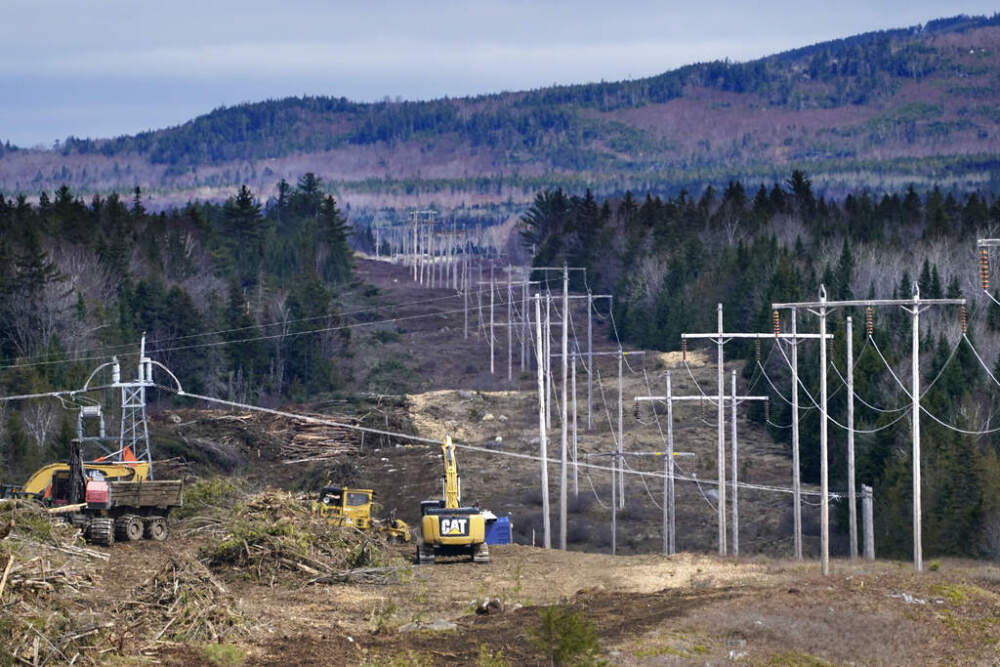
In a year marked by setbacks for Massachusetts' climate agenda, a rare bright spot emerged this week: The news that a long-delayed transmission line bringing carbon-free electricity from Canada to New England is expected to be up and running by the end of the year.
Avangrid, the developer of the New England Clean Energy Connect project, announced Wednesday that it got the final permit for the project from the Maine Department of Environmental Protection and should finish testing and commissioning next month.
Once online, the project will carry about 1,200 megawatts of electricity generated at Hydro Quebec into New England — approximately what's needed to power 1 million homes in the region.
"This achievement is the culmination of years of hard work, collaboration, and perseverance,” Avangrid CEO Jose Antonio Miranda said. “We have secured every permit, met every regulatory requirement, and overcome significant challenges because we believe we must address the urgent need for reliable energy at a time of rising demand. Today, we stand ready to deliver on that promise."
The transmission line is the product of a long-running effort to tap Canadian hydroelectric power. On paper, it looked like a simple way to access abundant clean energy in a region hungry for reliable non-fossil fuel supply. But in practice, the development process was anything but
Because Massachusetts does not border Canada, the state has been forced to rely on cooperation from neighbors. After New Hampshire rejected a proposed route in 2018, then-Gov. Charlie Baker turned to Maine, where Central Maine Power, an Avangrid subsidiary, proposed a 145-mile line that would snake from the Canadian border to an interconnection point in Lewiston.
What followed was a years-long political and legal brawl: conservation concerns, fights over the Appalachian Trail crossing, a statewide ballot question in Maine that temporarily halted construction and court battles over whether Avangrid had vested rights to resume the work. Even after a jury sided with the company in 2023, vegetation began to regrow in cleared areas, and construction costs ballooned.
Those delays have had real implications for Massachusetts, which will receive the bulk of the power.
This January, state regulators approved a settlement with Eversource, National Grid and Unitil, where the utilities agreed to pay $521 million more to cover a cost increase tied to the delays imposed by the 2021 referendum.
Utilities can pass the higher costs along to their ratepayers under a law Gov. Maura Healey signed in December 2023 that sponsors pitched as necessary to get the project back on track. In total, utilities may recover $1.4 billion over 20 years from ratepayers, the Portland Press Herald reported.
Still, regulators insist the long-term contracts remain cost-effective, citing $3 billion in net benefits for Massachusetts ratepayers. That translates into monthly bill reductions of roughly $1.50 for many households, per the DPU settlement from earlier this year.
Phelps Turner, a Maine-based lawyer with the Conservation Law Foundation, said the new transmission line will provide a much-needed source of power and "will lower electricity costs throughout the region, which is significant, given the current affordability crisis in New England."
The project "will also very likely reduce the need for gas power plants to run on cold winter days when gas is in short supply and expensive, thus saving customers money and reinforcing the lack of need for gas pipeline expansion in the region," he said
Healey, whose administration inherited the project after years of controversy, also celebrated the progress.
"It's great to see the NECEC line on track to finish construction by the end of this year," she said in a statement. "This transmission line will deliver affordable, stable power from our partners in Canada to our residents and businesses. More energy means lower costs."
Healey has cast her administration's strategy as an "all-of-the-above" approach.
At an investor conference in Boston this month, she emphasized the need for reliability and diversity: "Wind, solar, battery storage, energy efficiency — we’ve got hydro coming in from Canada later this year. We've still got gas," she said, noting her support for increased natural gas capacity coming into the state through the Algonquin Gas Transmission Pipeline.
Her comments underscore a growing sense among policymakers that the state cannot rely on clean energy alone — especially amid affordability concerns, federal uncertainty and regional grid constraints.
With offshore wind timelines slipping and solar deployment slowed by grid capacity issues, the infusion of Canadian hydropower represents one of the only major new clean-energy sources expected to reach Massachusetts in the near term.
The project also offers something offshore wind does not: firm, around-the-clock electricity. As the state works to reduce fossil fuel reliance in its energy mix, and as heating and transportation electrify, the demand for reliable, non-intermittent capacity is rising quickly.
If the final testing proceeds as promised, the hydropower flow could begin before the year ends — the end to a long road for Massachusetts ratepayers who have already spent hundreds of millions to secure it, and for policymakers struggling to keep the state’s climate goals on track.
Related:
- What's up with offshore wind in New England? Here's a map
- As Mass. pushes for big batteries on the grid, some communities push back
- Why a new gas pipeline into New England may (or may not) lower energy bills


No comments:
Post a Comment
Note: Only a member of this blog may post a comment.