Sunday, November 30, 2025
■ Today's Top News
The Israeli military claimed it had targeted two people who were conducting "suspicious activities," but the children's uncle said the 11- and eight-year-old had been gathering firewood for their father.
By Julia Conley
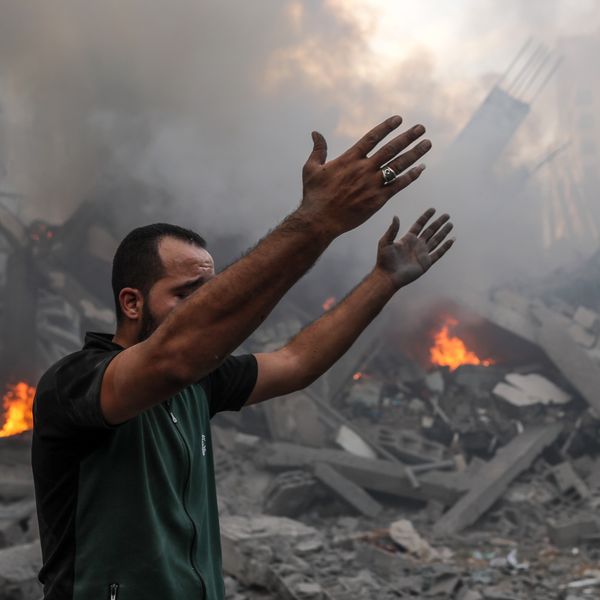
The Palestinian Health Ministry reported Saturday that nearly two months after Israel and Hamas reached a ceasefire agreement, the death toll in Israel’s war on Gaza has passed 70,000 as the Israel Defense Forces have continued to claim they are targeting only Hamas fighters—while killing civilians including two children who were gathering firewood for their father on Saturday.
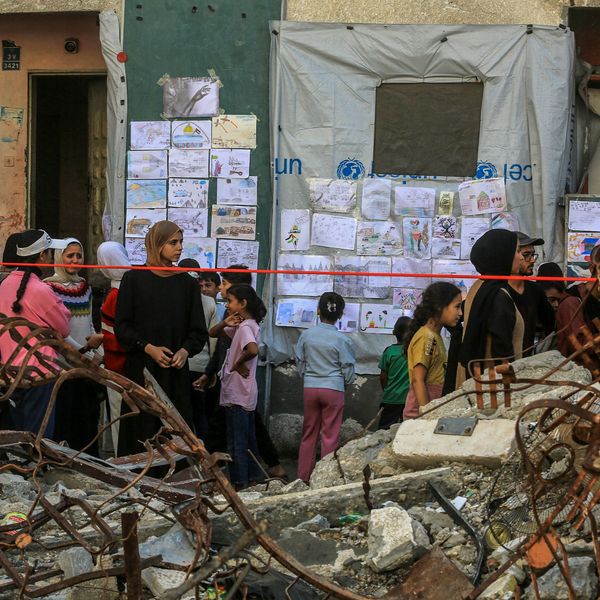
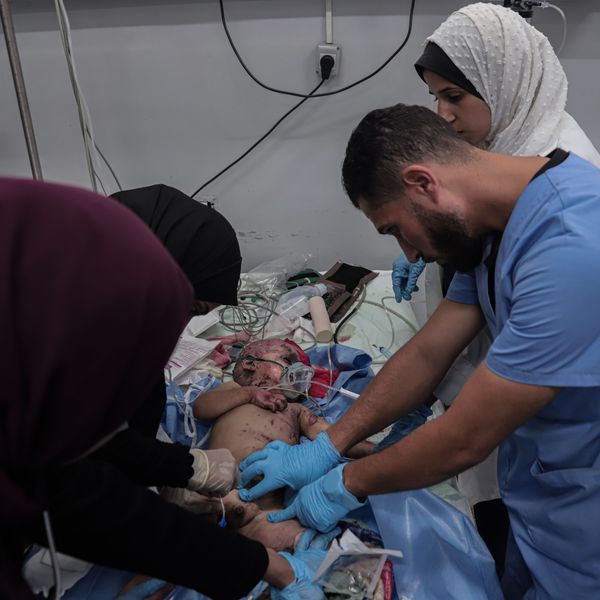
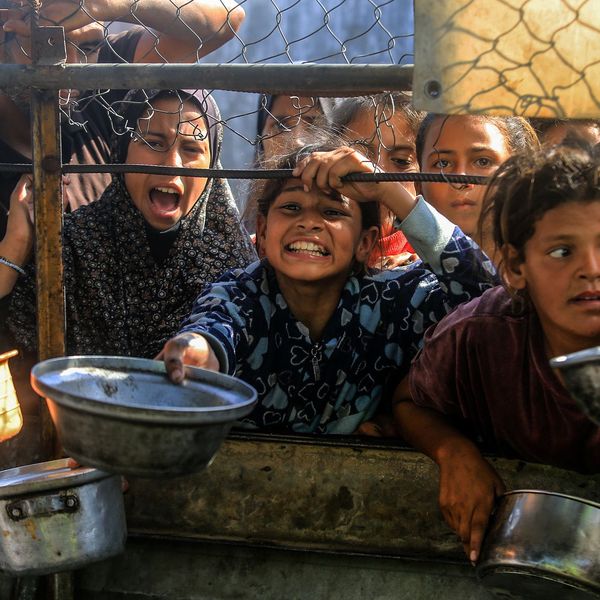
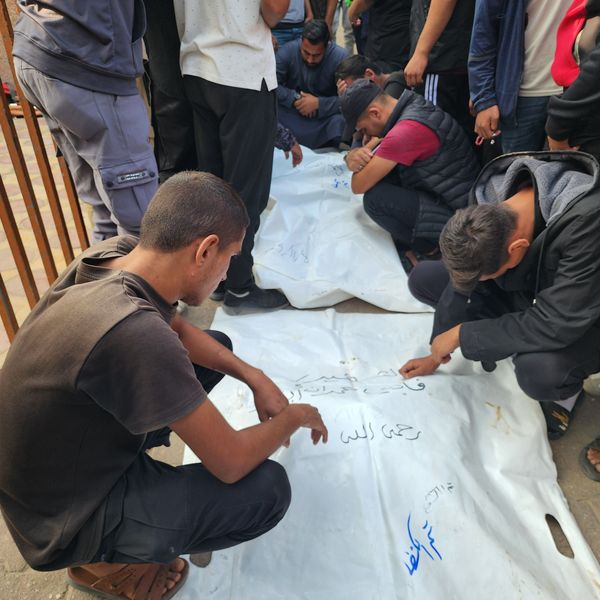
Fadi Abu Assi, 11, and Goma Abu Assi, eight, were close to a school sheltering displaced Palestinians near Beni Suhaila in southern Gaza when the IDF fired a drone in the area, killing both boys.
“They are children...what did they do? They do not have missiles or bombs, they went to gather wood for their father so he can start a fire,” the boys’ uncle, Mohamed Abu Assi, told Sky News.
Breaking the Silence, an IDF veterans’ group whose members speak out against Israel’s occupation of the Palestinian territories, condemned the military for a statement it released on the killing, which the group said amounted to “a pile of words meant only to keep justifying endless killing under insane and ruthless rules of engagement.”
The IDF told Sky News that troops had “identified two suspects who crossed the yellow line,” the point to which the IDF withdrew as part of the ceasefire deal in October.
The military said the two boys had “conducted suspicious activities on the ground, and approached IDF troops operating in the southern Gaza Strip, posing an immediate threat to them.”
The IDF claimed it identified the eight- and 11-year-old boys and “eliminated the suspects in order to remove the threat.”
Despite the ceasefire, said Kenneth Roth, former executive director of Human Rights Watch, “the Israeli military is still killing children.”
Drop Site News condemned the New York Times’ coverage of the boys’ killing, with the newspaper writing in a headline that “Gazans say” Fadi and Goma Abu Assi were killed by Israeli forces.
“The boys’ bodies, their ages, and their identities are fully documented—including videos of their lifeless shrouds and their wheelchair-bound father weeping over them—backed by eyewitness accounts and hospital confirmation,” said Drop Site.
The Times also reduced “the 350+ Palestinians killed since the October 10 ceasefire to ‘persistent violence,’” said the outlet.
The health ministry, whose statistics the World Health Organization and other international agencies have long viewed as credible, said 356 Palestinians have been killed by Israeli forces since the first phase of the truce began.
The Times’ framing, said Drop Site, “hides the truth that the violence is one-directional, systematic, and directed at civilians who pose no threat to Israelis.”
On Sunday, the outlet reported that the IDF was “boasting about breaking the ceasefire” as it announced troops had killed four Palestinian fighters as they emerged from underground tunnels in eastern Rafah.
“It remains unclear whether today’s casualties were fighters or civilians or children,” said Drop Site.
Hossam Badran, a member of Hamas’ political bureau, told Al Jazeera Sunday that the group is searching for the two remaining bodies of deceased Israeli captives, to be returned to Israel in accordance with the ceasefire deal, and accused Israeli officials of “using these bodies as a pretext to delay movement to the second phase of the ceasefire.”
"There is no such thing as a pardon request without an admission of guilt and without resignation," said one journalist. "This is a demand for the surrender of the rule of law in Israel."
By Julia Conley
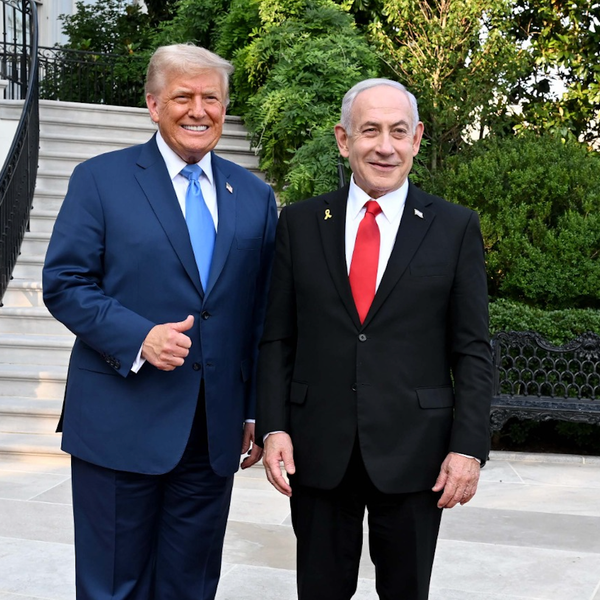
Weeks after President Donald Trump called for a pardon for his ally, Prime Minister Benjamin Netanyahu, the Israeli leader himself issued a formal plea to President Isaac Herzog and addressed the nation—claiming a pardon for allegations of bribery, fraud, and breach of trust, which he’s been on trial for since 2020, would be in the country’s best interest.
Netanyahu was indicted in 2019 in three separate corruption cases regarding allegations that he took more than $200,000 from wealthy businessmen in exchange for positive media coverage for himself and his family. He has denied wrongdoing in the cases.
The prime minister has also been accused by the International Criminal Court of war crimes and crimes against humanity in Gaza, where Israel has killed more than 70,000 Palestinians since October 2023, with the slaughter of civilians continuing despite a ceasefire deal that was reached in October. A New York Times report in July described how Netanyahu prolonged the war to maintain his political power. Netanyahu’s government also sought to fire the Israeli attorney general, who is prosecuting the prime minister’s case.
In his letter to Herzog, whose role is largely ceremonial but who has the authority to pardon convicted criminals, Netanyahu requested the pardon so that he can “devote his full time, abilities, and strengths to advance Israel in these critical times.”
“The continuation of the trial tears us apart from within, stirs up this division, and deepens rifts,” he added in his video address. “I am sure, like many others in the nation, that an immediate conclusion of the trial would greatly help to lower the flames and promote the broad reconciliation that our country so desperately needs.”
The request made clear that he has no intention of admitting wrongdoing or resigning from office—which critics including Israeli opposition leader Yair Lapid said must be a condition for any pardon.
“You cannot grant him a pardon without an admission of guilt, an expression of remorse, and an immediate retirement from political life,” said Lapid.
Israeli journalist Anshel Pfeffer, who authored a biography of Netanyahu, said the prime minister was “demanding immunity from prosecution” rather than asking for a pardon for a crime he’s convicted of.
“There is no such thing as a pardon request without an admission of guilt and without resignation,” said Pfeffer. “This is not a pardon request. This is a demand for the surrender of the rule of law in Israel.”
In the video address Netanyahu released, he suggested a pardon would be for the good of the nation and claimed that his “personal interest remains to continue the trial until the end.”
He also referenced Trump’s letter to Herzog, in which the president claimed he respected “the independence of the Israeli Justice System” but called the corruption cases a “political, unjustified prosecution.”
Herzog said Sunday that he would seek expert opinions on the request and would “responsibly and sincerely consider” a pardon, noting that it would have “significant implications.”
Emi Palmor, former director general of Israel’s Justice Ministry, told Al Jazeera that it is “impossible” for Netanyahu to halt his trial with a pardon request.
“You cannot claim that you’re innocent while the trial is going on and come to the president and ask him to intervene,” said Palmor.
In the US, Rep. Mark Pocan (D-Wisc.) said that should Herzog grant Netanyahu’s request, “it will be hard to consider [Israel] a law-abiding nation.”
“It would be a huge mistake,” said Pocan. “Real nations follow laws.”
Two Republican-controlled committees also said they were opening investigations into the defense secretary's alleged order to "kill everybody" aboard a boat in the Caribbean in September—the first of nearly two dozen strikes.
By Julia Conley
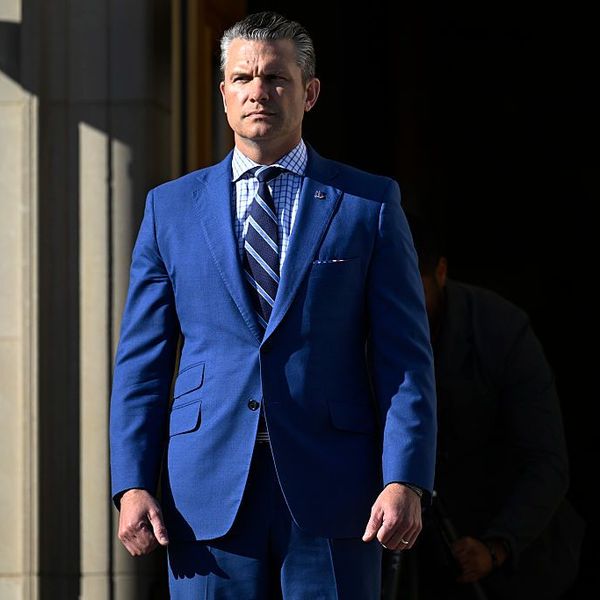
Former top military lawyers on Saturday said that new reporting on orders personally given by US Defense Secretary Pete Hegseth in early September, when the military struck the first of nearly two dozen boats in the Caribbean, suggests Hegseth has committed “war crimes, murder, or both.”
The Former Judge Advocates General (JAGs) Working Group, which includes former officials who served as legal advisers for the military, issued a statement in response to the Washington Post‘s reporting on the September 2 attack on a boat in the Caribbean—the first strike on a vessel in an ongoing operation that the Trump administration has claimed is aimed at stopping drug trafficking.
The Post reported for the first time on the directive Hegseth gave to Special Operations commanders as intelligence analysts reported that their surveillance had confirmed the 11 people aboard the boat were carrying drugs to the US—an alleged crime that, in the past and in accordance with international law, would have prompted US agencies to intercept the vessel, confiscate any illegal substances that were found, and arrest those on board.
But as the Trump administration began its boat bombing campaign, the order Hegseth gave “was to kill everybody,” one of the intelligence analysts told the Post.
After the first missile strike, the officials realized that two of the passengers had survived the blast—prompting a Special Operations commander to initiate a second strike to comply with Hegseth’s order.
The Former JAGs Working Group, which was established in February in response to Hegseth’s firing of Army and Air Force JAGs, said that the dismissal of the military’s top legal advisers set the stage for the defense secretary’s order and the continued bombing of boats in the Caribbean and the eastern Pacific, which have now killed more than 80 people.
Hegseth’s “systematic dismantling of the military’s legal guardrails” led to the formation of the working group, pointed out the former JAGs. “Had those guardrails been in place, we are confident they would have prevented these crimes.”
The working group said Hegseth’s order to “kill everybody” could be understood in one of two ways—a demand for the US military to carry out a clear war crime, or for those involved in the operation to commit murder:
If the US military operation to interdict and destroy suspected narcotrafficking vessels is a “non-international armed conflict,” as the Trump administration suggests, orders to “kill everybody,” which can reasonably be regarded as an order to give “no quarter,” and to “double-tap” a target in order to kill survivors, are clearly illegal under international law. In short, they are war crimes.
If the US military operation is not an armed conflict of any kind, these orders to kill helpless civilians clinging to the wreckage of a vessel our military destroyed would subject everyone from [the defense secretary] down to the individual who pulled the trigger to prosecution under US law for murder.
The Post‘s reporting comes less than two weeks after NBC News revealed that Senior Judge Advocate General (JAG) Paul Meagher, a Marine colonel at US Southern Command (SOUTHCOM) in Miami, had spoken out against the plans to begin bombing boats in the Caribbean, specifically warning in August that the operations would make service members liable for extrajudicial killing.
Following the Post‘s report, Republican-controlled House and Senate committees said they were investigating the allegations regarding Hegseth’s order, which the defense secretary dismissed on Friday as “fabricated, inflammatory, and derogatory reporting.”
Senate Armed Services Committee Chair Roger Wicker (R-Miss.), joined by Ranking Member Jack Reed (D-RI), said they had “directed inquiries to the Department [of Defense],” and would “be conducting vigorous oversight to determine the facts related to these circumstances.”
Reps. Mike Rogers (R-Ala.) and Adam Smith (D-Wash.), chair and ranking member of the House Armed Services Committee, released a similar statement.
The administration has never publicly released evidence that the dozens of people it’s killed in the Caribbean and eastern Pacific were drug traffickers. The Associated Press reported on the identities of some of the victims, finding among them an out-of-work bus driver and a fisherman who had agreed to help ferry narcotics—which led one policy expert to liken the boat-bombing operations to “straight-up massacring 16-year-old drug dealers on US street corners.”
President Donald Trump has told Congress—where lawmakers from both sides of the aisle have unsuccessfully sought to block further military action in the Caribbean and Venezuela—that the US is engaged in an “armed conflict” with drug cartels in the South American country. The Former JAGs Working Group suggested that Trump’s claims about the operation are immaterial considering Hegeth’s reported order for US officers to “kill everybody” on September 2.
“Regardless of whether the US is involved in an armed conflict, law enforcement operations, or any other application of military force, international and domestic US law prohibit the intentional targeting of defenseless persons,” said the former military lawyers. “If the Washington Post and CNN reports are true, the two survivors of the September, 2 2025 US attack against a vessel carrying 11 persons were rendered unable to continue their mission when US military forces significantly damaged the vessel carrying them. Under such circumstances, not only does international law prohibit targeting these survivors, but it also requires the attacking force to protect, rescue, and, if applicable, treat them as prisoners of war. Violations of these obligations are war crimes, murder, or both. There are no other options.”
The Joint Special Operations Command previously told the White House that the “double-tap” strike was necessary to sink the boat to avoid a “navigation hazard” to other vessels—a claim that Rep. Seth Moulton (D-Mass.), a Marine Corps veteran, called “patently absurd.”
“Mark my words: It may take some time, but Americans will be prosecuted for this, either as a war crime or outright murder,” Moulton told the Post.
Writer Ramez Naam said Saturday that Hegseth “telegraphed his intent to issue illegal orders the day he fired the JAGs,” when he told the press that the legal advisers had been dismissed to avoid “roadblocks to orders that are given by a commander in chief.”
The former JAGs called on Congress to investigate the new reporting on Hegseth’s order “and the American people to oppose any use of the US military that involves the intentional targeting of anyone—enemy combatants, non-combatants, or civilians—rendered hors de combat (”out of the fight“) as a result of their wounds or the destruction of the ship or aircraft carrying them.”
“We also advise our fellow citizens that orders like those described above are the kinds of ‘patently illegal orders’ all military members have a duty to disobey,” they said.
The reporting on Hegseth’s order came ahead of Trump’s latest escalation with Venezuela, with the president claiming he had ordered the airspace above and around the South American country closed—an action Venezuela’s government denounced as an “extravagant, illegal, and unjustified aggression” and a “colonialist threat.”
While the administration has repeatedly claimed its actions in Venezuela—including the boat strikes, an authorized CIA operation, and discussions about potential strikes inside the country—are aimed at dismantling drug trafficking operations there, US and international intelligence assessments have not pointed to Venezuela as a major source of drugs that enter the United States.
Meanwhile, Trump on Friday announced his plan to pardon former Honduran President Juan Orlando Hernández, who was convicted by a US jury of conspiring to traffic more than 400 tons of cocaine and who once said he wanted to “stuff the drugs right up the noses of the gringos.”
The president publicly stated in 2023 that had he won the 2020 election, he would have taken control of Venezuela’s oil reserves.
Sen. Chris Van Hollen (D-Md.) said the new reporting on Hegseth’s order made even clearer that the boat bombings have been “extrajudicial killings.”
“Hegseth needs to be held accountable,” said the senator. “What’s more, Trump promised the American people no new wars but is now manufacturing this conflict and lying about his motives. This warmongering has got to stop.”
A United Nations committee found Palestinian prisoners are regularly deprived of food and water and subjected to attacks by dogs, electrocution, and sexual abuse.
By Julia Conley
Reports of Israeli authorities torturing Palestinian prisoners have been publicized for years, with freed detainees describing frequent beatings, attacks by dogs, and rape and sexual abuse, and the United Nations Committee Against Torture now says Palestinians have been victimized by a “de facto state policy of organized and widespread torture.”
Both Palestinian and Israeli rights groups gave reports to the committee on conditions in Israeli detention centers, detailing Israel’s regular deprivation of food and water for detainees as well as the “severe beatings,” electrocution, waterboarding. and sexual violence Israeli guards and other authorities perpetrate.
A state policy of torturing prisoners constitutes the crime of genocide under international law, the committee said.
Peter Vedel Kessing, a member of the committee and a senior researcher at the Danish Institute for Human Rights, told the BBC the panel was “deeply appalled” by the accounts they heard, and expressed concern about the lack of investigations and prosecutions following allegations of torture.
The de facto policy of torture in Israel’s has “gravely intensified” since Israel began bombarding Gaza after a Hamas-led attack on October 7, 2023, the report found. Despite a ceasefire that was agreed to in October, those retaliatory attacks against the exclave are continuing and still constitute a genocide, Amnesty International said this week.
Friday’s UN report, said progressive Greek economist Yanis Varoufakis, provided the latest proof that “Israel’s insidious war crimes have not subsided just because Trump succeeded in convincing Western public opinion that the genocide in Gaza has paused.”
The UN committee found that at least 75 Palestinians have died in Israeli custody since the Gaza war began—an “abnormally high” death toll which “appears to have exclusively affected the Palestinian detainee population.”
“To date, no state officials have been held responsible or accountable for such deaths,” said the panel.
“Israel’s insidious war crimes have not subsided just because Trump succeeded in convincing Western public opinion that the genocide in Gaza has paused.”
The report comes nearly two weeks after the Israel-based rights group Physicians for Human Rights released an analysis showing that at least 98 Palestinian prisoners have died in Israeli custody since October 2023.
The UN committee noted that Israel’s use of “administrative detention,” in which roughly 3,474 Palestinians are currently being held without trial, has reached an “unprecedented” level in the last two years, with children among those who have been imprisoned without charges.
Child prisoners, some of whom are under the age of 12—despite 12 being the age of criminal responsibility in Israel—“have severe restrictions on family contact, may be held in solitary confinement, and do not have access to education, in violation of international standards,” the report says.
The report was released the same day the UN Human Rights Office accused Israeli soldiers of carrying out a “summary execution” of two Palestinian men who were seen with their hands up—indicating surrender—in the West Bank.
The committee emphasized its “serious concern” that Israel has no “distinct offense criminalizing torture, and that its legislation allows public officials to be exempted from criminal culpability under the so-called ‘necessity’ defense when unlawful physical pressure is applied during interrogations.”
The report was released days after Israel was one of just three countries—along with the US and Argentina—that voted against a UN General Assembly resolution against torture.
"Even if unenforced, Trump’s declaration functions as an improvised, extralegal no-fly zone created through fear, FAA warnings, and military pressure," said the anti-war group CodePink.
By Julia Conley
Policy experts and advocates on Saturday denounced President Donald Trump’s claim that he had ordered the airspace above and around Venezuela “to be closed in its entirety”—an authority the US president does not have but that one analyst said signaled a “scorched earth” policy in the South American country and that others warned could portend imminent airstrikes.
Francisco Rodriguez, a senior research fellow at the Center for Economic and Policy Research, said that after months of escalating tensions driven by Trump’s strikes on boats in the Caribbean and other aggressive actions, the US government was treating the Venezuelan people as “chess pieces.”
“A country subject to air isolation is a country where medicine and essential supplies cannot enter, and whose citizens cannot travel even for emergency reasons,” Rodriguez told Al Jazeera.
US strikes on vessels in the Caribbean and the eastern Pacific have killed at least 83 people since early September, with Defense Secretary Pete Hegseth reportedly ordering US military officers to “kill everybody” on board when he directed the first strike. The administration claims it is conducting the strikes to stop drug trafficking from Venezuela, though US and international intelligence has shown the South American country is not involved in trafficking fentanyl to the US and serves as only a transit hub—but not a major production center—of cocaine.
The Trump administration has claimed it is engaged in an “armed conflict” with Venezuela, though Congress has not authorized any such conflict. Lawmakers from both sides of the aisle have introduced war powers resolutions to stop Trump from conducting more attacks on boats and inside Venezuela, where the president has also authorized covert CIA operations and has threatened to launch strikes.
On Thursday, Trump said in a statement to US service members that the military could begin targeting suspected drug traffickers on land “very soon,” before claiming the country’s airspace was closed Saturday morning.
The US has also sent an aircraft carrier and 10,000 troops to the region in the largest US deployment to Latin America in decades.
The Federal Aviation Administration (FAA) last week urged civilian aircraft to “exercise caution” when flying over Venezuela due to the “worsening security situation and heightened military activity in or around” the country.
That warning led six airlines to suspend flights to Venezuela, which in turn prompted President Nicolás Maduro’s government to ban the companies, including Turkish Airlines, Spain’s Iberia, Portugal’s TAP, Colombia’s Avianca, Chile and Brazil’s LATAM, and Brazil’s GOL. Maduro accused the airlines of “joining the actions of state terrorism promoted by the United States government.”
The anti-war group CodePink said Trump’s claim about Venezuelan airspace represented “a dangerous escalation with no legal basis and enormous regional consequences.”
“The United States has no authority to close another country’s airspace,” said the group. “Under international law, only Venezuela can determine the status of its skies and enforcing a foreign no-fly zone without UN authorization or host-state consent would constitute an act of war. Even if unenforced, Trump’s declaration functions as an improvised, extralegal no-fly zone created through fear, FAA warnings, and military pressure.”
Trump’s actions in Venezuela in recent weeks—which come two years after the president explicitly said he wanted to take control of the country’s vast oil reserves—“form a familiar pattern,” said CodePink.
“Manufacture a crisis, then paint a sovereign government as a danger to US interests, and finally use the manufactured urgency to justify military measures that would otherwise be politically impossible,” said the group. “Trying to ‘close’ the airspace of another country is an act of aggression. It risks flight disruptions, economic panic, and aviation accidents. It is also an attempt to isolate Venezuela without admitting that the US is imposing a de facto blockade. The people of Venezuela have lived with the consequences of Washington’s reckless interventions. They deserve peace, not another manufactured war.”
“Diplomacy, not domination, remains the only path that respects international law and regional sovereignty,” added CodePink. “Hands off Venezuela. Hands off Latin America.”
Charles Samuel Shapiro, a former US ambassador to Venezuela, emphasized that Trump’s latest move in what he claims is a battle against drug trafficking came a day after he announced a pardon for right-wing former Honduran President Juan Orlando Hernández, who was convicted of working with drug traffickers.
“The whole drug trafficking thing is simply a pretext,” Shapiro told Al Jazeera. “If you look at the US government’s own reports, drugs coming into the United States from Venezuela are minimal, so declaring these people to be ‘narcoterrorists’—it makes no sense.”
The president backed a right-wing candidate as he announced a pardon for former President Juan Orlando Hernández—despite his involvement with drug trafficking, which Trump claims he's fighting in Latin America.
By Julia Conley
The US Congressional Progressive Caucus on Friday accused President Donald Trump of “flagrantly interfering” in Honduras’ upcoming presidential election after Trump announced his endorsement of right-wing candidate Nasry “Tito” Asfura and repeated threats he’s made previously ahead of other electoral contests in which he sought to secure a conservative win.
On the social media platform X, Trump warned that only a victory for former Tegucigalpa Mayor Asfura and the National Party in Sunday’s election will allow Honduras and the US to “fight the Narcocommunists, and bring needed aid to the people” of the Central American country.
He accused Asfura’s opponents—former finance and defense minister Rixi Moncada of the left-wing Liberty and Refoundation (Libre) Party, which is now in power, and sportscaster Salvador Nasralla of the centrist Liberal Party—of being communists and said Nasralla is running as a spoiler in order to split the vote and weaken Asfura. He added that a loss for the right-wing candidate would allow Venezuelan President Nicolás Maduro “and his Narcoterrorists [to] take over another country like they have taken over Cuba, Nicaragua, and Venezuela.”
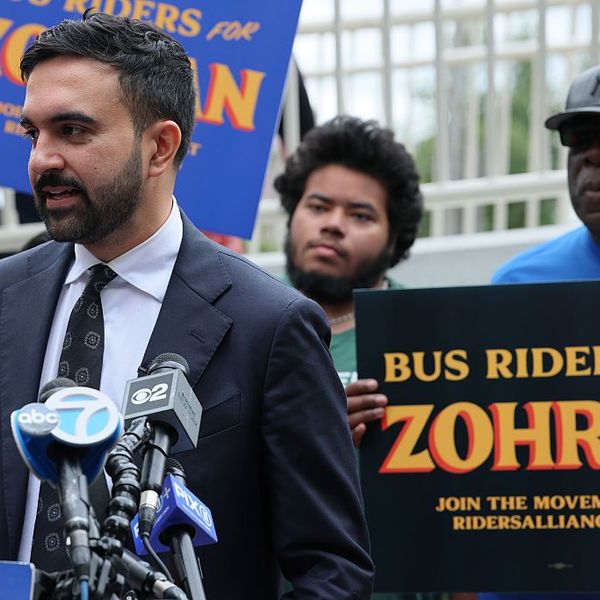
The president also wrote on his social media platform, Truth Social, that “if [Asfura] doesn’t win, the US will not be throwing good money after bad,” repeating a comment he made during New York City’s mayoral election in which he urged voters to reject progressive candidate Zohran Mamdani or risk losing federal aid for the city. Trump also offered Argentina a $40 billion bailout if voters elected his ally, Javier Milei, earlier this year.
Under President Xiomara Castro, the Libre Party’s government has invested in hospitals and education, and has made strides in halting the privatization of the country’s electricity system, Drop Site News reported. The poverty rate has also been reduced by about 13% since Castro took office in 2021, although, as the outlet reported, some rights advocates have criticized Castro’s government for keeping “many of her predecessor’s militarized policies in place, despite her commitment to implement a more community-minded strategy.”
Trump added in his social media post that he was issuing a pardon to former Honduran President Juan Orlando Hernández, who represented the National Party and is currently serving a 45-year prison sentence in the US after being convicted of working with drug traffickers who paid bribes to ensure more than 400 tons of cocaine were sent to the US. The pardon was announced as Trump continues his threats against Venezuela, which he has accused of trafficking drugs to the US.
CPC Deputy Chair Ilhan Omar (D-Minn.) and Whip Jesús “Chuy” García (D-Ill.) called Trump’s “smearing” of Asfura’s opponents “completely unacceptable,” and noted that the president has been joined by other congressional Republicans in making “wild, unsubstantiated allegations” regarding Honduras’ election—including Rep. María Elvira Salazar (R-Fla.), who voiced “support for a military coup.”
Salazar said recently that “16 years ago, the military saved its country from communism and today, they need to do the same thing,” referring to the US-backed overthrow of democratically-elected President Manuel Zelaya.
“These Cold War-era threats and blatant interventions create hostile conditions for free and fair elections and must stop immediately,” said Omar and García. “We also cannot tolerate premature declarations by prominent US politicians regarding the election results before ballots are fully counted. Attempts to delegitimize the vote based on who wins could be disastrous in light of the harmful history of US interference in modern Honduran politics.”
The two progressive leaders were echoing concerns brought up by Honduran Vice Foreign Minister Gerardo Torres, who spoke at a gathering of left-wing leaders on Thursday in Tegucigalpa.
Torres warned that the Electoral Council could claim Nasry is winning “with an irreversible trend” before the actual winner of the wide-open race is clear on Sunday.
“Even Trump could congratulate him—and that’s when real trouble will erupt in this country,” said Torres.
The chaos that could result could lead election officials to “nullify the elections and hold new ones in six months, leaving Libre weakened and allowing the right to win,” reported El País. Torres posited that this is the National Party’s “strategy.”
“The right wing cannot win on Sunday; that needs to be clear and repeated ad nauseam,” Torres said, urging advocates to promote Moncada’s candidacy on social media and help mobilize voters to get to the polls early.
Omar and García noted that after Honduras’ 2017 election, the Trump administration endorsed Hernández’s reelection “despite evidence of fraud and the killing by his security forces of Hondurans who protested the results.”
More than 20 people were killed in the aftermath of the disputed 2017 election
The two progressive leaders said that “Sunday’s elections are taking place at a critical moment, as the country aims to elect and transfer political power to a new leader for the first time outside of the context of the repressive post-coup regimes that persisted from 2009 to 2021.”
“At a time of global democratic fragility, we must move beyond US bullying and political interference in Honduras’s sovereign affairs. We need a relationship based on mutual respect, including respect for the will of Honduran voters,” said Omar and García.
Torres expressed hope that Trump’s backing of Asfura will have the opposite effect that the US president intended, saying Trump’s comments on social media were “a blow to the right; it hurts one of their candidates.”
“If there was anyone who didn’t know there were elections in Honduras this Sunday, now everyone knows,” said Torres. “There are even people who went to look at a map to see where Honduras is and find out who Rixi Moncada is... It puts us in an important position, which creates a wonderful scenario, because Rixi’s victory will be more famous and important. We have no doubt about her victory.”
Torres added that many conservative voters in Honduras are likely to reject the party formerly led by Hernández.
“These are right-wing people who opposed the narcostate, who stood with us in 2015 against [Hernández’s] embezzlement of social security, and who know what those criminals are,” he said, referring to previous governments. “Trump can tweet all day and those people aren’t going to vote for the return of the conservatives.”
José Mario López of the Jesuit Reflection, Research, and Communication Team in Honduras also told Drop Site News that the “red scare” tactics that the National and Liberal parties have joined Trump in using in the final weeks of the election are likely to have some sway with older people, but are “not expected to impact younger voters.”
“It’s a discourse that doesn’t really land, in my view,” López told the outlet. “I think what can move votes is the economic issue, because historically one of the main problems identified in public opinion polls is unemployment and lack of economic opportunities.”



















No comments:
Post a Comment
Note: Only a member of this blog may post a comment.