
10 September 25

$1-a-Day Jobs and the Logic of the New Immigrant Crackdown
 In Florida, lawmakers recently rolled back labor protections to allow children as young as fourteen to work overnight on school nights. (photo: Getty)
Immigration raids and detention aren’t just political theater — they supply corporations with cheap, captive labor and help roll back protections for all workers. Behind the language of border security lies coerced labor that echoes the convict lease era.
On Inauguration Day 2025, the new administration wasted no time in declaring war on an imagined “invasion,” dispatching Immigration and Customs Enforcement (ICE) agents to conduct raids in communities around the country. By late July, arrests of immigrants had increased by 200–400 percent. The rhetoric of invasion has served to brand many immigrants as criminals for committing the act, still only a federal misdemeanor, of crossing without papers. Further, the passage of the One Big Beautiful Bill this summer allots $165 billion to the Department of Homeland Security (DHS) over the next decade, funding a dramatic expansion of ICE into what amounts to a domestic army.
The question is whether these massive public expenditures on the war against immigrants help the economy. In short: no, they do not.
Agricultural industries, long reliant on immigrant labor, are facing the worst labor shortages in over a decade. The food service industry — with its low wages, lack of benefits, and poor job security — has struggled with hiring since the COVID-19 pandemic, and conditions have not improved in the last eight months.
Sending Kids to Work in the Sunshine State
In August, tariff wars resulted in the lowest employment levels in the manufacturing sector in half a decade. Manufacturing, food service, and other industries report strain caused by the departure of valued workers who have lost their ability to work legally because of the cancellation of programs like humanitarian parole and temporary protected status.
The war against immigrants has not improved the US economy. What it has done is open the door to labor practices long deemed unconstitutional and illegal, like child labor and forced labor. In Florida, for example, lawmakers recently rolled back labor protections to allow children as young as fourteen to work overnight on school nights. While child labor is not uncommon, particularly in the agricultural sector populated almost entirely by immigrant workers, laws like Florida’s generalize this exploitative practice to all workers. Florida’s agriculture sector, already strained by immigration crackdowns, stands to benefit from the new law, which expands the pool of workers who can legally be put to work in the fields.
Meanwhile, the expansion of immigration detention has become a boon for private prison corporations like the GEO Group, Palantir, and CoreCivic, which profit from rising incarceration. These corporations have quietly settled lawsuits over coerced labor in detention centers — cases courts have found violate the Trafficking Victims Protection Act. Forced labor is repugnant, yet it is being normalized through detention practices that compel immigrants to work under threat of punishment.
Detention, Coercion, Corporate Profit
In late June, 2025, ICE reported a record number of people in detention: 60,000, most with no criminal record at all. Ironically, even as DHS secretary Kristi Noem denounces human trafficking as a problem perpetrated by immigrants and declares that “forced labor is repulsive” with respect to China, she is working to expand DHS’s “voluntary work plan.” In practice, the program forces immigrants in detention to work, sometimes with no pay at all, and oftentimes under threat of solitary confinement if they don’t comply.
As Grace Hussain explains it, “The private businesses that overwhelmingly run the [detention] centers are choosing to take advantage of their captive populations in order to avoid paying higher wages to citizens.” The model is not unique to the United States. In El Salvador, Nayib Bukele’s flagship prison, the “Terrorism Confinement Center” (CECOT), enforces a “Zero Idleness Program” that compels inmates to perform agricultural and factory work as well as maintain the prison itself. The US has deported immigrants guilty of no crimes except being in the country without papers to this prison.
The legal basis for coerced prison labor lies in the Thirteenth Amendment to the US Constitution, which abolished slavery “except as a punishment for crime whereof the party shall have been duly convicted.” This exception created a loophole, exploited initially in the former Confederacy to fill the labor vacuum left by emancipation. Under the convict lease system, incarcerated people, predominantly but not entirely African American, were rented out to employers, generating revenue for the state and local governments that oversaw the prisons. “Criminal hunters” often pursued minor crimes such as unpaid tickets to supply this labor. The system endured through World War II, helping to build municipal infrastructure and private fortunes throughout the South.
The Thirteenth Amendment has since been used to justify prison labor more broadly, a practice that continues today. More than four thousand US companies currently rely on prison labor in their supply chains.
Forgetting the Past, Exploiting the Present
Ironically, while the Trump administration expands coerced labor, it is fueling efforts to reshape how the history of such labor is remembered. Trump has complained that institutions like the Smithsonian dwell too much on negative features of American history, including slavery and racial violence.
At the same time, conservative education projects such as PragerU and Prager UKids produce content criticized for downplaying the brutality of slavery — including scenes where a cartoon Christopher Columbus suggests “being taken as a slave is better than being killed. ” Although these accounts contradict seventy-five years of historical scholarship, they are now being shoved down the throats of K-12 students in several states, including Florida students just coming off an overnight shift.
Trump’s attack on education and public memory clears space for practices once thought confined to the past. As the immigration detention system expands with federal investment, the record profits netted by private prison concerns are just the beginning of a bonanza for corporate capital. These firms profit twice over: by collecting government funds for each occupied bed and by subcontracting the labors of detainees, who are paid little or nothing.
The war against immigrants is really a war against all workers — inside and outside the proliferating prison and detention gulags. Coerced labor drives down wages and undermines fair labor standards. Immigrants never “took” American jobs, but the resurgence of forced labor does threaten the rights and livelihoods of everyone.
Sudan’s People Tortured and Killed in ‘Slaughterhouses,’ Rights Probe Says
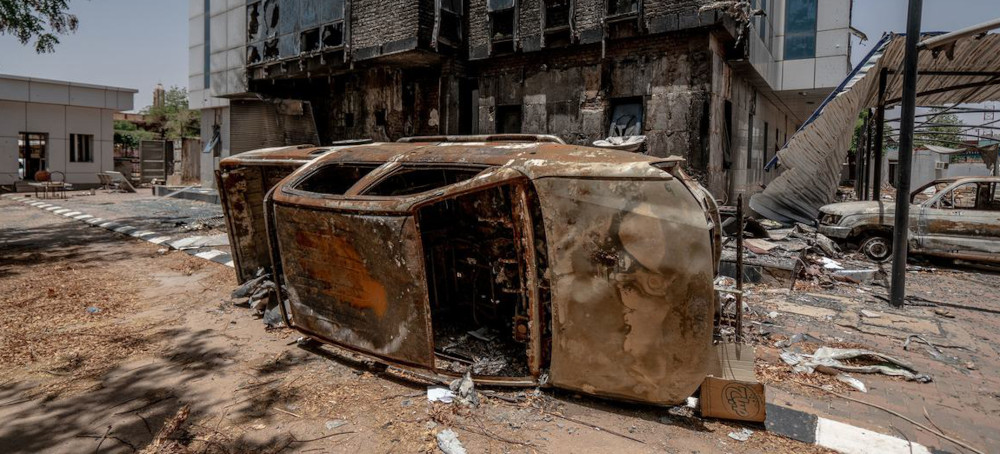 An upturned vehicle lies in front of a building in the Sudanese capital, Khartoum. (photo: Avaaz)
A high-level independent rights probe into the brutal war in Sudan condemned the many grave crimes committed by all combatants, citing evidence indicating that civilians have been “deliberately targeted, displaced and starved”.
Among the testimonies gathered for the report, survivors from RSF detention sites described the locations as “slaughterhouses”.
Tortured, staved, denied medical care
In one notorious RSF facility, dozens of detainees have died since June after being tortured, denied food and medical care, the independent rights expert said.
Equally, in SAF-run detention facilities, “civilians were also subjected to torture, including electric shock, sexualized abuse and they were held in cells so overcrowded that some prisoners had to sleep standing,” he added.
In addition, girls as young as 12 were forced into marriage, “sometimes under the threat of death to their families”, the fact-finding mission chair continued.
“Men and boys were also subjected to sexualized torture and such acts are rooted in racism, prejudice and impunity and they devastate entire communities.”
Highlighting the lack of diplomatic solutions to the conflict which began in April 2023, and its massive impact of the war on civilians, report co-author Mona Rishmawi insisted that “everybody knows you cannot rape, you cannot loot, you cannot destroy property. You cannot starve people…But if there is no accountability, of course they will continue doing it.”
Extermination goal
Asked why the report had decided not to describe what has been happening in Sudan as genocide, Ms. Rishmawi replied that the evidence “basically looks at more or less the same kind of violations as genocide”.
She added: “You kill, [you provide] no food, no water, you don't allow food production. You don't allow access to food, to markets…and you don't allow access to humanitarian aid. What you do want is to kill the population…So, the effect of this is really the crime against humanity…of extermination.”
Hunger crisis
The investigative body created by the Human Rights Council in October 2023 highlighted the devastating humanitarian emergency that has resulted from the war.
“In displacement camps such Zamzam and Abu Shouk, witnesses describe children dying of hunger and dehydration in the streets, including people eating animal food,” said Joy Ngozi Ezeilo, Expert Member of the Fact-Finding Mission.
Addressing the council earlier, fact-finding mission chair Mr. Othman insisted that the war was “destroying not only lives but also the means of survival”, with hospitals, markets, water and electricity systems – and even humanitarian convoys - systematically attacked.
“Markets, the backbone of food access, have been repeatedly bombed,” he said, adding that in October 2024, SAF airstrikes on El Koma market killed at least 45 civilians.
Dying of thirst
“Two months later, Kabkabiya market was struck, killing more than 100. In March this year, SAF bombed Tora market during peak hours, killing and injuring hundreds.”
The mission report underscored how the RSF had also shelled markets, pillaged entire areas and destroyed Zamzam camp’s market.
RSF drone strikes hit the Merowe Dam and water towers, leaving communities without drinking water, while “one mother told us she lost all four of her children to thirst while fleeing”, said Mr. Othman, who like the other members of the panel is an independent human rights expert and not a UN staff member.
 A worker drinks water from a botijo, a Spanish traditional earthenware drinking jug, to fight the heat in the midst of a heat wave in Madrid on Aug. 9, 2023. (photo: Getty)
Scientists say such source attribution could help power litigation aimed at holding the fossil fuel industry accountable for damages from heat waves and other extreme weather linked to climate change.
A study published Wednesday in the journal Nature finds that these emissions from the so-called carbon majors contributed to about half of the increase in intensity of heat waves compared to the preindustrial era. They have also contributed to significant increases in the likelihood of extreme heat events, including some that would have been virtually impossible without climate change.
Led by researchers at the university ETH Zurich in Switzerland, the study examined the influence of climate change on over 200 heat waves around the globe from 2000 to 2023. It also looked at how the carbon majors contributed to these heat waves, finding that they played a significant role in their occurrence.
The latter analysis involves what is known as source attribution. In climate research, that means attributing global warming and its impacts to specific emissions sources. Researchers calculate the carbon emissions attributable to the carbon majors using data on company operations and sold products and associated emissions factors for carbon dioxide and methane. Those emissions figures are then used in climate models (comparing scenarios with and without observed warming) to analyze how the emitting companies contributed to increased warming.
Scientists are also able to pinpoint the influence of human-caused climate change on specific extreme weather events. This study combines those two approaches. It is one of the first to systematically analyze the impact that emissions from specific companies have had on multiple extreme weather events, in this case extreme heat, over a particular time period.
Researchers say their results are especially relevant for informing climate accountability initiatives such as litigation and that the study helps fill an evidentiary gap that may assist in establishing legal responsibility for climate harms.
“We can expect this research will be quite relevant in a legal context,” Sonia Seneviratne, head of the Institute for Atmospheric and Climate Science at ETH Zurich, told Inside Climate News.
The study employed peer-reviewed research methods that scientists use to examine the role that human-caused climate change played in amplifying individual extreme weather events, known as extreme event attribution. But rather than focus on a singular event, the researchers analyzed 213 heat waves reported in the international disaster database EM-DAT.
“That helps us gain a more robust perspective on this link between climate change and heat waves,” Yann Quilcaille, a postdoctoral researcher at ETH Zurich and study lead author, explained.
Using observed changes in global mean surface temperature, the researchers used statistical assessments and modeling to link global warming to increasing intensity and frequency of heat waves. Their results show that climate change has made the heat waves both hotter and much more likely to occur.
According to the study, “the median estimates for the changes in intensity range across events from +0.3 °C to +2.9 °C,” with the higher figure in that range applicable to the 2021 Pacific Northwest heat dome. In the years 2020 to 2023, heat wave intensity increased by over 2°C (median estimates) due to climate change. In terms of probability, climate change has made heat waves about 20 times more likely between 2000 and 2009, and 200 times more likely between 2010 and 2019, compared to the preindustrial era.
Researchers then extended the analysis to quantify the contributions of the carbon majors to these 213 heat waves. Collectively, these fossil fuel and cement producers are responsible for the majority of anthropogenic CO2 equivalent emissions from 1850 to 2023. Previous source attribution climate research has found that about half of the Earth’s surface warming and approximately one-third of the rise in sea levels can be traced to the emissions of the carbon majors.
The new study demonstrates that these emissions have also contributed to the increasing intensity and probability of heat waves.
“We already have observations for what is the temperature of the planet and how it evolves over time,” Quilcaille explained. “Then we assess what would be the difference if we were to remove emissions from individual carbon majors. That difference goes into the statistical model to deduce the change in probability and intensity, and thus the contribution of the carbon major, to the heat wave.”
Specifically, emissions from the carbon majors are responsible for about half of the roughly 1.7 degrees Celsius increase in intensity over the period 2010 to 2019 that can be attributed to climate change. The top 14 carbon majors contributed to about 28 percent of that increase, while the other 166 entities contributed to 22 percent of it. “These results show that the emissions of carbon majors contributed to about half of the increase in intensity of heat waves since preindustrial times, and that this contribution is rising,” the study states.
Carbon majors are also making heat waves more likely to occur, the research suggests. “Depending on the carbon major, their individual contribution is high enough to enable the occurrence of 16–53 heat waves that would have been virtually impossible in a preindustrial climate,” the study explains. Even the emissions from the smallest carbon major contributed to more than a dozen heat waves that would have been virtually impossible absent climate change.
“While the 14 largest carbon majors have contributed the most to the occurrence of heat waves, the contributions of smaller players also play a significant role,” Quilcaille said.
The results are broadly consistent with another study published earlier this year in Nature, which went even further in quantifying economic damages resulting from intensifying heat waves that are linked to the emissions of the carbon majors. That study suggested that 111 carbon majors are responsible for $28 trillion in global economic losses stemming from extreme heat over the period 1991 to 2020.
“We show that emissions traceable to carbon majors have increased heat wave intensity globally, causing quantifiable income losses for people in subnational regions around the world,” the study, authored by researchers Christopher Callahan and Justin Mankin, states.
Mankin said the results of the new study by Quilcaille and colleagues are not surprising. “If you have made contributions to emissions, you have made contributions to extreme heat,” he told Inside Climate News. “But empirically showing that, as we did and now these authors have done, is crucial.”
Callahan agreed that the new study adds value as it, along with other studies, can strengthen the evidence base that informs discussions around corporate climate liability.
“It is only over the last few years that this emitter-specific attribution, or ‘source attribution’, has been performed, and the new paper is a very important contribution to that effort,” Callahan said. “Together, these research efforts are building a credible and consensus-based body of work that provides scientific support for climate accountability.”
Litigation is already underway in the United States attempting to hold carbon majors such as ExxonMobil, Chevron, and Shell liable for climate damages and alleged deception. Two of the lawsuits focus specifically on harms from the 2021 Pacific Northwest heat dome, which resulted in hundreds of deaths and billions of dollars in damage.
In 2023, Oregon’s Multnomah County brought a lawsuit against major fossil fuel companies as well as several of their trade associations and the consulting firm McKinsey … Company, seeking to recover over $50 billion in damage and adaptation costs. And on May 29 this year, the family of a woman in Washington State who died during the heat dome filed a first-of-its-kind wrongful death case against ExxonMobil and several other large oil companies.
Quilcaille said it is clear that climate change, and the emissions of large carbon emitters, played a substantial role in this extreme heat event. “Climate change had a very strong influence on the Pacific Northwest heat wave,” he told Inside Climate News. “Not all carbon majors made that heat wave possible. But the big ones, yes. And each one of them substantially contributed to its probability and intensity.”
Beyond the relevance of this research for legal proceedings, Quilcaille said that it could also have broader significance in informing policies around climate and energy. “This work is just one more reminder for decisionmakers that we need to phase out fossil fuels as soon as possible,” he said.
PO Box 2043 / Citrus Heights, CA 95611


No comments:
Post a Comment
Note: Only a member of this blog may post a comment.