
24 September 25

'Hugo himself would have been in awe of yesterday’s performance.' (photo: AFP)
"The article below is satire. Andy Borowitz is an American comedian and New York Times-bestselling author who satirizes the news for his column, 'The Borowitz Report'."
“In 2006, when Chávez referred to George W. Bush as the Devil and said, ‘This rostrum still smells like sulfur,’ most of us thought his record for making the most crazy-ass UN speech would stand for generations,” Guinness spokesperson Harland Dorrinson said. “We never saw this coming.”
In an official statement, the Hugo Chávez Memorial Society, based in Caracas, was philosophical about the Venezuelan’s wackadoodle utterances being bested by a new champion.
“Hugo himself would have been in awe of yesterday’s performance,” the statement read. “He said a lot of bonkers shit back in 2006, but he never exploded with rage about an escalator.”
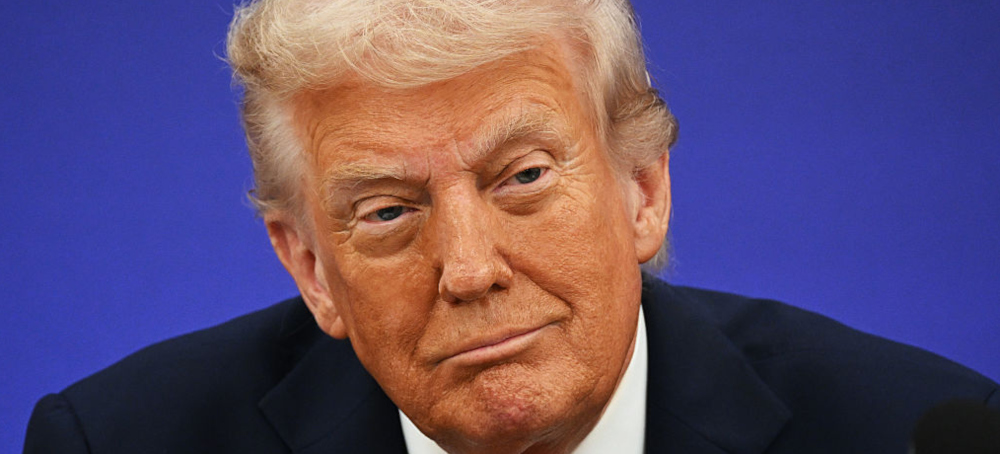
Donald Trump is amassing more and more tools of repression, and he is not afraid to use them.
The Renzino ambush became a crux of fascist propaganda. Mussolini’s Il Popolo d’Italia raged against a “ferocious ambush” executed by “cowards.” La Nazione, a Tuscan daily, described an “explosion of the most brutal forms of hatred,” with peasants “in a sort of competition to see who could act in the cruelest way.” In revenge, squadristi went on an arson and murder spree across Tuscany. Among the arrests were 107 anti-fascists and no fascists. Indeed, the non-fascist victims of those bloody days were ignored and remain ignored by today’s fascist successor parties.
The events after Renzino are worth conjuring now not because the unimaginative muse of history is prone to repetition. Clio knows better. But neither should we assume that history the second time will be farce, not tragedy again. This snapshot of blood-dappled Tuscany offers a reminder of how the Left can become a main victim of violence allegedly conducted in its own name. Those events don’t elucidate the specific tools available now to empty political space. Between times and places, the technologies of repression are mobile.
In the second Donald Trump presidency, the state’s tool kit has been evolving fast. It is dangerous complacency to assume that modes of suppression cannot change, even — as in the Italy of 1921 — shifting gears rapidly in mere weeks and months. So how might we characterize the state’s new left-oriented suppression?
To begin with, the national state is refining new, indirect ways of wielding repressive power. The American state has long shaped mainstream media, but the Federal Communications Commission chair’s recent naked flex of censorious power against a regime critic — even one as mild as Jimmy Kimmel — is new in its boldness. An increasing concentration of both old- and new-media venues in the safe hands of allies such as Larry Ellison will make such crass interventions unnecessary soon.
Media outlets are not the only instruments of narrow hegemonic power. Among its first acts, the new presidency pardoned some 1,500 people involved in the January 6 antidemocratic insurrection at the US Capitol, including Enrique Tarrio, former head of the Proud Boys, and Stewart Rhodes, head of the Oath Keepers. Such wide-ranging mercy — far beyond what seems to have been anticipated even by Trump’s allies — creates a ready reservoir of parastatal force. This can be tapped by the president with the implicit promise of immunity from later criminal prosecution.
New formal tools of repressive state power are no less significant. On the one hand, Trump has renewed his rumination about designating an elusive “antifa” as a terrorist organization under federal law, while his deputy has attacked the Nation magazine. Such designation would trigger an immediate asset freeze and criminalize aid to those entities as “material support.” The standard view is that the government lacks power to designate domestic entities or publications this way.
Yet this view holds excessive confidence in the limits imposed by existing law. In April 2003, the second Bush administration designated a Muslim charity, incorporated in California and then Texas, as a “Specially Designated Global Terrorist.” (The statute at issue, the International Emergency Economic Powers Act, is the same one stretched beyond breaking to accommodate Trump’s April 2025 global tariffs.) The designation was upheld against a due process challenge on the ground that the charity had received thirty-one days to review information allegedly linking it to Hamas. Notably, a court upheld the designation not simply on the information shared with the charity but also on the basis of “classified information presented to the court in camera” but withheld from the charity.
Under present law, then, a domestically incorporated entity can be frozen into oblivion on the basis of evidence of alleged links to overseas groups that it is not permitted to view. In an era in which many left groups and publications engage with non-US causes and campaigns, it is not hard to see how this power could be applied to devastating effect.
The mechanics of these organizational prosecutions will also interact with the administration’s aggressive use of the 1798 Alien Enemies Act against alleged members of the Venezuelan Tren de Aragua gang. While a circuit court deflected this designation as a basis for deportation for now, that case seems likely to be heard by the US Supreme Court. That body has bent an already-presidentialist body of constitutional law even further toward a posture of judicial abnegation. Once “transnational” gangs are deemed appropriate objects of designation, legal boundaries upon the reach of designation dissolve even further.
Designation involves an indirect use of state coercion. Upping the stakes, the Trump administration has called on military troops in Los Angeles, Washington, and soon in Memphis (if not Chicago or Baltimore, at least for now). Despite nostalgic sentimentality about the American revolutionaries’ opposition to militarization of la patrie, actual legal constraints on presidential weaponization of the military against domestic foes are fragile. They are found in a complex web of statutes, many of which have obscure and uncertain meanings.
To date, the administration has federalized national guard troops in response to immigration-related protests but has not deployed them against protests generally. But it has shown strategic savvy in the precedents it is creating. By drawing on troops from politically aligned states, for example, the White House avoids legal impediments that can be thrown up by blue-state governors.
Legal challenges to that deployment initially failed, with the Ninth Circuit Court of Appeals signaling a retreat from any serious scrutiny of the president’s initial justification for taking control of the guard. Subsequently, one district court held that some of the specific activities undertaken by the guard exceeded prohibitions found in the Posse Comitatus Act. Whether that opinion stands up on appeal is doubtful: the Supreme Court, after all, has already blessed racialized immigration raids in that city.
The present set of targeted deployments, in short, might be understood as a testing ground for mechanisms of deployment and as a means of generating favorable judicial precedent. Both open the gates, the next go around, to more nakedly suppressive uses of state violence.
If all this already seems concerning, let me add one more terrifying thought, though it is, for the moment, a more distant possibility: Three times this month, the US military has attacked boats allegedly used by Tren de Aragua for drug smuggling, killing those aboard. This is the first time the military has been directed against noncombatants in many decades (although certainly not the first civilian causalities from US military projection). Its putative legality rested, at least in part, on the notion that Tren de Aragua is a designated organization.
Consider then how these pieces fit together: An unbounded designation authority; the authority to use the military in US cities; and the claim that the military is allowed to kill civilians if the president designates an organization of which they might be a member. The terms of US coercive power, legal or otherwise, against its domestic foes are on the move.
Family of Former DACA Recipient Who Died in ICE Custody Says Officials Ignored His Pleas for Help
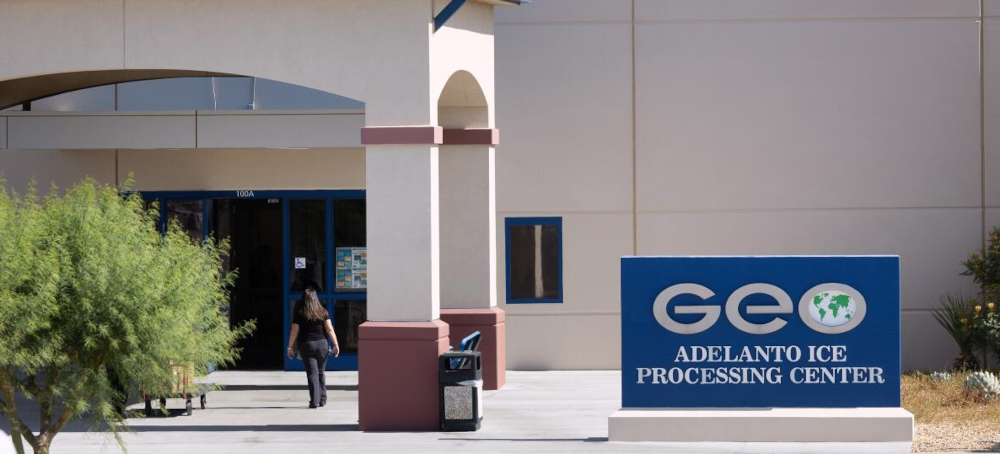 A former DACA recipient, Ismael Ayala-Uribe, 39, died on Sunday after being held at an Immigration and Customs Enforcement facility in Adelanto. (photo: Los Angeles Times)
Ismael Ayala-Uribe, 39, was pronounced dead Sunday at Victor Valley Global Medical Center, according to a statement from U.S. Immigration and Customs Enforcement.
Ayala-Uribe had received protection from deportation under the Deferred Action for Childhood Arrivals program in 2012, but his application for renewal was denied four years later.
He is the 14th person to die in immigration detention since January, when federal immigration officials began to carry out President Trump's mass deportation agenda.
“I'm angry, sad,” said Ayala-Uribe's younger brother, Jose. “My parents are pretty much broken.”
Jose, 31, said that officers from the Huntington Beach Police Department knocked on the door of his family’s home in Westminster Monday morning and informed them that his brother had died.
“They had him at the coroner's already,” Jose said.
Ayala-Uribe was arrested by Border Patrol agents on Aug. 17 during a raid at the Fountain Valley Auto Wash, where he had worked for about 15 years.
“One day they just decided to show up and take whoever was there," Jose said. "I don't feel it's right.”
On Aug. 22, Ayala-Uribe was transferred to the Adelanto detention center in San Bernardino County.
According to ICE, federal officials declined to renew Ayala-Uribe's DACA protection, which is granted to some immigrants who came to the U.S. as children, after he was convicted the year before of driving while under the influence.
Jose said that Ismael came to the U.S. from Mexico when he was about 4 years old, grew up in Orange County and went to Westminster High School.
Ismael had been pretty healthy, Jose said, with blood pressure on the high side but, as far as he knew, no other medical problems.
But not long after Ismael arrived at Adelanto, Jose said, he got sick.
“It started small with the cough, and then he started getting fevers,” Jose said. “They only were giving him, like, Tylenol and really, nothing else.”
As Ismael’s health declined, the family kept checking on his status. ICE, he said, did not keep them informed.
“They wouldn't tell us anything,” Jose said. “Eventually, we just got the word that he was in their infirmary, and that's all they would tell us. ICE wouldn't give us any other information.”
On Saturday, Ismael's parents visited him at Adelanto.
“He was telling them that he was sick, he wasn't feeling well,” Jose said. “He's tried asking for help, but they wouldn't really do anything.”
When Ismael was taken to an infirmary, he said, ICE did not inform the family. A fellow detainee called them at midnight.
“He called my mom and dad," Jose said, "saying that he started shaking really bad, and he was finally sent into the infirmary because they called the guards.”
On Sunday, they heard nothing. And on Monday came the knock on their door from local police.
Federal officials could not immediately be reached to respond to the family's allegations.
News of Ayala-Uribe's death comes amid intense scrutiny of immigration facilities as the Trump administration ramps up deportations.
On Tuesday, two Democratic senators from Georgia sent a letter to Homeland Security Secretary Kristi Noem and Todd Lyons, the acting director of U.S. Immigration and Customs Enforcement, raising concerns about the rise in deaths in ICE custody, in particular two that occurred at the Stewart Detention Center in Georgia. NPR was the first to report on the letter.
In July, Sen. Jon Ossoff (D-Ga.) released the findings of a probe into allegations of human rights violations at immigration detention centers, including dozens of reports of physical and sexual abuse, as well as mistreatment of pregnant women and children. The Department of Homeland Security rejected the senator's allegations in a statement.
In California, the Adelanto detention center, one of the largest in the state, has long been the focus of complaints from detainees, attorneys and state and federal inspectors about inadequate medical care, overly restrictive segregation and lax mental health services.
In June, critics — including some staffers who work inside — told The Times that conditions were unsafe and unsanitary. The facility, they said, was unprepared to handle the large waves of detainees pouring into the center.
That month, U.S. Rep. Judy Chu (D-Monterey Park), toured the detention center with four other Democratic members of Congress from California amid concern over the increasing number of detainees and deteriorating conditions inside.
The facility’s manager “has to clearly improve its treatment of these detainees,” Chu said at a news conference after inspecting the facility.
Some of the detainees told lawmakers that they were held inside Adelanto for 10 days without a change of clothes, underwear or towels, Chu said. Others said they had been denied access to a telephone to speak to loved ones and lawyers, even after repeatedly filling out forms.
A spokesperson for Homeland Security could not immediately be reached for comment on Ayala-Uribe's death. But the agency said in a statement that federal immigration agencies are committed to ensuring the safety of people who are in their custody.
"Comprehensive medical care is provided from the moment individuals arrive and throughout the entirety of their stay," the agency's statement read. "All people in ICE custody receive medical, dental and mental health intake screening within 12 hours of arriving at each detention facility, a full health assessment within 14 days of entering ICE custody or arrival at a facility, access to medical appointments and 24-hour emergency care. At no time during detention is a detained illegal alien denied emergent care."
ICE said in a news release that on Sept. 18, Ayala-Uribe was seen by an on-call medical provider, who prescribed medication for him.
According to internal emails written by a GEO intake lieutenant and obtained by The Times, an officer at Adelanto initiated a code blue medical emergency alert Thursday at 2:06 p.m. due to Ismael "shaking and complaining of pain in his rear."
"Responding officers and medical arrived carefully escorting detainee from the 2nd level floor down to a wheel chair and be escorted to medical where he will be medical assessed with a further evaluation," the email said.
About one hour and 29 minutes later, at 3:45 p.m., GEO medical staff cleared Ayala-Uribe to return to his unit.
"If it was due to an abcess," an Adelanto staffer not authorized to speak to the media told The Times, "it is not normal he was not sent out to the hospital for that."
Three days later, Ayala-Uribe was sent to the Victor Valley Global Medical Center to further evaluate an "abscess on his buttock" and was scheduled to undergo surgery for it, the statement said.
"Ayala was also hypertensive and displayed abnormal tachycardia," immigration officials wrote in the statement. "At 1:48 a.m. the [medical center] declared Ayala unresponsive and initiated lifesaving measures. He was declared deceased at 2:32 a.m. by medical staff."
The Inland Coalition for Immigrant Justice, a collective of more than 35 organizations serving the immigrant community across the Inland Empire, called for a full and independent report into Ayala-Uribe's death.
"The public and their family deserve the truth," the group said in a statement.
"This for-profit detention center has a long record of abuse, neglect, and inadequate medical care leading to preventable suffering and deaths," the coalition added. "No one should profit from immigrant incarceration, and no family should endure loss due to neglect."
According to ICE, after Ayala-Uribe's DACA renewal was denied, he was convicted of his second DUI in June 2019 and sentenced to 120 days in jail, plus five years probation.
The Inland Coalition for Immigrant Justice condemned ICE for publicizing Ayala-Uribe's DUI convictions.
"We reject ICE’s continued attempts to dehumanize immigrants by portraying them as disposable, pointing to past DUI convictions as if they negate a person’s right to live," the coalition said.
Immigration officials said Ayala-Uribe's cause of death is still under investigation. ICE is required to make public reports regarding in-custody deaths within 90 days.
ICE officials said they make official notifications to Congress, stakeholders and the media about a detainee's death and post a news release with relevant details on its website within two business days.
Ayala-Uribe's family has organized a Saturday fundraiser, selling tamales, carnitas and pozole to raise money for his funeral.
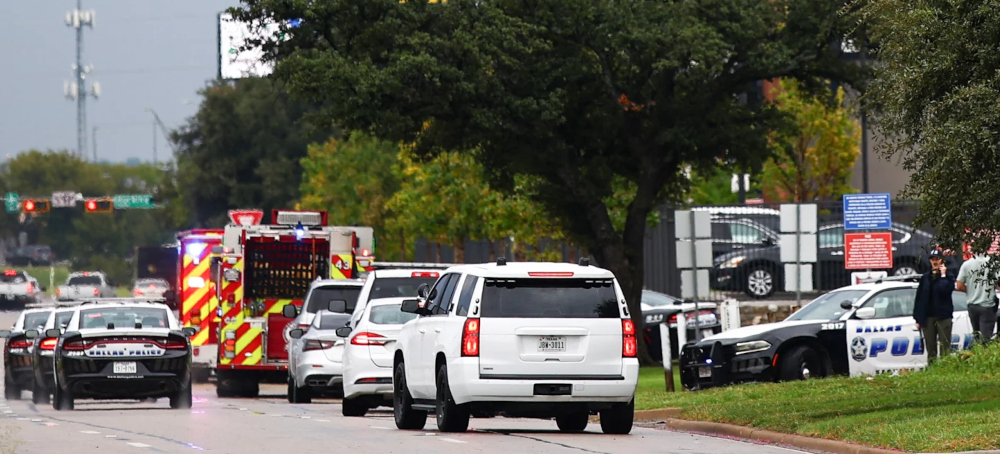
The Department of Homeland Security said a gunman fired at the ICE building "indiscriminately" and at a "van in the sallyport where the victims" were hit. Two detainees were killed and a third was hospitalized. Authorities say the suspect died of a "a self-inflicted gun shot wound."
The agency released two images showing a bullet hole in an exterior window of the Dallas facility and another in an interior display housing the American flag. DHS described the shooting as "an attack on ICE law enforcement."
Speaking during a news conference with politicians and authorities, Joe Rothrock, the FBI special agent in Dallas, said "early evidence" suggests the suspected shooter was "anti-ICE in nature," due to writings found on bullet casings near the gunman.
On X, FBI Director Kash Patel posted a picture of five unspent bullet casings with one engraved with the words, "ANTI ICE." Patel's post said, "These despicable, politically motivated attacks against law enforcement are not a one-off. We are only miles from Prarieland Texas where just two months ago an individual ambushed a separate ICE facility targeting their officers."
Texas Gov. Greg Abbott said the attack would not change his state's strict immigration crackdown. "We will not let this cowardly attack impede our efforts to secure the border, enforce immigration law, and ensure law and order," Abbott said in a statement.
Rothrock said no members of law enforcement were hurt during this attack. During the news conference, officials provided few details into the circumstances into the shooting. In an earlier statement, Department of Homeland Security Secretary DOG KILLER Kristi Noem said, "ICE law enforcement is facing unprecedented violence against them. It must stop."
Dallas Mayor Eric Johnson pleaded for people to be patient as the investigation continues. "Let's remain calm and let our law enforcement partners, our police department do their job," he said. "This is an active investigation. There are still a lot of unanswered questions."
Several officials, including Texas Sen. Ted Cruz, said "politically motivated violence" needs to stop. "Your opponents are not Nazis," Cruz said. "Divisive rhetoric has real consequences."
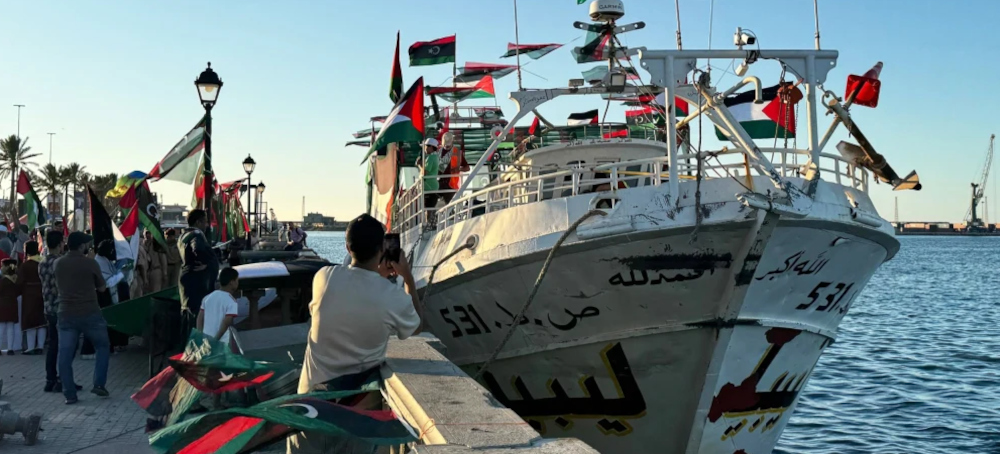 The ship Omar al-Mukhtar, a part of Global Sumud Flotilla, prepares to leave Tripoli, Libya, earlier this month. (photo: Anadolu)
“We are witnessing these psychological operations first-hand, right now, but we will not be intimidated,” Global Sumud Flotilla said in a statement.
Global Sumud Flotilla (GSF) which was sailing near Greece as of early Wednesday, according its online tracker, also saw its communications “jammed,” its organizers said in a statement.
“We are witnessing these psychological operations first-hand, right now, but we will not be intimidated,” they added. “Sumud” in Arabic means “steadfastness” or “steadfast perseverance.”
In an online video shared by GSF overnight, a bright light can be seen piercing the darkness, before a loud blast rings out. Organizers said that the video was filmed from one of its boats, Spectre, and that it captured one of the explosions heard by crew members.
In a separate video posted by Yasemin Acar on the vessel Alma, music from the pop group ABBA, whose members, like Thunberg hail from Sweden, can be heard ringing out. “They’re jamming our radio,” Acar says in the post, adding, “We do not know where this is coming from, the sound, but other vessels are experiencing the same thing.”
Thunberg told Reuters in a video interview Tuesday that drones were flying above them every night “but for Palestinians, especially in Gaza, those drones are dropping bombs constantly.”
“This mission is about Gaza, it isn’t about us. And no risks that we could take could even come close to the risks the Palestinians are facing every day,” she said.
Italian Defense Minister Guido Crosetto condemned the incident Wednesday, saying he had directed a navy ship to offer assistance, Reuters reported.
GSF did not immediately respond to a request for further comment from NBC News. Israel’s military and a spokesperson for Prime Minister Benjamin Netanyahu’s office also did not immediately respond to NBC News’ requests for comment Wednesday.
But the Israeli Foreign Ministry condemned the flotilla Monday. Without providing any evidence, Oren Marmorstein, a spokesperson for the ministry, said in a statement on X that the flotilla was “organized by Hamas” and “intended to serve Hamas.”
He added that Israel would not allow the flotilla to “enter an active combat zone and will not allow the breach of a lawful naval blockade.”
Marmorstein also called for the flotilla to dock at Israel’s Ashkelon Marina and unload aid there for it to be transferred to Gaza.
But GSF has argued that Israel is violating international law in its deadly offensive in Gaza, rendering the country’s blockade illegal.
The flotilla, which is carrying more than 500 people from more than 40 countries, set sail from Barcelona late last month in a bid to “break the illegal siege of Gaza.”
Earlier this month, GSF said that two of its boats had been attacked by drones while stationed in Tunisia.
The Tunisian Interior Ministry said at the time that reports of a drone hitting a boat at its Sidi Bou Said port had “no basis in truth,” and that a fire broke out on the vessel itself, according to Reuters.
The latest accusations come as Israeli forces continue their devastating assault on Gaza City that has seen scores killed in recent days and forced the displacement of hundreds of thousands of people. Deaths from starvation have also continued to rise in the enclave this month, according to Palestinian health officials.
Israel launched its offensive in Gaza following the Hamas-led attacks in 2023, when 1,200 people were killed and around 250 were taken hostage, according to Israeli officials, marking a major escalation in a decadeslong conflict. Since then, Palestinian health officials say, more than 65,000 people have been killed in Gaza, including thousands of children, while much of the enclave has been reduced to rubble.
This week, Tom Barrack, the U.S. special envoy to Syria and ambassador to Turkey, accused Israel of “attacking everybody,” in an interview with The National, the state-owned English-language daily newspaper based in the United Arab Emirates.
He named Syria and Lebanon among those attacked, as well as Tunisia, in an apparent reference to the alleged attack on the aid flotilla.
“Personally, I hate what’s happened in Gaza on all sides,” Barrack told the newspaper “For the Palestinians, for the Israelis, for the Jordanians, for the Lebanese, for the Syrians, for the Turks. You know … it’s a mess.”
“Israel is a valued ally,” Barrack said. “We subsidize them" by $4 billion to $5 billion a year. "It has a special place in America’s heart, and we’re living with the confusion of what’s happening in this transition.”
“So it’s complicated,” he added.
Trump Raised $8 Million for Hurricane Helene Survivors. Where Did It All Go?
Katie Myers, Grist
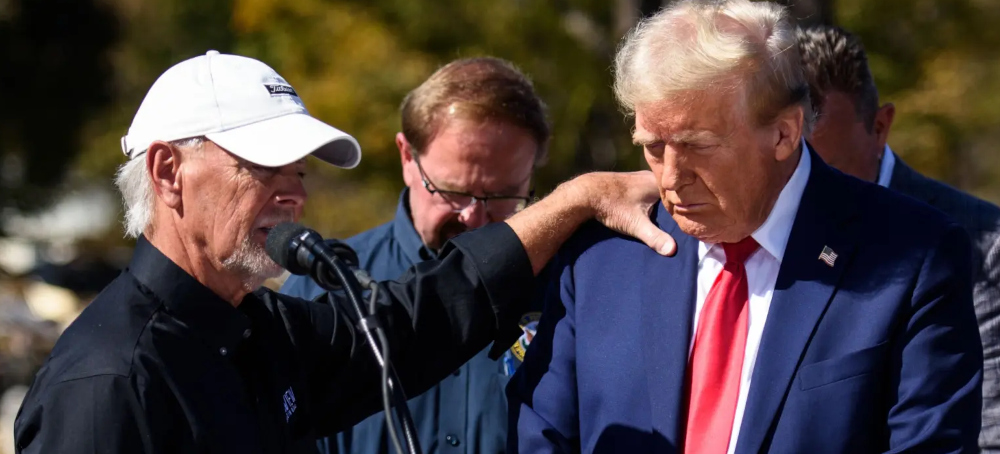 Donald Trump is prayed over by a local business owner in Swannanoa, North Carolina, during a visit to see the devastation of Hurricane Helene on October 21, 2024. (photo: Getty)
The presidential campaign bad-mouthed FEMA while using crowdfunding to donate to evangelical nonprofits.
“In the wake of this horrible storm, many Americans in this region felt helpless and abandoned, and left behind by their government,” Trump, still a presidential candidate at the time, said. “And yet in North Carolina’s hour of desperation, the American people answer the call much more so than your federal government.”
Trump was present to, among other things, deliver an update on a GoFundMe set up by his presidential campaign for those impacted by Helene. In three short weeks, the drive had raised $7.7 million from the pockets of ordinary Americans, prominent Republican political operatives, and some of the country’s most influential and wealthiest families.
“My prayers and encouragement goes out to all the victims,” one donor commented on the fundraiser’s public wall roughly a year ago. “I hope you know that we all love you.”
It wasn’t until a few days after money had begun to come in that the crowdfunding effort announced where the contributions were going: Mtn2Sea Ministries, Water Mission, Samaritan’s Purse, and the Clinch Foundation. On October 21, an additional recipient, Sweetwater Mission, was added. Four of the five organizations are faith-based Christian charities. Most of them have close ties to Trump or to prominent supporters of his.
Though political candidates have used GoFundMe to cover campaign costs, campaign finance and philanthropy experts told The Associated Press in October that a presidential candidate had never before used the platform in this way.
GoFundMe has become a central artery of immediate relief for disaster survivors. It raised $130 million in the wake of Helene, and hundreds of millions more for other disasters this year alone. But for all the good it does, critics have long lamented its layers of financial opaqueness. As a private platform, GoFundMe is not subject to public records requests. Anyone can set up a fundraiser, and although the site has an accountability team and lets users flag fraud, scams still happen — including those exploiting disaster victims. The platform has exploded in popularity and raised $30 billion since 2010, with significant growth in the last five years. Still, its lack of a more specific annual fundraising breakdown has prompted calls for further data transparency. The nonprofit’s annual report breaks down how much was raised for individuals and nonprofits, total number of donors, and average donation amounts, among other statistics. It also highlights certain large fundraising moments, such as Helene. But it doesn’t break down total donations by category, nor does it discuss how many campaigns hit their targets or delivered on their promises.
GoFundMe isn’t the only crowdfunding platform out there, either. There’s Kickstarter, Indiegogo, Fundable, Donorbox, and others, though many work better for small businesses and nonprofits; GoFundMe was ranked by one site as the best for personal fundraisers. Other charities and funding organizations support specific populations, like Baby2Baby, which allows donors to give to parents with young infants, or Direct Relief, which provides medical aid.
A year after Helene, what exactly Trump’s GoFundMe campaign paid for remains unclear. Grist reached out to the recipient organizations asking how much they received, and how it was spent. Several responded to an initial email and offered vague explanations, but none except Mtn2Sea Ministries responded to follow-ups for a more specific breakdown of related expenditures.
Mtn2Sea Ministries, based in St. Simon’s Island, Georgia, publicly announced and provided Grist a clear breakdown of its portion of the funds, which it used to buy $25,000 in gift cards for rural communities in Clinch County.
North Carolina-based Samaritan’s Purse received $5.2 million, which its representatives said went toward Helene aid but did not elaborate when asked. South Carolina-based Water Mission would not say how much it received, though it has published updates on its website about its work supporting communities after Helene. Sweetwater Mission, located near Atlanta, did not respond at all to the request. Grist could find no record of a “Clinch Foundation,” as the GoFundMe page called it, though it could be referring to the Clinch Memorial Foundation, in Homerville, Georgia. That group did not respond to Grist’s request for comment. GoFundMe also refused to clarify or confirm.
Trump has repeatedly used Helene as a political signal over the past year: It is time to overhaul American disaster relief, he has argued, by shrinking the role of the federal government in preparedness and recovery. If that vision comes to pass, GoFundMe and private entities like these evangelical nonprofits may play a larger role in disaster recovery, making the pathways of disaster aid harder than ever to track. Some historians and philanthropy experts warn it also may make such work — while potentially more expansive — less equitable in terms of who receives help.
Some of the recipients appear to have friendly relationships with Trump, Trump’s political supporters, or prominent Republicans. The GoFundMe campaign’s top donor is Kelly Loeffler, a former U.S. senator from Georgia, who joined Women for Trump at a Sweetwater Mission donation event in the wake of Helene. Trump later named Loeffler to lead the Small Business Administration. She did not respond to a request for comment about her $500,000 donation. The board of Water Mission, a clean water charity, is studded with prominent Christian business owners, some of whom are large Republican donors (for instance, a member of the Cathy family, which owns the restaurant chain Chick-Fil-A).
The crowdfunding campaign’s biggest recipient, Samaritan’s Purse, is run by Franklin Graham, son of famed evangelical leader Billy Graham and a strong, if complex, Trump ally. Graham traveled with Trump to survey storm damage in Georgia last September, less than a week after Helene. He then delivered the invocation at Trump’s inauguration ceremony in January, celebrating the election results with the words, “Look what God has done. We praise him and give him glory.” Four days later, he accompanied Trump on another visit to Swannanoa.
Darren Grem is a historian at the University of Mississippi who studies the ties between the political right, the business world, and American evangelism. To him, the relationships underpinning the GoFundMe campaign reflect a deep-seated political ethic that ties conservative evangelical leaders and right-wing politics together when disaster strikes. “The goal is assuaging suffering to save individuals, not fix systems,” Grem said. In the short term, disaster response is quick and expansive, with faith-based organizations fanning across disaster-impacted regions to repair homes, replace cars, and deliver truckloads of donations. In many cases, faith-based disaster relief groups coordinate with local churches, which serve as ready-made response hubs.
Humanitarian disaster aid is key to the missions of the organizations that received the GoFundMe donations — and all contributed to the recovery after Helene. If the Clinch Foundation is indeed associated with Clinch Memorial Hospital, that organization fed and housed Helene survivors. Mtn2Sea’s aid benefited some of Georgia’s hardest-hit communities. Water Mission provided water purification packets and large containers of potable water to recipients like Asheville City Schools and a church in Vilas, North Carolina (neither responded to requests for comment).
“As a Christian nonprofit organization, we believe we are called by God to serve others, and we remain steadfast in this mission, committed to carrying it out with love, excellence, and integrity while maintaining political neutrality,” Water Mission told Grist by email.
Samaritan’s Purse spokesperson Mark Barber said its $5.2 million share went into the $90-million pot the organization spent on Helene. The group, based in Boone, North Carolina, has embedded itself deeply in hurricane response and has by its own count built about 300 homes and distributed 163 campers. It has also replaced over 200 vehicles, provided household items to more than 2,700 people, and again, by its count, saved 173 souls.
Grist contacted several Helene survivors who were helped by Samaritan’s Purse, but only one responded. This person declined an interview, noting that while she disagreed with the nonprofit’s conservative values, it was building her a home and she didn’t want to upset anyone.
Grist also reached out to Meredith O’Rourke, who served as the national finance director for Trump’s presidential campaign and who set up the GoFundMe, to ask why it chose these charities. She did not respond. We also contacted the fundraiser’s top donors — Ultimate Fighting Championship President and CEO Dana White, billionaire real estate investors and Trump megadonors Steve and Andrea Wynn, New York real estate investor and current Trump Middle East envoy Steve Witkoff — to ask if they had heard how the funds were spent, and why they chose to donate to the GoFundMe rather than, or in addition to, tax-deductible charities. None responded.
But the choices aren’t mysterious to experts who’ve studied the ongoing relationship between the far right and evangelical philanthropy. Both favor smaller government and individual giving over tax-based public relief, said Alison Greene, a religious historian at Emory University.
Before the sweeping economic, social, and political reforms of Franklin Delano Roosevelt’s New Deal, which were created to dig the United States out of the Great Depression, three-quarters of disaster relief went through private charities, most of which were faith-based, she said.
“Private aid organizations were really concerned with separating the deserving poor from the undeserving poor,” Greene, who is from Helene-impacted Mitchell County, North Carolina, said. The Great Depression cut so massive a swath of misery that support for federal relief ballooned. Some faith leaders and right-wing politicians opposed that, and continue to. Billy Graham, father of Samaritan’s Purse, was outspokenly among them, as are his descendants.
“Folks like Franklin Graham,” Greene added, “have this narrative that the state destroyed the work of the church.”
Despite Graham’s opposition to state disaster relief funding, his organization has received hundreds of millions of dollars from USAID and the State Department since 2016. The future of this federal funding — about 5 percent of the organization’s budget — remains uncertain, however, after USAID was more or less dismantled.
Grem, of the University of Mississippi, said the faith-based relief community’s alliance with Republican political actors has continued to advantage all involved.
“Evangelicals perfected the art of that deal long before anyone considered Donald Trump a viable political means or end,” Grem said.
First Amendment protections allow religious groups to sidestep federal oversight. Sometimes, Grem said, that’s a strength. “Such groups can quickly mobilize to provide immediate aid,” he said. Evangelical organizations also appear more culturally familiar to some of the communities they serve, and their speed is appealing to disaster survivors who just want a return to normalcy.
Without external checks and requirements, though, “they may misjudge local needs, duplicate efforts, or overlook or short-hop services,” Grem added. “The very same shortcomings often get criticized in bureaucracies like FEMA.” Long-term planning doesn’t really factor in, Grem added. Unlike the Federal Emergency Management Agency, religious charities’ work focuses on immediate needs and rebuilding houses, not long-term disaster risk and mitigation.
Though FEMA can be picky in disbursing aid, it must abide by federal civil rights law; private charities do not. Samaritan’s Purse and other religious charities have publicly opposed gay marriage and abortion. So have members of the Cathy family, who sit on the boards of many similar charities. It’s led some Helene victims to worry they might face differential treatment or judgment, or avoid seeking aid from such groups. Renters and undocumented immigrants are chronically overlooked by both public and private relief efforts.
To top it off, cash flow can be tricky in ministry groups — and things get more complicated with unusual circumstances like this GoFundMe. Warren Cole Smith, who directs the Christian aid transparency watchdog Ministry Watch, supports evangelical disaster relief but worries about the potential for financial mismanagement a GoFundMe presents.
“There are many ways to evade transparency and accountability,” he said, adding that some groups avoid filing required 990 tax forms by registering as a church even when they don’t operate like one. While Samaritan’s Purse is a disaster relief group that Smith trusts, a linked group, the Billy Graham Evangelistic Association, is registered as a church. Franklin Graham runs both organizations, which often deploy together into humanitarian missions.
“We think using a GoFundMe campaign in this way is not a good idea,” Smith said. “If President Trump had simply recommended these organizations, that way the organizations themselves would be direct recipients of the money … [and] individual donors could make up their own minds about which campaigns to support.”
GoFundMe, for its part, told Grist that the fundraising campaign was verified by its trust-and-safety team, a process that requires drives to “be clear who the organizer is, as well as the person, business, or charity they are raising funds for, the organizer’s relationship to the recipient of the funds, and how the funds will be used,” the organization said. If the team feels information is missing, they put the fundraiser on hold.
Since then, FEMA, though diminished, continues to make a point of opening grant opportunities to faith-based organizations and knocking down political barriers to religious influence.
The Helene campaign is closed, but some previously scheduled monthly donations continued to roll in as of July, and new donors were contributing in May. It is unclear where this new money is going, given that the last official spending update came 11 months ago. GoFundMe representatives assured Grist that the funds have all been distributed to the listed recipients.
Among the donors with messages of support was western North Carolina resident Stacie Johnson, who gave the GoFundMe $5, begging the campaign to notice her family’s plight — her father had lost his home and had no flood insurance. The same day Trump’s drive launched, on September 30, 2024, she had started a campaign for her father. But while Trump’s GoFundMe coffers grew, Johnson’s fundraiser brought in only an eighth of what her family needed. Johnson did not respond to a request for comment.
“I am curious when this money will be distributed,” Johnson wrote on the Trump drive’s page. She detailed her father’s situation before adding, “I pray that someone will see fit to help him rebuild very soon. There’s no other way than kind-hearted souls’ donations at this point.”
PO Box 2043 / Citrus Heights, CA 95611


No comments:
Post a Comment
Note: Only a member of this blog may post a comment.