"First Trump ordered 2,500 more American ground troops to the Middle East. Then it was doubled to 5,000," wrote one analyst. "Now Trump may literally double down again."
By Jake Johnson • Mar 27, 2026
The Trump administration is reportedly considering sending 10,000 additional US troops to the Middle East amid mounting fears of an invasion of Iran, which is mobilizing its forces ahead of a possible ground assault.
The Wall Street Journal reported that the new US troop deployment “would likely include infantry and armored vehicles” and “would be added to the roughly 5,000 Marines and the thousands of paratroopers from the 82nd Airborne Division who have already been ordered to the region.” The US Central Command has said roughly 50,000 American troops are currently stationed in the Middle East.
Lawmakers in the US have not authorized any attack on Iran, but legislative efforts to withdraw American forces from the war have thus far failed to pass either chamber of Congress. House Democratic leaders opted to punt a vote on a new Iran war powers resolution until mid-April despite apparently having enough support for passage, and the Senate isn’t planning to hold its first public hearing on the war until after lawmakers return from spring recess.
“Sure am glad the US Congress thoroughly debated the merits of this war and the American public had a chance to weigh in regarding this expenditure of blood and treasure before the legislative branch ultimately decided it was worthwhile and voted to authorize it,” Brian Finucane, senior adviser to the US Program at the International Crisis Group, wrote sardonically in response to reports of the new troop deployment plans.
Dylan Williams, vice president for government affairs at the Center for International Policy, warned that the rapidly expanding troop deployments are “like a mathematically simplified escalation trap hypothetical come to life.”
“First Trump ordered 2,500 more American ground troops to the Middle East. Then it was doubled to 5,000,” wrote Williams. “Now Trump may literally double down again by deploying an additional 10,000 ground troops.”
The Times of Israel reported Thursday that an unnamed official “from one of the countries mediating between the US and Iran” believes President Donald Trump “appears to be leaning toward ordering a US ground operation against Iran.” Israeli Prime Minister Benjamin Netanyahu has said publicly that a “ground component” is necessary in Iran, and Saudi Crown Prince Mohammed bin Salman has reportedly pushed Trump behind the scenes to launch a ground assault.
According to The Times of Israel, “the official intimately familiar with the mediation efforts says the US privately recognizes that Iran is not likely to agree to the concessions presented in Washington’s 15-point plan and has dispatched thousands of troops to the region in order to capture Tehran’s Kharg Island on Trump’s orders.”
Kharg Island is Iran’s primary oil export hub. Among those urging Trump to seize the island is former Israeli Defense Minister Yoav Gallant, who wrote Thursday that “on the strategic chessboard of this war, Kharg Island is the next piece.”
“Yes, there are risks,” wrote Gallant, who is wanted by the International Criminal Court for war crimes and crimes against humanity in Gaza. “Any operation to seize Kharg would require thousands of troops, sustained air and naval support, and detailed intelligence, and it would carry a real and expected cost in human life.”
“President Trump has set up the US for this option. By signaling willingness to explore a diplomatic agreement with Iran, he has shown both the American people and the international community that he is prepared to compromise if Iran meets core demands,” Gallant added. “In giving Iran days, not months, to meet these conditions, he buys time for US forces and their allies to prepare and finalize operational plans.”
Democrats may have enough votes to pass a war powers resolution before the two-week recess, but party leaders have still not committed to doing so, even as the president appears ready for a ground invasion.
By Stephen Prager • Mar 26, 2026
Backlash is continuing to grow after US House Democratic leaders made the decision to push off a war powers vote on President Donald Trump’s Iran war for more than two weeks, even though they may have the votes to pass it immediately.
With Trump appearing poised to make the deathly unpopular decision to deploy ground troops into Iran within days, momentum around an act to restrict his warmaking capabilities only continues to grow.
Most of the Democrats who killed the last war powers resolution are now reportedly on board. So is Rep. Nancy Mace (R-SC), who emerged from a closed-door House Armed Services Committee briefing on Wednesday saying she was “even more” opposed to boots on the ground than when she entered.
But despite having introduced the resolution himself, Rep. Gregory Meeks (D-NY), the ranking member of the House Foreign Affairs Committee, appeared to get cold feet about bringing it to the floor for a vote before next week’s recess, a move which was met with anger and confusion from progressive critics.
A spokesperson for Democrats on the committee told Common Dreams on Wednesday that Meeks was very much committed to passing a bill to “hold President Trump accountable for his reckless war of choice,” but that one could not be pursued until April 13, after the recess, because some of the necessary “yes” votes had left Washington.
Drop Site News co-founder Ryan Grim described this as a “pathetic” excuse. “As Trump threatens a ground invasion, Democratic members of Congress are saying they won’t do the one thing they are elected to do: Show up and vote,” he wrote on social media.
Additionally, Grim reported on Thursday that Reps. Eric Swalwell (D-Calif.) and Emanuel Cleaver II (D-Mo.) had since returned to town. The only Democrat not currently in DC, he said, was Rep. Jared Moskowitz (D-Fla.), who said on Wednesday that his wife was undergoing a routine surgery.
Axios reported on Thursday afternoon that Rep. Ted Lieu (D-Calif.) is also absent due to the recent death of his father, and Rep. Jared Golden (Maine), one of the Democrats who opposed the last war powers vote, was still wavering as of Wednesday.
Even with some absences, Republicans are also not at full strength. Assuming that Republican Reps. Thomas Massie (Ky.) and Warren Davidson (Ohio) plan to vote yes, as they did in February, there may still be enough votes for the resolution to pass.
When asked by Drop Site reporter Lily Franks on Thursday whether there were enough votes to pass the resolution, Meeks insisted, “We can’t win the vote.”
“When you see me put the bill on the floor, that means we’re going to win,” Meeks said sharply. “I know how to count. I know how to do my job.”
When Franks pointed out that enough Republicans appeared to be on board, Meeks—continuing to interrupt—told her to “go find out” herself if there were enough votes.
“If only there were some mechanism on the House floor to find out how somebody might vote,” Grim quipped in response.
The Democratic spokesperson could not be reached for comment when asked by Common Dreams whether Meeks was now planning to push for a resolution vote before the recess, given that some Democrats have returned to Washington.
Nathan Thompson, a senior policy adviser for Just Foreign Policy, argues that even if Democrats do not have the votes to pass the resolution now, there is no reason not to bring it to a vote.
“Forcing a vote will make House Republicans own an increasingly likely ground invasion,” he said in a letter sent to House Democrats on Thursday morning, which was shared with Common Dreams. “Even a vote that falls short will be painful for House Republicans and put real pressure on the Trump administration.”
“The attendance excuse doesn’t hold,” he said. “Members can return by tomorrow to vote, and Republicans aren’t at full strength either... An unfortunate scheduling error should not prevent Congress from weighing in at a critical moment in history.”
Calls for a war powers resolution on Capitol Hill continued to grow after reports that the Trump administration is mulling several potential ground operations in Iran, potentially as early as Friday.
Axios reported on Thursday that the Pentagon is considering “invading or blockading” Kharg Island, Iran’s primary oil export hub—and sending American forces “deep inside the interior of Iran” in an effort to seize the country’s enriched uranium.
The concerns about the repercussions of a prolonged war—even for just another two weeks—are broadly shared. Speaking on MS NOW on Thursday, former Defense Secretary and CIA Director Leon Panetta warned that serious dangers exist that a short extension of the war could lead to a much more intractable situation.
“If we continue the war,” Panetta said, “if we go another 16 days of war and we incur casualties, or they incur serious casualties, then the likelihood is that you’re planting the seeds for a more permanent war.”
As the risk of a more protracted conflict was magnified on Wednesday, Trump insisted that the US is not at war at all, but is simply waging a “military operation” against Iran.
This has heightened the urgency among many Democrats on Capitol Hill, including Rep. Pramila Jayapal (D-Wash.).
“If it looks like a war, sounds like a war, and costs like a war… It’s probably a war,” the former chair of the Congressional Progressive Caucus wrote on social media Thursday. “Trump is admitting to violating the Constitution. No amount of doublespeak can change that.”
“Congress must vote on another war powers resolution,” she added.
Rep. Delia Ramirez (D-Ill.) told Axios that there was “absolutely” frustration among progressives that Democrats were planning to punt the vote to next month.
Meanwhile, critics are increasingly raising suspicion that Meeks—whom The Lever noted received more than $2.2 million from pro-Israel lobbying groups according to the watchdog group TrackAIPAC—is intentionally dragging out the vote.
A prolonged war and the resulting economic turmoil are brutally unpopular, including among Republicans, and the theory goes that Democrats may seek to let it become an albatross around their opponents’ necks in this fall’s midterms.
Independent journalist Aída Chávez has emphasized that Meeks held up the previous war powers vote by overinflating the number of Democrats likely to defect, and may have attempted to do so again.
But with Democratic stragglers on board and more Republicans “starting to break,” Chávez said: “Democratic leadership can’t keep hiding behind process.
“Bring the Iran war powers resolution to the floor right now,” she said.
Thompson of Just Foreign Policy warned Democrats that “failing to force a vote will be noticed and covered in the media,” and that “the Democratic base is watching and expects their party to put up a real fight.”
“Even if the vote falls short by a couple votes, the members who voted yes will have a powerful record to champion to their constituents,” he said. “The members who voted no will have a very difficult record to explain if troops end up being killed and injured on the ground in Iran.”
"If there is nothing to hide, then why won’t Donald Trump Jr. explain to this committee why, just months after becoming a partner, his firm’s financial stake grew substantially following the single largest loan ever issued by the Pentagon’s Office of Strategic Capital?"
By Brad Reed • Mar 26, 2026
A Democratic member of the US House is calling out her Republican colleagues after they thwarted her attempt to subpoena Donald Trump Jr. to answer questions related to his financial stake in a company that scored a suspiciously timed $620 million loan from the US Department of Defense last year.
Rep. Maxine Dexter (D-Ore.) on Wednesday tried to force the House Natural Resources Oversight and Investigations Subcommittee to vote on subpoenaing Trump Jr. to testify about his venture capital firm’s investment in Vulcan Elements, a startup that specializes in producing rare-earth magnets used in drones, radars, and other pieces of military equipment.
According to CNBC, Rep. Paul Gosar (R-Ariz.), the subcommittee chairman, moved the committee into an hour-long recess immediately after Dexter motioned to subpoena the president’s eldest son. After returning from the recess, Republicans on the subcommittee voted to table the resolution.
Dexter, however, vowed that this wasn’t the end of the story.
“If there is nothing to hide,” she said, “then why won’t Donald Trump Jr. explain to this committee why, just months after becoming a partner, his firm’s financial stake grew substantially following the single largest loan ever issued by the Pentagon’s Office of Strategic Capital? This is the oligarchy on full display, and I’m committed to ending corruption.”
Rep. Jared Huffman (D-Calif.), ranking member on the House Resources Committee, told CNBC that investigations into Trump Jr. potentially using his father’s presidency to enrich himself are “not going away.”
“You can do these moves, but you cannot hide, you cannot dodge accountability,” Huffman emphasized.
The Financial Times reported in December that 1789 Capital, a venture capital firm founded by pro-Trump donors in 2023 that brought Trump Jr. in as a partner in 2024, bought an equity stake in Vulcan Elements, months before it was awarded the $620 million loan by the Pentagon.
Revelations about the Vulcan Elements contract came just weeks after the Florida-based drone startup Unusual Machines, in which Trump Jr. has held a $4 million stake, received a contract from the US Army to manufacture 3,500 drone motors.
"Every day this war goes on makes both the United States and Iran weaker, poorer, and less secure."
By Brad Reed • Mar 25, 2026
Even as President Donald Trumpsignaled this week that he’d like to quickly wrap up his unconstitutional war with Iran, some experts are warning that the president has put himself in a situation with no easy way out.
Military historian Bret Devereaux, a teaching assistant professor at North Carolina State University, published a lengthy analysis of the war on Wednesday in which he described it as a failed gamble that Iran’s regime would simply crumble in the face of a well-executed series of aerial strikes.
Devereaux said that this was highly unlikely given the nature of the Iranian regime, which is structured to maintain itself up and down the chain of command if one or even several of its leaders are killed.
And now that it’s very clear that Trump’s gamble of overthrowing the regime hasn’t paid off, Devereaux wrote, he will be at the mercy of events beyond his control.
“Once started, a major regional war with Iran was always likely to be something of a ‘trap,’” he contended, “not in the sense of an ambush laid by Iran—but in the sense of a situation that, once entered, cannot be easily left or reversed.”
While Iran’s response to the strikes carried out by the US and Israel in June 2025 was relatively tepid, Devereaux said, once Trump and Israeli Prime Minister Benjamin Netanyahu declared that the goal of their latest operation would be regime change, the Iranian government took the extraordinary step of shutting down the Strait of Hormuz, sending global energy prices skyrocketing.
It has been this threat to shut down the strait, as well as the massive difficulty and cost it would take to occupy a nation of 90 million people, the historian continued, that has kept every US president for the last five decades from launching an invasion of Iran.
At the same time, he continued, Trump cannot now simply walk away while leaving Iran with the ability to take the global economy hostage whenever it pleases.
“The result is a fairly classic escalation trap: Once the conflict starts, it is extremely costly for either side to ever back down, which ensures that the conflict continues long past it being in the interests of either party,” he wrote. “Every day this war goes on makes both the United States and Iran weaker, poorer, and less secure but it is very hard for either side to back down because there are huge costs connected to being the party that backs down.”
Summing up his argument, Devereaux declared, “This war is dumb as hell.”
Devereaux’s analysis was echoed by Ilan Goldenberg, senior vice president and chief policy officer at J Street, who wrote in a social media post Wednesday that the US and Iran appear to be caught in an escalation trap, as exemplified by the Trump administration’s recent decision to send more military personnel to the Persian Gulf.
“The much more important story right now isn’t diplomacy—it’s the thousands of US troops being mobilized and moving toward the Middle East,” he wrote. “That movement strongly suggests preparation for further escalation, with Kharg Island emerging as the most likely target. For any objective observer, the likely Iranian response to a US move on Kharg is obvious: escalation, not capitulation. Tehran would almost certainly respond by expanding attacks on energy infrastructure across the Gulf.”
Goldenberg added that “the most plausible off-ramp” will involve Trump simply declaring victory while leaving the regime intact and with vague promises to not produce a nuclear weapon, although he said that likely wouldn’t come until after more escalation and destruction.
“Better to accept this likely outcome today rather than six months from now,” he advised.
In a Wednesday analysis published at Liberal Currents, University of Illinois political scientist Nicholas Grossman cast doubt on Trump’s ability to simply wash his hands of the Iran conflict and walk away.
Part of the issue, said Grossman, is that Iran simply might want to keep inflicting economic damage on Trump to make him think twice before launching a future attack on the regime.
“In hard power dynamics, this is the strongest position the Islamic Republic has ever been in, the most leverage they have over the United States since the 1979-80 hostage crisis,” Grossman wrote. “Iran is likely thinking of longer-term security. If they can endure more US-Israeli bombing—and the war so far indicates that they can—then they can increasingly establish their ability to crash the global economy, a deterrent even the United States must respect.”
Given that Trump is unlikely to want to be seen as a “loser” for simply accepting Iran’s control of the strait, Grossman concluded, “that points to stablemate or escalation, more death and destruction, and a global economic disruption that will be bigger than many currently expect.”
"Each day we delay increases the risk of deeper US involvement and more lives lost," said one progressive policy adviser. "Failing to act now means owning what comes next."
An immigration researcher at the Cato Institute found that the Trump administration is "raking in billions of dollars in immigration fees and not providing the adjudications that applicants are entitled to."
By Stephen Prager • Mar 24, 2026
The US State Department under President Donald Trump has been accused of stealing more than a billion dollars from immigrants and sponsors in what experts are calling “the largest fraud in the history of the US immigration system.”
A report published last week by the Cato Institute, written by director of immigration studies David J. Bier, found that the State Department and Department of Homeland Security were receiving millions of applications from immigrants whom Trump has made ineligible for legal status and pocketing the fees without ever processing the requests.
“The US government collected over $1 billion in immigration fees then refused to process the applications,” said Austin Kocher, a fellow at Immigration Lab and a professor at Newhouse and Syracuse University in a social mediapost breaking down the report on Monday. “No denials. No refunds. Just silence.”
The report zeroes in on a series of policies signed by Trump and enacted by Secretary of State Marco Rubio and US Citizenship and Immigration Services (USCIS) head Joseph Edlow, which have collectively barred nationals from 92 countries from immigrating to the US.
One proclamation signed by Trump in December bans legal entry and most visas for the nationals of 40 nations—including Cuba, Venezuela, Nigeria, Iran, and Haiti—based on nationality. A memo sent by Edlow extended the freeze to many USCIS immigration-benefit applications for people from targeted countries already living in the US, including work authorization and permanent residency filings
Another State Department policy bans visa applications from immigrants in 75 countries from being processed indefinitely, purportedly based on data showing that residents of those countries use welfare at disproportionately high rates.
These policies block more than 320,000 people abroad from entering the US and potentially as many as 561,000 potential permanent residents when those already living in the US are considered.
Although people from these countries are categorically denied immigrant visas and most other visa types under a series of travel bans signed by Trump, the government is still collecting fees for visas, work permits, and green cards.
The report cited evidence that the department has directed consular officers that they “should not counsel applicants or advise them” that they are subject to the bans when they come in for their interviews, because it “could be seen as pre-adjudication.”
Upon revealing this directive last month, immigration attorney Curtis Morrison described it as a way that “embassies scam visa applicants subject to the travel ban out of fees.”
As Bier explained:
To immigrate to the United States or to obtain authorization to work or travel internationally, noncitizens must usually pay a fee to have their applications processed. USCIS’s immigration fee revenues were nearly $7 billion, and the Consular Affairs budget was about $6 billion.
The fees stack up. For instance, to sponsor a spouse, a US citizen must pay a $675 fee to USCIS to petition for their spouse to obtain lawful permanent residence. Then, the immigrant must pay $1,440 to adjust status from temporary to permanent residence. That application takes so long that people usually pay $560 for the spouse to receive an employment authorization document, so the total fees can add up to $2,675.
Bier estimated that more than 2 million applications were affected by the bans, with fees coming primarily from work permit filings and permanent residency or immigrant visa applications.
He explained that these fees are difficult to track precisely because the government does not publish detailed statistics on them. He was also forced to rely on out-of-date fee statistics from 2023-24 because the Trump administration “has simply stopped publishing most statistics.”
That said, Bier noted that the numbers are most likely to “understate reality” because they include only those who likely had their requests processed in the past year, not those whose processing was delayed by backlogs.
Of the more than $1 billion in fees the Trump administration would have collected for services it never rendered, data from previous years suggested that about $543 million came from Cuban immigrants, who filed about 935,000 applications during the period under review.
The next highest were Venezuelans, who paid an estimated $138 million in fees. Iranians, Haitians, and Afghans were also among the nationalities with the highest numbers of unprocessed applications.
The Trump administration has used high-profile instances of fraud committed by members of immigrant groups, such as Somalis in Minneapolis, to cast aspersions upon entire nationalities and target them for immigration bans and attacks by federal law enforcement.
However, as Bier explained before the Senate Judiciary Committee last month, based on the findings of a Cato report, “immigrants aren’t to blame” for most welfare fraud, accounting for just 5% of it, 31% less per capita than native-born US citizens.
He argued that the Department of Homeland Security “isn’t anti-fraud” but instead “openly carrying out the largest fraud in the history of the US immigration system... raking in billions of dollars in immigration fees and not providing the adjudications that applicants are entitled to.”
“DHS and State can deny anyone who fails to make their case. Instead, this administration is pocketing thousands of dollars from hardworking Americans and their relatives, including spouses and minor children of US citizens, and then not even looking at their applications,” he said. “This is a scam. This is fraud.”
"Who was it? Trump? A family member? A White House staffer?" asked US Sen. Chris Murphy.
By Jake Johnson • Mar 24, 2026
Just minutes before US President Donald Trump momentarily boosted the stock market—and sent oil prices tumbling—with his disputed Monday announcement of peace talks with Iran, unknown traders loaded up on positions that allowed them to profit from the resulting movement in equities and commodities.
The Financial Times reported that “roughly 6,200 Brent and West Texas Intermediate futures contracts changed hands between 6:49 am and 6:50 am New York time on Monday, just a quarter of an hour ahead of the US president’s post on Truth Social that there had in recent days been ‘productive conversations’ with Tehran to end the war in Iran.”
FT added that the notional value of those trades was $580 million.
“Trading volumes for Brent and WTI leapt at the same time, 27 seconds before 6:50 am,” the newspaper reported. “Futures tracking the S&P 500 share index jumped in price moments after the oil trade, with volumes also rising significantly during that timeframe. It was not known whether one entity or several entities were behind Monday’s trades.”
An unnamed trader at a “major hedge fund” told FT that “my gut from watching markets for the last 25 years is this is really abnormal.”
“It’s Monday morning, there’s no important data today, there aren’t any Fed speakers you’d want to front-run. It’s an unusually large trade for a day with no event risk,” the trader said. “Somebody just got a lot richer.”
A BBC review of market data similarly found that “traders bet hundreds of millions of dollars on oil contracts just minutes before” Trump’s announcement of talks with Iran. Iranian officials publicly denied that they are negotiating with the Trump administration, and Iran’s top lawmaker accused the US president of peddling “fake news” in an attempt to “manipulate the financial and oil markets.”
The suspiciously timed bets ahead of the US president’s post heightened concerns that Trump administration insiders are illegally trading on—and profiting massively from—nonpublic knowledge.
Responding to a report that $1.5 billion worth of S&P 500 futures was purchased just five minutes before Trump’s Monday announcement, US Sen. Chris Murphy (D-Conn.) asked: “Who was it? Trump? A family member? A White House staffer?”
“This is corruption,” the senator wrote. “Mind-blowing corruption.”
Last week, Murphy joined US Rep. Greg Casar (D-Texas) in unveiling legislation that would ban prediction markets on “government actions, terrorism, war, assassination, and events where an individual knows or controls the outcome.”
The bill came on the heels of suspiciously timed, highly profitable bets related to US military actions in Venezuela and Iran.
The Guardian reported Monday that several newly created accounts on the online prediction platform Polymarket “laid bets on a US-Iran ceasefire over the weekend that appeared to show signs of insider knowledge, according to experts.”
Researcher Ben Yorke told the newspaper that the accounts—which are anonymous—“definitely” look like “someone with some degree of inside info.”
The Guardian noted that “online crypto watchers and experts suggested that the bets bore the signs of insider trading—both because they bought their positions at market price, and because some of the accounts looked like they could belong to a single investor attempting to conceal their identity by splitting their bet between multiple wallets.”
According to Yorke, “Typically, when you see wallet-splitting and deliberate attempts to obfuscate identity, it’s one of two scenarios: either a very large investor trying to shield their position from market impact, or insider trading.”
The Trump White House insisted Monday that any suggestion of insider trading “is baseless and irresponsible reporting.”
“The White House does not tolerate any administration official illegally profiteering off of insider knowledge,” said White House spokesperson Kush Desai.
"Fake news is used to manipulate the financial and oil markets and escape the quagmire in which the US and Israel are trapped," said the speaker of the Iranian Parliament.
By Julia Conley • Mar 23, 2026
As the Iranian government denied President Donald Trump’s claim on Monday that “productive” talks are taking place between the US and the Middle Eastern country, which the White House has joined Israel in attacking for close to a month, a top Iranian lawmaker accused the president of attempting to manipulate global markets with his claim.
“No negotiations have been held with the US, and fake news is used to manipulate the financial and oil markets and escape the quagmire in which the US and Israel are trapped,” said Mohammad Bagher Ghalibaf, the speaker of the Iranian Parliament, in a post on X.
Ghalibaf’s theory appeared to be supported by developments in the financial markets shortly after Trump’s seemingly significant announcement Monday morning.
As the market analysis and commentary website The Kobeissi Letter reported, by 7:10 am Eastern—six minutes after Trump appeared to allude to diplomatic strides toward ending his unprovoked war—the S&P 500 surged by more than 240 points, adding more than $2 trillion in market capitalization.
Iran’s Foreign Ministry denied Trump’s claim 27 minutes later, and by 8:00 AM Eastern the S&P 500 had fallen by 120 points, erasing nearly $1 trillion in market value.
“That’s a $3 TRILLION swing market cap in 56 minutes, just in the S&P 500,” said The Kobeissi Letter. “What is happening here?”
Ahead of Ghalibaf’s remarks, The New Republic also posited that Trump’s “news” of productive discussions was “just a ploy at market manipulation.”
The quick denial of talks from the Foreign Ministry raised “serious doubts as to whether the president is telling the truth or just saying whatever he can to stop gas prices from rising more and more as Iran locks down the Strait of Hormuz.”
Since the US and Israel began its assault on Iran on February 28, Iran has effectively closed the Strait of Hormuz, through which roughly one-fifth of the world’s oil supply flows, and sent gas prices soaring to nearly $4 per gallon, up from $2.91 before the war.
The war, which has killed more than 3,200 Iranians and exploded into a larger conflict, with more than 1,000 people killed in Lebanon and at least 60 killed in Iraq, has appeared politically toxic for Trump, who campaigned on “no new wars” and making life more affordable for Americans.
Nearly 80% of people who voted for Trump in 2024 said last week that they hope for a quick end to the war.
Some observers noted that even the president’s five-day deadline for negotiations to conclude—after which he suggested the US could launch strikes against Iran’s energy infrastructure—appeared to revolve around the week’s closing of energy markets on Friday.
“Every week, when markets open, Trump makes these kinds of statements to drive down oil prices,” said Iranian academic Seyed Mohammad Marandi. “Even his five-day deadline aligns with the closure of the energy market. But in reality, there are no negotiations underway, nor does Trump have the capability to reopen the Strait of Hormuz. Iran’s firm threat has once again forced Trump to back down.”
On Saturday, Trump had threatened to “obliterate” Iran’s power plants if it didn’t reopen the Strait of Hormuz by Monday. Iran responded with a threat to target energy infrastructure across the region, including in Israel.
A senior Iranian official told Drop Site News that “no new developments have occurred” diplomatically between the US and Iran.
Iran’s conditions for ending the war, the official said, include a simultaneous ceasefire in Iran, Lebanon, and Iraq. The government is also demanding an end to US sanctions on Iran’s procurement of defensive weapons and equipment.
“The fact that he publicly responds to [Iran’s position] by posting a tweet,” the official said, “is solely intended to manage the financial markets—nothing more.”
"Trump's paramilitary army of ICE agents does not belong in our airports and is not properly trained to do this work," said one Democratic congresswoman.
As a people-powered nonprofit news outlet, we cover the issues the corporate media never will.
Your contribution supports this bold media model—free, independent, and dedicated to reporting the facts every day. Stand with us in the fight for economic equality, social justice, human rights, and a more sustainable future.
People are seen at the site of the February 28, 2026 bombing of the Shajareh Tayyebeh girls’ elementary school in Minab, Iran.
(Photo by Mehr News Agency/Wikimedia Commons)
The Trump administration's behavior leaves no room for the common trust on which diplomacy depends. There are only two choices: surrender or strengthen your military in anticipation of war.
By David Bromwich • Mar 26, 2026
The joint US-Israeli killing of Iranian leaders on February 28 marked the second time in a year that the United States had used negotiations as a decoy for a surprise attack. On the pattern of Germany’s invasion of Poland in 1939, our own invasion of Iraq in 2003, and Russia’s invasion of Ukraine in 2022, the US under President Trump has indeed launched a criminal war of aggression. The run-up to the war, however, followed a discernible pattern. Throughout the months preceding it, the Trump administration was testing the American public’s tolerance for just such an adventure.
First came the drone killings of alleged “narco-terrorists” on boats in the Caribbean Sea; then, the kidnapping of the president of Venezuela; and finally, the seizure of oil tankers said to originate from Venezuela (an act of piracy by any other name). Now, with the attack on Iran, the message to the world should be considered unmistakable. Nations concerned for their own survival, if they aren’t already US vassal states, are likely to avoid negotiations with the Trump administration. And what else could be expected? Its behavior leaves no room for the common trust on which diplomacy depends. There are only two choices: surrender or strengthen your military in anticipation of war.
The United States is now widely judged to be the most dangerous country in the world. Niccolo Machiavelli in The Prince advised all aspirants to the leadership of a state that it is good to be feared, but he added: Take care that you are not more hated than feared.
We may already have crossed that line.
Since the Biden and Trump administrations threw this country’s weight behind the Israeli destruction of Gaza, we now lack the standing to claim a role as the benefactor of any other nation in that region, including Iran.
What, in all our history, could have led us to fall so far? The disaster of the Vietnam War offered a decade-long glimpse into such possibilities, but the last stage of this country’s descent began with the invasion of Iraq. In early 2003, President George W. Bush told United Nations inspectors to leave that country because our bombing was about to begin. Had they been allowed to complete their search for supposed Iraqi weapons of mass destruction, they would have established that such weaponry, the pretext for our invasion, was nonexistent.
Such actions have consequences. When an international Gallup poll in 2013 asked which country was the greatest threat to world peace, the United States finished in first place. (Iran and Israel were tied for fourth.) The question has not been asked again, but in view of the wars that followed, including NATO’s regime-change bombing of Libya; a CIA-sponsored insurgency in Syria; US bombing campaigns in Somalia, Sudan, and Nigeria; Washington’s support for the destruction and mass killings in Gaza; and now the assault upon Iran, the answer to that poll today would probably be the same.
Lawless With New Laws
Imperial expansion generally comes with a loss of liberty at home. In the United States, the Patriot Act began that process in October 2001. Passed by Congress as an apparent response to the fears of a terrified populace just a month after the 9/11 attacks on New York City and Washington, DC, it was a remarkably comprehensive document to have been written so fast. The enhanced surveillance and security measures of the Patriot Act would, however, turn out to be just the opening chapter in a long series of abridgments of rights and anti-constitutional innovations for which the Global War on Terror served as an excuse. Nor were the tools of that war laid aside by later presidents, even when they struck a different posture.
Presidents of both parties extended the reach of our global war by reducing its visibility. Drone assassinations of presumed enemies, for instance, became a remarkably routine tactic of the Obama administration. And in Donald Trump’s second term, Immigration and Customs Enforcement (ICE) agents in American cities have brought the War on Terror home. The arrests may still be largely limited to non-naturalized immigrants and their more vociferous supporters, but nothing in the history of empire would lead one to suppose that such repressive measures (demanded in the name of “national unity”) will cease to gather force. Contempt for legality is not just an international but a national tenet of Donald Trump’s presidency.
Latent in the presidency itself has always been a risk of dictatorship. The capabilities associated with the office by its most distinguished advocate, Alexander Hamilton, are instructive here: activity, energy, dispatch, and secrecy. There have in truth been just three presidents in 250 years, George Washington, Abraham Lincoln, and Franklin Roosevelt, for whom most Americans can still feel an honest admiration. Coincidentally, they led the country during three of the very few American wars that could be justified without embarrassment. But even in the War of Independence, the Civil War, and the Second World War, the cost to civil liberties always proved high. Those wars were invariably used to justify an expansion of state power that would open the way for wars of choice.
Our absorption in what we believe we are doing for others stops us from thinking about what we are doing to ourselves.
Of course, the sovereign branch of government under the Constitution was clearly meant to be Congress, not the presidency, but for the last 85 years, in one fashion or another, Congress has continually abdicated its responsibility to approve and oversee the wars that America conducts—wars that were meant to be launched only in self-defense. Defaulting to the president on the decision to go to war is by now a deeply ingrained habit of congressional cowardice.
President Trump’s wars, however, have been new in one obvious way. Unlike any of his predecessors, he gloats over his killed or kidnapped victims. But the outlandish quality of the man can be a distraction. In truth, imperial hubris had set in and diplomacy had already faded from view before the end of Joe Biden’s presidency. With Trump having already pulled out of the Joint Comprehensive Plan of Action—or JCPOA, also known as “the Iran nuclear deal”—in his first term in office, President Biden was content to let it go unrevived. And no sooner had Russia attacked Ukraine in 2022 than Biden all but abandoned diplomacy and, in the three years that followed, never lifted the phone to speak to Russian President Vladimir Putin. To judge by the record of his presidential travels, Biden came to believe that his real job description was President of NATO.
As for Iran, it has long since acquired for Americans the status of a myth rather than an actual nation and continues to occupy a twisted place in the national psyche. All 52 of the hostages taken in that country’s 1979 revolution were, in fact, released on President Ronald Reagan’s inauguration day in 1981. For him, that was a valuable piece of theater, supplied by the very people we were still calling terrorists. By 1986, when the Iran-Contra scandal broke—the illegal trade of arms to Iran organized by senior officials in the Reagan administration in exchange for money to finance a US-backed insurgency in Nicaragua—it became hard to avoid the inference drawn by Gary Sick, the Persian Gulf adviser to President Jimmy Carter, that US and Iranian arms-for-money hustlers in both governments enjoyed mutual confidence because they had dealt with each other before. As thoroughly forgotten as the Iran-Contra affair were the CIA’s overthrow of the democratic government of Iran in 1953 and American support for Iraqi ruler Saddam Hussein during the Iraq-Iran war of 1980-1988, in which Iraq used chemical weapons against Iranian civilians. (The recent poisonous smoke from the Israeli bombing of civilian oil depots in Tehran may be evidence of a comparable war crime.)
What Americans so easily forget, the world sometimes remembers, and the perception of the United States today in Africa, Asia, and Latin America differs markedly from our perception of ourselves. Worse yet, we are led to misjudge our stature by the encouragement we receive from subordinate members of NATO, especially Great Britain, France, and Germany, descendants of defunct empires whose servility to Washington is now almost total. As surely as their representatives trooped into the Oval Office by twos and threes to plead with President Trump for a gentler deal on tariffs, they have also offered military support—an aircraft carrier here or there—to assist with the challenges that confront Washington in its latest war. Feeble though such gestures may be, the North Atlantic commercial democracies are more than ever dependent on American protection and largesse. As a result, in line with Trump administration propaganda, they portray the new conflict with Iran as an episode in a clash of civilizations that was always bound to happen.
But how inevitable was any of this? Thanks to a story in The Washington Post by John Hudson and Warren Strobel, we now know that a week before the joint Israeli-US attack, President Trump received a report from the National Intelligence Council informing him that a full-scale war on Iran would likely fail to bring down the government.
Washington’s determination to annihilate Iran, however, is nothing new. It has, in fact, been more constant and obsessive than most people realize. Back in 2007, a shipload of British sailors was captured in the territorial waters of Iran. Negotiations between the two countries were already underway when then-Vice President Dick Cheney pushed to convert the incident into a cause for war. He had earlier registered his displeasure when that year’s National Intelligence Estimate on Iran gave no grounds for believing that country was close to having a nuclear weapon. In short, there was no pretext for the war that would have lived up to the neoconservative motto, “Boys go to Baghdad, real men go to Tehran!” Still, courageous resistance from the head of CENTCOM, Admiral William J. Fallon, at that moment actually stopped the Bush-Cheney administration from getting into their third Middle Eastern war in five years. There has been no one like Fallon within a country mile of the Trump administration.
The Cold War Legacy from Hell
During his first term in office, in the relaxed usage casually deployed on the American left, Trump was often called a fascist. But the immobilizing speed with which each of his transgressions has succeeded the last does prompt a comparison with German foreign policy in the 1930s. A violent lunge and jolt, followed by another and yet another, too fast for his opponents to catch their breath: that’s the drill. After massive DOGE cuts and further selective purges of government workers, as well as ICE raids in Democrat-run cities and those assaults on Venezuela and Iran, what might come next? One possibility certainly is Cuba. Trump has long been fascinated with Cuba, and he’s hardly alone. That annoying island, 90 miles off the Florida coast, has troubled violent minds in the United States even longer than Iran. And on March 7, Trump promised, “Cuba is going to fall soon.”
Anti-communism was a potent drug, and we are still getting high on its fumes. It outlasted the Cold War but gathered a deeper plausibility from an older model. The sentiment that we’re doing it for their own good goes back to that American favorite among world-conquering powers, the British empire of the 19th century. The British always claimed that they ruled their imperial subjects for their sake—that is, to advance them to the next stage of civilization.
Now, Washington has taken up, as Rudyard Kipling once put it, “the savage wars of peace” and, “cold edged” as we are “with dear-bought wisdom,” we will carry on until the final war is done. From the days of the Roman empire (so the imperialist story ran), the growth of civilization followed a path along which every society could theoretically progress. Nineteenth-century England stood at its happy terminus, but given the right training, any country could arrive there eventually. Rome was cruel by comparison since only Romans were full citizens of that empire and exempt from the most humiliating punishments. The British commonwealth had a more generous presentation and was less keen on wars. (In this regard, America’s rulers are the disciples of Rome.)
Giving up empire would mean detaching ourselves from the conceit that the world wants to have our way of life and that it is our moral duty, even at the point of a gun or a drone, to give the world’s people what we imagine they are asking for.
But the United States has added something new to the relationship between the imperial center and the outlands. We have long admitted refugees from the countries we opposed and supported their inveterate hatred of the regimes they fled. If a Cuban wants the US to bomb Cuba, that rates a cheer of solidarity from many Americans. The same goes for the Polish emigré clamoring for NATO to destroy Russia or the Iranian who cheers the death cloud lately oozing over Tehran from US and Israeli attacks on civilian oil depots in that city.
But there is something odd about this pattern of vicarious hatred: very few of those refugees intend to go back to their native lands. They prefer the United States. By their unquenched thirst for revenge—not just the destruction of the bad Islamist or communist government in their former home, but a legacy of further suffering for the people who remain—they are exhibiting a horrific side of human nature. But as empire builders, we are expected to empathize and never say a word against the miserable fate, including bombs and sanctions, that our leaders have been all too happy to impose on the actual inhabitants of Cuba or Iran.
In a speech delivered in 2017, former President George W. Bush expressed regret over a weakening American determination to spread our kind of democracy and markets globally. For 70 years, he said: “The presidents of both parties believed that American security and prosperity were directly tied to the success of freedom in the world. And they knew that the success depended, in large part, on US leadership.” The world thus owed its stability to the portability of “the DNA of American idealism.” This was the language of the Berlin Airlift at the very start of the Cold War with the Soviet Union. Three generations later, we still speak that language even as, in our recent actions, we repeat the collective self-hypnosis that drew us into Vietnam. We are “winning” in Iran, Secretary of War Pete Hegseth has claimed, “decisively, devastatingly, and without mercy.”
Stop a moment at that last phrase—without mercy. It betrays a thought that American soldiers are not supposed to think, or at least not say aloud. Such strutting brutality lowers general morale by proudly displaying a failure of self-discipline. There is such a thing, in foreign policy, as lacking the standing to make certain claims. Since the Biden and Trump administrations threw this country’s weight behind the Israeli destruction of Gaza, we now lack the standing to claim a role as the benefactor of any other nation in that region, including Iran.
The worst of empire is this: that it requires conquest for its self-definition, which means it has no permanent self. Yet to the eye of the empire builder, war is an adequate substitute, an acceptable second best. Our absorption in what we believe we are doing for others stops us from thinking about what we are doing to ourselves. Giving up empire would mean detaching ourselves from the conceit that the world wants to have our way of life and that it is our moral duty, even at the point of a gun or a drone, to give the world’s people what we imagine they are asking for.
We will go on being the most dangerous country in the world, as well as an empire in free fall, until we stop supposing that we know other nations better than they know themselves. But the crisis we are now in also requires an inward look. Recalling the state of German society in the mid-1930s, in her extraordinary essay “Personal Responsibility Under Dictatorship,” Hannah Arendt offered a startling reflection: “It was as though morality, at the very moment of its total collapse within an old and highly civilized nation, stood revealed in the original meaning of the word, as a set of mores, of customs and manners, which could be exchanged for another set with no more trouble than it would take to change the table manners of a whole people.” At home and abroad, how close are we coming to just such a change?
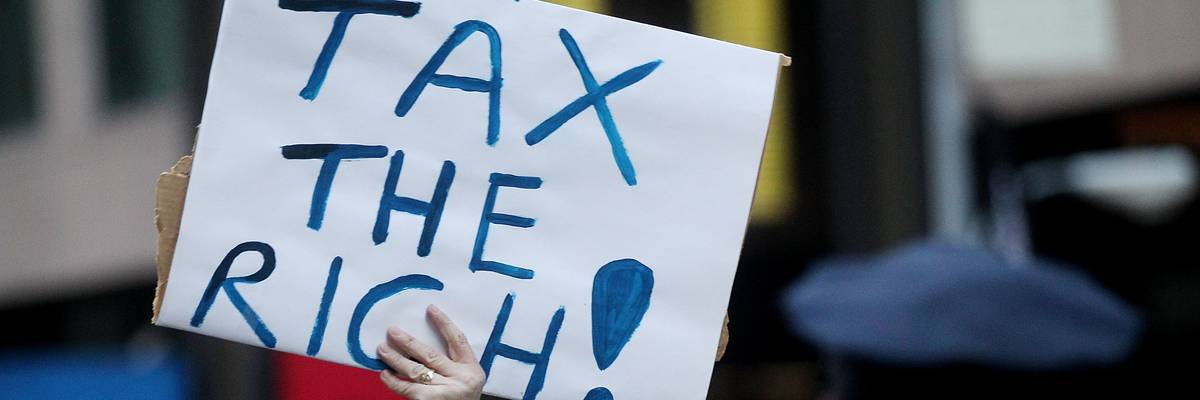
A protester holds a “Tax the Rich” sign as he marches during a rally against budget slashing held by union supporters on March 24, 2011 in New York City.
(Photo by Mario Tama/Getty Images)
A recent poll found that 80% of American respondents viewed wealth inequality as a problem, 80% said the rich had too much political power, and 78% said taxes on billionaires were too low.Social Scheduling
By Lawrence Wittner • Mar 26, 2026
With the deadline for paying federal income taxes fast approaching, the thoughts of American taxpayers turn naturally toward the age-old question: Why isn’t there a fairer tax system?
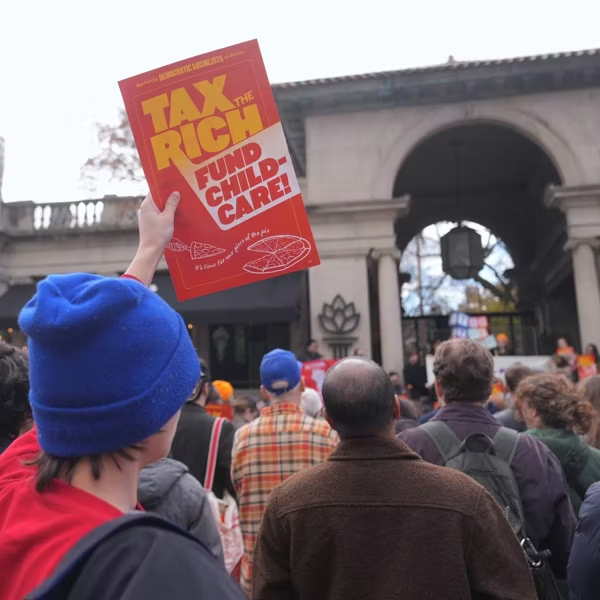
Currently, in fact, campaigns for state tax-the-rich legislation are flourishing in California, Colorado, New York, Oregon, Rhode Island, Texas, and Virginia, and have already succeeded in getting such legislation adopted in Massachusetts and Washington. Similarly, in Congress, Sen. Elizabeth Warren (D-Mass.) and Rep. Pramila Jayapal (D-Wash.) have introduced the Ultra-Millionaire Tax Act, while Sen. Bernie Sanders (I-Vt.) and Rep. Ro Khanna (D-Wash.) are sponsoring the Make Billionaires Pay Their Fair Share Act. The tax-the-rich proposals range from increasing the tax rate for the very highest annual income earners, to instituting an annual wealth tax on the very richest Americans, to a combination of both.
Although the most affluent Americans, like other Americans, have always paid taxes to fund public services, the dispute has been over how much they should pay. Sales taxes and property taxes place a heavy burden on people of modest means, but a much lighter burden on the wealthy. Therefore, the wealthy have tended to favor these generators of public revenue and to oppose a progressive income tax, under which the rich would pay at a higher rate than the poor. A lengthy political battle for a tax system based upon ability to pay led to passage of the 16th Amendment to the US Constitution, which empowered Congress to levy an income tax.
Initially, the new income tax, though progressive, was rather small-scale. But as the federal government took on new and costly tasks―particularly funding US participation in two world wars and the Cold War―the federal income tax grew accordingly. By 1944, the official tax rate for the highest income earners stood at 94%―although, thanks to deductions, loopholes, and the rate’s confinement to the top increment of their income, the richest Americans actually paid at a much lower rate.
Increasingly, in politics, big money talks―and on behalf of Republicans.
Like their well-heeled predecessors, many wealthy Americans were outraged at funding public services that benefited people whom they often regarded as their inferiors. Why, they wondered, was their money being “wasted” on things like public schools, public housing, and public healthcare, when “the best people” went to private schools, lived in private mansions or gated communities, and employed private “concierge doctors”? While chatting with their friends over lunch on their yachts or at their tennis clubs, they complained of “welfare queens” and the “ungrateful poor.”
Consequently, Congress―badgered by the wealthy, their corporations, and conservative ideologues―cut the progressivity of the federal income tax. In 1964, the top marginal tax rate was reduced from 91% to 70%, in 1981 to 50%, and in 2018 to 37%.
Given these dramatic cuts in the federal income tax rate, plus preferential tax treatment for dividends and appreciation in the value of stock, bonds, and other investments―the wealthiest Americans managed to secure a much lower tax rate than most Americans. According to a ProPublica investigation, the 25 richest Americans, who had $401 billion in income from 2014 to 2018, paid taxes on it at a rate of just 3.4%. Indeed, during some years, the world’s top billionaires―including Elon Musk, Jeff Bezos, Michael Bloomberg, and Carl Icahn―paid no federal income taxes at all.
When it came to corporate income, the federal government slashed the corporate tax rate from 53% to 21% between 1969 and 2025. And this, too, produced enormous benefits for very affluent Americans, who own most stock market wealth. According to the Institute on Taxation and Economic Policy, 23 of the largest and most profitable US companies paid no federal corporate income taxes at all from 2018 to 2022. And 109 corporations paid no federal tax in at least one of those years.
The Trump administration’s tax policies lifted the fortunes of the wealthy to unprecedented heights. According to a September 2025 report by Americans for Tax Fairness, the wealth of the 15 richest US billionaires increased by over 300% after the passage of the first Trump-GOP tax cut in December 2017. The wealth of the very richest of them, Elon Musk, grew 20-fold. In the first year of Trump’s second term, marked by another huge tax cut for the rich, US billionaire wealth jumped from $6.7 trillion to $8.2 trillion.
Not surprisingly, government taxation policy―coming on top of low-wage rates, corporate outsourcing, assaults on unions, and government subsidies for big business―has resulted in rising economic inequality in the United States. By late 2025, the richest 1% of Americans possessed some $55 trillion in assets―roughly equal to the wealth held by the bottom 90%. “Household wealth is highly concentrated and becoming steadily more concentrated,” reported the chief economist at Moody’s Analytics, a major financial research firm.
This rising economic inequality enhances the growing power of the wealthy in public affairs. Increasingly, in politics, big money talks―and on behalf of Republicans. Federal election contributions from the nation’s 100 richest Americans averaged $21 million between 2000 and 2010, but rose beyond $1 billion in 2024. In that year, contributions to Republicans surged from roughly $300 million to just under $1 billion, while donations to Democrats dropped from roughly $300 million to less than $200 million. A right-wing political party, led by a demagogic billionaire promising more tax cuts, proved irresistible.
Jeff Bezos walks near Blue Origin’s New Shepard after flying into space on July 20, 2021 in Van Horn, Texas.
(Photo by Joe Raedle/Getty Images)
The poverty wage business model that is so prevalent in Corporate America works spectacularly well for a handful of wealthy and politically powerful executives and shareholders. For the rest of us, not so much.
By Sarah Anderson,Reyanna James • Mar 25, 2026
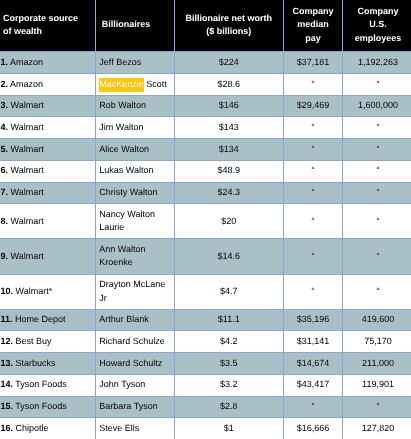
At least 16 US billionaires owe their wealth to one of America’s 20 largest low-wage employers—corporations where a significant share of workers earn so little they have to rely on public assistance.
Of these 16 billionaires, 8 are associated with Walmart. Amazon and Tyson Foods have two members of this elite club, while Home Depot, Best Buy, Starbucks, and Chipotle each have one.
Seven descendants of Walmart founder Sam Walton have accumulated their multi-billion-dollar fortunes off the backs of the giant retailer’s low-wage workers. His eldest son, Rob Walton, leads the pack, with $146 billion. Another billionaire, Drayton McLane, gained entry to this elite club by selling his grocery distribution business to Walmart for a significant share in the retailer.
When corporate resources are funneled into the pockets of those at the top while ordinary employees have to rely on public assistance, we are all subsidizing the executive mansions and private jets.
Median pay at Walmart, the largest US private sector employer, stood at $29,469 in 2024. That’s below the income limits for a family of three to qualify for Medicaid and Supplemental Nutrition Assistance Program (SNAP) food aid benefits. It’s nowhere near the $59,600 income level needed to afford the US average rent for a two-bedroom apartment.
In addition to median pay figures reported in corporate proxy statements, we gathered data from the small number of state governments that disclose corporations’ use of public assistance programs to subsidize their low wages.
In Nevada, Walmart had 4,574 employees, 29.3% of their employees in that state, enrolled in Medicaid in 2024. In four states (Colorado, Massachusetts, Illinois, and Michigan), Walmart had a total of 10,920 employees enrolled in the SNAP food aid program.
The media organization More Perfect Union points out that Walmart not only relies on SNAP to make up for the low wages they pay their workers, but they also benefit when people use food stamps to buy groceries in their stores. According to a Numerator survey covering the 12 months ending July 31, 2025, Walmart ranked No. 1 for SNAP benefit redemption, receiving nearly 26% of all SNAP dollars.
Amazon
Since MacKenzie Scott received 4% of Amazon stock in her 2019 divorce settlement, the ecommerce goliath has had not one but two reps on the billionaire ranking. Scott has become a major philanthropist, but is still sitting on an estimated $28.6 billion. Her ex, Amazon founder and current Trump ally Jeff Bezos, came in fourth in the world in the Forbes list this year, with $224 billion.
Amazon’s typical employees are on another economic planet. Their median pay of $37,181 just barely exceeds the family-of-three income limits for Medicaid and SNAP. With half of Amazon employees earning less than that amount, a significant share of the company’s 1.2 million US employees no doubt have to rely on public assistance.
Indeed, the Nevada state government’s Medicaid report reveals that Amazon had 8,951 employees enrolled in that health program in that state in 2024, making up 48.4% of all of the firm’s employees in Nevada. In the four states that report SNAP enrollee data by employer, Amazon came in second after Walmart, with 9,633 employees receiving those benefits.
Home Depot
Home Depot co-founder and Atlanta Falcons owner Arthur Blank holds an estimated $11.1 billion. His fellow co-founder, Bernard Marcus, died on election day in 2024, after donating $9.4 million to the campaigns of President Donald Trump and other Republicans.
While ranking among the country’s lowest-paying companies, Home Depot has had plenty money to blow on stock buybacks. This is a financial maneuver that artificially inflates the value of a company’s shares—and the stock holdings of wealthy executives and stockholders.
The big-box chain spent $37.9 billion on share repurchases between 2019 and 2024. That sum would have been enough to give each of Home Depot’s 419,600 US employees six annual $15,039 bonuses. Home Depot’s median pay in 2024 stood at just $35,196—less than the $35,631 income limit for a family of three to qualify for Medicaid.
State government data show that Home Depot employees had a total of 2,213 employees enrolled in SNAP food aid in Colorado, Massachusetts, Illinois, and Michigan.
Starbucks
Longtime Starbucks CEO Howard Schultz has accumulated $3.5 billion in wealth off a company that paid its median earner just $14,674 in 2024. Employee discontent has sparked pro-union elections at more than 570 stores over the past four years. But the company has used various tactics to prevent workers from securing a first contract, including during a period when Schultz returned to his CEO post.
Schultz recently purchased a $44 million penthouse in Surfside, Florida, a state with zero personal income tax.
Taxing away excessive wealth could also encourage business models that share profits equitably with all employees.
Rounding out the low-wage billionaires list are the founders of Best Buy and Chipotle and two descendants of John Tyson, the founder of Tyson Foods, a meat processor with a sizeable immigrant workforce.
The poverty wage business model that is so prevalent in Corporate America works spectacularly well for a handful of wealthy and politically powerful executives and shareholders. For the rest of us, not so much.
When corporate resources are funneled into the pockets of those at the top while ordinary employees have to rely on public assistance, we are all subsidizing the executive mansions and private jets, the massive political spending, and all the other trappings of excessive wealth.
Taxing Excessive Wealth
Lawmakers have introduced several tax proposals to curb the size of billionaire fortunes. Under current law, the ultra rich hold most of their wealth in stock and other financial assets that are not taxable until they are sold. In the meantime, they’re allowed to borrow against these assets to fund their lavish lifestyles and then pass their wealth on to heirs tax-free.
One federal bill to address that loophole, the Billionaires Income Tax Act, would impose an annual tax on billionaires’ gains from tradable assets like stocks, whether or not they sell the asset.
Several other proposals would tax billionaires’ accumulated wealth. For example, Sen. Elizabeth Warren (D-Mass.) and Rep. Pramila Jayapal (D-Wash.) are the lead advocates of the Ultra-Millionaire Tax Act, which would apply a 2% annual tax on the net worth of households and trusts between $50 million and $1 billion and a 3% tax on those with net worth above $1 billion.
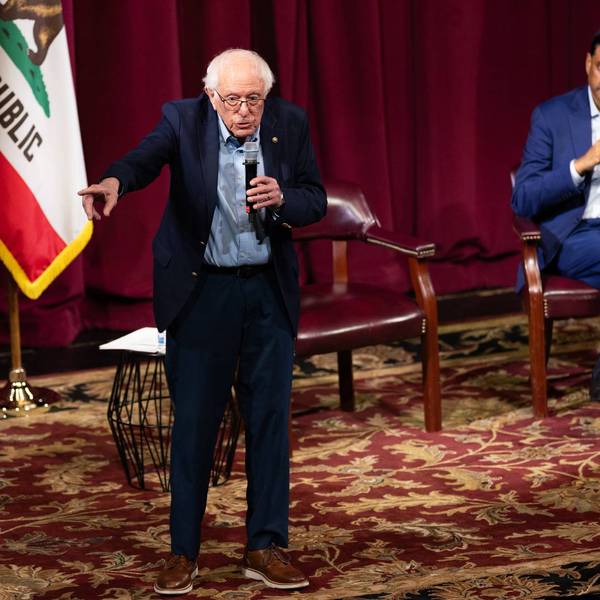
Sen. Bernie Sanders (I-Vt.) and Rep. Ro Khanna (D-Calif.) recently introduced a slightly different model that would establish a 5% annual wealth tax on billionaires. This proposal is similar to a California state ballot initiative for a 5% one-time wealth tax on billionaire residents of that state.
Each of these proposals would raise massive revenue for public investments. At the same time, taxing away excessive wealth could also encourage business models that share profits equitably with all employees instead of extracting from those at the bottom to make wealthy executives and shareholders even richer.
This year will feature, more than any time since the Civil War, an unprecedented referendum on democracy. Time is short, and both the danger of fascism and the opportunity to renew America are at our doorsteps.



















No comments:
Post a Comment
Note: Only a member of this blog may post a comment.