Monday, March 30, 2026
■ Today's Top News
The head of the Institute on Taxation and Economic Policy praised state policymakers for "listening to the demands of the people to create a less regressive state tax system."
By Jessica Corbett
While nearby California prepares for a November vote to tax the ultrarich, Democratic Washington Gov. Bob Ferguson on Monday signed state legislation that creates a tax on income over $1 million in a single year.
“Adoption of the historic Millionaires’ Tax makes our tax system more fair, and means free meals for K-12 students, the largest tax break in state history for small businesses, eliminating the sales tax for baby diapers, and sending a check to nearly 500,000 working families to make life more affordable,” Ferguson highlighted in a statement.
Senate Bill 6346, sponsored by state Sen. Jamie Pedersen (D-43), was delivered to the governor earlier this month after passing the upper chamber 27-21. In the Washington House of Representatives, where the companion bill was led by Rep. Joe Fitzgibbon (D-34), it was approved 51-46.
“With this bill, we’re going to begin to right a historic wrong that has plagued our state for nearly 100 years, and made our tax system one of the worst and most regressive in the entire country,” said Pedersen. “We’ve asked Washington’s working families for far too long to shoulder far too much of the tax burden for the things we care about, and we have not asked enough of our wealthiest neighbors. The Millionaires’ Tax represents hope and change for people in communities like mine, and across the state.”
Bloomberg reported Monday that before adopting the law, which “applies a 9.9% levy on the roughly 30,000 taxpayers in the state who make more than $1 million a year,” Washington was one of just nine states without an income tax
Washington lawmakers previously “made progress in recent years by creating and later enhancing their capital gains excise tax,” but its “tax structure has been woefully unequal, ranking as the second-most regressive state and local tax system in the country,” according to the Institute on Taxation and Economic Policy (ITEP).
“Inequality is at a historic high and billionaires are walking away with ever-larger shares of our country’s collective wealth,” ITEP executive director Amy Hanauer said in a Monday statement. “With those in charge at the federal level passing policies that only make this worse, it is incumbent upon states to come up with solutions. It is inspiring to see Washington listening to the demands of the people to create a less regressive state tax system.”
Last year, congressional Republicans and President Donald Trump used the GOP’s narrow majorities to pass a budget package, the One Big Beautiful Bill Act, that provided the rich with more tax breaks while slashing programs for working families, such as Medicaid and the Supplemental Nutrition Assistance Program (SNAP).
Ferguson signed Washington’s bill as Republicans in Congress prepare for this year’s budget package, which they aim to pass ahead of the November midterm elections, and other states and localities consider measures to tax the rich and use the revenue to better serve the working class.
As historian Lawrence Wittner detailed in an opinion piece for Common Dreams last week, “Campaigns for state tax-the-rich legislation are flourishing in California, Colorado, New York, Oregon, Rhode Island, Texas, and Virginia, and have already succeeded in getting such legislation adopted in Massachusetts and Washington.”
US Sen. Bernie Sanders (I-Vt.) headed to New York City on Sunday to boost an effort by NYC’s newly elected mayor, Zohran Mamdani, to pressure Democratic Gov. Kathy Hochul to raise taxes on the rich. He addressed a rally at Lehman College in the Bronx.
“The people of the city, the people of this state, the people of this country, they do not want to see our kids go hungry,” Sanders said. “They do not want people to sleep out on the street or lack healthcare. They want the very rich to start paying their fair share of taxes.”
At the federal level, Sanders and Rep. Ro Khanna (D-Calif.) earlier this month introduced the Make Billionaires Pay Their Fair Share Act. They were followed last week by Sen. Elizabeth Warren (D-Mass.) and Reps. Pramila Jayapal (D-Wash.) and Brendan Boyle (D-Pa.), lead sponsors of the Ultra-Millionaire Tax Act. However, neither bill is expected to get through the current Congress.
Like in Washington, DC, efforts to tax the rich are still facing pushback in Washington state. After Ferguson’s signature, Citizen Action Defense Fund announced its intention to sue, with executive director Jackson Maynard declaring that “since lawmakers and the governor have chosen to ignore both the constitution and decades of settled case law, we will act.”
According to KUOW, during the bill signing event in Olympia that featured remarks from not only the governor but also the bill sponsors, a small business owner, and a tech executive, Ferguson acknowledged that “there’s going to be a public conversation around this in the days and weeks and months ahead, as there should be of something of this historic nature.”
“Putting front and center those perspectives you just heard, I think, will be critical,” he asserted, “because when Washingtonians hear the benefits that flow to working families, to businesses large and small, to kids in schools with those free meals, for childcare services for thousands of Washington families, it’s going to make a huge, huge difference.”
"There is nothing legal about an occupying power using the death penalty exclusively for the people it occupies," said one historian.
By Julia Conley
Leading international human rights groups as well as organizations in Israel swiftly demanded the repeal of a law passed by the Israeli Knesset on Monday that makes death by hanging the default punishment for Palestinians convicted of deadly attacks on Israelis—a law that one group called “discriminatory by design.”
Those were the words of the Association of Civil Rights in Israel, which petitioned the country’s Supreme Court minutes after lawmakers passed an amendment to the federal penal law, “Death Penalty for Terrorists,” in a vote of 62-48.
The group called on the high court to challenge the new law and said the far-right government had passed it “without legal authority” over Palestinians in the West Bank, which Prime Minister Benjamin Netanyahu’s government aimed to illegally annex to Israel.
The Association of Civil Rights was joined by groups including Amnesty International, which has spoken out forcefully against the legislation in recent months, in demanding the death penalty law be repealed.
Amnesty said that under the new policy, Israel—which has vehemently rejected accusations of imposing apartheid policies on Palestinians—“explicitly creates two legal frameworks for the use of the death penalty in the occupied West Bank... and in Israel.”
The law also does not allow for any pardons for those sentenced to death, making it “one of the world’s most extreme death penalty laws,” said Amnesty.
The new law demands that Palestinians be put to death by hanging if convicted of nationalistic killings in a military court, and gives Israeli courts the option of sentencing Israeli citizens to capital punishment if they’re convicted of similar crimes.
But Amichai Cohen, a senior fellow at the Israel Democracy Institute’s Center for Democratic Values and Institutions, told The Associated Press that only Palestinians will ultimately be killed under the law.
“It will apply in Israeli courts, but only to terrorist activities that are motivated by the wish to undermine the existence of Israel,” Cohen told the AP. “That means Jews will not be indicted under this law.”
Erika Guevara-Rosas, Amnesty International’s senior director of research, advocacy, policy, and campaigns, noted that Israeli military courts “have a conviction rate of over 99% for Palestinian defendants and... are notorious for disregarding due process and fair trial safeguards.”
“Israel is brazenly granting itself carte blanche to execute Palestinians while stripping away the most basic fair-trial safeguards,” said Guevara-Rosas.
She added that the law was passed weeks after the Israeli military attorney general dropped all charges against five Israel Defense Forces soldiers accused of raping a Palestinian prisoner—“a decision celebrated by the prime minister and several ministers.”
“It speaks volumes to the extent of Israel’s dehumanization of Palestinians that this law has passed” after those charges were dropped, said Guevara-Rosas. “For years, we have seen an alarming pattern of apparent extrajudicial executions and other unlawful killings of Palestinians—with the perpetrators also enjoying near-total impunity. This new law which allows for state-sanctioned executions is a culmination of such policies.”
Celebrations were seen among Netanyahu’s top ministers once again on Monday, with National Security Minister Itamar Ben-Gvir—whose Otzma Yehudit Party initially introduced the amendment—seen clutching a bottle of champagne after the passage was announced.
Historian Assal Rad noted that much of the international coverage of the bill’s passage has used “procedural language to sanitize the story and make it sound legitimate.”
The law, however, “is just another way for Israel to kill Palestinians,” she said.
The Euro-Mediterranean Human Rights Monitor warned that “the most dangerous aspect of the new law lies in its application within a judicial system that lacks any guarantees of a fair trial for Palestinians.”
“Confessions are often obtained under duress, access to effective legal representation is severely limited, the presumption of innocence is routinely ignored, and there are major restrictions on appeals or access to documents essential for the defense,” said the group.
“Combined with a lack of judicial independence and integrity in proceedings, applying the death penalty in this context cannot be considered a legitimate judicial measure,” the organization added. “Instead, it constitutes an arbitrary deprivation of life, in direct violation of fundamental principles of international human rights law.”
The Precision Strike Missile has never before been used in combat by the US military.
By Julia Conley
As experts and investigators analyze one of the first strikes carried out in the US-Israeli war on Iran, mounting reports point to a ballistic missile that had never been used before by the US military in combat—but which may have struck a residential area, a sports hall, and a school in the southern city of Lamerd.
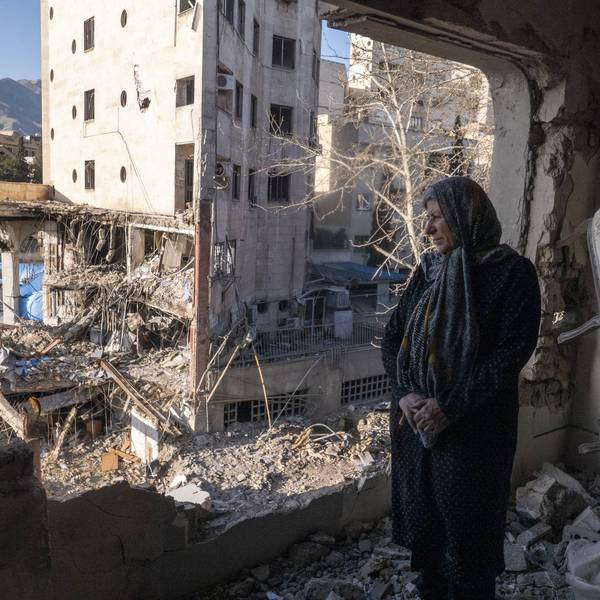
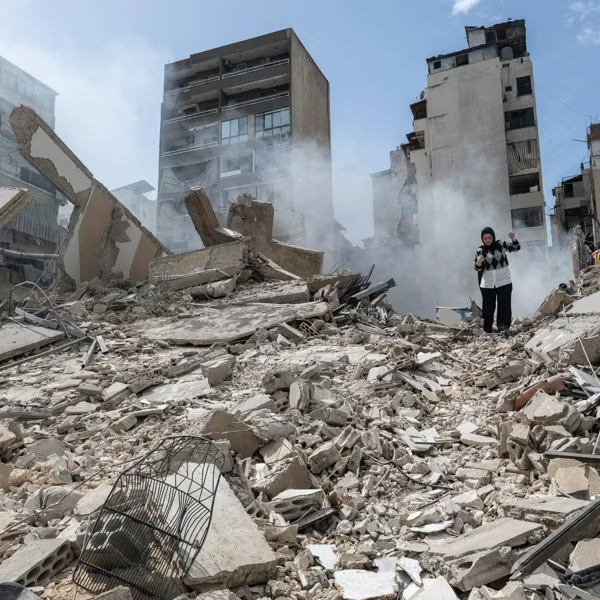
Along with being accused of bombing a school in Minab, killing more than 160 children and teachers, the US reportedly attacked several facilities and civilian areas near an Islamic Revolutionary Guards Corps facility in Lamerd, killing an additional 21 people, including children.
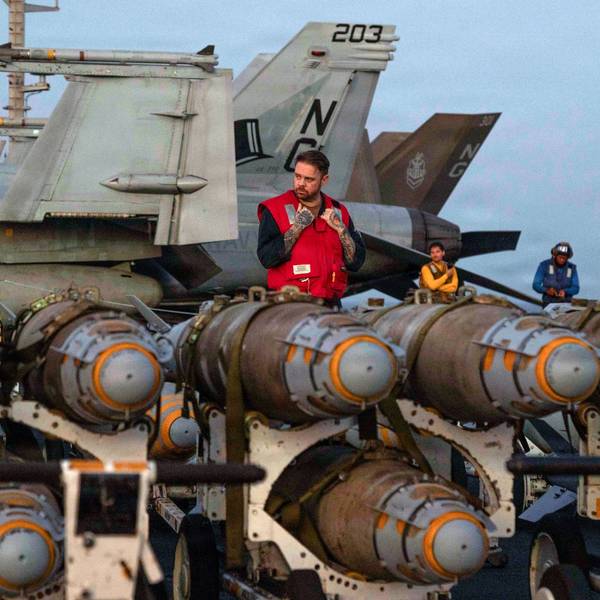
While analysts have found a US Tomahawk cruise missile was used in the Minab attack, munitions experts interviewed by the BBC and The New York Times in recent days said footage of the attacks and images of the targets after they were struck suggest a short-range ballistic missile called a Precision Strike Missile (PrSM) was used to bomb a sports hall, school, and residential neighborhood in Lamerd.
The missiles are newly developed and are designed to detonate just above a target and propel small tungsten pellets into the surrounding area.
As the Times reported, the PrSM is manufactured by Lockheed Martin and has the capability to hit targets at a 400-mile range, “but additional details about the weapon, including its expected accuracy and the quantity of explosives it carries, remain unknown to the public.”
The Times reported that munitions experts had analyzed footage of a weapon in flight over a residential area about 900 feet from the sports hall and school, showing the missile erupting “in a large fireball midair.”
Another video showed an explosion in midair just above the sports hall and nearby school, and photos of the aftermath showed the sites with numerous holes, presumably from the tungsten pellets.
The Times also verified a video that showed a plume of smoke rising in an area close to the other strikes at the same time, and local media reports said a cultural center had been hit in that attack. The target couldn’t be independently verified.
Late last week, the BBC also reported that the PrSM was likely used on residential buildings in Lamerd on the first day of the war.
Experts at the defense intelligence firm Janes and at McKenzie Intelligence told the BBC that the shape, length, and size of the explosions created in verified footage they analyzed indicated the weapons were likely PrSM missiles.
“US Central Command has admitted to using PrSM in strikes from the desert of an unnamed Gulf country against Iran in the early phases of the conflict,” McKenzie Intelligence emphasized.
Joint Chiefs of Staff chairman Dan Caine also celebrated the use of the PrSM in a press conference on March 13, reported the BBC, saying the US military had “made history” and carried out attacks with “precision and determination that comes from relentless training and trust in each other and in their weapon systems.”
But a spokesperson for US Central Command on Saturday told the Times that Pentagon officials are “aware of the reports and are looking into them,” and claimed US forces “do not indiscriminately target civilians.”
The US has also not officially taken responsibility for the attack in Minab that happened on the same day as the ones in Lamerd, but fragments of a Tomahawk missile that were found at the site are among the mounting evidence pointing to the Trump administration as the perpetrator.
The sports hall in Lamerd was reportedly being used by a children’s volleyball team at the time of the strike; fourth grader Helma Ahmadizadeh and fifth grader Elham Zaeri were among those killed while at volleyball practice, according to an Iran-based journalist, Negin Bagheri.
Zaeri’s father “described her as an avid volleyball player, who would always turn up to the sports hall 20 to 25 minutes early,” the BBC reported.
The outlet also said the youngest victim of the suspected PrSM strike was two years old.
At Drop Site News, Mahmoud Aslan reported on the attack on the sports hall shortly after it took place, before analysts linked the bombing to the PrSM.
Hossein Gholami told Aslan his 16-year-old daughter, Zahra, had been training in the facility when he “noticed a strange gathering of people at the corner of the street leading to the sports hall.”
“The screaming was rising from a distance,” said Gholami. “A colleague ran toward me, waving his arm, and said in a shaken voice: ‘Zahra, the hall, there has been an explosion.’”
“The continuous screaming of the injured mixed with the sounds of secondary explosions,” said Gholami, whose daughter was killed in the attack. “The ground was covered in debris and shattered glass. It was difficult to move with all the rubble. Ambulances arrived after about twenty minutes, but most of the injured were in critical condition. The smell of blood and burns covered everything.”
“Every time I close my eyes,” he said, “I see her face, her smile, and I hear the sound of the explosion.”
"Republicans in Congress want to cut Americans' healthcare to pay for more war in Iran. Let that sink in."
By Jessica Corbett
“Republicans won’t think twice about *literally* sacrificing you to get their way.”
That’s how Democrats on the US House Ways and Means Committee responded to Axios’ Monday reporting on congressional Republicans considering more healthcare cuts to help fulfill President Donald Trump’s request for $200 billion to continue partnering with Israel for an unconstitutional war on Iran—including a potential ground invasion.
Other critics said:
- “Is this America First?”
- “You know who isn’t losing their government subsidized healthcare over this war that their government started? Israelis.”
- “Republicans would rather set money on fire than try to help a single American see a doctor.”
- “Cutting healthcare to pay for another regime change war in the Middle East. It’s like GOP want to lose in November.”
- “Are they calling this strategy Project Blue Wave?”
- “This should surprise no one: MAGA wants to pay for a war that no one wants by chipping away at your healthcare.”
Michael Hardaway, a geopolitical strategist who has worked for top Democrats, argued that they “must convert this into a House AND Senate majority in November,” noting that Republicans “took healthcare away from millions of Americans to pay for tax cuts for the 1%.”
That was last year, when congressional Republicans and Trump used the budget reconciliation process to pass their so-called One Big Beautiful Bill Act. Between $1 trillion cuts to Medicaid over the next decade and failing to extend expiring Affordable Care Act (ACA) tax credits, the OBBBA is expected to strip healthcare coverage from up to 15 million Americans.
While the impacts of the OBBBA will play out over years, already, “in red states and blue states alike, Republican healthcare cuts are hitting communities like a wrecking ball,” Senate Finance Committee Ranking Member Ron Wyden (D-Ore.) said last week, while releasing a related report with House Energy and Commerce Committee Ranking Member Frank Pallone Jr. (D-NJ).
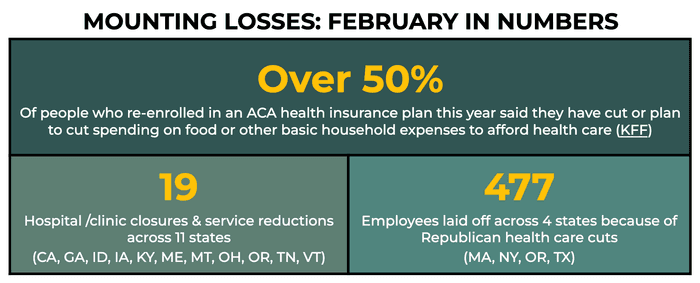
Wyden and Pallone found that over half of the people who reenrolled in an ACA plan this year have had to or plan to reduce spending on other essentials; at least 19 health facilities have closed across 11 states; and nearly 500 employees were laid off in four states because of the GOP’s healthcare cuts last year.
“Despite attempts by Trump and his allies to cast blame elsewhere, the stories and facts are rolling in from across the country,” Wyden said. “Democrats will not stop elevating the voices of Americans whose health is in harm’s way as a result of Republicans’ healthcare cuts.”
One proposal that the GOP considered but ultimately did not include in the OBBBA related to ACA cost-sharing reductions. The Congressional Budget Office estimated that the specific policy considered last year would save $31 billion but leave 300,000 more Americans uninsured through 2034.
Reporting emerged last week that House Budget Committee Chair Jodey Arrington (R-Texas) wants to bring back the push for that policy. It quickly spurred criticism, with Sen. Elizabeth Warren (D-Mass.) saying: “Republicans in Congress want to cut Americans’ healthcare to pay for more war in Iran. Let that sink in.”
“Republicans ransacked $1 trillion from Medicaid, and then they more than doubled premiums for over 20 million Americans in order to fund tax breaks for billionaires and big corporations,” Leslie Dach, chair of the advocacy group Protect Our Care, said in a statement last week. “Now, care for 15 million working Americans will be ripped away, nursing homes and hospitals are on the chopping block nationwide, and Americans are buried under skyrocketing healthcare hikes.”
“But that’s not enough for Republicans who have been at war with working families’ healthcare for decades—now they want to slash healthcare even more to bankroll the war in the Middle East and to fund ICE, Trump’s unaccountable, lawless paramilitary force,” Dach continued, referring to US Immigration and Customs Enforcement. “The American people reject these Republican priorities and will make their voice known in November.”
Axios reported Monday on Arrington’s preferred timeline for a new budget package: “60 to 90 days,” he said.
Arrington is also eyeing some potential changes to Medicare, which provides health insurance coverage to Americans age 65 and older, according to Axios:
- One, known as “site-neutral” payments, would equalize payment across hospital outpatient facilities and doctors’ offices. A second would crack down on what critics say is insurance company gaming of the Medicare Advantage system through “upcoding” of patients’ medical conditions.
- Arrington expressed skepticism that either would be included, saying they’d open up “a false narrative that we’re cutting Medicare.”
As for Medicaid, one of the programs attacked by the OBBBA, Arrington told the outlet that there is hesitancy “to open that back up,” but some policies considered in 2025 could be revived.
In a Monday statement, Democratic National Committee rapid response director Kendall Witmer called out Trump and Vice President JD Vance for past and possible future GOP healthcare cuts, accusing them of breaking their campaign promises.
“Donald Trump and Republicans already made the largest cuts to healthcare in history, causing healthcare costs to skyrocket for millions of Americans while billionaires and big corporations get massive tax cuts,” Witmer said. “Now, Republicans want to slash even more healthcare funding for working families to pay for their war with Iran.”
“After promising on the campaign trail to stop the endless wars, reduce the national debt, and lower costs,” Witmer added, “Trump and JD Vance have done the opposite: putting everyday Americans on the chopping block to wage their deadly and costly war of choice.”
"This decision is part of the decision already made by the Spanish government not to participate in or contribute to a war which was initiated unilaterally and against international law," said one Spanish minister.
By Julia Conley
Doubling down on its status as an outlier among European countries that have largely supported or avoided speaking out forcefully against the US-Israeli war on Iran, Spain is closing its airspace to US military planes that are part of the invasion, with Defense Minister Margarita Robles on Monday calling the war “profoundly illegal and profoundly unjust.”
“We don’t authorize either the use of military bases or the use of airspace for actions related to the war in Iran,” Robles told reporters. “I think everyone knows Spain’s position. It’s very clear.”
Spanish Prime Minister Pedro Sánchez angered President Donald Trump soon after the US and Israeli Prime Minister Benjamin Netanyahu launched their war against Iran on February 28, with one of the first attacks striking a school and killing at least 160 children and teachers.
Sánchez responded to the assault by announcing the US would not be permitted to launch attacks on Iran from Spain’s military bases, prompting Trump to threaten a full trade embargo against the country in retaliation.
On Monday, Spanish Economy Minister Carlos Cuerpo appeared unfazed by a reporter’s suggestion that closing the country’s airspace to the US could worsen relations with the White House.
“This decision is part of the decision already made by the Spanish government not to participate in or contribute to a war which was initiated unilaterally and against international law,” Cuerpo said simply in a radio interview.
International legal experts have said the war is clear violation of the United Nations Charter, which “prohibits the use of force against another State unless that use of force is authorized by the UN Security Council or is a necessary and proportionate act of individual or collective self-defense in response to an armed attack.”
Sánchez told the Spanish Congress last Wednesday that the country has “denied the United States the use of the Rota [de la Frontera] and Morón bases for this illegal war.”
“All flight plans involving operations in Iran have been rejected. All of them, including those for refueling aircraft,” said Sánchez.
In the US, Progressive Mass political director Jonathan Cohn said it was “refreshing to see a European country take a hard line against the United States’ illegal and immoral wars.”
US aircraft can continue to use the airspace and land at the bases in emergency situations, and are still able to provide logistics support to 80,000 US forces stationed across Europe.
But as The Guardian reported Monday, 15 US refueling planes were diverted from the Morón de la Frontera and Rota bases to military facilities in France and Germany at the beginning of the war.
The US was also forced to find an alternative location for B-52 and B-1 bombers due to Spain’s policy, with British Prime Minister Keir Starmer agreeing to allow Trump to send them to Fairford Air Base in Gloucestershire, England in the first days of the war.
The Seville Air Traffic Control Center has provided navigation support to B-2 Spirit bombers that have traveled from Whiteman Air Force Base in Missouri to carry out strikes in Iran, but those planes do not enter Spanish airspace, instead crossing the Strait of Gibraltar.
Sánchez has rejected Trump’s criticism of Spain’s policy, noting that the country has also led the way in recent years in recognizing the state of Palestine and speaking out against Israel’s assault, as other European governments eventually did.
“They say that Spain is alone,” the prime minister said earlier this month. “They said the same when we recognized the state of Palestine, and then others followed. We are not alone. We are the first. Those defending the indefensible will be the ones left alone.”
"Attacking civilian infrastructure, and acutely desalination plants, is a war crime," said former Swedish Prime Minister Carl Bildt. "Will American armed forces accept orders to do so?"
By Jake Johnson
US President Donald Trump on Monday threatened to destroy every desalination plant in Iran along with the country’s energy infrastructure, which human rights organizations and legal experts say would be a grave violation of international law and a war crime.
In a post on his Truth Social platform, Trump warned that if Iran’s government doesn’t agree to a deal with his administration “shortly,” the US military will “conclude our lovely ‘stay’ in Iran by blowing up and completely obliterating all of their Electric Generating Plants, Oil Wells, and Kharg Island (and possibly all desalinization plants!), which we have purposefully not yet ‘touched.’”
Former Swedish Prime Minister Carl Bildt wrote in response that “attacking civilian infrastructure, and acutely desalination plants, is a war crime.”
“Will American armed forces accept orders to do so?” he asked.
Brian Finucane, senior adviser to the US Program at the International Crisis Group, wrote that “the categorical and retributive framing of this threat to attack Iranian infrastructure makes clear that this is a threat to commit war crimes.”
Trump’s Monday post marked an escalation of his previous threat to target Iran’s civilian infrastructure, specifically its power plants, if the Strait of Hormuz was not fully reopened. The US president initially gave Iran 48 hours to capitulate to his demand, but he later pushed his arbitrary deadline back to April 6, claiming progress in diplomatic talks with Iran.
Iranian officials have repeatedly denied that any direct talks with the US are taking place and rejected the administration’s proposed 15-point ceasefire plan.
Erika Guevara-Rosas, senior director of research, advocacy, policy, and campaigns at Amnesty International, said last week that by threatening strikes on Iran’s civilian infrastructure, the Trump administration is “effectively indicating its willingness to plunge an entire country into darkness, and to potentially deprive its people of their human rights to life, water, food, healthcare and adequate standard of living, and to subject them to severe pain and suffering.”
“When power plants collapse, horrific consequences cascade instantly,” said Guevara-Rosas. “Water pumping stations would stop functioning, clean water would become scarce, and preventable diseases would spread. Hospitals would lose electricity and fuel, forcing surgeries to be cancelled and life-support machines to shut down. Food production and distribution networks would collapse, deepening hunger and causing widespread food scarcity. Many businesses would also shut down with devastating economic consequences, including mass unemployment.”
Kenneth Roth, the former executive director of Human Rights Watch, told The New York Times that he sees “no difference between what Trump is threatening to do in Iran and what the International Criminal Court charged four Russian commanders for doing in Ukraine.”
“Trump is openly threatening a war crime,” said Roth.
In June 2024, ICC judges issued arrest warrants for top Russian commanders accused of “the war crime of directing attacks at civilian objects.” The judges cited “a large number of strikes against numerous electric power plants and sub-stations were carried out by the Russian armed forces in multiple locations in Ukraine.”
According to Iranian Foreign Minister Abbas Araghchi, the US has already targeted Iran’s water infrastructure, specifically “a freshwater desalination plant on Qeshm Island.”
“Water supply in 30 villages has been impacted,” Abbas wrote in a March 7 social media post. “Attacking Iran’s infrastructure is a dangerous move with grave consequences. The US set this precedent, not Iran.”
Iran is among the most water-stressed countries on the planet, and large-scale US strikes on the country’s desalination and power plants would make conditions significantly worse.
While “only a small fraction of Iran’s water supply comes from desalination plants,” Grist’s Frida Garza wrote last week, “strikes on its power plants would indeed hamper the country’s water supply.”
“Without electricity,” Garza wrote, “water treatment operations could not run.”
























No comments:
Post a Comment
Note: Only a member of this blog may post a comment.