Wednesday, March 18, 2026
■ Today's Top News
“While Trump voters by and large stand behind Trump, they overwhelmingly want him to declare an end to the war."
By Julia Conley
War hawks such as Sen. Lindsey Graham are pushing President Donald Trump to keep escalating the war he is waging against Iran, but a new poll of the president’s base—those who voted for him in 2024, when he campaigned on “no new wars”—found that doing so would likely anger the steadily shrinking faction of Americans who have thus far continued to support him.
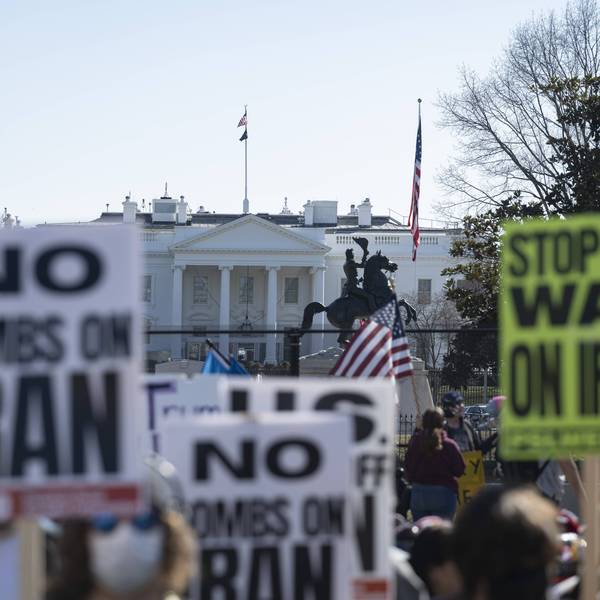
The poll, commissioned by the Quincy Institute for Responsible Statecraft and The American Conservative, found that 79% of those who voted for Trump in 2024 want a swift end to the US and Israel’s war in Iran, which began on February 28 when the president abruptly ended talks regarding Iran’s nuclear program and joined Israel in attacking the country.
The survey revealed a political reality at odds with Trump’s recent claim that “MAGA loves what I’m doing—every aspect of it.”
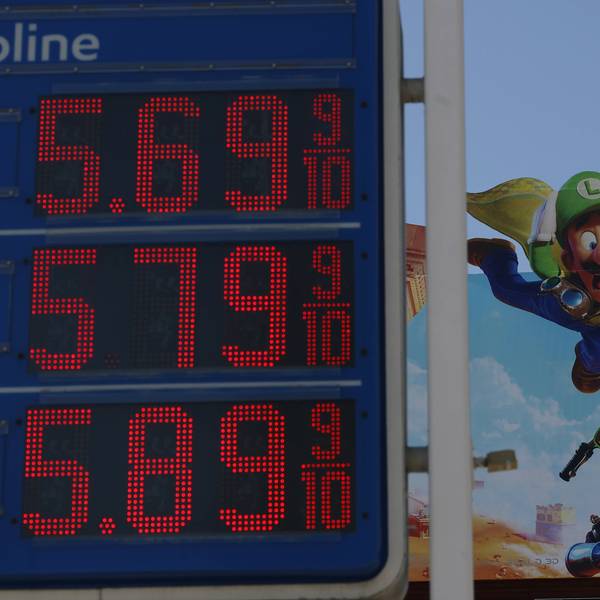
More than a year after they cast votes for Trump, who campaigned relentlessly on making life more affordable for Americans, the poll found that 55% of people who supported the president are concerned about rising gas prices as a result of the war. The average price of gas has been steadily rising since the US and Israel began the war, leading Iran to close the Strait of Hormuz, through which around a fifth of the global oil supply flows. As of Wednesday the average price in the US was up to $3.842 per gallon.
Fifty-eight percent of Trump voters said they would oppose sending US troops to fight on the ground in Iran, a step the president is reportedly considering taking in order to seize Iran’s crucial oil hub on Kharg Island in the Strait of Hormuz.
Just over three-quarters of people who backed Trump in the last election said they supported the president’s decision to go to war, but less than a month into the conflict, that number is down eight points from 84% on February 28, according to a Fox News poll at the time.
Quincy Institute executive vice president Trita Parsi noted that even the White House is seemingly searching “for an off-ramp from this widening conflict,” in which 13 US troops have been killed and 200 have been wounded. More than 1,300 Iranians have been killed, according to the country’s ambassador to the United Nations, as well as more than 900 Lebanese civilians, and at least 15 people in Israel.
“Trump’s base favors a face-saving declaration of victory by Washington that could enable a ceasefire and prevent further economic shocks.”
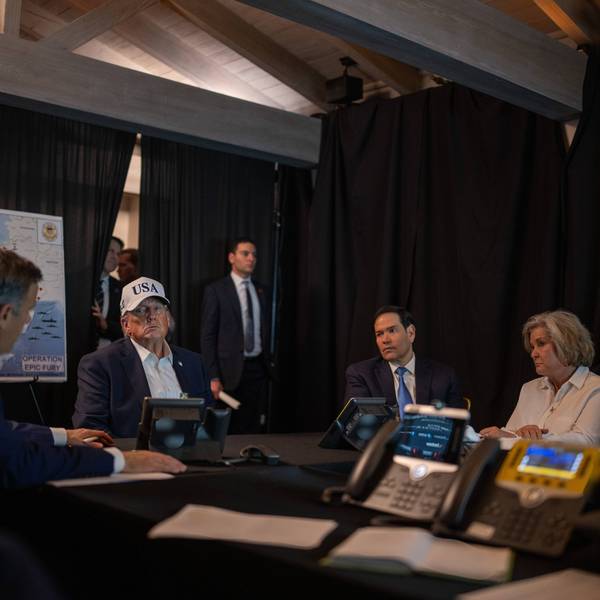
Trump said earlier this week that “maybe we shouldn’t be there at all,” and his advisers have reportedly been calling on the president to quickly determine an exit plan to avoid a political backlash.
Meanwhile, said Parsi, “neoconservatives are pressuring President Trump to double down on this war. But this poll shows that Trump’s base favors a face-saving declaration of victory by Washington that could enable a ceasefire and prevent further economic shocks.”
In Responsible Statecraft, which is published by the Quincy Institute, Kelley Beaucar Vlahos noted that young MAGA voters, whose support was instrumental in delivering the White House for Trump in 2024, are “driving much of the rising opposition to the war among the president’s base.”
Only 54% of Trump voters aged 18-29 said they supported the war, while 46% opposed it.
“The cracks are beginning to show in President Donald Trump’s base” over the war, wrote Beaucar Vlahos.
Saagar Enjeti, conservative host of the popular Breaking Points podcast, told Responsible Statecraft that “the Republican base is clearly willing to trust President Trump up to a point but remain weary of any potential escalation.”
“As evidenced by this polling the wisest move would be to declare victory and end this immediately,” he said.
The poll, which was taken between March 12-14, was released a day after Joe Kent, director of the National Counterterrorism Center, announced he was resigning from his position because Iran had “posed no imminent threat to our nation” when Trump began the war. The president, said the longtime Trump loyalist, had attacked Iran “due to pressure from Israel and its powerful American lobby.”
Kent, whom critics noted has ties to white nationalists and conspiracy theorists, is the most prominent Trump administration official to resign from the White House in protest of the president’s policies and actions.
On Wednesday, Director of National Intelligence Tulsi Gabbard said in her opening statement that the US intelligence community determined that US airstrikes last year “obliterated” Iran’s nuclear enrichment program, before claiming that the president alone can determine whether a country poses an “imminent” threat.
While those who voted for the president “by and large stand behind Trump, they overwhelmingly want him to declare an end to the war,” said Parsi on Wednesday. “Trump risks losing significant portions of his base if he escalates the war with ground troops and allows the war to further push up gas prices.”
"This is repression carried out by the state for electoral purposes. It's about stamping out your objections to their autocratic aims," said one critic.
By Brad Reed
A Wednesday CBS News report claimed that the FBI and Internal Revenue Service are “forming a new initiative to investigate nonprofit organizations over suspected possible links to domestic terrorism.”
According to CBS News, the new initiative is the agencies’ response to a December memo written by Attorney General Pam Bondi requiring the US Department of Justice (DOJ) to compile a list of potential “domestic terrorism” organizations that espouse “extreme viewpoints on immigration, radical gender ideology, and anti-American sentiment.”
A government official told CBS News that the FBI-IRS initiative would focus on “exploring potential funding streams at nonprofits that support domestic terrorism or political violence.”
But Tom Brzozowski, former domestic terrorism counsel at the DOJ’s National Security Division, told CBS News he was concerned by the broad scope of investigatory activities outlined in Bondi’s memo, and he questioned whether the DOJ had established the proper predication to justify amassing a list of nonprofit groups to be targeted in a criminal probe.
“If you’re going to pull down information and retain it in a government data set, you have to have predication to do that,” Brzozowski emphasized, “especially if you’re looking at it through an investigative lens.”
Bondi’s December memo was written in response to National Security Presidential Memorandum-7 (NSPM-7), a directive signed by President Donald Trump in September that demanded a “national strategy to investigate and disrupt networks, entities, and organizations that foment political violence so that law enforcement can intervene in criminal conspiracies before they result in violent political acts.”
Rights groups have for months been sounding the alarm about the implications of NSPM-7, which they said could be used to initiative a widespread crackdown against the Trump administration’s critics.
Melanie D’Arrigo, executive director of Campaign for New York Health, wrote that news of the FBI-IRS initiative was a “periodic reminder that Trump’s DOJ changed the indicators of domestic terrorism to include pro-immigrant, pro-LBTQ, anti-Trump, and anti-capitalist speech.”
Journalist Marcy Wheeler wrote that the FBI’s initiative with the IRS shows it’s “trying to criminalize dissent over protecting against Islamic and antisemitic terrorism that Trump has stoked with his illegal war” against Iran.
Journalist Diego Fonseca noted that going after nonprofit groups has long been a hallmark of authoritarian regimes seeking to consolidate power.
“[Salvadoran President Nayib] Bukele has treated nongovernmental organizations as ‘foreign agents,’” Fonseca observed, while Hungarian Prime Minister Viktor] Orbán “has a ‘Transparency Law’ targeting civil society orgs. Left or right, it’s the authoritarian playbook: round up and paralyze any possible criticism.”
Matt Ortega, a Democrat running to represent California’s 14th Congressional District in the US House of Representatives, warned that the FBI-IRS initiative was a sign of a widespread crackdown against political opposition.
“They called Alex Pretti a ‘domestic terrorist’ and only backtracked because witnesses had NFL-like coverage of the incident,” Ortega wrote. “This is repression carried out by the state for electoral purposes. It’s about stamping out your objections to their autocratic aims.”
"For the 22 million Americans whose premiums have doubled, and the millions more who stand to lose coverage, a $56 discount on a fertility drug is not 'immediate relief.'"
By Jake Johnson
US President Donald Trump launched TrumpRx last month with a bold promise to the American public: “dramatically lower prices on dozens of common, high-cost, brand-name prescription drugs.”
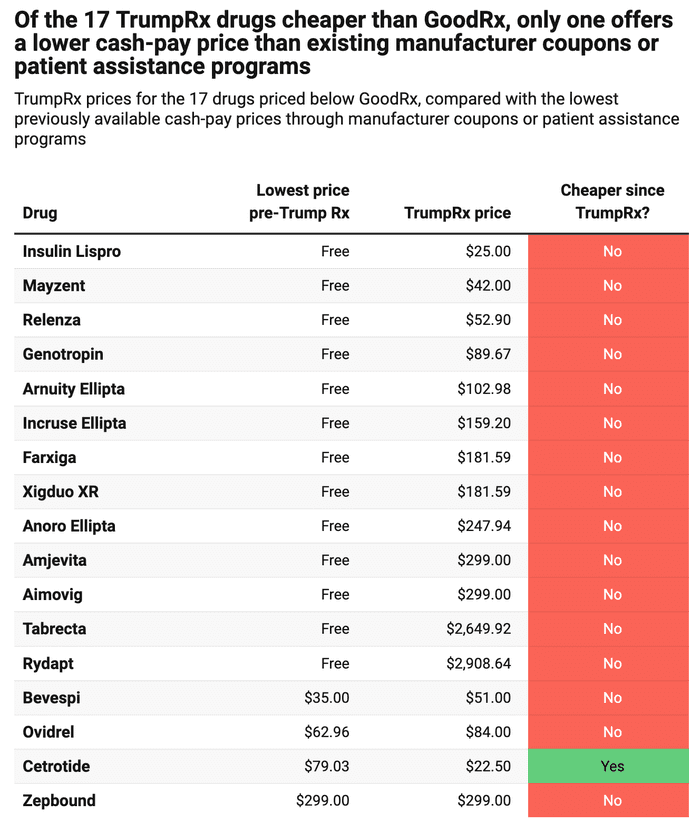
But an analysis released Tuesday by the Center for American Progress (CAP) found that of the 54 medications listed on TrumpRx.gov as of March 16, “exactly one” drug—the fertility medication Cetrotide—is available at a “genuinely new lower price” not available elsewhere.
The CAP analysis emphasized that TrumpRx—touted by the administration as a path to “immediate relief” for consumers in the country with the highest drug prices in the world—is extremely limited by design, listing just 0.2% of all federally approved medications in the US.
Additionally, the terms that site users must accept before gaining access to coupons for discounted prices state that beneficiaries cannot be “enrolled in insurance from any government, state, or federally funded medical or prescription benefit programs.”
Patients also must have a prescription to use TrumpRx for discounts. “According to a KFF analysis,” CAP noted, “nearly half (46.6%) of uninsured adults ages 18 to 64 reported not seeing a doctor or other health professional in 2023.”
“Applied to the estimated 27.9 million adults without insurance in 2026, this means that approximately 13 million Americans will never reach the most basic prerequisite for using TrumpRx: a visit with a clinician who can write a prescription,” CAP added.
The think tank’s analysis found that 17 of the drugs on TrumpRx—or over 30% of them—have genetic equivalents that are available at a lower cost elsewhere, something that the Trump-branded platform doesn’t tell users.
“Among the remaining 37 drugs without lower-cost generics, GoodRx offers comparable or lower prices for 20,” CAP found. “That leaves 17 drugs where TrumpRx appears to offer a better deal. But in 16 of those cases, the same or lower prices were already available through manufacturer coupons and patient assistance programs. After accounting for all existing discount channels, just one drug—Cetrotide, a fertility medication—offers a price that was not previously available to cash-paying patients.”
Neda Ashtari, associate director of health policy at CAP and author of the new analysis, said in a statement that the Trump administration is “undermining the most powerful tool for lowering patients’ costs at the pharmacy counter—health insurance coverage—and replacing it with a government-branded coupon book.”
“For the 22 million Americans whose premiums have doubled, and the millions more who stand to lose coverage,” due to Trump and the GOP’s refusal to extend enhanced Affordable Care Act subsidies, “a $56 discount on a fertility drug is not ‘immediate relief,’” Ashtari added.
CAP’s analysis was released a day before The New York Times and the German news organizations Süddeutsche Zeitung, NDR, and WDR debunked Trump’s claim last month to have delivered the lowest drug prices “in the entire world”—which would be news to the 1 in 3 US adults who say they’ve rationed medications, skipped meals, or made other painful tradeoffs over the past year to afford healthcare expenses.
“The drugs listed on TrumpRx can cost American patients up to hundreds or thousands of dollars, while a patient walking into a German pharmacy pays next to nothing,” the Times observed on Wednesday. “The German health system foots the bill, and records show that, more often than not, it pays less than what the Trump administration negotiated for Americans.”
"With every ICE raid, every escalation abroad, and every abuse of power at home, Americans are rising up in opposition to Trump’s attempt to rule through fear and force."
By Jessica Corbett
As President Donald Trump on Wednesday continued to wage war on Iran, threaten Cuba, and push his mass deportation agenda across the United States, people nationwide were preparing for the next round of No Kings protests on Saturday, March 28.
“Just months ago, millions of people took to the streets across thousands of events to say no to Trump’s abuses of power, and today that movement is only growing,” noted Ezra Levin, co-executive director of Indivisible, one of the organizing groups, in a statement.
There were more than 2,100 demonstrations during the coalition’s first day of action last June. Then, over 2,700 events were held last October. As of Wednesday, just 10 days away from the upcoming mobilization, more than 3,000 events are planned.
“This unprecedented mobilization is the American people saying NO to President Trump’s violent, inhumane treatment of our immigrant neighbors, attacks on our freedom of speech and voting rights, and the weaponization of the federal government.”
The rallies will follow Trump’s deployment of agents with Customs and Border Protection as well as Immigration and Customs Enforcement to Minnesota’s Twin Cities—where CBP and ICE fatally shot two Minnesotans and violated the rights of many more. Local protests and national outrage led to a drawdown, but critics fear similar invasions of other US cities.
“With every ICE raid, every escalation abroad, and every abuse of power at home, Americans are rising up in opposition to Trump’s attempt to rule through fear and force. Each day Trump crosses a new red line, and more people are deciding they’ve had enough,” said Levin. “That is why people across the country are organizing, showing up for their neighbors, and making one thing unmistakably clear: We are done with the corruption, the cruelty, and the authoritarianism.”
Naveed Shah, political director of Common Defense, highlighted that while “we’ve watched citizens killed in the streets by militarized forces” in recent months, the Trump administration has also “dragged us deeper into war: sending brave American service members into harm’s way and leaving their families to carry the weight of that loss.”
In addition to partnering with Israel to launch a war of choice in Iran, Trump this year has sent US forces to abduct Venezuelan President Nicolás Maduro, deployed troops to Ecuador for a joint campaign against “narco-terrorists,” continued to bomb boats allegedly trafficking drugs in international waters, and engaged in “economic warfare” against Cuba while repeatedly threatening to take over the island.
“On March 28, we will come together to show that our communities reject corruption, senseless war, and division,” declared MoveOn Civic Action executive director Katie Bethell.
Human Rights Campaign President Kelley Robinson similarly said that “millions of us will come together to reject the attacks on LGBTQ+ people, the deadly occupation of our cities, and the assaults on our freedoms and demand a nation that lives up to its promise.”
Other advocacy and labor groups in the No Kings coalition include the ACLU, American Federation of Teachers (AFT), 50501, League of Conservation Voters, National Education Association, National Nurses United, Public Citizen, Service Employees International Union, and United We Dream.
“This unprecedented mobilization is the American people saying NO to President Trump’s violent, inhumane treatment of our immigrant neighbors, attacks on our freedom of speech and voting rights, and the weaponization of the federal government,” said Deirdre Schifeling, the ACLU’s chief political and advocacy officer.
At Trump’s direction, Senate Republicans are trying to send the so-called SAVE America Act, a voter suppression bill already approved by the GOP-controlled House of Representatives, to the president’s desk. Opponents warn that the legislation would disenfranchise eligible voters who lack access to proof-of-citizenship documents.
“Trump has promoted violence, hatred, lawlessness, and chaos across the country, proving time and time again that he is not a leader,” argued Public Citizen co-president Lisa Gilbert. “As we approach our country’s 250th birthday, we urge all fellow Americans to join the No Kings movement as a show of patriotism and a vision of the country we deserve.”
Next week’s protests are scheduled just over seven months before the November midterm elections, which will determine whether Trump’s Republican Party keeps control of Congress. The GOP has used its slim majorities in both chambers to impose a 2025 budget package—the One Big Beautiful Bill Act—to pass new tax giveaways to the ultrawealthy while cutting key federal food and healthcare benefits for working-class Americans.
As billionaires enjoy some benefits of GOP policies, working people across the country are struggling with the cost of gasoline, groceries, healthcare, housing, and more. Trump’s contested tariffs and war on Iran are exacerbating the affordability crisis.
“America is at an inflection point. Our communities are hurting. People are afraid, and they can’t afford basic necessities. It’s time the administration listened and helped them build a better life rather than stoking hate and fear,” said AFT president Randi Weingarten. “That’s why record numbers of us will again take to the streets on March 28 to protect our neighbors, schools, and hospitals from the illegal actions of a wannabe king.”
"All of Beirut shook," said one resident who was forced to take shelter in the city after an Israeli displacement order forced her from her home in the suburbs.
By Stephen Prager
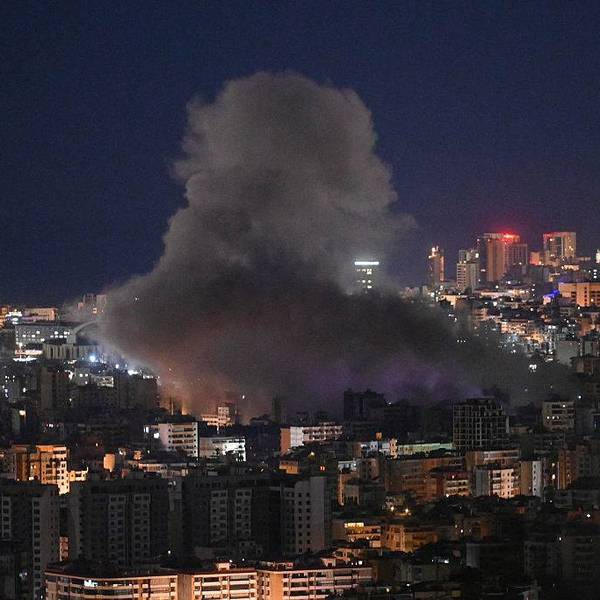
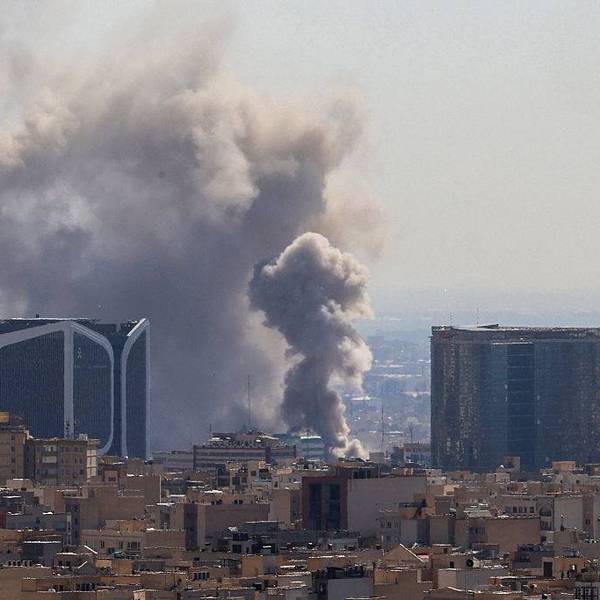
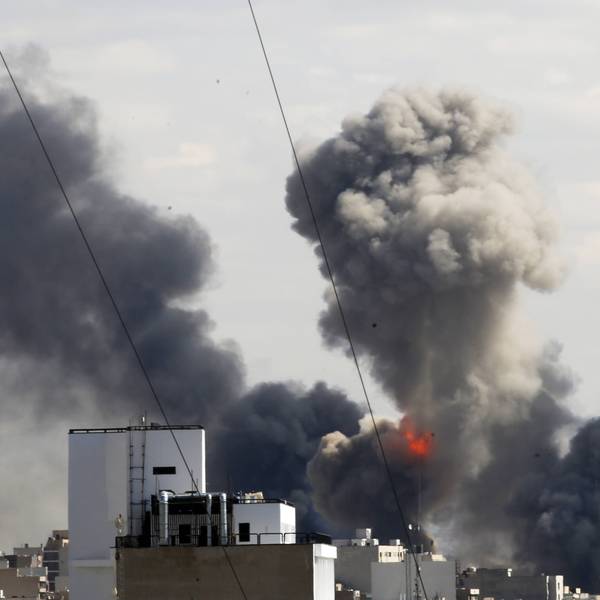
An Israeli airstrike totally demolished a large apartment building in central Beirut on Wednesday, following a night of attacks on densely populated residential areas, several of which reportedly came without warning.
Videos shared to social media and by local media outlets show the 10-story building, located in the Bachoura neighbourhood in central Beirut, suddenly collapsing into rubble in the early hours of the morning after being struck with a missile.
Israeli authorities issued a forced displacement order to residents of the building over social media around 4 am local time, roughly an hour before the strike. It warned residents of buildings in the Bachoura area that they were “located near Hezbollah facilities” and needed to move at least 300 meters away.
Israel has claimed the building was used by the militant group Hezbollah to stash large sums of money, but has provided no evidence publicly.
Citing Lebanon’s Health Ministry, the Associated Press reported that at least four people were wounded in the attack, which sent emergency teams rushing to the scene through a plume of black smoke.
Residents of the collapsed apartment building have taken to social media to describe their horror at seeing their home suddenly destroyed.
“I am a US citizen and surgeon who took care of the Boston Marathon bombing victims in 2013,” said Haytham Kaafarani, a professor of surgery at Harvard Medical School. “I paid for seven years to own a small apartment in downtown Beirut for my three kids to enjoy summers there. Today, Israel reduced my dream home to rubble, with American weapons, paid by my taxes.”
Another professor, Bilal R. Kaafarani, who teaches chemistry at the American University of Beirut, said something similar.
“Israel demolished the building I have an apartment in. It took 22 years of my work here and 20 years of my wife’s work to own this apartment,” he said. “This madness has to stop.”
The attack came after a night of intense airstrikes upon civilian areas in Lebanon’s capital, which reportedly came without warning in the middle of the night and into the early morning.
According to Lebanese authorities, at least 20 people were killed in a series of attacks on Beirut and the southern and eastern parts of the country, while dozens more were injured.
Lebanon’s health ministry reported that more than 900 people have been killed and 2,200 injured in Israel’s latest round of attacks in Lebanon, which began on March 2 after Hezbollah retaliated against the US-Israeli war in Iran.
The attacks beginning Tuesday night came less than a day after Volker Türk, the United Nations High Commissioner for Human Rights, warned that “deliberately attacking civilians or civilian objects amounts to a war crime,” noting that hundreds of homes and other civilian infrastructure, including health facilities, had been destroyed by prior Israeli attacks in Beirut.
Israel has issued evacuation orders that have forced more than 1 million Lebanese people from their homes as part of an expanding ground invasion into southern Lebanon.
Sara Saleh, a 29-year-old taking shelter in a nearby school after being forced from her home in Beirut’s southern suburbs, told the Agence France-Presse that she and her family “were asleep” when Israel’s warning came down early Wednesday morning. She said they were left to flee for safety in their pajamas.
She said the attack on the apartment “was terrifying... all of Beirut shook.” Speaking with a face mask to protect herself from dust kicked up by the demolished building, she said her sister’s children “started crying and panicking, it was heartbreaking.”
The mass displacement of civilians in Lebanon and Iran has been met with increasing criticism from UN experts and human rights organizations.
As reports of the apartment bombing rolled in, Philippe Lazzarini, the commissioner-general of the UN agency for Palestinian Refugees (UNRWA), said that “international law is being openly ignored” and that “impunity reigns and disproportionate actions are being normalized amid the escalating conflicts in the Middle East.”
“It is a vicious circle,” he said. “The more violations, the stronger the culture of impunity becomes.”
One expert warned of a "direct hit on consumer prices" if the Iran war persists.
By Brad Reed
President Donald Trump’s unprovoked and unconstitutional war against Iran has already been raising gas prices for US drivers, and could soon raise the cost of food both in the US and all over the world.
NBC News reported on Tuesday that the price of diesel fuel has now soared above $5 per gallon for the first time since December 2022. If the price of diesel remains high, the report explained, it will raise the price of all goods delivered by trucks throughout the US, including food.
Paul Dietrich, chief investment strategist at Wedbush Securities, told NBC News that diesel prices will become a “direct hit on consumer prices” if they remain elevated, as “groceries get more expensive, delivery costs rise, and household budgets are tightened.”
“Diesel is what moves the real economy,” explained Dietrich. “It hauls the food, the packages, the building supplies, and the inventory sitting on store shelves.”
The cost of diesel isn’t the only factor that could spike food prices, as the Iran war has also put a strain on fertilizer that farmers need to grow crops.
Al Jazeera reported on Wednesday that there is growing concern that the rising price of fertilizer caused by the closure of the Strait of Hormuz could lead to a global food crisis.
As Al Jazeera explained, almost half of the global supply of urea, the most commonly used fertilizer, is shipped from Middle Eastern nations through the Strait of Hormuz.
With the strait closed by Iran in response to US and Israeli attacks, Al Jazeera wrote, “urea export prices from the Middle East have surged by about 40%, rising from just less than $500 to a little more than $700 per metric ton as of last Friday.”
Al Jazeera also cited an estimate from data and analytics firm Kpler projecting that up to one-third of the global fertilizer trade could be disrupted if the strait remains closed for a prolonged period.
Carl Skau, deputy executive director and chief operating officer of the World Food Program, warned on Tuesday that the Iran war could push millions of people into extreme hunger should it persist.
“If this conflict continues, it will send shockwaves across the globe, and families who already cannot afford their next meal will be hit the hardest,” said Skau. “Without an adequately funded humanitarian response, it could spell catastrophe for millions already on the edge.”
WFP said the disruption in fertilizer markets offers “the most recent proof that conflict is the number one driver of hunger.”
“Conflict forces people from their homes, destroys infrastructure, fuels inflation, and wipes out jobs,” said the agency. “All of this makes it nearly impossible for people to find or afford enough food to survive. And children are always hit hardest: A child living in a country ravaged by conflict is more than twice as likely to be malnourished and out of school than their peers in peaceful settings.”
Warnings about the war’s impact on the price of food come as the US economy is showing signs of accelerating inflation.
As reported by CNBC on Wednesday, wholesale prices in February surged by 0.7%, more than double economists’ consensus estimate of 0.3%.
On a year-over-year basis, wholesale prices rose by 3.4% in February—the highest increase in a year.
Spikes in wholesale prices, which reflect the amount that firms pay for inputs for their products, typically also lead to increased consumer prices, as companies pass on their cost increases to customers.
“The report suggests that pipeline inflation pressures remain persistent, particularly on the services side, complicating the Fed’s path as it weighs how long to keep interest rates elevated,” CNBC noted.





















No comments:
Post a Comment
Note: Only a member of this blog may post a comment.