LOTS OF POSTS IGNORED BY BLOGGER.....
ALL POSTS ARE AVAILABLE ON
MIDDLEBORO REVIEW AND SO ON
January 9, 2026
Cover-Up: How One Reporter Spent 50 Years Exposing America’s Murder Inc.
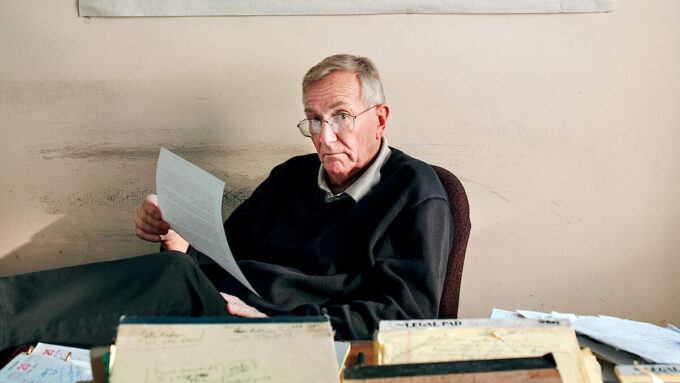
Seymour Hersh, still from Cover-Up (Netflix).
Laura Poitras opens her documentary Cover Up with an interrogation of the interrogator. She presses Seymour Hersh on the one subject that has become his greatest vulnerability and his most sacred shield: his sources. Hersh, both irascible and steadfast, continues to maintain his fortress-like demeanor. Despite presenting the filmmaker with tangible documents containing the names of high-ranking “ghosts” inscribed on them, he remains silent for the sake of documentation. “No,” he barks, “I’m not going to talk about my sources.”
It is a masterful opening, mirroring the anecdotal beginning of Hersh’s memoir, Reporter. It immediately plunges the viewer into the fundamental tension of modern journalism: the distinction between adversarial sourcing and stenographic access. For the “steno-journalists” who populate the White House press corps, a source is a transactional partner—someone who provides a curated “truth” in exchange for the journalist acting as a megaphone for the state. For Hersh, the source is a weapon of sabotage. This refusal to name names is not just professional ethics; it is an act of war against an administrative state that relies on anonymity to commit its crimes and transparency to punish its whistleblowers.
The Mouse Turd and the Pentagon
The film’s narrative arc begins at the Pentagon, the site of Hersh’s “Socratic awakening.” Poitras captures the youthful, gadfly energy of this era, punctuated by the kind of gallows humor that defines the trade. Hersh recalls a lunch with a young Ralph Nader during those early days, when Nader was also challenging the military-industrial behemoth from a consumer safety angle. Nader looked down at Hersh’s plate and pointed out that his salad contained a mouse turd—a tiny piece of filth hidden among the greens.
The anecdote is simultaneously absurd and profound. While the rest of the press corps consumed the entire “salad” of military briefings, Hersh was the only one searching for the hidden filth among the greens. He eventually broke the My Lai story because he was willing to look where the stenographers were trained to look away. He realized early on that the relationship between a journalist and power should be, as H.L. Mencken observed, like that between a dog and a lamppost.
But the mouse turd story also reveals something else about Hersh: a capacity for camaraderie and self-deprecating humor that balances his well-earned reputation for being difficult. The image of two young muckrakers—Hersh and Nader—sharing a laugh over contaminated food while plotting to expose far greater contaminations in the body politic is a reminder that adversarial journalism need not be joyless. Together, as Hersh puts it in the film, they were forming “a tag-team tandem up against the Goliath forces of the public government mask of the Deep State.” The anecdote humanizes Hersh precisely because it shows him in a moment of vulnerability and connection, not as the lone wolf crusader but as someone who understood the value of friendship in the fight against institutional rot.
The Trade Value of Secrets and Why Sources Talk
One of the most revealing moments in Cover Up comes when Poitras presses Hersh on why his sources talk to him. Hersh’s answer is characteristically blunt: “I don’t know if you work in the Secret World, but there are people out there who are actively gathering information. You know, why not talk to me? I don’t know. I don’t psychoanalyze those who talk to me.”
This deflection is itself instructive. To understand Hersh’s career is to understand the “trade value” of secrets. In the ecosystem of Washington, D.C., a secret is a high-stakes currency. For the adversarial journalist, a secret is used to bankrupt the state’s credibility. However, the government’s “secret sharers” often use secrets as bait. This is the dark legacy of Project Mockingbird, the CIA’s mid-century initiative to recruit journalists as assets to facilitate the spread of propaganda.
When the state “shares” a secret with a stenographer, it is often a managed leak designed to manipulate public perception or neutralize a coming scandal. The trade value for the journalist is “access”—the prestige of being “in the know”—but the cost is their independence. Hersh’s brilliance lies in his ability to navigate this minefield. He takes the secret but refuses the leash. Unlike Judith Miller, whose “exclusive” secrets about WMDs facilitated the Iraq War, Hersh views the secret as a Socratic opportunity to reveal the truth, not as a reward for compliance.
Hersh articulates his philosophy clearly in the film:
My job as a newspaper reporter is to find out secrets and facts. You publish these secrets, fully aware that we are violating rules and laws and compromising national security. It’s top secret information above top secret, because we think there’s an outstanding reason. We think there’s a story here of officials with responsibility not conducting their affairs correctly.
Reporting such secrets is akin to the Necessity Defense. (The CIA’s secret wars in Latin America became so egregious that activists eventually found a legal weapon to expose them: the necessity defense, a legal doctrine that allows defendants to argue they broke the law to prevent a greater harm. In the 1980s, Abbie Hoffman successfully used this defense in his trial as an anti-CIA activist on the campus of UMass-Amherst, transforming the courtroom into a forum where evidence of CIA atrocities in Latin America was presented to the jury, effectively putting the Agency itself on trial for its crimes against democracy.)
This formulation is crucial. The point of a classification violation is accountability. Hersh operates according to a higher law than the state’s obsession with secrecy. He identifies what he calls “self-censorship by the press” the greater threat: “I think what you have in America is not so much censorship but self-censorship by the press.” It is the internalization of the state’s priorities by journalists themselves that makes stenography so effective.
Realpolitik and the 40 Committee
The meat of the film concerns the “Kissinger Doctrine.” Poitras uses archival snippets to bring us into the heart of the 40 Committee, the secret body that oversaw the subversion of foreign democracies. Here, we discover the soul of American Realpolitik: Kissinger’s infamous 1970 proclamation regarding the election of Salvador Allende (and its wider implication about democracy, in general):
“I don’t see why we need to stand by and watch a country go communist because of the irresponsibility of its own people. The issues are much too important for the Chilean voters to be left to decide for themselves.”
This doctrine remains the definitive modus operandi of modern foreign policy. (One can see how it functions today in the destabilization of the Venezuelan government and the subsequent kidnapping of its leadership). It is the “Abyss” that Senator Frank Church warned of in 1975—a surveillance apparatus so powerful that it creates a tyranny from which there is “nowhere to hide.”
Frank Church on Meet the Press
Caption: The Abyss Foretold: Senator Frank Church warns of a domestic tyranny that would render traditional journalism—and democratic dissent—obsolete.
The Empire and the “Turd Blossom”
The film eventually leads to the era of “reality-making.” As Ron Suskind reported, a senior advisor (believed to be Karl “Turd Blossom” Rove) mocked the press as the “reality-based community,” asserting that the Empire creates its own reality while journalists are left to “judiciously study” the debris.
In this environment, Hersh’s adversarialism becomes institutional apostasy. When Hersh challenged the Obama-controlled narrative of the bin Laden raid in Abbottabad, or when he voiced skepticism regarding the sarin gas attacks in Syria, he was blaspheming against the Empire’s manufactured reality. In the film, when pushed on the sarin error, Hersh simply shrugs. He admits that errors are part of the game of secrets revealed. He would rather be wrong while hunting the truth than be “right” by transcribing a state-sponsored fiction.
This moment captures something essential about Hersh’s methodology. Late in the film, when discussing his reporting on the Nord Stream pipeline sabotage—which implicated the Biden administration—Hersh addresses the criticism that he relies on single sources. His response is unrepentant: “What am I going to do? I can’t write about who else I know was brought in I cannot disclose the names of the sources from the Army or the Air Force because doing so would expose them. Even if there’s nine sources, sometimes it’s much better just to make it one.”
Critics will pounce on this admission as evidence of sloppy journalism. But Hersh’s point is more sophisticated: the protection of sources is not merely ethical window dressing but the precondition for all adversarial reporting. When he says, “I’ve got 20 years of working with the guy that I’ve been wrong on. Time after time, I’m told things that turn out to be right,” he is articulating a form of journalistic trust that exists outside the official methodologies taught in J-schools. It is a trust built on results, not credentials.
The Missing Chronicles: Gaza and Nord Stream
While Poitras spends time on the “Dark Side of Camelot,” Cover Up notably sidelines Hersh’s most recent stings. There is no mention of his Substack reporting on the Nord Stream pipeline—where his sources point to the Biden administration—nor his skepticism regarding the Israeli intelligence failures of October 7th. He remains a “heretic” in the eyes of the media pack that has consolidated around the official narratives of the Ukraine and Gaza conflicts.
Yet the film does gesture toward Hersh’s ongoing work on Gaza through a brief but powerful scene late in the documentary. Hersh speaks with a researcher recently returned from Gaza who describes the systematic targeting of children with quadcopter-mounted weapons. The researcher shares X-rays showing bullets lodged in the necks and heads of young victims. Hersh’s response is succinct: “A fucking nightmare. And we’re only in the first stage of it.”
The scene is brief, but it connects the My Lai massacre to the present moment. Just as Hersh documented the murder of Vietnamese civilians, he is now documenting the murder of Palestinian children. The continuity is not merely thematic—it is methodological. In both cases, Hersh relies on sources who are horrified by what they have witnessed and who believe the public has a right to know.
Poitras’s Lens: The Trilogy of Exile and Dissidence
Cover Up is the spiritual prequel to Poitras’s Citizenfour (Snowden) and Risk (Assange), but it also represents a departure in her filmmaking approach. With Snowden, Poitras was present at the moment of revelation—she filmed him in that Hong Kong hotel room as he prepared to become the world’s most famous whistleblower. With Assange, Poitras captured the gradual breakdown of a man under constant pressure, stemming from both external factors and his paranoia.
With Hersh, Poitras faces a different challenge: how do you document the work of a journalist whose entire career has been built on protecting sources and operating in the shadows? Her solution is to make the documentary about the process of investigative journalism rather than a singular revelation. She lets Hersh’s notebooks speak for They filmed him leafing through decades of handwritten notes that are filled with the names of CIA operatives, military officers, and Pentagon insiders.
The documentary’s aesthetic is deliberately rough-hewn. Poitras doesn’t glamorize Hersh. We see him in his cluttered apartment, arguing with his editors on the phone, expressing frustration and despair. At one point, he threatens to quit the documentary itself: “You guys know too much about what I’m doing. You have too many people. There’s people there. You don’t even realize who they are.” The moment is electrifying as it unveils a paranoia that is not pathological but rather logical for an individual who has dedicated 50 years to the illicit trade of state secrets.
But where Citizenfour ends with Snowden in exile in Russia and Risk ends with Assange’s eventual extradition and imprisonment, Cover Up ends with Hersh still standing. He is 87 years old, still reporting, still writing for Substack, and still taking on the intelligence agencies. The irony is heavy: Assange has been returned to Australia a ghost of his former self, and Snowden has been absorbed by the draconian silence of wartime Russia. They are the victims of the “Abyss” Frank Church prophesied.
Hersh, however, remains. His parents fled the massacres in Lithuania, and that ancestral memory of state-sponsored slaughter informs his moral core. He knows that the “Empire” only creates “new realities” to hide old bodies. In one of the film’s most poignant moments, Hersh recalls his father’s death from lung cancer and his inability to say goodbye in a family that “couldn’t say goodbye” and “was an unthinking family.” The trauma of silence—the refusal to speak of the Holocaust, the refusal to acknowledge suffering—becomes the psychological origin of Hersh’s compulsion to expose every buried secret.
Poitras’s genius is to connect Hersh’s personal biography to his professional mission. Unlike Snowden and Assange, who were young men when they became whistleblowers, Hersh has been doing this work for over half a century. He is not a martyr; he is a survivor. And Cover Up is not a hagiography—it is a portrait of what it costs to survive as an adversarial journalist in an empire built on lies.
Coda: The Rat Cage and the Present
Even when he is sidelined, even when he is “wrong,” Seymour Hersh remains the only one willing to point out the mouse turd in the state’s salad. As I wrote in my review of Raoul Peck’s Orwell: 2+2=5, “The rat cage tied to the face has gone from metaphor to reality.” The present’s surveillance and assassination programs have literalized Orwell’s vision of totalitarian torture. Hersh has spent his career documenting this process, from My Lai to Abu Ghraib to the drone assassination programs to Gaza, which features soul-leeching facial recognition technology..
In Cover Up, Poitras presents us with a portrait of a man who refuses to stop looking. Even at 87, Hersh is still chasing secrets, protecting sources, and willing to be wrong in pursuit of the truth. His mantra, articulated near the end of the film, is simple:
You can’t have a country that does that. That’s why I’ve been sort of on the warpath ever since. You can’t just have a country that does it and looks the other way. If there’s any mantra to what I do, that’s it.
It is a modest statement of purpose, but it contains within it the entire architecture of adversarial journalism. The work is not about heroism or martyrdom—it is about the refusal to look away. Poitras understands this. Her trilogy of dissidence—Snowden, Assange, Hersh—is ultimately about the cost of seeing clearly in an empire that demands blindness.


No comments:
Post a Comment
Note: Only a member of this blog may post a comment.