UNDER CONSTRUCTION - MOVED TO MIDDLEBORO REVIEW AND SO ON
https://middlebororeviewandsoon.blogspot.com/
Monday, December 1, 2025
Top News | White House Claims Trump 'Has the Authority to Kill' Survivors of Boat Strikes
Stand With Independent Media This Giving Tuesday
As corporate influence grows, independent journalism is more important than ever. If you value reporting that puts people and the planet first, please support Common Dreams this Giving Tuesday. We couldn't do it without you—thank you for keeping independent journalism alive.
One legal expert called the press secretary's remarks "painful" to watch and warned of "how the reported patently illegal orders will affect US service members."
By Jessica Corbett
While continuing to deny that the Pentagon chief ordered those carrying out the first known US military strike on an alleged drug-running boat to “kill everybody” on board, the top White House spokesperson on Monday reiterated the administration’s position that President Donald Trump has the authority to take out anyone he deems a “narco-terrorist.”
Rights advocates, legal scholars, American lawmakers, and leaders from other countries have condemned the boat bombings in the Caribbean and Pacific Ocean, which began on September 2, as murders, and rejected the Trump administration’s argument to Congress that the strikes are justified because the United States is in an “armed conflict” with drug cartels.
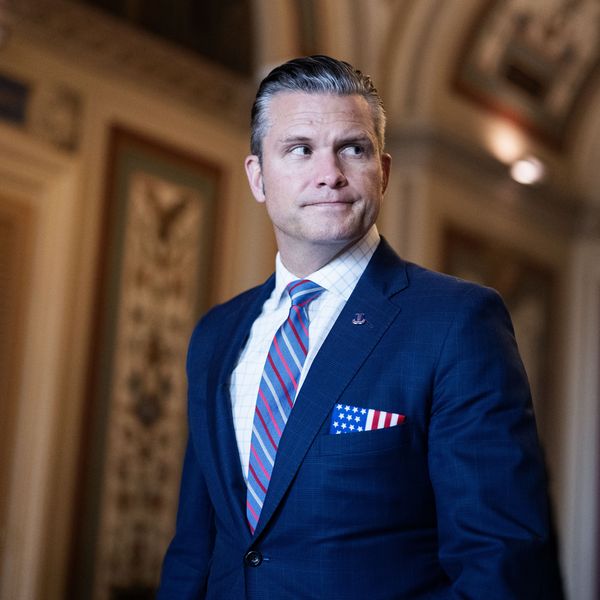
A week after the first bombing, the Interceptreported that people on board survived but were killed in a follow-up attack. The Washington Postprovided more details on Friday, including that Adm. Frank M. “Mitch” Bradley ordered a second strike on two survivors to fulfill US Defense Secretary Pete Hegseth’s alleged directive to kill everyone.
CNN also spoke with an unnamed source who confirmed Hegseth’s supposed edict—which the White House press secretary, Karoline Leavitt, denied on Monday.
During Monday’s press briefing, NBC News White House correspondent Gabe Gutierrez noted Trump’s “confidence” in Hegseth’s claim that he did not give an explicit order to kill everyone on the first vessel, and asked Leavitt, “Does the administration deny that that second strike happened, or did it happen and the administration denies that Secretary Hegseth gave the order?”
“The latter is true,” Leavitt said. She then read a statement that she often referred back to throughout the briefing:
President Trump and Secretary Hegseth have made it clear that presidentially designated narco-terrorist groups are subject to lethal targeting in accordance with the laws of war. With respect to the strikes in question on September 2, Secretary Hegseth authorized Adm. Bradley to conduct these kinetic strikes. Adm. Bradley worked well within his authority and the law, directing the engagement to ensure the boat was destroyed and the threat to the United States of America was eliminated.
“And I would just add one more point,” Leavitt continued, “to remind the American public why these lethal strikes are taking place: Because this administration has designated these narco-terrorists as a foreign terrorist organizations, the president has a right to take them out if they are threatening the United States of America, and if they are bringing illegal narcotics that are killing our citizens at a record rate—which is what they are doing.”
Asked by Gutierrez to confirm Bradley ordered the second strike, Leavitt did so, saying that “he was well within his right to do so.”
Multiple other reporters also inquired about the recent reporting, including Fox News senior White House correspondent Jacqui Heinrich, who said: “You said that the follow-up strike was lawful. What law is it that allows no survivors?”
Leavitt responded: “The strike conducted on September 2 was conducted in self-defense to protect Americans and vital United States interests. The strike was conducted in international waters and in accordance with the law of armed conflict.”
Noting that exchange on social media, former Congressman Justin Amash, a Michigan Republican, said: “This is not how self-defense works. Everyone understands that self-defense requires an immediate physical threat and proportionality. Repelling a missile attack with a missile is self-defense. Blowing up boats hundreds of miles from US shores is not. This isn’t complicated.”
“This is not how self-defense works... Repelling a missile attack with a missile is self-defense. Blowing up boats hundreds of miles from US shores is not.
Ryan Goodman, a former Pentagon special counsel who’s now a New York University law professor and Just Security coeditor-in-chief, also weighed in. “This has got to be one of [the] most painful responses to watch,” he said, also pointing out that “the ‘law’ Leavitt cites is utterly irrelevant (self-defense is non sequitur, it’s not armed conflict, and ‘no survivors’ is a crime).”
“Part of the pain in watching that response is knowing how the reported patently illegal orders will affect US service members,” Goodman added, referring to a new Just Securityessay by Mark P. Nevitt, a retired judge advocate general who is now an associate law professor at Emory University.
Notably, Trump suggested last month that Democratic members of Congress who previously served in the US military and intelligence service and recently warned service members of their duty not to comply with illegal orders should be hanged. The Pentagon has since threatened to court-martial one of them: Sen. Mark Kelly (D-Ariz.), a retired US Navy captain.
c by CBS News senior White House correspondent Weijia Jiang about Hegseth’s reported spoken directive to kill everybody on the boat. Using Trump’s preferred term for the Defense Department’s leader, she said: “I saw that quoted in a Washington Post story. I would reject that the secretary of war ever said that. However, the president has made it quite clear that if narco-terrorists... are trafficking illegal drugs toward the United States, he has the authority to kill them, and that’s what this administration is doing.”
According to a CNNtimeline, from September 2 to November 15, at least 22 US boat strikes killed 83 people and left two survivors who were initially taken onto a warship but ultimately returned to their home countries of Colombia and Ecuador.
So far, Congress has failed to advance war powers resolutions intended to stop Trump’s boat-bombing spree. However, since the Post reporting, top Democrats on both the US House and Senate Armed Services Committees have promised vigorous oversight.
Following Leavitt’s remarks on Monday, the New Republic‘s Greg Sargent said that “it’s doubly relevant that Adm. Bradley is in talks about briefing the House Armed Services Committee,” and pointed to his new interview with Congressman Adam Smith (D-Wash.), the panel’s ranking member.
The congressman told Sargent he will pressure GOP members of the committee, including Chair Mike Rogers (R-Ala.), to “use whatever leverage is available to us to try to get answers,” including subpoenaing top civilian and military officials.
Smith also discussed the reporting during a weekend appearance on MS NOW. Posting a clip of it on social media Monday, he declared that “Americans want to live in a constitutional republic, not an authoritarian dictatorship.”
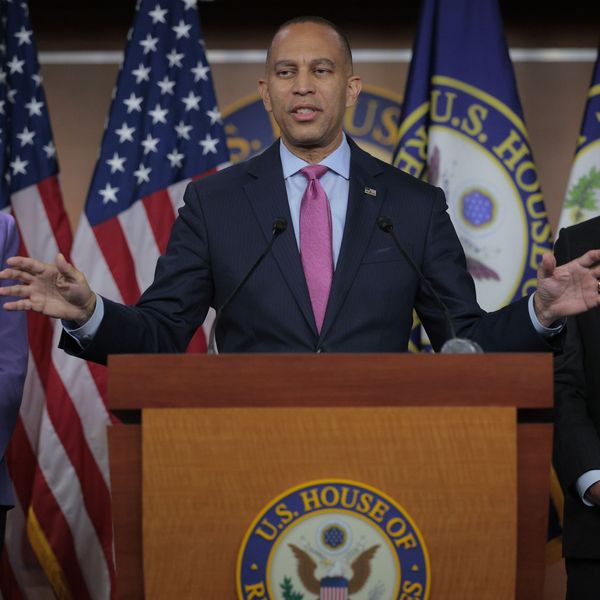
Meanwhile, Senate Minority Leader Chuck Schumer (D-NY) said on the chamber’s floor Monday that “I don’t think we have ever seen someone so unserious, so childish, so obviously insecure serving as secretary of defense as Pete Hegseth—and that should alarm every single one of us.”
Schumer called on Hegseth to release the tapes “that would show exactly what happened during these military strikes,” and to “come before the Congress to testify under oath about the nature of his order, the evidence supporting the strikes, and an explanation for what the goals are in Venezuela.”
Democratic State Sen. Fady Qaddoura, who immediately filed legislation to ban mid-decade redistricting, called the new map an illegal "racial gerrymander."
By Stephen Prager
After months of escalating attacks against Indiana’s Republican lawmakers by President Donald Trump, the state House GOP has revealed a new map for the 2026 midterms designed to hand every US House seat in the state to Republicans.
Republicans won 58% of the vote across Indiana’s US House elections in 2024, granting them an already overrepresentative seven of the state’s nine congressional seats. The new map, published Monday, would eliminate the remaining two seats in the state held by Democrats.
As Bolts magazine editor and founder Daniel Nichanian explained on social media, under the new map, “Indianapolis would be cracked into GOP seats, and Gary would be drowned in red.” In other words, the new map would transparently dilute the power of Indiana’s two largest concentrations of nonwhite voters.
The redrawing of Indiana’s map comes amid a wider push spearheaded by Trump for Republican states to pursue unprecedented mid-decade gerrymandering in hopes of clinging to a governing trifecta against what is expected to be a wave year for Democrats in 2026.
A similar effort has been undertaken in Texas to potentially add five more seats to the GOP ranks, which is currently under appeal at the US Supreme Court. Trump has likewise pressured Republican lawmakers in Missouri, Utah, and North Carolina to draw maps that would net the GOP even more seats. This power grab has been met with redistricting efforts by some blue states, most notably California, which passed a new map last month, likely adding five more seats to the Democratic column.
Indiana’s new map could be put to a vote in the state House as soon as December 8, where it would then be kicked up to the Senate. That is where Trump has run into some resistance, and he hasn’t taken it well.
In mid-November, a group of 19 Republican state senators joined a united Democratic caucus to vote down the new map—one of the no votes, state Sen. Kyle Walker (R-33), said he’d “spent the past several months listening closely to [his] constituents on mid-decade redistricting” and found “93% opposed.”
After the map was voted down, Trump lit into some of the holdouts in a rant on Truth Social. He said he was “disappointed” in the senators who voted against the map, adding that “any Republican that votes against this important redistricting, potentially having an impact on America itself, should be PRIMARIED,” before calling to “get them out of office ASAP” if they failed.
Trump identified two specific lawmakers—Senate Pro Tem Rod Bray (R-37) and Sen. Greg Goode (R-38)—as the “RINO Senators” most responsible for the vote failing.
Within hours of the post, Goode was targeted by a “swatting” attack, in which an anonymous person placed a fraudulent emergency report in hopes of provoking a SWAT team or other large law enforcement response at the target’s residence.
Four other Republicans, all of whom had voiced opposition to the map, were also swatted. Another received a bomb threat at his business. And on Monday, another opponent of the map, Sen. Jean Leising (R-42), said she’d received a pipe bomb threat over the weekend, which she blamed on “DC political pundits” in favor of redistricting.
As NBC Newsreported Monday, at least 10 Indiana Republican lawmakers have received violent threats since Trump’s rant—most of whom have been opponents of redistricting.
Indiana Gov. Mike Braun (R) also received threats after catching heat in Trump’s rant. But he joined Trump’s attacks on the Republican caucus, specifically Bray, who he said “was forced to partner with DEMOCRATS to block an effort by the growing number of America First Senators who wanted to have a vote on passing fair maps.”
Fearful of the wrath of Trump and Braun, Indiana’s House reconvened last week. And after saying that the Senate would not reconvene in December, Bray said it would do so on December 8 to “make a final decision… on any redistricting proposal sent from the House.”
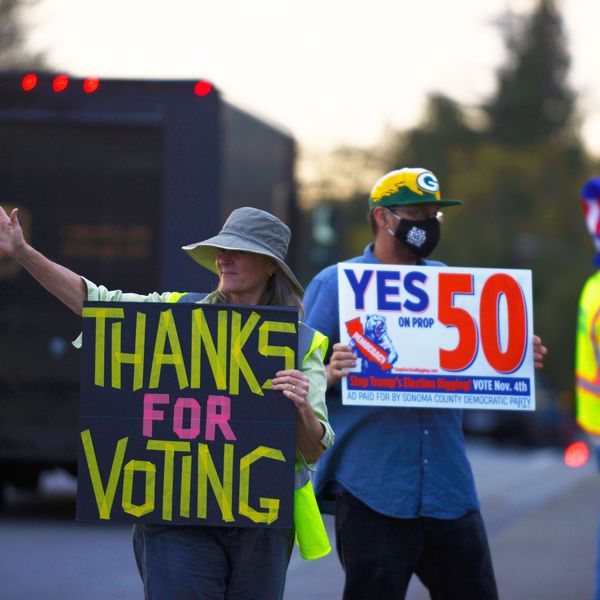
Within an hour of Monday’s announcement of the GOP map, Democrats, led by state Sen. Fady Qaddoura (D-30), said they planned to introduce legislation to ban mid-decade gerrymandering.
“Voters should choose their leaders, not the other way around,” said Qaddoura, who added that the map was “racially gerrymandered.”
If the map does pass the Senate, this may present an obstacle. Texas’ map is under review by the US Supreme Court after a GOP-majority lower court ruled that the legislature had redrawn districts “based on their racial makeup,” which is illegal under Section 2 of the Voting Rights Act.
But its passage in the state Senate is far from certain. Despite continued pressure from the White House, Politicoreports that Bray remains opposed. Meanwhile, Walker has accused the White House of violating the Hatch Act when it invited him to meet with Trump to discuss redistricting.
Trump also lost another ally this weekend in Sen. Mike Bohacek (R-8), who announced that he’d be voting no on redistricting after Trump referred to Minnesota Gov. Tim Walz (D) as “retarded” in an unhinged Thanksgiving Day social media rant.
“I have been an unapologetic advocate for people with intellectual disabilities since the birth of my second daughter,” Bohacek said, noting that his daughter has Down syndrome. “This is not the first time our president has used these insulting and derogatory references, and his choices of words have consequences. I will be voting NO on redistricting, perhaps he can use the next 10 months to convince voters that his policies and behavior deserve a congressional majority.”
The GOP map remains largely unpopular among Hoosiers. The most recent survey, conducted by the Virginia-based firm Bellwether Research, found that among its sample of 800 voters, “51% didn’t want redistricting now—with 45% ‘strongly’ opposed. About 39% supported the prospect, but just 23% ‘strongly’ backed it,” as Indiana Public Mediareported.
As the map was introduced on Monday, hundreds of Hoosiers gathered inside the State Capitol to voice their disapproval.
“At a time when Hoosiers are facing high costs for childcare, groceries, utilities, housing, and health care, the last thing needed is politicians manipulating maps instead of solving real issues,” Qaddoura said. “Hoosiers deserve fair elections, stable districts, and a government that reflects them.”
One British lawmaker condemned the agreement as "a Trump shakedown of the NHS."
By Jake Johnson
The government of British Prime Minister Keir Starmer faced swift backlash on Monday after the Trump administration announced a deal under which the United Kingdom’s prized National Health Service would pay higher prices for new medicines in exchange for tariff exemptions.
The agreement in principle, outlined in a statement by the Office of the United StatesTrade Representative, was seen by UK lawmakers and advocacy groups as a gross capitulation to US President Donald Trump and the pharmaceutical industry that would harm the NHS and British patients for years to come.
“Giving in to Big Pharma’s demands to hike the price of medicines spells disaster for our NHS, and for the lives of ordinary people,” said Global Justice Now, a UK-based group. “We are being held to ransom. Our government must stand up to Big Pharma and for our NHS by reversing course.”
Under the three-year deal, the NHS would boost the net price it pays for new pharmaceutical drugs, many of which emerge from the US, by 25%—a change that’s expected to cost British taxpayers roughly £3 billion. In return, Trump has agreed not to impose tariffs on UK pharmaceuticals.
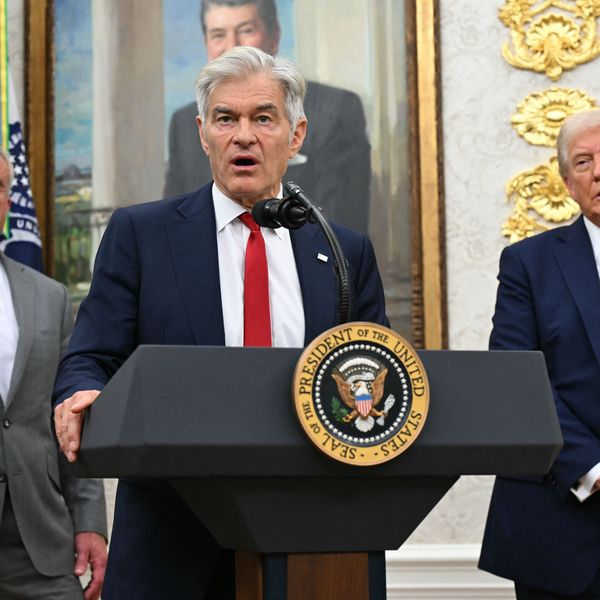
Helen Morgan, the Liberal Democrat MP for North Shropshire, denounced the new agreement as “a Trump shakedown of the NHS.” As evidence, she pointed to US Health and Human Services Secretary Robert F. Kennedy Jr.'s celebration of the bilateral deal.
“It cannot go ahead,” said Morgan. “RFK Jr. has put it in black and white: Trump demanded these pay rises to put Americans first, and our government rolled over. Patients stuck on crammed hospital corridors, or unable to get an ambulance, won’t forget it.”
“The British people didn’t vote for this,” Morgan added. “The government must put this agreement to a vote in parliament.”
Andrew Hill, a visiting health economics researcher at the University of Liverpool, similarly criticized the deal.
“The UK hasn’t benefited from this at all, but we’re having to pay all this extra money,” said Hill. “More money spent on drugs means less money spent on ambulances, doctors, nurses, simple health interventions.”
In addition to facing the threat of Trump tariffs, the UK government was under pressure from the powerful pharmaceutical industry to jack up NHS drug spending. The Guardianreported in September that “big pharmaceutical companies have ditched or paused nearly £2 billion in planned UK investments so far this year” as the firms “accused the government of not spending enough on new medicines.”
Survey data released just ahead of Monday’s deal announcement shows that 64% of the British public is opposed to the NHS paying higher prices for medicines.
“This is a betrayal of NHS patients,” said Diarmaid McDonald, executive director of the advocacy group Just Treatment. “Big Pharma have got what they want. Donald Trump has got what he wants. In the face of their coordinated threats, the government has folded and thousands of patients will pay for this with their lives, as precious funds get stripped from other parts of the health service to line the pockets of rich pharmaceutical execs.”
“MPs need to urgently hold the government to account,” McDonald added, “and demand they publish the evidence showing the impact of this catastrophic move.”
“This outrageous giveaway to Big Pharma does nothing to lower prices in the United States. It only hurts UK patients.”
Asked at a Monday press briefing if the deal would actually benefit US patients and consumers, as the Trump administration has claimed, or if the alleged revenue generated by the agreement would just be “sucked up” by the drug companies, White House Press Secretary Karoline Leavitt did not have an immediate answer.
“I’m going to be honest with you, Ed,” Leavitt told the reporter: “I’ll get you an answer to that question after the briefing.”
Peter Maybarduk, Public Citizen’s Access to Medicines director, argued in a statement that the agreement wouldn’t help Americans or Britons.
“ Drug prices are far too high everywhere, including in the UK, backed by patent monopolies and contributing to rationing and preventable suffering,” said Maybarduk. “This outrageous giveaway to Big Pharma does nothing to lower prices in the United States. It only hurts UK patients while distracting from the serious action needed at home to hold Pharma accountable and make medicine affordable and available for all.”
"Even when fighting stops, these hidden killers remain active for decades, continuing to destroy lives long after the combat has stopped," said one campaigner.
By Jessica Corbett
The 27th annual Landmine Monitorreport revealed on Monday that antipersonnel landmines and other explosive remnants of war killed at least 1,945 people and injured another 4,325 in 2024—the highest yearly casualty figure since 2020 and a 9% increase from the previous year.
Since the Mine Ban Treaty entered into force in 1999, “casualty records have included 165,724 people recorded as killed (47,904) or injured (113,595) or of unknown survival outcome (4,225),” according to the new report from the Nobel Peace Prize-winning International Campaign to Ban Landmines (ICBL).
The ICBL published the report as state parties to the treaty kicked off a meeting in Geneva, Switzerland. It details not only casualties but also treaty updates; production, transfers, and stockpiles of mines; alleged or confirmed uses; existing contamination; and international efforts to aid victims and clean up impacted regions.
Also known as the Ottawa Treaty, it is now supported by 166 countries, after the Marshall Islands ratified the pact in March and Tonga acceded in June. Despite that progress, there have also been steps backward, as Mark Hiznay, Landmine Monitor editor for ban policy, highlighted in a Monday statement.
“Five states renounced their treaty obligations in a matter of months,” Hiznay said, “when evidence shows if they use mines, it can take decades and enormous resources to clear contaminated land and assist the new victims, who will feel the impact of mine use long after the conflict has ceased.”
The state parties in the process of legally withdrawing are Estonia, Finland, Latvia, Lithuania, and Poland. ICBL director Tamar Gabelnick argued Monday that “governments must speak out to uphold the treaty, prevent further departures, reinforce its provisions globally, and ensure no more countries use, produce, or acquire antipersonnel mines.”
“Turning back is not an option; we have come too far, and the human cost is simply too high,” Gabelnick warned.
There have been recent reports of mine use by both state parties to the pact and countries that have refused to embrace the treaty. The publication notes alleged use by government forces in Myanmar; by Iran, along its borders with Afghanistan and Pakistan; and by North Korea, along its borders with China and South Korea. Additionally, in July, Thailand accused a fellow state party, Cambodia, of using mines along their disputed border. Cambodia has denied the allegations.
Another state party, Ukraine, is trying to unlawfully “suspend the operation” of the treaty while battling a Russian invasion, and the report points to “increasing indications” of mine use by Ukrainian forces in 2024-25. Russia—one of the few dozen nations that have not signed on to the agreement—has used mines “extensively” since invading its neighbor in February 2022.
The United States has also never formally joined the treaty and has come under fire for recent decisions. After initially aiming to accede to the treaty, the outgoing Biden administration last year approved a plan to provide antipersonnel landmines to Ukraine. This year, the Trump administration has made deep cuts to foreign aid that have disrupted mine clearance operations.
“Even when fighting stops, these hidden killers remain active for decades, continuing to destroy lives long after the combat has stopped,” Anne Héry, advocacy director at the group Humanity & Inclusion US, said in a Monday statement. “States parties must live up to their obligations under the Mine Ban Treaty: to condemn, in the strongest possible terms, any use of antipersonnel mines by any actor, under any circumstance.”
“A large part of the victims recorded in the Landmine Monitor 2025, like in the previous years, are injured or killed by landmines and explosive remnants long after the fighting has ended, when people return to their homes believing they can start a new life,” she continued. “Landmines are truly barbaric weapons that kill and injure largely outside periods of active conflict.”
On Wednesday, Humanity & Inclusion US executive director Hannah Guedenet will join fellow experts for a virtual briefing “to discuss the latest Monitor reports, the human cost of these weapons, and the role US leadership must play at this pivotal moment,” the group leader previewed in a Monday opinion piece for Common Dreams.
“Bringing these insights directly to policymakers and advocates is essential to strengthening global norms and advancing effective solutions,” she wrote. Despite never joining the Mine Ban Treaty or the 2010 Convention on Cluster Munitions, “the United States has long been one of the world’s largest supporters of mine clearance and victim assistance, helping make former battlefields safe for farming, economic investment, and community life.”
“The case for action is both moral and pragmatic. Every mine removed or cluster bomb destroyed reopens land for cultivation, enables displaced families to return home, and prevents future casualties. These are tangible, measurable outcomes that support US foreign policy priorities: stability, economic recovery, and the protection of civilians in conflict,” she added. “In a time of never-ending partisan fights, this is a place where both sides can come together and agree on the right steps forward.”
“We need to confront climate change effectively,” Indonesia's president said.
By Stephen Prager
More than 1,100 people across South Asia have died after torrential rains fueled by warming temperatures caused widespread flooding and landslides in recent days.
Following days of unprecedented cyclone conditions, people across Indonesia, Malaysia, and Thailand have been left with their homes destroyed and forced to flee for their lives. A separate cyclone in Sri Lanka has left hundreds more dead.
The worst devastation has been seen in Indonesia, where Cyclone Senyar has claimed over 500 lives as of Sunday. On the island of Sumatra, rescue teams have struggled to reach stranded people as roads have been blocked by mudslides and high floodwaters. Many areas are still reportedly unreachable.
As Reuters reported Monday, more than 28,000 homes have been damaged across the country and 1.4 million people affected, according to government figures. At least 464 were reported missing as of Sunday.
Other countries in the region were also battered. In Thailand, the death toll was reported at 176 as of Monday, and more than 3 million people are reported to be affected. The worst destruction has been in the southern city of Hat Yai, which on November 21 alone experienced 335mm of rain, its single largest recorded rainfall in over 300 years.
At least two more have been killed in Malaysia, where nearly 12,000 people still remain in evacuation centers.
Sri Lanka has witnessed similar devastation in recent days from another storm, Cyclone Ditwah, that formed around the same time as Senyar. Floods and mudslides have similarly killed at least 330 people, and destroyed around 20,000 homes, while leaving around a third of the country without electricity. More than 200 people are missing, and over 108,000 are in state-run shelters, officials say.
Work has begun in Indonesia to restore damaged roads, bridges, and telecommunication services. But after he visited survivors in Sumatra, Indonesian President Prabowo Subianto said that the work will extend beyond merely recovering from the storm.
“We need to confront climate change effectively,” Prabowo told reporters. “Local governments must take a significant role in safeguarding the environment and preparing for the extreme weather conditions that will arise from future climate change.”
Southeast Asia was top-of-mind for many attendees at last month’s COP30 climate summit in Brazil. As Winston Chow, a professor of urban climate at Singapore Management University and part of the UN’s Intergovernmental Panel on Climate Change (IPCC), told the Straits Times, this is becausethe region “is highly vulnerable to climate change.”
“As a whole, it faces multiple climate risks and hazards, such as rising temperatures, sea-level rise, increasing droughts and floods, and the intensification of extreme events like typhoons,” he continued.
In recent years, the region has been hit by annual devastating heatwaves, resulting in record-shattering temperatures. In Myanmar, where temperatures exceeded 110°F last April, Radio Free Asia reported that 1,473 people died from extreme heat in just one month.
Floods have likewise grown more deadly in recent years. Just this month, floods killed dozens more people in Vietnam, and a pair of typhoons killed hundreds more in the Philippines and forced over a million people to evacuate their homes.
While it’s difficult to determine the extent to which any one disaster was caused by climate change, in aggregate, they are growing more intense as the planet warms.
“As the world’s oceans and atmosphere warm at an accelerating rate due to the rise in greenhouse gases from burning fossil fuels, tropical cyclones are expected to become more intense,” explained Steve Turton, an adjunct professor of environmental geography at CQUniversity Australia in TheConversation on Sunday. “This is because cyclones get their energy from warm oceans. The warmer the ocean, the more fuel for the storm.”
According to the National Centers for Environmental Information, part of the US National Oceanic and Atmospheric Administration, October 2025 was the third-warmest October on record globally and had above-average tropical cyclone activity.
“The warming atmosphere is supercharging the global water cycle, and peak rainfall rates are increasing,” Turton said. “When more rain falls in a short time, flash flooding becomes more likely.”
At COP30, protesters from across Southeast Asia assembled to demand action from global leaders. On November 10, shortly after her home in Manila was battered by a pair of typhoons, 25-year-old activist Ellenor Bartolome savaged corporations and world leaders who have continued to block global action to reduce fossil fuel usage.
“It gets worse every year, and for every disaster, it is utterly enraging that we are counting hundreds of bodies, hundreds of missing people... while the elite and the corporations are counting money from fossil fuels,” she told attendees as they entered the conference.
Ultimately, many climate activists and scientists left the conference enraged yet again, as the final agreement stripped out all language related to fossil fuels.
"Last year global arms revenues reached the highest level ever recorded by SIPRI as producers capitalized on high demand," said researcher behind annual report.
By Jon Queally
An annual report out Monday that tracks global arms sales shows that weapons makers in 2024 generated more revenue than at any time since the group behind the research began tracking the data over 35 years ago.
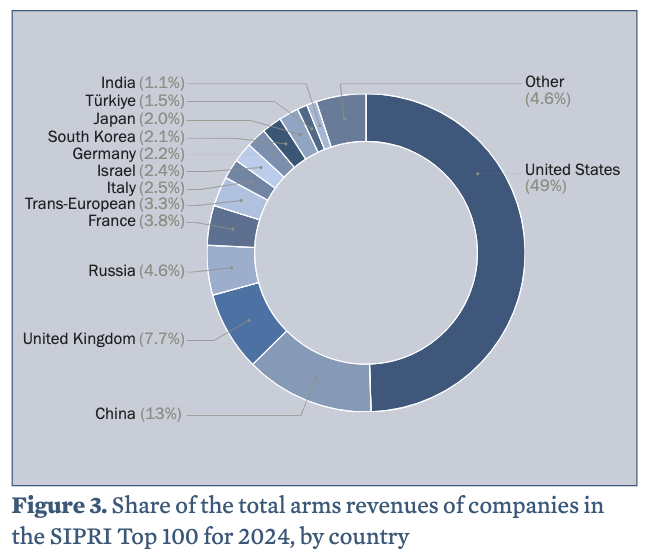
The annual report by the Stockholm International Peace Research Institute (SIPRI) shows that the top 100 weapons makers in the world—led by those in the United States—brought in a record-setting $679 billion over the course of the year, fueled mainly by the war in Ukraine, Israel’s genocidal assault on Gaza, and spending on nuclear weaponry.
“Last year global arms revenues reached the highest level ever recorded by SIPRI as producers capitalized on high demand,” said Lorenzo Scarazzato, a researcher with the SIPRI Military Expenditure and Arms Production Programme, which has been tracking global arms sales since 1989.
“In 2024,” the report explains, “the growing demand for military equipment around the world, primarily linked to rising geopolitical tensions, accelerated the increase in total Top 100 arms revenues seen in 2023. More than three-quarters of companies in the Top 100 (77 companies) increased their arms revenues in 2024, with 42 reporting at least double-digit percentage growth.”
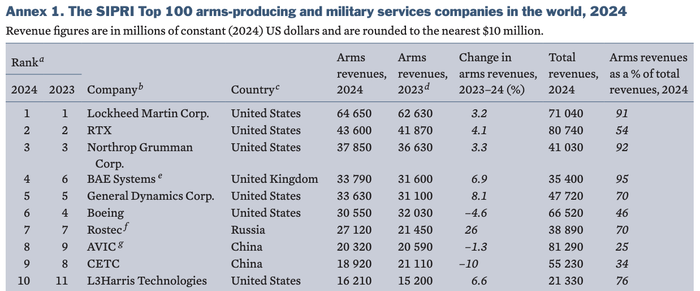
In 2024, SIPRI noted, “all of the five largest arms companies increased their arms revenues,” the first time that has happened since 2018. According to the report, those five companies alone—Lockheed Martin, RTX, Northrup Grumman, BAE Systems, and General Dynamics—accounted for an estimated $215 billion of the total arms sales tabulated in the report. Of those five, four are US companies while BAE is based in the United Kingdom.
In the sixth spot overall was Boeing, another US company, which generated nearly $31 billion in revenue.
According to SIPRI’s summary of the report:
Although the bulk of the global rise was due to companies based in Europe and the United States, there were year-on-year increases in all of the world regions featured in the Top 100. The only exception was Asia and Oceania, where issues within the Chinese arms industry drove down the regional total.
The surge in revenues and new orders prompted many arms companies to expand production lines, enlarge facilities, establish new subsidiaries or conduct acquisitions.
With the genocide in Gaza, Israel’s largest weapons makers also had surging revenue in 2024 as bombs, missiles, and tank shells were fired on the besieged enclave, killing and maiming large numbers of Palestinian civilians, including children. As Al-Jazeera notes:
The three Israeli arms companies in the ranking increased their combined arms revenues by 16 percent to $16.2 billion amid the ongoing genocidal war on Gaza, which has killed nearly 70,000 Palestinians and destroyed most of the besieged enclave.
Elbit Systems pocketed $6.28 billion in profits, followed by Israel Aerospace Industries with $5.19 billion and Rafael Advanced Defense Systems with $4.7 billion.
In the United States, where nearly half of the global revenue for weapons makers was generated, another notable development in 2024 was SpaceX, owned by right-wing libertarian Elon Musk, landing in the Top 100 for the first time.
SpaceX’s arms revenue more than doubled compared with figures from 2023, reaching $1.8 billion.
Musk is a close ally of US President Donald Trump and a major GOP donor in 2024. According to OpenSecrets, which tracks campaign spending, the mega-billionaire donated more than $291 million to Republican candidates, including Trump, during the 2024 cycle.
JOIN THE MOVEMENT
As a people-powered nonprofit news outlet, we cover the issues the corporate media never will.
Your contribution supports this bold media model—free, independent, and dedicated to reporting the facts every day. Stand with us in the fight for economic equality, social justice, human rights, and a more sustainable future.















No comments:
Post a Comment
Note: Only a member of this blog may post a comment.