
01 September 25

Judge Halts Effort to Deport Guatemalan Children as Planes Sit on Tarmac
 A U.S. Air Force plane that was used to deport migrants in Guatemala City in January. (photo: Daniele Volpe/NYT)
ALSO SEE: Judge Blocks Flights Sending Hundreds of Children Back to Guatemala
The temporary block ended another last-minute flurry of legal action over the Trump administration’s immigration crackdown.
The order brought to a close, for now, another last-minute flurry of court action in the administration’s mass deportation drive. Lawyers for the children said that they would face peril if they were sent to Guatemala and that doing so would deny them due process. They also argued that the government had ignored special protections for minors who cross the border alone.
In the early morning hours on Sunday, Judge Sparkle L. Sooknanan of the U.S. District Court for the District of Columbia issued a temporary restraining order forbidding the administration from deporting the children after the National Immigration Law Center filed an emergency request.
Judge Sooknanan’s order was intended to be in place until an emergency hearing could be held in the afternoon. But there was initial confusion among lawyers whether the order applied to a limited number of children.
Dozens of children were then removed by immigration authorities from shelters overnight and boarded onto chartered planes. After lawyers for the children notified the judge, the emergency hearing was moved up to midday, and with planes awaiting takeoff in Texas, the judge clarified her order to apply to all Guatemalan children in the custody of the federal Office of Refugee Resettlement for the next 14 days while the case is pending. She directed the government to take the children off the planes, and in a court document on Sunday evening, the government confirmed that was done.
About 2,000 children, a majority of them from Guatemala, are currently being held in dozens of shelters.
“I don’t want there to be any ambiguity about what I am ordering,” said the judge. “You cannot remove any children” while the case proceeds.
In the hearing, the judge expressed frustration with the government and her inability to reach its representatives the early hours of Sunday, before issuing her initial order.
“I have the government attempting to remove minor children from the country in the wee hours of the morning on a holiday weekend, which is surprising,” she said.
The government’s lawyer, Drew Ensign, said that the repatriations had been requested by the Guatemalan government and that the children were to be reunited with parents and guardians in their home country.
“The United States government is trying to facilitate the return of these children to their parents or guardians, from whom they have been separated,” Mr. Ensign said.
But Efrén Olivares, the lawyer representing the children, disputed that argument. At least some of the children “have not requested to return,” he said. “They don’t want to return.”
He added that the law prevents children from being removed expeditiously from the United States until a judge has assessed the safety of their return. Many of the children have cases that are still pending, he said.
Carlos Ramíro Martínez, Guatemala’s minister of foreign affairs, said on Friday that his country had been coordinating with the United States and expected to receive more than 600 minors. In an interview on Friday, he told The Times that he hoped that the repatriations would happen in a gradual, organized manner. He added that the initiative began when Kristi Noem, the homeland security secretary, visited Guatemala in July.
Judge Sooknanan’s order at least temporarily hamstrings the federal government’s attempts to return to Guatemala hundreds of unaccompanied minors who have been in U.S. custody after crossing the southern border.
The judge, who was nominated to the bench by President Biden, granted a request by the government lawyer to file a response opposing the order on Friday.
On X, Stephen Miller, a White House official and architect of Mr. Trump’s immigration crackdown, blamed the Biden administration for children being in the United States without their parents, saying they were “orphaned in America” by that administration. He added that “a Democrat judge is refusing to let them reunify with their parents.”
Though the judge’s order is temporary, it is the second recent setback for President Trump’s immigration policies. On Friday, another judge blocked the administration from carrying out rapid deportations far from the border, a cornerstone of the White House’s immigration policy.
The lawsuit over the Guatemalan children was filed in the early hours of Sunday after staff members at shelters that were holding the children were notified by email on Saturday that they should prepare some of them to be sent back to Guatemala. Lawyers representing some of the children received a similar email.
In its lawsuit, the National Immigration Law Center said that the children’s repatriation would violate federal law and the Constitution. It called the government’s actions “unlawful and reckless.”
Ten children, between the ages of 10 and 16, are identified by their initials in the lawsuit. They have told judges that they are afraid to return to Guatemala, the lawsuit says.
The number of unaccompanied minors entering the United States has plummeted since Mr. Trump began his second term.
Migrant children have posed a particular challenge to the Trump administration’s immigration agenda because they are entitled to special protections.
Hundreds of thousands of children, mainly from Central America, have crossed the southern border into the United States in the last decade, often seeking to join friends or relatives. Many of the minors have won the right to remain in the United States permanently by proving that they were abandoned or persecuted in their home countries.
When unaccompanied children entering the United States are taken into custody, they typically remain in shelters until they are released to sponsors or guardians who have been vetted. The children the Trump administration was seeking to deport have been awaiting release from the shelters.
“We are very concerned that our clients could be returned to unsafe situations,” said Alexa Sendukas, a managing attorney with the Galveston-Houston Immigrant Representation Project.
He’s Brazenly Anti-Worker’: US Marks the First Labor Day Under Trump 2.0
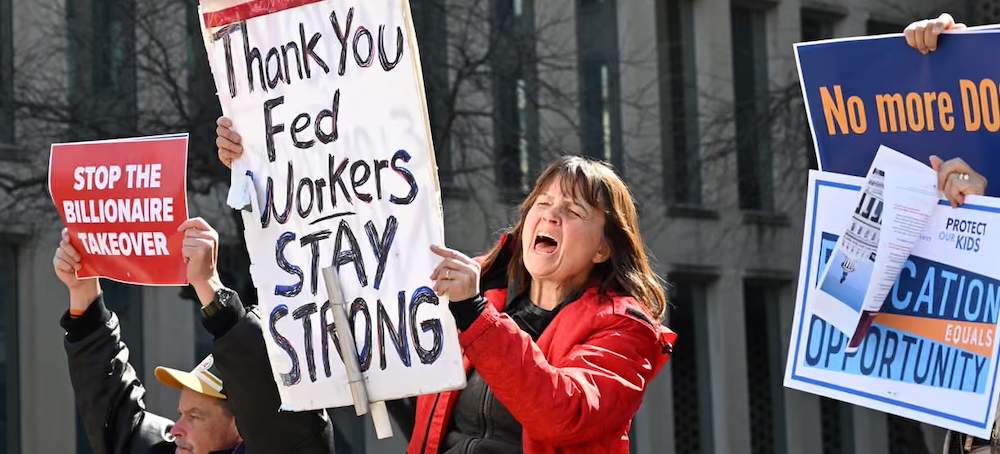 A rally in support of federal workers at the office of personnel management in Washington DC, on 4 March 2025. (photo: Alex Wroblewski/AFP/Getty Images)
Steven Greenhouse, Guardian UK
Advocates say Trump has hurt workers in many ways, often by cutting their pay or making their jobs more dangerous
Trump was elected on promises, since repeatedly pledged, that he would fight for workers and forgotten Americans. But many labor advocates say that Trump has consistently put corporate interests first in his second term as he has taken dozens of actions that hurt workers, often by cutting their pay or making their jobs more dangerous.
Despite his vow to help coal miners, Trump halted enforcement of a regulation that protects miners from a debilitating, often deadly lung disease. He fired the chair of the National Labor Relations Board (NLRB), leaving the US’s top labor watchdog without a quorum to protect workers from corporations’ illegal anti-union tactics. Angering labor leaders, Trump stripped one million federal workers of their right to bargain collectively and tore up their union contracts.
“It’s a big betrayal,” Liz Shuler, president of the AFL-CIO, the main US labor federation, said. “We knew it would be bad, but we had no idea how rapidly he would be doing these things. He is stripping away regulations that protect workers. His attacks on unions are coming fast and furious. He talks a good game of being for working people, but he’s doing the absolute opposite.”
“This is a government that is by, and for, the CEOs and billionaires,” Shuler added.
Trump has hurt construction workers by shutting down major wind turbine projects and ending Biden-era subsidies that encourage the construction of factories that make renewable-energy products. In moves that will harm some of the nation’s most vulnerable workers, the Trump administration has proposed ending minimum wage and overtime protections for 3.7 million home-care and domestic workers. It has also killed a Biden plan to prevent employers from paying disabled workers less than the $7.25-an-hour federal minimum wage.
“There is a huge disconnect between Trump’s pro-worker rhetoric and the policies he’s putting in place. The gulf is enormous,” said Heidi Shierholz, president of the Economic Policy Institute, a progressive thinktank. “In his second term, he’s been absolutely, brazenly anti-worker.”
“I keep thinking about his taking away the Biden-era increase in the minimum wage for federal contractors. It’s unbelievably brazen,” Shierholz continued. (Trump ended the requirement that federal contractors pay their workers at least $17.75 an hour.) “The minimum wage is incredibly popular. He just took away the minimum wage from hundreds of thousands of workers. That blew my mind.” As a result, many full-time workers will see their pay drop by more than $9,200 a year.
The administration disputes all these criticisms. “The American worker has been left behind by the Democrat party for years, but President Trump has championed an agenda that puts the American worker first,” said Taylor Rogers, White House assistant press secretary.
Trump has “unleashed an economic boom”, she said. Inflation is cooling, native-born Americans are benefiting from private-sector job gains and blue-collar wages are rising fast. “Under President Trump’s leadership, Republicans are once again the party of the American worker,” said Rogers.
Many labor experts say Trump is even more anti-union than Ronald Reagan, often called the most anti-union president of modern times. Reagan fired 11,345 air traffic controllers who went on strike, but the AFL-CIO’s Shuler said that “pales in comparison” to Trump’s ending collective bargaining for 1 million federal workers. “That’s the largest single act of union-busting in our history,” she said.
“He is worse than Reagan when it comes to his approach to unions,” said Julie Su, who was acting labor secretary under Biden. “We saw what Reagan did in the 1980s. That began a long decline in unionization. This president wants to make America non-union again. He’s certainly trying to make the government non-union again.”
Shierholz said the “absolute scale of crushing unions” under Trump is “on a whole different scale from what we saw under Reagan. Trump is saying it’s absolutely open season on union folks. He took an absolute chainsaw to the federal workforce. He’s giving the green light to the private sector and local government to do the same.”
Justin Chen, president of an American Federation of Government Employees council representing 8,000 Environmental Protection Agency (EPA) workers across the US, is angry that Trump halted collective bargaining for EPA employees, voided most of their union contracts and fired probationary workers. “Whatever he said about fighting for workers was a complete lie,” Chen said. “He treats federal employees with a great deal of disdain, not as civil servants valuable to make our government and economy run.”
Many labor advocates say Trump’s signature policies, including tariffs and deportations, are hurting US workers. Trump’s tariffs are pushing up prices and slowing economic growth, economists say. Trump’s “big, beautiful” tax cut will harm millions of working families by cutting food assistance and causing many to lose health coverage. As for Trump’s deportation campaign, many workers say it’s undermining their employers’ businesses and forcing them to work harder because they have to do the work of their departed co-workers.
In her annual State of the Unions address, AFL-CIO president Shuler said on Wednesday: “The state of working people in this country is they’re under attack.” She added: “We want cheaper groceries, and we get tanks on our streets. We want more affordable healthcare, and we get 16 million Americans about to be kicked off their coverage.” Shuler said unions will hold close to 1,000 rallies and other events this Labor Day across the US to kick off a year of mobilization.
Jenny Smith, a home-care worker in Champaign, Illinois, said Trump’s plan to end overtime and minimum-wage protections for home-care workers shows contempt for struggling, low-wage workers. “Trump doesn’t know what it means to go to work day after day to earn a living,” she said. “If you take away these wage protections, it will take money out of these workers’ pockets. The majority of these workers are Black, brown and single mothers. You’re taking from their children’s mouths.”
Smith voiced dismay that Trump hasn’t made good on his promise to reduce prices. “I’m very disappointed that prices aren’t going down,” she said. “I just bought a dozen eggs for $6.”
She added: “I don’t think he cares about us, but he does care about the billionaires.”
Trump has taken numerous steps that will weaken safety protections for workers. He is cutting staffing by 12% at the Occupational Safety and Health Administration (Osha). His administration has proposed eliminating a requirement for adequate lighting on construction sites. It is reducing the fines that small businesses pay for violating safety rules. It has proposed blocking the government’s mine-safety district managers from ordering upgrades in mine ventilation and safety. It has slowed action on Biden’s effort to protect workers from high temperatures.
Trump also froze enforcement of a Biden-era regulation that protects miners from silicosis, a serious lung disease.
“Silicosis has become a major killer among coal miners, but the Trump administration is trying to make silicosis great again,” said David Michaels, a professor of public health at George Washington University who headed Osha under Barack Obama. “The Trump administration has taken several steps that are devastating to the safety and health of the nation’s workers. Osha, which is under-resourced and underpowered, has become significantly smaller as a result of the Trump and Doge [Trump’s unofficial ’department of government efficiency’] cuts.”
Michaels warned that Trump’s cuts to Osha penalties will reduce incentives for companies to ensure safe conditions.
Administration officials point to the Trump-backed “no tax on tips” and “no tax on overtime” as clearly pro-worker. But Yale’s Budget Lab notes that only 4% of workers in the bottom half by income are in tipped jobs, while almost 40% of tipped workers earn so little they don’t pay federal income taxes.
Moreover, the no-tax-on-overtime provision will reduce income taxes far less than most workers realize. The deduction applies only to the “half” in “time-and-a-half” overtime pay. If a worker earns $20 an hour and their overtime rate is $30, that worker can deduct only the $10 premium for each overtime hour, not the full $30.
Shierholz said that if Trump were serious about helping workers, “he would raise the minimum wage, make overtime pay double pay and do away with the sub-minimum wage for tipped workers. That would truly help workers, but that’s not what he’s doing. He’s doing as little as possible to help workers, while helping employers.”
While Trump says his deportations will create job opportunities for US-born workers, Shierholz’s economic institute forecasts that Trump’s effort to deport 1 million immigrants a year will result in 5.9m lost jobs after four years: 3.3 million fewer employed immigrants and 2.6 million fewer employed US-born workers. “If you don’t have immigrant roofers and framers, you’re not building houses, and that means electricians and plumbers lose their jobs,” Shierholz said. “Plus, you lose the consumer spending from those workers.”
Corey Mahoney, a 35-year-old cargo handler at John F Kennedy international airport in New York, said Trump’s policies have whipsawed workers at his warehouse. “The tariff situation has slowed down work, and many people lost their jobs,” he said. When Trump ended protected status for many Venezuelans and other immigrants, some of his Venezuelan co-workers left or were deported. “Some of the people I was working with tried to come to work, but they weren’t allowed,” he said. “We were left with less people, and we had to work twice as hard. It’s unfair.”
“Trump is in an alternative universe thinking everything is good,” Mahoney said. “He doesn’t realize that normal people who are just trying to make a living aren’t happy with what he’s doing.”
The Supreme Court Has Expanded Trump’s Power. He’s Seeking Much More.
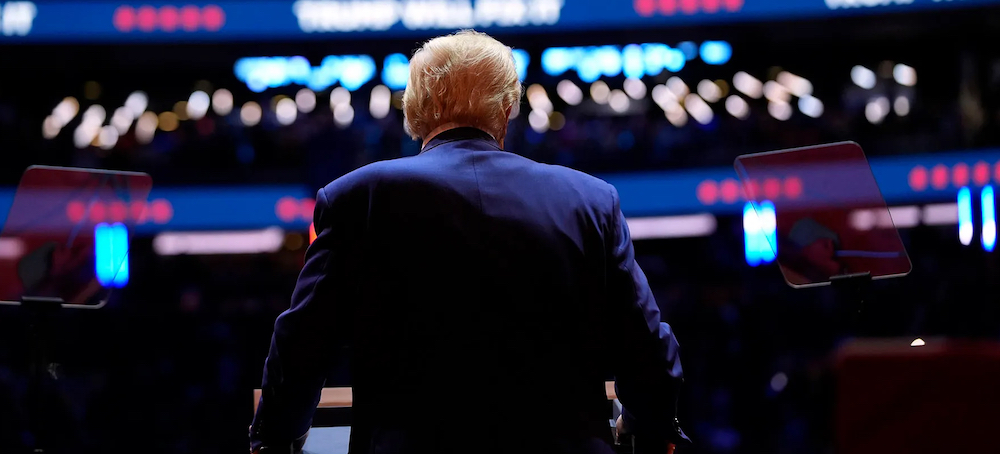 President Donald Trump. (photo: Alex Brandon/AP)Justin Jouvenal, The Washington Post
Excerpt: "The president’s firing of Federal Reserve governor Lisa Cook and other cases could serve as major tests of how far the high court is willing to go."
The president’s firing of Federal Reserve governor Lisa Cook and other cases could serve as major tests of how far the high court is willing to go.
The cases could serve as major tests of how much further the nation’s high court is willing to go to bless the president’s assertion of executive authority. They differ from previous showdowns because of the sheer magnitude of the authority Trump is seeking to wield and because he wants greater control over powers the Constitution ascribes to another branch of government.
In addition to Cook’s lawsuit, which could make its way to the high court after she sued last week, a blockbuster case over Trump’s tariffs is expected to arrive at the high court soon after an appeals court struck them down. The Trump administration’s push to withhold tens of billions of dollars in foreign aid appropriated by Congress could also end up in the court.
Peter Shane, a law professor at New York University, called Trump’s assertions “breathtaking.”
“Other presidents have tried to use their authority aggressively, but usually it’s been done through aggressive interpretations of statutory law and in a pretty targeted way,” Shane said.
Each of the presidential powers being contested by Trump, he said, “is a challenge to what I think heretofore would have been regarded as a core power of Congress.”
The high court has already signaled openness to broad presidential authority to replace some heads of independent agencies.
The justices handed Trump a major victory in May when they allowed him to remove the leaders of the National Labor Relations Board and the Merit Systems Protection Board while legal challenges play out over their firings. Trump gave no reasons for the dismissals.
The court’s conservative majority ruled the Constitution vests all executive power in the president, so Trump could fire the agency heads “without cause” even though Congress set up the agencies to be insulated from political interference.
But the justices drew a red line around one agency: the Federal Reserve, which was created by Congress to operate independently of the president so it can set interest rates based on economic conditions — not political pressure.
The justices indicated its governors probably could be only removed for cause.
Trump is testing that red line in his firing of Cook, making him the first president in the 111-year history of the agency to try to oust one of the seven governors who help set U.S. monetary policy.
Trump said he was firing Cook for “sufficient cause,” alleging she made false statements on mortgage applications in 2021 before she was nominated to the Fed by President Joe Biden. Trump officials have since made additional allegations.
Cook called her removal “unprecedented and illegal” and a pretext to allow Trump to cobble together a Fed board that will accede to his wishes for lower interest rates.
A federal judge heard Cook’s request for an injunction Friday but was not expected to make a decision until after Labor Day.
The legal battle over Cook’s firing is likely to turn on how the courts interpret “for cause” — something not defined in the law creating the Fed and has never been litigated before.
Duke University law professor H. Jefferson Powell said there is also a procedural question: “Does [Trump] have to establish up front in some clear way that he knows she did something that gives him for cause removal basis or can he just go ahead and remove her?”
Trump officials said in filings in Cook’s case that the courts should be “highly deferential” to the president’s determination of cause and not second-guess his rationale.
In the second case, over most of Trump’s tariffs, an appeals court last week found the levies on foreign goods were illegal, but stayed its ruling for now. Trump has indicated an appeal to the Supreme Court is coming.
The sweeping tariffs have been the main feature of Trump’s trade war. He called them necessary to restore America’s manufacturing base and save jobs. But they have unnerved investors and created uncertainty for consumers and businesses.
Trump began imposing tariffs in February, declaring a series of emergencies under the International Emergency Economic Powers Act (IEEPA). The law allows the president to take actions on trade in response to foreign threats, but Trump is the first to use it to assert powers to impose virtually unlimited authority to impose tariffs. Congress has delegated limited authority to the president to impose tariffs, but the Constitution gives the legislature the power to levy taxes on imports.
The president announced levies of 10 to 25 percent on goods from China, Mexico and Canada for allegedly failing to stem the flow of fentanyl and other illegal drugs into the United States. In April, Trump imposed a universal 10 percent import tax on all trading partners and higher rates on roughly 60 countries, dubbing it “Liberation Day.”
Trump wrote in his executive order on the latter tariffs that “large and persistent” U.S. trade deficits constitute “an unusual and extraordinary threat to the national security and economy of the United States.”
A handful of small businesses and a group of states filed separate lawsuits against the tariffs in April, saying they would cause widespread economic harm. The small businesses called Trump’s imposition of tariffs an illegal “power grab.”
The U.S. Court of Appeals for the Federal Circuit ruled Friday the law did not give Trump that power.
“The statute bestows significant authority on the President to undertake a number of actions in response to a declared national emergency, but none of these actions explicitly include the power to impose tariffs, duties, or the like, or the power to tax,” the majority wrote in the ruling.
The third case, on whether the Trump administration can freeze billions in foreign aid, is part of a long-running legal standoff that is reaching a head because the funds budgeted by Congress are set to begin expiring at the end of the fiscal year in September.
As one of his first acts in office in January, Trump announced a wholesale pause on foreign aid, saying it was not in keeping with American interests or values. International aid groups sued saying the block would cause a humanitarian crisis and was a violation of the separation of powers, since the Constitution gives Congress the power of the purse.
U.S. District Judge Amir H. Ali found in February that Trump did not have the authority to withhold money and ordered it restarted. A fierce legal battle followed over whether Trump officials were complying with the order.
This month, a panel of appeals court judges blocked Ali’s injunction, saying the plaintiffs didn’t have standing to sue. But the full appeals court did not allow that order to take effect while it considered whether to rehear the case. That prompted the Trump administration to ask the Supreme Court to step in to block Ali’s order.
The appeals court ultimately declined to rehear the case, but sent it back to Ali, leaving open the possibility the legal fight could continue and the aids groups could seek a new injunction on the aid freeze.
That means the case could once again wend its way back to the Supreme Court in the coming days, setting up a showdown over Trump’s authority to impound funds.Separately, the Trump administration moved last week to use a little-tested tactic, known as a “pocket recission,” to unilaterally cancel about $5 billion of the foreign aid without congressional approval. Both Democratic and Republican leaders questioned the legality of the move, and it could spark additional legal challenges.
Lauren Bateman, an attorney for plaintiffs in the foreign aid case, contends it was always the administration’s intent “to run out the clock and allow those funds to expire" against the wishes of Congress.
“The administration’s affronts to the rule of law are staggering — and all to withhold aid from the most vulnerable people in the world,” Bateman said in a statement.
Chicago Launches Resistance Campaign as Trump Threatens to Send Troops
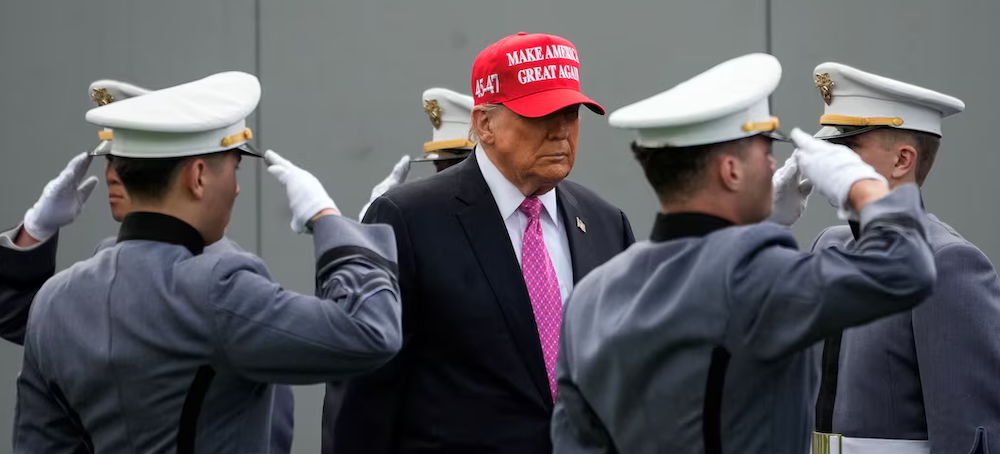 President Donald Trump. (photo: Reuters)
The Pentagon has been planning a possible National Guard deployment in Chicago, in a model that could be used for other cities.
The comments came after Chicago Mayor Brandon Johnson (D) signed an executive order instructing police not to cooperate with troops or federal agents in the event of such a deployment. Johnson, surrounded by other city leaders, signed the order that also directs police not to wear masks and to use body cameras, while also launching a program to educate residents on how to prepare in the event they are detained by federal agents.
“We send a resounding message to the federal government: we do not need nor want an unconstitutional and illegal military occupation of our city,” Johnson said in a Saturday statement. “We do not want military checkpoints or armored vehicles on our streets and we do not want to see families ripped apart.”
Trump has suggested expanding the use of troops in cities across the United States to stop what he sees as rampant crime and to bolster a crackdown on undocumented immigrants, while also ordering the National Guard to prepare for deeper involvement in policing civil unrest.
The Washington Post first reported earlier this month that the Pentagon has been planning a military deployment in Chicago for weeks, in a model that could later be used for other cities. Immigration and Customs Enforcement has requested to use a Navy base north of Chicago as its launchpad for a crackdown on undocumented immigrants.
State and local leaders have criticized the plan as unlawful and unnecessary.
“I’ve been standing up to Donald Trump, and I’m going to do everything I can to stop him from taking away people’s rights and from using the military to invade states,” Pritzker said on CBS’s “Face the Nation” on Sunday after Trump blasted him on Truth Social the previous day.
“JB Pritzker, the weak and pathetic Governor of Illinois, just said that he doesn’t need help in preventing CRIME. He is CRAZY!!! He better straighten it out, FAST, or we’re coming!” the president said in a post.
Chicago is among the many large cities across the country where crime has fallen in recent years. By mid-August, the city saw a 23 percent decline in violent crime compared with the same period last year, according to Chicago Police Department figures.
Chicago’s reaction contrasts with the more conciliatory approach of Mayor Muriel E. Bowser (D) in D.C., where the National Guard was deployed earlier this month. U.S. Attorney Jeanine Pirro said on “Fox News Sunday” that there have been more than 1,500 arrests related to the deployment.
Republicans have backed Trump’s move in D.C.
“Look at what the citizens are saying. They feel safer, they are pleased that there is enforcement and a presence,” said Sen. Marsha Blackburn (R-Tennessee). “President Donald Trump has been right on this from day one, and I think people are grateful to see this. Everyone wants their community safe.”
But as a federal district, D.C. is subject to greater oversight by the president and Congress than a city like Chicago or Los Angeles. Trump deployed the National Guard to L.A. in June amid broad protests of his administration’s aggressive effort to arrest and deport undocumented immigrants.
The administration has since argued that the deployment was a success and should be duplicated elsewhere.
“L.A. wouldn’t be standing today if President Trump hadn’t taken action, then that city would have burned down if left to the devices of the mayor and the governor of that state,” said Homeland Security Secretary Kristi L. Noem, also on Sunday’s “Face the Nation.” “There’s a lot of cities that are dealing with crime and violence right now. And so, we haven’t taken anything off the table.”
Noem encouraged major cities — including San Francisco, Boston and Chicago — to work with the federal government to improve public safety.
Trump has also threatened to deploy troops in Baltimore, igniting a feud with Maryland Gov. Wes Moore (D).
Whether criminal charges against those arrested amid deployments will stand up in court is unclear, with judges questioning the legality of federal agents’ tactics. Grand juries in Washington and L.A. have also refused to indict some inpiduals for alleged crimes, including a man who threw a sandwich at law enforcement officers.
PBS, NPR Stations Struggle With Trump-Fueled Government Funding Cuts
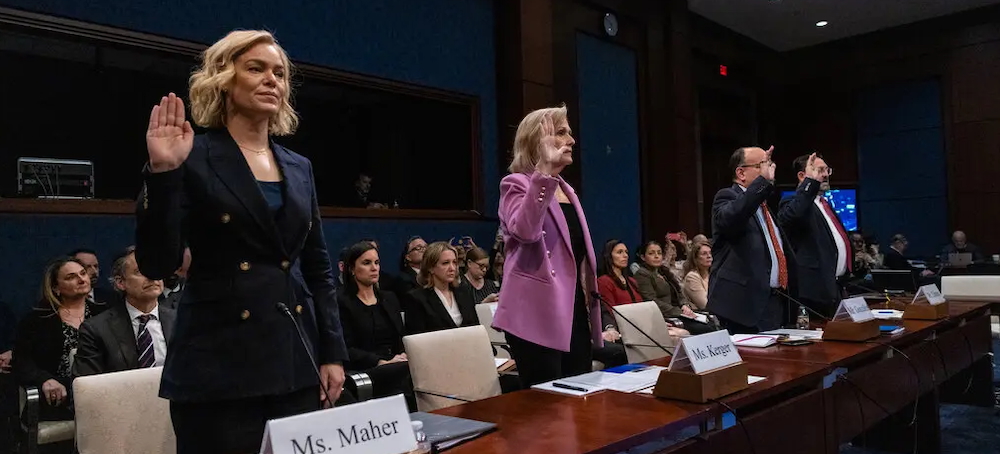 Katherine Maher, the chief executive of NPR, and Paula Kerger, the chief executive of PBS, at a March congressional hearing about funding for public broadcasting. (photo: Anna Rose Layden/NYT)
When Congress decided this summer to eliminate $1.1 billion allocated to public broadcasting, it left some 330 PBS and 246 NPR stations, each with unique issues related to their communities and history, to figure out what that means.
Many launched emergency fund drives and are heartened by the response. The national NPR and PBS networks are reducing expected dues payments, and a philanthropic effort focused on the hardest-hit stations is taking shape. No stations have shut down, but job and programming cuts are already beginning.
In Spokane, KSPS has always tried to keep its requests for member donations separate from appeals for public funding. Not anymore. Congress left the station with a $1.2 million hole to fill, about 18% of its budget, and the station is using that as a pretext to seek help from listeners.
“We have definitely seen some attrition from our Canadian members,” said Skyler Reep, the station’s interim general manager.
Pleas for donations exceed expectations in many parts of country
Long suspicious of a liberal bent to public media news coverage, Republicans in Congress responded to President Donald Trump’s wishes in July and eliminated funding for the systems. The Corporation for Public Broadcasting, which distributes the funding, has taken steps to shut down.
In some parts of the country, the answer to pleas for help have exceeded expectations. Public radio station WHQR in Wilmington, N.C. raised more than $200,000 in three days, filling a $174,000 hole and then some. It’s a small community growing fast with an influx of retirees, many who depend on the station’s news to learn about their new home, said general manager Kevin Crane.
With $525,000 gone from its budget, Hawaii Public Radio has already raised $650,000 in an emergency fund drive. “It’s a validation that what you’re doing is essential to the community and is appreciated by the community,” said Meredith Artley, president and CEO. The 2023 wildfires in Maui and their aftermath were covered steadily by Hawaii Public Radio news reporters.
“The initial response in terms of support for both stations and the NPR network has been extraordinary,” said Katherine Maher, NPR president. “People did a lot of work leading up to the vote, in actions and calls. When that did not prove convincing, they turned to direct support.”
Stations across the country have stories that make them smile: the youngster from Florida who collected money for public stations in Alaska, sending a note written in crayon; the regular $300 donor who came in to PBS SoCal with a $100,000 check, one of three six-figure donations the station has received.
Most stations aren’t in areas with so many wealthy donors. Most station managers are like Jeff Hanks of PBS’ LPTV in Lakeland, Minnesota. He lies awake wondering where he will find $1 million to pay for things like his station’s nightly newscast, a primary news source for central and northern Minnesota.
“These are extremely, extremely challenging times,” Hanks said. “We’re fighting hard every way we can.”
He knows membership donations won’t make up for what is missing. Both PBS and NPR have taken steps to reduce the annual dues that stations pay for programming and other services. At PBS, it’s an average 15% reduction, but needy stations get more — in one case, more than half of next year’s dues will be forgiven, said PBS president Paula Kerger.
Adopting stations in poorer, more rural areas
NPR is encouraging donors in wealthier areas to adopt stations in poorer ones, perhaps in an area where a contributor has emotional ties.
Public media leaders are also working with a group of philanthropists led by the Knight and MacArthur foundations that is hoping to raise some $50 million to support stations in areas hardest hit be the cuts. Ed Ulman, president and CEO of Alaska Public Media, which represents nearly two dozen radio and television stations in the largest state, said he’ll be seeking money from this fund.
Ulman said he’s been buoyed by the response from Alaskans in their effort to raise $15 million through various sources by October. The services their stations provide is free, and citizens see its value.
“I’ve never been worried about the future of public television or radio because our community needs us,” he said, “and what we’ve seen in Alaska is an outcry about that.”
Still, Alaska Public Media has suspended the weekly public affairs television show “Alaska Insight,” which isn’t returning after a summer hiatus. The future of “Indie Alaska,” a weekly video series highlighting the lives of Alaskans, is also in danger.
Some stations are already making the difficult decisions of cutting staff, In Spokane, for example, 12 of KSPS’s 35 staff members have either been laid off, had their hours reduced or pay cut. Reep is also considering that future seasons of local shows like “Northwest Profiles” or the arts showcase “Inland Sessions” will have fewer episodes.
Similar programming decisions are also being weighed on a national level. While several upcoming shows, like Ken Burns’ six-part miniseries “The American Revolution” scheduled for November, are completed, PBS will have to consider making shorter seasons of its series, Kerger said.
“We’re working very hard so that the public doesn’t feel that there’s a change,” Kerger said.
Looking for ways to share services
Between an increase in donations and “rainy day” resources set aside, the initial impact of the government action may be minimized. But that brings its own worries: It’s unlikely public media will be able to count on sympathy donors to the same extent in the future. And there’s a risk that some politicians will feel the response proves that public support isn’t necessary.
The bigger reckoning may come a year from now, Kerger said. “I am a realist,” she said. “I have to believe that there are some vulnerable stations that are not going to make it.”
The crisis is forcing some public stations to work together, searching for ways to share services in areas not before contemplated, in things like finances, management and programming, said Andy Russell, president and CEO of PBS SoCal. Public stations in Washington are meeting to see if they can get state financing.
In Los Angeles, PBS SoCal has shared some of its templates for fundraising appeals with other stations. Several celebrities — people like Kerry Washington, Jack Black, Ziggy Marley, John Lithgow and John Leguizamo — have volunteered to film pitches, and the station is making them available nationwide, too, said Maura Daly Phinney, senior vice president for membership engagement and strategy.
“We’re going to make it,” Phinney said. “The system is going to be different. But we’re going to make it.”
PO Box 2043 / Citrus Heights, CA 95611


No comments:
Post a Comment
Note: Only a member of this blog may post a comment.