
13 August 25

He doesn’t understand why Americans care about illegal immigration in the first place.
The government’s tough tactics are eating into the widespread support President Trump initially had for his election-season stance against illegal immigrants. Shortly after his return to the White House, Trump promised to “rescue every city and town that has been invaded and conquered.” He said his administration would “put these vicious and bloodthirsty criminals in jail, then kick them the hell out of our country as fast as possible.” Trump understood, in a way Democrats did not, that Americans don’t like chaos, which is what they saw at the border through much of the Biden administration’s term.
But support for Trump’s aggressive tactics against illegal immigration is ebbing. Americans don’t like what they’re seeing. We’re not used to having people grabbed off the streets and whisked away in unmarked cars, never to be heard from again.
A June Gallup poll found that support for mass deportation has dropped to 38 percent among American adults, while 78 percent favor a path to citizenship for illegal immigrants if they meet certain requirements. These numbers reflect a 9-point drop on deportation compared to one year earlier and 7-point increase supporting a path to citizenship. Notably, Republicans are warming faster on a path to citizenship than Democrats and independents. Another recent poll, from CNN, shows that 55 percent of Americans think the president has gone too far in deporting illegal immigrants and 58 percent believe the government hasn’t been careful enough in following the law in its deportation policies.
More Americans believe that sending heavily armed, masked men, many with no identifying badges or uniforms, into Home Depot parking lots, farms, restaurants, and car washes, or having them lurk outside courthouses, schools, and even churches to snatch suspected illegal immigrants without warrants violates the essence of American justice. Almost nobody would tolerate a local police force rounding up suspected drug dealers or thieves in this manner, much less breaking into houses or cars on the street, as agents have done repeatedly in the last few months.
The rough enforcement actions have provoked civil unrest, with some individuals striking back with rocks and even incendiary devices. To be clear, this violent response is both wrong and counterproductive. It feeds the administration’s narrative that Immigration and Customs Enforcement (ICE) is pursuing dangerous criminals, as opposed to peaceful families who have lived in the United States for decades.
Contrary to the administration’s claims that it is focused on deporting violent criminals, a new Cato Institute analysis shows most recent ICE detentions—about 65 percent—involve immigrants with no criminal convictions whatsoever. And administration efforts have snagged a lot of longtime residents, which isn’t surprising given that an estimated two-thirds of illegal immigrants have lived in the United States for more than ten years. ICE recently detained a 75-year-old Cuban man who had been here almost sixty years and an Iranian woman who has been here forty years. They released the woman after House Majority Leader Steve Scalise intervened; the septuagenarian wasn’t so lucky.
Isidro Pérez died in ICE custody less than a month after he was picked up as an inadmissible alien based on 1980s convictions for simple drug possession. He became one of ten detainees to die in ICE custody so far this year. At the current rate, ICE can expect sixteen people to die in its detention centers in 2025—the largest number since the pandemic year of 2020 and the second-largest since the agency began publishing data in 2018.
Many critics of the administration’s policies have gone to the courts seeking relief. In July, the Ninth Circuit Court of Appeals upheld a temporary restraining order barring federal agents from detaining people indiscriminately based on their ethnicity, language fluency, location, or the type of work they do. But the administration will appeal to the Supreme Court. The underlying class-action suit claims the administration’s snatch-and-deport tactics violate the Fourth and Fifth Amendments. The administration will no doubt appeal the decision of the trial judge, too, if it doesn’t go their way.
Respect for the rule of law goes both ways in a democracy. Individuals must abide by the law or risk the consequences, including arrest, trial, and punishment. But those responsible for enforcing the law also agree to respect basic rights and follow certain procedures, including properly identifying themselves as officers of the law, notifying the person what they’re accused of, and if it’s a criminal offense, informing them of the right to remain silent and to legal counsel. Immigration enforcement officers have greater latitude in dealing with persons suspected of being in the country illegally—which in most cases is a civil offense, not a criminal one—but they may not violate basic constitutional rights, such as warrantless searches on private property, and they need, at a minimum, reasonable cause that their target is indeed illegally present.
Though the administration claims there are 21 million illegal immigrants in the United States, the best estimates of the population are in the 12–14 million range, with a median U.S. residence of fifteen years. The vast majority, of course, are not criminals. Trump has vowed to deport one million people per year. It’s simply not possible to summarily remove hundreds of thousands, much less millions, without trampling on civil liberties and abusing police powers.
The tide of illegal migration has now shifted. Attempted crossings are down at the Mexican border from their peak of more than 300,000 per month during Biden’s term to about 12,000 per month since Trump took office. Spending on border enforcement is set to soar to $170 billion under the president’s “big beautiful bill,” making ICE the largest and best-funded law enforcement agency in the federal government.
As ICE grabs more construction workers, landscapers, farmhands, and domestic workers in its effort to fulfill quotas handed down by White House Deputy Chief of Staff Stephen Miller, ordinary Americans will feel the pain. Those burned out by the devastating Los Angeles fires in January won’t be able to return to their homes any time soon because the workers doing toxic cleanup are afraid to show up. Employers in western North Carolina hit hard by Hurricane Helene complain, “There are just not enough people being born here to fill all the roles that need to be filled.”
Red states and blue states alike are experiencing the ill effects of our haphazard and sometimes rough immigration policies. There is a better way: Reform our outdated immigration laws to make it possible for more workers to come legally and concentrate on removing convicted felons who have committed serious, violent crimes.
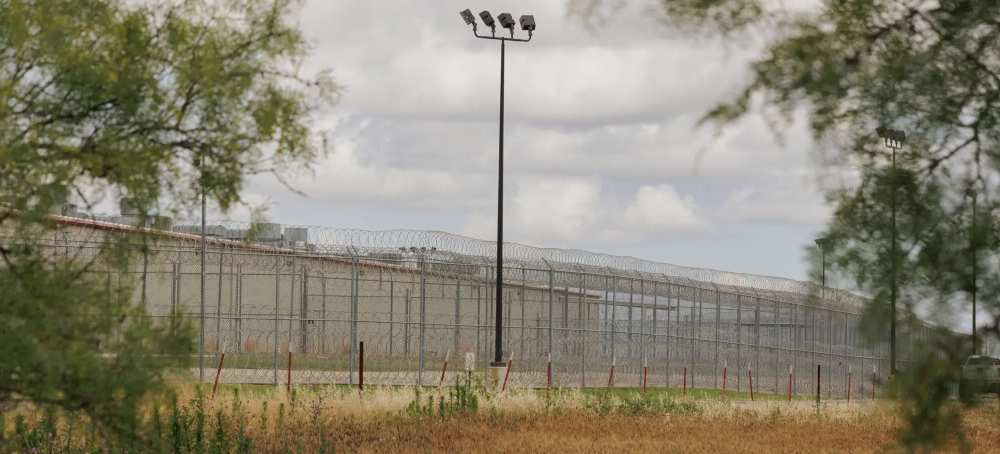 The Bluebonnet Detention Facility in Anson, Texas, in May. (photo: The New York Times)
The numbers reflect the significant effort the Trump administration has put into its escalating immigration crackdown.
The number of detained people has jumped since January, when about 39,000 people were in immigration detention, reflecting efforts by the Trump administration to quickly ramp up arrests and deportations. According to ICE records obtained by The New York Times, more than 1,100 people had been detained since Friday, about 380 people a day.
The capacity for immigration officers to detain people has grown rapidly since ICE was formed in 2003. Twenty years ago, the average daily population of detained immigrants was approximately 7,000, according to the American Immigration Lawyers Association. The previous peak since the government’s current method of counting began was 55,654 in August 2019, during the first Trump administration.
The latest figures reflect the shifting focus of immigration policing: Most of the people detained in January had been arrested by Customs and Border Protection, the agency that patrols the nation’s land borders, seaports and airports. ICE, which conducts immigration raids in the nation’s interior, is now making the overwhelming majority of arrests six months into President Trump’s second term.
Mr. Trump has made his escalating immigration crackdown a focus of his second term. His administration, and his allies in Republican-led states, have devoted considerable effort to expanding the government’s ability to arrest, detain and deport immigrants. Mr. Trump, who was re-elected on a promise of mass deportations, has often expressed frustration that arrests and deportations are not rising more quickly.
Immigration arrests require extensive resources, including ample time for surveillance, and the Trump administration has laid out ambitious long-term plans to expand ICE, after Congress more than tripled the agency’s budget from about $8 billion to roughly $28 billion.
The military has also become increasingly involved in the escalating immigration crackdown: Days after Mr. Trump returned to the White House, the Pentagon authorized using a military base in Colorado to hold immigrants, and the administration has sent some migrants to the American military base at Guantánamo Bay, Cuba. Last week, the Defense Department announced that it was building another detention facility at a military base in Texas with capacity for 5,000.
Late last month, the Trump administration authorized the deployment of National Guard units at immigration facilities, the most direct effort yet to meld military operations with domestic immigration enforcement.
Immigrant advocates expressed outrage at the growth of ICE detention during the Trump administration.
“The Trump administration is building an unprecedented detention system of extraordinary size and cruelty to terrorize immigrant communities,” Kica Matos, the president of the National Immigration Law Center, said in a statement.
Kathleen Bush-Joseph, an analyst at the Migration Policy Institute, a nonpartisan think tank, said that detention had grown rapidly under Mr. Trump compared with past administrations.
“Compared to past administrations’ records, this detention level is much, much higher — almost twice as many noncitizens are being detained now as were under President Obama,” she said.
But for as rapidly as detentions have risen, Ms. Bush-Joseph noted, the administration still remains far from its goal of 100,000 detention beds.
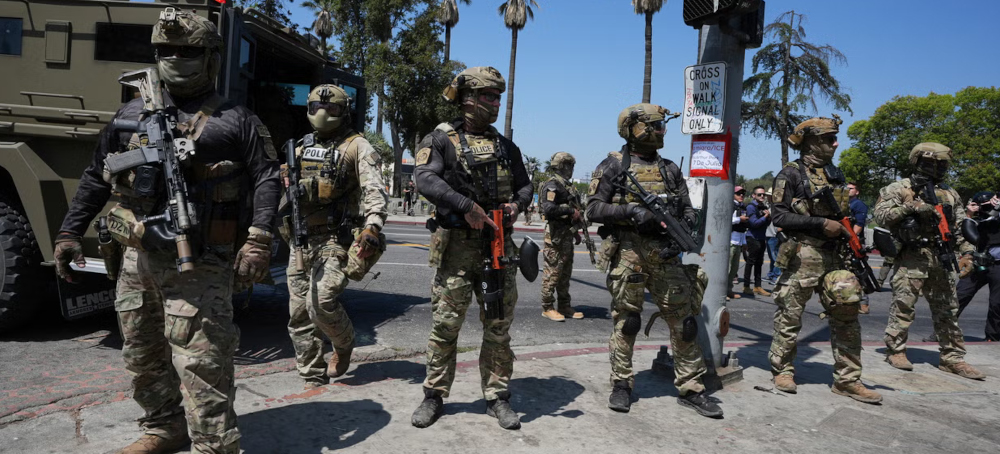 President Donald Trump's recent actions have sparked debate over the Posse Comitatus Act, a law from 1878 that limits military involvement in domestic affairs. (photo: AP)
 An exam room at the Boston Health Center at the Planned Parenthood League of Massachusetts last month. (photo: Getty)
Reproductive health giant’s ability to treat patients at risk due to Republicans’ plans to cut Medicaid reimbursements
Donald Trump’s tax and spending package, passed in July, bans Planned Parenthood from receiving reimbursements from Medicaid, the US government’s insurance program for low-income people. After Planned Parenthood sued over the ban, a judge temporarily stopped it from taking effect.
If the ban moves forward, experts warn that it could cripple the entirety of the US healthcare social safety net.
“Planned Parenthood has filled a very important role in the reproductive healthcare safety net for people living on low incomes,” said Kari White, executive and scientific director at Resound Research for Reproductive Health. White was the lead author on the research paper released on Wednesday. “Other providers have counted on them to do so. They just don’t have the capacity to step in and fill the place that Planned Parenthood has had in the safety net.”
In particular, White said, people will probably struggle to access contraception. After Texas started to ice Planned Parenthood out of its Medicaid program more than a decade ago, placements of contraceptive implants and IUDs – two of the most effective methods of birth control – fell by more than a third in counties that had a Planned Parenthood clinic. That indicated that those who had used Medicaid to obtain contraception at Planned Parenthood were no longer doing so. Provision of injectable contraceptives also fell; among people who used it, births covered by Medicaid rose by almost a third.
Republicans have long sought to defund Planned Parenthood over the organization’s commitment to providing abortions. But Planned Parenthood does not rely on Medicaid to fund its abortion provision as it is already illegal to use federal dollars, including Medicaid, to pay for the vast majority of abortions. The 1.5m visits documented in Wednesday’s research paper, which was published in the medical journal Jama, only include visits for reasons other than abortion.
More than 80 million people in the US use Medicaid, and 11% of female Medicaid beneficiaries who are between the ages of 15 and 49 and who receive family-planning services go to Planned Parenthood, according to an analysis by the non-profit KFF, which tracks healthcare policy. But defunding Planned Parenthood will probably hit blue states hardest, since they are home to larger numbers of Medicaid beneficiaries.
About 50% of the people who visit Planned Parenthood of Orange and San Bernardino Counties, which operates clinics in California, use Medicaid in some way, experts told the Guardian. If the defunding moves forward, the affiliate would lose roughly $50m, or half of its budget. It already went without Medicaid reimbursements for about five weeks earlier this year.
“It was a really stressful time for my staff. They have fees and bills to pay. And some of them probably were wondering if they would still have a job,” recalled Dr Janet Jacobson, the affiliate’s medical director and vice-president of clinical services.
“It’s hard not to take federal legislation that basically comes out and names you and threatens you and tries to defund you personally.”
Jacobson is particularly worried about the future of a program at Planned Parenthood of Orange and San Bernardino Counties that screens about 100,000 patients annually for sexually transmitted infections.
Between July 2024 and June 2025, the affiliate uncovered more than 1,500 positive tests for syphilis, as well as almost 400 cases of trichomoniasis in pregnant women. Both STIs – which often do not have symptoms in their early stages – can have devastating consequences for pregnant women and their babies, such as preterm birth and birth defects.
“They haven’t been able to ban abortion outright, so they’re trying to take away the money for services like cancer screening, STI testing, birth control, and essentially trying to shut us down that way so that we can’t provide abortion,” said Nichole Ramirez, senior vice-president of communication and donor relations at Planned Parenthood of Orange and San Bernardino Counties.
“They’re taking away this vital care from mostly underserved communities. They’re willing to have an increase in STIs, have a potential increase in cancer rates so that they can try to get rid of abortion.”
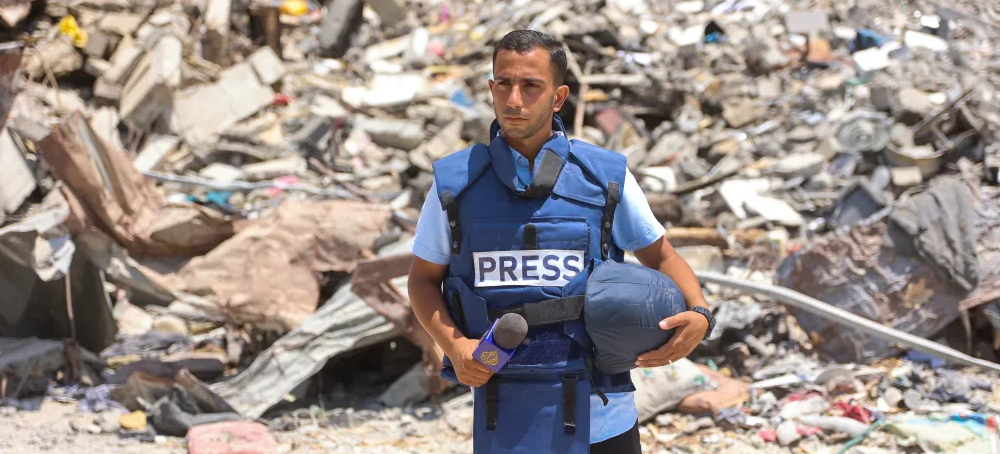 Al Jazeera correspondent Anas al-Sharif reports near the Arab Ahli Hospital in Gaza City in the Gaza Strip on Oct. 10, 2024. (photo: AFP)
I met Anas during an Israeli siege of a hospital. He grew to be my mentor — and my friend.
Anas was lying on the floor in front of the emergency room with tears in his eyes.
“Why are you so sad?” I asked him sardonically. “We’re still at the beginning of this movie!”
He laughed. Anas felt the weight of the war heavily, but he was still from Gaza, and we have our trademarked Ghazawi way of lighthearted humor in the face the most unfathomable loss and unbearably dark days.
“You’re right,” he responded. “The climax, the real tragedy, the end of the story, are still on the way.”
For Anas, the end would come too soon.
On Monday, Anas, 28, was targeted, along with three other Al Jazeera journalists, in an Israeli strike on a tent complex around Al-Shifa Hospital.
The Israeli government mocked him in death — even accusing him of being a Hamas operative. It’s their way of belittling Anas because he did something so small as tell our story.
Israel fears so many simple facets of Palestinian life, a child wearing a keffiyeh or a mother telling her son to fight for Palestine. Above all, though, Israel fears the people who tell the world about what is happening in Gaza — the war, the genocide, the famine. Anas made it a mission to tell these stories, our stories, all over the world. And people listened.
For me, though, Anas wasn’t just a star journalist. He shepherded me through tough times, encouraged me to do reporting, and shared his knowledge freely. Along with my father, Anas’s strength was the biggest inspiration to my life. It helped keep me going. He was a mentor and, moreover, a friend.
In the hospital that day we met, we chatted for a couple hours.
We both grew up in Jabaliya refugee camp. He knew some of my relatives.
It was Israel’s occupation that inspired him to become a journalist. Anas told me once about how, when he was still young, one of his relatives had been arrested. When the relative returned from Israeli prisons, Anas listened intently as the man narrated tales from behind bars for his family. Those were the kinds of stories — of injustice, of torture, of indignity — that needed to be told to the wider world, Anas realized.
Palestinian communities are famously tight-knit, but it was especially true in our camp, where people felt each other’s needs and wants intensely. In the camp, people supported each other at any cost. Anas was known for being close to the children in his community, connecting with them and instilling pride in them by teaching them about Palestine.
The spirit of telling people’s stories while also supporting them as human beings was ever present in his work. Anas could be seen walking through a hospital at work, microphone in hand, but pausing to express sympathy for mothers who had lost their sons.
We would both come to know tremendous loss in this war. Anas’s father was killed by Israel in an airstrike a month after our meeting. And my family home was hit by an airstrike on our densely populated neighborhood shortly before we encountered each other; my mother had been killed, and my sister landed in the intensive care unit of Al-Shifa Hospital, part of the reason I was there that day.
We were also, for the meantime, stuck. Israel was besieging the hospital. It was an affront to international norms, and Israel justified its attack with bogus propaganda about militants hiding out in tunnels beneath the complex.
We spent a lot of time together during the offensive and formed a bond that would continue until the day Anas died.
Anas pushed me further into journalism — and once I was getting my feet under me, he pushed me to keep going.
When we had met at the hospital, I’d already been taking photos. Every morning, I’d put on my nearly five-pound press vest and sprint from massacre to massacre. Darting around Gaza City, I took pictures with one hand because my other arm was severely injured in the attack that killed my family members.
“I see you’re working with one hand,” Anas said at the hospital, and I told him my story.
At the time, I had mostly been posting to social media. Anas, though, was an official journalist with Al Jazeera. He began to show me the ropes, patiently answering any questions I might have had and telling me how to interact with editors abroad.
This was a crucial part of the job for Anas: His journalism came first, but he knew that our stories needed to reach the world outside Gaza if there was any hope of international intervention to stop the genocide. We had to give a voice to our fellow Palestinians.
He knew it was dangerous work, but it was worth it. When I worried about a dangerous outing, Anas told me about the value of risking your life for silenced people — how if we didn’t do it, those voices may never get heard.
He also, however, understood that sometimes people needed to move on. I hadn’t been able to leave the hospital because I was with my ailing sister, but during the siege, the lack of power brought her life support down and she succumbed to her injuries. It was time to go south and reconnect with my father.
Anas understood and urged me to go — but to keep working.
He told me, “Don’t forget you survived the bombardment of your house for a reason, and you need to continue.”
I wondered about him. Why was he staying in such a dangerous place? He answered that his people were still there in the north and he would stay with them.
Eventually, I had to leave the Gaza Strip to get medical care for my injured arm and was lucky enough to get out. I ended up in the U.S. I began pursuing a degree but continued to do journalism work. And, through WhatsApp, Anas continued to be there for me — just as he was for his colleagues who were in Gaza.
I was very close with one of Anas’s colleagues at Al Jazeera, Fadi al-Wahidi. Last October, al-Wahidi was behind the camera in Jabaliya, within an area Israel had labeled a “yellow” zone — not in a forbidden “red” zone — when gunfire broke out. He was hit in the neck and paralyzed.
A few months ago, Anas began leading the charge to get his colleague evacuated to Qatar. He activated a network of contacts to prod international organizations. It would turn out to be a long fight and Anas wouldn’t see it to its conclusion.
His own work, too, was becoming more difficult. Israel’s targeting of journalists has made the genocide the deadliest war for the press in history. Anas himself had received explicit threats.
“I feel tired,” he told me a few days before he was killed. Even as he had encouraged me to leave, however, and worked to get colleagues evacuated, he had resolved to stay, to never give up. He said, “This is my land and this is my reality.”
We had been speaking for a story I am working on. Anas had, in his usual generous way, agreed to help me find sources. We set up a meeting for 5 p.m. Eastern time in the U.S. — late at night for Anas, when little would be going on. I messaged him at the appointed time, but no response came.
I sat and waited, a pit in my stomach. I opened Instagram, something I had been seeking to do less of. Immediately, I saw the news about Anas. Without thinking, reacting on instinct, I threw my phone across the room.
Anas spent so much of his life making sure other people’s stories were heard. When I got the news, however, my voice didn’t produce any words. All I could do was scream.
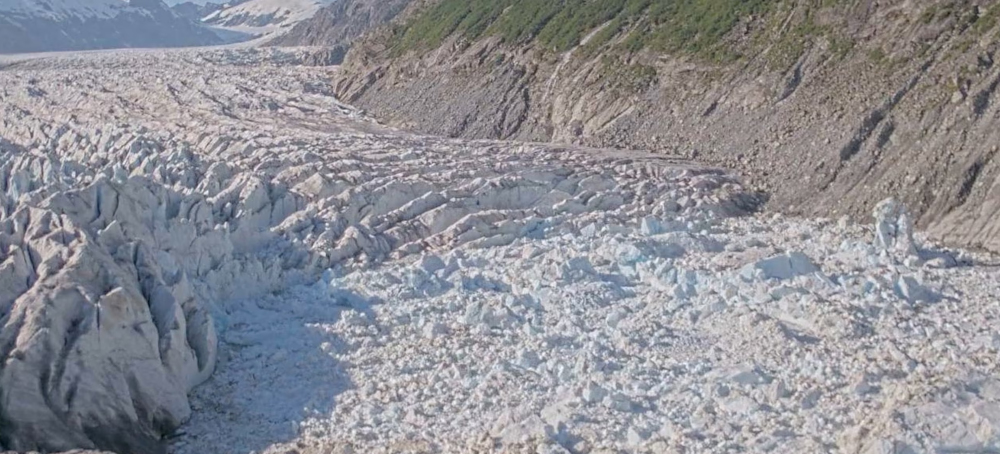 A view shows the Suicide Basin on 22 July 2025, before it reached full capacity due to glacial flooding, in Juneau, Alaska. (photo: Reuters)
Mendenhall Glacier outburst threatens homes, with scientists warning events are intensifying
Summer glacial flooding, known as a glacial lake outburst flood, or GLOF, threatens parts of the city due to a combination of rainwater and snowmelt.
Authorities say flooding from the Mendenhall River will probably crest around 4pm Alaska time, or 8pm ET on Wednesday. They hope that recently installed emergency flood barriers will hold back the waters and protect Mendenhall valley, where a majority of Juneau’s 32,000 full-time residents live.
On Tuesday morning, authorities confirmed water had started escaping the ice dam, with flooding expected into Wednesday. Some Juneau residents in the flood zone have already evacuated as officials intensified their warnings on Tuesday, saying “Don’t wait, Evacuate TONIGHT.”
The National Weather Service (NWS) office in Juneau said in an X post late on Tuesday that local hydrologists had adjusted their Mendenhall flooding forecast, anticipating that the river would crest at over 16ft on Wednesday morning.
Nicole Ferrin, with the NWS, said during a briefing on Tuesday that the flood warning was issued after “a lot of analysis” but the calculations were complicated by rainfall causing significant rising of the lake and river and confirmed that a sub-glacial release had occurred.
“This will be a new record based on all of the information we have,” Ferrin said, according to the Juneau Empire.
The Mendenhall Glacier fills a large valley north of Juneau, creating an ice dam for a meltwater lake that fills Suicide Basin. Since 2011, outburst floods from the depression have been pouring into Mendenhall Lake and rushing down the river toward Juneau each year.
But the annual Mendenhall glacial lake outburst flood is judged to be intensifying as a result of climate change.
The National Oceanic and Atmospheric Association (Noaa), said in a statement that Alaska had warmed twice as fast as the rest of the US over the last several decades.
Over the last century Alaska’s average annual temperature has risen 3.1 degrees fahrenheit and the overall trend continues to increase, according to data from Noaa’s National Centers for Environmental Information.
Scientists have attributed the retreat, melting and thinning of glaciers over the last century to Earth’s warming climate. Alaska’s glaciers are among the fastest-melting glaciers on Earth and have been in steep decline since the late 1980s, according to the Alaska Climate Science Center.
On the record amounts of water now threatening Juneau, Rick Thoman, Alaska climate specialist at the Alaska Center for Climate Assessment and Policy, told Climate.gov, Noaa reported: “Without climate change, there is no reason to think that this would be happening on the Mendenhall Glacier, then in the lake, and downriver.”
An outburst in August 2023 sent record amounts of water into Mendenhall Lake and down Mendenhall River toward Juneau, inundating areas that had not experienced flooding before, the NWS office in Juneau said at the time, causing significant erosion.
The Mendenhall Glacier is about 12 miles from Juneau and considered a popular tourist attraction. Juneau lies 800 miles from Anchorage, where Donald Trump and the Russian president, Vladimir Putin, are due to meet on Friday to discuss the war in Ukraine.
Flooding from the glacier has become an annual concern for almost 15 years, and in recent years has swept away houses and swamped hundreds of homes.
It is blamed on the retreat of a smaller glacier near Mendenhall Glacier – a casualty of the heating climate – and left a basin that fills with rainwater and snowmelt each spring and summer.
When the water creates enough pressure, it forces its way under or around the ice dam created by the blue ice Mendenhall glacier.
The Mendenhall was originally named Sitaantaagu (“the Glacier Behind the Town”) or Aak’wtaaksit (“the Glacier Behind the Little Lake”) by the Tlingit Indians, but later called Auke (Auk) Glacier, for the Auk Kwaan band of Tlingit Indians, by naturalist John Muir. It was renamed in 1892 for Thomas Corwin Mendenhall, who had helped determine the boundary between Canada and Alaska. It is considered a relic of the little ice age that lasted until the mid-18th century and is now receding at about 100 to 150 feet a year.


No comments:
Post a Comment
Note: Only a member of this blog may post a comment.