
07 September 25

In this week’s Slate Plus bonus episode of Amicus, Dahlia Lithwick spoke with Mark Joseph Stern about Burroughs’ rebuke, part of a growing chorus of lower court judges who are angry that SCOTUS keeps throwing them under the bus. A preview of their conversation, below, has been edited for length and clarity.
Dahlia Lithwick: I think what Judge Burroughs did was quite remarkable—she took a thwack at Justices Neil Gorsuch and Brett Kavanaugh in the opinion itself. I haven’t seen a lot of this punching up at the Supreme Court. Can you talk about what prompted this particular clapback?
Mark Joseph Stern: Two weeks ago, in a shadow docket order, Justice Gorsuch decided to write a little missive aimed at lower courts that were failing to divine exactly how SCOTUS wanted them to handle these decisions. He wrote: “Lower court judges may sometimes disagree with this court’s decisions, but they are never free to defy them. This is now the third time in a matter of weeks this court has had to intercede in a case squarely controlled by one of its precedents.” Justice Kavanaugh joined this bench-slap to the lower courts. It was so harsh that the judge in this case, William Young, issued an apology from the bench. He said he really did not understand what the Supreme Court was trying to say in its shadow docket orders, and wasn’t really sure that they were precedential. In fact, the Supreme Court has never actually deemed shadow docket orders to be precedent. A few years ago, Justice Samuel Alito insisted that they were not fully precedential!
Anyway, in response to Gorsuch and Kavanaugh’s scolding, Judge Burroughs dropped an extraordinary footnote. She wrote: “The court respectfully submits that it is unhelpful and unnecessary to criticize district courts for ’defying’ the Supreme Court when they are working to find the right answer in a rapidly evolving doctrinal landscape, where they must grapple with both existing precedent and interim guidance from the Supreme Court that appears to set that precedent aside without much explanation or consensus.” This is Judge Burroughs standing up for her colleagues, like Judge Young, and telling Gorsuch and Kavanaugh: You aren’t even explaining yourselves most of the time and you have the gall to accuse us of defying your orders? Get a grip.
Burroughs is not the only judge who is clapping back at the Supreme Court this week. On Thursday, Lawrence Hurley at NBC published a shocking piece citing 10 federal judges who are absolutely willing to say that the Supreme Court is not OK, and that they’re frustrated with the shadow docket rulings and the justices’ refusal to defend Article 3 judges against a pervasive pattern of threats and harassment—not just from the American public, but from the president and members of Congress.
It does feel as though we are seeing a really burgeoning number of lower court judges just telling SCOTUS: You know what? You’re not the boss of me. And you may technically be the boss of us, but I’m not going to treat you as a Supreme Court if you don’t have my back here. This is an astonishing piece of reporting, but also an astonishing decision by jurists who are loath to criticize anyone.
I think this response from lower court judges is long overdue. And I also would bet that all of the judges who express this frustration are relatively recent appointees on the younger side. I think there is an emerging generational divide: Older judges grew up with a Supreme Court that was still acting like a real court for most of their time on the bench; younger judges have only ever served under a Supreme Court that is corrupted by partisan politics. I think it has now fallen on these younger judges, like Burroughs, to stand up and defend colleagues who are temperamentally disinclined to stand up for themselves.
I guess now there’s the inevitable counter-response from at least some of the justices who are out there now saying that they didn’t really mean to criticize the lower courts. At a talk on Thursday, Justice Kavanaugh went out of his way to praise “trial judges who operate alone” and “operate on the front lines of American justice.” And he added: “I definitely want to thank all the judges.” How do you square this with him fully signing off on a Gorsuch opinion smacking trial court judges upside the head? I guess he’s trying to still the waters here, but this is just shoddy PR.
I can’t tell if Kavanaugh genuinely regrets signing onto that and is experiencing true remorse—especially after seeing some judges’ reactions—or if he’s just trying to play good cop and bad cop all at once. Kavanaugh has done this before; for instance, he notoriously signed onto a Clarence Thomas dissent in the census citizenship case that accused the district court judge, Jesse Furman, of being a kind of crazy-eyed conspiracy theorist who puts pins on a board and connects them with string. And afterward, according to CNN’s Joan Biskupic, he wrote a letter to Judge Furman essentially apologizing for joining an opinion that slandered him.
So maybe this is just Kavanaugh’s MO; he signs on to these nasty, unfounded criticisms of lower court judges, and then walks it back later on. But he literally said on Thursday to the lower court judges: “Keep doing what you’re doing.” That is the polar opposite of the Gorsuch opinion that he just joined! It’s a really bad look. And I think it shows him still struggling to figure out the right tone to strike when there is an unprecedented revolt in the lower courts against the Supreme Court’s partisanship.
File this under Kavanaugh having no self-regulation when it comes to how stuff is going to land. But it’s not just Kavanaugh; Chief Justice John Roberts also seemed to comment on the utter abandonment of lower court judges by some members of the Supreme Court. And he did it through his counselor, Robert Dow, who was speaking at the 6th Circuit Judicial Conference this week. Dow said: “The problem for our branch is that we have a very tiny megaphone, and if we use our megaphone too often, we risk losing what I would say is the long game, and the long game is to preserve our independence.”
It’s this completely inscrutable message where Dow is simultaneously saying that Roberts is trying to protect the integrity and the esteem of the judiciary, but at the same time, he’s trying to steer clear of politics. If this is an attempt to mollify district court judges who are essentially telling SCOTUS that it’s letting them twist in the wind, does it help?
Obviously not. And to be clear, Roberts hand-picked Dow; we should assume that Roberts signed off on anything Dow says in public. So I think this is the chief’s attempt to respond. And it won’t work, in part because it’s not really an apology at all. It’s an excuse. It’s an effort to say: Don’t be mad at us. We just have the world’s tiniest megaphone. So I will play the world’s tiniest violin for them and say: No, you don’t. When the justices want to crap all over the lower courts, that megaphone gets nice and loud. But when there is a potential confrontation with Donald Trump—when the Trump administration violates lower court orders—the megaphone suddenly shrinks to microscopic size. It doesn’t work as an excuse at all. And Roberts must know that.
I also think this will likely be the chief justice’s last word on this for some time. And if he continues signing off on these opinions that reward the Trump administration for defying lower courts, that condemn lower courts for allegedly defying inscrutable shadow docket orders, he is still part of the problem. He is still putting lower court judges at risk. He is still fostering a culture of disregard for judicial orders. And that is all going to come back to bite him when the Trump administration decides: Hey, if we can ignore these lower courts without any real consequence, we can ignore the Supreme Court too
Bernie Sanders Assails Democrats for Not Endorsing Mamdani
 Zohran Mamdani, center left, and Senator Bernie Sanders of Vermont, center right, joined a Labor Day parade in Manhattan on Saturday. Union support has almost exclusively lined up behind Mr. Mamdani. (photo: Victor J. Blue/The New York Times)
Mr. Sanders appeared with the Democratic front-runner for mayor of New York City at a town hall in Brooklyn on Saturday night as part of his Fighting Oligarchy tour.
Speaking at an evening town hall in Brooklyn, Mr. Sanders said the party leaders’ reluctance to back Mr. Mamdani after his decisive win in the Democratic primary showed how deeply disconnected they had become from voters. He said that Democrats in New York should be “jumping up and down” to support Mr. Mamdani after the excitement over his underdog campaign.
“So we’ve got another fight on our hands,” Mr. Sanders said. “And that is the future of the Democratic Party.”
Mr. Mamdani joined Mr. Sanders on the latest stop on his national Fighting Oligarchy tour, the town hall feeling like a passing of the torch from Mr. Sanders, who turns 84 on Monday, to a new generation of leaders like Mr. Mamdani, 33, and Representative Alexandria Ocasio-Cortez, 35. Ms. Ocasio-Cortez met with Mr. Sanders and Mr. Mamdani earlier in the day and endorsed Mr. Mamdani, a state assemblyman, during the primary.
The trio are democratic socialists and have tried to push the Democratic Party to the left. But Mr. Mamdani has also faced pressure to distance himself from the Democratic Socialists of America to appeal to a broader audience.
Many Democrats in New York have not yet endorsed him, among them Gov. Kathy Hochul, as well as Hakeem Jeffries and Chuck Schumer, the minority leaders in the House and Senate.
Mr. Sanders said in an interview before the town hall that Democratic leaders were missing an opportunity by failing to embrace Mr. Mamdani.
“It’s no great secret that they’re way out of touch with grass-roots America, with the working families of this country, not only in New York City, but all over this country,” he said.
Mr. Mamdani’s populist proposals, Mr. Sanders said, were “not radical ideas.”
“We’re the richest country in the history of the world,” he said. “There’s no excuse for people not having affordable housing, good quality, affordable, decent transportation, free transportation.”
Mr. Mamdani praised the D.S.A. at the town hall, urging a mother who supported his universal child care plan to join the group when she asked how she could help.
He also weighed in on a host of local issues, including expressing support for faculty members and protesters on college campuses who support Palestinians. Elected officials have protested how four faculty members at Brooklyn College lost their jobs.
“No faculty member should be disciplined for supporting Palestinian human rights,” Mr. Mamdani said.
When Mr. Mamdani was asked about Mr. Trump’s threats to send the National Guard to the city, he said: “We have to prepare for the inevitability of that deployment.”
Mr. Mamdani said that elected officials in California had worked together to oppose Mr. Trump’s incursion and cast doubt on whether his closest mayoral rival, former Gov. Andrew M. Cuomo, could work with Ms. Hochul and others to stop him.
“Why would he fight back when it’s Donald Trump that is trying to get him elected right now?” he said.
Mr. Sanders and Mr. Mamdani also took aim at Mr. Trump’s agenda and the wealthy donors who are trying to defeat Mr. Mamdani. Mr. Sanders said that wealthy Americans had too much power and that the mayor’s race was a “test case of whether or not democracy can prevail.”
“They’re afraid of Mr. Mamdani becoming an example of what can happen all over this country,” Mr. Sanders said.
Mr. Trump has said that he wants two of the mayoral candidates to drop out so that one of them can beat Mr. Mamdani in a head-to-head competition. The New York Times reported on Friday that Trump advisers had been putting together a plan for Mayor Eric Adams to be nominated as ambassador to Saudi Arabia as a way of removing him from the race and consolidating the field to help Mr. Cuomo’s chances.
On Saturday morning, Mr. Mamdani and Mr. Sanders marched in a Labor Day parade in Manhattan with elected officials, including Ms. Hochul.
Mr. Mamdani told reporters that watching Mr. Sanders’s insurgent 2016 presidential campaign had inspired him to become a democratic socialist.
Mr. Mamdani added that the initial canvassing effort for his first State Assembly run in 2019 had taken place outside a Sanders rally.
“He was a mayor who ran with a message that Burlington is not for sale,” Mr. Mamdani said of Mr. Sanders, who served four terms as the mayor of the Vermont city early in his career.
“We are running with a message that New York City is not for sale,” Mr. Mamdani added. “There are echoes and parallels, and an inspiration in the work that he has done.”
The appearances on Saturday were a homecoming for Mr. Sanders, who grew up in the Midwood neighborhood of Brooklyn and still holds a grudge against Walter O’Malley for moving the Dodgers to Los Angeles. Despite representing Vermont in Congress for decades, his local accent has never faded and his forceful denunciations of economic disparity have made him a popular figure in New York City.
A recent poll by a progressive think tank of Democratic primary voters in the city found that Mr. Sanders was the most popular elected official among those listed on the survey, with 79 percent having a favorable view of him.
Mr. Mamdani has embraced Mr. Sanders’s message, criticizing his mayoral opponents’ reliance on large campaign donations from billionaires and political groups backed by corporations. In contrast, Mr. Mamdani has relied on smaller donors and announced on Friday that he had hit the $8 million fund-raising cap in the race.
Mr. Cuomo, who is running for mayor as an independent, was endorsed on Saturday by the Local Union No. 3 of the International Brotherhood of Electrical Workers and was greeted warmly by some New Yorkers on the labor parade route.
“Andrew Cuomo has stood hand in hand with unions for decades,” said Christopher Erikson, the union’s business manager.
Mr. Adams, who is fourth in the polls, said Friday that he would not leave the race and called Mr. Cuomo “a snake and a liar.”
On Saturday, Mr. Cuomo dismissed Mr. Adams and said he had long ago stopped listening to him.
“I believe the Republicans want Mamdani to win the election,” Mr. Cuomo said.
Mr. Sanders’s Fighting Oligarchy tour has drawn huge crowds across the country, channeling fury on the left over Mr. Trump’s first months back in office.
But Mr. Mamdani’s opponents have argued that the progressive wing of the party has hurt Democrats and is out of step with most Americans. Mr. Trump won more votes in New York City in 2024 than in 2020, in part over concerns about immigration and crime.
While Mr. Cuomo and Mr. Adams have concentrated their message on public safety, Mr. Mamdani has sought to keep his focus on another issue — affordability — and his plans to tax the wealthy to provide free buses and child care.
Mr. Mamdani, who has a healthy lead in the polls, said the race was not over and urged his supporters to canvas for his campaign.
“We have to beat Andrew Cuomo one more time, he said, adding: “The job is not done.”
Thousands March and Rally Across Washington to ‘Free DC’
 Protestors holding a "Trump Must go Now" banner at the "We Are All DC: A National March" protest in Washington on Saturday, Sept. 6, 2025. (photo: DC Bureau)Max Cotton, KPLC
Cotton writes: "Thousands protested the Trump administration’s crime crackdown in the nation’s capital Saturday."
The Free DC Project hosted the We Are All DC: A National March with the goal of ending what they call the Trump administration’s occupation of the city.
It comes as D.C. Attorney General Brian Schwalb, a Democrat, filed a lawsuit Thursday saying National Guard troops are illegally patrolling neighborhoods throughout the city.
That same day, the D.C. National Guard announced it’s extending its deployment through the end of November.
Natalie Howe, a rally-goer and D.C. resident, said the guard deployment isn’t necessary.
“Washington, D.C. is safe enough for me to have my kid in, and I really like it here,” she said. “And, as, as you know, from looking at the crime stats, the crime is not the problem in D.C.”
Stats show crime was at a 30-year-low in DC before the federal crackdown began in August, however violent crime has continued to drop since the enforcement surge.
The federal takeover of the DC police force is also set to end Wednesday unless Congress authorizes an extension.
Blackwater Founder and Maga Disciple Erik Prince Pitching Services in Ukraine
 Erik Prince, the founder of Blackwater, at a press conference in Guayaquil, Ecuador’s biggest city, in April. (photo: Gerardo Menoscal/AFP)
Sources say Prince, whose firm’s contractors committed 2007 Iraq massacre, eager to get into valuable drone sector
In the streets of Kyiv, military hawks and defense privateers have described how Erik Prince, Maga disciple and founder of the now-defunct mercenary company Blackwater, has been aggressively pitching his services and looking to buy.
According to those same sources who spoke on background and on the condition of anonymity to discuss sensitive defense matters, Prince was pitching himself to the valuable Ukrainian drone sector and seeking meetings with leading industry players.
“Erik is going out there to buy drone companies,” said one of the sources, with another confirming Prince was in the hunt to acquire drone makers with a footprint in Ukraine.
“Whether they would sell them …” the source said. “For the Ukrainians these companies are now strategic assets.”
Prince’s latest gambit in Ukraine coincided with Trump’s attempts at brokering a peace deal between the Kremlin and the Ukrainian government of President Volodymyr Zelenskyy in August, which has yet to yield any diplomatic breakthroughs.
Since drones became the main killing tool of the conflict, accounting for an estimated 80% of Russian casualties, western investors and defense companies have flocked to get in on Ukraine’s coveted battlefield data and emergent drone technologies for their own wares.
Now Prince allegedly wants to do the same, which experts say is an unsurprising development for an opportunistic defense contractor who is cozy with the Trump administration and has a history of profit-seeking from foreign wars.
“I’m not surprised at all,” said a former American special forces soldier with experience in Ukraine and knowledge of the defense companies operating there. “Drones are now an integral part of the PMC [private military contractor] world. If you’re a PMC and you don’t have a drone or possibly an electronic warfare capability, you are antiquated.”
The days of “former gunslingers” as private military contractors “are over”, he said, referring to when Blackwater was at its height during the wars in Iraq and Afghanistan. Back then, millions of dollars in contracts were doled out to Prince for the hiring of his cadres of former infantrymen and commandos as guards and operators for the CIA, state department and Pentagon. But a 2007 massacre in Baghdad at the hands of some of his contractors led to prison sentences, congressional inquiries and blacklistings of the firm.
Prince’s interest in Ukraine comes after he served as an adviser for a controversial drone assassination program in Haiti this year and also reportedly sending hundreds of fighters to the embattled country – home to western mining interest – under the banner of his new venture, Vectus Global.
Similarly, making what would be an unsuccessful sales pitch in another vulnerable country with natural resources wealth in 2018, Prince proposed financing a mercenary force to take over the war in Afghanistan by using local mining projects.
“He’s doing it in Haiti, so why not?” said Morgan Lerrette, a former Blackwater contractor in Iraq who later went on to become an author and critic of the wider private military contracting industry. “From a strategic look, [Prince] is going places where there are minerals and the US wants to create joint sovereign wealth funds.
“Ukraine fits that,” said Lerette.
Indeed, Prince has long seen Ukraine, which recently signed a rare-earth minerals deal with the Trump administration, as a potential cash cow: In 2020 he pitched a multibillion-dollar plan to Zelenskyy, then then newly elected president, to help settle what was a frozen war in the eastern Donbas region, using his private army. The deal never materialized.
“Prince went to the wrong network. He backed, like, outgoing corrupt [leaders], so he burned his first pitch,” said an executive at a multinational drone company, about Prince’s first foray into Ukraine after the election of Zelenskyy. “Prince has a bad reputation generally in the industry. No clean person will hire him.”
The same person said Prince’s work founding a Chinese mercenary company, which hired ex-members of the Chinese People’s Liberation Army, soiled his reputation and made him an intelligence liability that is “universally untouchable by most people”.
A separate cache of business documents and proposals shared with the Guardian shows how the Pentagon and its special forces sections are interested in partnerships with US drone manufacturers that have a presence in Ukraine, all with the aim of understanding how the next major conflict will be fought and what their soldiers will need.
In a splashy announcement in July on the grounds of the Pentagon, the secretary of defense, Pete Hegseth, announced he was “Unleashing US Military Drone Dominance” in a memorandum calling for the mass production and adoption of all unmanned aerial vehicle platforms.
“Drones are the biggest battlefield innovation in a generation, accounting for most of this year’s casualties in Ukraine,” he said. “Emergent technologies require new funding lines.”
Hegseth made clear the Pentagon would need corporate partners for the accelerated program and, so far, there is no shortage of takers. All future and current wars, with the nearly four-year full-scale invasion of Ukraine being no exception, attracts business interests and its requisite leaders.
The former Google chief executive Eric Schmidt openly touted that the war in Ukraine had turned him into an arms dealer, founding his venture White Stork, which is producing drones. Gen David Petraeus, the former director of the CIA and a chief warfighter for the Pentagon in the Iraq and Afghanistan conflicts, has an eye on Ukraine and has advised the burgeoning American drone and security contractor Vector.
Prince, through Vectus Global and his encrypted cellphone company, Unplugged, did not reply to multiple requests for comment.
Riots and Abuse Troubled These Former Prisons. Ice Plans to Reopen Them.
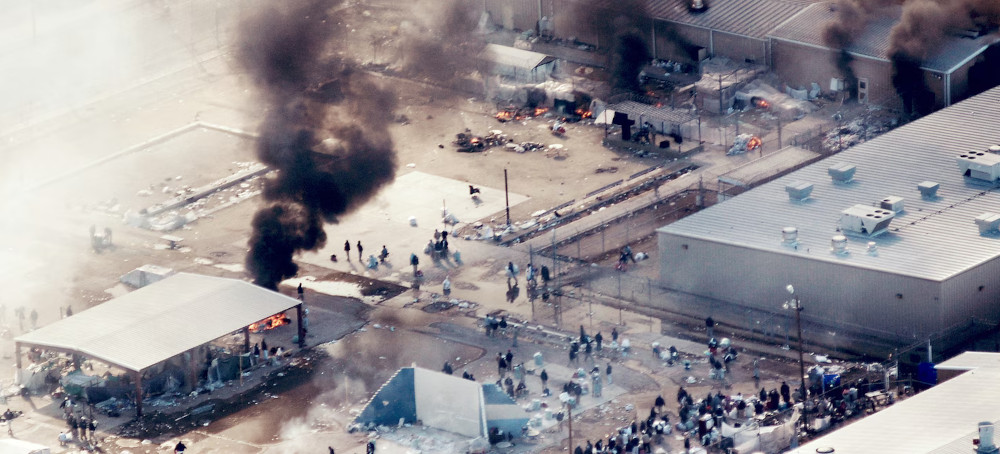 Smoke rises over the Reeves County Detention Center on Feb. 5, 2009, after inmates staged a riot. (photo: Smokey Briggs/Pecos Enterprise)
The same operators that closed facilities plan to reopen them to hold immigrants. Advocates say that puts detainees at risk of violence and mistreatment.
he Trump administration plans to reopen several former prisons and detention centers that were closed by the federal government years ago over concerns about violence, medical neglect and systemic understaffing, as part of the president’s plan to carry out the largest deportation campaign in U.S. history.
Three of the facilities, in Texas, Kansas, and Georgia, are on a government list of detention centers that U.S. Immigration and Customs Enforcement plans to reopen or expand by the end of this year, according to an internal planning document obtained by The Washington Post. All three would be operated by the companies that ran them previously.
Congress has approved $45 billion to expand immigrant detention over the next four years. Meanwhile, the Trump administration has stripped away oversight measures and provided limited details on how they plan to address chronic issues that led to past problems at these facilities, including understaffing in remote areas.
The troubled facilities were closed during the Biden administration after serious incidents, and in some cases, years of recurring problems.
At the sprawling Reeves County prison in West Texas, which could hold more than 4,000 people, inmates rioted to protest poor medical care, food and the use of solitary confinement, causing $20 million in damage.
A Senate investigation found that a physician affiliated with the 1,000-bed Irwin County Detention Center in rural Georgia appeared to have performed “excessive, invasive and often unnecessary gynecological procedures” on dozens of women detained between 2017 and 2020.
And at a prison in Leavenworth, Kansas, with capacity for about 1,000 inmates, understaffing led to such a level of violence and chaos that one federal judge characterized the facility as “an absolute hell hole.”
“The facilities that have been closed in prior administrations were closed for good reason, generally after a lot of thought and negotiation and consideration,” said Deborah Fleischaker, former acting ICE chief of staff under President Joe Biden. “And to reopen those without really, really clear mitigation plans and oversight and staffing models is just a recipe for more harm to detainees.”
Reeves was overseen by the Federal Bureau of Prisons, Irwin by ICE and Leavenworth by the U.S. Marshals Service. Representatives for the private companies that operate the Reeves and Irwin detention facilities — Geo Group and LaSalle Corrections, respectively — did not respond to requests for comment.
Steve Owen, a spokesman for CoreCivic, the owner of the Leavenworth facility, said in an email that the company meets or exceeds government standards at all its 42 correctional and detention facilities across the country. He said that the Kansas prison faced security challenges related to understaffing during a short period of its 30 years in operation, and that the company has seen a positive response from job seekers as it lays plans to reopen the facility.
“As with any difficult situation, we sought to learn from it,” he said. “Staffing was the main contributor to the challenges, and the COVID-19 pandemic compounded the labor issues.”
Tricia McLaughlin, a Department of Homeland Security spokeswoman, said in an emailed statement that ICE detention centers abide by higher standards than most prisons. She also said that the internal planning document is still subject to changes, and the agency may ultimately decide against issuing certain contracts. DHS noted that funds for staff that would be responsible for medical and detention standards compliance were included in Congress’s spending bill.
The Trump administration said in March that it was closing two watchdog agencies that oversaw detention centers and investigated detainee complaints. DHS reversed course, but lawyers for immigrants and nonprofit advocacy groups assert that deteriorating conditions at some locations are festering unchecked. A federal judge in New York ruled last month that ICE needed to improve conditions at a Lower Manhattan immigration holding facility, where detainees claimed they were held without beds, showers or medical support and received only two small meals a day.
Unlike criminal detention, immigration detention is not meant to be punitive. A Supreme Court ruling and ICE’s website state that those facing civil violations should not be held as a form of punishment; rather, detention for immigration offenses is meant to ensure people show up for proceedings.
Detainees at some facilities are housed in dormitory-style rooms with bunk beds and limited access to a recreational area at certain times during the day. But Eunice Cho, senior counsel at the American Civil Liberties Union’s National Prison Project, says detainees are increasingly being locked in cells with little access to bare necessities.
“Punitive conditions can take place in a number of ways,” Cho said, including “deprivation of medical care, deprivation of access to counsel; abuse of force; severe overcrowding.”
Remote locations, isolated detainees
Many of the facilities that ICE plans to reopen are in remote, rural areas where, historically, few people have been willing to work a difficult job that requires frequent overtime shifts. Many state and local prisons are already experiencing a staffing crisis, said Lauren-Brooke Eisen, who researches private prisons as a senior director of the Brennan Center’s Justice Program, a nonpartisan law and policy organization affiliated with New York University’s law school.
Nearly 90 percent of ICE detainees are held in facilities run by contract companies in the private sector. These firms shifted away from holding people in federal prisons over the past decade after Presidents Barack Obama and Joe Biden ordered the Bureau of Prisons to phase out contracts with privately run prisons, citing federal research showing such facilities were more likely to have security problems and do not substantially save taxpayers money.
Trump has reversed these policies, but federal prison contracts have continued to wind down and private prison companies now own many empty facilities. This year, ICE started working with contractors to convert a few of these prisons into immigrant detention centers, including in Michigan and Tennessee, and plans to issue many more contracts in the coming months.
The Reeves County Detention Center, located in the remote Trans-Pecos region of West Texas, was so hard to staff when it received a contract in 2007 to house migrant men that officials eliminated the minimum required staffing levels determined by the federal government, according to a 2015 audit by the Justice Department’s Office of the Inspector General. The unusual concession meant Reeves was rarely — if ever — fully staffed.
Reeves’s remoteness contributed to a sense that guards “can act with impunity,” said Lisa Graybill, former legal director for the ACLU of Texas, who sued the federal government and the administrators of the prison over the death of an undocumented immigrant who was denied medical care at the facility. Graybill, who litigated the case on behalf of his survivors, said that he was epileptic and put in solitary confinement merely because he was demanding medication.
Geo Group claimed legal immunity and said it had acted in “good faith" in court filings. The case was resolved in a monetary settlement awarded to the detainee’s family.
“The understaffing was astounding even in a system that flourishes and profits on what I would call planned understaffing,” she said.
These factors contributed to a series of riots in 2008 and 2009 in which inmates set a mattress on fire and destroyed property, demanding better food, medical care and living conditions. Three inmates were hospitalized, according to a CNN report at the time. Graybill described the events as an act of “desperation.”
Two of the three units at Reeves closed in 2017, after the government did not renew its contract. The third unit closed in 2022 after the Biden administration issued its executive order phasing out Justice Department contracts with private prisons, saying they provide “incarceration that is less humane and less safe.”
ICE plans to award Geo a new contract to reopen Reeves by October, and eventually house up to 5,700 immigrant detainees there, according to the internal planning document obtained by The Post. That includes 2,000 beds for unauthorized migrant parents and children, which would make it one of the largest family detention centers in the country.
'Gynecological abuse’
The Irwin County Detention Center is in the tiny town of Ocilla, Georgia, which is more than 100 miles from the nearest major city and has a population smaller than some high schools. In 2020, former Irwin detainees complained that they’d undergone nonconsensual and unnecessary gynecological procedures by an outside doctor that Irwin’s medical staff had referred them to.
Sarah Owings, a Georgia-based immigration attorney who represented some of the women alleging mistreatment, said the facility’s location “in the middle of nowhere” likely constrained its ability to hire qualified medical staff, as well as the failure of authorities to see what was happening to the women there.
“There’s no oversight,” she said. “When you combine that with the absolute powerlessness of the people you are talking about detaining, that makes it possible for bad things to happen in the dark.”
Studies have shown numerous deficiencies in the health care that ICE and its contractors typically provide detainees, from ineffective mental health screenings to improper surgical procedures. One report last year by the ACLU and Physicians for Human Rights found that over 95 percent of the deaths that occurred in ICE custody between 2017 and 2021 could have been prevented.
A bipartisan Senate report in 2022 found that ICE failed to end a years-long pattern of what medical experts described as “aggressive and unethical” treatment by a single doctor working with Irwin’s detainees.
Sen. Jon Ossoff (D-Georgia), then-chair of the Senate subcommittee that led the investigation, blamed ICE for not properly vetting the doctor and noted that he had previously been sued by the Justice Department and the state of Georgia for allegedly “performing excessive and unnecessary procedures.” He also had been dropped by a major insurer for “excessive malpractice cases” and was not board-certified, the report said.
At the time, an ICE health care official testified that the agency did not find evidence of such procedures but immediately stopped sending patients to the doctor “out of an abundance of caution.” A representative from LaSalle Corrections, the Irwin operator, testified that ICE “was solely authorized and responsible for vetting and credentialing all off-site medical providers.” The doctor has denied any wrongdoing.
Elora Mukherjee, a law professor at Columbia University who filed a class action complaint against the facility, said that “the gynecological abuse was one piece in a horrifying scene of myriad problems.” The case was settled last year.
The Biden administration ended ICE’s contract with Irwin in 2021. Irwin is on the list of facilities for which ICE plans to issue a new contract in the coming months, according to the agency planning document.
Trump’s border czar, Tom Homan, has repeatedly said that expanding ICE’s detention capacity is necessary to arrest and deport more people.
“The more beds we have, the more success we’re going to see,” he told reporters at a press briefing in Washington last month.
Communities on edge
With the reopening of these facilities, some people who live near them see the problems of the past as reason to worry about what happens next.
A group of residents in Leavenworth has come together to oppose the planned reopening of the local prison as an ICE facility, writing newspaper editorials, putting up yard signs and staging protests. They contend that the facility’s owner, CoreCivic, presided over an era in which the prison failed to keep its guards and inmates safe.
A judge in Kansas issued a temporary injunction this summer blocking CoreCivic from reopening the facility without a local permit or sign-off from a court. CoreCivic is appealing that decision.
CoreCivic operated the former maximum security prison before closing it in 2021, after the ACLU wrote a letter to the White House claiming that understaffing and rampant drug use by prisoners created an unruly atmosphere where beatings and bloodshed were the norm. At the time, a CoreCivic representative described the allegations in the letter as “false and defamatory” and designed “to exert political pressure.”
William Rogers, a former guard at the Leavenworth facility, said in an interview that he was assaulted seven times during the five years he worked there, from 2016 to 2020, including once when he was stabbed.
CoreCivic’s Owen said the company has hired about 130 of the 300 staff it expects to need at the facility, and plans to pay them a starting wage of $28.25 an hour — slightly higher than the median wage for correctional officers last year, according to the Bureau of Labor Statistics. The facility is about 30 miles from Kansas City — closer to a major city than many other detention centers.
Owen said the facilities are “regularly subject to independent audits without any prior notice” and that the company sees it as its responsibility to “care for each person respectfully and humanely while they receive the legal due process that they are entitled to.”
Rogers, a member of the local community who has participated in recent protests against CoreCivic, said he nonetheless fears that conditions could be worse than they were before, in part because the Trump administration’s aggressive approach to arresting and deporting people might foster an atmosphere of carelessness toward migrants.
“There’s going to be a whole different level of how these people are treated,” Rogers said.
Loss of Koala Habitat Shows ‘Total Failure’ of Nature Laws, Conservationists Say
 Nearly 4,000 hectares of koala habitat has been lost in 2025 so far. (photo: Ellen Smith/Guardian UK)
More habitat has been given up legally in 2025 so far than any other year since the animals were listed as threatened, analysis shows
The destruction of 3,958 ha of bush approved across eight projects, including a coalmine in Queensland, equates to about four Sydney airports’ worth of clearing.
The environment group said despite the government’s commitment to zero new extinctions the data highlighted that nature laws were failing to protect the endangered species from harm.
“Given that the koala has been recognised as threatened with extinction since 2012 and therefore should be protected from harm, this underscores the total failure of the current laws to keep trees in the ground and prevent the further decline of the species,” ACF nature campaigner Darcie Carruthers said.
The analysis came as New South Wales announced its long-awaited great koala national park, in a “historic” victory for community environment advocates who had lobbied successive state governments for more than a decade.
The koala was first listed as vulnerable under national laws in 2012. Its conservation status was upgraded to endangered in 2022 – meaning its trajectory had worsened – with habitat destruction and fragmentation identified as a major and increasing threat.
The ACF analysis examined project approvals under the Environment Protection and Biodiversity Conservation (EPBC) Act that affect koala habitat. The nature group separately used state government land-clearing data in NSW and Queensland to calculate how much koala habitat had been cleared in those states from 2011 to 2023 – the most recent year for which data was available.
It found 2,295,134 ha of bushland that was likely koala habitat – more than twice the size of greater Melbourne – had been destroyed in that period. More than 1.9m ha of that clearing was in Queensland. The ACF said 98% of the clearing had not been referred for any assessment for its environmental impacts under national law, with agriculture the biggest driver of the destruction.
“The very law meant to protect nature is so poorly enforced that it has failed to stop nearly 2.3m hectares of likely koala habitat from being bulldozed and cut down,” Carruthers said.
The analysis found native forest logging, particularly in NSW, was also contributing to koala habitat loss, with 391,170 ha of likely koala habitat destroyed by logging operations over the 12-year period.
Carruthers said a forthcoming overhaul of the EPBC act “must set clear rules to protect habitat for threatened species like the koala, close loopholes that enable rogue bulldozers and establish an independent watchdog to enforce the law”.
The environment minister, Murray Watt, has said the promised reforms will be put to the parliament this year and that delay would hold up investment in projects and cause more environmental destruction.
A 2020 review of the EPBC Act by the former competition watchdog head Graeme Samuel found successive governments had failed to protect Australia’s unique species and ecosystems, which were in unsustainable decline.
Dr Kita Ashman, an adjunct professor at Charles Sturt University, urged the government to adopt Samuel’s recommendation to abolish the effective exemption from environment laws granted to all native forest logging covered by regional forestry agreements between the federal and state governments.
“The way regional forests agreements operate under the EPBC Act is effectively as a backdoor for destructive practices like logging to continue with very little scrutiny,” she said.
“If we remove this loophole, it will mean climate refuges and places that are critical for the survival of the species will remain intact.”
A spokesperson for the federal environment department said all projects referred to the government were assessed on a “case-by-case basis” and developers were required to demonstrate they had avoided and mitigated potential damage to the environment to the greatest extent possible.
“The Australian Government is committed to strengthening and streamlining our national environmental laws and establishing a national environment protection agency (EPA),” they said.
“One of the key pillars of the new laws will be stronger environmental protection and restoration including through introducing new national environmental standards. These standards will improve environmental protection and guide decision making.”
They said Watt was consulting extensively ahead of the reforms, which would deliver “a balanced package of changes, based around the recommendations of the 2020 Samuel Review”.
The spokesperson said the federal saving koalas fund had invested more than $76m in koala conservation measures.
PO Box 2043 / Citrus Heights, CA 95611


No comments:
Post a Comment
Note: Only a member of this blog may post a comment.