
22 September 25

"The article below is satire. Andy Borowitz is an American comedian and New York Times-bestselling author who satirizes the news for his column, 'The Borowitz Report'."
Patel, who earlier this month was replaced as FBI director by a startled deer, received a ringing endorsement from Disney CEO Bob Iger.
“We’re confident that all of Kash’s jokes will be acceptable to the president, especially since his head writer will be Stephen Miller,” Iger said.
Urging viewers to “give Kash a chance,” Iger added, “If he’s even half as funny as he was at the Senate last week, this show is going to be huge.”
America’s Slow-Motion Coup Speeds Up
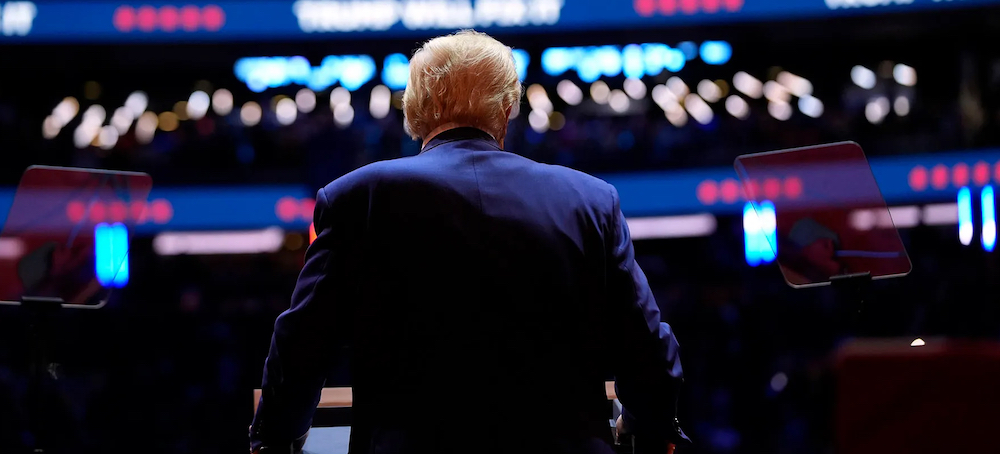 President Donald Trump. (photo: Alex Brandon/AP)
MAGA forces told us all along they wanted to crush free speech. Maybe we'll believe them now
Trump sat next to British Prime Minister Keir Starmer at the latter’s English country retreat on Thursday and delivered a veritable torrent of half-truths, misstatements, fantasies and flat-out lies: Inflation had been vanquished, fuel prices were down, the U.S. economy was booming, he had personally resolved seven (!) international conflicts, although those did not, sadly enough, include the ones in Ukraine and Gaza. Public opinion polls suggest it might be hard to find anyone in America who believes all that, even among Republican voters. But Trump and his minions have a plan — or concepts of a plan, we might say — to change that too.
When asked about ABC’s abrupt decision to “suspend” Jimmy Kimmel’s late-night talk show, the president tried to have it both ways in classic Trumpian fashion, strutting for his fans just a bit while also brushing off the question with obvious lies. “Jimmy Kimmel was fired because he had bad ratings” and “for lack of talent,” he said, but oh yeah, by the way, Kimmel had also “said a horrible thing about a great gentleman known as Charlie Kirk.” (Unnecessary fact check: Kimmel hadn’t said anything about Kirk, horrible or otherwise, and had offered routine social-media condolences to Kirk’s family.)
Jimmy Kimmel isn’t the point here, as I hope everyone understands. Jimmy Kimmel will be fine. It’s already been suggested over the weekend that, under some benevolent compromise, he may be allowed to return to the airwaves, lack of talent and all. It isn’t quite right to call Kimmel a canary in the coal mine; we’ve had plenty of those already. His literal cancellation is more like a test case, designed to measure the breadth and power of the accelerating authoritarian coup now underway in America.
The MAGA assault on late-night comedy — which is doubly vulnerable, as both a fading cultural institution and the veritable definition of First Amendment-protected speech — represents a kind of pincer movement, bringing together multiple overlapping fascist tendencies. On one hand, we see the consolidation of mainstream media companies, now increasingly under the oligarchic control of Big Tech and finance capital, and increasingly dependent on the corrupt Trump regime to approve their corrupt cartel-building mergers and acquisitions. On the other, we see the regime’s undisguised campaign to restrict and punish dissent, and to redefine “free speech” as a conditional benefit conferred only on its most loyal grovelers and forelock-tuggers, and subject to revocation at any time.
Those two tendencies are, of course, not independent or purely coincidental. They are part of a larger pattern, which former Salon columnist Bill Curry (also a former Democratic Party insider) described in a recent Facebook post as a “Gaza-like assault on civil society.”
As a media creature and low-grade oligarch himself, as well as a hopeless cable-TV addict, Trump remains personally fixated on the idea of manipulating public opinion by forcing the networks to lavish him with 24/7 praise and affection. It was his slavishly loyal pals at Nexstar and Sinclair, the right-wing corporations that between them control nearly 400 local TV stations across the U.S., who led the pitchfork brigade against Kimmel’s show and forced Disney/ABC corporate leadership to choose between commitment to principle and capitulation to power. (Sinclair announced on Thursday that suspending Kimmel was “not enough,” saying it wouldn’t bring his show back to its stations absent “immediate regulatory action” and a public display of contrition.)
Did Nexstar and Sinclair take marching orders directly from the White House, or did their leaders just seize an opportunity to curry favor and demonstrate obedience in advance? It hardly matters (although I’d go with option A), but the importance of those hundreds of outlets, whose cookie-cutter local news broadcasts are overtly driven by the MAGA agenda and overwhelmingly watched by lower-income senior citizens, should not be underestimated. Consider this extraordinary remark from Trump’s attack-dog FCC chairman, Brendan Carr, in a recent Fox News interview: “We’re going back to that era where local TV stations, judging the public interest, get to decide what the American people think.”
At least we can’t accuse Carr of concealing his intentions. I don’t know whether that’s more menacing or more ridiculous: We will tell the TV stations what to say, and they will decide what you think. That is straight-up Donald Trump’s thinking — and although public opinion doesn’t exactly work like that, it probably works more like that than most of us would like to admit. If it sounds like Carr is describing an unachievable MAGA-world dystopia, let’s consider what has already happened in actual reality:
- The Washington Post, now owned by Amazon tycoon Jeff Bezos, has declawed its opinion section, decreeing that it must advocate for “personal liberties and free markets.” It recently fired Karen Attiah, its only full-time Black opinion columnist, for posting comments about race and gun control (that did not directly mention Charlie Kirk’s killing).
- CBS, CNN, HBO and Paramount are all likely to end up under the control of Big Tech billionaire Larry Ellison and his son, David, who are Trump supporters eager to push those venerable news organizations to the right. Along the way, CBS has already forced out the editorial leadership at “60 Minutes,” paid Trump $16 million to settle a specious lawsuit and canceled Stephen Colbert’s late-night show. Reports suggest that Bari Weiss, founding editor of the conservative Free Press and a staunch supporter of Israel, will land a leading editorial position at the network that once employed Dan Rather, Walter Cronkite and Edward R. Murrow.
- ABC News also settled a bogus Trump defamation suit it could likely have won, paying him $16 million and forcing “Good Morning America” anchor George Stephanopoulos to apologize. Then came Kimmel, of course.
- NBC News is likely next on the list: Trump has said he hopes to force its late-night hosts Jimmy Fallon and Seth Meyers off the air as well. Recently spun-off subsidiary MSNBC covered itself in infamy by firing commentator Matthew Dowd, a former Republican strategist, for anodyne comments about the Kirk shooting.
- Twitter and Facebook became … whatever it is that they became. I’m so old that I can remember when people thought Elon Musk and Mark Zuckerberg were cool!
- Oh, and there’s the New York Times. Let’s have that conversation another time, shall we? Ezra Klein, Tom Friedman, Ross Douthat and David Brooks are still hanging out together in bearded-dude podcast-land, trying to be Responsible Voices of the Sensible Center, and no doubt there’s an audience for that. (It might be my mother’s cousin in Savannah and a few of her book-group friends.)
As I suggested earlier, Jimmy Kimmel was a test case, deliberately pushing the outer edges of MAGA power to see what was possible. It may turn out to be a slight overreach, given the existence of weirdo Republicans like Ted Cruz and Rand Paul who cling to the last tattered remnants of libertarian ideals. But as with all acts of state terror and intimidation — as with Kilmar Ábrego García and Mahmoud Khalil and Rümeysa Öztürk and so many other people whose names we don’t know — the specifics are less important than the heightened climate of fear and the much larger and more ominous message: We will do whatever we want to whoever we want whenever we want, and you are powerless to stop it.
If Donald Trump is personally obsessed with the media, the people who actually steer his administration — first and foremost that would be Stephen Miller, the Gríma Wormtongue of MAGAville — understand that they can never exert full control over what can be said, seen and heard. Furthermore, they know that’s only one element of an authoritarian seizure of power, which demands, to quote Bill Curry again, “the nullification of our Constitution and the collapse of every institution our democracy runs on.”
In other words, the point of forcing ABC/Disney, and effectively every other major media corporation, to bend the knee before a president who got 49.8 percent of the popular vote (and won by the smallest margin in 24 years), is to convince everyone — on the left, the right, the center and nowhere in particular — that no one is fighting back and there’s no point in fighting back. The Supreme Court has given Trump free rein, the FBI and Justice Department have become his enforcers, the civil service has been co-opted and subverted, the public health agencies have been conquered by moonbats and Republican state legislatures are doing their best to rig the midterm elections. As Curry puts it, leaders at white-shoe law firms, elite universities and major foundations have repeatedly surrendered without a shot, revealing themselves as “traitors, cowards, rank opportunists or simply inept.”
Maybe there’s a valuable lesson in the near-total capitulation of mainstream media conglomerates: It might just put to rest the innocent neoliberal doctrine that the marketplace of capitalism prefers democracy over tyranny, or values “diversity” as a market opportunity. I would suggest there are bigger lessons available as well, too big to tackle here and now.
Those institutions of democracy that fill Americans with so much outmoded pride served as inspirations to the world; that much is true. But they were always intended to sustain an unstable compromise between true popular sovereignty and the oligarchic forms of power created and demanded by an economy built on private enterprise. That compromise has now been breached by dedicated and determined enemies of democracy, and the institutions can do nothing to stop them. Only the people can do that.
Documents Offer Rare Insight on ICE’s Close Relationship With Palantir
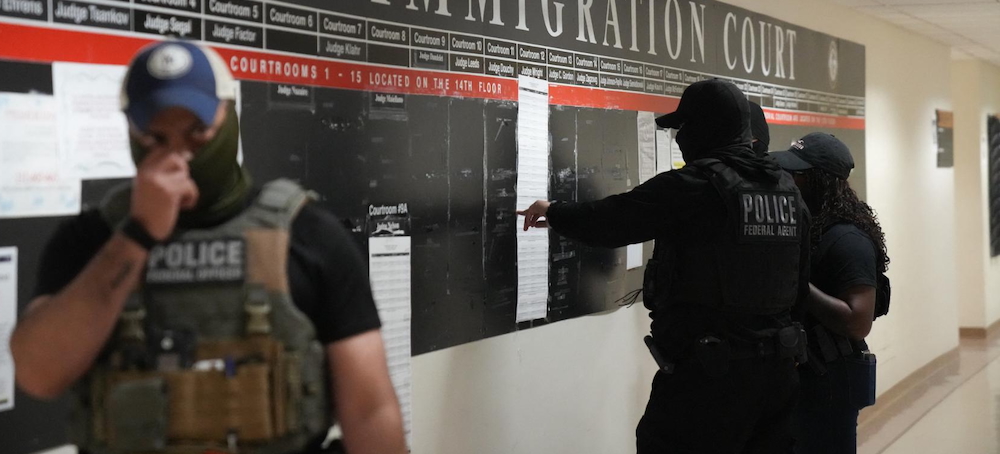 US Immigration and Customs Enforcement (ICE) agents look over lists of names and their hearing times and locations inside the Federal Plaza courthouse before making arrests on June 27, 2025 in New York. (photo: Bryan R. Smith/AFP/Getty Images)
For years, little was known about the multibillion-dollar company that handles data for the US immigration enforcement agency. Now, a cache of emails, training documents and reports sheds light on how Palantir helps Ice with investigations and on-the-ground enforcement
And there’s been one, multibillion-dollar tech company particularly instrumental in enabling Ice to put all that data to work: Palantir, the data analytics firm co-founded by Peter Thiel, the rightwing mega-donor and tech investor.
For years, little was known about how Ice uses Palantir’s technology. The company has consistently described itself as a “data processor” and says it does not play an active role in any of its customers’ data collection efforts or what clients do with that information.
Now, a cache of internal Ice documents – including hundreds of pages of emails between Ice and Palantir, as well as training manuals, and reports on the use of Palantir products – offer some of the first real-world examples of how Ice has used Palantir in its investigations and during on-the-ground enforcement operations.
The documents, which were obtained by immigrant legal rights group Just Futures Law through a Freedom of Information Act request and reviewed by the Guardian, largely cover Palantir’s contract with Homeland Security Investigations (HSI), the investigative arm of Ice that is responsible for stopping the “illegal movement of people, goods, money, contraband, weapons and sensitive technology”.
The documents span the period of 2014 to 2022, illustrating Palantir’s work with both Democratic and Republican administrations. But experts say the insights are especially alarming in light of the second Trump administration’s unprecedented investment in Ice. As the agency chases aggressive deportation quotas, Ice is set to gain even more personal data from federal agencies, including the Internal Revenue Service, as well as from new tools such as facial-recognition software made by Clearview AI.
Palantir recently won a $30m contract to build the government a new platform called ImmigrationOS that will service Ice branches beyond HSI, and aims to “streamline” the identification and deportation of immigrants. While the documents are largely limited to HSI’s operations, it’s easy to see how the tools could be of use to other branches of Ice.
“We’ve always known what the tools Palantir built are capable of. We now have the receipts for that,” said Jacinta González, one of the original organizers behind the No Tech for Ice campaign and the head of programs at digital rights non-profit MediaJustice.
The documents reveal how deeply embedded Palantir’s tools were in HSI’s day-to-day operations, helping its agents to investigate and arrest people using a searchable super-network of government and private databases.
They show the HSI team used Palantir platforms and apps to track air travel, analyze information like driver’s license scans and track people’s locations using cell phone records.
In an example that highlights the vastness of the data Ice has access to: one March 2020 training document detailed how Palantir software allowed Ice agents to search across data from the Student and Exchange Visitor Information System (Sevis), which at the time contained 4.9 million records “of non-immigrant students, exchange visitors and their dependents” dating back to 2016. Another told Ice agents they could enhance their investigations by using phone numbers or names extracted from phones the agents unlocked using technology from Cellebrite, an Israeli forensic software company that has had a contract with Ice since 2019.
“Palantir is the corporate backbone of Ice that the agency is relying on for surveillance and deportations,” said Hannah Lucal, a data and tech fellow at Just Futures Law. “Palantir has been used in Ice’s day-to-day operations for data surveillance around deportations and that’s been true for over a decade.”
Palantir spokesperson Lisa Gordon said the company has been working with the Department of Homeland Security since 2012 and the company “focuses on supporting the agency’s investigations and operations – including but not limited to everything from stopping drug trafficking cartels to disrupting human trafficking networks”.
Ice did not respond to a request for comment.
A custom-built app for field operations
One of the most revealing elements of the documents relates to Falcon, a desktop and mobile app Palantir custom-built for Ice.
Palantir won the contract to build Falcon in 2014, and designed it to help agents at HSI better communicate with their teammates and analyze data they collect. Ice stopped using Falcon in 2022 in favor of an HSI-built tool called Raven.
The documents show Ice agents used Falcon to help run on-the-ground operations and report back. The app allowed agents to track their own teammates’ and subjects’ locations, and record and share real-time information from in-person encounters such as field interviews or scans of people’s licenses.
One document showed that agents could use Falcon to search for people’s names, known locations, vehicles or passport information against Department of Homeland Security (DHS) and other federal databases like the Enforcement Integrated Database (EID) – a vast database that holds biometric and personal information on anyone who has been encountered or arrested, detained or deported by any DHS agency – on the go.
For example, in January 2019, Ice’s investigative unit was preparing for an anti-human-trafficking operation at the 53rd Super Bowl in Atlanta, which DHS had designated a high-level security event that could require “extensive federal interagency support”. HSI was expected to deploy “dozens of agents” for enforcement operations throughout the weekend in teams that would rely heavily on Falcon, emails between Ice agents show. The agents’ tasks included “performing field interviews, analysis, blueforce tracking, command center functions”, one HSI special agent wrote.
In addition to collecting and analyzing field interviews, the agents used Falcon for “blueforce tracking”, a military term for tracking someone’s GPS location. Training documents show Ice agents could also use Falcon to track a person’s location, including their “route and movement”, hour by hour using cell phone tower records.
In advance of the Super Bowl operations, Ice officials dispatched a Palantir employee to Atlanta to refresh local agents on how to take advantage of Falcon’s capabilities while in the field. When reporting back from the training, the Palantir representative wrote in an email that “agents seemed pretty excited about the ease and power of Falcon Mobile to support the operation” and particularly the “ease of the driver’s license scanning”.
In another case, Ice touted the use of Falcon to find a target’s location in a February 2018 gang “takedown” operation in New York. Falcon was used to plan several aspects of the operation, including mapping out the gang’s organizational structure. When one of the targets was not at the initial location, Ice agents used Falcon “to develop information for another address in Manhattan based on a tip the target was with family members”, the document reads.
Embedding with Ice agents and helping them find new ways to use Palantir products was a big part of certain employees’ jobs, according to Olive Ratliff, a former Palantir employee who worked at the company from 2021 to 2022. Palantir engineers acted as consultants, helping customers figure out how to use apps like Falcon, and were incentivized to find new use cases “that the client hasn’t thought of yet” that would make Palantir products more integral to the client’s work. “Palantir’s whole business model is about upselling. That’s the only way that they grow,” Ratliff said.
A vast and powerful dataset
The documents also reveal the breadth of information that Palantir enabled Ice to access, allowing them to track people across multiple databases, at times at the request of other government agencies.
Both the Falcon app and another Palantir-built platform, Investigative Case Management (ICM), enabled Ice to access a network of federally and privately owned databases of people’s information. Ice agents were encouraged to upload as much data as possible from field operations into Falcon and to share it with other Ice officials. “Importing data from sources not ingested into Falcon is a great way to add data that bolsters your investigation,” a Palantir training guide reads.
One guide detailed how to import digital files from phones that agents had confiscated at US borders, or obtained in the course of arrests and had unlocked using Cellebrite technology. The guide indicated agents could search for phone numbers and names extracted from those phones to see whether they came up in databases already accessible via Palantir platforms. If an Ice agent confiscated someone’s phone, saw messages between that person and another number, and wanted to check whether the recipient’s name or number came up in other databases, they could search Sevis, for instance, which at the time included nearly 5 million records on student visa holders and their dependents.
“With more than 7,000 agencies worldwide conducting 1.5 million legally authorized investigations annually, we provide targeted evidence extraction and digital investigation capabilities under strict legal oversight,” said Cellebrite spokesperson Victor Cooper.
Emails also show Ice used Palantir products to track individuals across various databases at the behest of other agencies. In emails from June 2020, an agent in an HSI office in Arkansas asked for technical support tracking whether someone being investigated by another government agency had boarded a flight. The emails show the agents expected to be able to search for this individual across two DHS databases: the Advance Passenger Information System (Apis), which includes “pre-arrival and departure manifest data on all passengers and crew members”, and a Customs and Border Protection (CBP) border crossing database that tracks people, cargo and vehicles crossing through US ports of entry and exit.
“We received a request to locate a person from a partner agency who has had extensive international travel,” the email read.
Ice agents were also encouraged to import information from databases not connected to the Palantir tools, including subscription-based services like the investigative platform Thomson Reuters Clear, which collects information from data brokers like Equifax; news articles and social media posts; CBP border crossing data; and local, state, national and international law enforcement offices including the FBI’s National Crime Information Center.
Data collected in the ICM platform was, in some cases, made accessible to agents in other parts of Ice, including units within CBP, the Transportation Security Administration and the US Coast Guard, emails from July 2019 show. A unit of immigration officers charged with arrests and removals, known as Enforcement and Removal Operations, or ERO, was also in some cases given access to Palantir platforms. ERO officers who were on HSI taskforces were required to “document all investigative activity” related to the taskforce in Palantir’s ICM platform, a policy memo published in 2016 shows.
Experts fear that the Trump administration will start to use the vast database network powered by Palantir to supercharge its deportation machine – which has already removed more than 216,000 people in the first nine months. While Palantir did not contract with ERO before, the company will now be working with this unit under the $30m contract.
“We actually get to see Palantir providing these directions for very intense data surveillance,” Lucal of Just Futures Law said. “As the administration is doing this work to consolidate systems of state surveillance even more than it already is, Palantir stands to profit from that.”
Experts warn that, in light of the Trump administration’s threats to crack down on “far-left” groups, the scope of application for Palantir’s tools could only grow. Already, a new report from the Intercept revealed HSI subpoenaed and received information from Google about international students who were being investigated over their pro-Palestinian activism.
“Now [with access to more federal databases] Ice can use this type of surveillance apparatus on anyone – not only anyone who is undocumented but anyone who this administration wants to criminalize and anyone who the administration wants to put under surveillance,” said González of MediaJustice.
“Time and time again, you’re seeing Ice act in ways that are incredibly violent and aggressive. It does have a chilling effect. When you know they have a technology that can track relationships, your conversations, and your organizing activity, that can be a silencing force.”
The Firing of Educators Over Kirk Comments Follows a Familiar Playbook
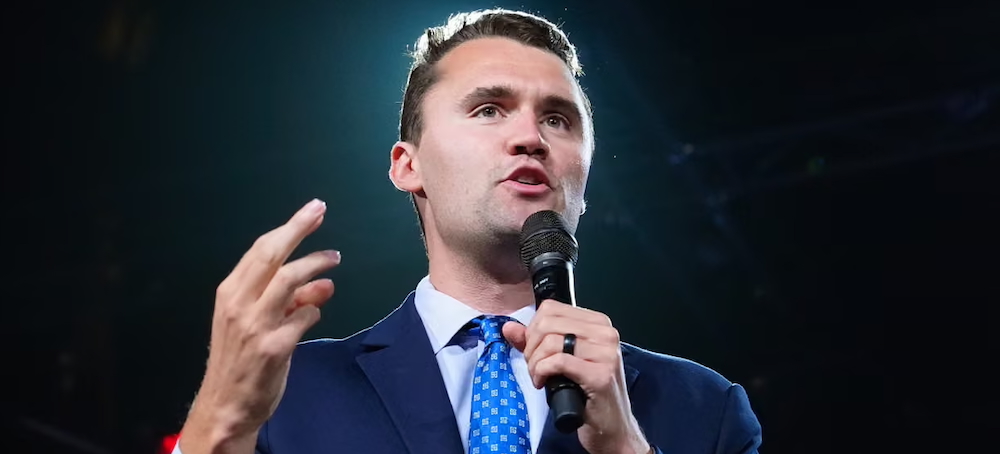 Turning Point USA founder Charlie Kirk in 2024. (photo: Ross D Franklin/AP)
Conservative efforts to call out and punish educators over liberal ideas have grown for years, led in part by Charlie Kirk himself.
The email rapidly spread on social media and would soon unravel the career of Prof. James Bowley, who had sent it to the three students enrolled in his “Abortion and Religions” class at Millsaps College. One of them shared it on Instagram. The professor was ordered to leave campus the next day.
The episode reflected a growing clampdown on campus speech that had been gaining steam since the onset of pro-Palestinian campus protests. And it presaged the enormous current backlash against teachers and professors following the killing of Charlie Kirk. Many of those educators now face investigations or dismissal after voicing criticism of Mr. Kirk.
The American Association of University Professors, an organization founded to defend academic freedom, said it was aware of retaliation against about 60 professors and teachers in connection with critical comments they made about Mr. Kirk or people mourning him.
Faculty First Responders, an organization that works with the association to advise educators who are the victim of doxxing and harassment campaigns, has reached out to 35 academic workers in the past week, most of them professors, whose comments about Mr. Kirk have been spread in right-wing media, according to Heather Steffen, the group’s director.
At Clemson University, a public institution in South Carolina, two professors and a staff member have been fired over social media posts, including one that called the murder of Mr. Kirk “swift and ironic” karma because of offensive things Mr. Kirk had said over the years. The firings followed pressure from Republican politicians.
A law professor at the University of Arkansas at Little Rock was suspended after comparing people mourning Mr. Kirk to the Ku Klux Klan.
A retired professor at the University of Florida’s Levin College of Law lost his emeritus status, which gave him special campus privileges, over a social media post that referred to Mr. Kirk. A campus publication, the Independent Florida Alligator, reported that the post said, “I did not want him to die,” and added, “I reserve that wish for Mr. Trump.”
The Texas Education Agency has said it is investigating hundreds of employees at elementary or secondary schools for similar reasons.
The campaigns to silence educators who speak critically of figures on the political right have been effective, suggesting they are likely to expand, Dr. Steffen said. “I’m concerned that this will continue to be a strategy used to limit free speech and academic freedom,” she said.
The strategy has the endorsement of the Trump Administration, as evidenced by comments Vice President JD Vance made recently to Fox News. While acknowledging that the First Amendment protects “very ugly speech,” he added, “If you are a university professor who benefits from American tax dollars, you should not be celebrating Charlie Kirk’s death, and if you are, maybe you should lose your job or your university should face a loss of funding.”
Dr. Bowley, the former Millsaps professor, is a scholar of religion and an expert on the political and social factors that gave rise to the Holocaust. He said he was considering suing Millsaps, a small United Methodist Church-affiliated college in Jackson, Miss., where he had taught for 23 years, over his dismissal.
Dr. Bowley said he believed he was a victim of homegrown American fascism. “I did not use the word fascist lightly,” he said.
Officials at Millsaps declined to be interviewed about the matter, citing privacy concerns. They said in a written statement that “Millsaps is dedicated to academic excellence and open inquiry.”
The American Civil Liberties Union has condemned the firings, saying they infringe on the First Amendment rights of the educators.
If they choose to mount a legal fight, fired employees of public institutions, which are bound by the First Amendment, probably have better chances of prevailing in court than those fired from private institutions.
In a letter last week, for example, Alan Wilson, the attorney general of South Carolina, wrote to Clemson, saying that if the dismissed professors believed their First Amendment rights were violated, they may sue the university. “However,” he wrote, “it should be noted that the First Amendment is not absolute.”
Although some states have restricted the ability of private employers to fire employees for their opinions or speech, in many places private employers have broader discretion to do so than public employers do.
The killing of Mr. Kirk, an influential figure on the right, devastated his fans and people close to President Trump, who has himself been the target of assassination attempts. Mr. Kirk’s supporters, including many in the Trump administration, have made strong statements in the past supporting free speech, no matter how ugly. But now, many of those same officials are trying to limit speech that they say could lead to more violence.
Mr. Kirk, who was known for making statements that were often criticized as racist, antisemitic and sexist, declared himself to be a proponent of free speech. Though comments made by some of his critics may seem callous and inappropriate in the wake of his shooting, even some of his right-leaning supporters have defended people’s right to say them.
Most of the attacks on professors have come from the right, but progressive activists have also waged campaigns at times against educators and others they disagreed with.
In the wake of the murder of George Floyd in 2020 and the unrest that it spawned, Charles Negy, a psychology professor at the University of Central Florida, found himself under attack over his social media posts about race. “Black privilege is real,” he wrote.
When the university tried to fire him, he sued on First Amendment grounds, and in May, a federal judge ruled that his case could proceed.
Proponents of academic freedom see the current crackdown on professors as an assault on freedom of expression that echoes dark periods in American history. At Brooklyn College, where four adjunct professors were dismissed this year for their pro-Palestinian activism, a faculty union called the movement to curb educators’ speech the “New McCarthyism.”
One of the four, Corinna Mullin, who was an adjunct professor of political science, said that recent developments show that academic freedom is not a universal right but a conditional privilege.
“And it seems that it’s granted or withdrawn based on the context of our speech — those who echo power are shielded,” said Dr. Mullin, who was arrested during a police raid on a Gaza Solidarity encampment at City College in 2024. Trespassing charges against her were later dropped.
She said she believed that activists on the right will continue to expand their attacks to take in “all speech on the left associated with social justice, racial justice, all these uncomfortable truths that challenge power in this country.”
In a written statement, a spokesman for Brooklyn College, Richard Pietras, said the school strongly supports freedom of expression. He said the college chose not to reappoint the four adjunct faculty members based on their conduct, not their political beliefs. He declined to give more specifics.
Katherine Franke, a well-known professor at Columbia Law School, was forced to retire in January following comments she made criticizing Columbia students who had served recently in the Israeli Defense Forces over what she viewed as the students’ harassment of Palestinian students.
She said in an interview that the growing attacks on Mr. Kirk’s critics were a frightening, but not surprising, next step.
“In some ways, this bears a family resemblance to the Red scare of the 1950s,” Ms. Franke said. “In other ways, this is different. It’s not just a single ideology, and it’s not just one senator. It’s an across-the-board exercise of the whole of government to bully universities, law firms, the media, all of us into a kind of obedience.”
A recent case at Texas A…M University illustrates the increasing breadth and depth of outside influence over speech on university campuses. A professor there was fired over a lecture about gender expression, an episode that also spurred last week’s resignation of the university’s president, Gen. Mark A. Welsh III.
The controversy arose after a student circulated a video of an exchange with the professor over the lecture — an increasingly common worry for professors. Gov. Greg Abbott of Texas and other Republican state politicians complained to the university about the lecture.
Turning Point USA, the campus group Mr. Kirk led, often placed giant beach balls on campuses and invited students to write on them, in a symbolic exercise of their free speech rights. Mr. Kirk also invited students to debate him, advocating “reasonable disagreements.”
In several instances, Mr. Kirk has used the First Amendment to sue universities that tried to block his organization’s campus presence.
But critics have argued that Mr. Kirk’s promotion of free speech was riddled with hypocrisy. Matthew Boedy, a professor at the University of North Georgia who has written a book that focuses heavily on Mr. Kirk, “The Seven Mountains Mandate,” called Mr. Kirk’s stance “an empty support of free speech.”
Turning Point’s efforts to target professors it sees as radical date back nearly a decade, to 2016, when it began asking students to report professors who “discriminate against conservative students and advance leftist propaganda in the classroom.” Some of the educators whose names were put on the group’s “watch list” have said they became the targets of merciless harassment on social media.
A spokesman for Turning Point USA, Andrew Kolvet, said the watch list “doesn’t target professors.” “It simply organizes already public statements, articles or quotes professors make, putting them in one easy-to-find places as a resource for parents and prospective students,” Mr. Kolvet continued. “Families deserve to know what professors really believe.”
But Dr. Boedy, whose name was placed on the list over an opinion piece he wrote criticizing legislation that permitted weapons on campus, said the list was “a prime example of their free speech hypocrisy — they’re targeting people they don’t like.”
UN Chief Sounds Alarm Over Worsening Crisis in Sudan’s El Fasher
 Displaced persons, mostly women and children, in North Darfur, Sudan. (photo: Hamid Abdulsalam/UNAMID)
The UN Secretary-General on Saturday voiced grave alarm at the rapidly deteriorating situation in El Fasher, the capital of North Darfur, warning of mounting risks to civilians trapped in the besieged city.
“The fighting must stop now,” Secretary-General António Guterres said in a statement issued by his spokesperson.
He reiterated his call for “an immediate cessation of hostilities in El Fasher, as well as for the respect and protection of civilians and for the facilitation of safe, unhindered and sustained humanitarian access.”
The UN chief also stressed that safe passage must be assured for civilians wishing to leave voluntarily.
Mosque attack
The Secretary-General’s warning followed an attack on a mosque in El Fasher on Friday that reportedly killed dozens of civilians during morning prayers.
UN Humanitarian Coordinator in Sudan Denise Brown said she was “gravely alarmed” by the strike, stressing that international humanitarian law demands the protection of religious sites and those worshipping in them.
“It is also a war crime to intentionally direct attacks against buildings dedicated to religion. This attack, reportedly carried out by the RSF, must be investigated and the perpetrators held accountable,” she said in a separate statement.
Humanitarian emergency
Conditions in El Fasher and its surrounding camps have worsened dramatically since famine was identified in the area last year.
The risk of ethnically motivated violence is also rising as fighters advance deeper into the city.
Civilians continue to bear the brunt of the conflict between the RSF and the Sudanese Armed Forces (SAF), which has raged since April 2023 and claimed thousands of lives and forced millions more from their homes.
Call for global action
Mr. Guterres urged both sides to swiftly engage in dialogue to halt hostilities and return to negotiations for a sustainable political solution.
tHe also called for “concerted international action in support of the people of Sudan” as world leaders gather in New York next week for the UN General Assembly.
The Secretary-General’s Personal Envoy for Sudan, Ramtane Lamamra, “stands ready to support genuine efforts to end the conflict and establish the inclusive political process that the people of Sudan demand,” the statement said.
Wildfire Smoke Could Soon Kill 71,000 Americans Every Year
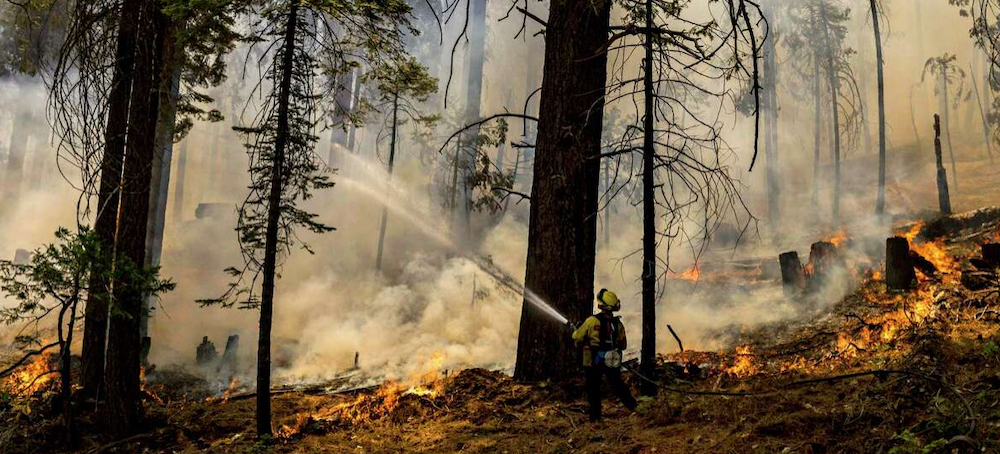 Smoke from a wildfire. (photo: Stephen Lam/SF Chronicle)
The haze may already kill 40,000 people in the U.S. each year — the same number who die in traffic crashes. Climate change will only make matters worse.
As climate change makes such conflagrations ever more catastrophic, that mortality is only going to escalate. A new study in the journal Nature estimates that wildfire smoke already kills 40,000 Americans each year — the same number who die in traffic crashes — and that could rise to more than 71,000 annually by 2050 if emissions remain high. The economic damages in the United States may soar to over $600 billion each year by then, more than all other estimated climate impacts combined. And the problem is by no means isolated to North America: A separate paper also publishing today estimates that 1.4 million people worldwide could die prematurely each year from smoke by the end of this century — six times higher than current rates.
Together, the studies add to a growing body of evidence that wildfires are killing an extraordinary number of people — and are bound to claim ever more if humanity doesn’t rapidly slow climate change and better protect itself from pollution. “The numbers are really striking, but those don’t need to be inevitable,” said Minghao Qiu, an environmental scientist at Stony Brook University and lead author of the first paper. “There are a lot of things we could do to reduce this number.”
The core of the problem is desiccation: As the planet warms, the atmosphere gets thirstier, which means it sucks more moisture out of vegetation, turning it to tinder. Scientists are also finding more weather whiplash, in which stretches of extra wet conditions encourage the growth of plants, followed by stretches of extra dry conditions that parch all that biomass. Droughts, too, are getting worse, making landscapes exceptionally flammable.
Tragically enough, wildfires have grown so intense and deadly in recent years that scientists have been getting bountiful data to make these connections between the haze and cascading health problems downwind. “We totally underestimate the total burden when we don’t consider the smoke that is generated, that can be transported miles and miles away,” said Tarik Benmarhnia, a climate epidemiologist at the Scripps Institution of Oceanography, who studies the impacts of smoke but wasn’t involved in either of the new papers. “That is by far the biggest factor for mortality and other health issues associated with this type of pollution.”
Bigger, more intense infernos are belching smoke not just for days or weeks, but sometimes months at a time. This year’s blazes in Canada, for instance, have consistently blanketed parts of the U.S. in unhealthy air quality. That adds to the haze produced by domestic fires, especially in the West, making for dangerous conditions across the country. Indeed, Qiu’s modeling estimates that annual wildfire emissions from the Western U.S. could increase by up to 482 percent by 2055, compared to the average between 2011 and 2020.
In the global study published today, researchers estimate that worldwide, this deadly pollution could grow by nearly 25 percent by the end of the century. But it won’t be evenly distributed: Africa could see 11 times more fire-related deaths by that time, compared to Europe and the U.S. seeing one to two times as many. “Africa has the world’s largest burned area due to extensive savannas, forests, and grasslands, combined with long dry seasons,” said Bo Zheng, an associate professor at Tsinghua University in China and co-author of the paper, in an email to Grist. “This widespread burning drives disproportionate smoke exposure and health impacts.”
The major concern with wildfire smoke is PM 2.5, or particulate matter smaller than 2.5 millionths of a meter, which burrows deep into the lungs and crosses into the bloodstream. More and more research is showing this irritant is far more toxic than that from other sources, like industries and traffic. “We have mountains of evidence that inhaling these particles is really bad for a broad range of health outcomes,” said Marshall Burke, an environmental economist at Stanford University, who co-authored the paper with Qiu. “They’re small enough to sort of spread throughout your body and cause negative health impacts — respiratory impacts, cardiovascular impacts. Most, I would say, bodily systems now show responses to air pollution and small particle exposure.”
Making matters worse, wildfires aren’t just turning plants into particulates. Those Canadian conflagrations have been burning through mining regions, where soils are tainted with toxicants like arsenic and lead, potentially mobilizing those nasties into the atmosphere. And whenever fires burn through the built environment, they’re chewing through the many hazardous materials in buildings and vehicles. “It burns up cars, it burns up bicycles, it burns up anything that’s in your garage,” Burke said. “That’s incinerated, aerosolized, and then we’re literally breathing cars and bicycles when we are exposed to that smoke.”
All told, even brief exposures to wildfire smoke can be devastating, exacerbating respiratory conditions like asthma and chronic obstructive pulmonary disease, as well as cardiovascular diseases, since PM 2.5 is entering the bloodstream. Those issues can continue for years after exposure, and other toxins like carcinogens in the haze can cause still more problems that might last a lifetime.
Qiu and Burke’s new modeling estimates that cumulative deaths due to wildfire smoke in the U.S. could reach 1.9 million between 2026 and 2055. That’s a tragic loss of life, but it also comes at a major economic cost of lost productivity. And that doesn’t even include the impacts that are non-lethal, like the degradation of mental health and people missing school and work because of poor air quality.
There are ways to blunt this crisis, at least. Reducing carbon emissions will help slow the worsening of wildfires. Doing more controlled burns clears built-up fuel, meaning the landscape might still ignite, but less catastrophically. And governments can help their people get air purifiers to run during smoky days. “If climate change continues apace, but we reduce the amount of fuel loading in our forests and are better able to protect ourselves, then our projections are going to be overestimates of the damages, and that will be a good thing,” Burke said. “These damages are not inevitable.”
PO Box 2043 / Citrus Heights, CA 95611


No comments:
Post a Comment
Note: Only a member of this blog may post a comment.